Haemodynamically significant patent ductus arteriosus is an important problem of pre-term babies.Reference Dani, Bertini and Corsini 1 – Reference Bose and Laughon 3 The first-line treatment is accepted as intravenous indomethacin and ibuprofen.Reference Van Overmeire and Chemtob 2 , Reference Bose and Laughon 3 Because of the more frequency of side effects, usage of indomethacin is limited in time.Reference Bose and Laughon 3 , Reference Chiruvolu and Jaleel 4 , Reference Ohlsson, Walia and Shah 5 Although intravenous ibuprofen is widely used with a high closure rate and acceptable side effects, the intravenous form of the drug is not available in all countries.Reference Ghanem, Mostafa and Shafee 6 In patients with contraindications to ibuprofen, treatment of haemodynamically significant patent ductus arteriosus is challenging. In recent years, the first experiences with oralReference Hammerman, Bin-Nun, Markovitch, Schimmel, Kaplan and Fink 7 – Reference Jasani, Kabra and Nanavati 15 or intravenous paracetamolReference Terrin, Conte and Scipione 16 – Reference Tekgunduz, Ceviz and Demirelli 18 is reported with promising results. In the present study, we aimed to give the results of our experiences with lower doses of intravenous paracetamol in pre-term babies with haemodynamically significant patent ductus arteriosus and contraindications to oral ibuprofen.
Materials and methods
The medical records of the 13 pre-term babies who received intravenous paracetamol (Perfalgan; Bristol-Myers Squibb, Munich, Germany) owing to contraindications to oral ibuprofen (n=7) and discontinuation of oral ibuprofen treatment owing to side effects (n=6) were retrospectively evaluated.
Demographic features, postnatal age at diagnosis, postnatal age at first intravenous paracetamol dose, dose of intravenous paracetamol, pre- and post-treatment transaminase levels, response to treatment, recanalization after successful closure, and surgical ligation, if performed, were noted.
Our first-line treatment in patients with haemodynamically significant patent ductus arteriosus (symptoms related to significant ductal shunt, ratio of left atrium/aorta >1.5, left heart enlargement, patent ductus arteriosus diameter with colour Doppler >1.5 mm) is fluid restriction and administration of oral ibuprofen. All patients had either contraindication for oral ibuprofen, or developed side effects related to ibuprofen.
In the first patient, the dose regimen was 15 mg/kg/dose, every 6 hours. As the patient developed significant elevation in the transaminase levels, the dose was decreased to 10 mg/kg/dose, every 8 hours. The treatment was administered with intravenous infusion. Daily echocardiographic examination was conducted. In case of closure, it was repeated after 2 days and when needed thereafter in terms of reopening. Daily serum transaminase levels were also analysed.
Necrotising enterocolitis was staged according to the previously defined criteria.Reference Gregory, Deforge, Natale, Phillips and Van Marter 19 Feeding intolerance defined that the inability to digest enteral feedings presented as gastric residuals volume of more than 50%, abdominal distension, or emesis, or both.Reference Moore and Wilson 20
Results
Between October, 2012 and November, 2013, a total of 13 patients received intravenous paracetamol. Median gestational age was 29 weeks ranging from 24 to 31 weeks and birth weight was 950 g ranging from 470 to 1390 g. Of the 13 patients, 8 were male.
In seven patients, owing to feeding intolerance intravenous paracetamol was the first-line treatment given. Of the remaining six patients, four developed necrotising enterocolitis, and two developed feeding intolerance after oral ibuprofen treatment; therefore, treatment was continued with intravenous paracetamol owing to persistence of significant ductal shunt. Oral ibuprofen received patients were unresponsive to one (n=5) or two (n=1) full courses.
The median postnatal age at the first intravenous paracetamol dose was 3 days ranging from 2 to 9 days. In the first patient, drug was administered in a dose of 15 mg/kg/dose, four doses a day. However, serum transaminase levels significantly increased at the end of first four doses (aspartate aminotransferase: 260 U/L, alanine aminotransferase: 180 U/L) when compared with pre-treatment levels (aspartate aminotransferase: 43 U/L, alanine aminotransferase: 11 U/L). Therefore, treatment was stopped, and the transaminase levels decreased to normal values during the following 5 days. The patient was relatively stable and received oral ibuprofen after resolution of feeding intolerance, and ductal closure occurred. In the following 12 patients, the dose was adjusted as 10 mg/kg/dose, three doses a day, and none of the patients developed hepatotoxicity during the median treatment duration of 2 days ranging from 1 to 5 days.
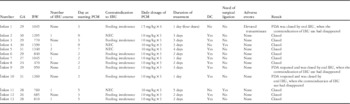
In 10 of the 13 patients (76.9%), patent ductus arteriosus was closed at the median 2nd day of intravenous paracetamol ranging from 1 to 4 days. When the patient who developed hepatotoxicity was eliminated, the closure rate was found to be 83.3% (10/12). There were two unresponsive patients who underwent surgical ligation at the 3rd and 5th days of intravenous paracetamol treatment because of the ongoing renal failure and/or heart failure (Table 1).
Clinical characteristics of the study population.
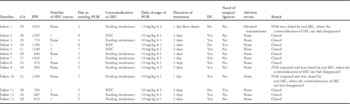
BW=birth weight; DC=ductal closure; GA=gestational age; IBU=ibuprofen; NEC=necrotising enterocolitis; PCM=paracetamol
Of the 10 responsive patients, 2 developed reopening 2 days after ductal closure. In both the patients, patent ductus arteriosus was haemodinamically significant. Signs of feeding intolerance were resolved and they had become suitable for oral ibuprofen treatment. In both the patients, ductal closure was observed after one course of oral ibuprofen treatment.
Discussion
Efficiency of ibuprofen and indomethacin are proven in pre-term infants with haemodynamically significant patent ductus arteriosus.Reference Ohlsson, Walia and Shah 5 Nevertheless, their usage can be limited in the presence of contraindications or owing to some side effects, such as intraventricular haemorrhage, necrotising enterocolitis, renal failure, thrombocytopenia, etc.Reference Dani, Bertini and Corsini 1 – Reference Bose and Laughon 3 In these conditions the alternative treatment may be surgical ligation. However, oral or intravenous paracetamol has been reported as an effective alternative recently.Reference Hammerman, Bin-Nun, Markovitch, Schimmel, Kaplan and Fink 7 – Reference Tekgunduz, Ceviz and Demirelli 18 In most of these reports results of oral administrations have been reported,Reference Hammerman, Bin-Nun, Markovitch, Schimmel, Kaplan and Fink 7 – Reference Jasani, Kabra and Nanavati 15 and results of intravenous administration mostly depend on case reports.Reference Terrin, Conte and Scipione 16 – Reference Tekgunduz, Ceviz and Demirelli 18
The first report on the effects of intravenous paracetamol in pre-term infants with haemodynamically significant patent ductus arteriosus belongs to Oncel et al.Reference Oncel, Yurttutan and Degirmencioglu 17 In 10 patients with a median gestational age of 274/7 weeks ranging from 24 to 29 weeks), they applied a 3-day treatment (15 mg/kg dose, 4 doses/day), and in the case of treatment failure at the end of the 3rd day a second course was administered. Intravenous paracetamol resulted in successful closure of haemodynamically significant patent ductus arteriosus in all patients. Of the cases (70%), seven responded to a single course of intravenous paracetamol treatment, whereas three cases (30%) needed an extended course. No adverse side effects were observed in association with intravenous paracetamol. Unfortunately no information about reopening was given. In our study, 10 of the 13 patients responded to intravenous paracetamol in 4 days. In three patients, treatment could not be completed because of side effect of the drugs (n=1) and because of gradual deterioration of haemodynamic status (n=2). In two patients, reopening occurred on the 2nd day of successful closure. The duration of the treatment was 1 day in 1 patient and 3 days in another patient.
There are two main differences present between our study and a study by Oncel et alReference Oncel, Yurttutan and Degirmencioglu 17 study. In our study, the dose is lower. In the literature, there is no information on the safe range of the serum level of paracetamol in pre-term infants, and for those pre-term infants it is advised to decrease the dose and increase the time interval between doses.Reference Anderson, Van Lingen and Hansen 21 – Reference Allegaert, Van der Marel and Debeer 23 Depending on this knowledge and our observation in the first case, we lowered the dose. The second difference is the study design. We controlled the patients daily by echocardiography, and in case of ductal closure we stopped the treatment. Therefore, the maximum treatment duration was 5 days in our study.
In a recent report, with intravenous paracetamol in pre-term infants who had contraindications to indomethacin and ibuprofen, Terrin et alReference Terrin, Conte and Scipione 16 reported a closure in six of the eight patients with a dose of 7.5–15 mg/kg/day. They did not observe reopening. In this report, the intravenous paracetamol dose in patients with an unsuccessful result had not been reported. Therefore, we could not compare our results with that of this study.
There are some case series reporting the effects of oral paracetamol in pre-term infants, and closure rate with oral paracetamol has been reported to be 71.4–100%.Reference Hammerman, Bin-Nun, Markovitch, Schimmel, Kaplan and Fink 7 – Reference Jasani, Kabra and Nanavati 15 There are only two prospective studies comparing the results of oral paracetamol and ibuprofen.Reference Dang, Wang, Zhang, Zhou, Zhou and Wu 10 , Reference Oncel, Yurttutan and Erdeve 11 Dang et alReference Dang, Wang, Zhang, Zhou, Zhou and Wu 10 administered oral paracetamol to 80 pre-term infants (<34 weeks) with haemodynamically significant patent ductus arteriosus and compared the results with that of patients who received the standard dose of ibuprofen. Closure rate with one course was 81.2 and 78.8%, respectively, and the difference was not significant. Reopening rate was 7.7% (n=5) and 9.5% (n=6), respectively. An additional four patients from both the groups responded to a second course with the same drug. Oncel et alReference Oncel, Yurttutan and Erdeve 11 compared oral paracetamol (n=40) and oral ibuprofen (n=40) in pre-term infants (<30 weeks) with haemodynamically significant patent ductus arteriosus. Closure rate with one course was 72.5 and 77.5%, respectively. Reopening rate was 24.1% (n=7) and 16.1% (n=5), respectively. Another five patients from the paracetamol group and four patients from the ibuprofen group responded to a second course with the same drug. In both the groups, no side effects related to paracetamol was reported.
The closure rate in our study was similar to the previously reported rates with oral paracetamol, and the reopening rate was similar to that reported by Oncel et al.Reference Oncel, Yurttutan and Erdeve 11 These results suggest that oral and intravenous administration are not superior to each other in terms of closure rate and reopening rate.
Ibuprofen reduces prostaglandin synthesis by inhibition of cyclooxygenase. As for paracetamol, it acts by inhibition of peroxidase.Reference Anderson 24 – Reference Allegaert, Anderson, Simons and van Overmeire 26 In our study, two patients with reopening responded to oral ibuprofen. On the other hand, Ozdemir et alReference Ozdemir, Doğan, Küçüktaşçı, Ergin and Sahin 13 reported a successful closure in five of the seven (71.4%) pre-term infants who were unresponsive to oral or intravenous ibuprofen. These results suggest that efficient prostaglandin synthesis inhibition pathways may be different in each patient. Therefore, in case of failure of one drug the other may be an efficient alternative, or both drugs may be used simultaneously in some patients.
Hepatotoxicity is dependent on the balance between the rate of NAPQI formation, the elimination rate of sulphate, and the rate of glucoronide production, as well as on the initial contact and maximal rate of synthesis of hepatic glutathione. The balance between these factors in neonates is unknown. Consequently, it is impossible to predict ‘‘safe’’ doses.Reference Porta, Sánchez, Nicolás, García and Martínez 27 , Reference Allegaert, Anderson and Naulaers 28
Pharmacokinetics studies with intravenous, rectal, and oral paracetamol indicated a prolonged serum half-life in pre-term infants. Therefore, dose adjustment is advised in this age group.Reference Anderson, Van Lingen and Hansen 21 – Reference Allegaert, Van der Marel and Debeer 23 , Reference Arana, Morton and Hansen 29 , Reference Palmer, Atkins and Anderson 30 In the present study, we decreased the intravenous paracetamol dose to 30 mg/kg/day, after the first case in whom hepatotoxicity developed at the end of the 1st day of intravenous paracetamol in a dose of 60 mg/kg/day. Although the success rate was 76.9% in all cases, when the first case was eliminated the success rate was 83.3% (10/12). In addition, no new case of hepatotoxicity was observed. In their letter, Alan et alReference Alan, Kahvecioglu, Erdeve, Atasay and Arsan 31 reported hepatotoxicity in two of the three cases treated with intravenous paracetamol in the dose of 60 mg/kg/day. These results suggest that lower dose of intravenous paracetamol is as effective as high dose, and possibly lowers the risk of hepatotoxicity.
Study limitations; the retrospective nature of the study is a major limitation. As we controlled the patients after each day of paracetamol, we could not define the extent of one course. In patients with reopening, as the contraindication for paracetamol was disappeared oral ibuprofen was used. Therefore, we could not make a comment on the effectiveness of paracetamol on the reopened patent ductus arteriosus.
In conclusion, intravenous paracetamol seems as an effective and safe treatment option in pre-term infants with haemodynamically significant patent ductus arteriosus and contraindication to ibuprofen. Owing to the potential for hepatotoxicity of paracetamol, the transaminase levels should be monitored, and it should be kept in mind that the safe dose for paracetamol is unknown in pre-term infants. New studies that aim to compare the different doses of paracetamol are needed.
Acknowledgements
None.
Financial Support
None.
Conflicts of Interest
None.
Ethical Standards
The authors assert that all procedures contributing to the work comply with the ethical standards of the Declaration of Helsinki.