Introduction
US Treasury Secretary Timothy Geithner's recent public call to ‘strengthen the International Monetary Fund's (IMF) legitimacy’ through reforms creating ‘a more representative, responsive and accountable governance structure’ suggests that the global financial crisis has made enhancing the legitimacy of global financial institutions into a matter of pressing practical importance.Footnote 1 Yet, reform proposals adopted by the G20 seek only to correct the under-representation of major developing states on the IMF's board. No equivalent momentum is building for additional measures, of the kind advocated by many normative theorists, that would enhance accountability to non-state constituencies.Footnote 2 These developments draw attention to questions about sociological legitimacy and global governance that have received little theoretical attention.Footnote 3 What determines the identity of the political communities that must grant legitimacy to an international organisation (IO)? Furthermore, under what conditions is legitimacy in a particular community important for the functioning or effectiveness of that organisation? Whereas analysts of various international ‘legitimacy crises’ have proposed that an IO's capacity to achieve its goals depends upon its ‘legitimacy’, the identities of the communities in which legitimacy is required often remain opaque.
This article contends that the relationship between IO effectiveness and legitimacy in specific constituencies is a variable. The term legitimacy nexus is proposed to describe this variable, such that a ‘strong legitimacy nexus’ refers to a relationship in which legitimacy in a particular constituency both enhances an IO's power and is also seen as normatively desirable by all actors. At the other end of the spectrum, a ‘weak legitimacy nexus’ describes a relationship where legitimacy in a particular constituency is neither instrumentally valuable nor considered normatively desirable.
Examination of historical change in the legitimation needs of global governance qualifies the view that legitimation by ‘world society’Footnote 4 is incrementally displacing legitimation by international society, as it reveals that moves toward greater transparency and accountability are neither inevitable nor irreversible.Footnote 5 The legitimacy nexus between IOs and affected communities instead appears likely to fluctuate with changes in normative standards, the impact and reach of global governance and shifts in actors’ relative power. Contemporary moves to reform IOs through enhanced representation of developing powers are consistent with this argument that when an actor or community gains power it will become a more significant constituency of legitimation.
The article develops in four sections. The first outlines the theoretical question concerning the identity of the social constituencies that grant legitimacy. It argues that a failure to systematically assess IOs’ motivations for seeking legitimacy among different social constituencies inhibits recognition of historical change in legitimacy requirements. The second section responds to this theoretical question by proposing that the need for legitimacy be treated as a variable. It surveys legitimacy literature to specify the different paths through which legitimacy influences actors’ behaviour and identifies five factors that are hypothesised to influence the importance of legitimation within specific constituencies. Section three outlines the legitimacy needs of contemporary IOs in terms of this schema and discusses some examples linked to the trade regime. This focus is prompted by the trade regime's role as an incipient ‘global economic constitution’ whose influence reaches deep into domestic economies.Footnote 6
The concluding section offers a more detailed probe into the plausibility of the legitimacy nexus through examination of the creation of the International Labour Organization (ILO) in 1919 as a tripartite IO including state, union and employer representatives. This investigation is narrowly focused on direct participation in global governance and so offers only limited parallels with contemporary moves toward enhanced accountability and transparency. Nevertheless, this anomalous historical case represents an early high-water mark in non-state involvement in global governance; it illustrates how factors calibrating the legitimacy nexus can play out to create unexpected requirements for legitimacy. Examination of the ILO's genesis reveals that the international state system was subject to a different set of legitimacy demands and a different social constituency of legitimation in 1919 due to unique post-war circumstances of weakened states, powerful internationally organised trade union movements, a militarised ‘proletariat’ and a European revolutionary threat.
The problem: identifying the social constituency of legitimation
Defining legitimacy
The sociological concept of legitimacy is deeply contested. Confusions between normative and sociological conceptions of legitimacy, conflicting definitions, and the difficulty of measuring a ‘latent’ psychological variable have lead many scholars to question the concept's explanatory value.Footnote 7 Nevertheless, it is commonly argued: (1) that ‘legitimacy’, ‘coercion’ and ‘self-interest’ are the three fundamental mechanisms of social control within both domestic and international societies;Footnote 8 (2) that legitimacy is a quality of ‘oughtness’ that arises where there is a general perception within a community that the actions and normative precepts of an actor or institution are rightful or socially sanctionedFootnote 9 and, (3) that actors often seek legitimacy to reduce the costs of exercising power by securing a higher degree of voluntary compliance.Footnote 10
Scrutiny of this framework might lead us to ask how important legitimacy would be within a power relationship in which compliance can be achieved more cheaply via coercion or through appeal to self-interest, or in circumstances where compliance is not required. We might go further and question whether habit, ignorance of alternatives and unexamined psychological motivations should join legitimacy, coercion, and self-interest as explanations for compliance? If so, might legitimacy in some constituencies be practically unnecessary when compliance can be secured via alternative mechanisms or is not needed? Since international organisations generally have little need for ‘compliance’ among mass publics, we might ask why mass legitimacy would be necessary for them to be effective in achieving organisational goals.
Of course organisations might seek legitimacy not simply as a means to achieve social control but because their members and decision-makers are also influenced by accepted standards of appropriateness and legitimacy. At the same time as possession of legitimacy empowers specific actors, standards of legitimacy also function as forms of structural power which constitute and constrain actors. Discussion in this article focuses on questions concerning the nature and boundaries of the community that dispenses legitimacy to a particular international organisation at a particular point in time. This narrow concern has implications for the broader topic of how structures of legitimacy and normative standards are transformed over time. Although the article offers some tentative ideas concerning the political agencies that influence the process of normative change, responding to these broader questions is not its primary purpose.
The social constituency of IOs’ legitimacy
Studies of international legitimacy have, until recently, paid scant attention to the question of which actors are ‘dispensers of legitimacy’ who form the social constituency of legitimation.Footnote 11 Since International Relations theory has traditionally viewed states as the primary international actors it has frequently been assumed that states, not people or non-state actors, must form the social constituency of international legitimacy.Footnote 12 Early accounts presume that if global governance is influenced by wider legitimacy dynamics it is via domestic constraints on state autonomy. This process, which could be termed piggybacked legitimation, might exercise a permanent influence upon the exercise of public power above the state, even if it is only clearly visible at exceptional moments such as in the protest-driven collapse of the Multilateral Agreement on Investment.Footnote 13 Nevertheless, in recent decades the growing influence of non-governmental organisations (NGOs) has prompted speculation that IOs may need to be ‘attentive to a global public opinion directly, as expressed by NGOs, in a way that bypasses member states’.Footnote 14 Leading scholars now ask if ‘world society’ is replacing ‘international society’ as the arbiter of legitimacy claimsFootnote 15 and assert that ‘multilateral institutions will only thrive if they are viewed as legitimate by democratic publics’.Footnote 16 However, the identity and boundaries of the community in which legitimacy must be secured is rarely specified.
Chris Reus-Smit recently crystallised this emerging consensus by arguing that ‘the constituency an actor must establish legitimacy in’ if it wishes to preserve its power is determined ‘by the political realm in which he or she seeks to act’.Footnote 17 By way of example Reus-Smit argues that, in order to be effective, US foreign policy requires legitimacy in both ‘international and world society’.Footnote 18 Here, Reus-Smit makes explicit an assumption that is implicit within much recent analysis of legitimacy. By specifying a relationship between the social constituency of legitimation and the realm of political action Reus-Smit advances the conceptual clarity of legitimacy theory. But does his model describe an empirical reality or a normative ideal?
It would follow from Reus-Smit's position that the WTO would require legitimacy among all domestic communities that are significantly affected by trade rules. Surely though, the WTO's efficacy is not beholden to legitimation among Cambodian garment workers despite the significant impact of WTO rules on their livelihoods. In fact, a survey taken immediately after the 2003 Cambodian protocol of WTO accession found that only 40 per cent of workers and 50 per cent of small and medium-sized business leaders in Phnom Penh had heard of the WTO.Footnote 19 Whereas Reus-Smit is correct to suggest that a coherent account of legitimacy must specify the social constituency of legitimation, the model he proposes requires refinement.
The view that legitimacy is required in all subject constituencies is inconsistent with accounts that identify particular relationships in which legitimacy is unnecessary. For example, many scholars propose that elite rather than mass legitimacy was essential to regime survival in the former USSR.Footnote 20 Likewise, David Beetham's observation that legitimacy is unnecessary where the relationship between ‘dominant and subordinate is so distant, or indirect, that little is required by the one of the other’ suggests that legitimacy among non-state constituencies may be of little significance to IOs.Footnote 21 The idea that legitimacy is required within all affected social constituencies also raises peculiar challenges in explaining historical change. Jens Steffek grapples with this dilemma and concludes that if IOs ‘can suffer a legitimacy crisis after many decades of existence this somehow implies that they have been regarded as legitimate before’.Footnote 22 Steffek's conundrum would be resolved if mass legitimacy were of greater consequence in some eras and contexts than in others. In this case an IO might face a legitimacy crisis because it comes to require legitimacy in a particular constituency for the first time, rather than because an existing endorsement has been withdrawn. Indeed this idea – that the value of legitimacy is a variable – seems to be recognised implicitly by some authors. John Ruggie, for example, identifies the emergence of a ‘new global public domain’ of institutionalised ‘discourse, contestation and action organised around the production of global public goods’.Footnote 23
Contemporary accounts of legitimacy crises
The importance of these theoretical questions is illustrated by recent accounts of legitimacy crises within global governance. While authors implicitly recognise variation in the practical consequences of illegitimacy, the lack of a theoretical language for identifying the relevant social constituency of legitimation limits analysis. Consider three examples: first, in a nuanced account of the IMF's international crises of legitimacy Leonard Seabrooke identifies legitimacy deficits among member states, NGOs and IMF staff. Seabrooke argues that the Fund's efforts to seek legitimacy through public diplomacy addressing domestic publics are ‘wrongheaded’ as it undermines the principle of rightful membership (sovereign non-interference) that underpins its legitimacy within international society.Footnote 24
Yet, if Seabrooke is correct to argue that crises of IMF legitimacy have been apparent at least since the Asian financial crisis of 1997, then the organisation has proved so resilient that we might wonder which, if any, of these legitimation deficits are detrimental to organisational effectiveness. It is apparent, from his recommendation for increased deliberation with debtor states, that Seabrooke regards legitimacy among states as of primary practical importance. However, the lack of a conceptual framework differentiating the instrumental value of legitimacy within specific social constituencies means Seabrooke is not able to make this argument explicit.
Second, the Kyoto protocol might illustrate the potential for a substantial disconnect between a realm of political action and a legitimating social constituency. Reflecting on the protocol's apparent ‘legitimacy honeymoon’, Robyn Eckersley asks if it is ‘possible to have an international regime that is legitimate but nonetheless mostly ineffective in solving the problem it is designed to address’.Footnote 25 If Eckersely's claim that the Kyoto protocol is both legitimate and relatively ineffective is accepted (many would disagree) then this apparent paradox might result from the limited present-day impact of this governance failure. If, as scientists argue, there is a lag-time of several decades between the emission of carbon dioxide and its full environmental impact, then there may be a disjuncture between the Kyoto protocol's realm of political action (communities in the future) and its contemporary social constituency. Consequences that are predicted to be felt in several decades time have little impact on current day political constituencies.
Daniel Esty's account of the WTO's ‘legitimacy crisis’ also contains implied recognition of the changing legitimacy nexus connecting the WTO to mass publics.Footnote 26 However, his failure to assess the need for legitimacy results in confusion between empirical and normative argument. Esty argues that in the past the WTO/General Agreement on Tariffs and Trade's (GATT) low profile and technocratic realm of action allowed legitimation via efficacy but that ‘the seeds’ of trouble were ‘planted dialectically in the furrows’ of the WTO's success as ‘increasing numbers of people’ came to see the ‘WTO as a key decision-making body and an important point of policy leverage’.Footnote 27 While Esty implicitly identifies a changing legitimacy nexus between the WTO and mass publics he lacks tools to assess the consequences of this change. The solutions he proposes – of increased transparency, NGO consultation and enmeshment in a legitimated system of global governanceFootnote 28 – are tailored toward international civil society rather than states. Herein lies the rub.
Esty makes a compelling case that the WTO lacks popular legitimacy and his reform proposals may be normatively justifiable. However, Esty does not substantiate the empirical claim that the WTO needs legitimacy for organisational effectiveness. It might be countered that a deficit of non-state legitimacy is far from foremost among factors stalling WTO negotiations. Whereas the WTO's Seattle Ministerial in November 1999 has become the paradigmatic example of mass demands for democratisation of global governance, these negotiations collapsed due to the opposition of developing state members, rather than the presence of 50,000 demonstrators outside.Footnote 29 Likewise, in June 2007 interstate-disagreements prompted the Doha round's demise. WTO negotiations are being bypassed in favour or regional and bilateral deals, rather than undermined by illegitimacy among non-state constituents. Although the relationship between IOs and non-state actors appears to be changing it seems premature to claim that IOs require mass legitimacy.
Conceptualising the need for legitimacy as a variable: the legitimacy nexus
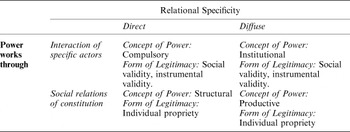
Just as legitimacy has always been understood as a question of degree, there is also a second continuum between actors who require legitimacy to attain their goals and those that can survive a legitimacy deficit within specific constituencies. In order to unpack the relationship between legitimacy and power, I map three different ways in which legitimacy influences behaviour against a typology of four dimensions of power proposed by David Barnett and Michael Duvall.Footnote 30 Barnett and Duvall represent power along two analytical dimensions: according to the ‘kinds of social relations through which power works’ (specific interactions versus constitution of actors); and the ‘specificity of social relations through which effects on actors’ capacities are produced’ (direct versus diffuse).Footnote 31 These two distinctions produce a four part typology wherein: compulsory power (direct interaction among specific actors) refers to direct action among specific actors which allow one actor to shape the circumstances or actions of another; institutional power (diffuse interactions among specific actors) describes indirect control over socially distant others via mediating institutions; structural power (direct social relations of constitution) refers to direct constitution of the structural positions and capacities of actors; and productive power (diffuse relations of constitution) identifies the ‘constitution of all social subjects with various social powers through systems of knowledge and discursive practices of broad and general social scope’.Footnote 32 (See Table 1.)
Legitimacy and power: three forms of behavioural influence
Constructivist accounts of legitimacy in International Relations have commonly emphasised internalisation of external norms and values as the key mechanism through which legitimacy influences behaviour. This definition identifies legitimacy exclusively as a constitutive form of power (structural or productive) because it constitutes actors’ identities and helps to define the way they conceive of their interests. Prominent constructivist theorists have gone so far as to define legitimacy as the internalisation of an external norm.Footnote 33
This narrow, psychological and individualist conceptualisation of legitimacy is problematic because it does not capture the social dimension of legitimacy judgements. Ian Hurd, one of the leading exponents of the ‘internalisation’ definition of legitimacy, has more recently recognised a second ‘structural’ aspect to legitimacy. Hurd adopts the Weberian term ‘validity’ to describe ‘a quality of the system that exists when the general expectation is that one might encounter a believer of norms in one's international interactions’ which in turn ‘affects how states calculate their decisions by altering actors’ cost-benefit calculations about compliance.Footnote 34
Arguably, Hurd's account of validity (which I term instrumental validity) still does not fully capture the social aspect of legitimacy. It might usefully be supplemented by an alternative account of collective level judgements which has been developed within social psychological legitimacy research. Here, action motivated by individual belief (termed propriety) is commonly contrasted with motivation by a desire for social membership (termed validity).Footnote 35 This research suggests that identification with a social group often results in a desire to adopt group behavioural norms even when these norms are not internalised (that is, group norms are valued, independently of their specific content). An analogous behaviour might arise among states if IO membership is seen as a marker of legitimate state-hood – states may then seek accession to assert group membership. I adopt the term social validity to describe this belief by an actor that norms associated with a particular social identity should be followed.
Analysis of the distinction between propriety and validity reveals that legitimacy is not only an institutional form of power. Further, it seems possible that instrumental validity might not simply result from diffuse social relations, but could also be amenable to intentional manipulation. Consider Hurd's account of instrumental validity. There is no reason to assume that actors’ assumptions about societal norm acceptance match with the actual distribution of internalised beliefs. It is probable, especially if information costs are high, that actors might instead act on erroneous beliefs. Alexis de Tocqueville's report of an astonishing decline in religious observance preceding the French Revolution, as fear of being caught in a minority created a snow-ball of performed atheism, is often cited as an example of such a disjuncture.Footnote 36 Actors may directly alter perceptions about collective opinion through organised public displays of support (for example, the totalitarian state's mass rally or an IO's public relations campaign) or dissent (for example, NGOs protesting outside an IO ministerial meeting).
Social validity may also be manipulated if strategic claims about which norms are accepted in a group are made to actors seeking group membership. A developing state delegate's description of how the Doha Declaration drafting committee overcame India's objections provides an example:
Those who supported the text were given the floor to speak first […] It was arranged in this way to literally set the consensus […] People cheered and clapped after every endorsement of the text […] This made those who wanted more clarifications feel like they were the bad guys […] This is a common tactic, to make a certain viewpoint appear dominant.Footnote 37
This example concerns manipulation of individual state representatives. However, states may also make strategic claims concerning which norms are accepted within the international community. Anne Florini documents how in the 1960s, the US unsuccessfully sought information about Soviet military capabilities by asserting that a ‘transparency’ norm applied to nuclear arsenals. The US was subsequently trapped by this strategic rhetoric when this same norm was successfully promoted by other states in the 1980s and 1990s.Footnote 38 Such efforts to directly assert or contest communal beliefs reveal how legitimacy (social and instrumental validity) can function as a form of ‘compulsory power’, operating directly through the interactions of specific actors. (See Table 1.)
Legitimacy and types of power (adapted from Barnett and Duvall, p. 12).Footnote 39

Individual propriety: ‘the normative belief by an actor that a rule or institution ought to be obeyed’ that ‘affects behaviour because it is internalised by the actor and helps to define how the actor sees its interests’.Footnote 40
Instrumental validity: ‘a quality of the system that exists when the general expectation is that one might encounter a believer of norms in one's international interactions’ which influences behaviour by shaping the perceived structure of incentives.Footnote 41
Social validity: normative belief by an actor that norms associated with a particular social identity should be followed even though the norms are not internalised or accepted independently.
The legitimacy nexus
Analysis of the ways in which legitimacy influences behaviour gives some indication of factors that might influence the legitimacy nexus. If we conceive of a relationship between a governing body (A) and subject group (B) the instrumental value of legitimacy arises where it generates voluntary compliance among B. This can occur through the constitution of B as compliant (individual propriety), or if legitimacy allows A to control B's behaviour (through social or instrumental validity). The value of voluntary compliance within a specific community then turns upon the questions: (1) is B's compliance valuable to A and, (2) can B's compliance be achieved most efficiently through legitimacy or another form of behavioural control? The following schema's first three factors address these questions by assessing whether a subject group possesses the capacity, cognisance and will to thwart A's goals. The fourth factor relates to the ways in which individual propriety influences the exercise of power by constituting A's identity.Footnote 42 Beliefs concerning legitimacy may be internalised (individual propriety) by A and constitute A's identity so that it sees B's consent as normatively desirable even when it is not practically necessary. The schema's final factor concerns the situation where A promotes the importance of legitimacy in a particular constituency for strategic reasons. Strategically adopted norms may later constrain A's actions.
These five factors (impact; perceptions and salience; means and organisation; principled norm-compliance; and strategic empowerment) are probably not an exhaustive list of influences on the legitimacy nexus, nor do they combine via any neat equation. Whereas the first three elements combine (each factor is generally necessary, but rarely sufficient) to generate an instrumental need for legitimacy the final two constitute alternative paths through which beliefs concerning appropriateness influence behaviour.
Impact
A's impact on B is a primary factor shaping a legitimacy nexus. Since states, rather than substate actors, are the usual addressees of IO rules and norms their impact beyond the state is usually indirect. IOs that do make direct demands upon non-state actors, such as those that are reliant on NGO networks to implement their agendas, may require a high degree of legitimacy among these constituencies. For example, the Joint UN Programme on HIV/AIDS, which is dependent upon the active cooperation of civil society to fulfil its goals, was the first UN program to include NGO representatives as full participants on its governing body.Footnote 43 In domestic politics it has been argued that European democratic institutions evolved when increasing taxes sparked popular demands for political representation,Footnote 44 and that the inverse relationship between rentier income and democracy results from reduced need for taxation.Footnote 45 Eckersley's paradox – wherein the Kyoto Protocol appeared to be both ineffective and legitimate – might also be explained by the weak legitimacy nexus created by the climate regime's relatively light impact (measured either in economic cost or present-day climatic harm).
Perceptions and salience
Cultural interpretation mediates perceptions of rulers’ actions and of the salience attributed to governing bodies. Beetham's example of the pre-modern state, where the strong link between king and local chiefs meant that there was only a limited connection between the people and the state, illustrates this capacity for perceptions to limit a legitimacy nexus.Footnote 46 Internationally we might expect the mismatch between the structure of political identification (primarily national) and the increasingly international locus of governance to limit the legitimacy nexus between IOs’ and mass populations (and to a lesser extent between IOs and corporate or civil society actors).
Means and organisation
Opposition does not of itself make legitimacy instrumentally necessary. Only where a subject constituency also possesses the means and willingness to resist, and the cost of action is not prohibitive, does legitimacy become instrumentally necessary. Beetham's example of an employer who has little need for legitimacy among employees since work quality is unimportant illustrates this dynamic – a legitimacy nexus is weak if compliance is not necessary. A constituency's degree of organisation and preparedness to take collective action also enhances a legitimacy nexus. Shared expectations concerning the rightful basis of power will also strengthen the nexus as they are enabling of political organisation. Beetham's observation that communal values are necessary to ground the legitimacy of authority has an important flipside: governance involving constituencies that do not form a common community will have less need for legitimation. Alternatively, legitimacy may be judged by different standards in multiple different communities.Footnote 47
A constituency's cultural attitudes to political action also contribute to a legitimacy nexus because possessing the means to take action is unimportant if a community is culturally inclined to acquiescence. Rosemary O'Kane goes so far as to argue that the coherence of the concept of sociological legitimacy is undermined by the culturally ingrained political quietism embodied in Wahabi Islamic, Quaker, Buddhist and Hindu faiths.Footnote 48 I reject this argument because situations where culture precludes political action might be said to affirm both the key claim of legitimacy theory (that collective judgements concerning rightfulness influence behaviour) and to demonstrate that the instrumental value of legitimacy is a variable. However, ideational preclusion to political action weakens a legitimacy nexus.
Principled compliance: self-legitimation of rulers
Legitimacy is also a form of structural power; standards of legitimacy may constitute the identities of those holding authority and lead them to act in ways they regard as appropriate and in compliance with collective judgement. For example, deference to contemporary social standards concerning good governance might prompt IO decision-makers to increase transparency or consult with representatives of affected communities (for example, the WTO Appellate Body's ruling that it would accept amicus curiae briefs from NGOs).Footnote 49 However, this effect may be limited. After reviewing social psychological research, Morris Zelditch argues that individuals are generally only weakly motivated to comply with social norms but that levels of norm-compliance are higher within densely linked communities that possess a high level of normative consensus and resource dependence among actors.Footnote 50
This analysis suggests that acceptance of democratic norms within decision-making communities, institutionalisation of particular forms of interaction, and development of social connections between decision-makers and subject communities may strengthen this element of a legitimacy nexus. While there is often overlap between the social norms accepted by citizens and leaders within states, in global governance such commonality seems more likely to connect IO decision-makers with international civil society than, say, mass publics in the developing world. For example, the culture of the WTO's ministerial council is presumably quite disconnected from that of Cambodian garment workers. Nevertheless, the influence of principled commitment seems likely to be highly variable between cultures and individuals.
Strategic empowerment
Strategic empowerment of new actors has the least intuitive fit with the idea of a spectrum of legitimation. However, it is a recurring mechanism through which social constituencies gain influence. This process most commonly arises where one party in an elite power struggle identifies a potential ally among subordinate groups and promotes greater representation of their interests – generally via strategic acceptance of a normative argument for increased representation.Footnote 51 When strategic acceptance alters political culture or involves institutionalisation of new norms of representation it often alters beliefs regarding appropriate behaviour and thus strengthens the legitimacy nexus.
The literature contains many examples of this dynamic. Mlada Bukovansky charts the emergence of an alliance between radical nobility and bourgeoisie in the lead-up to the French Revolution such that radical nobility sought to bolster their own position by supporting greater representation for the bourgeoisie.Footnote 52 Ian Clark identifies a similar process at the Congress of Vienna (1815) that concluded the Napoleonic wars. Here Talleyrand, the French Foreign Minister, challenged Spain, Portugal and Sweden for their arrogation of authority, on behalf of the rest of international society.Footnote 53 France ultimately abandoned its support for the rights of minor powers when it regained great power status. However, Clark recounts that this dispute left a lasting cultural legacy by crystallising separate roles for ‘great’ and ‘minor’ powers in international society.Footnote 54 Pertinently, elite cooption also appears to have contributed to the provision for NGO-consultation established in UN Article 71. Here, the USSR accepted a US proposal in order to enhance the influence of the communist World Federation of Trade Unions vis-à-vis the ILO.Footnote 55
If these five elements (impact; perceptions and salience; means and organisation; principle; and strategic empowerment) capture key processes shaping the relationship between legitimacy and the exercise of power, then analysis of these factors should provide insight into legitimacy dynamics within global governance.
The legitimacy nexus in global governance
Does the legitimacy nexus apply to IOs and do the various elements shaping a legitimacy nexus interact in patterned ways within global governance? Different theoretical conceptions of IOs suggest different answers and carry varying implications for the relevance of legitimacy. The historical inattention given to IOs’ legitimacy requirements is probably a consequence of structural-realist theory's claim that IOs are epiphenomenal (in particular hegemonic stability theory). In this account state behaviour is dictated by interests that are structured by the distribution of material capability in the international system. Since states guard their power jealously, IOs will only flourish when they are controlled and promoted by a powerful hegemon. It follows that IOs’ legitimacy or illegitimacy is of little consequence.Footnote 56
Conversely, neo-liberal institutionalist (institutionalist) and constructivist research provides grounds for expecting that legitimacy will enhance IO effectiveness. Institutionalist analysis diverges from structural realism in understanding IOs as the artefacts of mutually beneficial cooperation among states. In this account states join regimes because membership reduces transaction costs, allows governments to bind their successors and enhances states’ reputations for keeping commitments.Footnote 57 Importantly, the instrumental calculus motivating this cooperation includes consideration of collective judgements and so encompasses the kinds of influence I have termed instrumental validity and social validity. For example, Robert Keohane argues that rational actors minimise calculation costs by developing rules of thumb for dealing with common scenarios. Rules linked to regimes carry ‘the advantage of constraining the actions of others’ and generating predictable cooperation.Footnote 58 Some institutionalist analysis draws on principal-agent theory to argue that powerful states design partially autonomous and legitimate IOs because a reputation as a respected, independent actor allows IOs to shape states’ perceptions of their interests and to act as neutral conciliators.Footnote 59 Perhaps ironically, this institutionalist analysis has close parallels to the Gramscian understanding of hegemony popularised by Robert Cox.Footnote 60 Constructivist research places still greater emphasis on the capacity of legitimate IOs to socialise and constitute the identity of other actors and to develop and pursue independent (sometimes self-defeating and ‘pathological’) agendas and interests.Footnote 61
What inferences can be drawn from this theoretical synopsis for IOs’ likely legitimacy requirements? First, IOs generally depend for their effectiveness on maintaining support and legitimacy in the eyes of either a hegemonic power or a preponderance of great powers. This legitimacy nexus is strengthened because in seeking to regulate state behaviour IOs have a significant impact on states and powerful states have the capacity to undermine them. Historically, some IOs have struggled to retain the endorsement of all major powers and so have lost influence (Cold War battles over the ILO and the fractious relationship between the League of Nations (and UN) and the US are examples).Footnote 62 Second, IOs will seek legitimacy among a wider state constituency if they wish to influence the broader community of states.
Theoretical accounts perhaps reveal less (or have more contradictory implications) concerning the relationship between IOs and non-state actors. The key to understanding these dynamics is recognition that states, IOs, business and civil society actors are not wholly discreet actors. Instead, each represents, and is influenced by, an overlapping ensemble of social forces. If state interests reflect the weighted interests of powerful domestic constituencies that influence state leaders, then we see that the legitimacy (particularly validity) of states and leading non-state actors is not entirely distinct. Although the legitimacy nexus between IOs and non-state actors is typically weak, social interconnections mean non-state interests and normative standards will sometimes influence IO agendas indirectly.
The WTO's legitimacy needs: powerful ‘core’ states
The dynamic of limited IO independence and a strong legitimacy nexus with powerful states is illustrated by the trade regime. The WTO's primary impact on powerful states is the requirement that they should comply with the organisations’ existing agreements and (if the WTO is to be effective) engage in future rounds of multilateral negotiation. This requirement has historically been relatively unproblematic because agreements under the GATT/WTO have been dominated by powerful states (historically by a ‘quad’ consisting of the US, EU, Japan and Canada who have often collaborated and had a high level of agreement about appropriate purposes).Footnote 63 Recently, the growing influence of emerging powers such as Brazil, India and China has been a significant cause of deadlock. This growing multipolarity weakens the interest-based motivation for powerful states to prioritise WTO negotiating rounds. This may make legitimacy of greater importance for the WTO as state participation in future negotiation rounds may be more dependent on the legitimacy of the WTO's animating norm-set: the idea that states should pursue prosperity and peace through multilateral negotiation of trade liberalisation.
Weaker ‘peripheral’ states
The legitimacy nexus connecting IOs and peripheral states is in some ways the inverse of that with powerful states, as this relationship is also marked by state inequality which renders peripheral states ‘regime takers’ not ‘regime makers’. These states seek IO membership because stable rules-based regimes are beneficial and because they value the status and entitlements that flow from membership. While well-organised middle-powers can sometimes achieve flashes of influence (such as the Cairns groups’ successful insertion of agriculture into the GATT's Uruguay Round agenda),Footnote 64 peripheral states generally have limited means to influence multilateral agendas. Conversely, IO effectiveness in promoting organisational agendas internationally does require compliance and participation among peripheral states. Accordingly, IOs generally seek legitimacy among peripheral states, but this legitimacy nexus will be of secondary importance.
This legitimacy nexus also varies with the political context of negotiations. As Robert Hudec observes, in the 1950s and 1960s Cold War competition for economic influence and loyalty among developing states (in particular decolonising French and British colonies) gave developing countries considerable power in the GATT.Footnote 65 Since the Western dominated GATT was challenged by the Soviet backed UN Conference on Trade and Development (UNCTAD), attracting and retaining developing state membership became a pressing GATT goal.Footnote 66 The legitimacy nexus connecting the regime to its peripheral members was transformed because they now had the means to thwart regime goals through defection. Accordingly, developing states enjoyed a brief period of comparative influence.
Individual propriety and semi-voluntary compliance among states
Even where compliance is partially induced through interest-based mechanisms, IO legitimacy influences the ease with which states can be induced to reconceptualise their interests, and can make the difference between formal and substantive compliance.Footnote 67 Substantive compliance is most likely if it is promoted by a legitimate IO. As Rodrigo de Rato, then the IMF Managing Director, explains of the IMF:
The Fund's ability to persuade our members to adopt wise policies depends not only on the quality of our analysis but also on the Fund's perceived legitimacy.Footnote 68
This analysis applies equally to the WTO where much rule-compliance has a semi-voluntary character. WTO dispute settlement procedures only operate in response to member complaints from states and aim to settle specific disputes to the satisfaction of parties rather than to enforce compliance in all circumstances.
Commentators have concluded that, while developed states generally implement agreements, many less developed states form a ‘non-compliance track’ in the WTO. They neither implement their membership obligations nor are meaningful participants in negotiations.Footnote 69 This non-compliance track does not significantly undermine the WTO's efficacy because compliance can be enforced when significant economic interests are at stake. However, WTO legitimacy enhances regime effectiveness within the substantial margin of optional compliance by raising voluntary compliance. For example, the ‘Trade Policy Review Mechanism’, which aims to achieve transparency and understanding through regular reporting and review of member trade policies, relies primarily on social influence and reputational concerns (social validity) to achieve compliance.Footnote 70
WTO legitimacy can also boost effectiveness in more diffuse ways. For example, China's leadership appears to have chosen WTO accession as a solution to internal problems when, in the 1980's, there was a pressing need to reform loss-making state owned enterprises whose liabilities threatened the stability of China's banking sector. In Hui Feng's account state leaders utilised the prestige of WTO accession to overcome otherwise insurmountable internal opposition to banking reform.Footnote 71 Feng also suggests that new economic ideas were successfully inculcated in Chinese elites by interaction with the trade regime.Footnote 72 Long Yongtu, who headed China's GATT/WTO negotiations for much of the 1990s, recounts:
The negotiation is not just a process of external bargaining, but a process of internal idea shift. We used to believe that the higher tariff rates we can retain from the talks, the better protection it will be for our domestic industries […later] we realised that only market competition can boost the development of market. Only this is the best protection.Footnote 73
State accession to the WTO also illustrates how, in the context of cognitive limitations and uncertainty, decision-makers’ judgement calls may be influenced by IO legitimacy. For example, Cambodia's leaders justified WTO accession in terms of a general expectation of economic benefits and specific advantages for the garment industry. However, these claims were not backed by any economic modelling or analysis of the costs of membership (which include implementation expenses plus lost benefits of a lax intellectual property regime).Footnote 74 Thus a decision expressed in the language of economic interest seems to have been premised in internalisation of the appropriateness of WTO rule-compliance.
Non-state actors
Riots in Seattle and the suicide of a Korean Farmer (Lee Kyong Hae) at the Cancun WTO Ministerial are among the images that are most indelibly associated with questions about the WTO's legitimacy among non-state constituencies. However, stronger legitimacy nexuses connect the WTO to multinational corporations, whose executives have commonly been included in state delegations and whose influence on state policy is typically strong, and the international epistemic community of economists who promote the WTOs’ norms within national politics the world over. Since these actors are well-represented within states, they have the means to impact on WTO effectiveness, so this legitimacy nexus is strengthened. WTO rules have an impact on mass publics everywhere, but a lack of organisation or institutional representation of the global demos makes this a weak legitimacy nexus. Yet, the WTO has also proven responsive to social pressures and has adopted measures that increase organisational transparency and consultation with civil society representatives. The legitimacy nexus with civil society and mass publics may be weak, but civil society is able to exert a limited persuasive influence. Such deference to social standards is even more apparent in non-governmental standard-setting organisations such as the International Organization for Standardization or Forest Stewardship Council, both of which involve corporate, academic and civil society actors in their regulatory work.Footnote 75 Here, the legitimacy nexus is strengthened by non-state actors’ capacity to inflict reputational damage.
IOs and non-state actors: explaining tripartism in the International Labour Organization
In this final section I utilise the concept of the legitimacy nexus to analyse the creation of a highly anomalous IO that might be considered a bold experiment in the democratisation of global governance. Creation of the ILO as Part XIII of the Treaty of Versailles (1919) constitutes an historical and theoretical anomaly in that the ILO's unique tripartite structure eschews the norms of statism by including an institutionalised mechanism of non-state representation and legitimation. While contemporary pressures for enhancing IO legitimacy have focused on different areas (for example, accountability and transparency), the ILO is still noteworthy as an early and unprecedented attempt to open an IO to non-state constituencies. Seeking to explain this anomaly I contend that the ILO was created in response to the demands of a trade union movement that had been so strengthened by war conditions as to create a strong legitimacy nexus with ‘international society’ even prior to the creation of global labour standards regime. In the context of a revolutionary Bolshevist threat, it seemed that the survival of the existing international state system required that its legitimacy be enhanced among the international labour movement. It is as though for a brief moment internal challenges eclipsed external threats in the calculus of state security and the logic of the international system was inverted. In short, the ILO's design is anomalous because forces exogenous to the international system shaped its creation. Rather than focus our attention only on the legitimacy needs of a particular institution (the ILO), this case draws our attention to the interconnection between the legitimacy of states, the state system and particular institutions at times of revolutionary upheaval. In 1919 the legitimacy nexus between ‘international society’ and the labour movement was so strong that the need for the labour movement to grant legitimacy to the ILO became a proxy for the legitimacy needs of capitalist international society more generally.
The challenge to statist norms
The ILO's major design innovation is its tripartite structure, such that each national delegation consists of two government, one employer and one worker representative. State, union and employer delegates are equal in all respects and are represented in the same ratio throughout the three primary bodies: the International Labour Conference, the Governing Body (executive) and the International Labour Office (permanent secretariat).Footnote 76 Conference committees, in which the elaboration of most proposals occurs, were to be composed on a 1–1–1 basis.Footnote 77 Not only did the ILO constitution break with the norms of exclusively statist treaty making, but it also foreshadowed the UN Charter in that it was the first major international treaty to explicitly link peace and stability to the advancement of social justice and human rights. This begs the question – why did states, led by the UK, create an IO that empowered non-state actors?Footnote 78
These design elements violate the expectations of any theory, rationalist or constructivist, which seeks to explain state behaviour in terms of the structure of the international system. Regime theory does not account for why labour regulation should become a subject of international treaty making, or why states would empower non-state actors within the ILO's design. Meanwhile, structural constructivism (which holds that the international system shapes states’ identities) is at a loss to explain the constitutionalisation of tripartism in the ILO given that this norm did not evolve within the international system and is inconsistent with the deeper norms of international society. This gulf between theoretical expectation and ILO design is highlighted by participant accounts of the ILO's creation, which advance reductionist explanations.
Participants in the Paris Peace conference's International Labour Commission overwhelmingly reported that the ILO was created in response to the demands of the international labour movement with a view to averting threatened international communist revolution.Footnote 79 The Russian revolution, German and Hungarian communist uprisings and mass strikes across Europe formed the backdrop to negotiations. Participants reported feeling that their work would be compared with the demands of the wartime and post-war labour conventions. Edward Phelan, the Labour Commission secretary, writes:
The preoccupations of Mr Lloyd George and of M. Clemenceau were certainly similar. Both were fearful of an extension of Bolshevism, which had now spread to Budapest: both realized how the trade-union movement had grown in power in their respective countries, how the unions had made sacrifices to secure war production and expected some return; and above all both were concerned with the problem of demobilisation and its results, a proletariat trained to the use of arms and hardened to warfare.Footnote 80
Subsequent analysis of the ILO's foundation has recognised the same basic elements. One contemporary account concludes:
The continental European states, by contrast, faced revolutionary political movements that threatened political order in the name of liberating the working class, and had to address the injustice that, the more vigorous they were in legislating social reform, the more they placed their national firms at a disadvantage in international trade. Only if all nations would agree to level their labour standards upwards could revolution in Europe be staved off and free international trade be reconciled with ‘fair’ international trade, according to norms of reciprocity and non-discrimination.Footnote 81
Conventional understandings of international regimes find little resonance in these narratives as they typically downplay the role of domestic forces in IOs’ creation. Some rational choice accounts point to the legacy of domestic politics in such institutional design features as escape clauses that allow state leaders to manage exceptional domestic pressures while avoiding violation of an agreement.Footnote 82 However, the logic of these explanations remains structural and statist; domestic politics functions as a theoretical bolt on.
We must also ask how labour regulation came to be constituted as an international problem requiring political action. States, as autonomous security or wealth-seeking entities, might rationally propose an IO to impose raised labour standards on others only if internal forces were already demanding labour regulation domestically. The ILO's creation would therefore reflect the systemic phenomenon of a simultaneous international strengthening of mass society's position vis-à-vis the state.
Evolution of the norm of tripartism
It is also difficult to square the ILO's tripartite design with structural constructivist theories of evolutionary norm change. In short, selection of this norm confounds the constructivist expectation that new norms will evolve within and be selected for consistency with the deeper norms of international society.Footnote 83 Once again, this inconsistency would be explained if tripartism was imposed from beneath, rather than generated within, the international society of states.
The origins of tripartism can be traced in familiar constructivist terms through identification of a norm entrepreneur (Leonard Wolf) and a state norm leader (UK). Whereas demands for international labour regulation to avert a competition-based ‘race to the bottom’ stretched through a century of liberal, humanitarian, socialist and labour reform campaigns, the concept of international tripartism was very new. Many European states had developed domestic traditions of tripartite labour negotiations to maximise war-time production. However, the only international precedent for tripartism was the non-governmental International Association for Labour Legislation that was created in 1900.Footnote 84 Organised labour had demanded political representation at all levels since the late nineteenth century and the principle of equal union and state representation in international labour regulation was a key demand of the socialist Berne manifesto of 1919.Footnote 85 However, socialist challenges to statist governance did not include a proposal for tripartism.
The idea of a tripartite international body regulating labour standards was first proposed by Leonard Wolf in a London Fabian Society essay of 1916.Footnote 86 Contrasting the International Association for Labour Legislation's ineffectiveness with the legal harmonisation achieved by the non-state International Maritime Committee, Wolf argues that the clash of group interests between labour and capital make desirable international agreements unachievable.Footnote 87 He proposes that the conceptual link between employer and ‘national interest’ must be broken through an internationalisation of the dispute between capital and labour within cosmopolitan international congresses involving representatives of both vertical interests (national) and horizontal group interests (labour and capital).Footnote 88 Perhaps it was because tripartism both satisfied and moderated union demands that Woolf's ideas were incorporated into the British Labour Ministry's draft ILO constitution, which served as the negotiating text for the Peace Conference's Labour commission.Footnote 89
The legitimacy nexus between states, labour, and the ILO
Why did the British government become the state ‘norm leader’ promoting the establishment of a tripartite ILO given that tripartism was anathema to the norms of international society? Whereas theories of norm-evolution are commonly silent concerning the motivations of state norm-entrepreneurs, in accounting for the ILO's creation an understanding of the legitimation needs of states (and the community of states) appears to fill these gaps. The arguments detailed in respect of the leading norm entrepreneur (Great Britain) below also apply in varying degree to other states.
Impact, salience and perception
Preoccupation with the relationship between labour and capital within communist and socialist ideology made the trade union movement's conceptions of the salience of the international labour standards regime of critical importance. By 1919 socialist agitation reframing political perceptions meant that union movements no longer accepted that the absence of international labour regulation was tolerable. The anarchic status quo had been reconceptualised as a political structure maintaining the impoverishment of workers via a competitive race-to-the-bottom. Workers’ resentment over this governance failure was channelled toward state governments and contributed to civil unrest and communist uprisings. Thus, the absence of global regulation of labour standards was perceived as injurious to the legitimacy of the capitalist state system.
In this context, a popularly legitimated tripartite ILO might reasonably have been expected to advance instrumental goals of countering the Bolshevist threat and advancing British industry. Some writers explain the ILO's foundation as the peace conference's response to the threat of Bolshevism.Footnote 90 Robert Cox, for example, describes the organisation as ‘offering organised labour participation in social and industrial reform within an accepted framework of capitalism’,Footnote 91 and there is much evidence that this threat preoccupied conference delegates.Footnote 92 For example, George Barnes, the English Labour Commission representative and primary author of the ILO's constitution, argued that the ‘menace posed to the peace of the world’ by workers’ conditions ‘makes labour regulations and improvement an integral part of the work of a Peace Conference’.Footnote 93 Likewise, Prime Minister Lloyd George overcame opposition to the ILO from the dominions by arguing that refusal to accommodate labour in the peace treaty would risk the spread of communism.Footnote 94 Yet, the limited communist movements in the UK and many other European states give cause for scepticism that this factor was determinative of state policy.
Organisation, means and attitudes to action
While war-time conditions raised states’ material needs and strengthened unions domestically, international organisation and an action-oriented political ideology enhanced their capacity to take action. The combination of acute labour shortages and the necessity of maximising munitions and other wartime production brought enormous power. Between 1910 and 1919 UK trade union membership increased from 2,400,000 to 8,024,000.Footnote 95 Unions’ financial situation improved even more dramatically since rising subscriptions coincided with reduced provision for strike pay during wartime industrial restraint.Footnote 96 Meanwhile, the pressing wartime need to maximise production meant the government needed to reform manufacturing practices at a time when union power was at its zenith.
As losses on the western front eroded popular support for the war the government sought to maintain worker support by enacting conciliatory social policy. In addition to recognition of unions, establishment of tripartite industrial committees and national enterprise bargaining, conciliatory measures included promises for a radical post-war social agenda. To this end, on 5 January 1919, Liberal PM Lloyd George addressed a trade union meeting with a major pronouncement on war aims that mirrored Labour Party policy. Lloyd George spoke of a coming democratic peace and promised that international labour regulation would be a central focus of the peace conference. British promotion of the ILO in peace negotiations might accordingly be partially explained as the internationalisation of a corporatist deal and fulfilment of a bargain that secured union support for the war effort.
The radical wing of the socialist movement also deserves analysis. In the early years of the twentieth century avowedly socialist organisations had been sidelined by the success of the new British Labour party.Footnote 97 Even the major socialist organisations (the Social Democratic Federation and Independent Labour Party) advocated parliamentary programmes, and sought social reforms that would prepare workers for a coming cooperative commonwealth rather than revolution.Footnote 98 Yet at the war's close, factors including hyperbolic anti-communist propaganda, widespread industrial unrest and statements by the United Socialist Council welcoming the Bolshevik success combined to create the impression that the threat of revolution was real.Footnote 99
Wartime demand and labour shortages had created a similar strengthening in the position of labour across Europe. While the pre-war level of socialist and trade union international organisation had dissipated, international connections remained strong. The wartime Labour Conferences in Leeds and Berne attracted much publicity and articulated clear demands for post-war structural reform.Footnote 100 The post-war labour shortage also gave organised labour unprecedented influence. Unions possessed a high level of organisation, the means to undermine national governments, and an internationally agreed set of demands. State leaders’ desire to coopt the moderate trade union movement was consequently strong. Anthony Alcock writes:
[Commission] members were made only too aware by their daily papers of the penalties that might be exacted for failure to meet working-class desires from the extremist wing of that class, unrepresented at the Conference: communist uprisings in Germany and Hungary and an attempt on the life of the French Prime Minister, Clemenceau.Footnote 101
Post-war troop demobilisation also enhanced the proletariat's capacity to rebel. A large percentage of Europe's workforce was now trained and experienced in the use of arms – creating at the very least a heightened fear of revolutionary unrest.
While the international trade union movement experienced considerable internal division, and in some cases unionists were actively hostile toward socialists, the two movements did agree on basic goals. The cohesion of labour groups began to dissolve toward the end of 1918 as splinter groups pressed disparate agendas. Ironically, this factional tension ultimately increased public attention to labour demands.Footnote 102 The labour conferences that coincided with the Paris Peace Conference split into a purely trade union grouping and a larger ‘Labor and Socialist Conference’, but produced similar demands for inclusion of a labour charter in the Peace Treaty.Footnote 103 Thus, although the labour movement was organisationally divided, European unions shared a minimum set of expectations for a post-war social agenda. The trade union, socialist and smaller communist movements were all commitment to regulating labour standards internationally.
Principled commitment
Some accounts stress that the UK government might have formed a principled commitment to the idea of tripartite international labour regulation. After all, incorporation of labour ministers into the wartime government had created close ties between the government and union movement and infused the state executive with individuals who were personally committed to the cause of international labour regulation.Footnote 104 Others have suggested that the British government was repaying a wartime debt to the labour movement. For example, the British delegate to the Peace Conference, Sir Malcolm Delevingne, argued that the wartime experience of intense cooperation between allied states, coordination between government, workers and employers to maximise production, and the recognition of ‘great efforts and sacrifices’ of the working class to the war effort, combined to make the creation of a tripartite ILO a logical development.Footnote 105 Lloyd George's stated desire to honour his war-time commitments also suggests that principled commitment might have played a part in the adoption of tripartism.
Strategic empowerment of new allies: a cheat move in a two level game
Louis Henkin speculates about an additional strategic motivation for British promotion of tripartism.Footnote 106 In the early twentieth century it was widely believed that raised labour standards harmed the competitive position of a state's industry. It follows that states might be attracted by measures that would raise labour standards among their competitors. Since each state's interest in raising its competitors’ labour standards aligned with those of foreign trade unions, support for trade union representation at the ILO might have been partly motivated by a desire to strengthen internal demands for raised labour standards within competitor states. Since Britain, the state norm leader, possessed among the world's highest labour standards and believed that its workmanship was superior to its rivals,Footnote 107 self-interest might dispose it to support foreign unions. In Robert Putnam's metaphor of International Relations as a two level game, tripartism might be conceptualised as affording Britain a cheat's move on competitors’ domestic boards by enhancing the influence of foreign unions.Footnote 108 However, since unions could have been incorporated into a compliance mechanism within a state-controlled ILO, this argument should not be overstated.
The legitimacy nexus, tripartism and subsequent history of the ILO
The ILO was created at a time when the labour movement possessed the means and organisation to threaten state interests. British state officials may also have been motivated by principled beliefs and an interest in strategic empowerment of foreign unions. These elements all point toward a strengthened legitimacy nexus connecting unions, states and the capitalist international system. It seems probable that states institutionalised the ILO's mechanism for non-state representation in response to this unprecedented need for mass legitimation and that the norm of tripartism was adopted through capitulation to labour movement demands. The exceptional circumstances of 1919 thus explain why the ILO's design contradicts the expectations of structural theories.
The survival of a tripartite ILO after the revolutionary threat had waned reflects the acceptance of a new norm of non-state representation within the labour regime. Nevertheless, the ILO's international influence has been much less than its founders anticipated. Indeed, despite the ILO's early successes, as its mostly European members tackled the most egregious harms associated with industrialised workplaces, early favourable commentary has given way to a common contemporary belief that the ILO is relatively unimportant.Footnote 109 Analysis of the changing legitimacy nexus between the ILO and its membership helps to explain these various trends.
First, the decline in the political significance of trade unions has coincided with the decline in the ILO's perceived significance. For example, as the union movement's strength waned in the post-WWI decades, a pattern emerged where although many new conventions were adopted unanimously few states went on to ratify them.Footnote 110 Constitutional entrenchment of tripartism has both ensured the ongoing strength of the legitimacy nexus connecting the ILO to the labour movement and indelibly linked the ILO's international influence to the strength of this constituency. Since trade unions usually provide support for the ILO within domestic political processes boosting the influence of labour movements within member states provides a means through which the ILO can enhance its own influence. From the ILO's early move to allow worker and employer groups to request a ‘Commission of Inquiry’ concerning convention violation,Footnote 111 through to contemporary efforts to protect freedom of association (the current campaign for labour law reform in Iraq is an example),Footnote 112 the ILO has exhibited a consistent determination to strengthen domestic labour movements.
The ILO's leadership has also cultivated its legitimacy among a succession of different groups as each has gained influence over the organisation's survival and effectiveness. This recurring dynamic was apparent even in the efforts of the first ILO secretary, Albert Tucker, to accept state members from outside the League of Nations, recruit new state members by shifting the organisation's work toward service provision and technical assistance,Footnote 113 and expand the ILO's monitoring role by creating a ‘body of experts’ to scrutinise national reports on compliance with ILO Conventions.Footnote 114
In the aftermath of WWII the ILO's continued relevance came into question. From 1945 to 1949 the ILO leadership sought support among the victorious allies in order to secure the organisation's ongoing survival, autonomy and formal recognition of its competency in the labour field.Footnote 115 After 1964, the newly formed Group of 77 less-developed countries pressured the UN to create the ‘UN Industrial Development Organization’. The ILO responded to this threat to its competency in industrial training by seeking to mobilise support in the UN General Assembly, an arena in which developing states were now numerically superior.Footnote 116 These developments strengthened the legitimacy nexus with developing states and so the ILO became focused on their needs; at this time the ILO became a site for the denunciation of racism and exploitative labour practices in South Africa, Rhodesia and Israel.Footnote 117
In the post-Cold War era the ILO's continued quest for influence resulted in further changes in the constituencies in which it cultivates legitimacy. As the importance of the labour movement declined still further, the ILO sought to strengthen and formalise links to NGOs that represent marginalised and non-unionised workers.Footnote 118 In 1994 an organisational review presaged the adoption of a new strategy. After years of expansion, the ILO now narrowed its mandate and pursued universal adoption of a more limited set of Conventions protecting fundamental labour rights. As Laurence Helfer points out, this narrowed mandate has allowed the ILO to shed its legitimating doctrine of averting a race to the bottom and to ground its legitimacy in the protection of fundamental rights – a justification which is more in tune with the ideology of dominant states in the contemporary international system.Footnote 119 Recently, the ILO's unprecedented use of sanctions in response to evidence of forced labour in Myanmar has demonstrated renewed organisational vigour within this restricted mandate.Footnote 120 Despite these reforms and the ILO's continued role in the developing world, its influence within the developed world remains limited. The factors that created the extraordinary legitimacy nexus of 1919 led to the creation of a lasting IO with institutionalised non-state representation; however, the passing of those factors hollowed out the significance of these institutional gains and left the ILO with only a marginal position in international society.
Conclusion
This article has sought to establish that IOs’ need for legitimacy is a variable and to identify some of the factors that capture key aspects of this variable. Applied to contemporary global governance this argument suggests that we should expect variation in the degree of legitimacy sought by IOs within different subject social constituencies. If, as is commonly argued, the social constituency relevant to the legitimation of global governance is expanding beyond states, legitimacy theory should account for this change. The model proposed in this article suggests at least three contributing factors: that broader legitimacy is becoming instrumentally necessary for the attainment of IO goals due to the increasing power of non-state actors (in particular of international civil society); that IOs are seeking alternative social constituencies as sources of leverage to enhance their autonomy vis-à-vis powerful states; and that states or IO decision-makers are being persuaded by normative arguments for increased transparency and accountability to non-state constituencies.
In recent decades growing normative acceptance of arguments for accountability, transparency and democratisation of public power, together with exponential growth in the NGO sector and changes in the relative influence of multinational corporations have made inroads into state domination of global governance. Yet, since IO membership is generally confined to states, IO requirements of non-state actors are typically indirect and the state boundary continues to circumscribe dominant conceptualisations of political responsibility. Further investigation of the legitimacy nexus connecting IOs to world society will be valuable both for efforts to assess the prospects for democratisation of global public power and to add clarity to debate about standards of normative legitimacy appropriate to global governance.