Introduction
Early indicators of treatment success during antidepressant therapy may guide clinical treatment decisions and potentially minimize the prolonged use of ineffective treatments for patients with major depressive disorder (MDD). Improvement—or lack of improvement—in symptoms of depression during the first few weeks of antidepressant treatment has been shown to significantly predict later response or remission status in patients treated for MDD. In several analyses in clinical trial populations, changes in depressive symptoms (most commonly based on the 17-item Hamilton Rating Scale for Depression [HAM-D17]Reference Hamilton1 or the Montgomery–Åsberg Depression Rating Scale [MADRS]Reference Montgomery and Asberg2) during the first 1 to 4 weeks of treatment are reported to predict achievement of response to treatment or remission of symptoms at the end of the 6- to 12-week trials.Reference Koran, Hamilton and Hertzman3–Reference Lin, Lane, Chen, Juo and Yen7 Those findings suggest that early changes in depression scale scores in an antidepressant trial could be potentially useful to clinicians in determining when a change in treatment plan might be considered.
Recovery from the significant functional impairment associated with depression8, Reference Hirschfeld, Dunner and Keitner9 is considered an important goal in the treatment of patients with MDD, along with remission from the symptoms of depression.Reference Hirschfeld, Montgomery and Keller10–Reference Trivedi, Corey-Lisle and Guo13 Moreover, the cost of functional disability associated with depression can be substantial, both in terms of medical care and lost work productivity. In a chart review of patients who were newly prescribed psychotropic drugs for the treatment of depression and anxiety, physical functioning was the only factor that differentiated patients whose treatment costs were offset by an overall reduction in medical costs from patients with no cost offset, and scores in 3 quality-of-life domains significantly predicted cost savings.Reference Fifer, Buesching and Henke14 In a second study based on a telephone survey of adult health plan members and review of administrative and clinical databases, the likelihood of receiving medical care and mean healthcare costs both increased significantly with the number of areas of functional impairment (social, family, or work functioning) in patients with anxiety and depression.Reference Hunkeler, Spector, Fireman, Rice and Weisner15 Both absenteeism and presenteeism in the workplace also increase significantly with severity of depressionReference Jain, Roy and Harikrishnan16; results of the American Productivity Audit conducted in 2002 estimated the cost of lost productive work time in the United States due to absenteeism and presenteeism associated with depression to be approximately $31 billion per year.Reference Stewart, Ricci, Chee, Hahn and Morganstein17 In depressed patients receiving new antidepressant treatment, better clinical outcome (persistent depression vs improvement vs remission) has been associated with a significant reduction in loss of work time.Reference Simon, Revicki and Heiligenstein18
In clinical trials, a significant correlation has been shown between functional impairment and severity of depression symptoms in MDD patients,Reference Guico-Pabia, Fayyad and Soares19 and, on average, significantly greater improvement in function is observed in patients who achieve remission from depression compared with patients who do not respond to treatment.Reference Trivedi, Corey-Lisle and Guo13, Reference Mauskopf, Simon and Kalsekar20 Nonetheless, improvements in functional impairment in patients with depression may be independent of or more complex than symptom improvements,Reference Hirschfeld, Dunner and Keitner9, Reference Trivedi, Corey-Lisle and Guo13 and can be measured separately in MDD trials using the Sheehan Disability Scale (SDS)Reference Sheehan21 or other established functional assessment tools.Reference Endicott and Dorries22 Although intuitively relevant, the extent to which early improvement in functional impairment during antidepressant treatment may predict later treatment success, as measured by functional outcomes, has not previously been assessed.
The objective of this post hoc pooled analysis was to determine whether early improvement in functional measures predicts functional response or remission at study end point (8 weeks) in MDD patients treated with desvenlafaxine or placebo. Treatment with desvenlafaxine (administered as desvenlafaxine succinate) at the recommended therapeutic dose of 50 mg/d is associated with significant improvement in HAM-D17 total scores compared with placebo in clinical trials, and early improvement in HAM-D17 total score is a robust predictor of response or remission at final evaluation in desvenlafaxine trials.Reference Soares, Fayyad and Guico-Pabia23
Methods
Functional outcomes, including SDS scores, were assessed in MDD patients treated with desvenlafaxine vs placebo in this pooled analysis, and the predictive value of early change in SDS total score on functional response and remission at final evaluation was examined.
Pooled data set
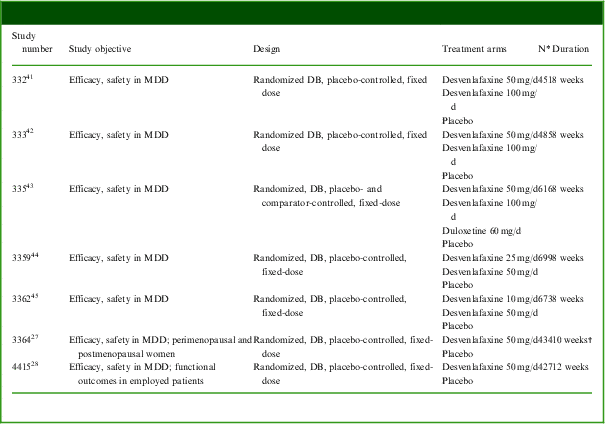
Data were pooled from 7 multicenter randomized, double-blind, placebo-controlled fixed-dose studies of desvenlafaxine 50 mg/d in MDD (Table 1). Six of the 7 studies included sites in the United States, with additional sites in Japan (1 study) and Canada (1 study). One study was conducted at sites in North America, South America, Europe, and South Africa. All studies were approved by the independent ethics committees or institutional review boards of the participating sites. Each study was conducted in accordance with the ethical principles that have their origin in the Declaration of Helsinki24 and was consistent with Principles of Good Clinical Practice and applicable regulatory requirements in each participating country. All participants provided written informed consent before enrollment.
Studies included in the pooled analysis
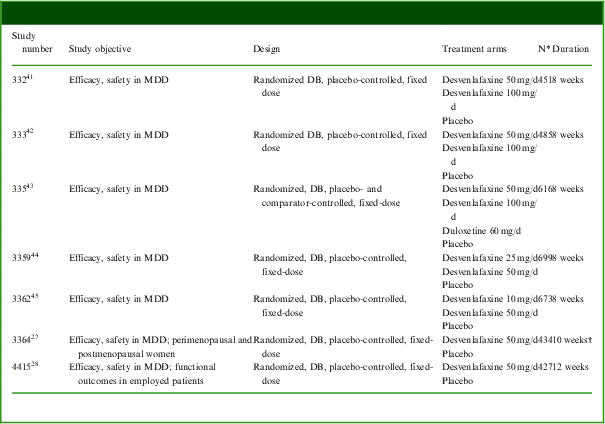
Abbreviations: DB, double-blind; MDD, major depressive disorder.
*Total number of patients in the safety population (all randomized patients who took at least 1 dose of study medication).
†Week 8 primary end point.
The 7 studies included in the analysis were of similar design. Patients were randomly assigned to receive placebo or a fixed dose of desvenlafaxine 10, 25, 50, or 100 mg/d (or duloxetine 60 mg/d in 1 trial); each trial included a desvenlafaxine 50-mg/d treatment arm. Data from the placebo and desvenlafaxine 50 mg/d arms only were analyzed. Five studies were 8 weeks in duration, 1 study was 10 weeks in duration with a week 8 primary end point, and 1 study had a week 12 primary end point. The primary efficacy end point for each of the studies was change in baseline in HAM-D17 total score (range, 0 [no symptoms] to 54 [most severe]).Reference Hamilton1 Secondary outcomes included in each study were the MADRS (range, 0 [no symptoms] to 60 [most severe])Reference Montgomery and Asberg2 and the SDS (range, 0 [unimpaired] to 30 [highly impaired].Reference Sheehan21 Safety and tolerability were assessed throughout the studies.
Patients
All studies enrolled adult outpatients with a diagnosis of MDD based on criteria from the Diagnostic and Statistical Manual of Mental Disorders, 4th Edition25 (DSM-IV) or the DSM-IV, Text Revision,26 with symptom duration of at least 30 days and a baseline HAM-D17 total score of 20 or greater (or MADRS score ≥25 in 2 studiesReference Clayton, Kornstein and Dunlop27, Reference Dunlop, Reddy and Yang28). Six studies enrolled men and women 18 years (or 20 years at Japanese sites) or older, with an upper age limit of 75 years in 1 study.Reference Dunlop, Reddy and Yang28 The seventh study enrolled perimenopausal and postmenopausal women, 40–70 years of age.Reference Clayton, Kornstein and Dunlop27
Exclusion criteria for the individual studies were designed to select medically stable patients with a principal diagnosis of MDD (excluding bipolar and psychotic depression). Patients were excluded if they had current psychoactive substance abuse or dependence, or comorbid psychiatric disorders based on the modified Mini International Neuropsychiatric InterviewReference Lipman29 and a psychiatric interview at screening; comorbid generalized anxiety disorder, panic disorder, or social anxiety disorder were allowed if MDD was the primary diagnosis. Patients with major medical illness (including uncontrolled hypertension or unstable angina) or clinically important abnormalities on screening laboratory evaluations, physical examination, vital signs, and electrocardiograms were excluded from all studies. Patients were excluded if they had a significant risk of suicide based on clinical judgment or a HAM-D17 suicide item score greater than 3 at screening. Patients were also excluded if they had been previously treated with desvenlafaxine at any time or with venlafaxine within a year prior to the study, or had a known sensitivity to either drug or others in their class.
Assessments
Functional end points for the pooled analysis were based on SDS, HAM-D17, MADRS, and World Health Organization 5-Item Well-Being Index30 (WHO-5; 5 studies only) assessments at week 8, and included SDS total and item scores, WHO-5 total score, HAM-D17 psychomotor retardation factor (HAM-D17 items 1, 7, 8, and 14),Reference Cleary and Guy31 and the MADRS lassitude item (item 7).
Four levels of treatment success were defined: functional response, SDS total score of 12 or lessReference Sheehan and Sheehan32 with at least 50% reduction from baseline in SDS total score; functional/depression response, SDS total score of 12 or less with at least 50% reduction from baseline in SDS total score and at least 50% improvement from baseline in HAM-D17 total score; functional remission, SDS total score less than 7Reference Guico-Pabia, Fayyad and Soares19; and functional/depression remission, SDS total score less than 7 and HAM-D17 total score 7 or less. Consistent with MDD treatment guidelines, early improvement in function was assessed based on SDS total score at week 2.Reference Lam, Kennedy and Grigoriadis33, 34
Statistical analysis
All analyses were based on the intent-to-treat (ITT) population, defined as all randomly assigned patients who had a baseline primary efficacy evaluation, took at least 1 dose of double-blind study drug, and had a baseline and at least 1 on-therapy primary efficacy evaluation. Analyses were performed at week 8, using the last observation carried forward (LOCF) approach for handling missing data.
Changes from baseline in functional outcomes were analyzed using analysis of covariance with study, baseline, and treatment in the model. Functional outcomes were analyzed for the overall pooled population and for 3 age groups (18–40 years, 41–54 years, ≥55 years). Effect of treatment on the proportion of patients achieving each of the 4 defined levels of treatment success at week 8 (LOCF) was analyzed using logistic regression with study, baseline, and treatment in the model. Because functional response was defined as SDS total score of 12 or less, patients with an SDS total score of 12 or less at baseline were excluded from all analyses of treatment success.
Early improvement in SDS total score at week 2 was evaluated as a predictor of later treatment success at each of the 4 levels. Week 2 improvement was used based on similar studies in the published literature.Reference Koran, Hamilton and Hertzman3–Reference Szegedi, Jansen and van Willigenburg5, Reference Farabaugh, Sonawalla and Johnson35–Reference McIntyre37 A receiver operating characteristic (ROC) analysis was conducted to determine the threshold of improvement (% change from baseline in SDS total score) based on the optimal operating point at week 2 that predicted each level of treatment success at end point.Reference Gallop38 The ROC analysis was conducted for the overall population and by treatment group. Sensitivity, specificity, positive predictive value (PPV), and negative predictive value (NPV) were computed for each SDS improvement threshold (thresholds for each level of success, overall and by treatment).
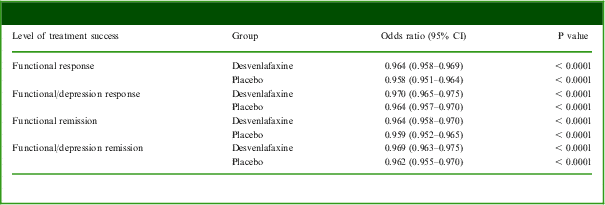
The predictability of achievement of the week 2 SDS improvement thresholds on later treatment success was assessed using logistic regression with threshold achievement (yes/no) as a response variable, treatment and study as factors, and baseline SDS total score as a covariate. Odds ratios were computed from the logistic regression results. Adjustments for baseline variables were subsequently added to the model; all baseline variables that were significant predictors of at least 1 of the levels of treatment success, overall or for at least 1 treatment, were included. Baseline variables assessed as potential predictors of treatment success were treatment, age group, gender, weight, duration of current episode, baseline HAM-D17 score, baseline SDS total score, and baseline SDS work, social, and family item scores.
Results
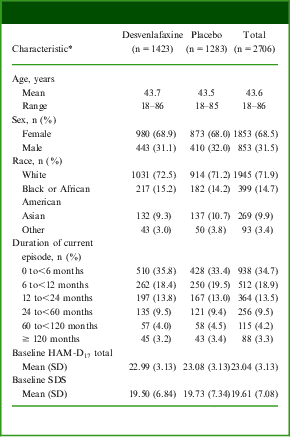
A total of 2706 patients was included in the analysis: 1423 received desvenlafaxine 50 mg and 1283 received placebo. There were no statistically significant differences in baseline demographic and clinical characteristics between desvenlafaxine and placebo groups in the pooled population (Table 2). Patients were on average 43.6 years of age with a mean current depressive episode duration of 22.5 months (median, 7.4 months); 68.5% of patients were women. At baseline, mean (SD) HAM-D17 total score was 23.0 (3.13) and mean SDS total score was 19.6 (7.08).
Baseline demographics and clinical characteristics

Abbreviations: HAM-D17, 17-Item Hamilton Rating Scale for Depression; SDS, Sheehan Disability Scale.
*No statistically significant differences between treatment groups were observed.
Functional outcomes
Desvenlafaxine treatment was associated with significantly greater functional improvement compared with placebo at final evaluation based on all functional measures assessed. The adjusted mean change from baseline (SE) in SDS total score was −7.04 (0.20) for the desvenlafaxine group compared with −5.33 (0.21) for the placebo group (adjusted mean difference [95% confidence interval]: −1.71 [−2.29, −1.14]; P < 0.0001). Desvenlafaxine treatment was associated with significantly greater improvement in all 3 SDS item scores at week 8 (LOCF) compared with placebo (social: −0.53 [−0.72, −0.34], P < 0.0001; family: −0.50 [−0.69, −0.31], P < 0.0001; work: −0.59 [−0.79, −0.40], P < 0.0001). The adjusted mean difference for desvenlafaxine vs placebo at week 8 (LOCF) was 1.14 (0.66, 1.62; P < 0.0001) for the WHO-5, −0.63 (−0.84, −0.43; P < 0.0001) for the HAM-D17 retardation factor score, and −0.24 (−0.35, −0.13; P < 0.0001) for the MADRS lassitude item.
For each functional outcome assessed, the treatment effect was most pronounced in the youngest age group. Patients aged 18 to 40 years (n = 1076) had significant improvements compared with placebo in in all functional outcomes: SDS total score, −2.31 (−3.20, −1.41), P < 0.0001; SDS social, −0.74 (−1.05, −0.44), P < 0.0001; SDS family, −0.70 (−1.01, −0.40), P < 0.0001; SDS work, −0.79 (−1.08, −0.49), P < 0.0001; WHO-5, 1.63 (0.96, 2.30), P < 0.0001; HAM-D17 retardation factor, −0.84 (−1.17, −0.50), P < 0.0001; and MADRS lassitude item, −0.39 (−0.56, −0.22), P < 0.0001. In the 41–54 year age group (n = 1060), significant improvements were observed in SDS total score (−1.25 [−2.17, −0.33]; P = 0.0078), all item scores (social: −0.37 [−0.67, −0.06], P = 0.0192; family: −0.36 [−0.66, −0.06], P = 0.0187; work: −0.38 [−0.69, −0.07], P = 0.0168), and HAM-D17 retardation factor (−0.58 [−0.90, −0.25]; P = 0.0005). In patients aged 55 or older (n = 570), improvement with desvenlafaxine treatment was statistically significant compared with placebo only for the SDS work score (−0.60 [−1.04, −0.17], P = 0.0071).
Treatment success
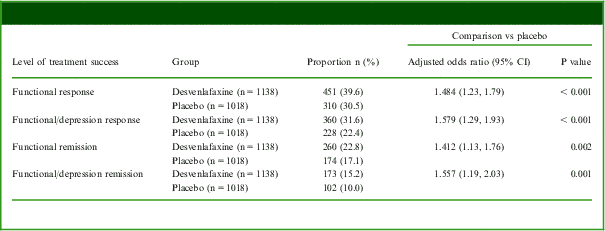
The proportion of patients achieving each level of functional treatment success was significantly greater for the desvenlafaxine 50 mg/d group compared with placebo (all P ≤ 0.002; Table 3). For desvenlafaxine-treated patients, the proportion of patients achieving some level of treatment success ranged from 15% achieving functional/depression remission to 40% achieving functional response (placebo, 10%–31%).
Number (%) of patients who achieved treatment success at week 8 (LOCF)
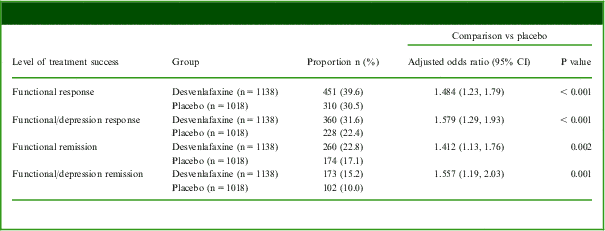
Abbreviations: HAM-D17, 17-Item Hamilton Rating Scale for Depression; LOCF, last observation carried forward; SDS, Sheehan Disability Scale.
Functional response: SDS total score ≤12 and ≥50% improvement in SDS.
Functional/depression response: SDS total score ≤12 and ≥50% improvement in both SDS and HAM-D17.
Functional remission: SDS total score <7.
Functional/depression remission: SDS total score <7 and HAM-D17 ≤ 7.
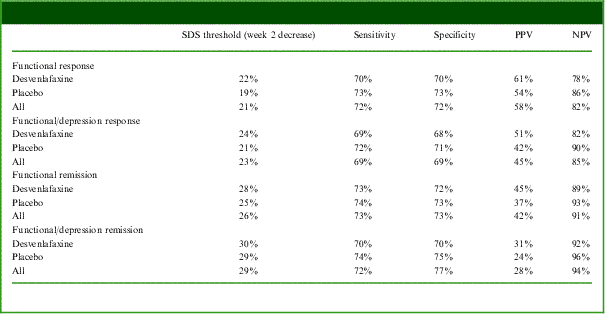
Week 2 SDS improvement thresholds derived from the ROC analysis ranged from 19% to 22% improvement in SDS total score for predicting functional response at week 8 to 29% to 30% improvement for predicting functional/depression remission (Table 4). Thresholds determined for the desvenlafaxine and placebo groups were similar (within 3 percentage points) at each level of treatment success. The highest PPV (61%) was associated with achievement of functional response in desvenlafaxine patients, indicating that 61% of desvenlafaxine-treated patients who achieved the SDS early improvement threshold at week 2 achieved functional response at week 8. The highest NPV (96%) was observed for functional/depression remission in placebo-treated patients: 96% of placebo patients who did not meet the SDS improvement threshold at week 2 also did not achieve functional/depression remission at week 8.
Operating characteristics of improvement in SDS at week 2 to predict later treatment success
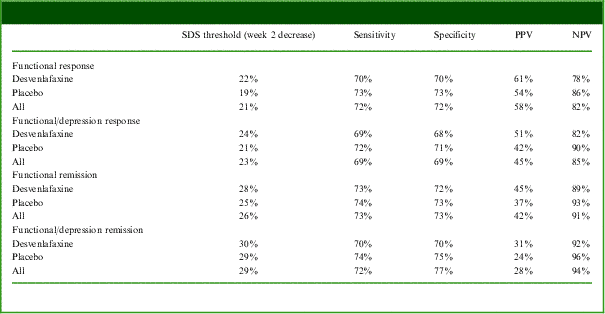
Abbreviations: HAM-D17, 17-Item Hamilton Rating Scale for Depression; NPV, negative predictive value; PPV, positive predictive value; SDS, Sheehan Disability Scale.
Functional response: SDS total score ≤12 and ≥50% improvement in SDS.
Functional/depression response: SDS total score ≤12 and ≥50% improvement in both SDS and HAM-D17.
Functional remission: SDS total score <7.
Functional/depression remission: SDS total score <7 and HAM-D17 ≤ 7.
The proportions of patients achieving each level of treatment success were numerically greater for patients in the desvenlafaxine group compared with patients in the placebo group, both among those who met improvement thresholds and among those who did not (Figure 1). Rates of treatment success were approximately 2 to 6 times higher for those patients who met the SDS improvement threshold at week 2 compared with those who did not. Early improvement (week 2) in SDS was a highly significant predictor of all levels of treatment success at week 8 overall and for desvenlafaxine and placebo groups (Table 5).
Rates of treatment success at week 8. A. Patients who met week 2 SDS improvement thresholds. B. Patients who failed to meet week 2 SDS improvement thresholds.
Abbreviations: HAM-D17, 17-item Hamilton Rating Scale for Depression; LOCF, last observation carried forward; SDS, Sheehan Disability Scale. Functional response: SDS total score ≤12 and ≥50% improvement in SDS. Functional/depression response: SDS total score ≤12 and ≥50% improvement in both SDS and HAM-D17. Functional remission: SDS total score <7. Functional/depression remission: SDS total score <7 and HAM-D17 ≤7.
Logistic regression predicting treatment success at week 8 (LOCF) based on early improvement with desvenlafaxine 50 mg/d or placebo
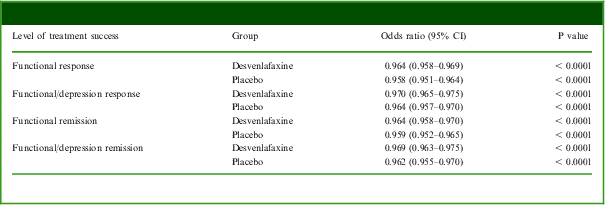
Abbreviations: HAM-D17, 17-item Hamilton Rating Scale for Depression; LOCF, last observation carried forward; SDS, Sheehan Disability Scale.
Functional response: SDS total score ≤12 and ≥50% improvement in SDS.
Functional/depression response: SDS total score ≤12 and ≥50% improvement in both SDS and HAM-D17.
Functional remission: SDS total score < 7.
Functional/depression remission: SDS total score < 7 and HAM-D17 ≤ 7.
Overall or for either desvenlafaxine or placebo, a total of 7 baseline characteristics significantly predicted at least 1 of the levels of functional treatment success: treatment, age category (18–40 vs ≥55), gender, baseline HAM-D17 total score, baseline SDS total score, and baseline SDS work and family item scores. Baseline weight, duration of current depressive episode, and SDS social item score were not predictive of any of the levels of treatment success. Treatment was a significant predictor for all levels of success (all P ≤ 0.0011); gender was a significant predictor only for functional remission (overall [P = 0.0376] and desvenlafaxine group [P = 0.0318]). All other predictors were significant for 2 or 3 of the levels of success, overall and/or for at least 1 of the treatment groups. Early functional improvement remained a significant predictor of all levels of treatment success, overall and for both treatment groups, after all 7 of the predictive baseline characteristics were included in the model (all P < 0.0001).
Discussion
In patients with MDD, improvement in depressive symptoms is not always accompanied by a return to normal functioning.Reference Guico-Pabia, Fayyad and Soares19, Reference Adler, McLaughlin and Rogers39 It is critical, therefore, that treatment decisions for patients with MDD focus on both alleviation of depressive symptoms and improvement of functional impairment.Reference Hirschfeld, Montgomery and Keller10–Reference Trivedi, Corey-Lisle and Guo13 Symptom reduction early in treatment has been shown to significantly predict achievement of response or remission based on depression scale scores.Reference Koran, Hamilton and Hertzman3–Reference Lin, Lane, Chen, Juo and Yen7 Treatment guidelines suggest that, although 4 to 8 weeks of pharmacotherapy may be required for a full treatment response, MDD patients who will eventually respond or remit may show improvement as early as the first 1 to 2 weeks of antidepressant treatment.Reference Lam, Kennedy and Grigoriadis33, 34 To our knowledge, this is the first analysis to examine whether early functional improvement can predict later function-based response or remission.
The results of this pooled analysis indicate that early improvement in functional symptoms, as measured by the SDS, is a significant predictor of later response and remission of functional impairment in MDD patients. The predictive value of early improvement was significant for patients treated with either desvenlafaxine 50 mg/d or placebo, although for each level of success, PPV was numerically higher for desvenlafaxine and NPV was higher for placebo. Almost half (45%) of desvenlafaxine-treated patients who met week 2 thresholds for improvement on the SDS achieved functional remission (SDS < 7) after 8 weeks of treatment, whereas patients who did not meet week 2 thresholds for improvement on the SDS had very low rates of functional remission (11%). For patients receiving placebo, functional remission was achieved by 37% of patients who met early improvement thresholds, and 7% of patients who did not. Further, desvenlafaxine 50 mg/d treatment was associated with significant improvement compared with placebo on all functional outcomes, and significantly greater percentages of those in the desvenlafaxine group vs the placebo group achieved each level of functional treatment success at week 8.
The finding that early functional improvement predicts later functional outcome is consistent with the published literature examining the predictive value of early changes in depressive symptoms for later HAM-D17 response or remission. The achievement of week 2 or 4 HAM-D17 total score thresholds significantly predicted week 8 response and remission in MDD trials for desvenlafaxine in a pooled analysis of 6 of the 7 studies included in the current analysis.23 The percentages of patients achieving functional remission were lower than those achieving symptom remission (based on HAM-D17 total score ≤7), but the pattern for patients who met early thresholds vs those who did not was similar in the 2 analyses: 52% of desvenlafaxine-treated patients and 39% of placebo-treated patients who met week 2 HAM-D17 total score improvement thresholds achieved symptom remission. In contrast, only 15% of desvenlafaxine-treated patients and 11% of placebo-treated patients who missed the week 2 threshold were remitted at week 12.Reference Soares, Fayyad and Guico-Pabia23 Comparable rates have been reported in studies for other antidepressant drugs.
The findings of this pooled analysis suggest that an assessment of patient functioning would be useful in reviewing treatment plans for patients with MDD. While a lack of significant functional improvement after just 2 weeks of treatment might not be cause for stopping a treatment, it could serve as an additional tool for the clinician to judge the effectiveness of the ongoing plan. To date, no studies have examined whether patients who fail to show functional improvement early in treatment would have better treatment success with a change of treatment compared with continued treatment. Future studies are needed to address whether treatment changes based on lack of functional improvement are warranted and to examine whether 2-week improvement, vs improvement at 3 or 4 weeks of treatment, would be useful for making that determination.
Failure to achieve early improvement thresholds may be an indication of inadequate treatment, requiring dose adjustment or augmentation, but other factors may be at play. Results from an analysis of data from the Sequenced Treatment Alternatives to Relieve Depression study demonstrated that patients who remitted earlier in treatment (treatment step 1 vs treatment step 2) had greater functional improvement at symptom remission.Reference Trivedi, Morris and Wisniewski40 The authors suggest that patients with initial treatment failure may have some degree of treatment resistance and might benefit from adding treatment modalities. Similarly, failure to reach early SDS thresholds while depressive symptoms improve might signal to the clinician that a patient has complex functional impairments associated with depression that will require additional treatment strategies. The assessment of both depressive and functional symptoms early in MDD treatment can help the clinician tailor the treatment plan to the patient's needs and progress.
This analysis has several limitations. The analysis was based on data from 7 studies that, although similarly designed, had differences in study duration, number of active treatment arms, and assessment intervals. Study populations also differed between trials, including differences in sexes enrolled, age limits, number of clinical entry criteria, and countries of origin. The baseline predictor analysis indicated that both age category (18–40 vs ≥55) and gender significantly predicted at least 1 level of functional improvement, and 1 of the studies in the pooled analysis enrolled exclusively perimenopausal and postmenopausal women.Reference Clayton, Kornstein and Dunlop27 However, no clear difference in functional outcome was noted in that study compared with the pooled population: mean (±SD) baseline SDS score was numerically lower for the perimenopausal/postmenopausal study compared with the pooled population (17 ± 6 vs 20 ± 7, respectively), but the mean difference from placebo (95% confidence interval) for the desvenlafaxine group at final evaluation (1.59 [−3.09, −0.09]) was significant (P = 0.038)Reference Clayton, Kornstein and Dunlop27 and comparable to the pooled population (−1.71 [−2.29, −1.14]).
Other limitations of the analysis should be noted: The generalizability of the results of this analysis is limited by the exclusions used for enrollment in the pooled studies: each study used entry criteria to select for medically stable patients with a primary diagnosis of MDD, and therefore these findings cannot be generalized to more medically complex patient populations. Further, none of the studies in this analysis was originally designed to explore the relationship between early improvement and treatment outcomes. Finally, the current analysis assessed the predictive value of early improvement for treatment success at week 8 only; relationships between early improvement and longer-term functional outcomes are unknown.
Conclusions
In this pooled patient population, treatment with desvenlafaxine 50 mg/d significantly improved functioning compared with placebo in patients with MDD. The proportion of patients achieving treatment success, defined by 4 distinct thresholds for functional-based and symptom-based changes, was significantly greater for the desvenlafaxine group compared with placebo. Early functional improvement at week 2 was highly predictive of later treatment success.
Disclosures
Dr. Soares has received payment for board membership from Pfizer, Lundbeck, AstraZeneca, and BMS; consultancy to Pfizer, Lundbeck, AstraZeneca, and Noven; grants from Pfizer, Eli Lilly, BMS, NARSAD Foundation, and CIHR; speaker bureaus from Pfizer, Lundbeck, and AstraZeneca; and development of educational presentations from Lundbeck. In the past 3 years Dr. Endicott has received research support from New York State Department of Mental Health and Cyberonics and has served as consultant or advisory board member to Amgen, AstraZeneca, Bayer Health Care, CHID Foundation, and New York University. None of the above affiliations should result in a conflict of interest related to the subject of this manuscript. Dr. Boucher is a Pfizer Canada employee and owns Pfizer stock. Dr. Fayyad is a Pfizer employee, New York, NY. Dr. Guico-Pabia, is a former employee of Pfizer.