Introduction
All ear operations carry a risk of hearing loss. The risk of deafness caused by operations to repair ear drum defects (myringoplasty) is usually considered to be very low and may not be mentioned in the pre-operative discussion. Typically, the patient is warned that there is no guarantee of successful closure of the perforation, and the surgeon might quote published or even personal success rates. The patient may not be fully apprised of the risk that hearing could be worse after the operation, even if the ear drum repair succeeds. This may be because the surgeon believes the risk to be so low as to not merit discussion, or it may be that the surgeon regards the average hearing change following the operation to be the likely result in every patient. This masks the fact that there are some patients who have markedly worse hearing as a consequence of the operation.
The International Ear Audit1 has been prospectively used to record details of the otology operations performed in two Norfolk hospitals. It incorporates all ear operations performed in a single consultant practice over a six-year period. A study on deafness following cholesteatoma surgery has recently been published using data from this audit.Reference Prinsley2 The current report uses data retrieved from the audit to evaluate deafness following myringoplasty. The data show that the incidence of significant hearing loss after myringoplasty is higher than one might think. This finding has implications for the process of informed consent.
Materials and methods
Patients who underwent myringoplasty between 2007 and 2013 as a single operative procedure were identified retrospectively from online records in the International Ear Audit database.1 This is a prospective, web-based audit tool of otology procedures performed. It is used to collect information about the nature and extent of disease, and the operations performed. In addition, the database includes prospective data concerning the post-operative course of the patient in the months and years after the procedure. It is free to use and is supported by ENT UK, the professional association of British ENT surgeons. The audit includes a facility to compare individual results with ‘benchmark centres’ of excellence.3
Both adults and children were included in the study. Patients who underwent myringoplasty in association with other procedures such as mastoidectomy or ossiculoplasty were not included in the analysis.
Hearing change was calculated from the average of air conduction thresholds at 0.5, 1, 2 and 3 kHz pre- and post-operatively. (If no value was supplied at 3 kHz, an average of 2 and 4 kHz was calculated by the audit database to provide a 3 kHz reading.)
The primary outcome was hearing change after myringoplasty. For those patients in whom a hearing loss of 10 dB or greater was found, a case note review was performed to identify: (1) the type of hearing loss suffered, (2) the possible cause of this loss, (3) any predictive factors and (4) subsequent treatment to correct the loss. Hearing outcomes are presented as average air conduction and bone conduction values.
Results
Out of a total of 617 ear cases in the audit, 193 patients undergoing myringoplasty as a single procedure were identified. Six patients did not have post-operative audiometry results. Post-operative hearing gain in the remaining 187 patients ranged from −53.75 to 46.85 dB, with mean of 7.19 dB. This information is represented schematically in Figure 1.
A scatter gram showing the hearing gain in patients following myringoplasty (each point represents an individual patient). Patients are ordered chronologically, which illustrates that there was no clustering of events at any one particular time in the surgeon's practice. The seven cases with hearing loss at or below −10 dB (indicated by the points below the red horizontal line) are discussed in detail in the main text.

Forty-four patients experienced a reduction in hearing thresholds; in 37 patients, the reduction was less than 10 dB (range, −0.625 to −9.375; mean, −3.97) and in 7 patients it was greater than 10 dB (range, −10 to −53.75 dB; mean, −27.05 dB).
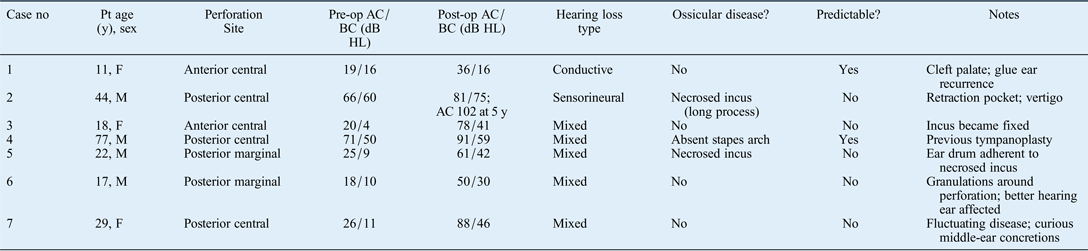
A case note review of the seven patients with the worst hearing results was conducted in an attempt to address the questions raised above. The cases are summarised in Table I.
Case summary
Case no = case number; pt = patient; y = years; pre-op = pre-operative; AC/BC = average air conduction and bone conduction values; post-op = post-operative; F = female; M = male
Case one
Background
An otherwise fit 11-year-old girl presented with a history of grommets for otitis media with effusion in conjunction with a repaired cleft palate. The patient wished to swim. Audiometry showed average air conduction and bone conduction values of 19 and 16 dB respectively in the perforated ear, and an average air conduction value of 16 dB in the opposite ear.
At operation, a 30 per cent dry anterior inferior perforation was seen alongside a dislodged grommet in the middle ear which was removed. The ossicular chain was intact and mobile. The defect was reconstructed with a temporalis fascial underlay graft.
Post-operative audiometry showed conductive hearing loss, with average air conduction and bone conduction values of 36 and 16 dB respectively. Examination revealed an intact ear drum and recurrent glue ear which was treated with hearing aids.
Observations
This patient had problematic eustachian tube function associated with the repaired cleft palate. The glue ear recurred causing deafness. The ear drum repair was successful and she could swim with no problems.
Case two
Background
A fit 44-year-old man presented with intermittent mucous discharge from a small right perforation. A left mastoidectomy had been performed previously. A pre-operative audiogram showed average air conduction and bone conduction values of 66.25 and 60 dB respectively, and an average air conduction value of 33.75 dB in the mastoidectomy ear.
At operation, a posterior retraction pocket containing a small perforation was found. There was significant ossicular disease, with necrosis of the long process of the incus and erosion of the stapes superstructure. The footplate was mobile with a remnant of anterior crus attached. The pocket was exposed by curetting the ear canal bone and was then excised. The ear drum was grafted with a temporalis fascia underlay.
Following the procedure, the patient developed episodic vertigo. The perforation was successfully closed. However, the ear drum retracted over the next few years and became adherent to the promontory. During this time, the patient developed progressive sensorineural hearing loss. Initial post-operative average air conduction and bone conduction values were 81.25 and 75 dB respectively. These deteriorated over the two years (average air conduction increased to 102.5 dB). Five years later, the disease was stable, with a dry ear and no vertigo. There was no remaining hearing in the operated ear (average air conduction was 121 dB).
Observations
This was not a simple myringoplasty. There was significant ossicular damage, and retraction recurred post-operatively with progressive loss. The early vertigo and sensorineural loss might have been the result of mechanical trauma to the stapes footplate.
Case three
Background
An 18-year-old girl presented with a left perforated ear drum, which was causing otalgia and discharge after swimming. Audiometry showed average air conduction and bone conduction values of 20 and 4 dB respectively in the perforated ear, and an average air conduction value of 6 dB in the other ear.
At operation, the tympanic membrane was sclerotic, with an anterior dry central perforation and an intact and mobile ossicular chain. The defect was reconstructed with a temporalis fascial underlay graft.
At follow up, the patient reported left-sided hearing loss. Audiometry showed mixed hearing loss, with average air conduction and bone conduction values of 78 and 41 dB respectively. The ear drum was intact. Computed tomography was performed at nine months post-operatively to assess the middle-ear structures. The scans showed an intact ossicular chain, with soft tissue of uncertain significance on the medial side of the posterior tympanic membrane.
Subsequent surgical exploration of the ear revealed that the incus had become fixed in the attic. The incudostapedial joint was divided and the incus gently mobilised. This was then relocated onto the stapes head supported with Gelfoam®. There has been no improvement in hearing.
Observations
The deafness was not predictable. The conductive loss was a result of the incus fixation and the sensorineural component may be due to transmitted force via the intact chain.
Case four
Background
A 77-year-old man, who had undergone right tympanoplasty 8 years previously, presented with an intermittently discharging right ear from a posterior perforation. Audiometry showed average air conduction and bone conduction values of 71 and 50 dB respectively in the diseased ear, and an average air conduction value of 41 dB in the other ear.
At operation, the posterosuperior quadrant of the tympanic membrane was perforated, with squamous epithelium on the mesotympanic surface. In addition, the second genu of the facial nerve was dehiscent, and the previous incus prosthesis was found to be non-functional as a result of erosion of the stapes superstructure (mobile footplate). The diseased segment of the tympanic membrane was excised, and cartilage and temporalis fascia (an underlay graft) was used to reconstruct the defect.
Audiometry showed mixed post-operative hearing loss (average air conduction and bone conduction values of 91.25 and 58.75 dB respectively), which required aiding. The perforation had healed.
Observations
This was not a simple myringoplasty. The limited cholesteatoma formation on the medial drum was not apparent pre-operatively and required full excision. The mixed loss was largely attributable to the conductive deterioration, which was unavoidable in this case given the ossicular chain disease and the failed prosthesis.
Case five
Background
A fit 22-year-old man presented with discharge when exposed to water, from a perforation of the left tympanic membrane. Audiometry showed average air conduction and bone conduction values of 25 and 8.75 dB respectively on the perforated side, and an average air conduction value of 15 dB in the healthy ear.
At operation, a posteromarginal perforation of approximately 40 per cent was found. The membrane was found to be adherent to a partially eroded incus, although the ossicular chain was otherwise intact and mobile. The adherent drum was elevated from the diseased incus and the defect reconstructed with a temporalis fascia underlay graft.
At six weeks post-operatively, the ear drum was found to be healed. Audiometry showed mixed hearing loss, with average air conduction and bone conduction values of 61 and 42 dB respectively.
Observations
Posteromarginal perforations can be associated with ossicular chain disease and progressive erosion of the incus. The hearing loss in this case followed ear drum elevation from the incus with manipulation of the ossicular chain.
Case six
Background
A fit 17-year-old man presented with intermittent discharge from a right-sided tympanic membrane perforation. Audiometry showed average air conduction and bone conduction values of 18 and 10 dB respectively in the perforated ear, and an average air conduction value of 32.5 dB in the other ear.
At operation, a posteromarginal perforation with granulations along the perforation edge was noted. The granulation tissue was resected and the defect reconstructed with an underlay of temporalis fascia.
At three months’ follow up, the patient reported his hearing to be worse. On examination, an inflammatory polyp was seen arising from the medial canal. The polyp was cauterised with silver nitrate. Subsequent follow up revealed a healthy, intact graft, with no infection. Audiometry showed mixed hearing loss, with average air conduction and bone conduction values of 50 and 30 dB respectively. The patient was happy regarding the perforation closure and felt no need for subsequent hearing amplification.
Observations
The posterior marginal perforation and the need to resect the granulation tissue meant that mechanical trauma probably occurred, a result of the intimate relationship of the ossicular chain in this region. In this case, the hearing in the better hearing ear was made worse by the operation.
Case seven
Background
A 29-year-old woman presented with recurrent pus, discharging through a left posterior perforation, which had been problematic since childhood. Audiometry showed average air conduction and bone conduction values of 26 and 11 dB respectively, and an average air conduction value of 6 dB on the right side. Her medical history was significant for polycystic ovary disease, obesity and smoking.
At operation, a small posterior perforation was found, with an intact chain. Abnormal concretions were found in the middle-ear cavity and removed. The defect was reconstructed with a temporalis fascial underlay graft.
Post-operatively, the patient reported poor hearing and vertigo. Audiometry showed mixed hearing loss (average air conduction and bone conduction values of 87.5 and 46 dB respectively), which improved later that same year (to 41 and 5 dB respectively). The defect had healed.
Over the next few years, the patient developed persistent left ear discharge. Although this was treated with multiple courses of topical antibiotics, the discharge became very problematic. Eventually, some three years after the first procedure, it was agreed to proceed to mastoid exploration.
At cortical mastoidectomy, a bleeding polyp was found within the ear canal. The mastoid cavity was full of granulation tissue interspersed with concretions. The ossicular chain was intact and mobile. Tissue removed showed non-specific inflammation; fungal cultures were negative.
The ear initially improved but then deteriorated, with intermittent discharge once again. Haematological and pathological investigations for systemic diseases such as vasculitis or tuberculosis were negative.
Observations
This is a curious case; while the original myringoplasty may have had an effect on the conductive component of hearing, the sensorineural component was thought to be due to the underlying disease, which resulted in a fluctuating picture. This case highlights the difficulty of patients who present with an apparently simple problem, but develop atypical features that did not manifest prior to surgery. The hearing loss in this case was not predictable pre- or intra-operatively.
Discussion
Hearing loss that occurs after surgery performed to close a perforated ear drum is not rare, or certainly not as rare as we might have thought or wished it to be. The average hearing change in this group of patients is a 7.19 dB benefit, but in this series 44 out of 187 patients (23.51 per cent) suffered loss of hearing. Seven of these (3.74 per cent of the total) had a loss greater than 10 dB. Quoting the benefit figure alone is misleading.
The operations were performed in a single consultant practice by the senior author and surgical trainees under supervision. In this context, previous observations have shown no difference between the grades of the operating surgeons in terms of the operation success rate.Reference Mahendran, Bennett, Jones, Young and Prinsley4 Indeed, for the great majority of patients, the procedure is successful in the sense that the perforation is healed. Comparison with expert benchmark centres (using the International Otology Audit3) showed that residual perforation rates at three months’ follow up are very similar. In patients in whom an ear drum repair (during any procedure) was performed, residual perforation rates in the benchmark group and the Norfolk group were 6 per cent and 6.5 per cent respectively. These figures suggest that the techniques used to repair the ear drum were of a standard comparable to that of the benchmark centres. The hearing results reported in this paper, however, refer to 187 myringoplasty operations performed as an isolated procedure.
The prospective UK national audit on myringoplasty published by Kotecha et al. in 1999 quoted a hearing loss rate of 2.1 per cent.Reference Kotecha, Fowler and Topham5 Unfortunately, the return rate of surgeons was low (only 73 out of 405 surgeons took part), and post-operative hearing thresholds were missing for 27.8 per cent of the patients included. The hearing loss rates for the 332 surgeons who failed to respond is unknown. The figures from the Kotecha et al. audit might be somewhat optimistic. The risk of hearing loss in this audit was roughly 10 times greater. Another recent study reported even higher rates of significant hearing loss (7.6 per cent of patients suffered loss greater than 10 dB), which further supports the findings in this paper.Reference Thiel, Mills and Mills6
Published reports of hearing loss following myringoplasty are unusual. This is perhaps unsurprising as few surgeons would wish to gain a reputation for causing this problem. In addition, data series are often incomplete, meaning that the true hearing outcomes are not known.Reference Karkanevatos, De, Srinivasan, Roland and Lesser7, Reference Pignataro, Grillo Della Berta, Capaccio and Zaghis8 Only six patients in this series failed to attend for post-operative audiograms.
Change in hearing thresholds is best considered in the context of the other ear and in relation to the impact on hearing overall. Hearing change can be illustrated using the Glasgow benefit plot;Reference Browning9 this is usually used to show improvement. We instead demonstrate the ‘Glasgow deficit plot’, which illustrates the seven cases with hearing loss greater than 10 dB (see Figure 2). The hearing change findings are considered in relation to hearing in the non-operated ear.
A ‘Glasgow deficit plot’. The upper line represents a ‘rule of thumb’ and the lower line is the ideal (wherein hearing in the operated ear reaches that of the non-operated ear). In a positive hearing outcome, one usually expects the post-operative result (the red boxes) to be below the pre-operative marker, and preferably between the two lines if not below the lower line. In these cases, it is apparent that the inverse has occurred. Pre-op = pre-operative; post-op = post-operative
Loss of good hearing is of course much more significant to the patient than the worsening of already poor hearing. In one case, there was a loss of hearing in the better hearing ear (case six). The surgeon is advised to exercise particular caution in such circumstances and counsel the patient carefully during consent if contemplating an operation on the better hearing ear. A change of less than 10 dB in an individual may not be noticed by the patient and may be regarded as within the error margin of the test. However, when such a change is observed averaged across a group of 187 patients, this does appear to be a real phenomenon.
Five of the cases were mixed hearing losses, one a conductive loss (secondary to glue ear) and one a sensorineural loss. In three of the patients (cases two, four and five), there was a significant ossicular problem, and ossicular manipulation to clear disease in order to produce a safe ear was unavoidable. We speculate that there was transmission of damaging energy to the cochlea via the ossicular chain during the operation in these patients.Reference Black and Wormald10 These three cases all involved posterior perforations, which may represent an increased risk because of the proximity of the disease to the ossicles.Reference Yung11 In three of the cases (two, five and six), ossicular manipulation was unavoidable in order to remove disease to ensure a safe ear. These three operations could be considered ‘myringoplasty of additional complexity’. The findings for these cases are similar to those documented in a recent case series by Thiel et al.,Reference Thiel, Mills and Mills6 where multiple regression analysis showed minimal hearing gains in patients with fixed or absent stapes (although no association with other ossicular disease was shown). The current study showed a higher rate of hearing loss (of more than 10 dB) overall.
In case three, there was no obvious reason why the incus should have become fixed. This is mysterious, but similar to cases reported in a series where the malleus and incus became ankylosed.Reference Vartiainen and Nuutinen12 The underlying disease in case seven resulted in the fluctuating loss. Neither of these cases were predictable.
• The incidence of hearing loss following myringoplasty is higher than originally thought
• Posterior marginal perforations are more often associated with ossicular problems
• Manipulation of an intact ossicular chain may be hazardous even in a ‘straightforward case’
Other than the otological conditions, there were no predictive factors such as systemic disease linking the cases. Two patients required hearing aids and two patients required further surgical exploration of the ear (one for hearing loss and one for other symptoms). Successful perforation closure was achieved in all seven cases.
Conclusion
In this series, the incidence of hearing loss after a myringoplasty was 23.51 per cent, with 3.74 per cent of patients (about 1 in 27) suffering a loss of 10 dB or more. This finding has important implications for the process of informed consent.
In some cases, the hearing loss was predictable given the natural progression and extent of disease, but in others it was not. Ossicular chain manipulation is at the forefront of the surgeon's mind during myringoplasty, but in some cases this is unavoidable.
Acknowledgement
We would like to thank Mr S Wilson who helped in searching the International Ear Audit database.