Introduction
Head and neck cancers are malignant tumours of the upper aerodigestive tract. This group of tumours is heterogeneous, arising from distinct anatomical subsites, including the oral cavity, the naso-, oro- and hypopharynx, the larynx, and the cervical oesophagus. Approximately 6700 new cases are diagnosed each year in England and Wales, and 1100 in Scotland.1–3
Squamous cell carcinoma (SCC) accounts for 90 per cent of all head and neck malignancies, and is the 6th most common cancer worldwide.Reference Marur and Forastiere4, Reference Parkin, Pisani and Ferlay5 Peak incidence occurs in the 5th and 6th decades of life, and there is a male predominance (male:female ratio, 3:1).Reference Sanderson and Montague6 Smoking and alcohol intake have historically been considered the most significant aetiological risk factors in the development of SCC of the head and neck.Reference La Vecchia, Tavani, Franceschi, Levi, Corrao and Negri7 More recent evidence, however, also suggests a correlation between human papilloma virus (in particular, genotype 16) infection and SCC of the oral cavity and oropharynx, particularly in younger age groups.Reference La Vecchia, Tavani, Franceschi, Levi, Corrao and Negri7, Reference D'Souza, Kreimer, Viscidi, Pawlita, Fakhry and Koch8
Research into international cancer survival between 1978 and 1990 showed a poor five-year survival rate in the UK compared with other developed countries.Reference Berrino, Sant, Verdecchia and Capocaccia9–Reference Berrino, Capocaccia, Estève, Gatta, Hakulinen and Micheli11 As a result, the Department of Health (DoH) published the 1997 white paper, entitled The New NHS, Modern, Dependable.12 The aim of this legislation was to speed up the referral process for suspected cancers, thus allowing earlier diagnosis and management, and subsequently improving survival rates. This paper, in conjunction with The NHS Cancer Plan of 2000, implemented a fast-track two-week rule target, stipulating that all suspected cancers should be seen by a specialist within 14 days of referral.13
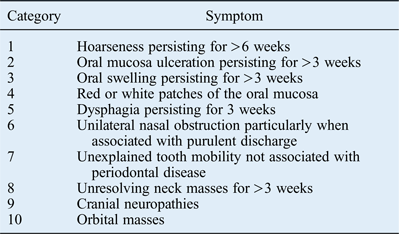
The national fast-track referral guidelines for suspected cancer of the head and neck are based on 10 red flag symptoms and clinical findings (Table I). These are used to improve general practitioner awareness of underlying malignant processes, thus leading to earlier detection.
Department of health referral guidelines for suspected head and neck cancer

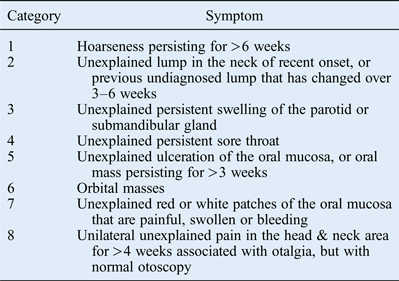
Wirral University Hospital NHS Trust has adapted these guidelines to produce its own two-week rule referral proforma, which uses eight indications for urgent referral (Table II). The actual referral form used by general practitioners in our catchment area includes the criteria of suspected cancers of the head and neck and the thyroid. General practitioners are expected to tick the appropriate box to indicate suspected cancer (Appendix I)
Referral criteria for suspected head and neck cancer
The purpose of the fast-track process is to increase efficiency of the diagnostic process and treatment pathway, thus improving patient care. However, such enhanced awareness has increased the pressure on the health service. More referrals are now being received by already busy out-patient departments. Priority is given to two-week referrals over other forms of referrals so as to meet targets. This also increases the pressures upon both the 31- and 62-day targets for cancer treatment set by the DoH, regarding time from diagnosis to start of treatment for all patients and time from general practitioner referral to start of treatment for two-week referral patients, respectively.
We undertook two audit cycles of two-week referrals in our hospital, 10 years apart. The aims of this study were to analyse the trends during both cycles, assess the efficiency of the referral pathway and suggest changes to improve the referral process.
Materials and methods
Arrowe Park Hospital is a busy district general hospital that caters to a population of around 350 000. The first audit cycle refers to the 12-month period between January 2002 and December 2002, and the second refers to the 6-month period between January 2012 and June 2012. For the first audit cycle, a list of all two-week rule referrals received by the Arrowe Park Hospital ENT department between 1 January and 31 December 2002 was compiled from the departmental referral database. Once the study group was obtained, fast-track referrals and patient case notes were collected and retrospectively reviewed. Data were compiled by a single researcher, using a standardised data collection form. Thereafter, the following categories were assessed: patient demographics; patient risk factors; meeting the two-week target for appointment; presenting signs and symptoms documented on the referral form; appropriateness of referral; and cancer pick-up rate.
The second audit cycle was undertaken 10 years later. For this, a second list of head and neck two-week rule referrals received by the Arrowe Park Hospital ENT department was compiled. A total of 676 referrals were obtained between 1 January and 31 December 2012. Owing to time constraints, only those patients referred from 1 January 2012 to 30 June 2012 were included in the second cycle. As before, a retrospective review of case notes and referral letters was carried out. The same data collection standardisation was undertaken and the same categories were assessed.
Results
Of the 149 patients referred during the first cycle (1 January 2002 to 31 December 2002), 123 sets of patient case notes were successfully obtained and reviewed (83 per cent). During the second cycle (1 January 2012 to 30 June 2012), 357 patients were referred. Of these, 339 sets of notes were obtained and reviewed (95 per cent).
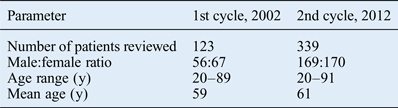
Patient demographics are shown in Table III. More female patients were referred in both audit cycles. The age range of patients was also similar, as was the average patient age at referral.
Patient demographics
y = years
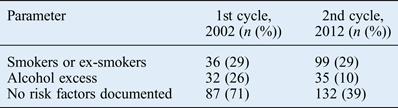
Head and neck cancer risk factors are shown in Table IV. The percentage of referred patients with a history of smoking was similar between the two audit cycles. The percentage of patients with excess alcohol intake fell from 26 per cent in the first cycle to 10 per cent in the second. Alcohol excess was defined as more than the recommended weekly intake. A large number of patients in both study samples had no documented risk factors. However, the overall proportion with documented risk factors was lower in 2012 than in 2002.
Risk factors
The efficiency of the ENT department in meeting the two-week rule target was assessed in both cycles. This was done by calculating the time from general practitioner referral to the out-patient appointment. In both cycles, 98 per cent of patients were seen within two weeks (Table V).
Failure to meet the two-week target
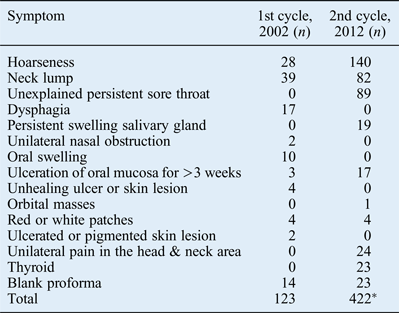
Both audit cycles assessed documentation provided by the general practitioner on presentation, symptoms and signs. This information was derived from the ticked boxes and additional information on the referral form. For some referrals, more than one box had been ticked. If no boxes were ticked, then the symptoms and findings specified in the additional information were used for analysis. However, referral forms were completely blank for 14 patients in the first cycle and 23 patients in the second (Table VI).
Presenting signs and symptoms
*More than one box ticked
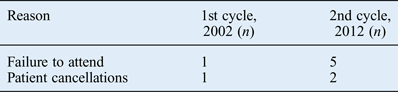
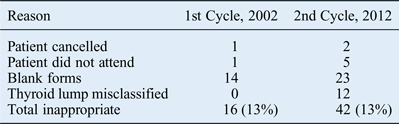
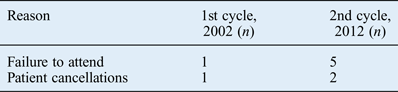
Referrals were classified as appropriate or inappropriate. Referrals were deemed inappropriate in the following circumstances: cancellation of appointment by patient; failure to attend clinic; blank referral form; and some thyroid referrals. Thyroid lumps referred to as neck lumps rather than indicated on the thyroid section of the proforma were classified as inappropriate. This was done because we consider that general practitioners should be able to correctly identify thyroid lumps and decide whether they represent a higher cancer risk, thus necessitating fast-track referral as a thyroid lump, or a lower cancer risk, which does not require a two-week referral (Table VII).Reference Perros14
Inappropriate referral
Despite more referrals being made in the second cycle, the overall cancer pick-up rate from fast-track referrals in our hospital fell from 9 per cent (11/123) to 5 per cent (17/339) in the 10-year intervening period.
Discussion
Our study compared 12- and 6-month patient samples, 10 years apart. Owing to the large number of referrals made during 2012, it was decided that a six-month sample in the second cycle would provide sufficient data to produce a meaningful comparison. In the 10-year period, the number of fast-track referrals made to our ENT department more than quadrupled, although the cancer pick-up rate fell by half. There are many reports regarding two-week rule pathways currently in place in various specialties.Reference Pacifico, Pearl and Grover15–Reference Thorne, Hutchings and Elwyn17 Although the change in the reported referral rate is variable, the general increasing trend echoes our own.
Pacifico et al. reviewed malignant melanoma fast-track referrals made to their rapid access clinic over a four-year period.Reference Pacifico, Pearl and Grover15 They reported an average annual increase of threefold in patients seen between 2003 and 2006, equating to an 28 extra patients per week requiring review within 2 weeks. Potter et al. performed a prospective review of patients referred to a breast clinic from primary care from 1999 to 2005.Reference Potter, Govindarajulu, Shere, Braddon, Curran and Greenwood16 Fast-track referrals increased by 42 per cent during this period; however, the cancer pick-up rate from these referrals dropped from 12.8 per cent in 1999 to 7.7 per cent in 2005. Notably, 27 per cent of all cancers diagnosed in this study were not two-week rule referrals. Similar findings were made in a study of colorectal cancer by Thorne et al. Reference Thorne, Hutchings and Elwyn17 They performed a critical appraisal of 12 studies to assess the impact of the fast-track referral process on colorectal cancer services.Reference Thorne, Hutchings and Elwyn17 They found that only 10.3 per cent of two-week rule referrals resulted in a diagnosis of cancer, accounting for 24 per cent of all cancer diagnoses.Reference Thorne, Hutchings and Elwyn17 Of the remaining cancer cases, 52.4 per cent came from standard referrals and 24.1 per cent from emergency referrals.Reference Thorne, Hutchings and Elwyn17
Our results are similar to those of other studies into head and neck cancer. Hobson et al. reviewed all patients presenting to their ENT department with suspected cancer in 2005.Reference Hobson, Malla, Sinha, Kay and Ramamurthy18 They found the commonest cause for referral to be hoarseness or a neck lump. Of the two-week rule patients, 12 per cent were subsequently diagnosed with cancer. Of all patients diagnosed with cancer, 44 per cent were not sent via the urgent referral pathway. Lyons et al. audited head and neck fast-track referrals during a 12-month period.Reference Lyons, Philpott, Hore and Watters19 They found that 71 per cent of patients diagnosed with cancer were not referred under the two-week rule pathway, and that only 15 per cent of all fast-track referrals were subsequently diagnosed with a malignancy. Of the patients sent as ordinary referrals, time taken to be seen was much longer than two weeks.
After reviewing both our findings and the published literature, we have some concerns about fast-track referrals. Our own figures show that the referral rate is increasing. Although cancer incidence rates are rising, the increase in referral rate is grossly disproportionate. One reason could be the improved general practitioner awareness of red flag symptoms as a result of the two-week rule guidelines. However, cancer pick-up rate amongst two-week referrals is declining. This is a significant concern because a large proportion of diagnosed malignancies still come from standard referrals from both general practitioners and other hospital departments. For example, during the 6-month second audit cycle, 27 patients were diagnosed with head and neck cancer in our ENT department. Of these, 10 patients (37 per cent) came from non-fast-track referrals. With priority being given to fast-track referrals and their increase in volume, patients with standard referrals are now taking longer to be seen, and cancer diagnoses are therefore delayed in this patient group. Further, the rise in referrals is increasing pressure on already stretched out-patient departments, and subsequently increasing patient morbidity and mortality.
• Head and neck cancers are malignant tumours of the upper aerodigestive tract
• Approximately 6700 new cases are diagnosed each year in England and Wales, and 1100 in Scotland
• The NHS Cancer Plan 2000 stipulated that all suspected cancers should be seen by a specialist within 14 days of referral
• The rise in fast-track referrals made increases pressures on ENT Departments, with only a small proportion yielding a cancer diagnosis
Interestingly, the proportion of inappropriate referrals was similar in both audit cycles. Reasons for this classification include blank proformas, thyroid lumps being referred to as neck lumps and patients cancelling or not attending their appointments. Reasons for patients failing to attend the out-patient appointment following a two-week referral could be their lack of awareness of the seriousness of their condition, their perception of low priority and incorrect prioritisation of their problems by the general practitioner. We believe that general practitioners often have a low threshold for using the two-week referral pathway. We also feel that general practitioners should explain the nature of the fast-track referral route, and decide with the patient whether the symptoms are serious enough to prioritise attending a hospital appointment over any other personal commitments. It is worrying that blank referral forms are still being received. This leads us to speculate about whether those patients actually met the fast-track guidelines, or whether the referral process was initiated for its ease of use and the guarantee that the patient would be seen within a short space of time.
We are particularly concerned that unexplained persistent sore throat qualifies as a referral criteria. Our study showed that although 89 patients with this symptom (26 per cent) were referred, only 1 case turned out to be malignant. In our opinion, this symptom is too vague, especially when not lateralised, and results in an extremely low cancer pick-up rate. We therefore recommend that the referral pathway should be restricted to including unilateral sore throat.
Conclusion
Our study showed that the number of two-week rule referrals made to a district general hospital ENT department increased over 10 years, but that cancer pick-up rates as a result of these referrals fell. Inappropriate referrals are increasing. Therefore, quality assessment and improvement of the referral pathway and education of general practitioners are required. Modifications should be made to improve the quality of patient care and decrease the pressure of these referrals on ENT departments.
APPENDIX I TWO-WEEK RULE REFERRAL PROFORMA