1 Clitic positioning
A considerable volume of literature exists on the syntactic and prosodic properties of clitics, both in particular languages and cross-linguistically. A brief overview of many of the issues surrounding clitics can be found in Gerlach & Grijzenhout (Reference Gerlach and Grijzenhout2000b); see further, for example, the works in Halpern & Zwicky (Reference Halpern and Zwicky (eds.)1996) and Gerlach & Grijzenhout (Reference Gerlach and Grijzenhout (eds.)2000a); for older literature see Nevis, Joseph, Wanner & Zwicky (Reference Nevis, Joseph, Wanner and Zwicky1994). Recent accounts in the framework of Lexical-Functional Grammar include Wescoat (Reference Wescoat, Butt and King2009), Bögel (Reference Bögel, Butt and King2010), Bögel et al. (Reference Bögel, Butt, Kaplan, King, Maxwell III, Butt and King2010) and Lowe (Reference Lowe, Butt and King2011); in Head-driven Phrase Structure Grammar (HPSG) Monachesi (Reference Monachesi1993, Reference Monachesi2000), Miller & Sag (Reference Miller and Sag1997) and Kupść (Reference Kupść, Kruijff and Oehrle1999, Reference Kupść2000); in transformational syntax Chomsky (Reference Chomsky1995: 219–394), Sportiche (Reference Sportiche, Rooryck and Zaring1996), Bošković (Reference Bošković2001), Anderson (Reference Anderson2005) and Franks (Reference Franks2008).
One of the major issues in accounting for clitic positioning is the extent to which both syntactic and prosodic/phonological processes are responsible for surface word order. Some approaches assume that prosody is entirely responsible for clitic positioning; see the recent work of Keydana (Reference Keydana2011). Other approaches assume that prosodic information is interpretable by, or even present in, the syntax, enabling prosodic factors to directly influence syntactic structure (e.g. Bögel et al. Reference Bögel, Butt, Kaplan, King, Maxwell III, Butt and King2010). A third approach is to assume a derivational system in which syntactic positioning is or can be followed by prosodic repositioning in a later phase of the derivation (e.g. Hale Reference Hale1995, Reference Hale1996, Reference Hale2007). Perhaps the most important evidence for prosodic influence on clitic positioning comes from the phenomenon to be treated in this paper, namely the appearance of clitics inside constituents of which they are not themselves a part.
The definition of a ‘clitic’ is in itself a controversial topic. Etymologically the name clitic implies a word that ‘leans’ on another, i.e. that is incapable of standing on its own, a fact that is usually correlated with some kind of prosodic deficiency, such as lack of stress or lack of a syllable nucleus. Syntactic peculiarities are usually found alongside these prosodic peculiarities, however, and in some cases, as we will see, clisis can be defined in purely syntactic terms. The positioning of the category clitic on the cline between full word and affix is also controversial, and will be discussed in more detail in Section 3 below.
I build on a model of the syntax–phonology interface developed by Dalrymple & Mycock (Reference Dalrymple, Mycock, Butt and King2011) in the framework of Lexical-Functional Grammar (LFG; Bresnan Reference Bresnan1982, Reference Bresnan2001b; Dalrymple Reference Dalrymple2001; Falk Reference Falk2001), in order to show how clitic positioning can be accounted for in a strictly modular framework, and to explore what the consequences of this are. Briefly, the model assumes that the output linear order of elements in a clause obtains in the s-string, a syntactic component of the grammar that encodes purely linear order and that is directly based on the output string. The c-structure, the representation of hierarchical syntactic relations, is ordinarily based directly on the s-string; where clitics appear in positions that are problematic from the perspective of hierarchical syntax, the c-structure is permitted to analyse them in a position different from that in which they appear in the s-string. This ‘permission’ is in fact highly constrained by Optimality Theoretic constraints. The Optimality Theory (OT) eval is assumed to assess constraints from all levels of the grammar, including both syntax and phonology/prosody. In this way, although syntax and prosody are entirely separate modules, prosody is able to indirectly constrain syntactic representations through the OT evaluation.
2 The phenomenon
A wide variety of problematic phenomena can be found cross-linguistically which involve, in one way or another, clitics. One of the most problematic of these, found in many languages, is the appearance of clitics inside otherwise coherent and indivisible syntactic units (words or phrases), i.e. in positions that cannot easily be accounted for under standard syntactic assumptions, apparently due to prosodic constraints. In this section I discuss data primarily from two languages, Ancient Greek and Pashto, which exemplify this phenomenon to different degrees.
2.1 Ancient Greek
Perhaps the simplest form of this phenomenon is found in, among other languages, Ancient Greek. Here, clitics, mainly conjunctions, can interrupt otherwise obligatorily continuous constituents. For example, as shown in (1)–(3) below, in Greek of the Classical period the definite article cannot be separated from its NP under any circumstances, except that it is possible for clitic conjunctions and sentence particles to intervene between a clause- or phrase-initial definite article and its NP.Footnote [2]

In (1) the clitic conjunction dé ‘and, but’ appears between the proclitic article ho and the noun Kûros ‘Cyrus’.Footnote [3] Example (2) is parallel. In (3) the clitic te ‘and’ likewise appears between the article and its NP barbarikón ‘barbarian’, but here there is a difference: the clitic appears following the first word, the article, of the NP of which it is a part, but the NP itself is not clause initial, unlike those in (1) and (2).
The same pattern appears also with PPs, as shown in (4): enclitic conjunctions and particles are the only words that can intervene between a preposition and the NP it governs.
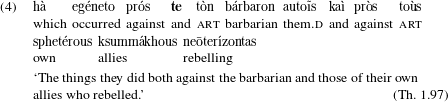
Under traditional syntactic assumptions there is no easy way to account for the position of the conjunction/particle in these contexts, since the clitic is syntactically associated with a position outside the constituent within which it appears, and there is no way for that position to access it.
It is worth noting that the conjunction te ‘and’ in (3) and (4) shares its coordinating function in both passages with the conjunction kaí ‘and’. This latter word is a non-clitic (in the sense defined below, at least), and appears directly before the element it conjoins: tò Hellēnikón ‘the Greek’ in (3), pròs toùs … neōterízontas ‘against those … who rebelled’ in (4). Descriptively, then, the position of the clitic te is parallel to that of the non-clitic conjunction, except thatte appears one word ‘to the right’ of the non-clitic’s position.
Although it is the rule in unmarked contexts, it is not necessarily the case that clitic conjunctions and particles in Ancient Greek follow the very first word of their domain, regardless of constituency. It is also possible for such clitics to appear after a whole phrase, when that phrase provides a focus or contrast of some kind. In (5) the two clitics in the first clause follow the first word (and phrase) of the clause, but in the second clause the prepositional phrase epì t ḗn Leukíppēn provides a contrastive focus, and the clitic conjunction dé follows the whole phrase rather than just the first word of that phrase.
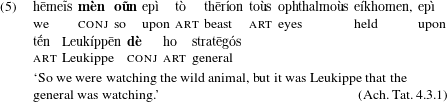
Although superficially similar, and indeed indistinguishable in some cases (when the first phrase in the domain of a clitic consists of only a single word, as in the first clause in (5)), these two possibilities for clitic positioning in Ancient Greek must have very different explanations. When a clitic appears following a full phrase, we can explain its position without difficulty in purely syntactic terms, by assuming a syntactic position to the left of the clitic in which focused or contrastive material appears. When a clitic appears following the first word and inside a syntactic constituent of which it is not itself a part, such explanations are impossible. There is no sense in which the definite articles in (1)–(3), or the preposition prós in (4), provide a focus or contrast, or indeed have any kind of information structural importance distinct from the phrases of which they are a part. Rather, the position of the clitic conjunctions in (1)–(4) corresponds to the descriptive generalization made above: their position is parallel to that of a non-clitic conjunction, but one word to the right. In all these examples, the ‘expected’ position of the clitic is at the left edge of a clausal or phrasal boundary. It would therefore be possible to remedy the syntactically problematic appearance of clitics inside constituents by analysing their default syntactic position as no different from non-clitic counterparts but overriden, as it were, by a constraint prohibiting the appearance of clitics at clausal or phrasal boundaries. The clausal boundaries in (1) and (2) likely coincide with prosodic boundaries of some kind, but this is not necessarily the case with the phrasal boundaries in (3) and (4). Indeed, we will see below that in the case of Ancient Greek, at least, there is no need to invoke prosodic constraints on clitic positioning, despite the close similarity between the Greek phenomenon and that found in Pashto, treated in the next section, for which prosody is unambiguously relevant.
Equivalent phenomena to those seen in Ancient Greek appear in a number of other languages. For example, they are found in Slavic languages such as Russian (Rudnickaya Reference Rudnickaya, King and Sekerina2000) and Bulgarian (Franks Reference Franks2008), and are claimed to exist in Serbian/Croatian/Bosnian, although there the facts are somewhat more controversial (Bögel et al. Reference Bögel, Butt, Kaplan, King, Maxwell III, Butt and King2010, Ćavar & Seiss Reference Ćavar, Seiss, Butt and King2011).
2.2 Pashto
The appearance of clitics inside syntactic constituents is the weakest degree of syntactic ‘invasiveness’ found. In some languages clitics can appear between two morphosyntactic elements whose connection seems to be closer than that of two independent syntactic elements. In Gothic (Eythórsson Reference Eythórsson1995, Reference Eythórsson, Thráinsson, Epstein and Peter1996; Ferraresi Reference Ferraresi2005), Old Irish (Watkins Reference Watkins1963; Sims-Williams Reference Sims-Williams1984; Eythórsson Reference Eythórsson1995; McCone Reference McCone, Crespo and García Ramón1997, Reference McCone2006) and Warlpiri (Simpson Reference Simpson1991, Austin & Bresnan Reference Austin and Bresnan1996) clitics can appear between preverbal particles and verbal stems which for all other intents and purposes are inseparable particle–verb complexes.Footnote [4] In all these languages the status of particle–verb complexes is difficult; they could be treated as lexical words, but could involve two separate (but closely associated) lexical items. Less ambiguously, a few languages are claimed to show ‘endoclisis’, that is the appearance of clitics within monomorphemic words, or at least between morphemes of a single word that cannot so easily be separated or distinguished as can verbs and preverbs.
Argument clitics in Pashto regularly appear in second syntactic position, following the first syntactic constituent of the clause which may, but need not, be a single word, as shown in (6) and (7); the verb is regularly final.
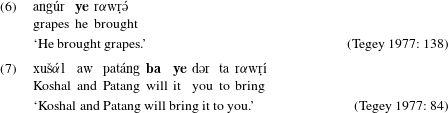
Argument clitics therefore usually precede the verb; when the only stressed word in the clause is the verb, however, this is impossible since argument clitics cannot precede the first accented syllable in a clause.Footnote [5] In many cases, the clitic simply appears after the verb, but with some morphological categories the clitic appears within the verb (see e.g. Tegey Reference Tegey1977, Kaisse Reference Kaisse1981, van der Leeuw Reference van der Leeuw1997, Roberts Reference Roberts, Booij and van de Weijer1997, Anderson Reference Anderson2005, Dost Reference Dost, Hoyt, Seifert, Teodorescu and White2007, Bögel Reference Bögel, Butt and King2010). For example, ‘bimorphemic’ Class II and III verbs have non-initial stress in the imperfective; if such a verb form appears alone in a clause with an argument clitic, that clitic will follow the verb, as shown in (8).

On the other hand, the perfective of these verbs is formed by shifting the stress to the first syllable; when this happens the clitic appears ‘within’ the word, as shown in (9).

The positioning of clitics in Pashto cannot be a purely prosodic phenomenon, with, for example, the clitic following the first stressed syllable of the verb, as may appear from (8) and (9) and as assumed by, e.g., Bögel (Reference Bögel, Butt and King2010), for there are also verbs, the class I ‘monomorphemic’ verbs, where in the imperfective the clitic follows the whole verb regardless of where in the verb the stress falls, as in (10).Footnote [6]

Nor can it be defined in relation to a larger prosodic constituent, e.g. a foot or Prosodic Word, unless such categories are defined by reference to syntactic material. In purely prosodic terms, the material preceding the endoclitic can consist of anything from one to at least seven syllables (Tegey Reference Tegey1977: 119). There are no purely prosodic patterns determining stress placement within that material: there are examples of a stressed syllable followed by three unstressed syllables preceding the clitic (Tegey Reference Tegey1977: 88), examples of six unstressed syllables followed by a stressed syllable preceding the clitic (Tegey Reference Tegey1977: 119) and examples of unstressed syllables either side of a stressed syllable, all preceding the clitic (as in 10). The common factor to all these sequences is not prosodic, but syntactic: it is the verb or a lexically specific part of the verb, perhaps preceded by one or more unstressed particles, that precedes the clitic.
At the same time, the positioning of argument clitics in Pashto is not a purely syntactic phenomenon. Besides the argument clitics, Pashto also has a set of (unstressed) proclitics, which regularly precede the verb, just like the enclitics, but which can appear before the verb even when standing at the left edge of a clause. When a clause consists of a verb, proclitics and enclitics, any enclitic must appear following the verb, i.e. the only word with lexical stress, rather than following the first non-enclitic word. The generalization over all possible positions for argument clitics in Pashto is therefore that they cannot precede the first syntactic word in a clause that supplies a stressed syllable in the prosody. In (11), the first four words are proclitics, and the argument clitic appears finally, following the verb.

With verb forms that license endoclisis, as shown in (12), the same pattern is found: the argument clitic appears ‘inside’ the verb, that is to say following the stressed first ‘part’ of the verb (in cases of endoclisis it is always the first part of the verb that is stressed).

The constraints on the positioning of argument clitics in Pashto must therefore be stated with reference to both syntax and prosody. Usually, argument clitics follow the first full constituent of a clause and precede the verb, but when the clause consists of only a verb and clitics, argument clitics must follow the first syntactic element that provides the first (only) stressed syllable.Footnote [7]
It should also be noted that endoclisis is not a morphological phenomenon restricted to the perfective: there is a small set of class I verbs with initial a- which show stress variation in the imperfective (with no semantic implications), and again when the stress is on the first syllable the clitic follows that syllable, appearing ‘within’ the word; this is shown in (13) and (14).
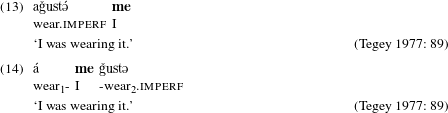
Endoclisis in Pashto is therefore neither purely morphosyntactic nor purely prosodic. It is found with a certain set of lexical items, all verbs, only when those verbs are stressed on their initial syllable. Diachronically, all or nearly all the verbs that display this ‘endoclisis’ derive from prefixed verbs. The few arguable exceptions to this are etymologically unclear and, if they do not reflect originally prefixed verbs, must have been reanalysed at some stage as consisting of two separable elements on the analogy of the more common bipartite verbs. Synchronically, however, what was once a preverb–verb complex is no longer morphologically analysable into two distinct morphemes. In this sense, then, Pashto really does display endoclisis. From a diachronic perspective, Pashto attests the same phenomenon as mentioned above for Gothic, Old Irish and Warlpiri, only with a further grammaticalization of the original preverb, such that it is no longer clearly a separate morpheme.
Endoclisis is also claimed to exist in European Portuguese (van der Leeuw Reference van der Leeuw1997; Crysmann Reference Crysmann, Butt and King1997; Vigário Reference Vigário2003; Luís & Otoguro Reference Luís, Otoguro, Butt and King2004, Reference Luís, Otoguro, Butt and King2005; Anderson Reference Anderson2005), where it is more commonly referred to as ‘mesoclisis’, and in the Northeast Caucasian language Udi (Crysmann Reference Crysmann2000; Harris Reference Harris2000, Reference Harris2002; Anderson Reference Anderson2005; Luís & Spencer Reference Luís, Spencer, Otoguro, Popova and Spencer2005; Wescoat Reference Wescoat, Butt and King2009). In both these languages too, what are often argued to be clitics appear within certain verbal forms which derive historically from an original periphrastic construction involving two independent words. However, the phenomena in European Portuguese and Udi are slightly different from the phenomenon treated in this paper; both these languages in fact attest a further step in the development of the phenomenon under discussion here, in which the supposed clitics are actually closer to inflectional infixes. There is clear evidence for the affixal status of the ‘mesoclitics’ of European Portuguese (see van der Leeuw Reference van der Leeuw1997; Luís & Otoguro Reference Luís, Otoguro, Butt and King2004, Reference Luís, Otoguro, Butt and King2005), and Wescoat’s (Reference Wescoat, Butt and King2009) approach to Udi endoclisis likewise implies an affixal analysis. For example, in European Portuguese some sequences of verb plus supposed clitic pronoun show highly irregular phonology that strongly suggests affixal status for the pronominal element: so e.g. comes ‘eat.2sg’ followed by o ‘it.a’ becomes comelo ‘you eat it’, which cannot be derived by regular phonological processes, meaning that comelo must be formed in the lexicon. Because of this, the Portuguese and Udi data cannot be accounted for under the model developed here, though they can be treated satisfactorily by different means within the same architecture.Footnote [8] The final stage of grammaticalization may appear in Lithuanian where, according to Nevis & Joseph (Reference Nevis, Joseph, Booij and van Marle1993), the reflexive marker, historically a clitic and parallel in its positioning to the endoclitics of Pashto, is synchronically fully affixal (but see also Stolz Reference Stolz1989). In this paper I will consider only Pashto, since only here is the evidence for the clitic as opposed to affixal status of the person markers sufficiently unambiguous.
3 What are clitics?
Before we move on to the specific proposal, we must first address the question of the precise grammatical categorization of ‘clitics’. The term ‘clitic’ can be used in a variety of ways, and is used by different authors to refer to a range of problematic categories in different languages that are in some way or another less than full words, yet more than pure affixes. For the purposes of this paper I restrict the term to refer only to morphosyntactic categories whose syntactic positioning cannot be accounted for by the ‘ordinary’ rules used to account for the positioning of other lexical and functional words. In this way, my use of the term largely coincides with Zwicky’s (Reference Zwicky1977) category of ‘special clitics’. On the other hand, Zwicky’s ‘simple clitics’, prosodically deficient items that are nevertheless positioned entirely according to the same syntactic rules as used to position non-clitic items, are not of direct interest here, and so I exclude them from my use of the term.Footnote [9]
Clitics are sometimes defined in purely prosodic terms, e.g. as ‘stressless’, or lacking syllable nuclei, and it is true that syntactic clisis is very often accompanied by prosodic deficiency of one kind or another. However, in some languages we find clitics that are not obviously prosodically ‘deficient’ in comparison with non-clitic words, but that nevertheless are undeniably syntactic clitics. For example, in Ancient Greek, the class of clitics includes both accented and unaccented words; compare accented dé and oûn in (1) and (2) with unaccented te in (3) and (4).Footnote [10]
The prosodic deficiencies and/or peculiar syntactic properties of clitics lead to their often being treated as somehow less than full words. They can be treated as essentially affixal, or as phonological manifestations of features passed down syntactic trees (e.g. Monachesi Reference Monachesi1999, Reference Monachesi2000; Everett Reference Everett, Coopmans, Everaert and Grimshaw2000; Payne Reference Payne2009; Bermúdez-Otero & Payne Reference Bermúdez-Otero, Payne, Galani, Hicks and Tsoulas2011). Alternatively, they can be treated as a special category of grammatical item, neither affix nor word. This is referred to as the ‘hypothesis of Clitic Idiosyncrasy’ by Bermúdez-Otero & Payne (Reference Bermúdez-Otero, Payne, Galani, Hicks and Tsoulas2011), and comprehensively criticized by them. One instantiation of this idea, by e.g. Klavans (Reference Klavans1982, Reference Klavans1985) and Anderson (Reference Anderson1993, Reference Anderson1996, Reference Anderson2000, Reference Anderson2005, Reference Anderson2008), treats at least some clitics as ‘phrasal affixes’, accounted for by a special set of morphosyntactic rules that are separate from the rules of morphology and syntax that govern all other morphemes and words. A similar principle underlies the LFG-based approach of O’Connor (Reference O’Connor, Butt and King2002a).
The key feature of both these approaches is that clitics do not require their own c-structure nodes, either because they are an inherent part of the word they follow (i.e. they are affixes) or because they ‘piggy-back’ on the word they follow and share its terminal node. This makes it considerably simpler to account for clitic phenomena of the type discussed in this paper, since features can be passed down phrase-structure trees relatively easily without causing constituency problems. In contrast, a more traditional approach, which treats clitics as words with their own c-structure nodes, is more constrained and is therefore, if for no other reason, to be preferred, at least in principle, as long as the facts can be accounted for under such an approach.
Moreover, this more constrained approach aligns well with the lexicalist underpinnings of the grammatical formalism utilized in this paper. A strictly lexicalist distinction between words and affixes, as assumed in a theory like Lexical-Functional Grammar, leaves no room for an intermediate category such as ‘phrasal affixes’.Footnote [11] Affixation occurs in the lexicon, creating words that are then the object of the syntactic representation; within such a dichotomy of grammatical items, clitics are words. There are phenomena often referred to as involving ‘clitics’ which are better understood as affixal phenomena (i.e. those of European Portuguese and Udi, mentioned above); however, this does not mean that all clitic phenomena can be so analysed. In the terms of this paper affixal phenomena are not clitic phenomena (although there is often a diachronic association with clitic phenomena brought about by grammaticalization).
As stated, clitics are words, i.e. separate items in the lexicon. Zwicky & Pullum (Reference Zwicky and Pullum1983) provide criteria for distinguishing clitics from affixes (see also, e.g., Zwicky Reference Zwicky1985, Reference Zwicky1994). Clitics exhibit a low degree of selection with respect to their hosts, while affixes exhibit a high degree of selection with respect to their stems; arbitrary gaps in the set of combinations are more characteristic of affixed words than of clitic sequences; morphophonological idiosyncrasies are more characteristic of affixed words than of clitic sequences; semantic idiosyncrasies are more characteristic of affixed words than of clitic sequences; affixed words, but not clitic sequences, are the basic units to which syntactic rules refer; clitics can attach to material already containing clitics, but affixes cannot. These criteria are tendencies, and there exist ambiguous forms which show properties of both affix and clitic.Footnote [12] Nevertheless, the generalization over these criteria is that clitics function like ordinary lexical words, in terms of their morphophonological, syntactic and semantic independence from their ‘host’ words. In fact, by these criteria, clitics tend towards absolute identity with full words, or to put it another way, full words actually fit the syntactic description of an ideal clitic suggested by these criteria.
In terms of these criteria the ‘clitics’ discussed in the previous section are all incontestably clitics, i.e. words rather than affixes. In fact it is these and similar criteria that are used in support of the claim that, for example, endoclisis exists in Pashto, since if the forms involved show merely infixation they are in no way linguistically exceptional. As words, these clitics necessarily have their own node in the c-structure. All the forms treated in this paper can be treated as ‘non-projecting’ categories (Toivonen Reference Toivonen2003), i.e. they do not project a full phrasal structure, but this is not necessarily an inherent constraint on clitics, and in some languages clitics may well project full phrasal structure.Footnote [13]
4 The syntax–prosody interface
In this section I discuss the architectural assumptions that underlie the formal treatment of clitic positioning presented in the following section.
4.1 Modularity
Clitic positioning challenges the theory that the grammatical architecture is strictly modular, i.e. that it consists of a set of modules, components or projections, each of which exclusively and exhaustively analyses one aspect of linguistic structure, and that no aspect of linguistic structure is analysed, even marginally, in any module except the one specific to it. How many distinct grammatical modules should be assumed, and of what sort, is a question that goes beyond the scope of this paper, but perhaps the most widely accepted division of the grammatical architecture is the division between prosody/phonology and syntax-semantics.Footnote [14]
There exist many divergent approaches to the syntax–phonology interface, both specifically and in more general architectural terms. An in-depth analysis of many theories of the syntax–prosody interface has recently been undertaken by Scheer (Reference Scheer2010). According to the principle of strict modularity, the syntactic component(s) of the grammar will neither contain nor interpret any prosodic information, and vice versa; at the same time, of course, there must be some interface between the two modules that permits transfer of information. The degree to which modularity is enforced, and the precise nature, mechanism and location of the interface, vary considerably in different theories.
Several recent studies, e.g. Scheer (Reference Scheer2010, Reference Scheer2012), Šurkalović (Reference Šurkalović2011) and Bye & Svenonius (Reference Bye, Svenonius and Trommer2012), stress the importance of full modularity as a principle of grammatical analysis but also note the failure of current theories to achieve this. One of the most influential approaches to the syntax–prosody interface is that of Truckenbrodt (Reference Truckenbrodt1995, Reference Truckenbrodt1999, Reference Truckenbrodt and de Lacy2007), which, as shown by Šurkalović (Reference Šurkalović2011), is not fully modular; nor is the Direct Syntax theory of Kaisse (Reference Kaisse1985). One recent approach does claim, at least, to adhere to strict modularity: that of Dalrymple & Mycock (Reference Dalrymple, Mycock, Butt and King2011), formalized in the framework of Lexical-Functional Grammar. In this paper I utilize this model to provide a formal account of clitic positioning, thereby also submitting it to empirical scrutiny in terms of its ability to deal with such phenomena while maintaining strict modularity.
A full justification of modularity as a principle of grammatical modelling is beyond the scope of this paper, but a few comments may be made. Purely linguistic evidence for the absolute modularity of grammar is necessarily ambiguous, while the cognitive evidence is likewise unclear.Footnote [15] However, insofar as the cognitive and linguistic evidence can be considered unclear at the present time, the best approach to modularity in the grammatical architecture will be the one that is most highly constrained, and thereby most easily falsifiable (in general terms, not just in the context of clitics). That is to say, an absolute modularity of the grammatical architecture is a theoretical desideratum, at least in the first instance. Only if it can be shown that absolute modularity is not able to account for certain linguistic data should a less highly constrained model be sought. The specifics of a fully modular account would stand even if absolute modularity were subsequently abandoned (although they may be unnecessarily complex), whereas the converse would not hold.
4.2 A parallel approach to the interface
The model of the syntax–prosody interface developed by Dalrymple & Mycock (Reference Dalrymple, Mycock, Butt and King2011) and utilized here seeks to maintain strict modularity of the grammatical architecture, in the sense that the syntactic component deals purely in syntactic elements, information and rules, and mutatis mutandis for other components such as prosody. Dalrymple & Mycock’s approach to the question of modularity is exemplified in the following quote.
The proposed analysis is based on a view of modularity and domain specificity rooted in the fundamental differences that have been shown to exist between different aspects of linguistic structure. We take it to be a fact about the nature of language that, for instance, syntax interprets only syntactic units and structure, while phonology interprets only phonological units and structure. However, it is clear that syntax and phonology, as integral parts of any string, are related to one another in a non-trivial way. If syntax and phonology are to interact, it is clear that certain syntactic information should be available to the phonology, and as a consequence phonological structure or processes may (or may not) correlate with syntactic structure. (Dalrymple & Mycock Reference Dalrymple, Mycock, Butt and King2011: 174–175)
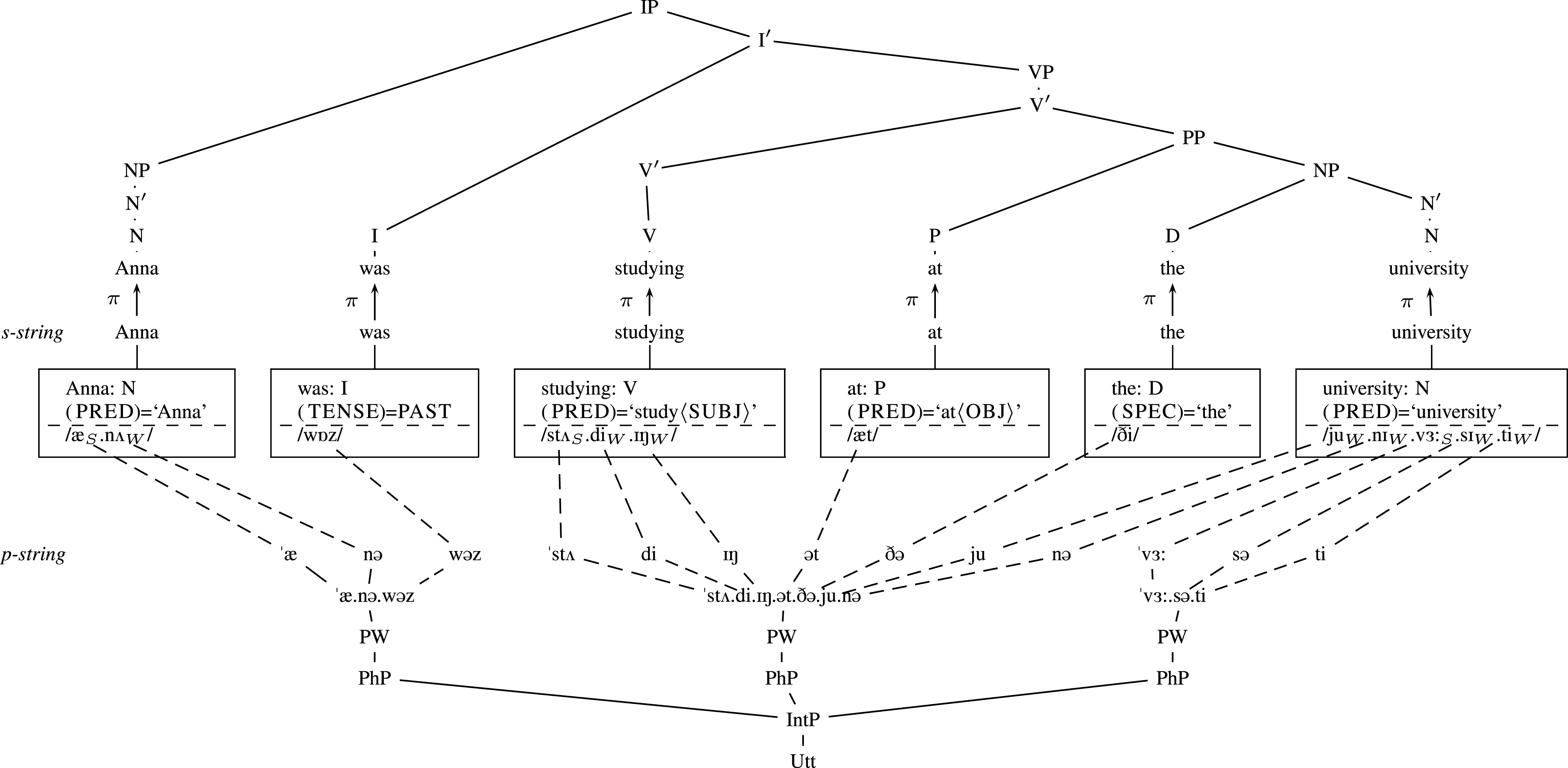
Dalrymple & Mycock (Reference Dalrymple, Mycock, Butt and King2011) illustrate the lack of correlation between syntax and prosody with reference to the following sentence (15), a declarative question. Their syntactic and prosodic analysis of the sentence is as given in Figure 1.

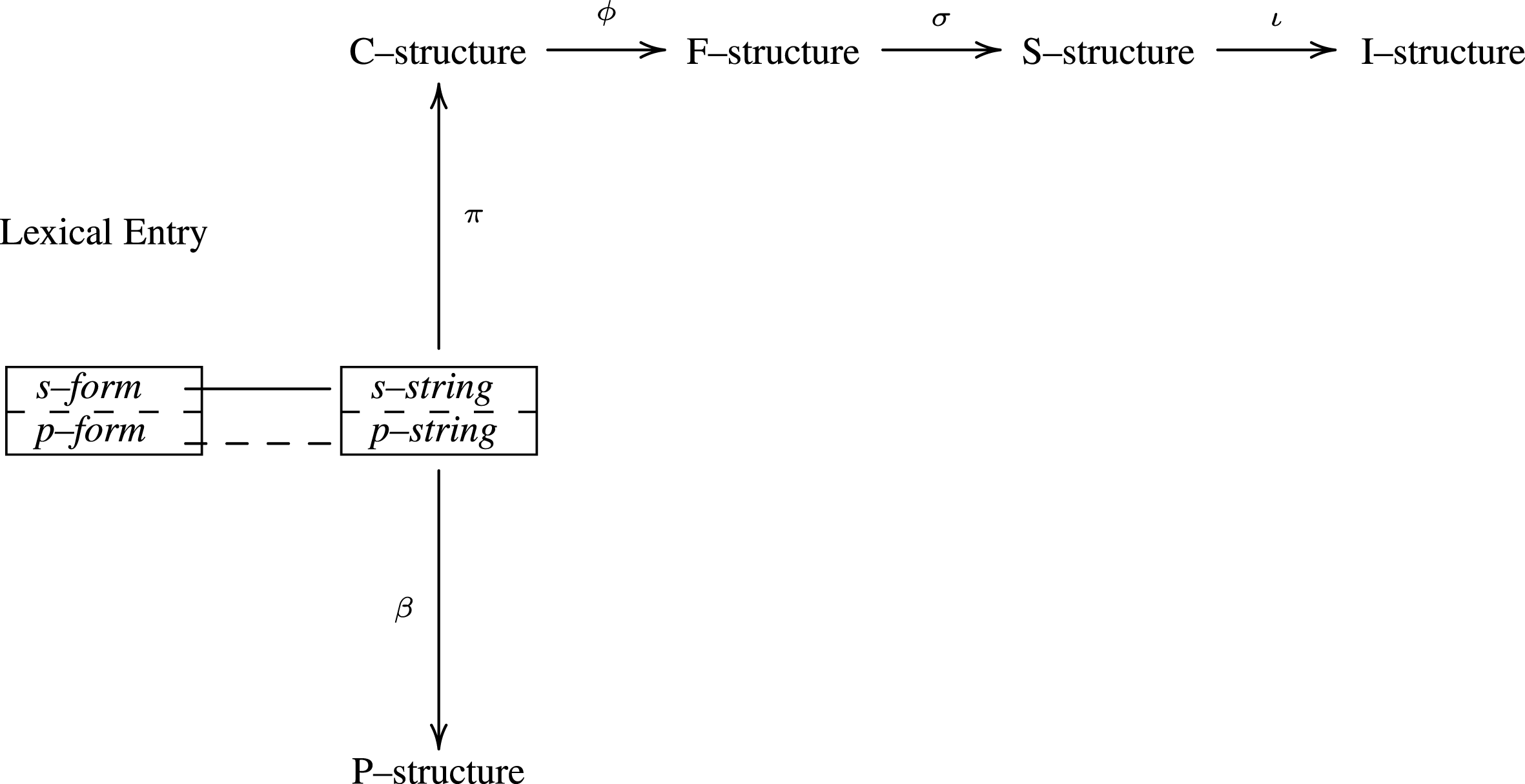
The ‘double tree’ in Figure 1 shows the syntactic and prosodic analyses of (15) in a single diagram, based on the projection architecture in Figure 2.Footnote [16]
Syntactic and prosodic analyses of (15) with default phrasing, from Dalrymple & Mycock (Reference Dalrymple, Mycock, Butt and King2011: 181).
It is important to note that the use of double trees is entirely representational, and implies no unity of syntactic and prosodic analysis; the two trees could as easily, and perhaps less ambiguously, be represented entirely separately. The upper, syntactic, tree represents the c(onstituent)-structure projection, the hierarchical relations between syntactic units. From the c-structure are projected the f(unctional)-structure, s(emantic)-structure and i(nformation)-structure (Dalrymple & Nikolaeva Reference Dalrymple and Nikolaeva2011). Separate from the c-structure projection is the s(yntactic)-string (Kaplan Reference Kaplan, Whitelock, Wood, Somers, Johnson and Bennett1987), which alone and only encodes relations of linear precedence between atomic syntactic elements. The string actually consists of two parts, the s-string and the p(rosodic)-string. The string represents the signal, simultaneously parsed into minimal syntactic and prosodic units (for our purposes words and syllables, respectively). In this model, the string hosts the interface between syntax and prosody. From the syntactically parsed ‘side’ of the string, the syntactic analysis is projected, while from the prosodically parsed ‘side’, the prosodic analysis, the p(rosodic)-structure, is projected. Again, although represented together in a double tree, the projections and resulting structures are entirely separate and formed according to their own principles and primitives; i.e. there is nothing syntactic about the bottom half of the tree, nor anything prosodic about the top half. S- and p-string elements are associated via their co-occurrence in lexical entries, for which reason the lexical entries are represented between the two parts of the string in Figure 1. This is merely representational, however, of the reference made to the lexicon in the dual parsing of the string, and in most diagrams Dalrymple & Mycock (Reference Dalrymple, Mycock, Butt and King2011) omit the lexical entries for the sake of clarity, by which the direct interface between the s- and p-strings is then clearly represented.
Dalrymple & Mycock use this architecture to model prosodic contributions to semantic analysis, as in the prosodically marked declarative question in (15), and also comma intonation. The model permits, but does not depend on, correlation between syntactic and prosodic structure, allowing significant divergence between the respective syntactic and prosodic hierarchical structures of a given sentence (following the observations of Lahiri & Plank Reference Lahiri and Plank2010). For Dalrymple & Mycock (Reference Dalrymple, Mycock, Butt and King2011) the availability of syntactic information to prosody and vice versa required by such phenomena is limited to the marking of syntactic and prosodic constituent edges, which are required to match up to a greater or lesser degree (similarly, outside LFG, Bermúdez-Otero Reference Bermúdez-Otero and Trommer2012). The precise mechanism of match up is left undefined by Dalrymple & Mycock (Reference Dalrymple, Mycock, Butt and King2011), but in the model to be presented here is a set of OT constraints. Full modularity is maintained insofar as there is no mutual comprehension between prosody and syntax, but the OT eval assesses both syntactic and prosodic constraints, thereby indirectly permitting match up (and in effect ‘passing’ of information) between the two modules.
The projection architecture.
Dalrymple & Mycock (Reference Dalrymple, Mycock, Butt and King2011: 191) mention the possibility that their framework could also be utilized to model the apparent misalignment found in clitic positioning between their surface position and the position in which they can be accessed and analysed by the c-structure. They suggest that the repositioning of clitics could take place in the  ${\it\pi}$ mapping between the s-string and the c-structure. The following sections take up that suggestion, showing how this can be achieved, and what the consequences are for the architecture.
4.3 Clitic repositioning as a syntactic phenomenon
In the framework utilized here, the ‘repositioning’ of clitics is primarily a syntactic affair, in the sense that it is part of the syntactic component of the grammar. This must be the case, since the input to the syntactic component is the parsed string (i.e. the s-string). This is the parsed surface string, i.e. the input to the syntax is not based on some kind of abstract ‘underlying’ string, segments of which could be ‘repositioned’ before reaching the surface string; in such a scenario, almost anything would be possible. The consequence is that, according to this model, repositioning of any kind in the prosodic component itself is impossible.
What is possible, then? The s-string represents the output order of lexical items; as we have seen above, however, clitics can appear in positions where, according to the surface order, they cannot be accessed by the relevant node in the hierarchical (c-structural) representation. We also noted that if we permit such clitics to be analysed in the c-structure one syntactic (and in Pashto also prosodic) word ‘to the left’ of their surface position, the problem is resolved. In this way, the repositioning or misalignment of clitics between the s-string and c-structure represents a strategy, a repair mechanism, for resolving the problem of an otherwise hierarchically unanalysable element. There is no other alternative if traditional X-bar theoretic hierarchical c-structure is to be retained. The possibility of misalignment must also be restricted only to clitics, so as to prevent the application of the same principle to create discontinuous constituents, or otherwise undermine the identity between surface and c-structure order (any further).
5 Formalization
In this section I present the formal details of my account of clitic positioning within the framework of Dalrymple & Mycock (Reference Dalrymple, Mycock, Butt and King2011). We must first distinguish two major types of clitic, which I will refer to by the neutral terms ‘class 1’ and ‘class 2’. The difference between these two categories is the relevance or irrelevance of prosody to their positioning. The Ancient Greek clitics discussed above exemplify class 1 clitics: their extraordinary positioning can be accounted for in purely syntactic terms, by assuming a constraint that prohibits their appearance at the left edge of a clause or phrase. Pashto argument clitics exemplify class 2: it is not only the case that these clitics cannot stand at the left edge of a clausal or phrasal boundary, but in addition they must follow at least one stressed syllable, which may cause them to appear further to the right than the purely syntactic constraint would require.
5.1 Class 1
Since the ‘extraordinary’ positioning of class 1 clitics can be stated without reference to prosody, they are somewhat simpler to account for, in formal terms, than class 2 clitics; we will therefore treat these first. As we have seen, in Ancient Greek enclitics regularly appear one syntactic word ‘to the right’ of their expected location, when that location is at the left edge of their syntactic domain. Therefore, the clausal conjunction dé in (1), which, if it were not enclitic, we would expect to appear in first position in the clause, after a prosodic break, appears one word to the right of its expected position; the same is true of enclitic conjunctions that appear inside sentences, where there is no clear evidence that their ‘expected’ position follows any kind of prosodic boundary, as we saw in (3) and (4). There is no evidence for significant prosodic boundaries preceding a conjoined NP; in fact, the accentual evidence of Ancient Greek, non-probative though it is, suggests that there was no such boundary in the majority of instances.Footnote [17] Therefore, there is no need to invoke prosody in any way in accounting for their ‘clitic’ positioning.
As discussed above, in the architecture of Dalrymple & Mycock (Reference Dalrymple, Mycock, Butt and King2011) the syntactic string (s-string), which encodes linear order, is separated from the terminal string of the c-structure by the mapping  ${\it\pi}$. This introduces the possibility of misalignment in the linear order of syntactic elements between the s-string and the c-structure. It is here that clitic ‘repositioning’ must take place, since the s-string must directly reflect the output word order, while the c-structure must reflect a viable constituent hierarchy in which no syntactic element interrupts another constituent. Any such ‘repositioning’ is in principle to be dispreferred, and therefore if admitted must be highly constrained. Rather, the formalism presented here seeks, as a high priority, to maintain the absolute identity of c-structural order with output (s-string) word order, except where this is impossible. The positioning of class 1 clitics is, on the basis of the evidence discussed above, one of those impossible contexts, such that in this context and this context only we must permit a very specific and highly constrained misalignment between the order of elements in the c-structure and s-string.
To achieve this, we must first distinguish clitics from non-clitics in the lexicon. Clisis is primarily a syntactic property, not necessarily correlated with any phonological property such as lack of pitch or stress (at least in the case of class 1 clitics). Specifically, it is a property relevant to the instantiation of a word in the s-string, since it is here that its consequences are felt. Mycock & Lowe (Reference Mycock, Lowe, Butt and King2013), who build on, and in certain ways streamline, the architecture of Dalrymple & Mycock (Reference Dalrymple, Mycock, Butt and King2011), propose that string elements are not atomic units, but include different sorts of features that can be represented using an attribute–value matrix. I therefore assume an s-string feature clitic, with values  $\pm$. The different repositioning possibilities of clitics and non-clitics can then be stated in reference to this feature.
Every non-clitic in the lexicon must be specified such that it is not repositioned in relation to other words in the mapping from s-string to c-structure. Using  $\ast$ to refer to c-structure nodes, in this context restricted to terminal nodes (on this restriction see Asudeh Reference Asudeh, Butt and King2009: 111, fn. 4), and ∙ to refer to elements in the s-string, the function N(∙) maps from the current s-string element to the next in linear sequence (which is the only relation existing between s-string elements). Likewise, the function N(
 $\ast$) maps from the current (terminal) c-structure node to the ‘next’ terminal node. While N(∙) is easily defined, N(
 $\ast$) is more complicated, since in theory, following the allocation of linear order information to the s-string, c-structure contains only information about hierarchical structure, with inherent reference to linear order existing only in relation to sister nodes. Nevertheless, N(
 $\ast$) can be defined in the following way:Footnote [18]
Informally, S( $\ast$) finds the nearest immediate rightward sister node of the current terminal node, or the nearest immediate rightward sister of the nearest dominating node, if the current node has no rightward sister, and then N(
 $\ast$) finds the leftmost terminal daughter of that sister node, if any. This will be the ‘next’ terminal node in a corresponding linear representation.
Using ∙ $_{-c}$ to refer to any non-clitic item in the s-string (beside ∙
 $_{c}$ for clitics), we can then state that

This is one of the basic rules underlying the  ${\it\pi}$ mapping between the s-string and the c-structure: informally it states that for any non-clitic word, anything that precedes it in the s-string must also precede it in the c-structure, and anything that follows it in the s-string must follow it in the c-structure; in other words, there can be no repositioning of non-clitics in the
 ${\it\pi}$ mapping. It can be assumed that this rule is a general constraint on the
 ${\it\pi}$ mapping.
Clitics are not specified so, nor are they referred to by the equation above. Nevertheless, it is clearly not the case that clitics can be repositioned at will, any number of words to the left or right of their expected position. Rather, any repositioning is heavily constrained. We can therefore assume two further constraints on the  ${\it\pi}$ mapping, which state that clitics should not be moved leftwards or rightwards in
 ${\it\pi}$:

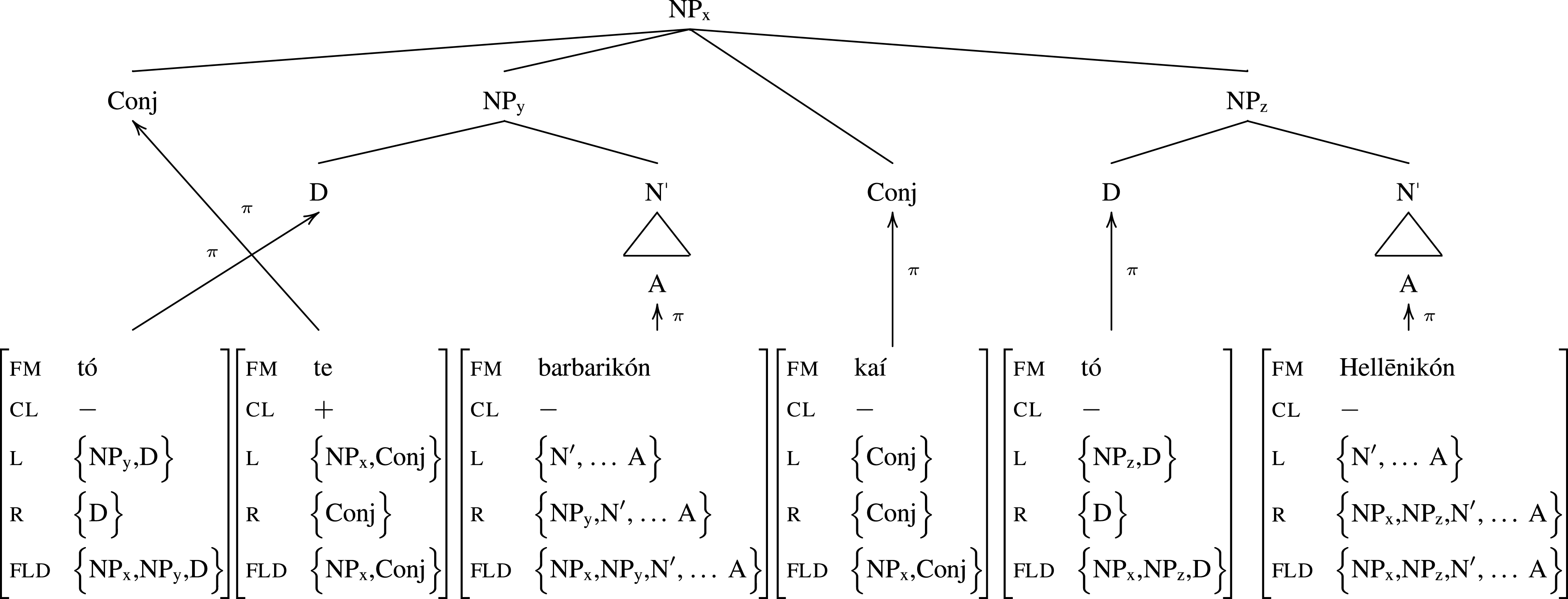
These constraints can be overridden, however, when a clitic would otherwise appear at the left edge of its syntactic domain. Dalrymple & Mycock (Reference Dalrymple, Mycock, Butt and King2011) assume that category edge information is passed down the c-structure and is associated with s-string elements, where it must be available at the interface with prosody. In the formulation of Mycock & Lowe (Reference Mycock, Lowe, Butt and King2013), this information appears in the s-string features l and r; therefore, an s-string element that appears at the left edge of an NP, for example, will have the label NP in the value of its l attribute. How this works can be seen in the tree in Figure 3 below.Footnote [19] Although it may seem ideal for the task, the attribute l cannot, in fact, be used to prohibit the appearance of a clitic at the left edge of a syntactic constituent. As it is formulated by Mycock & Lowe (Reference Mycock, Lowe, Butt and King2013), category edge information is passed directly to string elements via a path that includes the  ${\it\pi}^{-1}$ mapping from terminal c-structure nodes to string elements. This means that any word, for example an enclitic conjunction, at the left edge of an NP in the c-structure will have the feature l
 $\{\text{NP}\ldots \}$ in the s-string whether or not it is the leftmost element of the NP in the s-string. Therefore, in Figure 3, the clitic te has the label NPx in the value of its l feature, even though in s-string terms it is not the leftmost element of NPx.
We therefore require recourse to a different s-string feature, f(ie)ld. field is similar to l and r, but while the latter have as their values a set of labels referring to only the syntactic categories which the word in question appears at the left or right edge of, field has as its value a set of labels referring to all the syntactic categories which the word in question is dominated by (which will include all those of which it is at the left or right edge). I assume that all the relevant enclitics in Ancient Greek are non-projecting and appear in the c-structure as daughters of the node that constitutes their domain. The constraint against enclitics appearing at the left edge of their domain can then be stated as in (19). Informally, this states that there must be a label in the field feature of the s-string element preceding a clitic which refers to the node immediately dominating the category node of the clitic. This means that a clitic cannot stand at the left edge of its syntactic domain.

This constraint must override the constraints in (18) prohibiting the repositioning of clitics in  ${\it\pi}$, causing a clitic that would otherwise appear at the left edge of its syntactic domain to appear one word to the right (the smallest repositioning possible). The effect of all these interacting constraints is exemplified in Figure 3, which provides the c-structural and s-string representations for the relevant part of (3).
Syntactic structures for example (3).
Since it is a clitic, the feature cl(itic) + appears in the s-string AVM for te ‘and’. The constraint in (19) therefore applies; in the context of Figure 3, (19) requires NPx to appear in the f(ie)ld attribute of the s-string element to the left of the clitic. Were te to appear in its ‘expected’ position at the left edge of the conjunct, i.e. between toútous and tó, this requirement would not be fulfilled. By violating the constraint in (18a), which prohibits the leftward ‘movement’ of clitics in  ${\it\pi}$, the rule in (19) is satisfied.
5.2 An OT formalization of the constraints
We have seen that the positioning of class 1 clitics requires reference to a number of rules applicable to the  ${\it\pi}$ mapping, and that these rules interact in such a way that the satisfaction of one requires the violation of another. One way to deal with this sort of interaction is by recourse to Optimality Theory (OT; Prince & Smolensky Reference Prince and Smolensky1993/2004). In Optimality Theoretic approaches to LFG, the input is taken to be a full or partial f-structure representing some morphosyntactic content, the gen is a ‘universal’ LFG grammar, and the set of candidates produced by applying the input to gen are evaluated according to a set of ranked constraints (eval) (for Optimality Theoretic LFG see, for example, Bresnan Reference Bresnan, Butt and King1996, Reference Bresnan, Barbosa, Fox, Hagstrom, McGinnis and Pesetsky1998, Reference Bresnan2000a, Reference Bresnan, Baltin and Collinsb, Reference Bresnan2001a; Frank, King, Kuhn & Maxwell Reference Frank, King, Kuhn, Maxwell, Butt and King1998; Kuhn & Roher Reference Kuhn and Roher1997; Choi Reference Choi1999; Kuhn Reference Kuhn1999, Reference Kuhn2001; Sells Reference Sells2001; Vincent Reference Vincent, Pintzuk, Tsoulas and Warner2001). The early and most important work on Optimality Theoretic approaches to LFG focused primarily on the core projections, f-structure and c-structure; in the current more extensive projection architecture some alterations to the traditional approach are required. First, the input can be any full or partial structure; in the case of parsing, for example, the input could be a p-structure or an s-string. On the basis of the input, the gen will produce sets of structures; each candidate will therefore consist of a full grammatical analysis. The constraints against which the candidates are evaluated can refer to any one of these structures or to the mappings between them. Thus, for Bresnan (Reference Bresnan2000a: 15) each candidate was a quadruple consisting of a c-structure, an f-structure and two mappings, from the lexicon to c-structure and from c-structure to f-structure. Under the present architecture, the candidates are 15-fold: s-string, p-string, p-structure, c-structure, f-structure, s-structure, i-structure,
 ${\it\beta}$,
 ${\it\pi}$,
 ${\it\phi}$,
 ${\it\sigma}$,
 ${\it\iota}$, two ‘lexicalization functions’, which here map from the s-string and p-string to the lexicon, and the interface between s-string and p-string. The rules defined in (17), (18) and (19) can be reformulated as OT constraints as follows:Footnote [20]

In contrast to the most common formulations of OT (but in no way contradicting the original conception), OT-LFG makes use of a large number of inviolable constraints (which can be thought of as restrictions on gen), essentially to enforce well-formed structures, e.g. f-structure conditions such as Completeness and Coherence (while violable constraints determine selection between competing well-formed structures). The prohibition on mismatches between the s-string and p-string can be formulated as such a constraint:

In approaches that utilize post-syntactic prosodic movement to account for clitic positioning, such movement occurs between the prosody and the syntax, which, transposed into our terms, is between the s-string and the p-string. In the architecture of Dalrymple & Mycock (Reference Dalrymple, Mycock, Butt and King2011), where the s- and p-strings are based on the same output string, any movement or repositioning of material at this interface is impossible. That is, constraint (21) is inviolable: in fact it is a restriction on gen, since candidates violating it simply could not be generated. However, for the present purposes, because the interface between the syntax and the prosody is the most common locus for clitic repositioning in previous literature, I treat Interface-Identity as a violable constraint, purely to make as explicit as possible its role in eliminating the candidates most similar to previously proposed approaches.
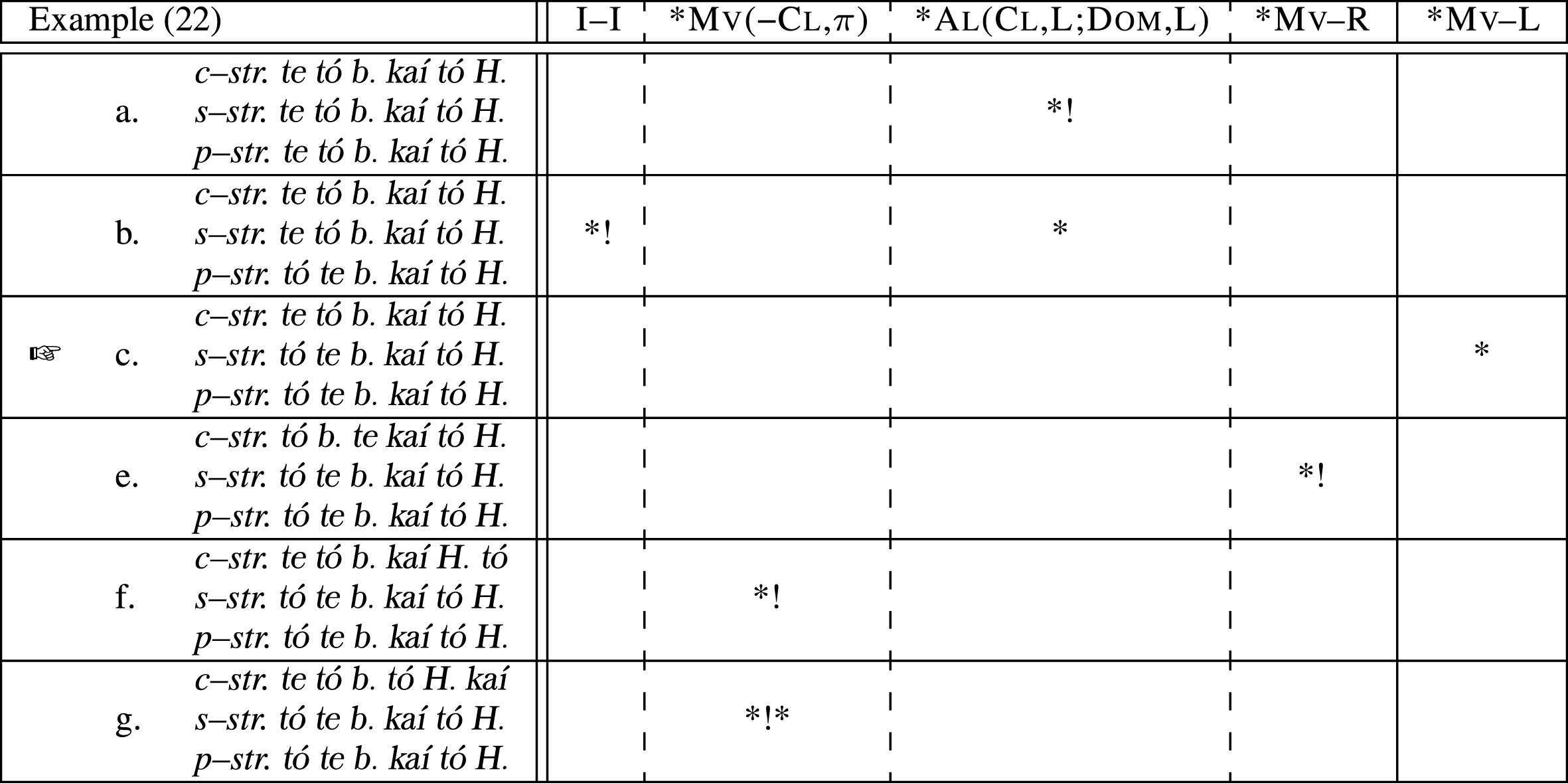
It is now possible to specify the OT derivation of the syntactic structure in Figure 3. The c-structure, s-string and  ${\it\pi}$ mapping in Figure 3 are derived as shown in the tableau in Figure 4, based on an input such as (22).

Tableau for example (3).
The optimal candidate violates only the lowest ranked constraint *Move-Lft; no constraint ranking for the other constraints can therefore be extracted from the tableau in Figure 4. As stated, Interface-Identity, which penalizes mismatches between s-string and p-string, is in reality an inviolable constraint: candidate b therefore could not in fact be generated, but I show it, and treat Interface-Identity as if it were violable, since b corresponds most closely to the way in which clitic repositioning is most commonly treated in other analyses. The crucial ranking is that of *Align(Cl,L;Dom,L) above *Move-Lft, which licenses the leftward repositioning of the clitic in  ${\it\pi}$ so that it does not appear at the left edge of its syntactic domain in the s-string, as seen in Figure 3.Footnote [21] The constraints on repositioning of clitics in
 ${\it\pi}$, *Move-Rt and *Move-Lft are respectively formulated so as to introduce violations for each rightward or leftward ‘jump’ of a clitic (whether over another clitic or a non-clitic). The ‘optimal’ situation in respect of either of these constraints alone is therefore that in which no clitic is repositioned; however, it is more optimal for a clitic to be repositioned leftward than rightward, and more optimal for a clitic to be repositioned only one word to the left or right than for it to be repositioned more than one word in the same direction.
One might ask why we need two distinct constraints, one penalizing leftward, the other rightward, repositioning of clitics in  ${\it\pi}$. There are cases where in principle either rightward or leftward repositioning of a clitic would yield a valid c-structure. However, it seems to be the case cross-linguistically that, in our terms, only leftward repositioning of clitics in
 ${\it\pi}$ is found. Granted, however, that there may be instances where there is no other reason to choose leftward over rightward repositioning, we must assume two separate constraints in order to preserve both language-internal and cross-linguistic consistency in the preference for leftward repositioning; moreover, this licenses the possibility that in some languages rightward repositioning is preferred to leftward.
In this way, the constraints conspire to produce a valid c-structure for (3) from its apparently problematic s-string, with the clitic te repositioned to the left of the determiner tó, so that the NP ‘the barbarian’ forms a single uninterrupted constituent and both conjunctions precede their conjuncts. Precisely the same analysis will apply to the other Greek examples given above, accounting for the repositioning of dé and oũn to the left of the determiners in (1) and (2), the repositioning of te to the left of the preposition in (4) and the non-repositioning of dé in (5), in the latter case since its position in the c-structure does not correspond to a violation of *Align(Cl,L;Dom,L) in the s-string.
5.3 Class 2
When we turn to the formalization of class 2 clitics, additional constraints need to be invoked. As discussed above, positional realignment of class 2 clitics cannot be stated purely in reference to syntax, since it is also sensitive to prosody. As with Ancient Greek clitics, Pashto argument clitics can appear in a syntactically unproblematic position, e.g. following the first syntactic constituent of the clause, as in (6) and (7) above; indeed, they usually do appear in such a position (in contrast to Ancient Greek clitics), as long as there is something other than the verb and other enclitics or proclitics in the clause. Pashto argument clitics regularly follow the clause-initial constituent, while the verb is final, but if the only non-clitic word in the clause is the verb, an argument clitic must follow it. This is a prosodic restriction: enclitics must align with the right edge of a prosodic word, and are prevented from surfacing in their default syntactic position if this default position stands to the left of the first or only prosodic word in a clause.
I assume the phrase-structure rule in (23) for Pashto main clauses;Footnote [22] the vital aspect is that the clitic cluster, when it appears, is generated in a position to the left of the verb, either directly to the right of the first XP of the clause or at the left edge of the clause, in the absence of such an initial XP.Footnote [23]

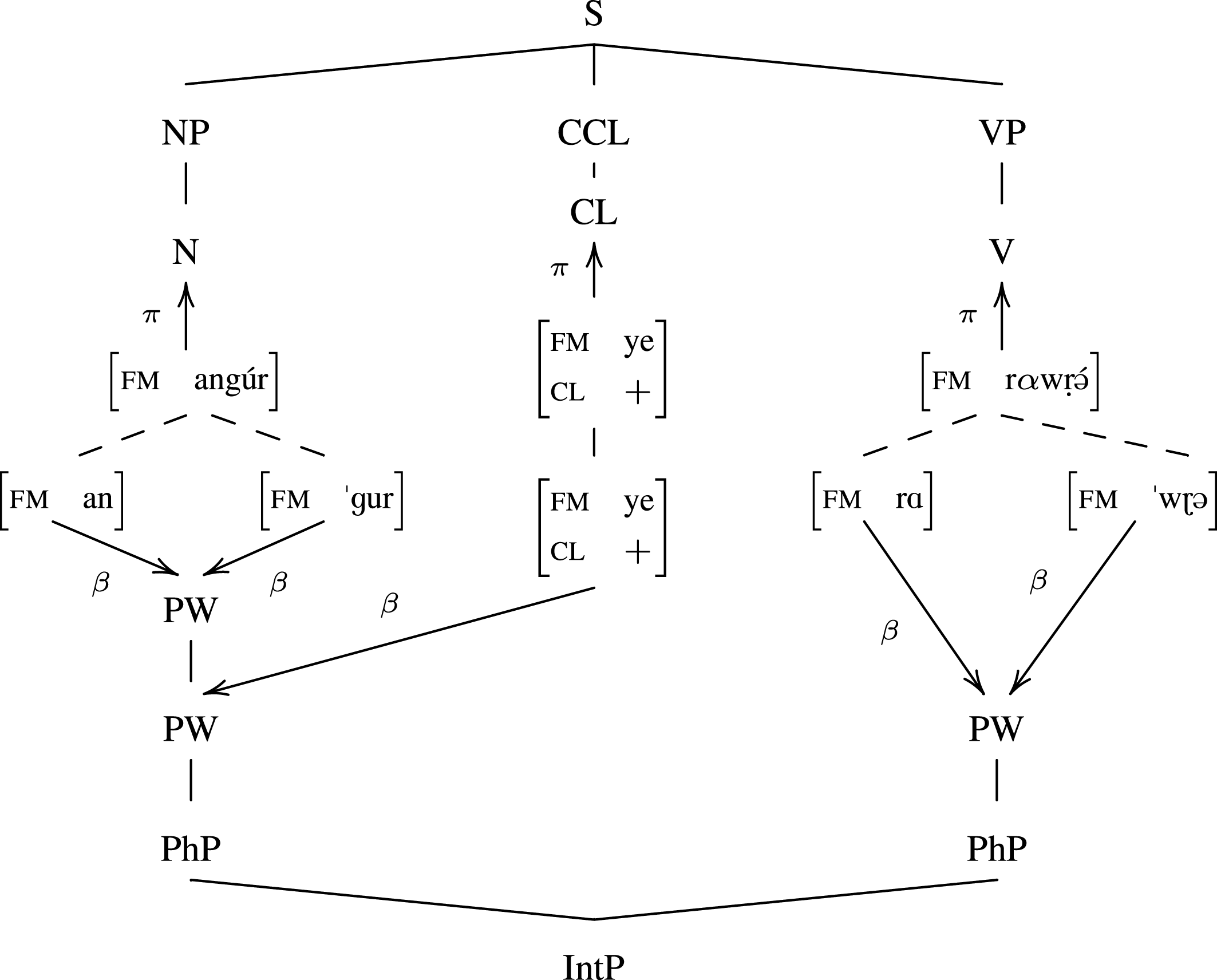
When the clause initial XP position is filled, any enclitics in the CCL can align with the right edge of the final or only prosodic word in that XP, and so no repositioning is necessary. This is shown in Figure 5, which provides both a syntactic and a prosodic analysis for (6).
Syntactic and prosodic analysis for example (6).
The p-string element corresponding to the argument clitic ye is marked with the feature cl(itic) +, which is the prosodic equivalent of the s-string cl(itic) feature introduced above.Footnote [24] The prosodic constraints on class 2 clitic positioning, then, can be stated in relation to this feature. A prosodic word (PW) in Pashto must contain one stressed syllable. The two syllables that correspond to the first syntactic word of this sentence, /an/ and / ॑gur/, therefore constitute a PW; the clitic ye can therefore align with the right edge of this PW, the whole sequence also forming a PW.Footnote [25]
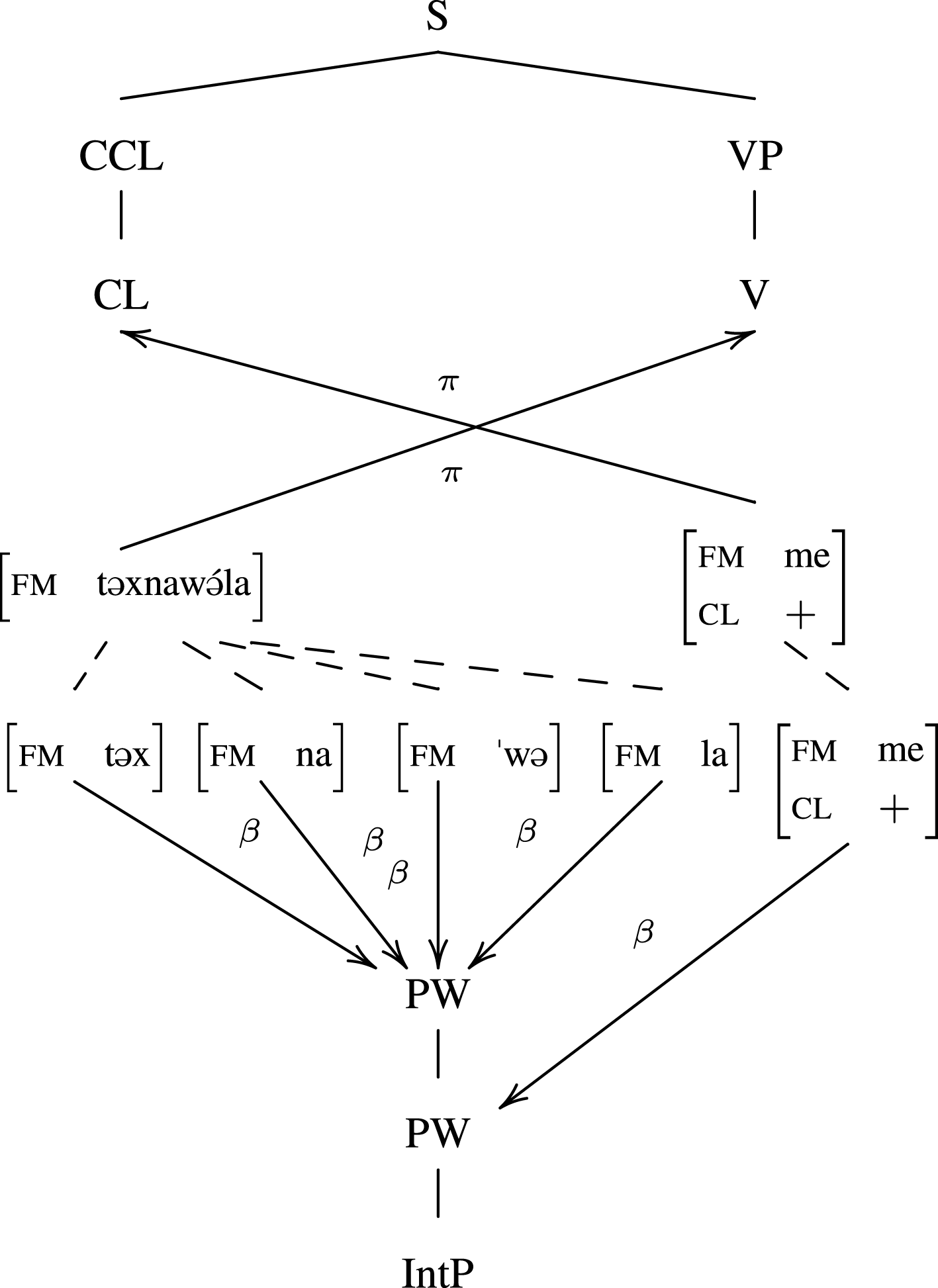
Given the syntactic rules of clitic placement in (23) and the prosodic constraint discussed above, in contexts where only an argument clitic and a verb appear in the clause (as in 10) there is a mismatch between the syntactic and prosodic requirements. The prosodic constraint prevents the argument clitic from appearing in the string (both p-string and s-string, since there can be no mismatch between the two) in a position that corresponds to its position in the c-structure. As with the analysis of Ancient Greek clitics provided above, we must be dealing with a repositioning of the clitic between the c-structure and the s-string, as shown in Figure 6 for (10); the only difference is that in this case the repositioning is enforced by the prosody.
Syntactic and prosodic structure for example (10).
According to the phrase-structure rule given above, the clitic cluster, and therefore the terminal CL node, appears to the left of the VP and V in the c-structure. The p-string exponent of the clitic, however, has the feature clitic +, meaning that it must align with the right edge of a PW. Such a PW is supplied by the four syllables that constitute the verb form; in the string, therefore, the clitic appears to the right of the verb. It is worth noting that while the constraint in question is purely prosodic, the effect of the constraint is itself constrained by the syntax. For example, the first three syllables of the verb would be sufficient in and of themselves to constitute a PW, but the clitic does not appear inside the verb form, between the third and fourth syllables. This is because Interface-Identity, formulated as an inviolable constraint above, prohibits mismatch between p-string and s-string, and in the s-string the whole verb form constitutes a single element. Therefore, while in prosodic terms it might be valid for the clitic to appear following the third syllable, this would be impossible in syntactic (s-string) terms; the position in which the clitic appears, following the whole of the verb form, is the only position that satisfies both the prosodic constraint on clitic positioning and the facts of the s-string.
5.4 Prosody constraining syntax
The prosodic constraint on positioning of Pashto argument clitics can be formulated in OT terms, just like the syntactic constraints on Ancient Greek clitics. As discussed above, in the OT system envisaged here the eval assesses candidates in relation to constraints on all the different components of the grammar, not only syntax but also prosody. In a sense, then, the OT eval functions as the locus for interaction between syntax and prosody, which in the modular grammatical architecture itself are kept strictly separated.
The constraint on prosodic structure required to account for Pashto argument clitics is given in (24). The phrase-structure rule given in (23) can also be formulated as a set of OT constraints. For the present purposes the two constraints in (25) are sufficient; these constraints specify the usual verb-final word order by constraining the VP to occur at the right edge of the clause, and the V rightmost in the VP (compare Grimshaw Reference Grimshaw1997).Footnote [26]


Besides these constraints, the constraints penalizing repositioning of clitics and non-clitics given in (20a–c), and Interface-Identity (21), also apply. The constraint in (20d), penalizing the appearance of a syntactic clitic at the left edge of its syntactic domain, can be assumed to apply in Pashto, but it need not be ranked above any of the constraints discussed here, and is essentially irrelevant for the analysis of Pashto, since its effects would merely be a subset of the effects of the prosodic rule in (24).
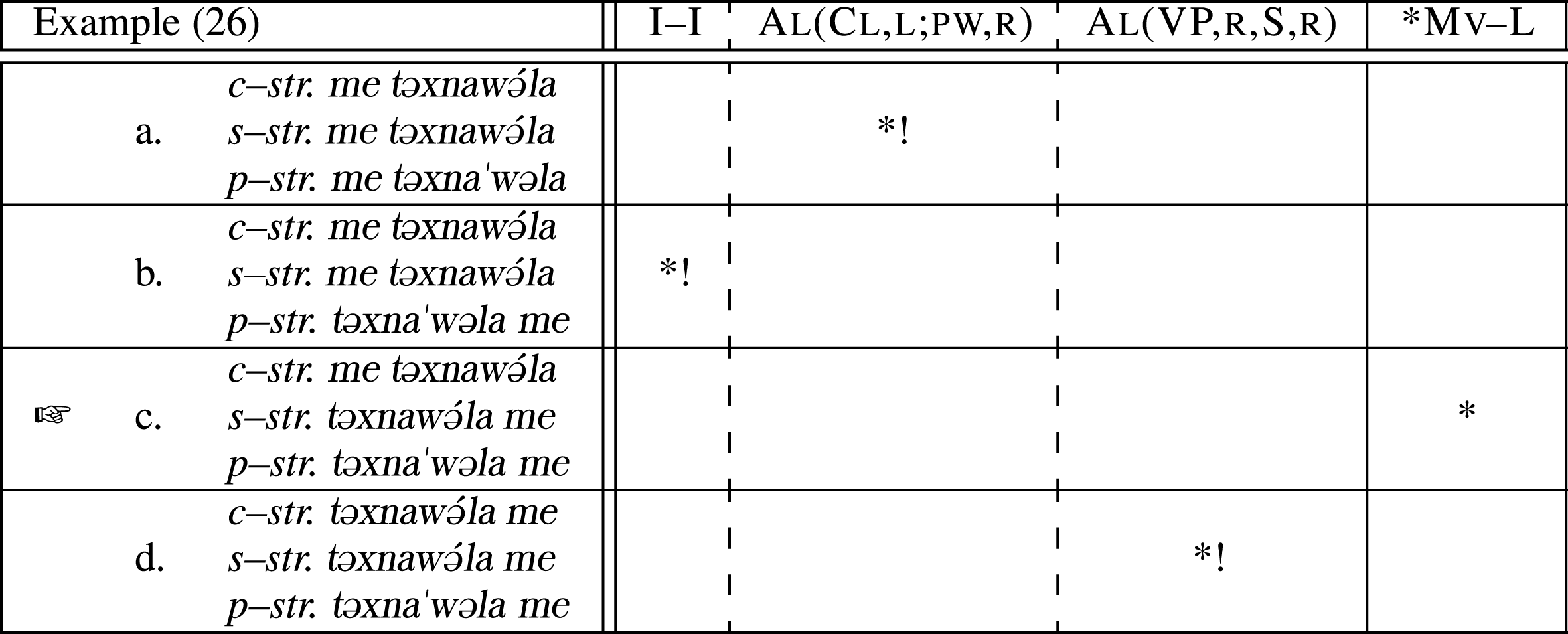
Tableau for the derivation of figure (6).
Let us consider the Pashto example in Figure 6 above. The tableau in Figure 7 represents the derivation of the relevant structures in Figure 6, based on the input f-structure given in (26). Essentially, the constraint requiring prosodic clitics to align with the right edge of a PW, combined with the constraints specifying a verb-final c-structure, enforces the choice of candidate (c) as optimal, even though this involves repositioning of the clitic between the s-string and the c-structure.Footnote [27]

5.5 ‘Endoclisis’
As discussed above, the phenomenon of ‘endoclisis’ is superficially more problematic than the appearance of clitics inside, or on the ‘wrong’ side of, other constituents, since endoclitics appear to surface inside lexical words. Strictly, however, in the framework of clitic positioning developed here endoclisis is, by definition, impossible. Since the order of material in the s-string is identical to that in the p-string (since the s-string is the parsed output), even in cases of endoclisis clitics must appear between distinct s-string elements.
Endoclisis can be considered problematic on two counts. First, insofar as clitics appear to surface between distinct morphemes of single lexical words they appear to violate the principle of Lexical Integrity (Bresnan & Mchombo Reference Bresnan and Mchombo1995). Second, endoclisis can also involve clitics appearing inside lexical words but not between synchronically identifiable morphemes; this is particularly problematic for morphological approaches to clitic positioning. However, in both cases the very fact that clitics can appear between two parts of a single ‘word’ is itself evidence for the syntactic divisibility of that word. Nor is it necessarily valid to distinguish inter-morphemic from intra-morphemic endoclisis: again the very appearance of clitics inside a morphologically simple word is itself evidence for the synchronic composition of that word from two ‘cranberry’-type morphemes.
The framework adopted here compels us to assume that verb forms licensing endoclisis are lexically specified as having two distinct and separable parts in both the s- and p-strings.Footnote [28] We must assume the same also for the terminal string of the c-structure. In order to model this, I make use of Toivonen’s (Reference Toivonen2003) ‘non-projecting categories’. Toivonen (Reference Toivonen2003) proposes that instead of a single zero-level category type X or X0, which necessarily projects full phrasal structure (i.e. X $^{\prime }$ and XP), there are in fact two different sorts of zero-level category: X0, which projects full phrasal structure, and X̂ (‘X hat’), which does not project phrasal structure but adjoins directly to another zero-level category. In many languages some particles can be treated as non-projecting, where there is no evidence that they project an XP; this may be a valid analysis for English not, for example. In English also prenominal adjectives, which in contrast to adjectives in other syntactic contexts cannot take complements, can similarly be treated as non-projecting (Sadler & Arnold Reference Sadler and Arnold1994, Arnold & Sadler Reference Arnold, Sadler, Butt and King2013). I assume the following phrase-structure rule for Pashto, treating the first element of the verb as a non-projecting V̂ syntactically adjoined to the projecting V.Footnote [29]
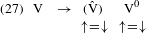
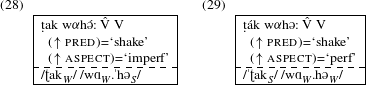
Verbs that display endoclisis are therefore assumed to contribute two elements to the s-string, and thereby two elements to the c-structure (one V̂, the other V0). This implies a degree of syntactic complexity in the lexicon for the forms concerned. It is undoubtedly the case, however, that syntactically complex idioms can be stored in the lexicon, so this is conceptually unproblematic.Footnote [30] Moreover, the contribution of two s-string elements by one lexical entry simply parallels the common contribution of more than one p-string element by a single lexical entry. I therefore assume lexical entries such as (28) and (29) for Pashto verbs like ṭak w𝛼h ə ‘shake’ (seen in (8) and (9)) which license endoclisis.
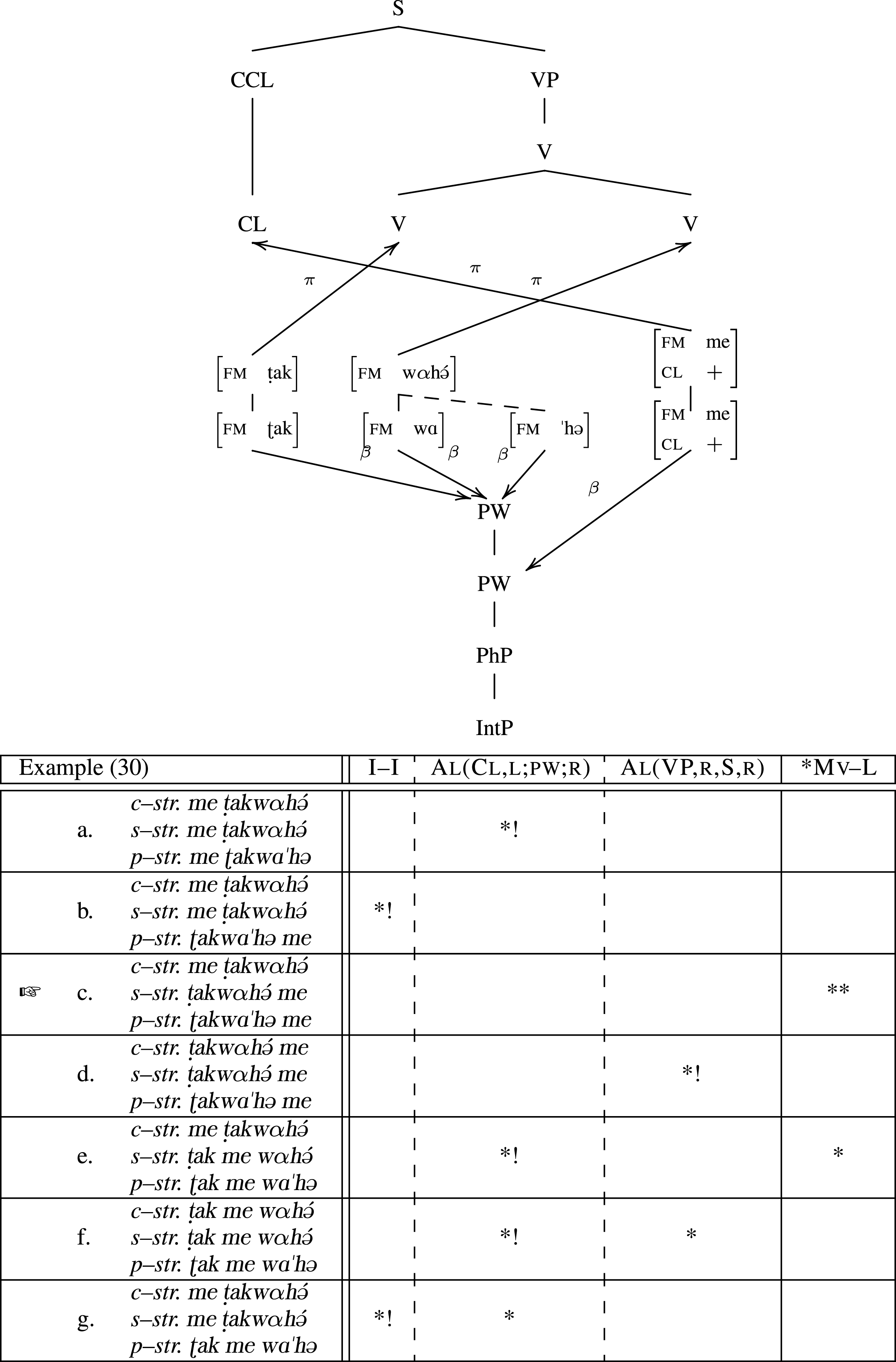
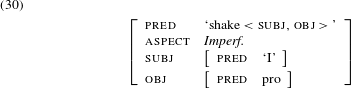
To take the non-endoclitic imperfective first, i.e. (8), the syntactic and prosodic analysis of this clause can be derived from an input such as (30) by the same constraints as utilized above, with the same ranking; the syntactic and prosodic structures, together with the OT tableau, are shown in Figure 8.
Syntactic/prosodic structure and tableau for example (8).
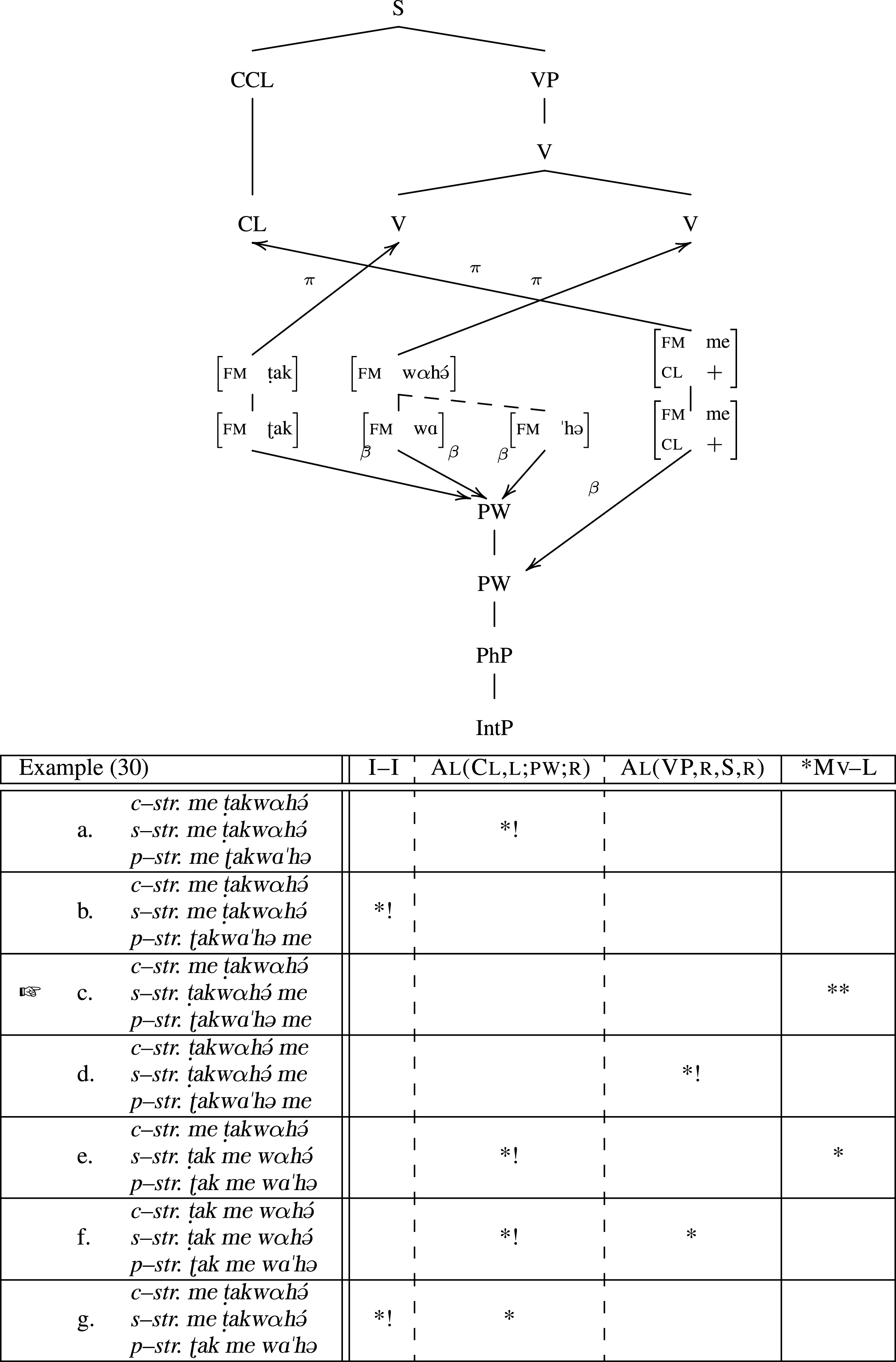
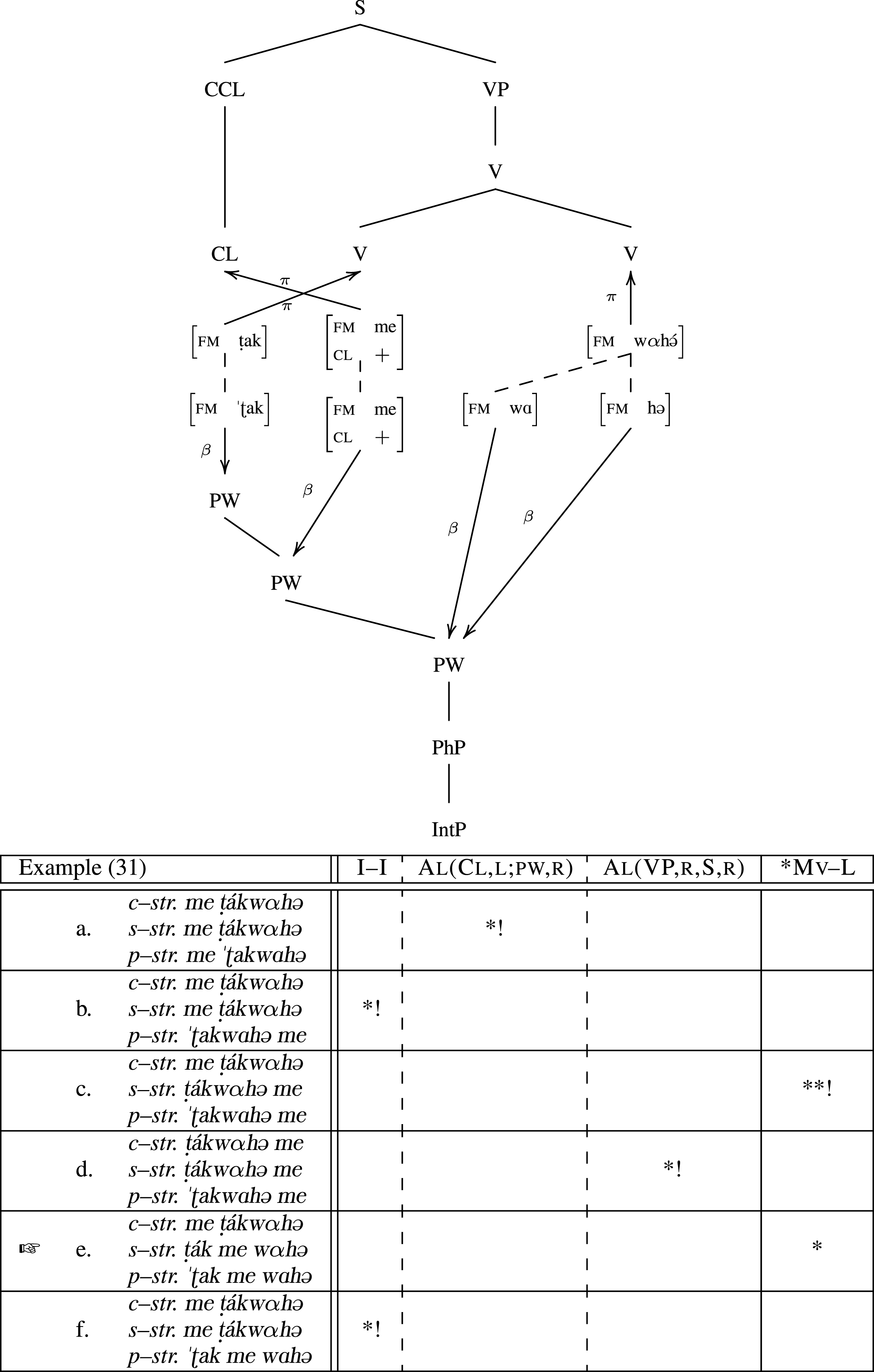
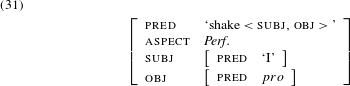
In contrast, the optimal candidate for the perfective, seen in (9), by the same constraints, involves repositioning of the clitic in the  ${\it\pi}$ mapping, but only by one s-string element, leading to ‘endoclisis’; this is shown in Figure 9, derived from an input such as (31). In particular, candidate e is preferred to c because the latter involves repositioning around two c-structure and p-string elements in
 ${\it\pi}$. The constraint Align(Cl,l;PW,r) is satisfied in candidate e since, as discussed above, the minimal phonological word in Pashto contains one stressed syllable; i.e. the element ॑ʈak is a valid prosodic word.
Syntactic/prosodic structure and tableau for example (9).
In this section, I have developed a formal model of clitic repositioning. I have shown that it is possible to account for prosodic constraints on the syntactic positioning of clitics while maintaining a fully modular grammar, and without recourse to any kind of non-syntactic (i.e. phonological) repositioning or movement.
6 Previous accounts
As stated above, the literature on clitics is considerable, and the theories proposed to account for their positioning are too numerous to adequately address all of them in this paper. I will therefore focus in this section on the most important trends and their consequences in terms of grammatical modularity, restricting my account to mainstream transformationalist approaches and approaches specific to Lexical-Functional Grammar.
6.1 Positioning in syntax, repositioning in prosody
One widespread approach to clitic positioning utilizes a combination of syntactic and prosodic positioning to obtain surface orders. Generally, clitics are positioned in the syntax as close as possible to their surface positions, but where they cannot be placed directly into their final position a second process is invoked, a prosodic ‘movement’ which can ignore syntactic constituency to get the clitics where they need to go. This concept was popularized under the name ‘prosodic inversion’ by Halpern (Reference Halpern1995). This prosodic inversion is a last resort, invoked only when required, the principle in general being that as much as possible of word order should be accounted for in the syntax.
Mark Hale (Reference Hale1995, Reference Hale1996, Reference Hale2007), working in a Government & Binding/minimalist framework, uses a combination of syntactic and prosodic movement to account for clitic positioning in Ṛgvedic Sanskrit. Clitics undergo syntactic movement processes, of the same order that non-clitics are subject to, but following this it is possible for clitics to be repositioned by prosodic inversion if they are, following syntactic movement, in a prosodically illegitimate position.
Essentially the same combination of processes is utilized in Lexical-Functional Grammar by Bögel et al. (Reference Bögel, Butt, Kaplan, King, Maxwell III, Butt and King2010), building on a model of the syntax–prosody interface developed by Bögel, Butt, Kaplan, King & Maxwell III (Reference Bögel, Butt, Kaplan, King, Maxwell, Butt and King2009).Footnote [31] Just as in Hale’s approach to Ṛgvedic Sanskrit, they explain the appearance of clitics inside constituents in Serbian/Croatian/Bosnian by assuming that clitic clusters can be generated in the c-structure at the left edge of a clause but are unable to stand there in the prosody and so ‘move’ to the right of the first non-enclitic word in the clause. In order to constrain the movement of clitic sequences at the interface between syntax and prosody, Bögel et al. (Reference Bögel, Butt, Kaplan, King, Maxwell III, Butt and King2010) introduce into the phrase-structure rules, and thereby the c-structure, reference to prosodic boundaries, specifically the left edge of a clause. This is required so that their Interface Mapping Rule that ‘moves’ clitics can apply only in the required contexts. Bögel et al.’s projection of prosodic boundaries in the c-structure clearly undermines the principle of modularity, and significantly changes the nature of the syntactic representation by allowing it to represent more than just the position and constituency of words. In their approach this is necessary, however, because the interface mapping rule needs to make reference to prosodic boundaries.
The same principle is broadly followed by many authors, e.g. Simpson (Reference Simpson1991) and Austin & Bresnan (Reference Austin and Bresnan1996) on Warlpiri, Schütze (Reference Schütze, Carnie and Harley1994) on Serbo-Croat, King (Reference King1996) on Russian, Nordlinger (Reference Nordlinger1998b: 55ff.) on Wambaya, Franks (Reference Franks2008) on Bulgarian, Bögel (Reference Bögel, Butt and King2010) on Pashto, Agbayani & Golston (Reference Agbayani and Golston2010) on Ancient Greek, and Lowe (Reference Lowe, Butt and King2011) on Sanskrit.
Approaches that utilize both syntactic and prosodic positioning of clitics reflect the intuition that we are dealing here with a phenomenon that has both a syntactic and a prosodic component to it. Moreover, the desire to account for word order as far as possible in the syntax, limiting the influence of prosody to something of a ‘last resort’, reflects the assumption followed here that, at least in theory, word order phenomena ought by definition to be the domain of syntax. In several respects, then, this way of accounting for clitic positioning is very similar to that argued for in this paper. The difference is that the current model permits no repositioning outside the syntactic component.
The assumption of movement or repositioning in the prosody itself is problematic, insofar as it is always syntactic elements that are repositioned (as discussed in more detail under the next heading). This means that, as in Bögel et al.’s (Reference Bögel, Butt, Kaplan, King, Maxwell III, Butt and King2010) formalism, approaches of this kind can only account for the relevant data by abandoning strict modularity. Moreover, the last resort ‘prosodic inversion’, invoked in approaches as divergent as those of Hale and Bögel et al., can account for many examples of clitic ‘movement’ but, crucially, not all. Class 1 clitics, like the Ancient Greek conjunction te, can be subject to repositioning even when they appear clause internally and not in the vicinity of any discernable prosodic boundary. The concept of a post-syntactic prosodic inversion is, therefore, problematic in more than one respect; nevertheless, the underlying intuition, that prosody has an effect on the ordering of syntactic items, is undeniably correct and is essentially the same position as that adopted in this paper.
6.2 Prosody alone
An alternative approach seeks to explain clitic positioning purely with reference to post-syntactic operations, i.e., in transformational theories operations located in PF. The difference from the preceding approach is that the clitics may be specifically unordered, linearly or hierarchically, with respect to the other elements of a clause in the syntactic component, and that rather than being a last resort, prosodic or PF positioning is the primary or exclusive means of obtaining the correct ordering of clitics in the output. This is the approach taken, for example, by Radanović-Kocić (Reference Radanović-Kocić1988, Reference Radanović-Kocić1996), Anderson (Reference Anderson1993, Reference Anderson1996, Reference Anderson2000, Reference Anderson2005), O’Connor (Reference O’Connor2002b) and Keydana (Reference Keydana2011), who goes so far as to say that the purely prosodic positioning of clitics should be the ‘null hypothesis’, due to their peculiar properties. As discussed above, the theoretical framework adopted here excludes the possibility of word order being determined or altered purely in the prosodic component of the grammar; moreover, there are reasons for considering this exclusion to be justified.
The same problems as discussed above with regard to combined syntactic–prosodic accounts apply also to purely prosodic accounts of clitic positioning. In particular, there are no instances (known to me, at least) of purely prosodic positioning or inversion of clitics (or any words). For example, it is never the case that a clitic is ‘moved’ or repositioned to directly following the first syllable or mora of a clause, regardless of whether the end of that syllable or mora coincides with a syntactic word or morpheme boundary and regardless of the syntactic class of word involved; this would be predicted under a purely prosodic or ‘prosodic inversion’ account of clitic positioning. In contrast, reference to syntactic units and categories is always required. Even in contexts where it is possible to analyse clitic positioning in prosodic terms, the prosodic constituent with which the clitic is aligned is always coterminous with a morphosyntactic element (usually a word or a syntactic phrase), which supports an analysis of positioning in primarily syntactic terms. In fact, the assumption that repositioning can be stated in purely prosodic terms is necessarily based on the further assumption, which can be shown to be incorrect for at least some languages (Lahiri & Plank Reference Lahiri and Plank2010), that there is a very close, almost one-to-one, correspondence between syntactic and prosodic categories. Therefore, for example, repositioning can be stated purely in reference to prosodic words only when prosodic words are assumed to align with prosodic words. The same issue applies to the wider domain of cliticization: Keydana (Reference Keydana2011), for example, states the generalizations on clitic positioning in Ṛgvedic Sanskrit with reference to ‘sentences’, and subsequently refers to this domain in purely prosodic terms as an intonational phrase, purely on the assumption that CP corresponds to an IntP (his I).
6.3 Syntax alone
As argued in detail above, the clitic phenomena under discussion are not easily amenable to a purely syntactic treatment, which is, after all, the reason why they are interesting. Nevertheless, a few accounts of specific languages attempt in various ways to deal with clitic positioning without recourse to prosody. It goes without saying, of course, that syntactic movement is unavailable in a non-transformational theory of syntax like LFG, in which the current approach is based. However, even where syntactic movement is available, it struggles to account alone for the whole range of phenomena under discussion.
Eythórsson (Reference Eythórsson1995, Reference Eythórsson, Thráinsson, Epstein and Peter1996), for example, provides a purely syntactic account of clitic positioning in Gothic, where certain clitics can interrupt otherwise indivisible particle–verb complexes. Eythórsson assumes that these clitics are generated in C0; processes such as head-to-head movement of the verb to C and topicalization result in the usual position of the clitic directly following the first word of the clause. In the problematic case of clitics appearing ‘inside’ the verbal complex, Eythórsson argues that, as perfectivity markers, verbal prefixes are generated in the head of AspP, separated from the verb itself; movement again accounts for the final position. Within the theory he adopts, Eythórsson’s approach accounts for the facts. Even so, there is something slightly fortuitous about the way that various movement processes position words in different ways in different constructions such that the correct order always results, and such that the absolute generalization, that the clitics concerned always follow the first syntactic element in their prosodic domain, is essentially an accident. Moreover, the clear prosodic element to the phenomenon is thereby lost.
Furthermore, it should be clear that while the assumption of a separate Aspectual Phrase enables clitic positioning to be accounted for syntactically in Gothic, this approach would not be generalizable to the parallel phenomena in the languages discussed above. Such an approach is possible only where one can justify the splitting and movement of parts of either constituents or words such that the constituents or words concerned appear in two distinct phrase-structure positions on either side of the clitic. The Pashto verbs that show ‘endoclisis’, for example, cannot be split into an aspectual morpheme and a verbal base. Equally, there would be little motivation for moving Ancient Greek determiners and prepositions out of their phrases to a position higher than the clitic conjunctions, beyond the desire to account for the surface word order. Most seriously, it is not possible to state the generalizations on Pashto argument clitic positioning in purely syntactic terms, since reference must be made to the prosodic feature of stress and (on that basis) to the prosodic word.
As I have argued above, the positioning of class 1 clitics does not require reference to prosody, and can be accounted for purely in syntactic terms. Although syntactic movement is unavailable in LFG, the repositioning of class 1 clitics between the c-structure and the s-string on the basis of purely syntactic rules or constraints represents the LFG equivalent of purely syntactic clitic positioning. In regard to class 2 clitics, however, it has been shown that there are clear prosodic constraints at issue, such that a purely syntactic account is unable to properly account for their positioning.
6.4 LFG accounts
The majority of LFG-based treatments of clitic positioning fit under one or other of the headings above; here, I merely draw out the specific trends in the LFG literature in relation to the approaches detailed above. Most early work in LFG assumed prosodic inversion, formalizing this in various ways and to varying degrees of precision (Newman Reference Newman, Butt and King1996; Austin & Bresnan Reference Austin and Bresnan1996; Nordlinger Reference Nordlinger1998a, Reference Nordlingerb). This continues most recently in the approach of Bögel et al. (Reference Bögel, Butt, Kaplan, King, Maxwell III, Butt and King2010), discussed above.
An attempt has also been made to treat clitic positioning purely in prosodic terms in LFG, by O’Connor (Reference O’Connor, Butt and King2002a, Reference O’Connorb). O’Connor assumes not only that clitics can be positioned purely phonologically, but also that clitics are not full words with their own c-structure positions. As discussed above, phonological positioning is impossible in the framework proposed in this paper, but in any framework can only succeed at the expense of modularity; I also argued above that it is preferable, if possible, to treat clitics as full words with their own c-structure positions.
While the first two approaches to clitic positioning discussed above have been applied within LFG, the third has not. Due, presumably, to the impossibility of syntactic movement in the theory, there are to the best of my knowledge no attempts to account for clitic positioning in purely syntactic terms; the approach argued for in this paper in fact comes closest (while at the same time sharing many similarities with combined syntactic–prosodic approaches).
Like most previous LFG analyses of clitic positioning, the model presented in this paper takes seriously both the syntactic and the prosodic sides to clitic positioning. Its advantage over previous analyses, notably, e.g., the recent approach of Bögel et al. (Reference Bögel, Butt, Kaplan, King, Maxwell III, Butt and King2010), is that it does this while also taking seriously the principle of modularity. I hope to have shown that it is possible to account for prosodic constraints on syntax even in such a highly modular architecture as that of Dalrymple & Mycock (Reference Dalrymple, Mycock, Butt and King2011).
6.5 OT accounts
Insofar as the approach presented here is fundamentally dependent on the use of OT, it is worth briefly considering alternative OT approaches to clitic positioning. I know of no purely syntactic accounts of clitic positioning couched in OT; there is no reason why an approach such as that of Eythórsson (Reference Eythórsson1995, Reference Eythórsson, Thráinsson, Epstein and Peter1996) to Gothic could not be rewritten in terms of constraints determining syntactic movement, but the same problem and fundamental difference from the approach presented here would stand either way: a purely syntactic account does not reflect the clear prosodic factors involved.
On the other hand, prosodic (and combined syntactic/prosodic) accounts of clitic positioning often utilize OT. Details vary between authors, but for all the vital constraint is an alignment constraint, of the same form as utilized in the formalism above. For example, Roberts (Reference Roberts, Booij and van de Weijer1997: 389) proposes the following constraint for clitic positioning in Pashto.

Similar formulations include align(Cl,L;PW,R) (as in the present model, above), or align(Cl,L;Ft,R) (‘align the left edge of a clitic with the right edge of a prosodic foot’); the only difference, therefore, being what sort of prosodic constituent the clitic is constrained to align with. The OT account presented here is not incompatible with prosodic OT accounts of clitic positioning (insofar as they respect modularity); as stated, I utilize essentially the same prosodic constraint on clitic alignment, and other prosodic constraints proposed in previous literature need not be rejected. However, other prosodic constraints are not required in the formalism developed here, because the wider application of the OT system incorporates a number of theoretically and empirically motivated violable and inviolable constraints on syntactic well-formedness, which, together with the prosodic alignment constraint, are sufficient to account for the data.
Therefore, in purely prosodic OT accounts, the OT gen presumably generates prosodic structures and/or phonological strings, while the eval utilizes only phonological constraints on those strings/structures. Here, on the other hand, the gen produces full sets of parallel structures, prosodic, syntactic, semantics, etc., i.e. a full grammatical and phonological analysis, while the eval assesses candidates on the basis of constraints relating to all these structures and the mappings between them. In this way, the vital prosodic constraint on clitic alignment can indirectly constrain possible syntactic structures, with the result that the align constraint turns out to be the only prosodic constraint necessary, other constraints referring rather to syntactic structures and relations. In practical terms, then, the model presented here integrates phonological constraints into an originally syntactic OT model (that of Bresnan Reference Bresnan2000a), to produce a comprehensive OT system constraining full syntactic and phonological structures rather than one or the other.
6.6 General discussion
There is widespread agreement between purely syntactic, purely prosodic and combined accounts that the problem of clitic placement involves ‘repositioning’ relative to the default syntactic position at some stage in the derivation/analysis; approaches that deny this must assume that clitics are not full words but rather ‘features’ or affixes that lack their own phrase-structure nodes. The approach presented here attempts to overcome the different problems found with these approaches, recognizing that clitic positioning involves both syntactic and prosodic constraints on syntactic elements. By the strict modularity assumed here, it is necessary for the prosodic constraints to only indirectly affect the syntax, and indeed for the clitic positioning itself to take place purely in the syntactic component.
The approach presented here appears in several respects to be highly similar to approaches that utilize post-syntactic movement: in the syntactic ‘tree’, the clitic has a particular position, but then ‘moves’ between this and a final level that has the same linear order as the output. To an extent, the differences are merely conceptual. First, the architecture presented above is preferably conceived as a parallel, not a derivational (or ‘pipe-line’), architecture. That is, it is not the case that the hierarchical syntactic structure is constructed and that subsequently this structure is transformed into another structure; rather, all structures exist simultaneously, and thereby mutually constrain one another. Repositioning is enforced indirectly by the constraints simultaneously affecting the c-structure, p-structure, string and  ${\it\pi}$. Second, ‘post-syntactic movement’ is, as its name suggests, post-syntax: something happens after, or perhaps as, syntactic elements are converted or transformed into phonological elements. In the present approach, in contrast, the ‘repositioning’ takes place fully within the syntactic component.
One particular advantage of this approach is that, by utilizing a combination of syntactic and prosodic constraints, a single set of rules (constraints) is able to derive the placement of all varieties of both class 1 and class 2 clitics: those that need to be repositioned and those that do not, those whose repositioning can be stated in purely syntactic terms, and those whose repositioning must be stated with reference to both syntax and prosody. Clitics of all varieties are positioned correctly simply by virtue of the constraint ranking (and, most importantly, the alignment constraints), without recourse to additional mechanics.
7 Conclusion
The phenomenon, found in various languages, of clitics appearing inside syntactic units of which they are not themselves a part presents a challenge to any formal model of the syntax–prosody interface, particularly a modular one. Building on the modular grammatical architecture of Dalrymple & Mycock (Reference Dalrymple, Mycock, Butt and King2011), I have presented a formal account of clitic positioning, showing that this is indeed possible in such an architecture despite the clear influence of prosody on clitic positioning.
In the model proposed here, prosodic constraints on clitic positioning can be accounted for in the syntactic component of the grammar, without recourse to ‘movement’ or ‘inversion’ in the prosody, and without endangering the strict modularity which permits syntax reference only to syntactic units and processes. The locus of interface, where prosody is able to constrain syntax, is the OT eval, which assesses constraints relevant to all levels of the grammar.