

1. Introduction
Driven by increasing longevity and declining fertility, population aging threatens the prospects for growth in living standards in many countries (NRC, 2012). Extending working lives and harnessing the human capital of the older population may ease some burdens of population aging by raising the worker–elderly dependent ratio (Borsch-Supan et al., Reference Borsch-Supan, Hartl and Ludwig2014; Lee, Reference Lee2014). This common prescription runs into a contradiction in rapidly aging middle-income countries where one observes two retirement systems: formal retirement with relatively generous benefits enjoyed by civil servants and retirees from formal sector employers, and informal retirement, characterized by family support and depletion of own savings. Unsurprisingly, formal retirees are typically able to exit from work at relatively young ages, while informal retirees may need to work as long as their health allows. One policy imperative in middle-income developing countries involves expanding access to social insurance and pensions for informal retirees while finding ways to incentivize formal sector workers to extend their working lives (World Bank, 2016).
Increases in the average retirement age require consideration of the factors influencing exit from the labor market, both from wage employment and self-employed activities. In China, urban workers covered under the Urban Employee Pension system must leave their work and ‘retire’ (leave their long-term employer and start drawing their pension) at age 60 for men, 50 for blue-collar women, and 55 for white-collar women, and so in general, they retire early in the economic sense of exiting from work.Footnote 1 Farmers, by contrast, are frequently characterized as subject to ‘ceaseless toil’, and unable to retire until forced to by ill health (Benjamin et al., Reference Benjamin, Brandt and Fan2003). Anecdotal evidence indicates that informal sector workers in urban areas also exhibit strong labor force attachment. If most Chinese are already retiring late, then there may be little room for extending working lives and less of an argument for doing so. The first goal of this paper is, thus, to describe the retirement and labor supply patterns across older residents of China's urban and rural areas.
Choosing when to stop working is a critical decision in the life-cycle of an individual and his (or her) family, with impacts on both well-being in old age and accumulation of family resources. Even though employees covered under the Urban Employee Pension plan face mandatory retirement ages, they face no financial penalties or other restrictions from engaging in new work as a consultant or in a self-employed activity. Thus, retirement is not driven simply by pension eligibility age; it may be influenced by family wealth and circumstances and by individual health and preferences as well as policies and institutions. This paper aims to understand the factors behind the retirement decision, or the decision to stop working, by estimating empirical labor supply models among the older population. These analyses are a step toward informing on likely labor supply patterns of the elderly in the future and a source of insight into where policy may influence individual retirement decisions.
The Chinese labor market is distinctive in the institutional segregation of urban and rural registered residents, which is further magnified in retirement. Long-term residents of urban areas who are civil servants or formal sector employees, and covered under the Urban Employee Pension, must leave long-term formal employers and start drawing on relatively generous pension support at young ages, and thus they tend to cease activity after processing retirement at these mandatory ages. Rural residents, by contrast, work on the farm or in other agriculture-related activities until relatively late in their lives and only expect to receive pensions that are a small fraction of those afforded to urban residents (CHARLS Research Team, 2013). Evidence presented in the paper suggests that the advantage in social security and economic resources of the urban elderly contribute significantly to the urban–rural difference in retirement ages and that the rural elderly's heavy reliance on support from their children leaves them in a more vulnerable position.
Much of the research on the employment behavior in China's labor market has focused on prime-age adults in circumstances of restructuring (Appleton et al., Reference Appleton, Knight, Song and Xia2002; Giles et al., Reference Giles, Park and Cai2006), more recent adjustments due to labor shortages (Cai and Du, Reference Cai and Du2011; Li et al., Reference Li, Li, Wu and Xiong2012), and the effects on labor supply decisions of married women with care burdens (Dong, Reference Dong2010; Maurer-Fazio et al., Reference Maurer-Fazio, Connelly, Chen and Tang2011). A recent thread of labor research has also focused on the demand-side effects of minimum wage policies (Fang and Lin, Reference Fang and Lin2015; Hau et al., Reference Hau, Huang and Wang2020). Relatively little attention has been paid to the timing of entry into or exit from the labor force. A few papers have examined retirement patterns and decisions (Benjamin et al., Reference Benjamin, Brandt and Fan2003; Pang et al., Reference Pang, de Brauw and Rozelle2004; Giles et al., Reference Giles, Wang, Cai, Majmundar and Smith2012). The data sets used for these analyses were not nationally representative and likely fail to reflect all dimensions of the retirement decision from a national perspective. Getting this picture right, updating it with more recent data, and understanding important nuances, promises to inform on the types of interventions that might limit the adverse effects of population aging on economic growth and people's well-being.
The paper is organized as follows. In Section 2, we briefly describe pension policies in China. In Section 3, we first discuss the main data source used in the paper, and then describe the retirement patterns observed in China. Section 4 lays out factors influencing the retirement decision and descriptive evidence and a discussion of urban–rural differences in labor supply at older ages. Section 5 develops an analytical model used to estimate the correlates of labor supply in a multivariate framework and presents these results, and then Section 6 concludes.
2. Pension policies and retirement
The differences in pension policies, both in their administration and generosity, are likely to explain much of the difference between the retirement behavior of formal sector workers in urban China and that of informal workers concentrated in rural areas. Historically, only government and state sector employees held jobs that included a pension upon leaving one's job at mandatory retirement ages. This pension, established in the 1950s may be viewed as a defined benefit, pay-as-you go (PAYGO) system. Although initially managed nationally, administration of the system for workers was devolved down to the enterprise level, while government employee pension remained centrally managed. As it became clear by the mid-1990s that operating a PAYGO pension system at the level of the firm was unsustainable, and was pushing state-owned enterprises toward insolvency, and a significant reform moved the management of the employee pension to a city-level agency, with pooling at the county or city level, by 1995 (Feldstein, Reference Feldstein1999; Zhao and Xu, Reference Zhao and Xu2002). At present, county- or city-level governments administer pension pools, with a portion of contributions in individual accounts.
In 2015, another round of reforms merged the pension plan for government workers into the urban employee pension plan. The post-1995 urban employee pension is comprised of two components: a social account that is financed on a PAYGO basis and an individual account, funded with worker contributions, that is managed as a notional defined contribution plan. Contributions to the social account are made by firms, at a recommended level of 20% of the employee wage, and an 8% contribution by the employee to an individual account. In practice, local government decisions on the contribution rates for social accounts may be above or below 28%.
Under the urban employee pension, workers must contribute for a minimum of 15 years to be eligible for monthly benefits when they retire. Benefits consist of a basic benefit financed by employer contributions to the social account and an individual account benefit. The basic benefit is calculated based on the number of contribution years, with 1% for each year contributing, and the average of an indexed average wage of the employee and the average wage for the pooling area at the time of retirement. Monthly pensions, thus, increase with a worker's wage, with the number of years contributing and with the average wage of the city or region where the worker resides at retirement. The monthly individual account benefit is simply the worker's individual account divided by 139 for those retiring at 60 (the divisor is 195 and 170 for those retiring at 50 and 55, respectively).Footnote 2
Notable changes in pension policy were initiated in 2009 when the New Rural Pension (NRP) program was established to cover informal rural workers, both those in agricultural and non-agricultural activities (Lei et al., Reference Lei, Zhang and Zhao2013). In 2011, the Urban Resident Pension (URP) was introduced to cover informal workers in urban areas, consisting of those workers in smaller private sector enterprises and the self-employed. The NRP and URP programs were then merged in 2014 into the Resident Pension program, although the contributions and benefits of rural and urban participants continue to differ.
One does not need to have a formal job to participate in the Resident Pension program, and anyone may participate by making a minimum contribution of 100 Yuan per year. Governments subsidize participation with matching contributions, with the match for the minimum contribution at 30 Yuan per year. Participants may make larger contributions with higher matches, yet researchers who have studied the NRP (the precursor to the Resident Pension) found that the return to participating at higher levels was quite low and few rural residents contributed more than the minimum contribution (Lei et al., Reference Lei, Zhang and Zhao2013).
In principle, a participant is eligible to start receiving benefits at age 60 if he (or she) has contributed for at least 15 years. People over age 60 before the start of the program may receive the basic benefit from the government without ever contributing, and those over 45 at the start may receive a basic benefit with fewer years of contributions. The basic benefit from the program was 90 Yuan per month in 2018, and localities may increase the benefit if they have the fiscal space to do so.
The significant differences in contributions to the Urban Employee Pension and the Resident Pension are reflected in the generosity of benefits, which is evident in the replacement rates for the two programs. Recent calculations using data from the Ministry of Human Resources and Social Security of China suggest that the replacement rate for the Urban Employee pension beneficiaries ranges from 45.5% to 48.9% in 2018, while it ranged from 10.7% to 15.3% of the average monthly earnings for participants of the Resident Pension program, and rural residents were at the low end of this range (Xue and Zeng, Reference Xue and Zeng2019). As recipients of the Resident Pension have a much lower base income than those receiving the Urban Employee Pension, it is unsurprising that this pension is only a fraction of the income poverty rate in both rural and urban areas. Although an Urban Employee pension is sufficient to cover living expenses for most beneficiaries, most recipients of the Resident Pension are unable to support themselves through this pension alone.
Apart from the ability to retire after receiving a sufficient pension benefit, employees under the Urban Employee Pension program have mandatory ages at which they must administratively process retirement, begin receiving their pension, and leave their current employment. Although registering for and receiving the pension does not preclude working later as consultants for their former employer or other wage or self-employed work, the process of retiring leads to a break in what was often a long-term work relationship. For workers covered under the Urban Employee Pension, the mandatory retirement ages are 60 for men, 50 for blue-collar women, and 55 for white-collar women, and these ages have not changed since the retirement system's inception in the 1950s. The combined effect of the generosity of the Urban Employee Pension and the necessitated separation from a long-term job imply that economic retirement, or the final exit from work, occurs much more often at the mandatory administrative retirement age.
As we will see below, even with China's low official retirement age, substantial retirement occurs even earlier. Part of this practice reflects a legacy from efforts to restructure state-owned enterprises in the late 1990s. After pension responsibilities were shifted from enterprises to city-level entities, formal sector employees granted early retirement (and the ability to draw a pension based on years of employment) as a means of laying off workers within 5 years of retirement age (Giles et al., Reference Giles, Park and Cai2006). With sponsorship of an employer, the Urban Employee Pension program continues to permit early retirement for health reasons or hazardous work conditions, but evidence on when respondents processed retirement from the China Health and Retirement Longitudinal Study (CHARLS) suggests that early retirement is still granted quite liberally. Another special circumstance leading to early exits from work is known as internal retirement. This was a special practice during the 1990s when many firms experienced financial difficulties. Firms let redundant workers retire before the normal retirement age at the firms' expense and turned to the Social Insurance Administration to support payment of pensions after workers reached the normal retirement age. Internal retirement enabled workers to maintain eligibility for social insurance after reaching retirement age.
3. Retirement patterns in China
3.1 The China Health and Retirement Longitudinal Study (CHARLS)
The CHARLS is a nationally representative longitudinal survey of the middle-aged and elderly population (45+) in China along with their spouses, which includes an assessment of the social, economic, and health circumstances of community residents.Footnote 3 The CHARLS national baseline survey was conducted between June 2011 and March 2012 and enumerated surveys from 17,708 respondents. To ensure representativeness, the sample was chosen using multi-stage probability sampling. In the first stage, 150 county-level units were randomly chosen with probability proportional to scale (PPS) from a sampling frame including all county-level units of China (excluding only Tibet, Hong Kong, and Taiwan) with stratification by region and within each region by urban districts or rural counties. With each county-level unit, three villages or urban-resident communities were chosen using PPS random sampling. Within each village or resident community, mapping and listing operations were conducted to obtain a sample frame of households. Within each household, one person aged 45 and older was randomly chosen to be the main respondent and the spouse was automatically included. To avoid human manipulation, each stage of the sampling was computerized and all interviews were conducted using face-to-face, computer-aided personal interview technology. Training of interviewers and field procedures followed strict protocols to maximize data quality. As an indicator of the data quality, the demographics of the CHARLS respondents closely mimic those of the 2010 national population census (Zhao et al., Reference Zhao, Hu, Smith, Strauss and Yang2014).
Since the 2011 baseline, respondents were contacted again in 2013, 2015, and 2018 to complete follow-up surveys with the same structure and design as the baseline, with recontact rates of over 86% for the panel. Although the ‘work and retirement’ module remains almost the same across waves, more detailed questions have been introduced to the ‘pension’ module to accommodate the rapid reform of China's pension system in the 2010s. Respondents between ages 40 and 44 in 2011 were added to later waves as the refreshment sample, so younger groups in the CHARLS 2018 sample are still comparable to prior years.
CHARLS is a comprehensive survey that covers many aspects of both individuals and their families. Respondents are asked in detail about their current job status, work history, retirement, and pension information. Careful distinctions are made between drawing a pension, or administrative retirement, and actual retirement, which we define as an exit from work. Other information for this analysis includes individual characteristics (age, gender, education, etc.), family size and quality of family support network, specifically the number and education of all children whether or not they co-reside in the households, the availability of economic resources, and information about health status. In addition to current and historical conditions, CHARLS also asks respondents about their expected support in the future, which we bring into our discussion of expectations and retirement decisions.
3.2 Evidence on retirement patterns from CHARLS
This paper focuses on an economic definition of retirement: a person is considered to be retired if they have worked during their lives but are no longer engaged in any wage or self-employed activities, including both agricultural and non-agricultural work.Footnote 4 As farming is seasonal, a respondent is still considered to be employed if he, or she, worked for 10 days or more in the past year. All non-farmers were asked about employment activities in the past week, be it wage employment, self-employment, or unpaid family business work.Footnote 5 Those on temporary leave, or expecting to return to work, are considered to be working, and this should lessen any concern that older urban workers with only seasonal employment are someone misclassified as retired. We focus on employment instead of labor force participation because there are a vanishingly small number of respondents over age 50 who are not employed but report active searches for work. We have no doubt that a search process exists for older workers who wish to work, but it is difficult to capture, and this is particularly true when large shares of older workers are self-employed.
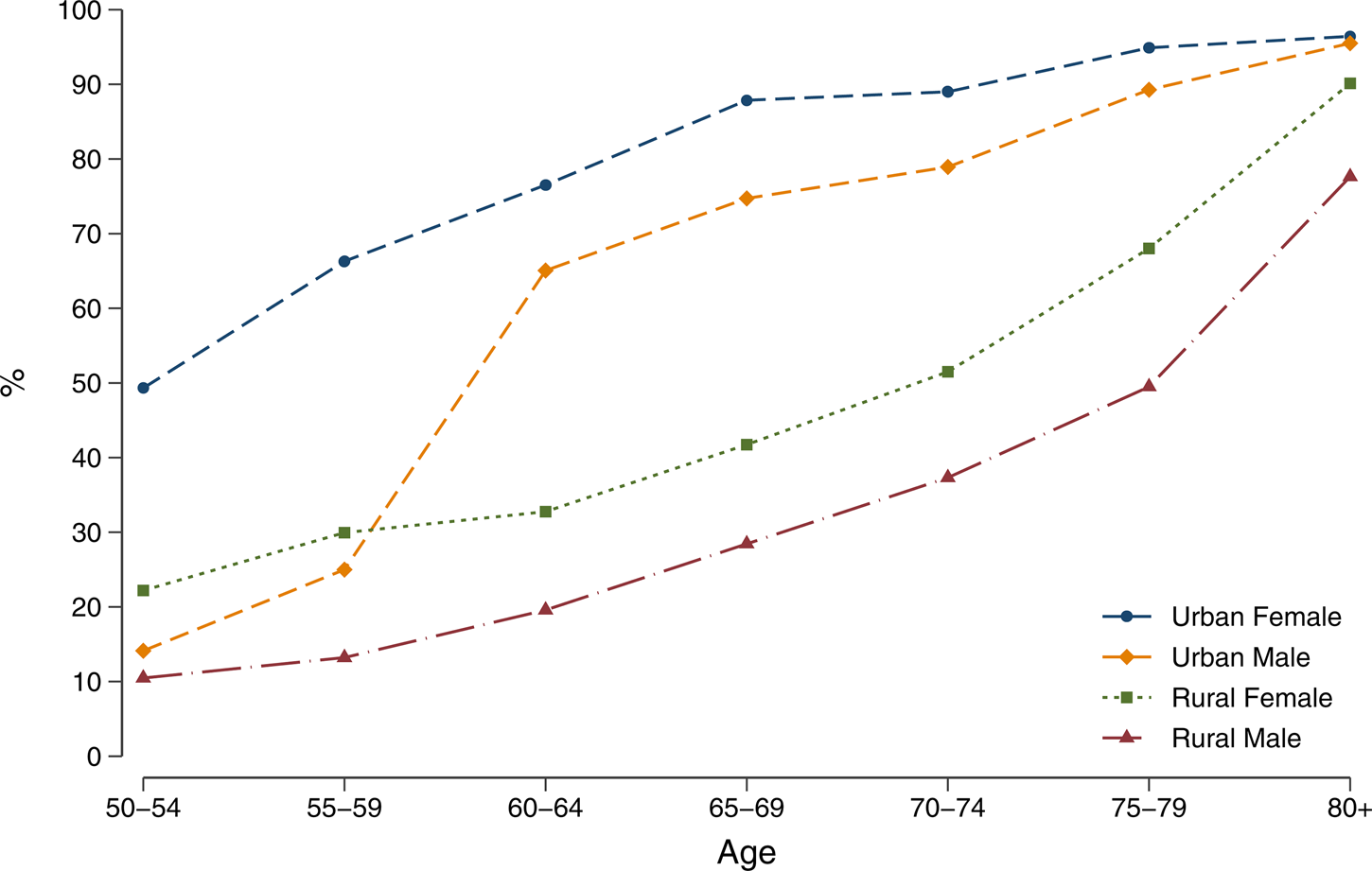
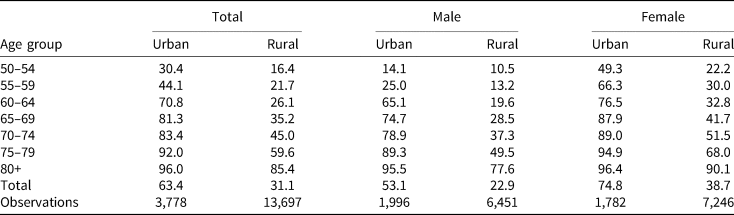
Overall, among those 50 and older, the retirement rate is more than twice as high among urban workers (63.4%) as their rural counterparts (31.1%) (Table 1). Given the younger retirement ages for women, it is unsurprising that women retire sooner than men – in urban areas, 74.8% among women versus 53.1% among men, while in rural areas, only 38.7% of women and 22.9% of men are retired. As expected, retirement rises with age, but the age patterns are quite distinct between urban and rural residents. As shown in Figure 1, the retirement rates differ sharply by urban–rural designation but become pronounced for cohorts beyond mandatory retirement ages for men and women covered under the urban employee pension system, informally called firm pension. Given the statutory retirement age of 50 for blue-collar urban women, it is unsurprising that for women in the 50–54 age cohort, 49.3% of urban women are already retired, while the comparable retirement rate for rural women is just 22.2%. Among men, there is much less difference in retirement rates across urban and rural areas for those in the 50–54 age cohort: 14.1% and 10.5% of urban and rural men, respectively. Retirement rates start to diverge for urban and rural men with the 55–59 age cohort, as some urban men become eligible for early retirement, and then the gap rises sharply for the 60–64 age cohort who have all crossed the statutory retirement age for men. By age 60–64, the urban–rural retirement gap reaches 45.5 percentage points for men and 43.7 percentage points for women. For the 65–69 age cohort, the urban–rural retirement gap for men and women both peak at 46.2 percentage points. By the 75–79 cohort, relatively few urban residents are still working (only 10.7% of men and 5.1% of women), but work is still common among rural people (50.5% of men and 32% of women).
Retirement rate by age, hukou and gender. Note: Hukou is the system of household registration in China. Source: CHARLS (2018), National Survey.

Retirement rate by hukou, gender and age (%)

All numbers are weighted.
Data source: CHARLS survey, 2018.
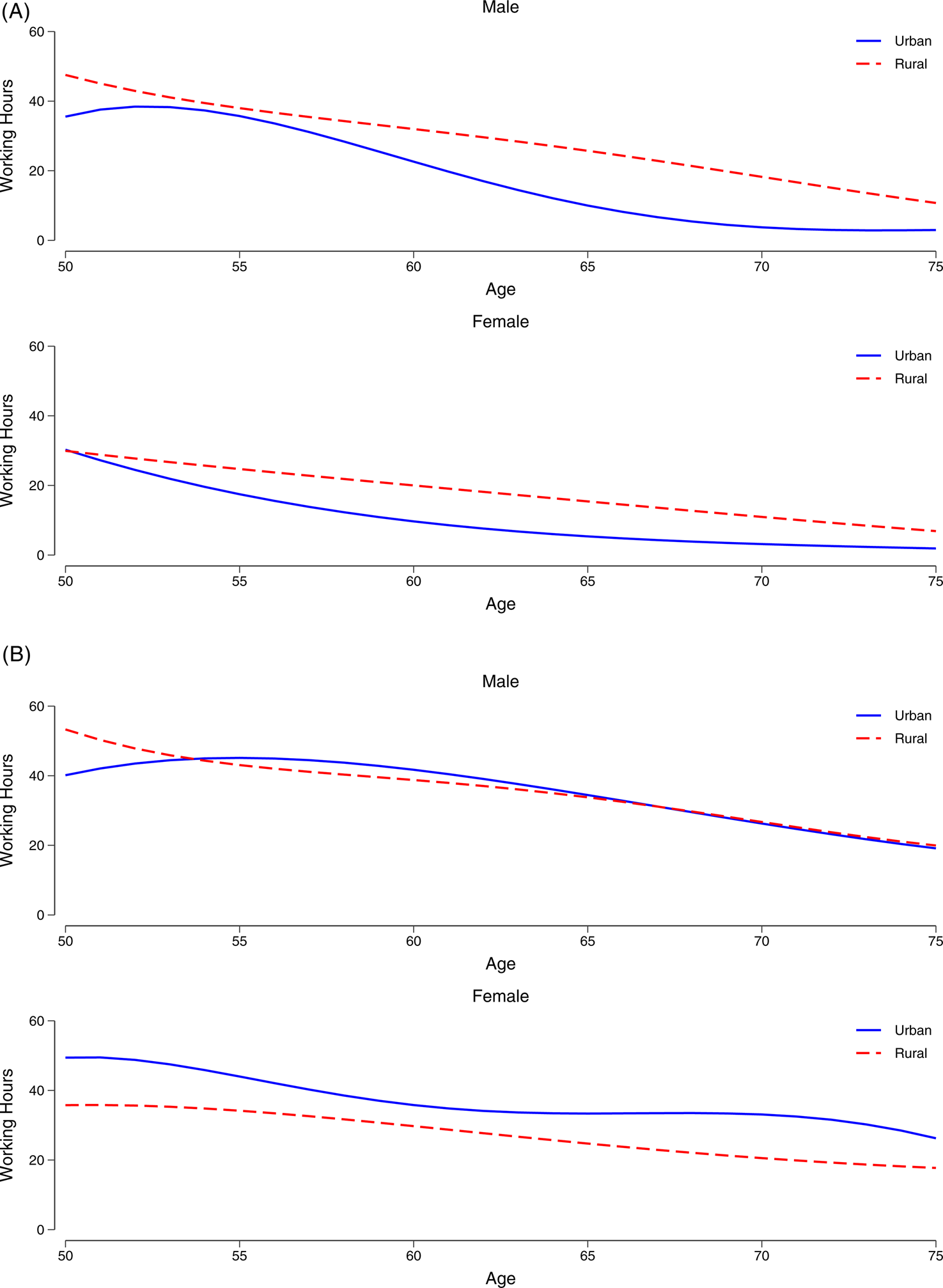
One may be concerned that definitional differences yield higher employment in rural areas: one could conceivably work just 10 days in a year and be counted as working, while an urban worker only needs to have worked an hour during a 1-week recall period. Alternatively, one could argue that the reason rural people work at older ages is that farming is less intensive and may amount to maintaining a garden plot as a hobby. To address these concerns, we examine the average hours of work per week by hukou (household registration) and gender in Figure 2. The unconditional graphs in panel A show averages across all persons, regardless of work status. As expected from much higher employment among rural people, there is a large gap for the age 65–69 cohort, rural men (women) on average work 23 (14) hours while urban men (women) only work 7 (4) hours. Taking the average only among those who work (the bottom two graphs), working hours are quite similar, with rural older men working more hours than urban men. However, the difference is unlikely to be statistically significant. Thus, it is unlikely that the higher labor force participation of rural elderly is due to lower work intensity.
Average hours of work per week. Panel (A) Unconditional. Panel (B) Conditional on working.
Note: Plotted working hours are from regressions of a sixth degree polynomial in age. Source: CHARLS (2018), National Survey.

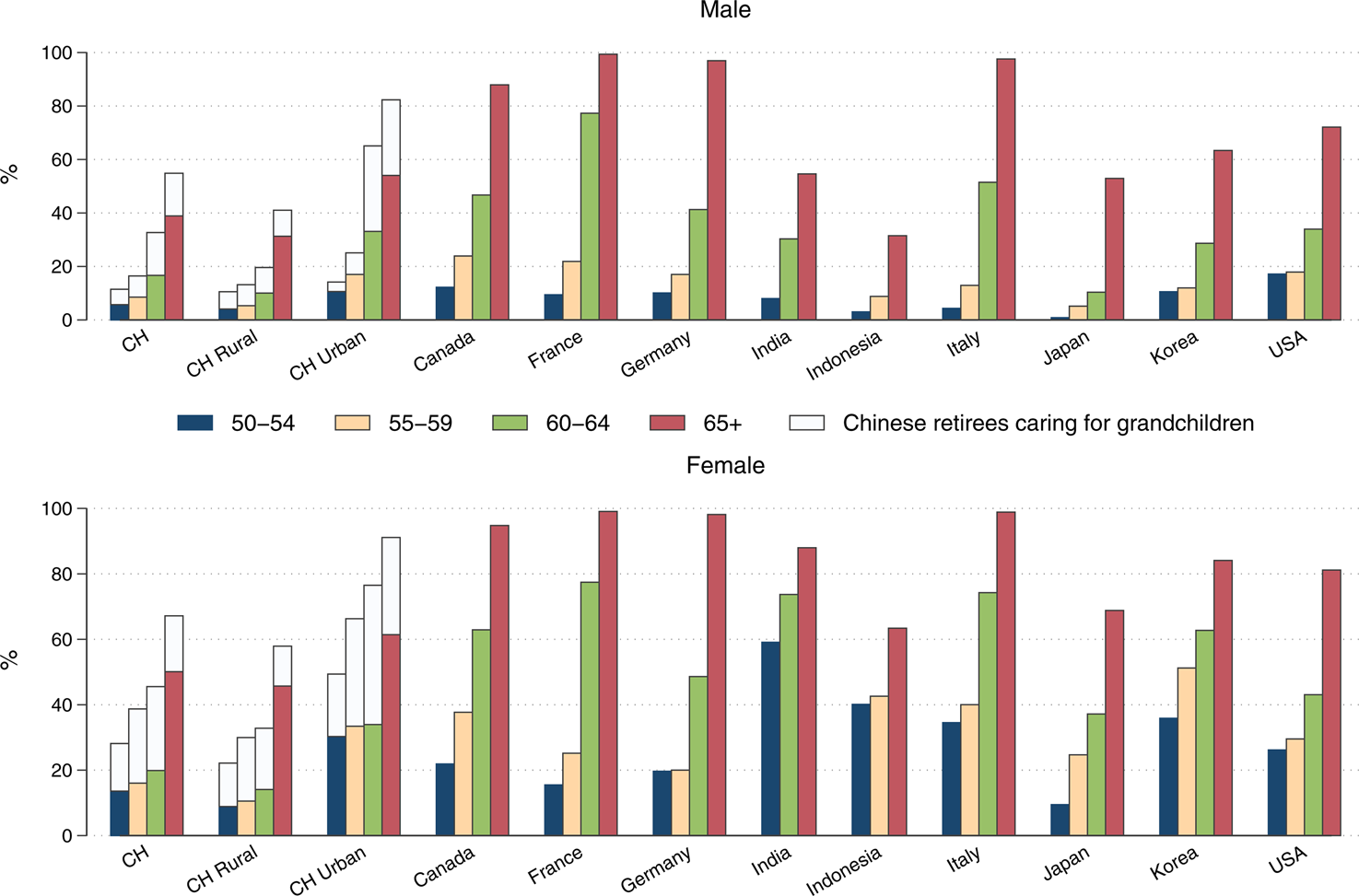
To give an international perspective on the Chinese retirement rate, Figure 3 highlights differences in retirement rates in China in comparison with seven Organization for Economic Co-operation and Development (OECD) countries (France, Germany, Italy, Canada, USA, Japan, and Korea) and two large Asian developing countries at a similar stage of economic development (India and Indonesia). For each country, we present retirement rates by 5-year age cohorts: 50–54, 55–59, 60–64, and 65+.Footnote 6 The top panel is for men, and the bottom is for women. For China, the height of each entire bar measures the retirement rate for each age group, comparable to other countries. To provide a sense of the importance of China's retirees as care providers, we also decompose China's retirement rates into the percentages of those caring for their grandchildren and those who do not, shown separately in white and the color of each age group. Men in India and Indonesia clearly exit employment much later than their richer OECD counterparts. Even within OECD countries, large differences exist, especially in the age group near benefit eligibility (55–59 and 60–64), which is a key feature of retirement policy (Gruber and Wise, Reference Gruber and Wise1998). For women, differences in retirement patterns among younger groups between the OECD and India and Indonesia are less pronounced as a result of differences in gender roles, but the same pattern emerges among older women, i.e., developed countries have higher rates of exit from work, and large differences exist within the OECD. The retirement pattern of China's rural workers looks much like patterns observed in India and Indonesia, but urban people retire at similar rates as in rich OECD countries. Among the 60–64 age group, the retirement rate of urban men far exceeds that in the USA, Canada, Japan, and South Korea and is on par with that observed in Western European countries. Although only 34.9% of urban Chinese men aged 60–64 are working, employment rates for this age group are 66.1% in the USA, 53.3% in Canada, 89.6% in Japan, and 71.4% in South Korea. Among the 55–59 age group, the Chinese urban women's retirement rate is the highest of all countries, exceeding even Western European welfare states. The younger age cohort of Chinese urban women, 50–54, overtakes European counterparts by an even larger margin. Although only 51.6% of urban Chinese women aged 50–54 are working, employment rates for women are 73.8% in the USA, 78.1% in Canada, 90.5% in Japan, and 64.1% in South Korea. Even in Italy, where evidence from Figure 3 suggests that retirement rates are the highest in Europe, 65.5% of women are working, which is 13.9 percentage points higher than among Chinese urban women. Almost half of Chinese women retirees under 65 take care of their grandchildren. If we exclude women caring for grandchildren from retirees, the retirement rate for women aged 50–54 drops to 13.6%, only slightly above the rates in France and Germany.
China's retirement rate in international perspective. Retirement rates by country, gender and age. Note: For China, the height of each entire bar measures the retirement rate for each age group, comparable to other countries. Retirees in this figure exclude 90 individuals who were unemployed and looking for jobs, to be consistent with statistics of other countries. We also decompose China's retirement rates into the percentages of those caring for their grandchildren and those who do not, shown separately in white and the color of each age group. Source: (a) China/CH: CHARLS, 2018, National Survey; (b) France (2014), Germany (2014), Japan (2010), Korea (2014) and the USA (2016): HRS-family harmonized data from the Gateway to Global Aging Data (g2aging.org); (c) Canada (2006), India (2001) and Indonesia (2005): ‘An Aging World: 2008’, issued by NIA of NIH, U.S. Department of Health and Health Services.

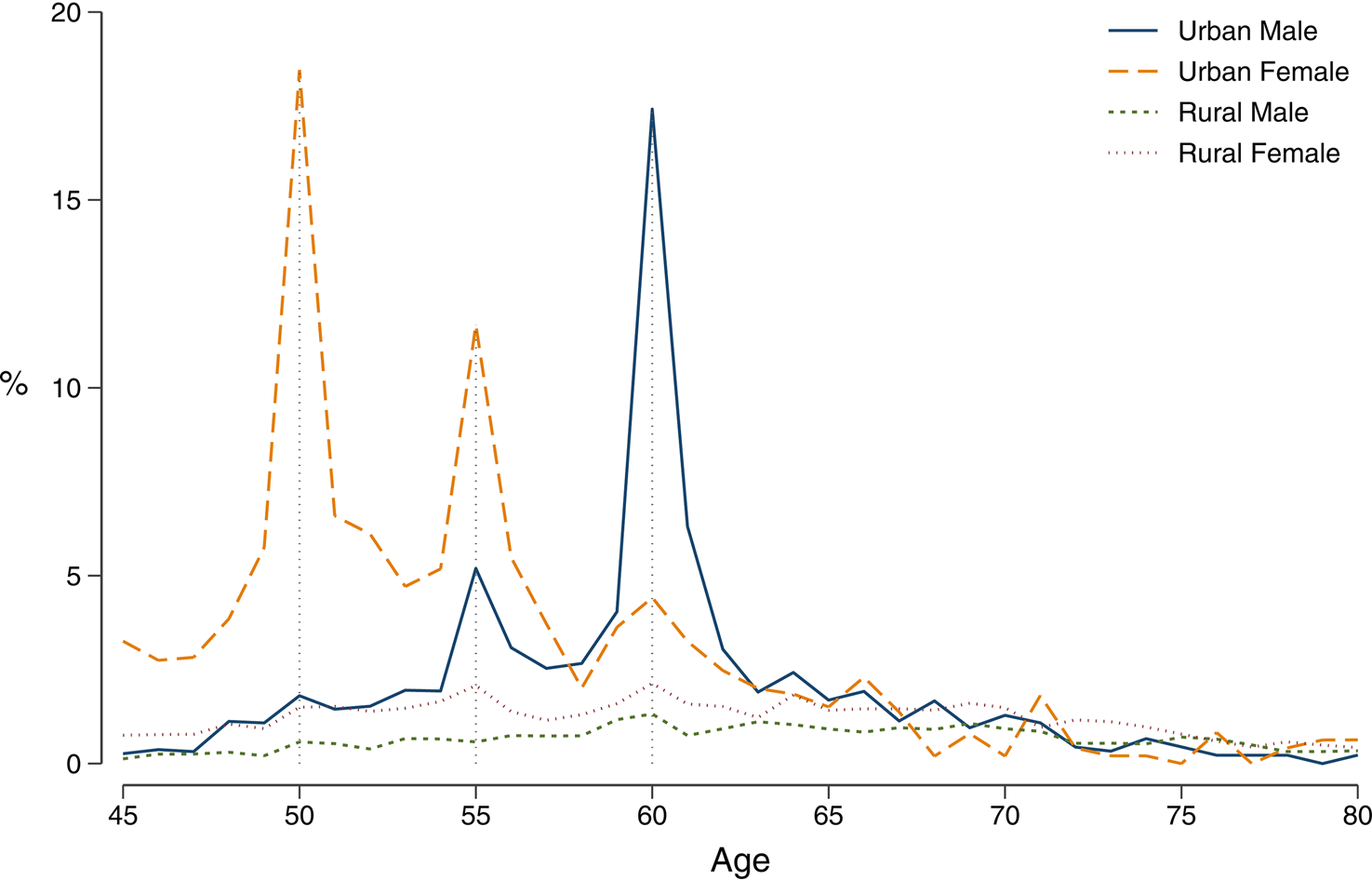
Another important phenomenon revealed in Figure 2 is that a substantial number of urban people have exited the workforce before official pension eligibility ages, which are set at 60 for men and at 50 and 55 for blue-collar and white collar-women, respectively. A total of 23% of urban men aged 55–59 have retired and nearly 50% of urban females have stopped working by 50–54. The presence of such substantial early retirement is further evidence of potential easy exits from work in urban areas, but more importantly, such early retirement is unsustainable in the face of population aging.
4. Mechanisms influencing retirement in China
In this section, we explore the institutional and policy origins of the significant difference in retirement patterns of China's urban and rural residents.
4.1 Mandatory retirement provisions under the Urban Employee Pension
The requirement that participants of the Urban Employee Pension program retire from their formal employment and start drawing a pension leads to a sharp break in employment. This association is evident in Figure 4, which shows the hazard rate of retirement. The retirement hazard rate is defined as the percent exiting employment in 2018 by age cohort among those who worked in the previous year, calculated over the entire sample of respondents, is over 18% (11) at age 50 (55) for urban blue (white) collar women, and 17% at age 60 for urban men. On the contrary, the retirement hazard for rural men and women does not exhibit sharp jumps, which is consistent with the hypothesis that the mandatory administrative retirement policy under the Urban Employee Pension is a major driving force behind observed retirement patterns.
Unconditional retirement hazard rates. Note: Hazard rates at each age are defined as the percentages of those who exited employment at the specified age among those who exited no earlier than the age. Source: CHARLS (2018), National Survey.

4.2 Social security coverage, generosity, and embedded incentives
The incentive for retirement created by the ability to draw a pension is well documented in the literature, especially concerning retirement timing (Stock and Wise, Reference Stock and Wise1990; Coile and Gruber, Reference Coile, Gruber and Wise2001). In the urban sector, pension programs associated with mandatory retirement policy are well established, and qualified retirees receive a pension based on certain characteristics of their employment history (Feldstein, Reference Feldstein1999). In rural areas, however, the NRP program has only been phased in since 2009. It has lower coverage, less generosity, and does not require exiting from work (agricultural activities) to claim it.
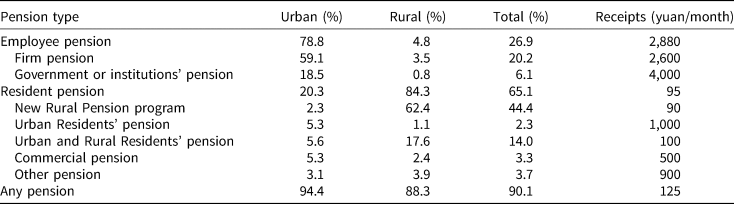
In Section 2, we referenced evidence from other work on replacement rates from the Urban Employee Pension and Resident Pension programs using administrative data. Table 2 describes evidence from CHARLS on pension coverage and monthly receipts by type in urban and rural areas. From the bottom line, we observe 94% of the urban elderly covered by at least one pension, while the fraction is as low as 88% for their rural counterparts. The urban pension comes mainly from the firm or government institution pension (76.9%), while rural people are covered primarily by the NRP program (60.5%), which is much less generous (90 yuan/month only).
Pension coverage and receipt by pension type (%)

All numbers are weighted.
Note: Pension receipts are calculated at the median for each type. Although the NRP program and URP program were merged into the Resident Pension program in 2015, many CHARLS respondents know the pension under their legacy names. We break them down here for clarity. Firm pension is formally called urban employee pension. Commercial pension refers to individually purchased insurance pension plans.
Data source: CHARLS survey, 2018.
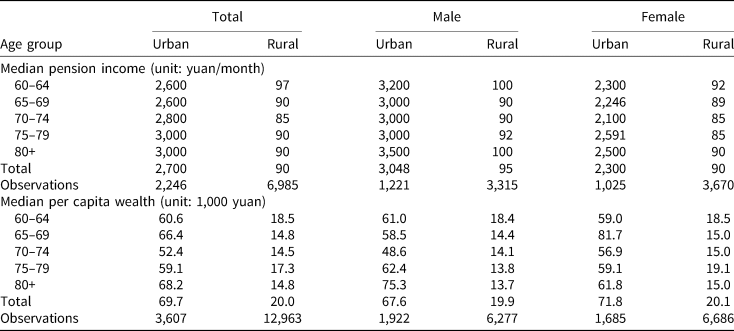
Pension coverage and generosity may be a driving force behind the retirement decision. The retirement rate for those covered by a pension is higher than those who are not across all age groups. When further separating by urban–rural classification, the difference only exists in urban areas and is statistically significant across most age ranges, while there is no difference in rural areas, suggesting that the rural pension may not be sufficient to support an exit from work. To support this claim, the top panel of Table 3 presents the median pension income of retirees with at least one pension. As expected, we observe a large urban–rural gap: the pension income of urban retirees is much higher than for their rural counterparts (3,000 vs. 95 Yuan/month). This difference persists for both men and women of all age groups. Even if one considers the differences in cost-of-living between urban and rural areas, this gap is still large.
Pension income and wealth

All numbers are weighted.
Note: Median pension income is calculated conditional on not working and being entitled to at least a pension currently or in the future, using the data of CHARLS 2018. Median per capita wealth is based on the data of CHARLS 2011.
Data source: CHARLS survey, 2011–12, 2018.
4.3 Economic resources
The importance of economic resources in the decision to retire is well documented in the literature (Poterba et al., Reference Poterba, Venti and Wise2011). Retired households are dependent on annuitized income streams (pension income) that they have built up during their working careers and on the wealth that they have accumulated in other forms. The 2011 CHARLS survey round enumerated information on respondents' wealth, including assets and home equity, with which we calculated the per capita wealth of each household. The bottom panel of Table 3 presents median per capita wealth in 2011 by hukou, gender and age, which shows that the wealth of urban people is nearly three times that of the rural people and this urban–rural discrepancy exists for all age groups, and for both men and women. The wealth gap is driven by long-standing income gaps between urban and rural areas and partly by an urban housing boom and sharp appreciation in home values that disproportionally benefitted urban residents. Furthermore, rural residents do not formally own the land that they farm: farm households have usufruct rights secured through long-term leases from the village collective. Although recent reforms have allowed farmers to sublease their land, they cannot sell their rights to land or use it as collateral.
4.4 Expected types of support
In addition to pension incomes and accumulated wealth, there may be other sources of support that China's elderly population might count on, and such support may affect retirement decisions. Adult children, for example, are frequently an important source of elderly support (Cai et al., Reference Cai, Giles and Meng2006; Zhang and Goza, Reference Zhang and Goza2006).
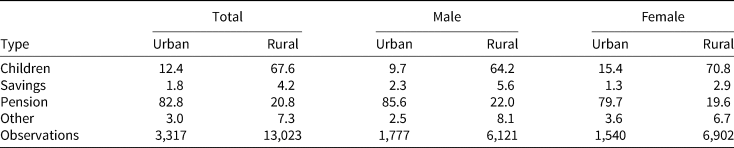
The CHARLS dataset provides insight into ‘retirement expectations’. Specifically, respondents are asked to state their expected primary source of economic support in old age when they lose the ability to work, choosing from the following options: from children, from own savings, from a pension, and from other sources. Table 4 summarizes the statistics by hukou and gender. As is revealed, the majority (82.8%) of urban respondents expect to rely on pensions, while the comparable figure for rural elderly is low (20.8%). This is consistent with less generous pension benefits under the resident pension program for rural people. Rural people overwhelmingly expect children to support them (67.6%), while only 12.4% of urban people expect children to be their primary source of support. The fraction expecting to rely on savings is low for both urban and rural people.
Expected source of economic support by type (%)

All numbers are weighted.
Data source: CHARLS survey, 2018.
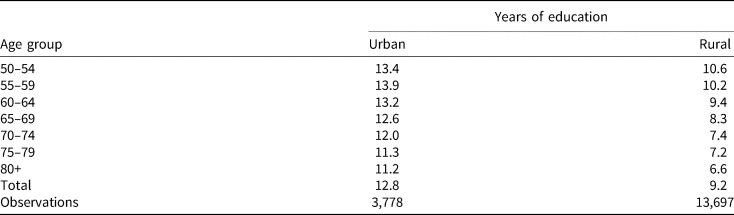
Given the paramount importance of children for the rural elderly, we examine what rural children have to offer. In absolute numbers, rural people have more children (2.68 among the rural elderly vs. 1.98 among urban elderly). However, if we look at earnings potential as reflected in educational attainment, the story is quite different. Table 5 shows the average years of education of children. Although adult children's years of education increase for younger cohorts of urban and rural people, the urban–rural difference remains (12.8 years for urban vs. 9.2 years for rural, on average). Children of rural residents consistently have lower education than their urban counterparts across all age groups. As the returns to a year of schooling are quite high in China, this suggests that the capacity to provide financial support in the future is lower for rural children than their urban counterparts. In other words, adult child support for rural elderly is unlikely to be as generous as the pensions and wealth that are drawn on by the urban elderly.
Education of children

The sample is restricted to respondents with at least one child.
All numbers are weighted.
Data source: CHARLS survey, 2018.
4.5 Other demands on time
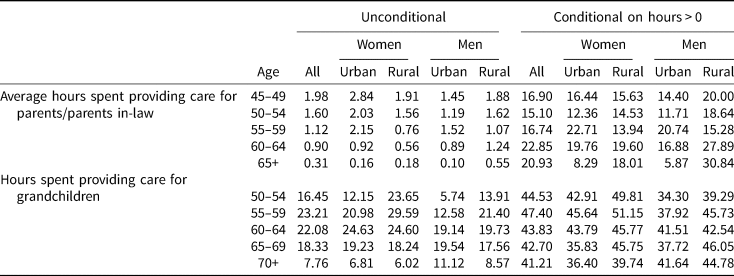
One obstacle to longer working lives, particularly for women, is the demand for ‘labor’ in household activities other than farming or other self-employed market-oriented work. Although few data sources provide information on time use, summary evidence from CHARLS, presented in Table 6, highlights the importance of older women in both child-rearing and eldercare. The first set of comparisons for men and women examine unconditional averages, and a second set examines average hours per week conditional on providing at least 1 h of care. Urban women between 55 and 60 years of age spend a considerable amount of time caring for grandchildren (24.6 h per week unconditional, and 45.6 h per week conditional on providing care). In rural areas, the peak ages for women to provide childcare are also between 55 and 60, for whom there is a conditional average of 51 h spent providing care. Time spent providing eldercare is somewhat lower, but conditional on providing care, urban and rural women aged 55–60 provided 23 and 14 h per week, respectively, in the 2011 CHARLS survey round (time spent on eldercare was not included in later CHARLS survey rounds). Somewhat surprisingly, both unconditional and conditional rates of care provision for elderly parents are modestly higher for rural men than women. The use of male support may reflect strength requirements for such activities as assisting disabled elderly in use of the toilet or in getting out of bed and dressing.
Time spent providing care to grandchildren and parents

Source: Hours caring for parents from CHARLS 2011 and hours caring for grandchildren from CHARLS 2018. (Hours spent on support of parents are not available in CHARLS 2018.)
As age 55 is the retirement age for white-collar women in urban China, it is reasonable to question whether family needs for care are responsible for exit from the workforce. Upon retiring, women may simply look for ways to help their families. We will examine correlations between potential family needs and labor force participation of women below, but it is possible that eligibility to start drawing a pension (at 50 and 55 for blue- and white-collar women, respectively) swamps the effect of potential care provision needs. Nonetheless, if one wants to create incentives for longer working lives, policy makers may need to confront expectations that China's relatively young urban-retired women (and their children) expect to spend their 50s providing care for family members.
5. The retirement decision of older adults
5.1 A model of labor supply
We examine the determinants of the labor supply (employment) of older workers, recognizing that important correlates, such as access to pensions, may be systematically related to both financial resources and unobservable characteristics (e.g., ability). Although these models should be viewed as providing descriptive evidence, we choose measures of health status and proxies for wealth and family characteristics with the aim of minimizing endogeneity biases.
As a framework for analytical explorations into the ‘retirement’ and labor supply decisions of the elderly, we assume that individuals (or households) maximize utility subject to a family budget constraint, which is a function of wealth, labor and non-labor income, available time and health status of household members. From the constrained utility maximization decision, we conceptualize a general model of labor supply:

where labor supply (or employment) of individual i, $L_i^S$ , is a function of household wealth $W_i^h$
 , income from work of all household members $I_i^w$
 , income unrelated to current work, $I_i^{nw}$
 , health status, H i, an individual's time endowment, T i, a vector of individual and household characteristics reflecting preferences, Xi which include the demographic characteristics of own and household members. Given the likely variation in opportunities and returns to labor across geographic regions (e.g., Jalan and Ravallion, Reference Jalan and Ravallion2002), we control for potential unobserved county-level characteristics affecting labor supply with a vector of county (or city) level indicators, Vj. Identifying the effects of each of these variables are complicated by three factors which may introduce bias into our estimates: (1) some are imperfectly observed; (2) there are significant inter-relationships among important variables (e.g., health status may affect income through productivity, available time and available household wealth); and (3) that labor supply of an elderly individual may be simultaneously determined by the labor supply decisions of other family members, especially a spouse. In order to reduce such bias, we estimate reduced-form models with proxies for longer-term determinants of (permanent) income and wealth.
First, we do not directly observe a long-term measure of household wealth ($W_i^h$ ), but indicators of educational attainment and hukou status are useful proxies for lifetime wealth. Furthermore, although the current labor income ($I_i^w$
 ) of a household will also be systematically related to own and family member labor supply decisions, the educational attainment of the elderly themselves is likely to be associated with lifetime earnings and accumulated wealth of the household. In addition, the educational attainment of a spouse acts as a proxy for the value of a spouse's labor and contribution to accumulated wealth.
Health status also affects productivity and ability to earn income through its impact on work capacity. Elderly who are ill or suffer physical limitations may be unable to work, and so we make use of self-assessments of ability to perform activities of daily living (ADLs) and instrumental activities of daily living (IADLs) as proxies for health status. In sum, the complete set of proxies for $W_i^h$ , $I_i^w$
 and H i in the reduced form are categorical educational attainment indicators, age and its square, measures of the health status of the respondent (number of ADL and IADL difficulties), and the educational attainment of a spouse of the household. As some older workers may find that their time is best utilized in the provision of care to relatives and that this may influence employment decisions, we also include the numbers of grandchildren and living parents, respectively, of the household head and spouse. We estimate the following reduced form of labor supply model:

where labor supply, $L_i^S$ , is a binary indicator of whether individual i has worked during the previous year. We expect that higher levels of educational attainment of elderly, E i, will be associated with higher wealth and savings and, as leisure is a normal good, may be negatively related to elderly labor supply.Footnote 7 Similarly, we expect that pension receipt,Pen i, and spouse pension receipt, Pen −i, will be negatively related to employment. For formal sector urban employees, the decision to take administrative retirement and to start receiving a pension requires an exit from a formal sector employer. Therefore, we should expect to see a significant negative effect of pension receipt (pension receipt is a decision). That said, workers who have processed formal administrative retirement are not penalized with reduced pensions if they choose to return to work. Receiving a generous pension does not preclude working.
The health of older workers and elderly are measured using the count number of disabilities, Dis i.Footnote 8 For each of the four data sources, we include the number of ADL and IADL activities that the respondent has difficulty performing (including those he or she cannot perform). Working decisions may be affected by the health status of a spouse, and for this reason, we also include a measure of spouse health status, Dis −i. One may plausibly observe an added worker effect, in which a spouse's health shock leads to increased labor supply to insure income against the earnings–loss associated with the health shock (e.g., Coile, Reference Coile2004), or find that spouse care needs will require exit from the labor force (e.g., McGeary, Reference McGeary2009).
We expect that declining health will have a negative impact on work activity, particularly for those workers in physically demanding occupations (Bound, Reference Bound1999). We also control for a vector of individual and household characteristics,Xi, which include age and age-squared that are associated with own productivity, numbers of young household members (age 0–6) and the number of elderly household members (age 80 and above) of the head and spouse that are associated with preferences for employment, and other indicators of the demographic structure of the household.
A large literature in the USA has focused on the important roles of spouse employment and spouse health status in labor supply and retirement decisions. Structural models (Blau, Reference Blau1994; Gustman and Steinmeier, Reference Gustman and Steinmeier2004) suggest that labor supply decisions of older couples reflect preferences for shared retirement. With this in mind, we also examine the correlation between labor supply decisions of husbands and wives. Our final model thus includes an indicator for the employment status of a spouse, $L_{{-}i}^S$ , as well as an indicator for whether or not the respondent has a spouse. The final model estimated is thus:

As the labor supply decisions of husbands and wives are likely to be jointly determined and have a dynamic relationship with health and shocks to health and employment, we view these models as purely descriptive but informative of the extent to which joint labor supply decisions may affect the timing of retirement. By exploiting the full panel in more comprehensive analyses, it will be feasible to control for unobservables and to unlock directions of causality among these variables.Footnote 9
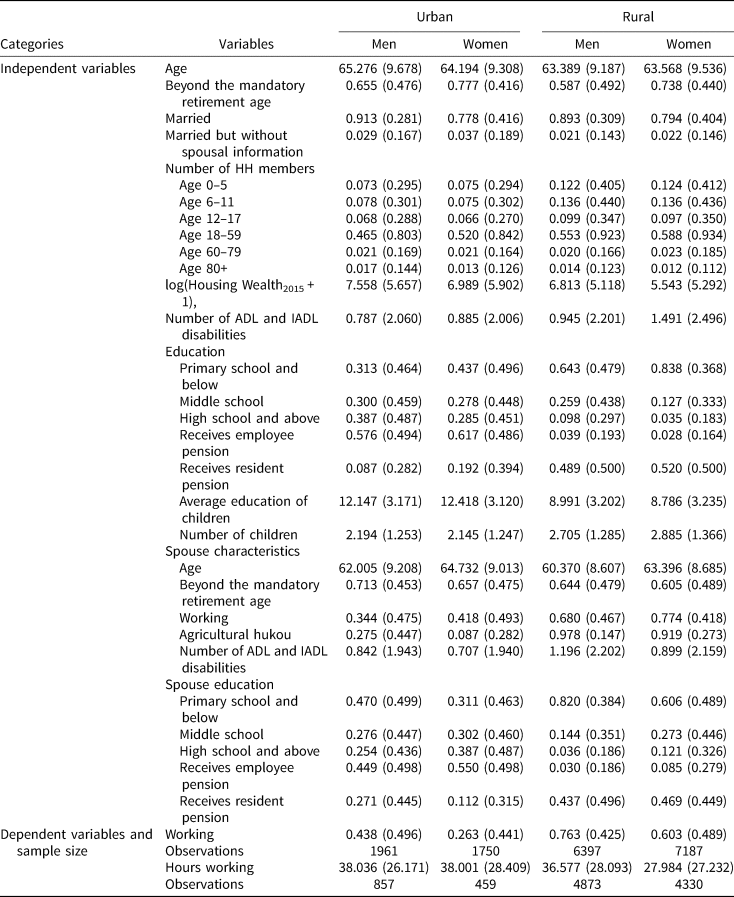
Descriptive statistics for our full set of regressors are shown in Table 7. As men and women in urban and rural areas likely faced different educational opportunities in their youth, labor market conditions in working age and the prospect of different retirement systems, we estimate models separately by gender and Hukou.
Summary statistics for labor supply models

Mean and standard deviations are calculated for each variable within one of the four groups. Standard deviations in parenthesis.
Source: CHARLS 2018.
5.2 Determinants of ‘retirement’ in China
5.2.1 Employment and pension receipt
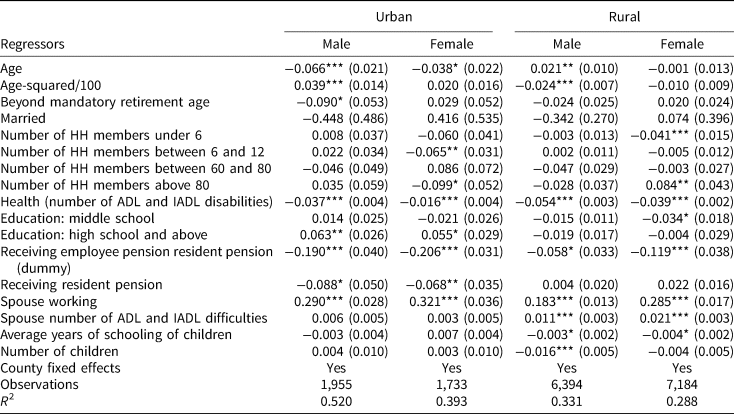
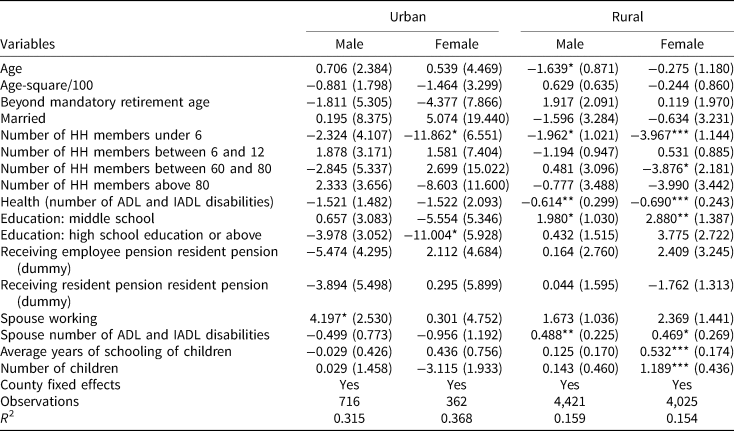
In Table 8, we show results from estimating the labor supply model presented in specification (3).Footnote 10 The results suggest the role that pension income plays in decisions to exit from the labor force. After controlling for age, education, the health status of the respondent and spouse, proxies for wealth and family demographic characteristics, receiving an employee pension is associated with a 19 and 20.6 percentage point reductions in employment for men and women, respectively, in urban China (Table 8). Given that 43.8% and 26.3% of urban men and women over 50 are employed (Table 7), these correspond to 43% and 78% reductions in the probability that urban men and women are working. Receiving the resident pension in urban areas is also associated with a reduction in the probability of working, but as this pension is not as generous, the impact is not as great in magnitude. Receipt of the resident pension is associated with 8.8 and 6.8 percentage point reductions in employment for men and women (or 21% and 26% reductions). In rural areas, relatively few residents receive an employee pension (primarily individuals who had been employed in township or county government units) and association between the receipt of the employment pension and the probability of working is modestly negative, while receipt of the resident pension is not associated with a change in work status.
Associations of pension receipt, health status and other characteristics with the employment of china's older residents

Dependent variable: currently working.
Other regressors (not shown) include: an agricultural hukou indicator, number of household members between 12 and 18, number of HH members between 18 and 60, log(Housing Wealth2015 + 1), an indicator for married without spouse information, spouse age, spouse age-square/100, spouse beyond the retirement age, spouse has agricultural hukou, spouse completed middle school, spouse competed high school, spouse receives a pension and county fixed effects.
Note: Standard errors clustered at the household level shown in parentheses: ***p < 0.01, **p < 0.05, *p < 0.1.
Source: CHARLS 2018.
In urban China, mandatory retirement provisions limit the scope for employment in larger formal sector workplaces beyond age 60 for men, and 50 and 55 for blue- and white-collar women, respectively. Although there are no explicit provisions or biases against working beyond the retirement age in urban China, the relative generosity of the urban employee pension combined with mandatory retirement makes it less likely. In rural China, the lack of an association between receipt of the resident pension and labor supply decisions makes sense giving the low value of these pensions, and is consistent with earlier evidence suggesting that the NRP had no impact on labor supply (Zhang et al., Reference Zhang, Giles and Zhao2014).
A respondent's educational attainment may be related to accumulated wealth (and ability to retire) but also with potential current returns available in the labor market, and thus we have no a priori prediction of how retirement will vary with education (and presumably skill) after controlling for pension receipt. Interestingly, we find that urban men and women with high school education or above are significantly more likely to be employed than those with primary school education or below(6.3 and 5.5 percentage points, respectively). In urban areas, this may partially reflect the fact that educated white-collar women are eligible for a pension at 55, as opposed to 50 for blue-collar women. As the coefficient of education is significant after controlling for pension receipt and an indicator for beyond mandatory retirement age, however, it reflects the fact that more educated women are more likely to return to work even after processing retirement, suggesting that skills are important for promoting continued work at older ages.
5.2.2 Work and health status
Lower health status, as measured through the count index of difficulty performing ADLs and IADLs, is strongly associated with reductions in employment. The coefficients on ADL–IADL difficulties, shown in Table 8, reflect the percentage point change in probability of employment associated with an increase of one disability. Given employment rates less than 100%, the percentage changes in the probability of employment with a disability will be larger. An increase in one disability is associated with 3.7 and 1.6 percentage point decreases in employment for men and women, respectively. They amount to 8.4% and 6.1% increases in the probability of exit from the workforce for currently employed men and women, respectively. In rural areas, coefficient estimates are somewhat larger, but a larger share of the population is working. Thus, coefficients on the ADL/IADL index of 5.4% and 3.9% for men and women in rural areas, where 76% and 60% work, respectively, amount to 7.1% and 6.5% reductions in the probability of working for each additional disability. As most work in rural areas is more physically demanding and rural residents are working until later ages, the stronger negative association of health to the probability of working in urban areas is particularly striking and underscores the difficulty of retiring for China's rural residents.
5.2.3 Employment and spouse health status
Examining the relationship between employment and spouse health status, also calculated using an index of spouse ADLs and IADLs, in Table 8, we find evidence of a significant and relatively small added worker effect if a spouse suffers a disability. The magnitudes are not large: coefficient estimates of 0.006 and 0.003 for men and women in urban China, and it is not statistically significant for women, and 0.01 and 0.02 in rural areas. These correspond to 1.4% and 1.1% increases in the probability of employment for men and women in urban areas, respectively, with an increase in each spouse disability and 1.3% and 3.3% increases in rural areas. As individuals may have more than one difficulty with an activity of daily living, the cumulative effect will naturally be more significant. In research using the US Health and Retirement Survey, the small positive effect of spouse disability on labor supply is interpreted as evidence of an inability to smooth income loss associated with health shocks (Coile, Reference Coile2004). Another perspective, however, might be that there are some differences across countries in the financial effect of health shocks. In China, the fact that older workers are more likely to work when a spouse is ill may reflect a greater need to cover the effects of both lost income and unreimbursed financial costs associated with health care.
5.2.4 Family care provision and employment
Requirements of families for the care of children or the elderly may also influence decisions to retire. As co-residence, since care and retirement decisions may be made jointly, we should take care in assigning a causal relationship between the exit from work and the presence of children or the elderly. However, many studies show that the provision of family care is associated with fewer working hours and a higher probability of retirement and exit from the workforce (Meng, Reference Meng2011; Van Houtven et al., Reference Van Houtven, Coe and Skira2013; Jacobs et al., Reference Jacobs, Laporte, Van Houtven and Coyte2014). Finding a negative relationship between the presence of children or elderly in the household and employment would suggest public support for care through pre-school or elderly community centers might influence labor supply decisions of older women, particularly if the opportunity cost of foregone earnings in the labor market is high (e.g., Bolin et al., Reference Bolin, Lindgren and Lundborg2008). For China, information on time allocation, available in the CHARLS, suggests that women in their 50s contribute significant amounts of time to the provision of childcare and eldercare. The contribution to childcare is also underscored in the labor supply models’ estimate in Table 8. The presence of an additional child under age 6 in the household is associated with 6 and 4.1 percentage point reductions in the probability that urban and rural women work, respectively. For urban women, the presence of a child between 6 and 12 years of age is associated with a 6.5 percentage point reduction in the probability of working, while there is no strong correlation between the presence of elementary-age children and the labor supply of women in rural areas.
5.2.5 Number of children, child educational attainment, and the retirement decision
As adult children are an important expected source of support for older Chinese in rural areas, it is worth emphasizing that increases in potential financial support from adult children, evident in both the number of children and their average educational attainment, are associated with the ability to exit from work. By contrast, no similar effect is evident in urban areas. A 1-year increase in the average years of schooling of adult children is associated with 0.3 and 0.4 percentage point reductions in the probability that rural men and women are working, respectively. Furthermore, an additional adult child is associated with a 1.6 percentage point decline in the probability that a man is working.
5.2.6 Interdependence of spouse-retirement decisions
The strong correlation between husbands and wives' employment suggests that spouses make joint labor supply decisions and may have a preference for retiring together. Although not causal relationships, the correlations between own and spouse labor supply are economically and statistically significant. In urban China, employment of a spouse is associated with 29% and 32% increases in the probability that men and women are working, respectively. In rural China, coefficient estimates suggest that a working spouse is associated with 18% and 29% point increases in probabilities the men and women are working, respectively. Joint labor supply, or retirement, decisions of spouses are of considerable policy relevance when considering incentives to increase the working ages of men and women. In China, where women have a lower retirement age than men, a gradual increase in the mandatory retirement age for women would likely lead to increases in the labor supply of both men and women. Apart from strong correlations in the work status of spouses observed in these data, other research exploiting natural experiments suggests that an increase in women's retirement age will increase the probability that men will work longer. Cribb et al. (Reference Cribb, Emmerson and Tetlow2013) exploit the gradual increase in the minimum age of state pension eligibility for women in the UK, and find that women's employment rates at age 60 increased by 7.3 percentage points when the state pension age was increased from 60 to 61, and the employment rates of their male partners also increased by 4.2 percentage points. The authors argue that the increase can be explained as the result of preferences for joint retirement more than the effects of either credit constraints or a response to financial incentives to work. Looking strictly at labor force participation, Schirle (Reference Schirle2008) finds that an increase in wives' participation in the labor force can explain one-fourth, one-half and one-third of the increase in older married men's labor force participation in the USA, Canada and the UK, respectively.
5.3 Is there evidence of gradual retirement?
In developed countries, retirement is often a gradual process: workers may reduce working hours at present employers, move to work arrangements requiring fewer hours per week or even transition in and out of retirement.Footnote 11 Using the US Health and Retirement Study (HRS), Gustman and Steinmeier (Reference Gustman and Steinmeier2000) find that 22% of the population reported being partially retired at some point and that a fifth of the population had partially retired by age 65. Exits from employment, or the labor force, are also not always permanent: Gustman and Steinmeier's study finds that over four waves, 17% of the sample experienced a reversal in which they moved from less-intensive work to more work.
In urban China, one might expect that low unemployment rates and skilled labor shortages will offer older skilled workers opportunities to re-enter the workforce. Their willingness to do so may depend, in part, on the ability to continue working later in life but for fewer hours. In China, hours of work conditional on working for both urban and rural residents remain quite high. Hours of work for those still working in urban areas (primarily the self-employed) tend to decline little and then drop off sharply around age 70.
Rural workers tend to work much longer hours, and given the physical requirements of farmers, those in poor health simply cannot work. Men and women working in agriculture still put in long hours at relatively old ages, which for one thing suggests that the absence of migrant adult children might contribute to a scarcity of labor and higher labor input of rural elderly in China; and for the other reflects the demand for longer working time to earn enough subsistence due to declining marginal productivity of older workers. To get a sense of how institutions and individual characteristics influence the intensity of work at older ages, we next estimate models similar to earlier employment regressions and examine the correlation of pension receipt, education, health status, spouse health and spouse employment status on hours of work for those who are still employed.
The estimation results are presented in Table 9. The coefficients are in general less significant compared with the regression on probability of working in Table 8, especially for urban residents, indicating that hours of formal work may not adjust with the levels of pension support: conditional on choosing to work, pension receipt does not significantly influence hours of work.
Correlations of hours worked conditional on working

Other regressors (not shown) include: an agricultural hukou indicator, number of household members between 12 and 18, number of HH members between 18 and 60, log(Housing Wealth2015 + 1), an indicator for married without spouse information, spouse age, spouse age-square/100, spouse beyond the retirement age, spouse has agricultural hukou, spouse completed middle school, spouse competed high school, spouse receives a pension and county fixed effects.
Note: Standard errors clustered at the household level shown in parentheses: ***p < 0.01, **p < 0.05, *p < 0.1.
Source: CHARLS 2018.
Conditional on choosing to work, high school education is negatively associated with hours of work per week among urban women, suggesting that more educated older urban women are able to find work with reduced hours. By contrast, completion of middle school education is positively associated with work intensity for rural men and women relative to those with primary education or less. One suspects that other dimensions of health status and cognitive ability may be correlated with completing at least middle school, and contribute to this association.
With respect to health status, an additional ADL–IADL disability is associated with reduced working hours for both men and women in rural China. This reflects the ‘working-till-dropping’ phenomenon that observers argue has long characterized the lives of older farm workers in China (e.g., Pang et al., Reference Pang, de Brauw and Rozelle2004). Poor health status of a spouse leads to an added worker effect in rural China: hours worked increases for both men and women in rural China with each additional functional limitation suffered by a spouse.
6. Conclusions
At lower levels of economic development and with a significant share of the elderly population vulnerable to falling into poverty, China's population is aging rapidly. To provide insight into the types of policy that might promote longer working lives and ease some strain from rising old-age dependency ratios, we describe the patterns of labor force participation in rural and urban China and the institutions that shape these patterns.
In examining older workers' employment patterns in a multivariate framework, the paper highlights the roles of pension receipt, spouse work status, family care requirements and health status. In urban China, where the Urban Employee Pension requires separation from one's employer at relatively young ages, and provides relatively generous pensions, we observe a strong relationship between pension receipt and exit from work. In consideration of recent findings by Hou et al. (Reference Hou, Wang, Wang and Zhao2021), that urban Chinese have a significant amount of unused health capacity to work, the observed early exits from work call attention to the importance of developing and unifying the Chinese old-age support system. To reduce the urban–rural discrepancy in retirement while also easing the burden of population aging, it is reasonable to encourage delays in the retirement age in urban sectors, and at the same time redesign the rural pension system so as to increase incentives to participate in plans with the higher levels of accumulation and expected future benefits. Participation in these plans will facilitate a secure retirement for future rural elderly.
Raising the retirement age is often politically unpopular, and this partially reflects opposition to increases in the age of eligibility for a pension. Concerns include fears that raising the retirement age will make it more difficult for young adults to find work, a lack of fairness for enterprise employees relative to civil servants and a belief that older workers (of the Cultural Revolution generation) are unproductive and lack skills (NETEAST, 2012). These types of concerns are not uncommon in other countries, but from the experiences of OECD, one suspects that these fallacies and misperceptions are likely to change with the increasing scarcity of labor. Much of the Cultural Revolution generation has already retired, and the education levels of workers in their late-middle ages will continue to rise, increasing the ability to learn new skills in middle age and to continue working at older ages.
Under China's 14th Five Year Plan, policy makers have highlighted a renewed focus on gradually raising the retirement age. One proposal suggests raising it by 1 year every 6 years for men, and by 1 year every 3 years for women. Even if this proposal was to be adopted, it seems unlikely that it will be sufficient to ease fiscal pressures on the Urban Employee Pension program.
Research conducted in the USA and Europe suggests that one might provide incentives within the pension system to encourage retirement later in life (Coile and Gruber, Reference Coile and Gruber2007; Gustman and Steinmeier, Reference Gustman and Steinmeier2009; Robalino et al., Reference Robalino, Zylberstajn, Zylberstajn and Afonso2009; Vere, Reference Vere2011).Footnote 12 Moreover, correlations in the retirement of spouses, reflecting coordination of retirement planning, raises the prospect that incentivizing women to remain in the labor force after 50, or 55, may encourage delayed retirement of their husbands as well.
The role played by women in providing care within the family implies that removing barriers to work at older ages, such as mandatory retirement, will not be sufficient to raise the employment rates for women. In the absence of both markets for care providers and public provision of care, older women may need to devote time to providing care for children or the elderly. Finding ways to support care for both young children and the elderly may make it feasible for women to extend their working lives.
Feasible extension of working lives also requires that older workers are physically and mentally capable of working, and poor health status is associated with exit from work. To the extent that younger generations are healthier than their older parents, as a result of better nutrition in their youth, and are more often engaged in white-collar occupations, low health status may not pose a significant obstacle to extending working lives.
Financial support
Grant support for research and the collection of survey data used in this paper (the China Health and Retirement Longitudinal Study, CHARLS) came from the National Institute on Aging (R01-AG037031), the Natural Science Foundation of China (72061137004, 72061137005, 8200903768, 8200904489, 71873006 and 72173008), the China Medical Board (16-249 and 20-364), Peking University and the Knowledge for Change Program (KCP) and the Jobs Umbrella Trust Fund at the World Bank.