

Published online by Cambridge University Press: 13 February 2006
Role-playing games and simulations emerged as a classroom techniqueto provide students an experiential or hands-on approach tolearning. Early use of simulations in the political scienceclassroom primarily focused on teaching American politics (Kaarboand Lantis 1997). However, the contemporary use of simulations nowextends into comparative politics (Shellman 2001) and internationalrelations (Jefferson 1999; Thomas 2002).
Role-playing games and simulations emerged as a classroom technique to provide students an experiential or hands-on approach to learning. Early use of simulations in the political science classroom primarily focused on teaching American politics (Kaarbo and Lantis 1997). However, the contemporary use of simulations now extends into comparative politics (Shellman 2001) and international relations (Jefferson 1999; Thomas 2002).
As a pedagogical tool, a number of justifications exist for using simulations. In experiential learning, simulations generate student interest beyond that of traditional classroom lectures (McKeachie 1986), and provide insight into political phenomenon (Walcott 1980). In addition, empirical evidence suggests that simulations enrich the learning environment (Endersby and Webber 1995; Ciliotta-Rubery and Levy 2000; Dougherty 2003).
This article analyzes the impact on student learning of a simulation of the Council of the European Union, a key legislative body of the EU.1
Prior to May of 2004, the Council consisted of two entities: the European Council, the heads of government of the Member States, and the Council of Ministers, various policy-oriented government ministers from the Member States. For this simulation, the focus was on the Council of Ministers.
The simulation was designed for an upper-level political science course, POLS 3200: Introduction to the European Union; the course met regularly during the spring semester of 2004.2
The simulation was initially conducted during the spring semester of 2002, the first time the course was offered at Georgia Southwestern State. Positive feedback from students at the time led to the inclusion of the simulation in the spring semester of 2004, when the course was next offered.
In constructing the simulation, Smith and Boyer's guidelines (1996) provide an appropriate model. The teaching goals of the simulation play an important role in its development. Because of the complexity of the EU, the primary goal of the simulation is to help students understand its politics, including its intergovernmental bargaining among Member States, decision-making processes of the Council, and policy-making procedures. Additional simulation goals focused upon encouraging student-to-student contact outside the classroom and promoting student research beyond classroom assignments.
I developed a number of assignments to achieve these goals. Students completed various reading assignments on the EU, its institutions, and its decision-making processes. Students composed short, three- to four-page writing assignments on important issue-areas currently facing the EU: the proposed constitution, further enlargement, immigration and asylum, and foreign policy. The students wrote these papers from the perspective of an assigned Member State.3
Assignment of Members States occurred by drawing from a hat. Because the number of students enrolled in the course was less than the number of Member States, one student played the roles of Belgium and Luxembourg. Finland, Austria, and Greece were not included in the simulation. Prior to the drawing, the role and function of the president of the Council of the European Union was briefly reviewed and an appeal was made for a student to volunteer for the role. Outside of class, one student came forward to volunteer and assumed that role and the position of Ireland, the Member State holding the presidency for the first half of 2004.
Several key activities occurred during the week just prior to the start of the simulation. Students submitted resolutions by topic or jurisdictional area: immigration and asylum policy, foreign and security policy, transportation policy, etc. Then, the resolutions were sorted so that those requiring unanimity were considered together followed by those needing Qualified Majority Vote (QMV).4
Qualified Majority Voting (QMV) is a weighted voting scheme used for most decisions of the Council of the European Union; QMV roughly reflects the population of the Member States so that more populous Member States receive more votes. Under QMV, a threshold of votes must be crossed for a resolution to pass.
The presidency of the Council of the European Union rotates according to a predetermined order among the Member States every six months.
Several students suggested a practice round after the spring semester 2002 simulation.
The simulation occurred over three class sessions. For the simulation, the students met in a conference room, complete with placards for each Member State and EU accoutrements such as the EU Flag. Students received a daily agenda, drafted by the president; the agenda listed the order in which resolutions were to be considered, crossing functional areas and pillars of the EU. Admittedly, the Council of the European Union meets as separate councils for each of these pillars.7
Normally, the Council of the European Union is divided along functional lines, with justice ministers meeting to discuss Justice and Home Affairs, agriculture ministers discussing agricultural policy, etc. Given the size limitations based upon student enrollment, a functionally divided Council was impossible in this simulation.
For the most part, the number of resolutions that failed exceeded the number of amendments that passed. The class discussed a total of eight resolutions: only two passed. This result stands in sharp contrast to the EU's Council where almost every proposal is passed. However, most of the failures occurred on the first day of the simulation and involved proposals requiring unanimity. The two proposals that were approved were amended extensively to ensure passage. These proposals were considered on the second and third days of the simulation, indicating a degree of student learning about the workings of the EU and the need for consensus and compromise in order to achieve a desired outcome.
I surveyed participants to assess the impact of the simulation on student learning. The survey encompassed the extent of extra-classroom contact between students, evaluation of the effectiveness of the simulation in promoting student learning objectives, and overall student perceptions of the simulation.8
The survey was conducted in accordance to regulations concerning the conduct of research on human subjects and with approval of the Institutional Research Board of Georgia Southwestern State University.
To complement the survey, students composed brief essays relating their thoughts about the simulation. Students were asked to comment specifically on their expectations about the simulation prior to its start. In addition, students reflected on the conduct on the simulation, including suggestions for improvement. Finally, students were asked to provide feedback on what they learned by participating in the simulation. This relatively unstructured qualitative data allowed students to go beyond the pre-scripted answers of the survey and to provide more detailed commentary on the simulation.
All 12 students enrolled in the class returned the survey. The class contained seven (58.3%) male and five (41.7%) female students. The majority of the students were seniors (seven students or 58.3%). The most common majors were history (six students or 50.0%) and political science (four students or 33.3%).
A series of questions asked about student contact outside the classroom. The survey included separate questions for contact initiated by Ireland, as the Council president, and contact with other students. Separate questions were also included for contact made prior to the first day of the simulation and contact after the simulation began.
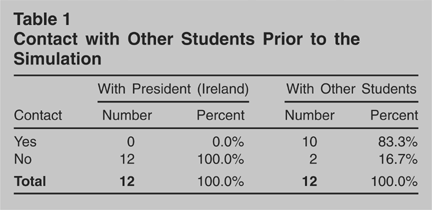
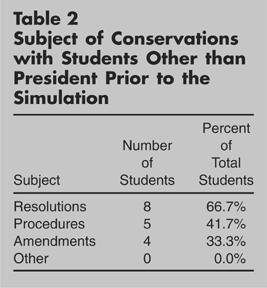
No students indicated that Ireland discussed the simulation with them prior to the start of the simulation. However, 10 students (83.3%) indicated that they were contacted prior to the start of the simulation by a student playing a Member State other than Ireland. A follow-up question, which asked about the topic of the discussion, contained a multiple response format; therefore, responses exceed the total number of students in the class. Of those students who discussed the simulation with a student other than Ireland, the most common subjects of discussion were resolutions (eight students, 66.7%), procedures (five students, 41.7%), and amendments to resolutions (four students, 33.3%). (See Tables 1 and 2.)
Contact with Other Students Prior to the Simulation

Subject of Conservations with Students Other than President Prior to the Simulation

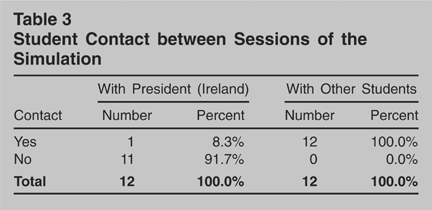
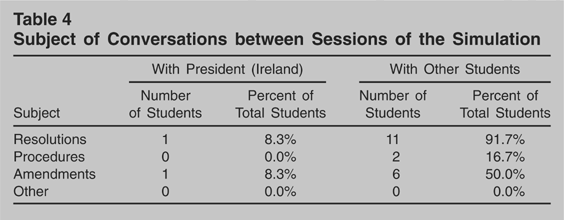
Between sessions of the simulation, one student (8.3%) indicated that they discussed the simulation with the student playing Ireland. The subject of this conversation was about both resolutions and amendments to the resolutions.
Between sessions of the simulation, all 12 students (100.0%) indicated that they discussed the simulation with students other than the student playing Ireland. The most frequent subject of these discussions included resolutions (11 students, 91.7%) and amendments to resolutions (six students, 50.0%). Two students (16.7%) discussed procedural rules. (See Tables 3 and 4.)
Student Contact between Sessions of the Simulation

Subject of Conversations between Sessions of the Simulation

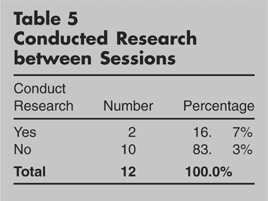
Two students (16.67%) conducted additional research on their country's position on issues and resolutions between the sessions of the simulation. When prompted for the subject of the research, one student indicated that he/she had conducted research on EU extradition and EU environmental policies. The other student indicated that he/she had searched for national legislation on several specific issues to be covered during the remaining sessions. (See Table 5.)
Conducted Research between Sessions

Students responded to a series of statements about the impact of the simulation on their understanding the European Union using a five-point scale ranging from “strongly agree” to “strongly disagree.” These questions were linked to the learning objectives for the course and simulation outlined above. For the purposes of analysis, responses to these questions were coded from five (strongly agree) to one (strongly disagree). Thus, higher scores on the scale indicate a higher degree of impact by the simulation on student learning.
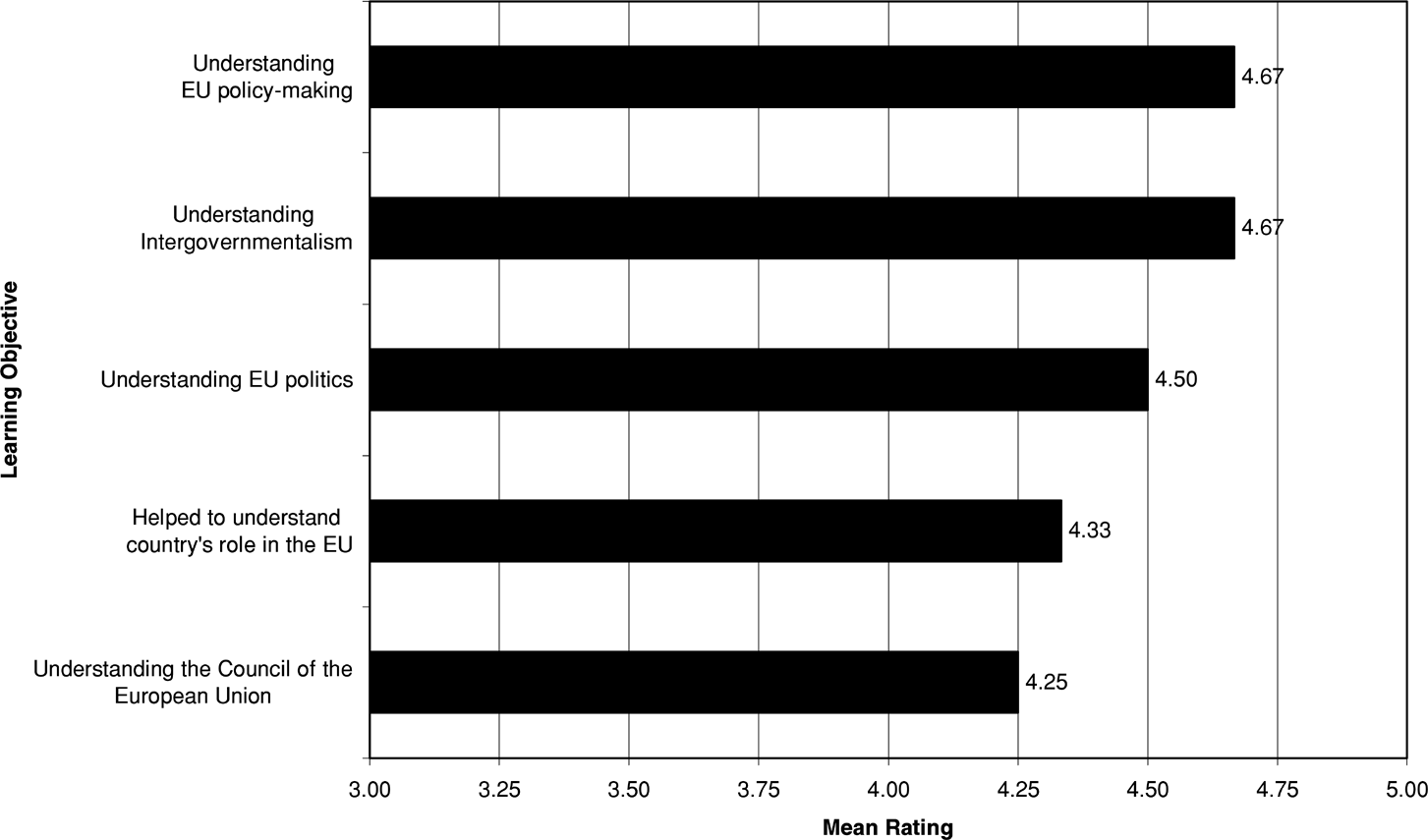
Figure 1 presents the mean ratings for the five scaled questions regarding student learning objectives. Results suggest that the simulation produced a positive impact on the student's understanding of the EU. The highest rating occurred for understanding EU policy-making (4.67) and understanding intergovernmentalism (4.67). For understanding EU politics, the rating was 4.50. As for if the simulation helped the student understand their Member State's role in the EU, the rating was 4.33. A mean rating of 4.25 occurred for if the simulation helped the student understand the Council of the European Union. Thus, the mean ratings were quite high, indicating a strong, positive impact of the simulation on student learning.

Mean Rating of Student Learning Objectives
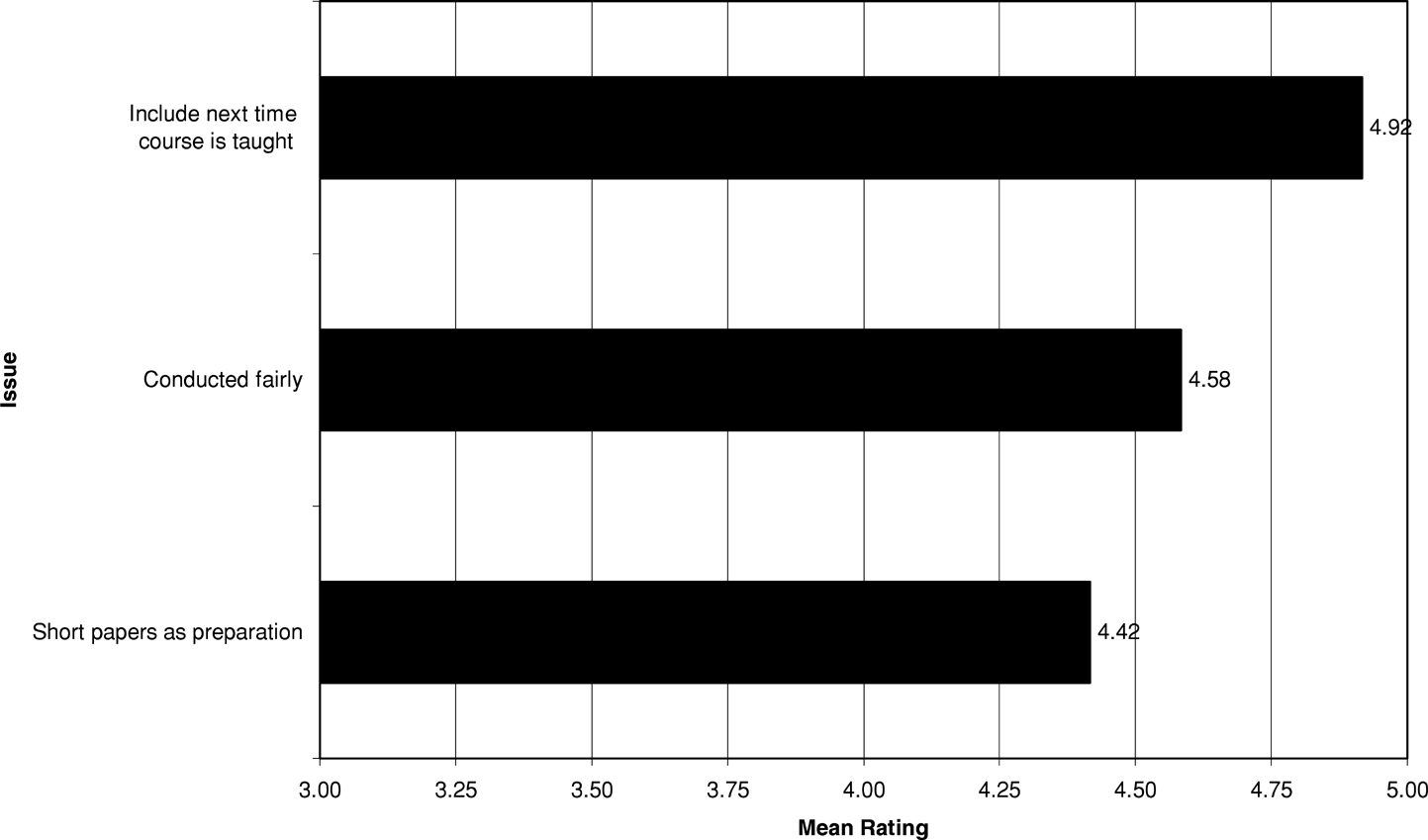
Figure 2 contains the mean ratings for questions that elicited student perceptions of the simulation process. Again using the same scale as the section regarding student learning objectives, students rated three specific issues. The highest mean rating occurred for the inclusion of the simulation as a component of the course in the future (4.92). The next highest rating occurred for the issue of if the president (Ireland) conducted the simulation according to the rules and procedures (4.58), followed by the usefulness of the short policy papers (4.42). Therefore, the mean ratings indicate a strong, positive perception among the students that the simulation, and the short papers, provided a positive learning experience.

Student Perceptions of the Simulation
The students' reflective papers provided additional insights into the simulation process. Many of these comments reinforced findings from the student survey. However, the reflective writing allowed students to go beyond the close-ended format of the survey and to explore more fully their thoughts and perceptions of the simulation.
Regarding expectations prior to the start of the simulation, several students expressed concerns that other students would not take the simulation seriously, or that the simulation would be an unproductive use of time. One student expressed concerns that little debate would occur: “I figured we (the students) would go in there and just look at each other.” Other students expressed concerns that the simulation would be very formal and dry, still others felt nervous or uncertain about the simulation. As one student stated, “Going into the simulation, I really did not know what to expect. I have had no experience with parliamentary procedures in any setting let alone having to deal with them in context of people representing actual nations and the interests of each specific nation.”
Only four of the 12 students in the course commented on the conduct of the simulation. Two students mentioned that some participants in the simulation seemed to be advocating positions that their assigned Member State did not support. The formality of the simulation and the extent of “behind the scenes” negotiation were mentioned. One student commented on the frustration of learning the rules of order.
More important, all of the students commented on the impact of the simulation on learning about the EU and the Council of the EU. Most often mentioned was a deeper understanding of the EU decision-making process. Of these comments, the key themes were a better understanding of the complexity of the EU decision-making process, the slow nature of EU decision-making, and the role of the president of the Council of Ministers in fostering compromise solutions. As one student stated, “The simulation really helped me understand some of the voting processes I was a little confused about. When a resolution needed unanimity and when it required QMV was good to know.”
Comments about how the simulation helped the student learn more thoroughly and understand better the competing and conflicting interests of the various EU Member States were also prevalent. In addition, two students stated that the simulation made them more aware of the role that blocs or coalitions of Member States can play in shaping EU policies. One student suggested that the simulation made him or her aware of the role that the largest Member States, especially Britain, France, and Germany, play in the EU.
Students also entered qualitative evaluations of the simulation as a pedagogical technique. Seven students commented explicitly on the importance of experiential or “hands on” learning. Three students remarked on the linkage between preparatory activities, for example the short papers, and the simulation. As one student stated, “All of the research I did to complete my papers … prepared me for … voting on the resolutions. The simulation makes the class and the research come full circle.” Finally, three students pointed out the serious manner in which the students conducted themselves during the simulation; these comments stand in stark contrast to the expectations of several students before the start of the simulation.
Three students suggested improvements to the simulation. One recommendation centered on lengthening the number of days devoted to the simulation. Another suggestion was to stress more thoroughly the importance for participants to stay in character with the positions of their assigned Member State rather than to adopt positions reflecting personal beliefs or U.S. foreign policy. Another useful comment requested more training and preparation on developing and writing policy proposals.
Several lessons may be drawn from the simulation of the Council of the European Union. First, the students' quantitative evaluation of the simulation indicated that it had a strong, positive impact on student learning. These findings are consistent with previous research on the impact of simulations on student learning (Endersby and Webber 1995; Ciliotta-Rubery and Levy 2000; Dougherty 2003). These findings are reinforced in the qualitative comments from the reflective writing. Thus, the qualitative data are complementary to the quantitative data. The simulation engaged the students in active learning about the Council of the European Union, its procedures, and its formal and informal decision-making processes.
Perhaps more important, the simulation provided an opportunity for students to become more active in the learning process. The fact that students contacted each other outside of the normal classroom times to discuss simulation activities, including resolutions, procedures, and amendments, suggests that under the appropriate circumstances students engage in extra-classroom discussions with peers. This is especially evident in the large majority of students who discussed aspects of the simulation outside the classroom between sessions of the simulation. Moreover, this extra-classroom activity is consistent with the informal, behind-the-scenes negotiations that often characterize decision-making processes in the Council of the European Union (McCormick 1999, 130–131; George and Bache 2001, 251).
Furthermore, the fact that the students did take the simulation seriously, to the extent that other students noticed and commented on the behavior of their fellow students, suggests that simulations are not merely “game playing.” Students do appear to see the simulation as an opportunity to engage in learning. Simulations are not simply a “free day” away from learning.
In addition, that two students were engaged enough to conduct additional research offered some indication of student willingness to go beyond the course requirements to learn about the EU. Although two of 12 students is not a large proportion of students, motivating any undergraduate student to engage in self-motivated research is often difficult and is, therefore, on some level a success.
However, the results of the survey also suggest the importance of the role of the president in the conduct of the simulation. In the “real world” of the EU, the Member State holding the presidency of the Council is normally very active in attempting to foster compromise solutions to various proposals. Much of this effort is exerted outside the Council's formal sessions. In this simulation, the president did not play as active role a role, as suggested by the quantitative data reported by students.
Finally, the simulation did significantly deviate from the “real world” of the EU in that much of the simulation was not characterized by consensus and cooperation in decision-making. Perhaps, the class sessions prior to the simulation that examine EU decision-making and the Council of the European Union may need to emphasize more completely the importance of consensus building as an integral component of decision-making in the EU. In addition, the importance of having the participants maintain policy positions consistent with their Member State should be stressed more completely.
In any case, the simulation of the Council of the European Union allowed students to have a hands-on experience while learning about the various workings of the EU. Even in a lecture class, students would have learned this information, but the simulation provided an appropriate method for students to become active learners. Moreover, the quantitative data collected from the students provides empirical evidence of the impact on learning. The simulation directly effected student understanding of the EU, its politics, and its policies in a profound manner. In addition, the simulation encouraged extra-curricular contact among students, and to a lesser extent, independent research by students enrolled in the course. As a result, this study adds to the body of quantitative evidence that demonstrates the importance of simulations, and the quantitative assessment of simulations, in teaching political science.
Steven E. Galatas is assistant professor of political science at Stephen F. Austin State University where he teaches courses in comparative politics. Prior to August 2005, he was an assistant professor at Georgia Southwestern State University where he served as campus coordinator for the European Union Studies Certificate Program.

Contact with Other Students Prior to the Simulation

Subject of Conservations with Students Other than President Prior to the Simulation

Student Contact between Sessions of the Simulation

Subject of Conversations between Sessions of the Simulation

Conducted Research between Sessions

Mean Rating of Student Learning Objectives

Student Perceptions of the Simulation