


Introduction
It is well documented that women are at risk of developing affective disorders in the antenatal and postnatal period, although to date the majority of research has focused on post natal depression (PND) (Dennis and Stewart, Reference Dennis and Stewart2004; Dennis, Reference Dennis2004). More recently, research has indicated an association with anxiety in the perinatal period and a range of adverse maternal, foetal and developmental outcomes (Bhagwanani, Seagraves, Dierker and Lax, Reference Bhagwanani, Seagraves, Dierker and Lax1997; Levine, Oandasan, Primeau and Berenson, Reference Levine, Oandasan, Primeau and Berenson2003; O'Connor, Heron, Golding, Beveridge and Glover, Reference O'Connor, Heron, Golding, Beveridge and Glover2002; Teixeira, Fisk and Glover, Reference Teixeira, Fisk and Glover1999).
OCD is an anxiety disorder characterized by recurrent, unwelcome thoughts, ideas or doubts (obsessions) that give rise to distress and urges to respond to this obsessional anxiety with excessive behavioural or mental acts (compulsions) (American Psychiatric Association (APA), 2000). Diagnostic systems, such as the DSM-IV (APA, 2000), presuppose that OCD is a distinct, categorical disorder. In recent years, however, this view has been challenged. There is now growing acceptance among researchers that OCD is a clinically heterogeneous condition with wide variation in the specific content of obsessions and compulsions and that there are discrete subtypes of the disorder (Abramowitz, McKay and Taylor, Reference Abramowitz, McKay and Taylor2005). Delineating subtypes, it has been argued, will aid theoretical development, result in the identification of vulnerability factors, and enhance the prediction of clinical course and response to treatment (Blashfield and Livesley, Reference Blashfield, Livesley, Millon, Blaney and Davies1999). Various approaches to subtyping OCD have been proposed; categorizations based on age of onset, family history, the presence or absence of tics, symptom clusters or types, personality traits and infectious diseases (Taylor, Reference Taylor, Abramowitz and Houts2005).
In recent years there has been growing interest in OCD in the perinatal period and an increasing number of studies and reports have suggested that pregnancy and the puerperium may precipitate or exacerbate OCD in some women (Abramowitz, Schwartz, Moore and Luenzmann, Reference Abramowitz, Schwartz, Moore and Luenzmann2003b). It has been suggested that, not only is the perinatal period a period of increased risk for the development of OCD, but that postpartum OCD (ppOCD) presents a “distinct clinical picture with prenatal onset characterized most often by contamination fears and postpartum onset, by unwanted thoughts of harm befalling one's infant” (Abramowitz and Fairbrother, Reference Abramowitz, Fairbrother, Abramowitz, McKay and Taylor2008, pp.153). That there is such a distinctive clinical picture raises the possibility that ppOCD may even be conceptualized as a distinct subtype. However, for ppOCD to be considered a distinct subtype it would be necessary to demonstrate unambiguously that the postpartum is a period of increased risk and that ppOCD presents a distinct clinical picture that is different from OCD in general and from OCD during pregnancy. There are, it has been suggested, five phases of development in the identification and validation of diagnostic subtypes. These are: clinical observation and description of the proposed syndrome or subtype; laboratory studies; exclusion of other disorders; follow-up studies to determine temporal stability; and family studies (Robins and Guze, Reference Robins and Guze1970). In view of the limited evidence available, this paper will review the evidence from clinical observation studies to determine whether the concept of ppOCD as a distinct subtype is justified and clinically meaningful. Studies for inclusion were identified by a search using Ovid (Medline, PsycINFO and Embase), EBSCO, Cochrane Library, Web of Science (ISI), PubMed databases and Google Scholar using the key words: “obsessive compulsive disorder” (and derivatives), “perinatal”, “pregnancy”, “postnatal”, “postpartum”, “mothers” (and derivatives), “anxiety disorders” and “subtypes.” This list of articles was supplemented by a review of their references.
Definition of ppOCD
A recent description of the clinical presentation of ppOCD includes the following signs and symptoms (Abramowitz and Fairbrother, Reference Abramowitz, Fairbrother, Abramowitz, McKay and Taylor2008, p. 140): 1) Onset (often rapid) or worsening during pregnancy or the postpartum; 2) Obsessional content involving contamination (particularly during pregnancy), illness, violence, harm, accidents or loss; 3) Avoidance of obsessional cues, sometimes including avoidance of the newborn; 4) Compulsive rituals may be overt (washing, checking) or covert (mental rituals, neutralizing); 5) Often associated with depressive symptoms; and 6) Not associated with postpartum psychosis.
In defining ppOCD the inclusion of signs and symptoms that are not exclusive to the postpartum period and the tendency to use the terms perinatal and postpartum interchangeably can be confusing. In view of this definitional confusion, this review will separate out the evidence relating to pregnancy onset and exacerbation from postpartum onset and exacerbation. It will also focus on studies reporting on clinical samples, due to the possibility that there might be important differences in the symptomatology experienced by women with OCD and non-clinical samples of healthy women who report sub-clinical OCD-like symptoms (Lee, Lee, Kim, Kwon and Telch, Reference Lee, Lee, Kim, Kwon and Telch2005, Rassin and Muris, Reference Rassin and Muris2006, Rassin, Cougle and Muris, Reference Rassin, Cougle and Muris2007, Julien, O'Connor and Aardema (Reference Julien, O'Connor and Aardema2009).
Prevalence of OCD
In exploring the question of whether the perinatal period is a high risk period for the expression or exacerbation of OCD in women, accurate estimates of the prevalence of OCD in the general population and in the female population in particular are of extreme importance. Herein lies a major problem because the prevalence of OCD is not definitively established and continues to be a source of controversy.
Early studies suggested that OCD was rare (Weissman, Prusoff, Thompson, Harding and Myers, Reference Weissman, Prusoff, Thompson, Harding and Myers1978); however, the US National Comorbidity Survey Replication (NCS-R) found a lifetime prevalence of OCD of 1.6%, varying between 0.7% to 2.3% across the various age bands, with a one year prevalence rate of 1.0% (Kessler et al., Reference Kessler, Berglund, Demler, Jin, Merikangas and Walters2005; Kessler, Chiu, Delmer and Walters, Reference Kessler, Chiu, Delmer and Walters2005). In contrast, the overall one year prevalence of clinically recognized OCD in a sample of 1.7 million people in California, was .084%, less than one-tenth as high as the prevalence estimates reported by community and primary care studies (Fireman, Koran, Leventhal and Jacobson, 2001). To further complicate the picture, there appear to be differences in prevalence and incidence linked to culture and ethnicity. The one year prevalence of OCD in an urban area of Turkey was 3% (Cilli et al., Reference Cilli, Telcioglu, Askin, Kaya, Bodur and Kucur2004) and in Taiwan 0.4% (Horwath and Weissman, Reference Horwath and Weissman2000). Thus, depending on the measures and methodology employed and the population sampled, one year prevalence rates estimates have varied between .084% and 3% and life time prevalence between 0% and 3.5%. Most recently, using data from the National Comorbidity Survey Replication, a subsample of 2073 respondents was assessed for lifetime OCD, indicating that 2.3% of respondents met full DSM-IV criteria for lifetime prevalence and 1.2% for one year prevalence (Ruscio, Stein, Chiu and Kessler, 2010).
The wide variation in prevalence rates between studies has been attributed to a diverse range of factors such as the skill of the assessors, the setting, the technology and measures used, the population under study, the inclusion of sub-threshold OCD and OCD that has never been clinically recognized, the inclusion of transient or misclassified cases, and the changing criteria from DSM-III to DSM-IV (Crino, Slade and Andrews, Reference Crino, Slade and Andrews2005, Fireman et al., Reference Fireman, Koran, Leventhal and Jacobson2001, Fontenelle and Hasler, Reference Fontenelle and Hasler2008). For example, in a Canadian epidemiological study, reappraisal of adults previously diagnosed with OCD resulted in the prevalence rate changing from 3.1% to 0.6% (Nestadt et al., Reference Nestadt, Samuel, Riddle, Bienvenu, Liang, Labuda, Walkup, Grados and Hoehn-Saric2000).
Despite the varied prevalence results, one relatively reliable finding is the higher rate of OCD in adult women compared to men. In a recent systematic review, in 22 of the 27 studies of adults that reported gender related data, there was an overall preponderance of females over males with OCD (Fontenelle, Mendlowicz and Versiana, Reference Fontenelle, Mendlowicz and Versiana2006).
Prevalence of perinatal OCD
Four studies have examined the prevalence of OCD in pregnancy (Andersson et al., Reference Andersson, Sundström-Poromaa, Bixo, Wulff, Bondestam and Åström2003; Sutter-Dallay, Giaconne-Marcesche, Glatigny-Dallay and Verdoux, Reference Sutter-Dallay, Giaconne-Marcesche, Glatigny-Dallay and Verdoux2004; Uguz et al., Reference Uguz, Gezginc, Zeytinci, Karatayli, Askin, Guler, Sahin, Emul, Ozbulut and Gecici2007b; Zar, Wijma and Wijma, Reference Zar, Wijma and Wijma2002). These found significantly different prevalence rates ranging from 0.2% to 3.5%. All the aforementioned studies used valid, albeit different, standardized assessment methodologies and in all studies, a significant proportion of the eligible sample either refused to participate or was excluded. In the Andersson et al. (Reference Andersson, Sundström-Poromaa, Bixo, Wulff, Bondestam and Åström2003) study of a Swedish sample, 20% of the original study sample were excluded for a variety of reasons (foetal malformations, miscarriage, refusal to consent and illiteracy). A similar proportion of the original Turkish sample (23%) also refused to participate (Uguz et al., Reference Uguz, Gezginc, Zeytinci, Karatayli, Askin, Guler, Sahin, Emul, Ozbulut and Gecici2007b). A larger proportion of both the French sample (37%) (Sutter-Dallay et al., Reference Sutter-Dallay, Giaconne-Marcesche, Glatigny-Dallay and Verdoux2004) and of a second Swedish sample studied by Zar et al. (Reference Zar, Wijma and Wijma2002) (37%) refused to participate or dropped out during the study. The sample in both Swedish studies and the French study consisted of consecutive referrals to local hospitals whereas in the Turkish study the women attended obstetric outpatient clinics in two research centres. It is not clear whether referral to these research centres was routine or if it was more likely if there were concerns about the pregnancy. In addition, all of the studies were carried out over differing time periods, which, due to seasonal and latitude-related variations in human birth rates, makes comparison with the rates of the more typical 12-month prevalence period problematic (Rojansky, Brzezinski and Schenker, Reference Rojansky, Brzezinski and Schenker1992).
In terms of OCD in the postpartum period four studies found prevalence rates varying from 2.7% to 9% (Wenzel, Gorman, O'Hara, and Stuart, Reference Wenzel, Gorman, O'Hara and Stuart2001; Wenzel, Haugen, Jackson and Brendle, Reference Wenzel, Haugen, Jackson and Brendle2005; Uguz, Akman, Kaya and Cilli, Reference Uguz, Akman, Kaya and Cilli2007; Zambaldi et al., Reference Zambaldi, Cantilino, Montenegro, Paes, de Aluquerque and Sougey2009). In one study, however, the sample assessed was a sub sample of a larger group of dysphoric/distressed postpartum women and as such was not designed to determine the prevalence of OCD in the general population of postpartum women (Wenzel et al., Reference Wenzel, Gorman, O'Hara and Stuart2001). In another American study the sample was recruited over a 9-month period via advertisements in the local newspapers, thereby raising the possibility of selection biases (Wenzel et al., Reference Wenzel, Haugen, Jackson and Brendle2005). The Turkish prospective study was carried out on a randomly selected group of 302 newly delivered women who were assessed for OCD at 6 weeks postpartum. Using the Structured Clinical Interview for the DSM-IV (SCID-I), 12 postpartum women (4%) met criteria for OCD with incidence rates of 6.57% in primiparous and 1.81% in multiparous women (Uguz, Akman, et al., Reference Uguz, Akman, Kaya and Cilli2007). In this incidence study the process by which the participants were randomly selected is not identified. Initially, 580 newly delivered women were approached to participate on the first day after childbirth, of which 127 (22%) refused. Fifty-nine women (10%) were excluded for a variety of reasons, including current depressive disorder, current OCD, and serious health problems with the baby, and a further 92 (16%) refused to participate at the second interview 6 weeks postnatally. Thus, in total, almost half of the original sample (278) did not participate. The authors acknowledge that the sample size was small and “may not be representative of all women who delivered”.
In the most recent study carried out in Brazil, a convenience sample of 400 postpartum women was recruited from three medical institutions (Zambaldi et al., Reference Zambaldi, Cantilino, Montenegro, Paes, de Aluquerque and Sougey2009). No information is provided about how the sample was recruited nor the number of women who declined to take part in this study; thus the total population size is unknown. Nine percent of the sample met DSM-IV criteria for a diagnosis OCD, although only 2.3% of the sample actually reported postpartum onset. In addition to the limitations of this study identified by the authors, the fact that this was not a randomly selected sample means the findings must be treated with caution.
In summary, prevalence studies of OCD in pregnancy range from 0.2% to 3.5%, while studies of the prevalence of OCD in the postpartum tend to be higher, varying from 2.7% to 9%, with the most recent prospective study indicating a prevalence rate much in excess of general population rates. The variation in estimates of the prevalence of OCD in the perinatal period mirrors that of prevalence studies of OCD in the general population and the differences are likely explained by the different methodologies, study samples and time periods. To date, the only prevalence studies, utilizing a randomly selected sample, that seem to indicate that the rate of OCD is elevated during pregnancy and the postpartum were both carried out in Turkey, mirroring the fact that one of the studies that found the highest prevalence rates of OCD in the general population was also Turkish. This raises the possibility of cultural differences in either prevalence/incidence and/or measurement.
Relative risk analysis
In order to determine whether OCD is more prevalent in the postpartum period, a relative risk analysis was calculated for this review using data from published prevalence studies that reported the actual number of women in the sample.
Relative risk is the ratio of the probability of an event occuring in one group compared to probability of that event occuring in another group. It is frequently used in the statistical analysis of binary outcomes and is often used in clinical trial data, where it is used to compare the risk of developing a disease in different groups. A relative risk of 1 means there is no difference in risk between the groups. A relative risk of <1 means the event is less likely to occur in the experimental group than the control group, and a relative risk of >1 means the event is more likely to occur in the experimental group than in the control group. Calculation of a confidence interval is used to determine whether a given relative risk is statistically significant.
In view of the varying prevalence rates between different countries, comparisons were only made between studies from the same country. Unfortunately, data for all three groups, general population (women only), pregnant women and postpartum women, were only available for the Turkish population (see Table 1).
Turkish studies included in relative risk analysis

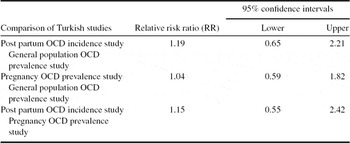
Although the analysis indicates a small increase in the relative risk of developing OCD in pregnancy and the postpartum, this risk was not statistically significant (see Table 2). This non significant finding is supported further by the results of the Turkish general population study where prevalence was not found to be related to childbirth (Cilli et al., Reference Cilli, Telcioglu, Askin, Kaya, Bodur and Kucur2004). From this analysis it would appear that the recent Turkish studies do not support the proposition that OCD is more prevalent in the perinatal period. Clearly this conclusion needs to be treated with caution unless it is replicated. However, despite the obvious methodological problems inherent in this form of analysis, such as the fact that the samples were not matched, the comparison of prevalence studies limited to the same country is a useful methodology as it is likely to reduce measurement error associated with combining studies across countries where prevalence rates have been demonstrated to be different.
Relative risk analysis: comparison of Turkish studies

Notes:
Turkish general population prevalence study: Cilli et al., Reference Cilli, Telcioglu, Askin, Kaya, Bodur and Kucur2004
Turkish post partum OCD prevalence study: Uguz, Akman et al., Reference Uguz, Akman, Kaya and Cilli2007
Turkish pregnancy OCD prevalence study: Uguz et al., Reference Uguz, Gezginc, Zeytinci, Karatayli, Askin, Guler, Sahin, Emul, Ozbulut and Gecici2007b
These relative risks are not significant (i.e. the 95% CI passes through 1)
Onset versus exacerbation
In addition to the suggestion that OCD is more prevalent in the perinatal period, it has also been suggested that pregnancy and the puerperium may exacerbate pre-existing OCD (Abramowitz et al., Reference Abramowitz, Schwartz, Moore and Luenzmann2003b). It is unclear, however, from the incidence and prevalence studies previously reviewed what proportion of OCD occurring in the perinatal period is due to new onset OCD and what is due to exacerbation of pre-existing or subsyndromal OCD.
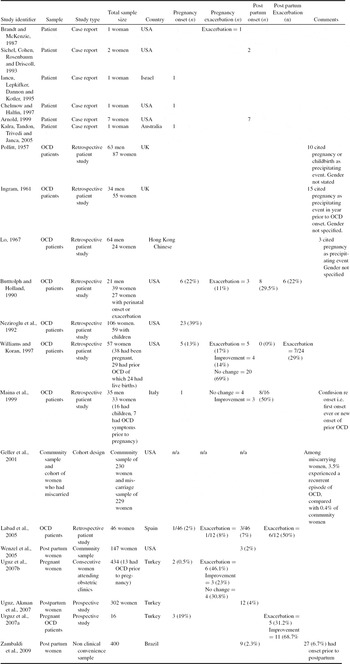
Six case reports, 8 retrospective patient studies, 1 community study, 1 cohort comparison study and 3 prospective patient studies address the issue of onset and exacerbation of OCD in the perinatal period (see Table 3). In general, one of the striking features of the majority of these studies is the small sample sizes.
Studies reporting onset and exacerbation of OCD in the perinatal period

Typically, reviews considering the evidence cite two early studies that identify subgroups of patients whose symptoms began in pregnancy and/or childbirth (Ingram, Reference Ingram1961; Pollitt, Reference Pollitt1957). Unfortunately, both of these early British studies suffer from severe methodological shortcomings. Both are retrospective reviews of case notes and histories, which are particularly unreliable sources of evidence. Both include a significant number of private patients, introducing the possibility of sample biases, particularly with respect to social class. Neither of these studies used reliable diagnostic instruments and the definition of what constituted an “obsessional state” is very broad by contemporary standards and is not co-terminus with DSM or ICD10 (World Health Organization, 1993) diagnoses of OCD. In addition, neither of these studies identifies the gender of those patients citing pregnancy as a precipitating factor. This is also the case with a contemporaneous Hong Kong study (Lo, Reference Lo1967). Given the methodological weakness inherent in these three early studies, it is not possible to confidently draw any conclusions from them with regard to the onset or exacerbation of OCD in the perinatal period.
In contrast to the earlier studies, the later retrospective studies utilized self-report questionnaires and interviews rather than case histories. In terms of the onset and exacerbation of OCD in pregnancy, the results of these studies are conflicting. Although five studies describe subsets of patients for whom symptom onset was specifically related to pregnancy (Butttolph and Holland, Reference Buttolph, Holland, Jenicke, Baer and Minichiello1990; Labad et al., Reference Labad, Menchón, Alonso, Segalas, Jimenez and Vallejo2005; Maina, Albert, Bogetto and Vaschetto, Reference Maina, Albert, Bogetto and Vaschetto1999; Neziroglu, Anemone and Yaryura-Tobia, Reference Neziroglu, Anemone and Yaryura-Tobia1992; Williams and Koran, Reference Williams and Koran1997) in two of these studies, in the majority of cases, symptom onset was prior to pregnancy (Maina et al., Reference Maina, Albert, Bogetto and Vaschetto1999; Williams and Koran, Reference Williams and Koran1997). Pregnancy exacerbation of pre-existing symptomatology was evident in three studies, (Butttolph and Holland, Reference Buttolph, Holland, Jenicke, Baer and Minichiello1990; Labad et al., Reference Labad, Menchón, Alonso, Segalas, Jimenez and Vallejo2005; Williams and Koran, Reference Williams and Koran1997), but in one study 83% of the sample reported either an improvement or no change in pre-existing symptomatology during pregnancy (Williams and Koran, Reference Williams and Koran1997).
All of the above retrospective studies have significant methodological shortcomings; all were conducted on patient populations and were not designed to answer questions about onset and exacerbation in the general population. Sampling, diagnostic and assessment procedures varied across the studies and all relied solely on patient recall. These factors are likely to contribute to the variation in study findings, which must therefore be considered with caution.
The only prospective study of OCD in a community sample of pregnant women in the third trimester reported that, of the 15 women identified with OCD, only two (0.5%) of the total sample of 434 women reported pregnancy onset, with the vast majority (13/15) reporting onset prior to pregnancy (Uguz et al., Reference Uguz, Gezginc, Zeytinci, Karatayli, Askin, Guler, Sahin, Emul, Ozbulut and Gecici2007b). Of this latter group just under half (n = 6, 46.1%) had pregnancy exacerbation, just over a fifth (n = 4, 23.1%) had an improvement in pregnancy and just under one-third (n = 3, 30.8%) experienced no change. Thus, of the women who had OCD prior to pregnancy, the majority experienced an improvement or no change in symptomatology during pregnancy (Uguz et al., Reference Uguz, Gezginc, Zeytinci, Karatayli, Askin, Guler, Sahin, Emul, Ozbulut and Gecici2007b).
By and large the studies addressing postpartum OCD onset and exacerbation are the same studies that investigated pregnancy onset and exacerbation (see Table 3). Hence, in addition to case reports (Arnold, Reference Arnold1999; Sichel, Cohen, Dimmock and Rosenbaum, 1993), the majority of studies are retrospective case series of women diagnosed with OCD. Depending on the methodology used, these retrospective studies of patient samples found rates of postpartum onset varying from 0% to 50% (Butttolph and Holland, Reference Buttolph, Holland, Jenicke, Baer and Minichiello1990; Williams and Koran, Reference Williams and Koran1997) and rates of OCD exacerbation that have ranged from 22% to 50% (Butttolph and Holland, Reference Buttolph, Holland, Jenicke, Baer and Minichiello1990; Labad et al., Reference Labad, Menchón, Alonso, Segalas, Jimenez and Vallejo2005). Due to the methodological shortcomings outlined previously these findings must also be considered with caution.
The one retrospective study of a community sample of 147 women traced from birth records assessed over the telephone at 8 weeks postpartum using the SCID (non patient version) found that 4 (2.7%) women met DSM-IV diagnostic criteria for OCD and, of these, 3 (2%) had postpartum onset (Wenzel et al., Reference Wenzel, Haugen, Jackson and Brendle2005). In contrast, in a recent prospective incidence study on a randomly selected group of 302 newly delivered women in a large maternity hospital in Turkey, 12 women (4%) met DSM-IV criteria for OCD at 6 weeks postpartum, with all reporting onset within the first postpartum month (Uguz, Akman, et al., Reference Uguz, Akman, Kaya and Cilli2007).
Unfortunately, in the recent Brazilian study no information is provided about the rates of pregnancy onset and exacerbation or postpartum exacerbation or what percentage of the sample had OCD prior to pregnancy (Zambaldi et al., Reference Zambaldi, Cantilino, Montenegro, Paes, de Aluquerque and Sougey2009).
In terms of postpartum exacerbation a recent prospective study of 16 pregnant women diagnosed with OCD found that while approximately one-third of the sample (n = 5, 31.2%) reported postpartum exacerbation, the vast majority (n = 11, 68.7%) actually reported an improvement in symptoms (Uguz et al., Reference Uguz, Gezginc, Zeytinci, Karatayli, Askin, Guler, Sahin, Emul, Ozbulut and Gecici2007a).
Retrospective studies of the onset or exacerbation of OCD in the perinatal period have produced conflicting results. To date, the two prospective studies that provide sufficient information, both Turkish, found that the majority of OCD detected in the antenatal period had its onset prior to pregnancy and the majority of OCD detected in the postpartum period had its onset after delivery (Uguz et al., Reference Uguz, Gezginc, Zeytinci, Karatayli, Askin, Guler, Sahin, Emul, Ozbulut and Gecici2007b; Uguz, Akman, et al., Reference Uguz, Akman, Kaya and Cilli2007). Clearly the results of these two studies are contradictory and it would be expected that a prospective study following women into the postpartum period would pick up women with both prenatal and pregnancy onset OCD, unless all of the cases of pre-pregnancy onset OCD apparent in the third trimester resolved around the time of delivery.
A further piece of evidence relevant to the question of whether aspects of pregnancy exacerbate existing OCD comes from a controlled study of the prevalence of anxiety disorders associated with miscarriage (Geller, Klier and Neugebauer, Reference Geller, Klier and Neugebauer2002). This study indicated that, in comparison to a matched community cohort of women (N = 230) who had not been pregnant within the previous year, the women who had experienced miscarriage (N = 229) were eight times more likely to experience a recurrent episode of OCD (Geller et al. Reference Geller, Klier and Neugebauer2002). Whether this effect can be attributed to the experience of miscarriage or the experience of pregnancy cannot be established from this study. However, this finding supports the recommendation of the need for further investigation of “special” populations such as women with pre-existing OCD and those who have had difficulties with prior pregnancies such as foetal loss or prematurity (Leckman, Mayes, Feldman, Evans and Cohen, Reference Leckman, Mayes, Feldman, Evans and Cohen1999).
In summary, there is no clear, unambiguous picture regarding OCD onset and exacerbation in pregnancy and the postpartum period. In addition, there is a need to critically assess the suitability of the screening and diagnostic tools being used with this population. There is considerable evidence from community studies that the perinatal period is associated with an increase in obsessive-compulsive type symptoms common across new parents (Abramowitz, Schwartz and Moore, 2003; Leckman et al., Reference Leckman, Mayes, Feldman, Evans and Cohen1999). Although this is widely known, the possibility that this normal phenomena are artificially elevating prevalence and incidence rates is rarely, if ever, considered in published studies. The possibility that this natural increase in obsessive-compulsive like symptoms in the perinatal period is confounding research findings needs to be considered because such symptoms are common and transient. Leckman's study, for example, indicated a peak of such symptoms and associated ritualized behaviour close to the birth of the infant and in the immediate postpartum period. Any study that does not take this into account runs the risk of overestimating OCD symptomatology in this period.
Symptomatic presentation of OCD in pregnancy
In their earlier review of the literature relating to ppOCD, Fairbrother and Abramowitz (Reference Fairbrother and Abramowitz2007) draw attention to the specificity in symptom presentation in the postpartum period namely “the predominance of obsessional thoughts concerning harm to the infant as opposed to contamination, hoarding, counting, somatic or symmetry/ordering obsessions and compulsions”. It is this specificity that lends weight to the possibility that ppOCD might be a distinctive “subtype”.
Evidence from the early studies is confusing due to the lack of clarity in the separation of pregnancy and postpartum symptomatology. One early study of “obsessional states” for example reports that “pregnancy” was identified by 27% (15) of women as a precipitant to the onset of the illness. The symptomatology subsequently described, such as fears of harming the child and washing and avoidance rituals, appears however to be related to the postpartum period (Ingram, Reference Ingram1961).
Subsequent studies offer more clarity and initially appeared to suggest a more consistent picture in terms of symptomatology. Diaz and colleagues described five women with perinatal OCD. In the three cases where symptom onset coincided with pregnancy, the major symptoms reported were contamination obsessions and washing or cleaning compulsions (Diaz, Grush, Sichel and Cohen Reference Diaz, Grush, Sichel, Cohen, Dicstein, Riba and Oldham1997). Similarly, a contemporaneous single case study described a 28-year-old woman who presented at 8 weeks gestation for prenatal care who had been diagnosed with OCD following her prior pregnancy. Her symptoms primarily involved obsessions about infectious disease and compulsive cleaning and organization of household items, both of which greatly distressed her and interfered with care of her children (Chelmow and Halfin, Reference Chelmow and Halfin1997).
In a more recent prospective study, 15 pregnant women were diagnosed with OCD by means of the Structured Clinical Interview for the DSM-IV (SCID). Overall, the most common obsessions were contamination (80%) and symmetry/exactness (60%) and the most common compulsions were cleaning/washing (86.7%) and checking (60%) (Uguz et al., Reference Uguz, Gezginc, Zeytinci, Karatayli, Askin, Guler, Sahin, Emul, Ozbulut and Gecici2007b). Among the women with pregnancy exacerbation the majority (9/13, 69.2%) reported no change in the content of their obsessions. The remaining 4 (30.8%) patients whose symptoms did change reported additional aggressive obsessions including fears of self harm (n = 1), images of harming the newborn after birth (n = 1) and contamination and cleaning obsessions due to fear of the foetus being contaminated by micro organisms.
Published in the same year the same research team presented a prospective case study of 16 women diagnosed with OCD in pregnancy who were followed up from the third trimester to the early postpartum. The most common obsessions at 38th gestational week were contamination (81.3%), symmetry/exactness (50%), aggressive (43.3%) and religious obsessions (37.5%). The most common compulsions were cleaning/washing (81.3%), checking (56.3%) and ordering/arranging (43.8%). Aggressive obsessions in 3 of 7 patients and contamination obsessions and cleaning /washing compulsions in 3 of 13 patients related to the foetus (Uguz et al., Reference Uguz, Gezginc, Zeytinci, Karatayli, Askin, Guler, Sahin, Emul, Ozbulut and Gecici2007b). The results from this second study are very similar to the first and it is unclear whether the sample in the follow-up study overlapped with the sample in the first study. Given this possibility it cannot be assumed that the second study is a replication study confirming the findings of the former study.
Finally, in a very recent study of the relationship between symptom dimensions and timing of OCD, women with contamination/cleaning symptoms were more likely to report onset during pregnancy or postnatally as opposed to menarche (Labad et al., Reference Labad, Alonso, Segalas, Real, Jimenez, Bueno, Vallejo and Menchon2010). This lends further support to the suggestion that contamination and cleaning symptoms is a common clinical presentation linked to pregnancy.
Symptomatic presentation of postpartum OCD
In terms of postpartum symptomatology, Diaz and colleagues described two women who experienced onset soon after childbirth, the main symptoms being upsetting thoughts of deliberately but not accidentally harming the infant (e.g. sexually molesting or stabbing) (Diaz et al., Reference Diaz, Grush, Sichel, Cohen, Dicstein, Riba and Oldham1997). Similarly, in a retrospective chart review that identified 15 women with ppOCD symptoms, although obsessive rituals were not observed in any of the subjects, all the women developed some degree of avoidance of their infants. These included not bathing the infant, avoiding kitchen knives, and staying physically isolated from the infant for fear of harming it. This avoidance arose in response to intrusive obsessional thoughts of harming their infants (Sichel, Cohen, Dimmock, et al., 1993). In this report the obsessions experienced by the women are described as “ego alien” but it is unclear whether these intrusive thoughts were of deliberate versus accidental harm. The one “representative” case that is described in some detail is of a woman experiencing thoughts of deliberately rather than accidentally harming her infant. In a subsequent case report, the same authors describe two non-depressed patients with new onset postpartum OCD who reported intrusive obsessional thoughts of deliberately but not accidentally harming their infant accompanied by avoidance of the infant (Sichel, Cohen, Rosenbaum and Driscoll, 1993).
Two additional studies further clarify the emerging constellation of symptoms specific to OCD in the postpartum period. In both, 100% of women with postpartum OCD reported obsessive aggressive fears and/or thoughts of harming the newborn (Maina et al., Reference Maina, Albert, Bogetto and Vaschetto1999, Arnold, Reference Arnold1999). In the latter study, the majority (71%) of women reported a dysfunctional relationship with their infant as a result of the symptoms, one reported avoidance of the infant while others reported being fearful of either separation from their infant or of allowing others to care for the infant (Arnold, Reference Arnold1999).
More recent studies have presented a less consistent picture of the symptomatology of OCD in the postpartum period. One study of the prevalence of panic and obsessive compulsive symptoms in a community sample of postpartum women identified 84 women who had subsyndromal symptoms of OCD (Wenzel et al., Reference Wenzel, Gorman, O'Hara and Stuart2001). Of the 23 women who met DSM-IV criteria for OCD almost half (n = 11, 47%) reported compulsive cleaning or hand washing and just over a quarter (n = 6, 26%) reported obsessions about disaster. Unfortunately, because the results are presented for all 84 women, that is combining subsyndromal and syndromal cases, it is not possible to further elucidate the specific symptomatology of the women meeting diagnostic criteria of OCD.
More recently a series of Turkish studies have been published. A prospective study of the course of OCD in the early postpartum period found that at 6 weeks postpartum among the sample of 16 women with ppOCD the most common obsessions were contamination (68.7%) and symmetry/exactness (50%). Only one participant reported aggressive obsessions related to her newborn and there is no mention that any of the women reported obsessions about accidentally harming their infant (Uguz et al., Reference Uguz, Gezginc, Zeytinci, Karatayli, Askin, Guler, Sahin, Emul, Ozbulut and Gecici2007a).
In another Turkish prospective study, on a randomly selected group of newly delivered women designed to investigate the incidence and symptomatology of postpartum onset OCD, 12 women (4%) met criteria for OCD at 6 weeks postpartum according to the Structured Clinical Interview for the DSM-IV (SCID-I). The most common obsessions were contamination (75%), but none of these obsessions were baby focused. The most common compulsions were cleaning and washing (66.7%), checking (58.3%) and ordering and arranging (33.3%). In contrast to previous studies aggressive obsessions were present in only a third of the sample with ppOCD and of these only 3 women reported fears of harming the baby (Uguz, Akman, et al., Reference Uguz, Akman, Kaya and Cilli2007). While these fears are described as “aggressive” it is not clear whether these were thoughts of deliberately or accidentally harming the infant. These 12 women were subsequently followed-up for one year (Uguz, Kaya, Sahingoz and Cilli, Reference Uguz, Kaya, Sahingoz and Cilli2008). One participant refused reassessment; of the remaining 11 over the course of the follow-up year the majority (9) did not receive any form of pharmacological or psychological treatment. At follow-up the most common obsessions were contamination (77.8%), aggressive (33.3%) and symmetry/exactness obsessions (33.3%) and the most common compulsions were cleaning/washing (66.7%), checking (55.6%) and ordering/arranging (33.3%).
In terms of ppOCD symptomatology the Turkish studies present a more diverse picture than previous studies. The extent to which this is due to the method of data collection and/or cultural differences in the acceptability of disclosing aggressive thoughts about one's infant is unclear. The authors acknowledge that the differences may be an artefact of the differing methodologies used (specifically, the use of the Yale-Brown Obsessive Compulsive Scale (Y-BOCS), a standardized assessment tool, compared to retrospective chart review or semi structured interviews). In addition, they acknowledge that sociocultural factors may have influenced not only the content of OCD symptoms but also disclosure of specific symptoms, a suggestion supported by previous research into the symptomatic expression of OCD within a Turkish population (Karadag, Oguzhanoglu, Ozdel, Atesci and Amuk, Reference Karadag, Oguzhanoglu, Ozdel, Atesci and Amuk2006).
In the recent Brazilian study the data relating to symptomatology are presented as a group combining women with postpartum onset and non postpartum onset OCD. Thus, a description of the symptomatology of women with postpartum onset OCD is not available. Additionally it is not possible to compare the symptomatology of perinatal onset and non perinatal onset OCD (Zambaldi et al., Reference Zambaldi, Cantilino, Montenegro, Paes, de Aluquerque and Sougey2009). Nevertheless, this study did show that women with OCD in the postpartum period reported that the most common obsessions were aggressive and contamination and the most common compulsions were washing/cleaning and checking.
Although there are relatively few descriptive studies of OCD symptomatology in the postpartum period, in those studies that have examined this phenomena, it is striking that all contain reports of varying degrees of baby focused aggressive obsessions. One clear finding, however, is that in stark contrast to women with postpartum psychosis and severe postpartum depression, women with ppOCD are aware that their symptoms are unreasonable and identify the thoughts as unwanted and ego dystonic, and there is no documented case of a woman with ppOCD intentionally harming her infant (Ross and McLean, Reference Ross and McLean2006).
“Normal” intrusive thoughts compared to clinical obsessions
Obsessional thoughts about harming the infant are not specific to OCD and have been reported by women suffering from depression (Jennings, Ross, Popper and Elmore, Reference Jennings, Ross, Popper and Elmore1999; Wisner, Peindl, Gigliotti and Hanusa, Reference Wisner, Peindl, Gigliotti and Hanusa1999). There is also considerable evidence that many new parents experience intrusive, unacceptable thoughts about their newborns and that some of these intrusions, particularly those related to intentional harm, are very similar to those reported in studies of perinatal women diagnosed with OCD (Leckman et al., Reference Leckman, Mayes, Feldman, Evans and Cohen1999; Abramowitz et al., Reference Abramowitz, Schwartz and Moore2003a; Fairbrother and Woody, Reference Fairbrother and Woody2008). Such thoughts are often a source of considerable distress and anxiety both for the women themselves and the health care professionals they consult.
In one prospective study of a non clinical sample of 41 pairs of new parents at 2 weeks postpartum, virtually all of the parents (>95%) reported recurrent thoughts concerning their child's well being (Leckman et al., Reference Leckman, Mayes, Feldman, Evans and Cohen1999). At 3 months postpartum, the majority of mothers (>95%) and fathers (88%) continued to report recurrent thoughts about the wellbeing of their baby, with 37% (14 mothers and 16 fathers) reporting thoughts of harming their unborn child, by losing control and hitting, shaking or throwing their infant. In the majority of cases these thoughts were “fleeting or momentary”, usually coinciding with times when the parents had been unsuccessful in comforting their child.
More recently, a study of the phenomenology of intrusive thoughts, images and impulses in the postpartum period indicated that, in a non clinical community sample of 92 mothers and 64 fathers, over two-thirds of mothers (69%) and over half of fathers (58%) experienced senseless, unacceptable infant focused intrusions (Abramowitz et al., Reference Abramowitz, Schwartz and Moore2003a). Seven categories of intrusions were identified: (a) thoughts of suffocation/sudden infant death; (b) thoughts of accidents; (c) unwanted thoughts of intentionally harming the infant; (d) thoughts of losing the infant; (e) illness; (f) unacceptable sexual thoughts; and (g) contamination. On average, intrusions lasted no more than one hour each day, with mothers reporting significantly more distress than fathers. A subsequent study of a non clinical sample of 50 first time mother father dyads revealed that 91% mothers and 88% fathers reported experiencing distressing instrusive thoughts (ITs) in the postnatal period (Abramowitz, Khandker, Nelson, Deacon and Rygwall, Reference Abramowitz, Khandker, Nelson, Deacon and Rygwall2006). The vast majority of these parents (91% mothers, 88% fathers) reported that they used deliberate strategies such as self-reassurance, distraction, prayer, interactions with the infant, social support, positive thoughts insertion and avoidance to cope with and/or control these ITs (Larsen et al., Reference Larsen, Schwartz, Whiteside, Khandker, Moore and Abramowitz2006).
In a more recent study, 100 healthy women were recruited in pregnancy and were followed-up at 4 and 12 weeks postpartum, using questionnaires and a semi-structured interview focusing on unwanted thoughts of harm related to the newborn (Fairbrother and Woody, 2009). All respondents reported having thoughts concerning accidental harm befalling their infant (e.g. neglect, sexual abuse/assault by another person, drowning, burns, animal attacks, abduction someone accidental injuring baby). In addition, 50% reported thoughts about intentionally harming the infant (e.g. screaming at the baby, shaking the baby, giving the baby away, intentionally hitting baby too hard when winding, dropping baby from high place, touching the baby's genitals inappropriately). On average, thoughts concerning accidental harm were more frequent and more time consuming than thoughts of intentional harm, but they were perceived as less distressing. Thoughts of intentional harm were predicted by high parenting stress and low social support, but no other demographic variables were predictive of these thoughts.
In summary, there appear to be striking similarities in the clinical obsessions experienced by women with OCD in the postpartum period and the intrusive thoughts experienced by healthy new mothers. However, the extent of the overlap in these experiences between clinical and non clinical groups has not been directly investigated and is, as yet, unknown.
Comparison of perinatal OCD and non perinatal OCD
In making the case for ppOCD as a distinctive subtype it would be necessary to demonstrate the existence of clinical features that distinguished it from non-perinatal OCD. One of the purported features of ppOCD is its rapid onset, which is often contrasted with a more gradual onset in non perinatal OCD (Abramowitz and Fairbrother, Reference Abramowitz, Fairbrother, Abramowitz, McKay and Taylor2008).
Three studies have directly compared perinatal and non-perinatal OCD. The first, a case controlled retrospective study of psychosocial stressors prior to OCD onset, compared women with a new onset of OCD during the puerperium (n = 8) to a matched group of 24 women who presented without a relationship between OCD and childbirth (Maina et al., Reference Maina, Albert, Bogetto and Vaschetto1999). There were no differences between the two groups in age of onset, illness duration and Y-BOCS scores. All 8 women with a “new onset of OCD after delivery” reported symptoms within the first 4 weeks postpartum, which appears to support the notion of rapid onset of symptomatology; however, it is subsequently stated that in one case obsessive symptoms developed in pregnancy but did not interfere with daily functioning until after delivery. Additionally, 7 of the 8 women had obsessive symptoms prior to pregnancy and “the OC symptoms were present for 18 months with a mean latency between symptom onset and disorder onset of 3.4 years” and thus onset might be regarded as not exactly rapid. No further information is provided about the extent of the pre-delivery symptomatology and so it is unclear exactly what the magnitude of change in symptomatology was pre-delivery and post-delivery. In addition, it is unclear whether the post-delivery distress was actually due to a significant increase in severity of symptomatology or due to a change in the form and content of symptomatology.
More recently, 15 women with OCD in pregnancy were compared with 58 nongravid female patients with OCD, indicating no statistical differences between the groups in terms of the severity and frequency of obsessive and compulsive symptomatology as measured by the YBOCs (Uguz et al., Reference Uguz, Gezginc, Zeytinci, Karatayli, Askin, Guler, Sahin, Emul, Ozbulut and Gecici2007a). In this study the vast majority of particpants (13/15) reported that their OCD was present prior to pregnancy and thus there was no evidence of rapid onset.
Members of the same Turkish research team compared 12 mothers with ppOCD with a matched group of 33 mothers with OCD without postpartum onset. Postpartum onset OCD symptoms began within the first 2 weeks for 58% (7) of the women and between weeks 2 and 4 for 42% (5) women, supporting the notion of rapid onset. Unfortunately, no information is provided about the speed of onset of OCD in the comparison group. There were no significant differences between women with and without ppOCD in terms of insight, planned or unplanned pregnancy, number of children, gender of baby, type of delivery, history of abortion, presence or absence of breast feeding, gestational complications, term of delivery, or cigarette smoking. The rate of primiparity was significantly higher in women with ppOCD (75%) than women without ppOCD (44.1%). The ppOCD group had significantly less severe obsessive compulsive symptoms as measured by the Y-BOCS than the non-postpartum onset OCD control group. Women with ppOCD had significantly higher rates of Axis II disorders and avoidant and obsessive compulsive personality disorders compared to women with non-postpartum OCD. Aggressive symptoms were significantly more common in the ppOCD group (33.3%) than the control group (6.1%), suggesting a greater tendency towards aggressive obsessions in ppOCD compared to non ppOCD (Uguz, et al., 2007c).
In summary, despite extensive anecdotal reports that ppOCD is atypically rapid in onset, there is insufficient detailed comparative data to be absolutely confident of this proposition. The main distinquishing feature of OCD in the postpartum appears to be a greater tendency towards aggressive obsessions. Further comparative studies of perinatal and non-perintal onset OCD taking into account the limitations of previous research are required to clarify whether or not reliable and meaningful differences do in fact exist.
Two studies have investigated the course of OCD in the perinatal period. In their prospective analysis of the course of OCD during early postpartum, Uguz and colleagues found that the majority of participants (68.7%) experienced a reduction in symptomatology between diagnosis in pregnancy and 6 weeks postpartum as measured by the Y-BOCS. Less than a third (31.2%) experienced an increase in symptomatology (Uguz et al., Reference Uguz, Gezginc, Zeytinci, Karatayli, Askin, Guler, Sahin, Emul, Ozbulut and Gecici2007a). Members of the same team conducted the first prospective study of the long term course of ppOCD. Twelve women with a diagnosis of new onset ppOCD at 6 week postpartum were recruited and followed up by telephone one year later. The majority (9/11) received no treatment either pharmacological or psychological during the follow-up year. Of the untreated group the majority (88.9%) met criteria for OCD at the end of year 1. In terms of their Y-BOCs scores two thirds (n = 5, 62.5%) got worse, a quarter (n = 2, 25%) remained the same and one eighth (n = 1, 12.5%) improved. Although the sample size was small this study suggests that many patients with ppOCD do not receive treatment and without treatment ppOCD persists and has a chronic course (Uguz et al., Reference Uguz, Kaya, Sahingoz and Cilli2008). Thus the limited evidence relating to the course of OCD in the perinatal period suggests that, as with OCD in general, if left untreated its course is chronic and episodic (Rasmussen and Eisen, Reference Rasmussen, Eisen, Davis, Charney, Coyle and Nemeroff2002).
In summary, to date in studies comparing OCD in the perinatal period, both pregnancy and the postpartum, with non perinatal onset, the main replicable difference relates to the content of specific obsessions. Given the very small sample sizes involved in these studies any conclusions must be treated cautiously until replicated.
Predictors of post partum OCD
One of the earlier studies, a retrospective study of the life events associated with ppOCD onset, suggested an association between ppOCD and pre-pregnancy obsessive symptoms and obstetric complications (Maina et al., Reference Maina, Albert, Bogetto and Vaschetto1999). In a later retrospective study, however, of 17 women, none of the clinical variables studied (primiparity, type of delivery, postpartum complications) were associated with OCD during the postpartum period. Those with postpartum onset or worsening were more likely than those without postpartum onset or worsening to have a history of major depressive disorder (Labad et al., Reference Labad, Menchón, Alonso, Segalas, Jimenez and Vallejo2005).
More recently, in a study of the factors related to ppOCD, using a logistic regression model a diagnosis of avoidant and obsessive compulsive personality disorder was found to be significantly associated with ppOCD whereas primiparity was not. In this study OCD and comorbid Axis II disorders were diagnosed by means of the Structured Clinical Interview for DSM-IV and the Structured Clinical Interview for DSM-III-R Personality Disorders, respectively. Postpartum women were screened for personality disorder the day after they had given birth. Of the 12 women with ppOCD who were screened, 16.7% (2) had had a surgical delivery and 83.3 % (10) had had a vaginal delivery, 1 was a pre-term birth and 1 woman was suffering from pre-eclampsia. It is unclear to what extent being screened on the first postpartum day after such a significant and painful experience might have affected screening for a personality disorder. No information is provided on what pain medication had been or was still being used and the possible impact of this on screening (Uguz, Akman, et al., Reference Uguz, Akman, Kaya and Cilli2007). In addition, the SCID-II questionnaire is not a diagnostic instrument for personality disorder, having been deliberately constructed to be over-inclusive and having a high sensitivity but low specificity (Fridell and Hesse, Reference Fridell and Hesse2006). Compared to clinical interview, schizotypal, obsessive-compulsive, passive-aggressive and masochistic personality disorders are reported more often by the SCID-II (Fridell and Hesse, Reference Fridell and Hesse2006). Given these methodological problems it is possible that there was an over identification of personality disorder and for these reasons the results of this study need to be considered with caution.
Although not based on clinical samples, two recent studies cast light on possible factors that may act as vulnerability factors for the development of ppOCD. The first study, a prospective study of first time expecting parents, indicated that pre-existing dysfunctional beliefs thought to underlie OCD, measured antenatally, predicted the severity of postpartum obsessive-compulsive symptoms (Abramowitz et al., Reference Abramowitz, Khandker, Nelson, Deacon and Rygwall2006). A follow-up study further indicated that the negative interpretation of normally occurring postpartum intrusive thoughts derive from pre-existing obsessive beliefs and are associated with distress and difficulty resisting and controlling such thoughts and subsequent ritualization (Abramowitz, Nelson, Rygwall and Khandker, Reference Abramowitz, Nelson, Rygwall and Khandker2007). These findings are consistent with contemporary models of OCD.
Conclusion
To date, the evidence from prevalence and incidence studies, both retrospective and prospective, is conflicting and studies carried out in different countries have produced markedly different results. Although the most recent Turkish prospective prevalence study seemed to indicate that the prevalence of OCD is elevated in the postpartum period, the results from the relative risk analyses (see Table 2) do not support this proposition.
In terms of course, although the evidence available is limited, there is considerable similarity between the course of ppOCD and non perinatal OCD, in that if left untreated OCD tends to be chronic with symptomatic fluctuation over time. In terms of onset and exacerbation, the evidence to date is also contradictory, with no clear picture emerging and with the results of recent prospective studies producing particularly confusing results. Similarly, with respect to symptomatology, until the publication of the recent prospective studies it did appear that a consistent picture was emerging that differentiated between ppOCD and OCD in general and pregnancy OCD, with ppOCD being characterized by obsessional aggressive thoughts about harming the baby. The most recent prospective studies have suggested a much more diverse picture, and whether this is due to cultural differences or related to methodological issues is unclear. What is clear, however, is that clarification from prospective studies in different countries is necessary.
The main replicable difference found in studies comparing OCD in the perinatal period, both in pregnancy and in the postpartum with non-perinatal onset, relates to the focus on specific obsessions and the resulting neutralization strategies. The importance of this is debatable and it is questionable whether the content of OC symptoms per se is significant, at least in terms of differentiating subtypes.
In addressing whether ppOCD is a specific subtype, future research needs to address a number of methodological issues including the definitional confusion that abounds. The interchangeable use of the terms pregnancy and postpartum is particularly confusing, as is the inclusion of pregnancy related symptoms in a definition of ppOCD. Additionally, definitions of what constitutes onset versus exacerbation need to be more clearly defined. In some studies onset refers to first onset of OCD ever, in others it refers to a new episode of pre-existing OCD that has perhaps been in remission. Such definitional laxity contributes to the difficulty in interpreting the results of studies. Refining these definitions is particularly important in addressing the question of whether ppOCD is a “subtype”. Collaborative international prospective studies that take into account the methodological issues raised above are necessary to provide further clarification.
Theoretical and clinical implications
To summarize, to date the concept of ppOCD as a specific subtype according to Robins and Guze's (Reference Robins and Guze1970) criteria has not been robustly demonstrated. The evidence is, however, supportive of Abramowitz and Fairbrother's (Reference Abramowitz, Fairbrother, Abramowitz, McKay and Taylor2008) contention that OCD in the postpartum period presents a distinctive clinical picture with less heterogeneity in symptomatology than OCD, which may occur at other time points.
It is not merely an academic issue to be clear about whether ppOCD is a distinct subtype as opposed to having a distinctive clinical presentation. It is increasingly accepted that there is very little difference in the clinical presentation of episodes of major depression occurring postnatally and those occurring at other times in a women's life (Cooper et al., Reference Cooper, Jones, Dunn, Forty, Haque, Oyebode, Craddock and Jones2007). Thus, postnatal depression is no longer regarded as a distinct subtype, although it is recognized that depression occurring postnatally has very specific adverse consequences for the developing infant and the mother-infant relationship if left untreated. Concerns have been expressed that the misconception that depression in the postnatal period is fundamentally different from depression at other times has, in the past, led to inappropriate responses by clinicians (NICE Antenatal and Postnatal Mental Health Guideline on Clinical Management and Service Guidance, 2007, p.58). Thus, it would be unwise to ignore the possibility of similar misapprehensions occurring if the notion takes hold, before it is proven, that ppOCD is a distinct subtype; the possibility that clinicians might mistakenly assume that OCD in the postnatal period requires specialized psychological and psychiatric treatment cannot be ignored. Such misapprehensions could potentially result in women being excluded from readily available treatment or result in inappropriate risk assessments being made by child protection agencies. Indeed, a recently published case study describes a young mother who, having sought treatment because she was experiencing aggressive obsessions of harming her baby, was “hospitalized because she was deemed to be a threat to her son” (Christian and Storch, Reference Christian and Storch2009). Of particular concern is the fact that she was involuntarily hospitalized despite being willing to be admitted voluntarily. Unsurprisingly, she interpreted the admission as “evidence” that she was in fact a threat to her son, an interpretation likely to strengthen the dysfunctional beliefs underlying her OCD.
To date, those studies that have reported on the symptomatology of OCD in the postpartum period have produced mixed findings. On the one hand the most recent Turkish studies have indicated a broader range of symptoms more typical of OCD in general whereas many of the other studies describe a much more limited symptomatological picture of aggressive obsessions, accompanied by avoidance of the infant. If OCD in the postpartum is typified by a limited range of obsessions and compulsion, then the use, in research, of standard OCD assessment measures rather than clinical diagnosis to identify clinical participants may prove to be problematic. This issue requires further clarification.
That OCD occurring postnatally has a distinctive clinical presentation is entirely consistent with cognitive behavioural models of OCD (Rachman, Reference Rachman2003; Salkovskis, Reference Salkovskis1999), which suggest that most adults experience intrusive, upsetting, ego dystonic thoughts and that such intrusions reflect that individual's current concerns and interests. Furthermore, research on both clinical and non-clinical populations indicates that although people experience a number of different intrusive thoughts, only a select few are experienced as highly disturbing (Purdon and Clark, Reference Purdon and Clark1993). According to cognitive theories intrusions are experienced as being upsetting only to the extent that they are appraised as being meaningful and contradictory to important and valued aspects of self (Rowa, Purdon, Summerfeldt and Antony, Reference Rowa, Purdon, Summerfeldt and Antony2005). From the perspective of cognitive theory, if an individual's obsessions are related to their particular concerns and to whatever he or she considers important and meaningful, then it is not surprising that obsessional thoughts about potential threats to the viability of the pregnancy (e.g. contaminants) are commonplace in both clinical and non-clinical populations. Similarly, in addition to longstanding cultural norms, given that new mothers today are bombarded with media images of the “perfect” “loving” and “selfless” mother, it is to be expected that the majority of women absorb these images, which are then transformed into internal expectations (Woodward, Reference Woodward and Woodward1997). Reality, no matter how fulfilling, never quite matches up with these images and initially most new mothers lack confidence and struggle at times when they are sleep deprived and their baby is unsettled. In this context, particularly if faced with other external stressors (financial, relational) ambivalence about motherhood and its demands is inevitable and perhaps it should be no surprise that the intrusive ego dystonic thoughts of many new mothers, clinical and non-clinical, are sometimes aggressive, reflecting this ambivalence.
Given that dysfunctional control strategies, such as ritualistic behaviour and avoidance, stem from obsessions, the differing control strategies in the antenatal and postnatal period are also predictable. In the antenatal period, avoidance of the foetus is not possible in the way that avoidance of the baby is in the postpartum period. Thus, the control strategies relating to the fears concerning the foetus are more likely to be indirect, such as avoidance of contaminants and hand washing, whereas in the postpartum more direct avoidance of or ritualization involving the baby is possible.
There is considerable evidence that many people hide their OCD symptoms for a considerable period of time before seeking help from a health provider, sometimes for many years (Rasmussen and Eisen, Reference Rasmussen and Eisen1989; Sasson et al., Reference Sasson, Zohar, Chopra, Lustig, Iancu and Hendler1997; Belloch, Del Valle, Morillo, Carrio and Cabedo, Reference Belloch, Del Valle, Morillo, Carrio and Cabedo2009). The predictable shift in the content of obsessions from pre-pregnancy to pregnancy and then into the postpartum might account for why a long standing OCD, or sub syndromal state, becomes more intolerable for a new mother. Obsessions in the postpartum period appear to focus more on the infant and tend to result in control strategies such as avoidance of the infant. Such obsessions are likely to be particularly intolerable for the mother and also the resultant control strategies are likely to create anxiety in the woman, her family and the professionals she consults, and are likely to be much harder to hide. As the postpartum coincides with the period when women are most closely monitored by health care professionals, this might account for the apparent increase in rates of OCD.
Cognitive models of OCD propose that clinical obsessions evolve from a modality of intrusive thoughts, images or impulses that are also experienced by the vast majority of people, and it has been suggested that clinical obsessions can be understood as an extreme variant of normal ITs (Rachman and De Silva, Reference Rachman and De Silva1978). Although empirical research has demonstrated that the majority of non-clinical participants report having intrusive thoughts, images or impulses that are very similar to those reported by OCD patients, more recent research has indicated that “normal” intrusive thoughts differ in subtle ways from clinical obsessions. Given this possibility, it is important not to assume that findings from non-clinical samples apply to clinical samples. As yet, there has been no study directly comparing the intrusive thoughts of a non-clinical sample of new parents with the obsessions experienced by women with a definitive diagnosis of OCD. Such studies should systematically collect the obsessions of women with OCD and rigourously differentiate between women with onset of new OCD in the postpartum and women with postpartum exacerbation of pre-existing OCD. By this process, we can identify the “authentic content” of the obsessions and then investigate the similarities of, or differences between, the cognitive intrusions of clinical and non-clinical samples (Julien et al., Reference Julien, O'Connor and Aardema2009). Potentially, such research might be very helpful in the early identification of women who require clinical services.
In conclusion, although the evidence to support the notion of ppOCD as a distinct subtype is debatable, there is no doubt that, if left untreated, ppOCD can have a serious and deleterious impact on the women, her relationship with her infant, and family relationships in general. In view of the evidence that people suffering from OCD avoid seeking help for many years, there is a pressing need for psycho-education about ppOCD for both perinatal women and health care professionals. Such education is necessary to counteract the societal stigma associated with disclosing OCD to encourage those who are affected to present for professional help early and to be informed about the most appropriate and effective forms of treatment. It is important that health professionals are sufficiently informed about and confident enough to ask directly about specific obsessions and compulsions and are able to differentiate between “normal” intrusions, OCD-related obsessions, and delusional and infanticidal ideation characteristic of severe depression and postpartum psychosis. Knowing what is normative and typical in the perinatal period is likely to be very helpful in reducing unnecessary anxiety and enabling health care professionals to respond more appropriately, make better risk assessments and consequently more appropriate referral decisions.




Comments
No Comments have been published for this article.