





Introduction
Animal-source foods (ASF), including eggs and flesh foods such as meat, poultry and fish, are critical during the complementary feeding period from 6 to 23 months. It is when children transition from exclusive breast-feeding to family foods and have increased nutrient needs for rapid growth(Reference Parikh, Semba and Manary1). The WHO recommends that ASF are among the best sources of high-quality nutrients during this period(2). ASF provide high-quality protein, Fe, Zn, vitamin B12 and other micronutrients that are often limited or absent in predominantly plant-based complementary diets(Reference Rueda García, Fracassi and Scherf3,Reference Sheffield, Fiorotto and Davis4) . Adequate consumption of ASF during this period is associated with improved physical growth(Reference Asare, Rosi and Faber5), a reduced risk of micronutrient deficiencies(Reference Muslimatun and Wiradnyani6) and better developmental outcomes(Reference Pokharel, Webb and Miller7,Reference Balehegn, Mekuriaw and Miller8) .
Despite the well-established benefits, ASF consumption remains suboptimal in many low- and middle-income countries, including Indonesia. Data from the 2023 Indonesia Health Survey indicate that only 78 % of children aged 6–23 months consumed any ASF, ranging from 40 % in Papua Pegunungan to 88 % in Yogyakarta(9). These marked subnational differences point to underlying socio-economic inequalities in access to and consumption of ASF. These variations likely reflect structural inequities that ASF consumption may perpetuate disparities in child nutrition, growth and developmental outcomes. For example, although the prevalence of stunting in Indonesia has declined from 36·8 % in 2007 to 21·5 % in 2023(9), progress remains uneven, suggesting that improvements in dietary quality, including access to ASF, are critical for achieving national and global nutrition targets.
Indonesia, an archipelagic country of over 17 000 islands with a socio-economically diverse population of more than 284 million, including 22·8 million children under 5 years of age, provides an important context for examining these inequalities(10). About 8·5 % of the population lives below the national poverty line(11), reflecting substantial economic disparities that may influence access to and consumption of ASF. Within the Infant and Young Child Feeding (IYCF) framework, the WHO and UNICEF identify the consumption of ASF, including eggs, meat, poultry and fish, as a key indicator for assessing complementary feeding quality(12). This reflects the well-established role of ASF as rich sources of high-quality protein, essential fatty acids and highly bioavailable micronutrients that are crucial for achieving optimal child growth and development(Reference Headey, Hirvonen and Hoddinott13).
Addressing inequalities in ASF consumption aligns closely with global nutrition and development agendas, including the UN Sustainable Development Goals (SDG), particularly SDG 2, which aims to end all forms of malnutrition by 2030(14). The WHO and UNICEF’s Global Nutrition Targets emphasise improving complementary feeding practices as a priority to reduce childhood stunting and micronutrient deficiencies(15). In Indonesia, programmes like the Integrated Nutrition Service Posts (Posyandu) provide supplementary complementary foods and nutrition education to promote equitable access to nutrient-dense foods for infants and young children(16). Despite these efforts, gaps remain in programme implementation and targeting, particularly regarding the quality of the children’s diet(Reference Kekalih, Februhartanty and Mansyur17,Reference Paramashanti, Dibley and Alam18) .
Although prior research in Indonesia(Reference Paramashanti, Dibley and Alam18) and other low- and middle-income countries(Reference Worku, Workie and Yohannes19,Reference Osborne, Bangura and Sesay20) have frequently employed Minimum Dietary Diversity (MDD) as a composite indicator of complementary feeding quality, this approach may mask important differences in the consumption of specific nutrient-dense foods, particularly ASF. Limited studies have disaggregated ASF intake, such as eggs and flesh foods, to investigate the distinct socio-economic disparities and underlying determinants influencing its consumption(Reference Kase, Frongillo and Isanovic21,Reference Hailu, Geremew and Liverani22) . ASF contribute uniquely to child growth and development, providing high-quality protein, essential fatty acids and bioavailable micronutrients beyond what is captured by overall dietary diversity(Reference Headey, Hirvonen and Hoddinott13,Reference Beal, Gardner and Herrero23) . Understanding inequalities in specific ASF types may therefore offer more targeted insights for nutrition policy and programming.
To fill this gap, this study aims to quantify the extent of socio-economic inequalities in egg and/or flesh food consumption among children aged 6–23 months in Indonesia using nationally representative data. Additionally, we apply decomposition analysis to identify the key child, parental, household and regional factors driving these inequalities. Findings from this study will provide valuable evidence to guide policies and programmes aimed at improving equitable access to nutrient-rich ASF, thereby supporting optimal child nutrition and development in Indonesia and similar settings.
Methods
Study setting and sample
This study utilised data from the 2017 Indonesia Demographic and Health Survey (IDHS), a nationally representative survey covering all thirty-four provinces in Indonesia. In Indonesia’s administrative hierarchy, provinces are the highest level, followed by districts or municipalities, subdistricts and finally urban or rural villages. The IDHS employed a two-stage stratified sampling approach. In the first stage, census blocks were selected using probability proportional to size, based on the number of households recorded in the 2010 Population Census. The sampling was stratified by urban and rural status, with further implicit stratification achieved by sorting census blocks according to the wealth index. In the second stage, twenty-five households were systematically chosen from each selected census blocks. All women aged 15–49 years residing in these households were eligible to participate in individual interviews. For this analysis, we included only women who had children aged 6–23 months at the time of the survey. Further information on the survey instruments and sampling methods is available in the 2017 IDHS final report(24).
Variables
The main outcomes in this study were three binary indicators of ASF consumption, based on maternal recall of the child’s food intake during the previous 24 h. These included (1) consumption of eggs and/or flesh foods, defined as whether the child consumed at least one item from the following categories: eggs, meat, poultry, fish or organ meats; (2) consumption of eggs, defined as whether the child consumed any eggs; and (3) consumption of flesh foods, referring to the intake of meat, poultry, fish or organ meats. These indicators are in accordance with the WHO’s recommendations on complementary feeding(2). The combined indicator of ‘egg and/or flesh food’ consumption corresponds to the global IYCF metric used to monitor dietary quality(12).
The explanatory variables encompassed a broad set of characteristics at the child, maternal, household and geographic levels. Child-specific factors included age (6–11 months, 12–17 months or 18–23 months). Maternal variables covered age categories (younger than 25 years, 25–34 years or 35 years or older), highest education attained (no formal education, primary, secondary or higher education), type of employment (not employed, working in agriculture or non-agricultural employment), exposure to media (no exposure or any exposure) and participation in household decision-making (not involved or involved). For fathers, the variables included education (no formal education, primary, secondary or higher education) and type of employment (not working or working in agriculture v. non-agricultural work). Health service-related variables included the number of antenatal care (ANC) visits (less than six or six or more) and whether the mother received postnatal care (yes or no). Household-level variables comprised the number of children under 5 years of age (one or two and more), total household members (fewer than five or five and above) and household wealth. Wealth status was derived using principal component analysis of household assets and housing conditions and was divided into five quintiles: poorest, poorer, middle, richer and richest. Geographic variables included type of residence (urban or rural) and region (Java and Bali, Sumatera, Kalimantan, Sulawesi and Eastern Indonesia).
Data analysis
We used descriptive statistics to summarise the characteristics of study participants and ASF consumption indicators. Categorical variables were presented as frequencies and percentages. We assessed socio-economic inequalities in ASF consumption indicators using the concentration index and Wagstaff normalisation for binary outcomes(Reference O’Donnell, O’Neill and Van Ourti25–Reference Wagstaff27). We performed decomposition analysis to quantify the contribution of each explanatory factor to observed socio-economic inequalities in ASF consumption, following the approach described by Wagstaff et al.(Reference Wagstaff27). Because ASF consumption indicators were binary outcomes, generalised linear models with a binomial distribution and probit link function were used to estimate marginal effects for decomposition analysis(Reference Yiengprugsawan, Lim and Carmichael28). The concentration index, concentration curves and decomposition procedures followed established methods described previously(Reference O’Donnell, O’Neill and Van Ourti25–Reference Wagstaff27) and have been applied in related analyses using the same IDHS dataset(Reference Paramashanti, Dibley and Alam18). Potential multicollinearity among explanatory variables was assessed using variance inflation factors (VIF) estimated from linear probability models including all covariates used in the decomposition analysis. All analyses were performed using Stata 17.0 (StataCorp). Survey weights, strata and clusters were incorporated using the svy commands to account for the complex survey design, with statistical significance set at P < 0·05.
Results
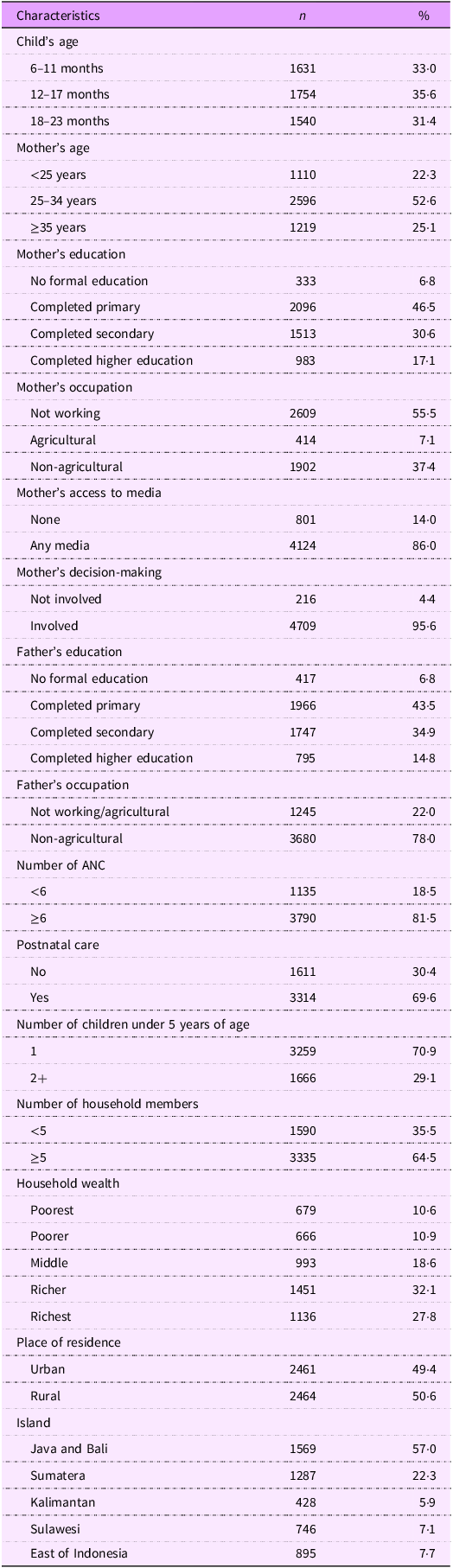
Overall, 70·9 % of children aged 6–23 months consumed eggs and/or flesh foods in the previous 24 h; 51·2 % consumed eggs and 57·1 % consumed flesh foods. Table 1 presents the characteristics of study participants. The analysis included a total of 4925 children aged 6–23 months. Over half of the children were male (51·9 %). The largest proportion was aged 12–17 months (35·6 %). Most mothers were aged 25–34 years (52·6 %) and had completed primary (46·5 %) or secondary (30·6 %) education. More than half of the mothers were not working (55·5 %). The majority of mothers had access to media (86·0 %) and were involved in household decision-making (95·6 %). Most mothers received adequate maternal health services, with 81·5 % attending more than six ANC visits and 69·6 % receiving postnatal care. About 60 % of households fell into the richer or richest wealth quintiles. The participants were evenly split between urban (49·4 %) and rural (50·6 %) areas, with the majority residing in Java and Bali (57·0 %).
Characteristics of study participants

Table 1. Long description
A table summarizing characteristics of study participants. The table has 25 rows and 3 columns. The columns are labeled Characteristics, n, and %. Row 1: Child’s age, 6-11 months, 1631, 33.0%. Row 2: Child’s age, 12-17 months, 1754, 35.6%. Row 3: Child’s age, 18-23 months, 1540, 31.4%. Row 4: Mother’s age, <25 years, 1110, 22.3%. Row 5: Mother’s age, 25-34 years, 2596, 52.6%. Row 6: Mother’s age, >=35 years, 1219, 25.1%. Row 7: Mother’s education, No formal education, 333, 6.8%. Row 8: Mother’s education, Completed primary, 2096, 46.5%. Row 9: Mother’s education, Completed secondary, 1513, 30.6%. Row 10: Mother’s education, Completed higher education, 983, 17.1%. Row 11: Mother’s occupation, Not working, 2609, 55.5%. Row 12: Mother’s occupation, Agricultural, 414, 7.1%. Row 13: Mother’s occupation, Non-agricultural, 1902, 37.4%. Row 14: Mother’s access to media, None, 801, 14.0%. Row 15: Mother’s access to media, Any media, 4124, 86.0%. Row 16: Mother’s decision-making, Not involved, 216, 4.4%. Row 17: Mother’s decision-making, Involved, 4709, 95.6%. Row 18: Father’s education, No formal education, 417, 8.5%. Row 19: Father’s education, Completed primary, 1966, 43.5%. Row 20: Father’s education, Completed secondary, 1747, 34.9%. Row 21: Father’s education, Completed higher education, 795, 14.8%. Row 22: Father’s occupation, Not working/agricultural, 1245, 22.0%. Row 23: Father’s occupation, Non-agricultural, 3680, 78.0%. Row 24: Number of ANC, <6, 1135, 18.5%. Row 25: Number of ANC, >=6, 3790, 81.5%. Row 26: Postnatal care, No, 1611, 30.4%. Row 27: Postnatal care, Yes, 3314, 69.6%. Row 28: Number of children under 5 years of age, 1, 3259, 70.9%. Row 29: Number of children under 5 years of age, 2+, 1666, 29.1%. Row 30: Number of household members, <5, 1590, 35.5%. Row 31: Number of household members, >=5, 3335, 64.5%. Row 32: Household wealth, Poorest, 679, 10.6%. Row 33: Household wealth, Poorer, 666, 10.9%. Row 34: Household wealth, Middle, 993, 18.6%. Row 35: Household wealth, Richer, 1451, 32.1%. Row 36: Household wealth, Richest, 1136, 27.8%. Row 37: Place of residence, Urban, 2461, 49.4%. Row 38: Place of residence, Rural, 2464, 50.6%. Row 39: Place of residence, Java and Bali, 1569, 57.0%. Row 40: Place of residence, Sumatra, 1287, 22.3%. Row 41: Place of residence, Kalimantan, 428, 5.9%. Row 42: Place of residence, Sulawesi, 746, 7.1%. Row 43: Place of residence, East of Indonesia, 895, 7.7%.
n, unweighted number; %, weighted percentage; ANC, antenatal care.
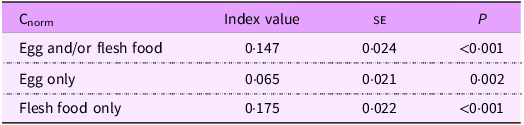
Table 2 shows Wagstaff’s normalised concentration index values, indicating pro-rich inequalities in the consumption of ASF among children aged 6–23 months. The greatest inequality was observed in flesh food consumption (C norm = 0·175, P < 0·001), followed by the combined consumption of egg and/or flesh food (C norm = 0·147, P < 0·001). Inequality was also evident, though to a lesser extent, in egg consumption alone (C norm = 0·065, P = 0·002). These results align with the corresponding Lorenz curves, all of which fall below the line of equality, indicating pro-rich distributions. Notably, the Lorenz curve for flesh food lies farther from the equality line than the curve for egg consumption, reflecting greater inequality (see Figure 1).
Wagstaff’s normalised concentration index for consumption of egg and/or flesh food, egg only and flesh food only consumption among children aged 6–23 months

Table 2. Long description
A table comparing normalized concentration index values for egg and flesh food consumption among children aged 6-23 months. The table has three rows and four columns. Column headers are C norm, Index value, SE, and P. Row labels are Egg and/or flesh food, Egg only, and Flesh food only. Row 1: Egg and/or flesh food, 0.147, 0.024, <0.001. Row 2: Egg only, 0.065, 0.021, 0.002. Row 3: Flesh food only, 0.175, 0.022, <0.001.
Cnorm,Waggstaff’s normalised concentration index.
Lorenz curves for consumption of a) egg and/or flesh food, b) egg only and c) flesh food only among children aged 6–23 months.

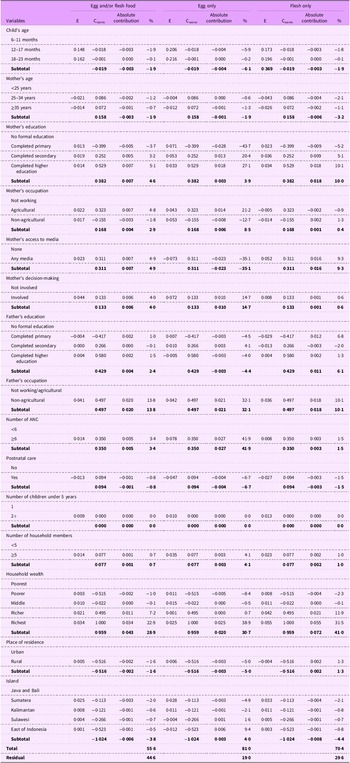
All variance inflation factors were below 5 (mean VIF = 2·32), indicating no evidence of problematic multicollinearity among the explanatory variables. As shown in Table 3, the decomposition analysis revealed that household wealth was the most influential factor driving inequality in children’s consumption of ASF. Elasticity measures the responsiveness of food consumption to changes in each determinant, indicating how strongly a factor influences the outcome. For example, the elasticity for the richest wealth quintile was 0·034 for combined egg and/or flesh food consumption, meaning that a 1 % increase in wealth among the richest households corresponds to a 0·034 % increase in consumption. The corresponding normalised concentration index (C norm) was 1·000, reflecting that this group is fully concentrated among wealthier households and significantly contributes to the observed pro-rich disparity. Father’s non-agricultural occupation also played a substantial role, with an elasticity of 0·042 for egg consumption and a C norm of 0·497, showing that this occupation is more prevalent among affluent families and positively influences children’s egg intake. Similarly, mothers with higher education had an elasticity of 0·034 for flesh food consumption and a C norm of 0·529, indicating that higher maternal education, concentrated in wealthier households, is associated with increased likelihood of flesh food consumption among children. Overall, the included variables explained 55·6 % of the inequality in combined egg and/or flesh food consumption, 81·0 % in egg consumption alone and 70·4 % in flesh food consumption. Residuals accounted for 44·4 %, 19·0 % and 29·6 % of the inequality across outcomes, indicating some unexplained variation.
Decomposition of socio-economic inequality in egg and/or flesh food, egg only and flesh food only consumption among children aged 6–23 months

Table 3. Long description
A table with 32 rows and 12 columns comparing socio-economic factors influencing egg and/or flesh food, egg only, and flesh food only consumption among children aged 6-23 months. The columns are labeled as Egg and/or flesh food, Egg only, and Flesh food only, each with sub-columns for Elasticity and Absolute contribution. The rows are labeled with various socio-economic factors such as Child’s age, Mother’s age, Mother’s education, Mother’s occupation, Mother’s access to media, Mother’s involvement in decision making, Father’s education, Father’s occupation, Number of ANC visits, Place of delivery, Number of household members, Household food wealth, and Residence. Each row provides values for Elasticity and Absolute contribution for each category. Notable trends include the significant influence of household wealth and father’s non-agricultural occupation on the consumption of animal source foods (ASF).
E, elasticity, Cnorm, Waggstaff’s normalised concentration index; %, relative contribution; ANC, antenatal care.
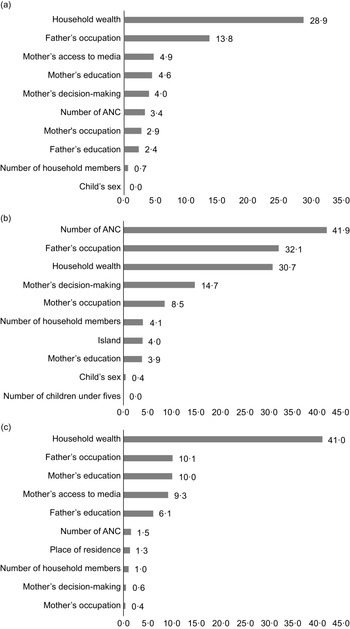
Relative contribution (%) reflects each factor’s contribution to the explained component of socio-economic inequality, rather than a direct effect on consumption. Positive contributions indicate factors that increase pro-rich inequality, whereas negative contributions indicate factors that reduce or offset such inequality. Based on Figure 2, household wealth consistently emerged as the leading contributor to inequality in the consumption of ASF among children aged 6–23 months, accounting for 28·9 % of inequality in combined egg and/or flesh food consumption, 30·7 % in egg only and 41·0 % in flesh food only. For egg and/or flesh food, other key contributors included father’s occupation (13·8 %), maternal access to media (4·9 %), maternal education (4·6 %) and maternal decision-making (4·0 %). In egg consumption alone, the top contributors after wealth were ANC visits (41·9 %), father’s occupation (32·1 %), maternal decision-making (14·7 %) and maternal occupation (8·5 %). For flesh food consumption, important drivers included father’s occupation (10·1 %), maternal education (10·0 %), maternal access to media (9·3 %) and father’s education (6·1 %). These findings highlight that economic status, parental education and occupation, healthcare access and information exposure are central to understanding dietary inequalities in early childhood.
Relative contributions of key determinants to inequality in a) egg and/or flesh food, b) egg only and c) flesh food only consumption. ANC, antenatal care.

Discussion
This study demonstrates clear socio-economic inequalities in the consumption of egg and/or flesh foods, as well as egg-only and flesh-food-only consumption, among young children in Indonesia. Decomposition of the WHO-defined combined indicator provides insight into the socio-economic drivers of overall ASF consumption inequality, while separate analyses of eggs and flesh foods help distinguish food-specific factors that vary across socio-economic groups. Children from wealthier households were consistently more likely to consume these nutrient-rich foods, underscoring persistent dietary disparities during a critical window of growth and development. These pro-rich inequalities reflect broader challenges in low- and middle-income countries, where economic constraints, cultural factors and limited access hinder equitable child nutrition. Although recent improvements in food distribution and egg affordability may have increased ASF consumption, such gains do not necessarily imply reduced inequality; the findings therefore provide a baseline for equity assessment.
Household wealth emerged as the most influential driver of these inequalities, confirming that financial resources remain a fundamental determinant of food choices and dietary quality(Reference Kase, Frongillo and Isanovic21,Reference Gebretsadik, Adhanu and Mulugeta29,Reference Mekonen30) . This finding resonates with established evidence that affordability and purchasing power significantly affect access to ASF, which tend to be more expensive compared to plant-based alternatives(Reference Hassan, Mahbub and Ali31). The stronger inequality observed for flesh foods compared to eggs suggests that the cost and availability of different types of ASF can vary(Reference Daba, Murimi and Abegaz32,Reference Headey and Alderman33) , potentially shaping consumption patterns within poorer communities. Policies that expand social protection programmes, such as conditional cash transfers or food vouchers for low-income families, are essential to reduce these financial barriers and improve equitable access to ASF.
Parental occupation plays a significant role in driving inequalities in the consumption of ASF among young children. A father’s non-agricultural occupation is strongly associated with higher household income and economic stability, which increases the capacity to purchase nutrient-rich foods, such as eggs and meat(Reference Headey and Alderman33). Maternal occupation also contributes, particularly to inequalities in egg consumption, indicating that working mothers may have different levels of resources, time availability or social exposure that influence feeding practices(Reference Kekalih, Februhartanty and Mansyur17,Reference Datar, Nicosia and Shier34) . These occupational factors highlight the economic dimension of food access and the complex ways employment shapes child nutrition. Targeted livelihood support and employment opportunities for parents, combined with workplace-based nutrition education, could help reduce these disparities.
Parental education similarly influences dietary disparities, but through knowledge, attitudes and caregiving behaviours(Reference Sarkar, Rifat and Bakshi35). Both maternal and paternal education levels are linked to increased consumption of ASF(Reference Miller, Webb and Cudhea36,Reference Paro, Davour and Acosta37) , reflecting greater awareness of the nutritional benefits and better child feeding practices. Maternal education, in particular, emerges as a key factor, reinforcing the need to empower mothers with nutrition information during critical periods like pregnancy and complementary feeding(Reference Nurokhmah, Februhartanty and Siscawati38–Reference Rahmawati, van der Pligt and Willcox40). Alongside education, maternal access to media and involvement in household decision-making further support improved child dietary choices by increasing exposure to health messages and enhancing women’s agency in the family(Reference Bouchard, Grigsby-Toussaint and Fox41,Reference Herman, Mansur and Chang42) . Policies should integrate nutrition education into school curricula and maternal health programmes, ensuring women are empowered with accurate information and decision-making skills that support healthy feeding practices.
A notable finding is the large relative contribution of ANC visits, specifically to inequalities in egg consumption. This contribution should be interpreted as reflecting the socio-economic patterning of maternal health service utilisation, rather than a direct effect of ANC attendance on egg consumption. Maternal health services nevertheless represent a critical platform for delivering nutrition counselling and support that may influence complementary feeding practices(Reference Wiradnyani, Khusun and Achadi43,Reference Nguyen, Sununtnasuk and Christopher44) . Eggs may be more readily encouraged because they are generally more affordable and accessible compared to flesh foods(Reference Hailu, Geremew and Liverani22,Reference Ryckman, Codjia and Nordhagen45) . In contrast, despite awareness or knowledge gained through health services, the higher price of flesh foods may continue to limit their consumption among poorer households(Reference Zerfu, Duncan and Baltenweck46). Strengthening antenatal and postnatal care programmes to routinely include practical, culturally relevant counselling on complementary feeding, while also addressing economic barriers through subsidies or vouchers, could further promote equitable ASF consumption.
Maternal access to media and involvement in household decision-making also emerged as important contributors to socio-economic inequalities in ASF consumption. Access to media serves as a key channel for disseminating nutrition information, shaping caregivers’ knowledge, attitudes and practices around child feeding. The larger negative contribution of maternal access to media for egg consumption, compared with flesh foods, likely reflects the greater affordability and availability of eggs, making them more responsive to information exposure. Mothers exposed to health messages through radio, television or digital platforms may therefore be more able to adopt recommended feeding behaviours for eggs across socio-economic groups(Reference Mekonen30,Reference Zemene, Kebede and Anteneh47) . In contrast, flesh food consumption may remain constrained by higher costs, limited access or cultural preferences, reducing the extent to which media exposure translates into more equitable consumption. Meanwhile, maternal participation in household decision-making reflects women’s empowerment and agency, which can influence food purchasing and allocation priorities within the family(Reference Santoso, Kerr and Hoddinott48). Leveraging mass media campaigns and community empowerment programmes to enhance women’s access to information and decision-making roles can play a vital role in narrowing these dietary gaps.
Strengths and limitations
This study’s strengths include the use of nationally representative data and robust analytical methods that provide a detailed assessment of socio-economic inequalities in egg and/or flesh food consumption among young children in Indonesia. The separate examination of different ASF offers specific insights into dietary disparities. However, the cross-sectional design limits causal inference, and reliance on self-reported dietary data may introduce recall bias. Additionally, the analysis uses data from the 2017 IDHS, the most recent survey with standardised IYCF indicators suitable for inequality decomposition. Although more recent nutrition initiatives may have affected consumption levels, the findings reflect underlying structural socio-economic disparities. Finally, factors such as cultural food preferences, seasonal availability and intra-household food distribution were not captured, which may explain some of the residual inequality observed. Despite these limitations, the study provides valuable evidence to inform targeted nutrition policies.
Conclusion
This study highlights substantial socio-economic inequalities in the consumption of egg and/or flesh foods among Indonesian children aged 6–23 months. Consumption was disproportionately concentrated among wealthier households, with household wealth, father’s occupation, maternal education and access to health and information services emerging as key drivers of inequality. These findings underscore the need for targeted policy interventions that promote affordable access to nutrient-rich ASF, particularly for low-income families. Strategies could include nutrition-sensitive social protection programmes, behaviour change communication and efforts to strengthen food systems to make ASF more accessible and acceptable for vulnerable populations.
Authorship
B.A.P., I.Y.H. and W.P.N. conceptualised the study and methodology. B.A.P. curated the data and conducted the formal analysis. M.I., Y.A., N.S. and M.A.M. validated the data. B.A.P., I.Y.H., M.I. and Y.A. drafted the manuscript. B.A.P., N.S., M.A.M. and W.P.N. reviewed and edited the manuscript. B.A.P. prepared the visualisation. W.P.N. supervised the study. All authors read and approved the final manuscript.
Financial support
None.
Competing interests
None.
Ethical standards
This study was conducted in accordance with the guidelines outlined in the Declaration of Helsinki. All respondents provided their consent before participating in the survey. The ICF International Review Board and the National Institute for Health and Research Development of the Indonesian Ministry of Health ethically approved the surveys. We obtained all the data through the DHS website after requesting access.


 Open access

