INTRODUCTION
The neural representation of peripersonal space (the region immediately surrounding the body that is within arms reach) may be distinct from the representation of extrapersonal space (the region beyond arms' reach). Lesion studies with monkeys support the neuroanatomical dissociation between peripersonal and extrapersonal space (for review see Graziano, 2006). In humans the data are more equivocal because relatively similar damage, often to the posterior parietal cortex, may result in either extrapersonal neglect or peripersonal neglect (e.g., Vallar et al. 2003). However, unlike the work with monkeys, these lesions are unplanned and frequently extensive, making interpretation of the human data difficult.
Behaviorally, hemispatial neglect can be specific to peripersonal space or extrapersonal space (Beschin & Robertson, 1997; Bisiach et al., 1986; Halligan & Marshall, 1991). When neglect is specific to peripersonal space, people exhibit left hemispatial deficits in tasks such as grooming or dressing. When neglect is specific to extrapersonal space, people fail to detect or respond to more distant leftward stimuli. Studies of neurologically intact individuals also suggest a functional distinction between peripersonal and extrapersonal processing. When line bisection is performed in peripersonal space, young neurologically intact people often exhibit leftward bisection errors (e.g., Varnava et al., 2002). When the same task is performed in extrapersonal space, this leftward bias disappears and in some cases, it even reverses direction becoming a significant rightward bias (e.g., Varnava et al., 2002).
Tasks of visuospatial attention also tend to elicit differences that depend on proximity to the body. For instance, McCourt and Garlinghouse (2000) observed that pseudoneglect, that is, the leftward bias in attention that can be observed under certain conditions in neurologically normal participants, was more pronounced in peripersonal space than in extrapersonal space. Butler et al. (2004) found that their control participants were less able to detect targets when they were presented in extrapersonal space than when they were presented in peripersonal space. Thus, proximity effects are not restricted to individuals with neurological impairments. They are observed in neurologically normal participants as well.
However, most of the tasks described earlier have combined spatial judgments with a motoric response [but see McCourt & Garlinghouse, 2000, in which the motoric component was very simple], both of which are skills that exhibit large sex differences. Judgments of line orientation, the bisection of lines, and rotation of objects all exhibit notable sex differences, with males typically outperforming females on these tasks (for review see Halpern, 2000). One notable exception to the male advantage for spatial tasks is the object location memory task (OLMT), a task that requires participants to compare a remembered array of line drawings with a second array of line drawings and indicate which drawings have changed position (Silverman & Eals, 1992). A recent meta-analysis of performance on the OLMT reveals that the female advantage on this task is reliable (Voyer et al., in press), although the exact nature of the female advantage requires more investigation. For instance, Voyer et al. (in press) suggest that the known female advantage for verbal memory and/or object identity memory may play an important role in the performance of the task.
In the motor domain, women typically perform better than men in peripersonal space (Tiffin, 1968), whereas men excel in extrapersonal space (Watson & Kimura, 1989). Because most of these tasks have confounded proximity with the type of spatial ability being tested, the effect that proximity has on sex differences in spatial ability among neurologically normal participants is unknown. Interestingly, although the OLMT is typically performed in peripersonal space, it is possible to present the stimuli in extrapersonal space.
It has been suggested that interactions with extrapersonal space might preferentially engage neural systems specialized for navigation and spatial orientation (Previc, 1998). However, unlike the OLMT, males perform navigation and spatial orientation more accurately than do females (e.g. Saucier et al., 2002). Thus, presenting the OLMT in extrapersonal space may alter the sex difference for this task.
The present study investigated how proximity to the body affected performance of the OLMT. Consistent with previous studies in which participants performed the OLMT within peripersonal space, we expected to observe a female advantage on the OLMT when it is performed in peripersonal space. However, given the potential to engage neural systems that relate to navigation, it may be that presenting the OLMT in extrapersonal space may reduce or even eliminate the female advantage.
METHOD
Participants
One hundred and twenty introductory psychology students (60 men) took part in the experiment in exchange for course credit. The participants were an average of 20.92 years of age (SD = 3.72; men M = 21.29 years of age, women M = 20.72 years of age), had normal or corrected to normal vision, and spoke English as their first language. Handedness was assessed by questionnaire (Elias et al., 1998), and a majority of participants were strongly right-handed, although 1 person responded that they were strongly left-handed. All procedures were approved by the local Research Ethics Board, in accordance with the guidelines of the Helsinki Declaration (http://www.wma.net/e/policy/17-c_e.html).
Peripersonal Version of the OLMT (peripersonal OLMT)
There were two arrays (reproduced on an 11 × 17 piece of paper; ∼13 degrees of visual angle at the furthest edge) of 27 line drawings of objects (Silverman & Eals, 1992). Participants were seated at a desk with the array centered on the tabletop in front of them, although they were free to move their heads and eyes. Participants studied the initial array for one minute. To ensure that it remained an incidental learning task, participants were instructed only to study the array, and no questions about the nature of the task were answered at this time. After one minute, the original array was removed and replaced with a second array, in which 14 of the objects had exchanged locations. Participants were then instructed to circle the items that remained in their original location (n = 13) and cross out any items that were not in their original location (n = 14). Participants were required to provide an answer for every item, and were encouraged to guess when they were unsure. Scores were determined by summing the number of correct answers (maximum score = 27).
Extrapersonal Version of the OLMT (extrapersonal OLMT)
To present the OLMT in extrapersonal space, we used an overhead projector to present the same arrays as in the peripersonal version of the OLMT. The arrays were projected onto a white wall 3.0 meters in front of the participant (projected 2.3 m wide by 1.1 m high; ∼20 degrees of visual angle at the furthest edge). The arrays, procedures, and time limits were the same as in the peripersonal version of the OLMT, although instead of a pen, participants used a laser pointer to indicate their answers. Answers were made in the same way, with participants circling the items that remained in their original location (n = 13) and crossing out any items that did not remain in their original location (n = 14). Answers were recorded as either “O”s or “X”s over the indicated item on the overhead transparency by the experimenter as participants responded. Scores were determined by summing the number of correct answers (maximum score = 27).
Procedure
Participants were individually tested. To insure that the task remained one of incidental learning, half of the participants (n = 60; 30 men) performed the OLMT in peripersonal space and the other half (n = 60; 30 men) performed the OLMT in extrapersonal space. Once the researcher obtained consent, the participants completed a demographic questionnaire, which surveyed age, sex, area of study, and handedness. Participants then performed one version of the OLMT. Because the OLMT is a test of incidental learning, it was not possible to have participants perform both versions of the OLMT.
RESULTS
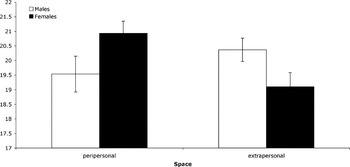
A 2 × 2 analysis of variance (ANOVA) with sex (male, female) and proximity to the body (extrapersonal, peripersonal space), as between subject variables, was performed using the number correct on the OLMT as the dependent measure. There was a significant interaction between sex and proximity to the body, F(1,116) = 7.57, p = .01 (Fig. 1). No significant main effects of sex, F(1,116) = 0.02, p = .89, nor of proximity, F(1,116) = 1.07, p = .30, were observed. As predicted, post hoc comparisons (Tukey) indicated for the peripersonal OLMT, females significantly outscored males, p < .05. Interestingly, for the extrapersonal OLMT, males significantly outperformed females, p < .05. As well, females who performed peripersonal OLMT outscored females who performed the extrapersonal OLMT, p < .05. There were no other significant differences observed among the 4 groups.

Performance on the OLMT in either peripersonal or extrapersonal space. Bars represent group means ±SEM.
To ensure that using a laser pointer to indicate their answers did not significantly affect performance in the extrapersonal OLMT, an additional 62 participants (26 men) performed the peripersonal OLMT using a laser pointer to indicate their preferences on the answer sheet. As was the case with the extrapersonal OLMT (earlier), the experimenter used a marker to record the participant's answer directly on the sheet. Results indicated that there was a significant sex difference, t(60) = 5.01, p = .023, 1-tailed, favoring females (females: M = 21.44, SD = 3.28; males: M = 19.54, SD = 4.10). Thus altering the means by which the participants provided their answers on the peripersonal OLMT did not eliminate the female advantage for this task.
DISCUSSION
As predicted, the typical female advantage was observed for the peripersonal OLMT. However, for the extrapersonal OLMT, the female advantage disappeared and males actually outperformed females. In addition, the performance of females on the peripersonal OLMT was significantly better than the performance of females on the extrapersonal OLMT. As the female advantage for the peripersonal OLMT persisted even when females answered with a laser pointer, it does not seem that altering the means by which participants responded in the extrapersonal OLMT can account for the observed male advantage.
Some have suggested that the female advantage on the standard peripersonal version of the OLMT relates to the nameability of the objects used in the array (e.g., Lewin et al., 2001; but see Eals & Silverman, 1994). For instance, Postma and De Haan (1996) demonstrated that object location memory of nameable objects relies on verbal components of working memory. Although this may be the case, the male advantage for the extrapersonal OLMT was observed using the same stimuli as the peripersonal OLMT. As such, the nameability of the stimuli remained constant across the two conditions. Thus, the sex differences appear to relate to the proximity of the task to the body, and cannot easily be explained by linguistic factors.
These results are consistent with the notion that extrapersonal space might be specialized for navigation and visual search (Previc, 1998). Because males excel on tasks of navigation (e.g. Saucier et al., 2002), the sex difference observed for the extrapersonal OLMT is consistent with the hypothesized specialization of the visual system to deal with extrapersonal space. However, within peripersonal space, Previc suggests that the dorsal visual stream dominates, with advantages accruing for tasks involving fine motor skill and manipulation. As such, the nature of the female advantage for the OLMT when in peripersonal space is not easily explained, because the current task does neither obviously rely solely on the dorsal visual stream nor does it require greater fine motor skill more in condition than the other.
However, the neural representation of peripersonal space might be distinct from the representation of extrapersonal space, especially when a motor response is required (Graziano, 2006). It is unknown whether there are sex differences in the neural organization of these skills, although it should be noted that sex differences are not observed for capuchin monkeys on an extrapersonal spatial-motor task (for review see Watson, 2001). Thus, a potential failure to observe sex differences in the neural organization of non-human animals may reflect unique selection pressures on behavior and brain that are related to the development of hunting in humans (Watson, 2001).
Thus, it may be that presentation of the OLMT in peripersonal space may preferentially activate neural circuits that underlie the female advantage for spatial-motor tasks performed in peripersonal space. Conversely, presentation of the OLMT in extrapersonal space may preferentially activate neural circuits that underlie the male advantage for spatial-motor tasks performed in extrapersonal space. It is parsimonious to note that for spatial-motor tasks, a female advantage emerges for tasks performed in peripersonal space and a male advantage emerges for tasks performed in extrapersonal space. In the present experiment, a peripersonal spatial task that typically elicits a female advantage was modified for presentation into extrapersonal space. This manipulation eliminated the female advantage, suggesting that the sex differences observed in spatial tasks are dependent on the spatial frames of processing required during performance of the task.
ACKNOWLEDGMENTS
This research was conducted with the assistance of discovery grants from the Natural Sciences and Engineering Research Council of Canada (NSERC) to DMS and LJE, the Canada Research Chairs program to DMS, and a postgraduate scholarship from NSERC to AJL. The information in this manuscript and the manuscript itself is new and original and has never been published either electronically or in print previously. No financial or other relationships that could constitute a conflict of interest exist that could affect this manuscript.