Postdispersal consumption of weed seed and waste grain in crop fields is an important ecosystem service provided by vertebrate and ground-dwelling invertebrate seed predators in many agricultural systems (Power Reference Power2010; Tscharntke et al. Reference Tscharntke, Clough, Wagner, Jackson, Motzke, Perfecto, Vandermeer and Whitbread2012). Multi-tactic weed control strategies that capitalize on natural seed predation may potentially reduce agrochemical use and improve farmland ecological integrity (Brust and House Reference Brust and House1988; Tscharntke et al. Reference Tscharntke, Klein, Kruess, Steffan-Dewenter and Thies2005). Studies of seed predation have shown natural consumers to be efficient in removing large proportions (e.g., >50%) of weed seeds presented during experimental trials (e.g., Westerman et al. Reference Westerman, Hofman, Vet and van der Werf2003) to levels that effectively reduce weed germination in subsequent growing seasons (Blubaugh and Kaplan Reference Blubaugh and Kaplan2016; Davis et al. Reference Davis, Dixon and Liebman2003). Therefore, it is important to understand factors that mediate the capacity of seed predators to regulate weed seed and waste grain populations in cultivated habitats. The majority of seed predation studies have focused on factors that influence rate of seed removal, which can include cropping system, vegetation structure, and seasonality (e.g., Booman et al. Reference Booman, Laterra, Comparatore and Murillo2009; Cardina et al. Reference Cardina, Norquay, Stinner and McCartney1996; Fischer et al. Reference Fischer, Thies and Tscharntke2011; Menalled et al. Reference Menalled, Marino, Renner and Landis2000; Navntoft et al. Reference Navntoft, Wratten, Kristensen and Esbjerg2011). Additionally, although less frequently acknowledged as a key factor affecting removal rates of particular seed types, preference for different seeds by vertebrate and invertebrate seed predators likely influences the overall impact of seed predators on regulation of weed seed and waste grain populations (Brust and House Reference Brust and House1988; van der Laat et al. Reference van der Laat, Owen, Liebman and Leon2015; White et al. Reference White, Renner, Menalled and Landis2007).
Selection of a seed type disproportionately more (or less) frequently than expected based on equal availability, i.e., preference (or avoidance), influences the capacity of seed predators to alter the amount and type of seeds entering the seedbank. Knowledge of seed preferences also establishes a baseline from which to understand better how physical and behavioral factors affect foraging decisions of seed predators in arable fields. Animal selection of seeds is influenced by seed characteristics such as size, shape, hardness, chemical defense, and nutrient content (Kelrick et al. Reference Kelrick, MacMahon, Parmenter and Sisson1986; Lundgren and Rosentrater Reference Lundren and Rosentrater2007; Sundaram et al. Reference Sundaram, Willoughby, Lichti, Steele and Swihart2015; Vander Wall Reference Vander Wall2010); animal characteristics such as body size, metabolic rate, and physiological state (Kaufman and Collier Reference Kaufman and Collier1981; Lichti et al. Reference Lichti, Steele and Swihart2015); and environmental context such as relative availability of seeds of different types (Sundaram et al. Reference Sundaram, Lichti, Steele, Dalgleish and Swihart2016; Sunyer et al. Reference Sunyer, Espelta, Bonal and Munoz2014; Theimer Reference Theimer2005) and spatiotemporal variation in foragers’ fear of predation (Brown and Kotler Reference Brown and Kotler2004).
Granivorous ground-dwelling invertebrates (i.e., ground beetles [Carabidae] and field crickets [Gryllidae]) are common in agricultural fields throughout North America, and their ability to regulate weed seed populations has been well studied (e.g., Blubaugh and Kaplan Reference Blubaugh and Kaplan2016; Menalled et al. Reference Menalled, Smith, Dauer and Fox2007). The role of small rodents as seed predators in cultivated habitats is less well known. The prairie deer mouse (Peromyscus maniculatus bairdii) inhabits a variety of sparsely vegetated habitats throughout the central United States and is the dominant vertebrate seed predator in row-crop fields (corn and soybean) in this region (Clark and Young Reference Clark and Young1986; Getz and Brighty Reference Getz and Brighty1986; Whitaker Reference Whitaker1966). Prairie deer mice are year-round residents in corn and soybean fields and have adapted to capitalize on an abundance of grain and other seeds available in row-crop habitats (Doudna and Danielson Reference Doudna and Danielson2015; Getz and Brighty Reference Getz and Brighty1986). Despite their potential impact as a dominant seed predator, particularly in overwinter removal of weed seed and consumption of waste grain (Williams et al. Reference Williams, Liebman, Westerman, Borza, Sundberg and Danielson2009), little is known about how prairie deer mice select among different food resources in row-crop habitats.
Deer mice are widely distributed and considered a “generalist” species, yet they are known to show distinct preferences for particular food resources and seeds in several habitat types (e.g., coniferous forests [Everett et al. Reference Everett, Meeuwig and Stevens1978], deciduous forests [Cramer Reference Cramer2014], and grasslands [Drickhamer Reference Drickhamer1970]). Deer mice foraging in row-crop habitats select among multiple exploitable food resources, including various weed seeds and waste grains that vary in size, nutritional content, and seasonal availability. Understanding seed preferences of dominant agricultural seed predators is important, because it can help elucidate the role of seed predators in population regulation of particular weed species and waste grain in crop environments, yet few studies have explicitly tested seed preference of vertebrate seed predators in cultivated habitats (Gallandt et al. Reference Gallandt, Molloy, Lynch and Drummond2005; Marino et al. Reference Marino, Cross and Landis1997; Mauchline et al. Reference Mauchline, Watson, Brown and Froud-Williams2005). To address this knowledge gap, we evaluated winter preference for several common agricultural weed seeds and waste grains by prairie deer mice in row-crop habitats.
Materials and Methods
We conducted seed preference trials on eight privately owned row-crop fields (four corn and four soybean) in Tippecanoe County, IN. Fields ranged in size from 8.97 to 188.25 ha (mean=60.08±33.44 SE) and managed under reduced tillage regimes; fields were not tilled following fall crop harvest in 2015. The weed community within the study area consisted primarily of common lambsquarters, common cocklebur, common ragweed, giant foxtail, giant ragweed (Ambrosia trifida L.), green foxtail [Setaria viridis (L.) Beauv.], redroot pigweed (Amaranthus retroflexus L.), and velvetleaf.
Seed Preference Trials
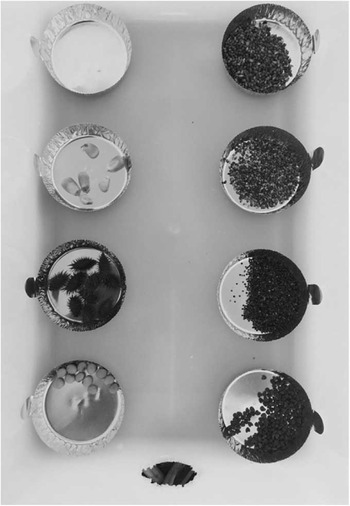
We used cafeteria-style feeding trials to evaluate preference for weed seed and waste grain by prairie deer mice in row-crop fields. Feeding trials were conducted within arenas constructed from standard plastic rodent cages (38 by 30 by 25 cm) with individual seed trays (aluminum weighing boats) affixed to the bottom (Figure 1). We covered each arena with a clear glass sheet and drilled a 2.54-cm hole into the side of the cage to allow mice to freely enter and exit during trials. Within each feeding arena, we presented 2 g (weighed to nearest 0.001 g) each of five agricultural weed seeds (common ragweed, common cocklebur, common lambsquarters, velvetleaf, giant foxtail; Azlin Seed Services, Leland, MS) and two grains (corn and soybean). We provisioned 2 g of each seed type to ensure that the total amount of seed available exceeded the daily intake requirements of adult deer mice (Stebbins Reference Stebbins1977). Arrangement of seed trays within arenas was randomized during each trial using a random number generator.
Overhead image of feeding arena (entrance hole at bottom) used in cafeteria-style feeding trials of seed preference by prairie deer mice in row-crop habitat in central Indiana.

During trials we placed feeding arenas adjacent to (within 1 m) wooden mouse nesting boxes (15 by 15 by 15 cm) that were buried flush with the soil surface within the interior of study fields (>100 m from field edge) for use in a concurrent investigation of prairie deer mouse demographics in row-crop habitat. We installed a grid of 36 nesting boxes per field with 20-m spacing between boxes. We placed feeding arenas only next to nest boxes that were occupied by mice and conducted only one feeding trial per nest box to avoid sampling the same individual mice on multiple trials. Average interarena distance averaged 55.2 m (SE=3.4) and ranged from 20 to 80 m. Feeding arenas were installed within fields at dusk (1900 to 2000 hours) and removed the following morning (0700 to 0800 hours); therefore, each trial consisted of a single night when seeds were exposed and available for consumption by free-ranging mice. We weighed seed (to nearest 0.001 g) remaining in trays after individual trials and calculated the percentage (%) of each seed type removed. Because we did not track seed fate, we do not know whether seeds removed from trays were subsequently consumed or cached by mice. All seed preference trials were conducted during winter (February 1 to March 3, 2016); we chose this study period to control for potential removal of seed by invertebrates, because granivorous insects exhibit little or no activity during this period (Carmona and Landis Reference Carmona and Landis1999; Denlinger and Lee Reference Denlinger and Lee1998). By conducting trials at night during winter in field interiors, we maximized the odds that prairie deer mice were the only active seed predator visiting trays, because invertebrates are dormant during this period and other potential vertebrate seed predators (i.e., ground-foraging birds) are diurnal. During our overwinter capture–mark–recapture efforts, prairie deer mice represented 98% of rodent captures (J Berl, unpublished data); the only other rodents captured were prairie voles (Microtus ochrogaster), which are predominantly herbivorous and consume seeds infrequently (Zimmerman Reference Zimmerman1965).
Data Analysis
We used compositional analysis (Aebischer et al. Reference Aebiescher, Robertson and Kenward1993) and the multinomial distribution method of Neu et al. (Reference Neu, Byers and Peek1974) to determine whether removal of available seed types significantly differed from random (i.e., equal consumption). Both methods yielded qualitatively similar results; for clarity and brevity we report only the results from compositional analysis. Commonly used to evaluate habitat preference of radio-tracked animals (e.g., Owen et al. Reference Owen, Berl, Edwards, Ford and Wood2015), compositional analysis is well suited to evaluate seed preferences by comparing the proportional (%) removal of different seeds available during feeding trials. We conducted compositional analysis using the ‘adehabitat’ package (Calenge Reference Calenge2006) implemented within R (R Development Core Team 2016). We calculated log-ratio differences in seed consumption per trial and computed the compositional analysis test statistic λ from the matrix of log-ratio differences to test for overall nonrandom seed selection. Individual seed preferences were then ranked in order of selection preference, and Student’s t-test was used to test for pairwise differences in preference among available seed types (Aebischer et al. Reference Aebiescher, Robertson and Kenward1993). Compositional analysis calculates log-ratios, which cannot accommodate zero-values; therefore, if seed types were available but not selected during individual trials, zero-values were replaced with 0.007 to reduce the likelihood of type I error rates, as recommended by Bingham and Brennan (Reference Bingham and Brennan2004). We present means ±SEs throughout.
Results and Discussion
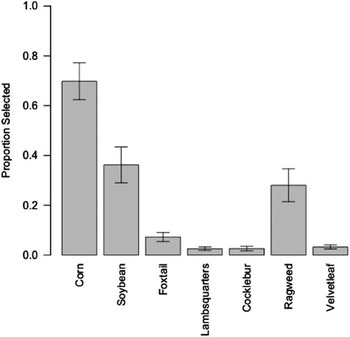
We conducted 45 cafeteria-style feeding trials adjacent to actively used nest boxes over the course of the study, but only 27 trials were used in our analysis of seed preference; 15 trials were excluded because mice did not visit arenas and 3 were excluded due to disturbance by raccoons (Procyon lotor). On average, mice removed 2.97 g (±0.36) of seed during preference trials, and the mean amount selected varied among seeds (Figure 2). Proportional selection was higher for waste grains than weed seeds, on average. Prairie deer mouse removal of seeds differed significantly from random (λ=0.086, P=0.002), with strong preference for corn over all other available seed types (Table 1). Soybean and common ragweed were also readily selected and were significantly preferred over seed types other than corn (Table 1). Giant foxtail was moderately preferred, whereas common lambsquarters, velvetleaf, and common cocklebur were rarely selected and significantly avoided relative to the other seeds (Table 1).
Mean (±SE) proportion of seed selected by prairie deer mice in experimental trials conducted on overwintering populations within corn and soybean fields in Indiana.

Preferences for weed seeds and waste grains (focal seed type in left column) by prairie deer mice during cafeteria-style feeding trials conducted on overwintering populations within corn and soybean fields in Indiana.Footnote a

a Within each row, cells indicate the focal seed type’s positive (+) or negative (−) preference from compositional analysis log-ratios; triple symbols represent significant preference. The seed rank column indicates the order of preference (6=most preferred; 0=least preferred).
Our results suggest that the prairie deer mouse, a dominant vertebrate seed predator in row-crop agriculture in the central United States, shows strong preferences among seed types and select waste grains (corn and soybean) over several common agricultural weed seeds. As such, prairie deer mice likely contribute most to reduction of waste grain populations when seasonally available in row-crop fields. However, selection of particular seeds may depend on relative availability within a choice set (e.g., Sundaram et al. Reference Sundaram, Lichti, Steele, Dalgleish and Swihart2016; Swihart Reference Swihart1990). Our experiment presented equal availability of different seed types, but this scenario is unlikely to occur naturally within crop habitats. The extent to which deer mice contribute to reduction of weed seed populations (e.g., giant foxtail and common ragweed) is probably mediated by relative availability of waste grain following crop harvest. Deer mice may contribute more to reductions of weed seed during periods when waste grain is generally unavailable, such as prior to crop harvest or after available waste grain has been exhausted or reached unprofitably low densities. Studies of dynamic preferences under varying levels of seed availability (e.g., with hierarchical multinomial logistic regression models; Blythe et al. Reference Blythe, Lichti, Smyser and Swihart2015; Richardson et al. Reference Richardson, Lichti and Swihart2013) and studies of frequency-dependent seed selection (sensu Greenwood Reference Greenwood1985; Sundaram et al. Reference Sundaram, Lichti, Steele, Dalgleish and Swihart2016) are needed to fully understand how seed selection by mice changes over time and as a function of background seed availability.
Optimal foraging theory and utility theory predict that foraging animals will balance trade-offs of energy gain and foraging costs and select the most profitable food item available (Brown and Kotler Reference Brown and Kotler2004; Pulliam Reference Pulliam1974). Postharvest crop fields offer minimal protective cover besides residual crop material and substrate unevenness (Orrock et al. Reference Orrock, Danielson and Brinkerhoff2004), and foraging mice must select food resources that maximize energy gains while reducing costs associated with search time and foraging effort. Therefore, mice likely prefer grains because they are relatively large and easily detected and handled. Consumption of waste grain likely in part explains why prairie deer mouse populations have flourished in row-crop habitats of the central United States (Doudna and Danielson Reference Doudna and Danielson2015; Whitaker Reference Whitaker1966). In addition to direct consumption, deer mice actively cache waste grain in underground burrows following crop harvest (JL Berl, unpublished data), thus providing a high-quality overwinter food supply. In reduced-tillage systems where waste grain remains readily available on the soil surface, deer mice, which do not hibernate (Degen et al. Reference Degen, Kam, Khokhlova, Krasnov and Barraclough1998), likely rely on consumption and storage of grain to maintain their populations over the winter.
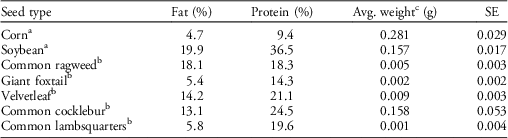
Previous investigations of weed seed predation have suggested that “field mice” (Peromyscus spp.) in cultivated habitats typically consume larger-sized seeds (Brust and House Reference Brust and House1988; Harrison et al. Reference Harrison, Regnier and Schmoll2003; van der Laat Reference van der Laat, Owen, Liebman and Leon2015). We observed a preference for large-seeded corn and soybean over most weed seeds, but seed size was not strongly associated with preference in our study, as the largest weed seeds presented in our choice set (common cocklebur and velvetleaf) were among the least preferred. Common ragweed was the most preferred weed seed among the choice set, and its high crude fat (18.1%, comparable to soybean) and protein content (18.3%; Table 2) may at least partially explain the high selection rates (equal to soybean) that we observed (Harrison et al. Reference Harrison, Regnier and Schmoll2003). Our study was not designed to test the specific mechanisms that lead to preference or avoidance of different seed types, but it appears that neither seed size nor nutritional content alone can explain seed selection. Common cocklebur seeds had relatively high fat and protein content (Table 2) yet were the least preferred seed type, likely due to handling costs associated with extracting seeds from burs. Similarly, despite its relatively large size (volume and weight) and nutritional content, velvetleaf seed may have been avoided because its chemical composition and the hardness of its coat make it unpalatable to rodent seed predators.
Characteristics of seeds used in cafeteria-style feeding trials conducted on overwintering populations of prairie deer mice within corn and soybean fields in Indiana.

a Corn and soybean composition data from U.S. Department of Agriculture (2015).
b Weed seed composition data averaged from Harrold and Nalewaja (Reference Harrold and Nalewaja1977), Schroeder et al. (Reference Schroeder, Deli, Schall and Warren1974), and Tkachuk and Mellish (Reference Tkachuk and Mellish1977).
c Average seed weight obtained from 10 samples of 5–100 seeds sample−1.
The relative contribution of vertebrates (e.g., rodents) and invertebrates (e.g., ground beetles, crickets, and ants) to the regulation of weed seed populations has been the subject of extensive experimentation, with conflicting evidence for which group of seed predators has the greater impact on weed seed regulation (i.e., larger proportion of seeds removed; Brust and House Reference Brust and House1988; Menalled et al. Reference Menalled, Smith, Dauer and Fox2007; Westerman et al. Reference Westerman, Hofman, Vet and van der Werf2003). A number of factors influence the relative contribution of vertebrate and invertebrate seed predators to weed seed removal in crop fields, including cropping system, seasonality, vegetation structure, and local species pools (e.g., Booman et al. Reference Booman, Laterra, Comparatore and Murillo2009; Fischer et al. Reference Fischer, Thies and Tscharntke2011; Menalled et al. Reference Menalled, Marino, Renner and Landis2000). In addition, although rarely studied, preference by seed predators for different seed types likely contributes to the varied results of previous studies of weed seed predation. The majority of experiments on weed seed predation are conducted using seeds of a single (or select few) weed species; however, both vertebrate and invertebrate seed predators are known to preferentially select among different food resources (Cramer Reference Cramer2014; White et al. Reference White, Renner, Menalled and Landis2007). Previous authors have suggested that vertebrate seed predators generally prefer to consume larger seed types (e.g., velvetleaf) over smaller ones (e.g., lambsquarters) (e.g., Brust and House Reference Brust and House1988); however, our results indicate that such generalizations cannot be reliably made and many factors other than size and shape can influence seed selection. Our study suggests that seed preference may partially explain the widely conflicting results demonstrated in previous investigations. For example, seed predation experiments that found minimal vertebrate consumption of velvetleaf (Cardina et al. Reference Cardina, Norquay, Stinner and McCartney1996) or lambsquarters (Blubaugh and Kaplan Reference Blubaugh and Kaplan2016) could reflect avoidance of those seeds by rodent seed predators. Future experiments on seed predation should carefully consider the type of seed selected for use in experimental trials, in particular when trying to tease apart the relative contribution of vertebrates and invertebrates to rate of seed removal.
Preference for particular weed seeds or waste grains likely affects the capacity of specific seed predators to regulate the amount and type of seed that enters or survives in seedbanks within crop fields. Although predation of weed seeds and waste grains by prairie deer mice can provide services that benefit farmers and potentially improve farmland ecological integrity through reductions in agrochemical applications, the role of these animals in agricultural habitats remains poorly understood. Deer mice show strong preference for waste grains over several common agricultural weed seeds and likely contribute to reductions in volunteer crops and certain weed populations. However, deer mice are omnivorous, and their diets shift seasonally (Whitaker Reference Whitaker1966). Further investigations of prairie deer mouse diets and foraging behavior are needed to clarify the role of these seed predators in row-crop habitats.
Acknowledgments
We are grateful to the farmers and landowners who granted us access to their properties. This study was supported by the Purdue Department of Forestry and Natural Resources, Indiana Academy of Sciences, Purdue Agricultural Science and Extension for Economic Development grant program, and the North Central Sustainable Agriculture Research and Extension grant program.