I. INTRODUCTION
Five member heterocyclic compounds are known for their multiple applications which have motive their wide study. Among this group of heterocycles, thiazolidinones have performed a wide range of biological activity (antifungal, antibacterial, analgesic, pesticide, herbicide, antitubercular, local anesthetic, and antimicotic) (Brown, Reference Brown1961; Singh, Reference Singh2014). The biological meaning of this class of compounds stimulates the study upon the synthesis and properties of our compound of interest 2-(α-naphtyl)-3-(α-pyridinyl)-1,3-thiazolidin-4-one, because several protocols have been developed for the synthesis of these kind of materials (Kouznetsov et al., Reference Kouznetsov, Amado, Bahsas and Amaro2006; Pȃnzariu et al., Reference Pȃnzariu, Apotrosoaei, Vasicu, Drăgan, Constantin, Buron, Routier, Profire and Tuchilus2016). Thiazolidinone of interest was synthesized via multicomponent reaction in order to obtain a new compound with prominent antifungal and antibacterial activity.
II. EXPERIMENTAL
A. Synthesis
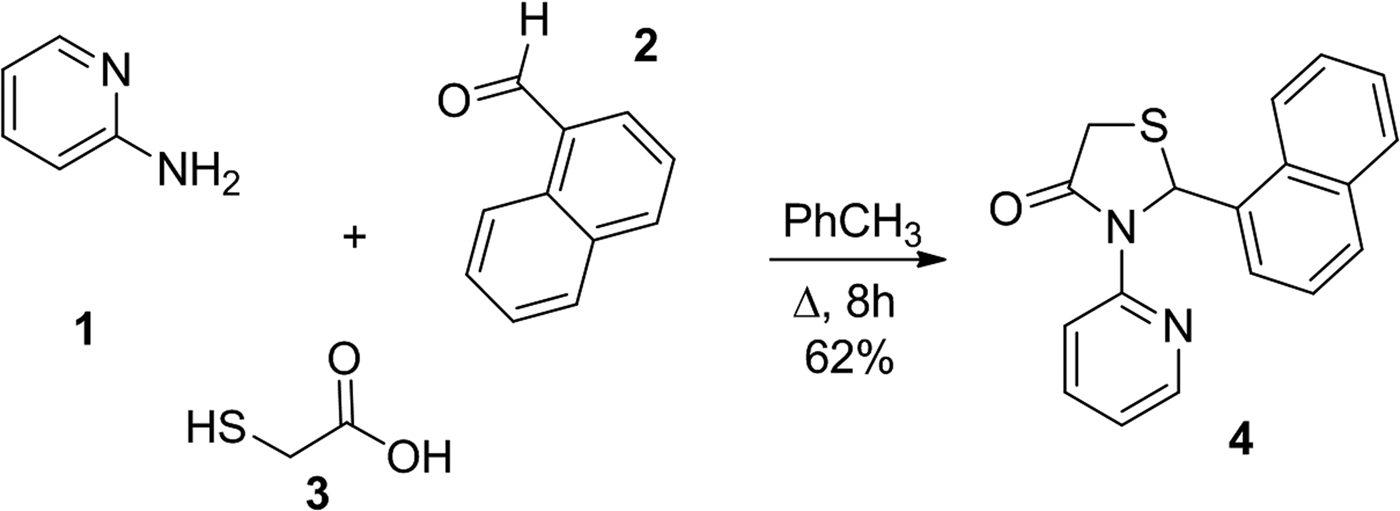
Compound 2-(α-naphtyl)-3-(α-pyridinyl)-1,3-thiazolidin-4-one (4) was synthesized by means of a multicomponent reaction promoted by glacial acetic acid in stoichiometric quantities between α-aminopyridine (1), α-naphtylaldehyde (2), and α-mercaptoacetic acid (3), employing anhydride toluene as solvent to reflux for 8 h. The preparation route of the interest compound is shown in Figure 1.
Synthesis of 2-(α-naphtyl)-3-(α-pyridinyl)-1,3-thiazolidin-4-one via multicomponent reaction.

Once the synthesis process was accomplished, the melting point (measured on a Fisher Johns melting point apparatus) and density (by floating method) were determined, and the molecular characterization of the compound was developed through instrumental methods of infrared spectrometry (IR) employing a Lumex Infralum FT-02 (KBr) spectrophotometer, gas chromatography coupled to mass spectrometry (GC–MS) using a gas chromatograph Agilent Technologies 6890 with an interface to a mass selective detector Agilent Technologies MSD 5963, and nuclear magnetic resonance (NMR) with a Bruker AM-400 or AC-300.
B. Powder data collection
A small amount of the compound, C18H14N2OS was gently ground in an agate mortar and sieved to a grain size of <38 µm. The specimen was mounted on a zero-background specimen holder (Buhrke et al., Reference Buhrke, Jenkins and Smith1998) for the respective measurement. The data were collected at 298 K using a Rigaku model D/MAX IIIB diffractometer with a graphite monochromator operating in Bragg–Brentano geometry equipped with an X-ray tube (CuKα radiation: λ = 1.5406 Å, 40 kV and 35 mA), a NaI (Tl) scintillation detector, and fixed scatter and divergence slits of 1° and 0.03 mm receiving slit. The scan range was from 2 to 70° 2θ with a step size of 0.02° 2θ and a counting time of 15 s step−1.
POWDERX program (Dong, Reference Dong1999) was used to remove the background (Sonneveld and Visser, Reference Sonneveld and Visser1975), smooth the data (Savitzky and Golay, Reference Savitzky and Golay1964), eliminate the Kα 2 component (Rachinger, Reference Rachinger1948), and to determine the positions and intensities of the diffraction peaks, using the second derivative method.
III. RESULTS AND DISCUSSION
A. Synthesis
Compound 2-(α-naphtyl)-3-(α-pyridinyl)-1,3-thiazolidin-4-one was obtained with a 62% yield, with a melting point of 141–143 °C, and a measured density of 1.32 g cm−3. Molecular characterization of the compound was developed by IR spectrometry: tension C(sp 3)–H (3054.74); tension C(sp 2)–H (3000.75); vibration tension C(=O)–N (1689.37); vibration tension C(sp 2)–C (1581.37); enlargement C–N (1432.22); asymmetric tension C(sp 2)–O (1288.24); deformation vibration C(sp 2)–H (779.11), deformation vibration C–S (685.33); GC–MS: m/z = 306.38 (M+) and NMR: 1H NMR (400 MHz, CDCl3) δ (ppm) 8.39 (1H, d, J = 8.4 Hz, 14-H), 8.12 (1H, d, J = 4.1 Hz, 4-H), 8.05 (1H, d, J = 8.4 Hz, 12-H), 7.89 (1H, d, J = 8.0 Hz, 10-H), 7.74 (2H, t, J = 8.4 Hz, 11-H, 13-H), 7.68 (1H, s, 3-H), 7.63 (1H, t, J = 7.6 Hz, 7-H), 7.55 (1H, t, J = 7.4 Hz, 7-H), 7.30 (1H, t, J = 7.7 Hz, 9-H), 7.19 (1H, d, J = 7.1 Hz, 6-H), 6.97 (1H, t, J = 6.0 Hz, 5-H), 3.97 (1H, d, J = 16.1 Hz, 1-H), 3.79 (1H, d, J = 16.1 Hz, 2-H). 13C NMR (101 MHz, DMSO) δ 172.19, 151.04, 147.96, 137.98, 136.19, 134.30, 129.92, 129.24, 128.68, 126.73, 126.19, 125.21, 122.83, 121.00, 120.57, 116.08, 59.84, 34.51.
B. X-ray diffraction of polycrystalline samples
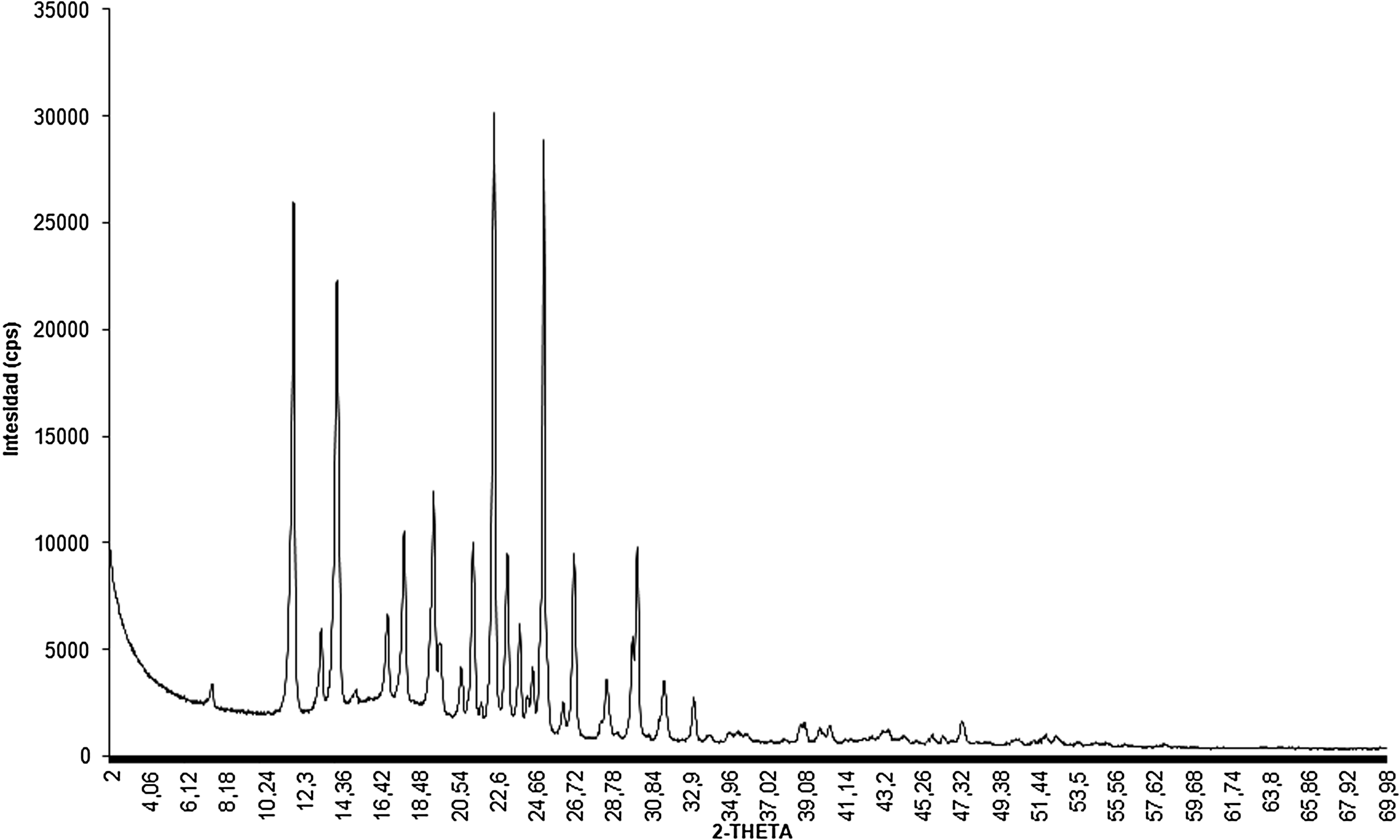
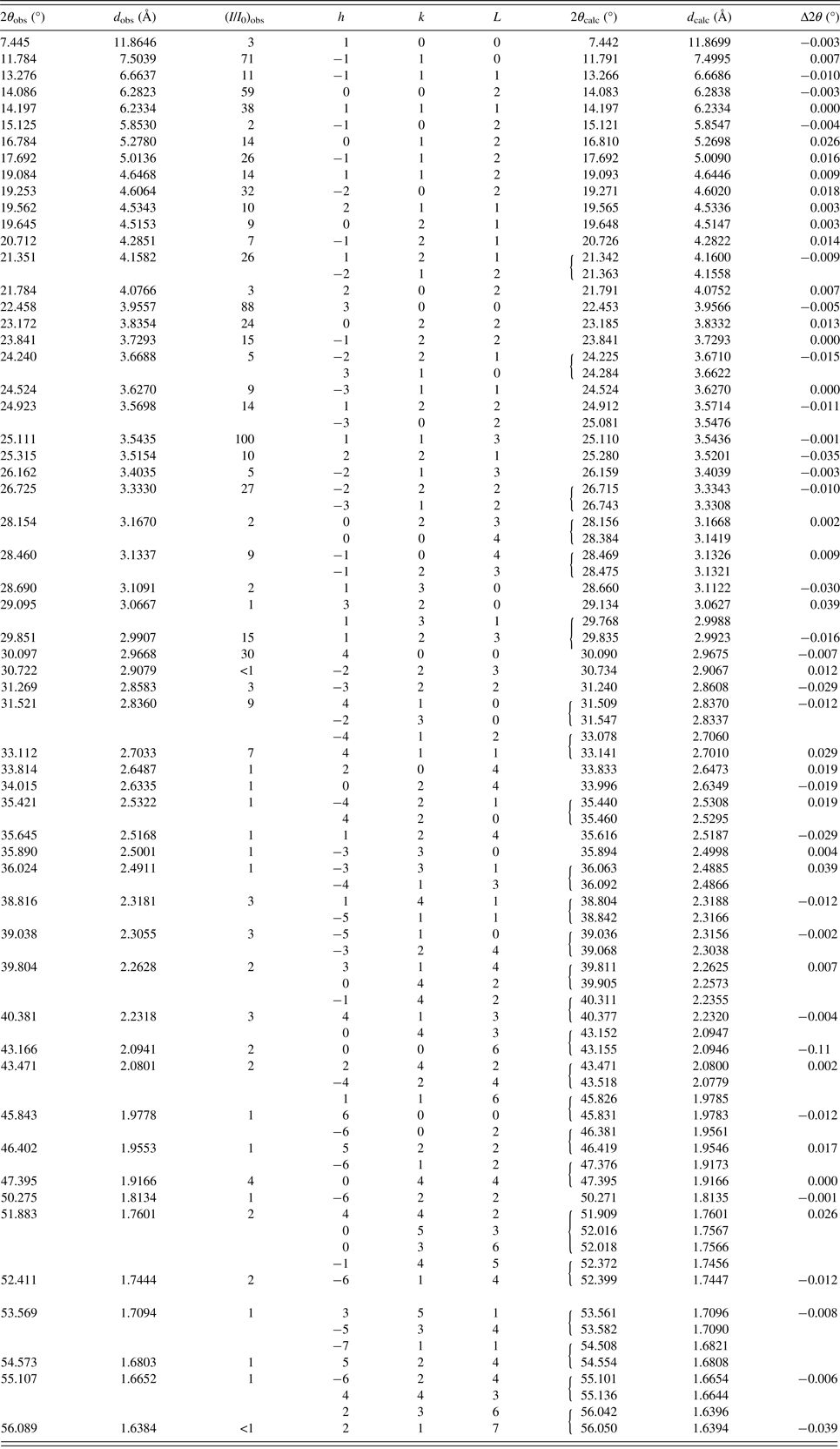
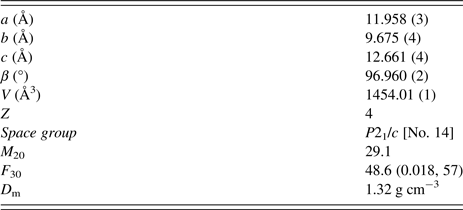
The X-ray powder diffraction (XRPD) pattern of 2-(α-naphthyl)-3-(α-pyridinyl)-1,3-thiazolidine-4-one is shown in Figure 2; a small amount of amorphous component in the background was observed because of the type of mount since paraffin was used as a support, which results in some discrepancies in peak intensities of the reflection list, compared with the simulated pattern, using a Le Bail refinement. The peak list for this compound are given in Table I. The XRPD pattern was successfully indexed using the DICVOL06 program (Boultif and Louër, Reference Boultif and Louër2006) on a monoclinic cell with an absolute error of ±0.03°2θ in the calculations. The space group, P21/c [No. 14] was estimated by the CHEKCELL program (Laugier and Bochu, Reference Laugier and Bochu2002), which was compatible with the systematic absences and the crystal density, 1.320 g cm−3. The unit-cell parameters were refined with the NBS*AIDS83 program using the total observed reflex ions (Miguell et al., Reference Miguell, Hubbard and Stalick1981). The crystal data, X-ray density, as well as figures of merit M 20 (de Wolff, Reference de Wolff1968) and F 30 (Smith and Snyder, Reference Smith and Snyder1979) are compiled in Table II.
X-ray powder diffraction pattern of 2-(α-naphtyl)-3-(α-pyridinyl)-1,3-thiazolidin-4-one.

X-Ray diffraction data for the compound 2-(α-naphtyl)-3-(α-pyridinyl)-1,3-thiazolidin-4-one.

Crystal data for 2-(α-naphtyl)-3-(α-pyridinyl)-1,3-thiazolidin-4-one via multicomponent reaction.

SUPPLEMENTARY MATERIAL
The supplementary material for this article can be found at https://doi.org/10.1017/S0885715618000453
ACKNOWLEDGEMENTS
This work was supported by grant 1102-05-17590 Colciencias (Patrimonio Autónomo del Fondo Nacional de Financiamiento para la Ciencia, la Tecnología y la Innovación, Francisco José de Caldas).