Is it justified to immerse a nerve fibre, which over the whole length of its course has been only a physiological structure subject to physiological modifications, with its end in the psyche . . .?
Freud, On Aphasia (1891)Footnote 1
Freud's early work, On Aphasia, has often been seen as the key to his turn to psychology.Footnote 2 It is here, after all, that Freud delineated his critique of the dominant localization discourse in the brain science of his time and first turned to questions of language. And yet it is an oft-neglected aspect of this work that Freud did not criticize contemporaneous brain sciences because they were insufficiently psychological and too mired in a restrictive somaticism; rather Freud criticized localizationists like Carl Wernicke and Theodor Meynert because their understanding of the nervous system was contaminated by psychology. Wernicke and Meynert hoped to build their model of the brain by translating association psychology into physiological terms. But according to Freud, they had not been sufficiently critical in this translation, because they assumed that the building blocks of the new association physiology would correspond directly to the building blocks of association psychology; the structures of association psychology had been imported wholesale into the new physiology. For Freud, however, a consistent physiological account of nervous processes would have to rid itself of these psychological remnants.Footnote 3
Quite how Freud's attempt to construct a thoroughly physiologized account of nervous processes relates to his increased interest in psychology remains an open historical question. It adds complexity to the apparent disjuncture between the analytic and pre-analytic phases of Freud's work, which has become the central guiding problem for studies of Freud's participation in the brain science of his time.Footnote 4 In this essay, I address this issue not by claiming that Freud's psychoanalysis marks a clean break with his earlier neurological work, nor by asserting an essential continuity between the two. Moreover, I do not attempt to give a full contextualization of his thought within the scientific work of the period.Footnote 5 Rather, by showing how Freud identified and exploited tensions within one particular strand of the localization project, I explain how he was able to develop a new theory and practice that, while tracing its heritage to the brain sciences—indeed by radicalizing certain of its principles—became significantly different from them.
In analyzing Freud's engagement with Meynert and Wernicke, I hope to demonstrate the ways in which intellectual history can benefit from an appreciation and understanding of contemporaneous science. Over the last two hundred years, but in the latter decades of the nineteenth century particularly, the brain sciences have had a profound impact upon numerous thinkers. One need only look at Durkheim and Nietzsche's work to see the ways in which developments in experimental physiology and psychophysics have provided important stimuli for philosophical reflection.Footnote 6 But in order to appreciate the ways in which the dialogue developed it is crucial to apply to contemporaneous scientific texts the same attentiveness to tension and aporia that is normally reserved for philosophical works. Thus, by examining how Freud worked out and drew productively on what he saw as conflicting strands within the localization-of-function project, I explain how this project provided the resources for its own unraveling. More specifically, I show that while brain anatomists like Meynert translated association psychology into physiological terms by recasting the reflex, thus providing a sensory-motor justification for the project of Zentrenlehre (theory of the localization of function in the brain),Footnote 7 Freud regarded the two moves as essentially conflicting. Freud argued that a fully physiological associationism made it impossible to think that functions could be localized at discrete points. Further, by criticizing localization theory, Freud was able to open up new possibilities for the etiology of nervous disease centered on a newly non-somatic lesion. And, as purely physiological, Freud's new model of brain structure provided him the tools to explain higher functions without relying on consciousness. Ironically, because Freud de-psychologized Meynert's physiology, he opened up the possibility for himself to develop his own psychology of the unconscious.Footnote 8
PHRENOLOGY AND THE SENSORY-MOTOR TURN IN THE LOCALIZATION OF FUNCTION
The confluence of associationism and the Zentrenlehre, which we see in the work of Meynert and Wernicke, is best understood through the history of the localization project. This history has two strands: first the application of sensory-motor (reflex) principles to the localization of function, and thus to the brain; second, the complicating of the reflex model with associationism, which was deemed necessary for understanding the cerebral reflex arc.
The attempt to locate mental functions in discrete areas of the brain had begun in the late eighteenth century with the work of the Viennese physician Franz Joseph Gall. Gall and his followers described the sites of various psychological faculties on the surface of the brain, manifested by bumps of the skull that could be felt and measured. Although Gall's phrenological ideas had a wide popular impact, his work was considered with skepticism, both by the medical establishment and by political and church authorities who opposed the materialism and secularism of his doctrine.Footnote 9
The most prominent attack on Gall's work came from the heart of the very scientific community of which Gall sought to be a part. French physiologist Jean-Pierre Flourens rejected the localization of different psychological faculties in circumscribed areas of the brain and suggested rather that the brain functioned in a unitary way. Drawing on the Cartesian notion that the mind was indivisible, Flourens believed that the organ of mind, the brain, must be functionally indivisible as well.Footnote 10 Commissioned by the Académie française in 1822 to test Gall's theory, Flourens made his claims on the basis of a wide range of experimental studies on rabbits and pigeons. Lesions of varying extent in the brain did not show any effects on the animals’ behavior: birds with various forms of localized brain damage still flew when thrown into the air, and walked when they were pushed. Flourens concluded that the localization of function à la Gall had to be rejected.Footnote 11
While Flourens's experiments marked the demise of the phrenological approach to localization, it did not lead to the end of the project. Flourens had gained authority for his criticism by drawing on the self-consciously academic standpoint of experimental physiology. For localization to find broader acceptance, especially within Germany, it would have to conform to similar experimental standards. In 1870 Eduard Hitzig, an electrotherapist working in private practice in Berlin, reported that he could cause a contraction of the eye muscles if he applied his electrodes to the area behind the ear. He concluded that the eye movements had been caused by the stimulation of those brain structures. In collaboration with the anatomist Gustav Fritsch, he began to explore systematically the functional anatomy of a dog's brain through direct electrical stimulation, noting down their findings in a brain map.Footnote 12 The two researchers identified various motor “centers” on the surface of the dog's brain, such as the “center for the neck muscles” or the “center for the extensor and adductor muscles of the foreleg.”Footnote 13 Their work was later extended to describe somato-sensory areas as well.Footnote 14
The sensory-motor model of localization came to dominate the project as a whole. Before Fritsch and Hitzig's experimental work had stimulated interest in the localization of function in Germany, developments in France had already raised its profile. In 1861 Paul Broca presented his patient “Tan” to the Paris Société d'anthropologie. Tan had difficulty producing speech, a condition that Broca called aphemia. This was correlated postmortem with the damage of the third frontal convolution. Broca did not apply the language of sensory-motor physiology to the brain; in his view, he had discovered the location of a higher, intellectual, function.Footnote 15 When his work was read in Germany over a decade later, however, it was translated into the sensory-motor paradigm. In 1874 Carl Wernicke recast Broca's aphasia as a disturbance in motor function, and thus presented his own discovery as the necessary complement.Footnote 16 Wernicke identified the sensory equivalent of Broca's aphasia, locating sensory speech in the left temporal lobe. The Broca–Wernicke synthesis became canonical for the new approach. Higher functions such as language were broken down into their sensory and motor components, each having specific locations on the brain surface. Where Gall's starting point had been various psychological faculties, which he then attempted to localize in the brain, the order of argumentation was now reversed: the new generation of localizationists started with the physiological, understood in sensory-motor terms, as a more respectable basis for the localization of psychological functions.Footnote 17 It appeared that the sensory-motor approach was the savior of the localization project.
CEREBRAL REFLEXES: BREAKING DOWN THE DISTINCTION BETWEEN HIGHER AND LOWER FUNCTIONS
The application of sensory-motor principles to the brain was a new development; traditionally, sensory-motor physiology had been tied to the spinal cord. After Charles Bell and François Magendie had described the motor and sensory functions of the ventral and dorsal roots of the spinal cord in 1811 and 1822, the anatomical structures of the spinal reflex had been identified, inspiring functional models like that by English physiologist Marshall Hall.Footnote 18 However, when reflex physiologists in the mid-nineteenth century made the attempt to extend the spinal reflex to the brain—like the later generation of localizers they applied sensory-motor principles to higher functions—Hall's mechanistic model was widely perceived as too restricted.
Hall's reflex was a purely spinal principle; he explicitly detached the reflex from higher functions. To Hall, the reflex consisted in the reflection (modeled on optics) of an incoming nerve excitation into an outgoing nerve excitation, taking place in what he called the excito-motor, or excito-reflector, system.Footnote 19 The reflex had nothing to do with the brain or with higher functions. Indeed, the reason Hall chose the term “excito-motor” to describe a reflex arc, rather than “sensory-motor,” was that it separated the reflex from sensation, which to him was conscious and thus only a function of the brain.Footnote 20
Applying the reflex to higher functions would require a more complex model, and physiologists could no longer rely on the simple stimulus–response/excito-reflector system that Hall proposed. Thus even if Hall's work on the reflex was the inevitable reference point for everyone working on the reflex at the time, not everyone agreed with Hall's account. Most reflex physiologists working after Hall would criticize the narrow scope of his concept and work around his strict distinction between lower and higher functions. On the question what a fully developed sensory-motor model might look like, however, there was less consensus. Debates over the nature of the complication would dominate the discussion among reflex physiologists in the following decades.Footnote 21
German anatomist and physiologist Johannes Müller extended Hall's reflex beyond the “reflector” spinal cord and medulla oblongata to all elements of the “central organ” (Centralorgan), including the brain.Footnote 22 Müller thus broke down the distinction between higher and lower neural structures that had dominated Hall's model. As a consequence of extending reflection to the brain, Müller no longer excluded sensation from spinal action. In fact, he suggested that Hall was wrong to assume that the spinal cord and medulla oblongata only “excited”—i.e. initiated—the motor action. Supposedly lower automatic reflex function involved “real sensations” (wirkliche Empfindungen) too.Footnote 23 The (reflex) movements of coughing and sneezing proved this, as they comprised real sensation even if the response appeared automatic. Similarly Müller aimed to complicate Hall's simple “reflection.”Footnote 24 Müller suggested a “principle of proximity” that determined the process of reflection, explaining the “flow or oscillation” (Strömung oder Schwingung) from incoming sensory to outgoing motor fibers.Footnote 25 Often, one incoming sensory flow would affect more than one motor fiber, resulting in the action of several muscles.
Another attempt to introduce complexity into the reflex can be seen in the work of the psychiatrist Wilhelm Griesinger. Like Müller, Griesinger suggested that this complexity was situated at the junction between the sensory and the motor nerves. Parallel to Müller's rather vague principle of proximity, Griesinger proposed a process of Zerstreuung in the central organ (Centralorgan). Zerstreuung, or dissipation, was made possible through a state of the Centralorgan, which resembled the tension of muscles: what Griesinger called “tonus.”Footnote 26 Although the tonus was produced by separate incoming sensory excitations, these excitations were not individually preserved, but contributed to an “average amount of excitation” (mittleres Facit der Erregung) in the Centralorgan.Footnote 27 Although Griesinger did not know the exact mechanism for Zerstreuung either, he offered a speculative anatomical model to explain it. He suggested a complex connection between centripetal impressions and already existing brain states: a combinatory process, in which different sensory impressions were redirected by Strebungen (volitional impulses) towards appropriate Bewegungen (movements).Footnote 28
* * *
The most significant extension of Hall's reflex, and more specifically the most important explanation of the mechanism of reflecting sensory into motor excitations, came from Theodor Meynert. Meynert, a brain anatomist and psychiatrist working at the General Hospital in Vienna, complicated the reflex by drawing on association psychology.Footnote 29 Originating in Britain in the eighteenth and early nineteenth centuries, but developed further in the German context by psychologists like Johann Friedrich Herbart, Friedrich Beneke, and Wilhelm Wundt, association psychology suggested that different elementary sensations in consciousness could become connected to produce more complex ideas.Footnote 30
Following association psychology, Meynert asserted that two sensations might be associated if they occurred simultaneously in consciousness. Take the example of a bleating lamb.Footnote 31 A bleating lamb excited two separate cortical cells. In the first cell, which was connected to the eye through a system of so-called projection fibers, it produced the visual Vorstellung (idea) of a lamb.Footnote 32 In the second cell, connected to the ear, it produced the acoustic Vorstellung of bleating. The acoustic or visual Vorstellungen of the bleating lamb thus could be traced to the particular physiological modifications of individual nerve cell bodies. This simultaneous excitation caused the two cells to be connected through an association fiber. After the first coincidence of the two sensations, which created the association, both Vorstellungen became obscured (verdunkelt), drifting out of conscious life.Footnote 33 But, in the future, when the sound of bleating was heard, exciting the auditory nerve, the nerve cell containing the lamb image would also be excited, and thus the complex audiovisual idea of a lamb would be produced in the mind, even if the lamb could not be seen.Footnote 34
After accounting for the association of the two ideas physiologically, Meynert broadened the sensationalist model to include motor function as well; if association could explain the connection between two sensations, it could also provide a mechanism for understanding how a sensory impulse could be connected to a motor response.Footnote 35 Like the physiologized connection between two sensations, sensory and motor images were physically linked through fibers of association. Meynert's dynamic and supple model of association, by translating psychology into a sensory-motor understanding of the brain, provided the basis for a more complex reflex that could be used to explain higher functions.Footnote 36
For Meynert, and later his student Wernicke, this more complex understanding of the reflex permitted the use of sensory-motor principles to explain the workings of the brain, and thus was a necessary condition for the new localization project. In his 1870 article “Beiträge zur Theorie der maniakalischen Bewegungserscheinungen,” Meynert brought the two sensory-motor traditions—localization and cerebral reflexes—together.Footnote 37
We have seen how in Meynert the sound or visual Vorstellungen of the bleating lamb were contained in nerve cell bodies. Further, drawing on Helmholtz's idea that each different pitch or color was perceived independently, and traveled independently along separate fibers, Meynert suggested that different cells in the brain were responsible for the perception of different colors; one could find a color spectrum inscribed on the brain.Footnote 38 These nerves were connected to the sensory organs through a system of projection fibers. As implied in the term “projection,” Meynert assumed a direct, one-to-one connection between points of the body surface and points of the cortex. Even though the fibers, on their way from the periphery to the cortex, traveled through various areas of gray matter, e.g. the optical nerve from the eye to the brain surface through the subcortical original cells (Ursprungszellen), the fibers did not undergo any change at this midway point; one might say that the projection fiber preserved its “identity” across gray matter, what Meynert called the “principle of isolated conduction.”Footnote 39 This fiber-based mapping thus provided a homology between sensations (and, by extension, motor processes) and specific locations on the brain.Footnote 40
This idea of localization was lent credibility by the “pathological anatomical method,”Footnote 41 to the development of which in the German-speaking context Meynert greatly contributed. Following Carl Rokitansky, the first professor of pathology and rector of the Vienna Medical School, Meynert correlated symptomatic changes with anatomical alterations of organs: a particular pathology could be traced to physical damage on the brain.Footnote 42 It is easy to see how this supported the view that particular areas of the brain were the seats of particular functions, especially when the localization of brain damage correlated so well with behavioral changes.
* * *
While the projection elements of Meynert's reflex model proved so central to the localization project, Meynert felt compelled, as we have seen, to elaborate an association system in order to justify the application of the reflex to the brain. Meynert recognized that the association system would add a level of complexity to the localization project because of the “manifold connections [i.e. associations] of projections of all sensory and motor organs, viscera and glands.”Footnote 43 As Meynert suggested, associations created complex structures that could not be located in one particular point. Even at this early stage Meynert recognized a tension between the Zentrenlehre and his associationist physiology. It is only with Freud, however, that this tension was radicalized to bring localization into question. Freud would go one step further and argue that association was essentially disruptive to the very localization project for which it had been invoked as a condition. As we will see, it was by expanding and exploiting this complication that Freud in the 1890s would be able to undermine the localization project and develop his own theory of psychoanalysis.
FREUD'S PHYSIOLOGY
Freud famously criticized the project of localization in his book On Aphasia in 1891.Footnote 44 As we shall see, however, though Freud's criticism might simply be seen as a turn away from brain science to psychology, it is significant that he gave it a diametrically opposed interpretation: Freud criticized the localization-of-function paradigm because it was not physiological enough. A purely physiological understanding of the nervous system could give meaningful insight into mental processes (and consequently psychology) in a way that was blocked to a simple and introspective psychological account. Indeed Freud's Aphasia itself is a prime example of the necessity of developing a thoroughgoing somaticism in order to be able to explain aphasic symptoms: the book is an object lesson in the need for a detour through physiology.Footnote 45 Freud's critique of localization, therefore, was informed by the insights from the very tradition he attacked, and consequently his formulation of psychoanalysis was not so much a break from earlier brain science, but rather can be more productively understood as a radicalization of its principles.
The term “physiology” in Freud's work is particularly difficult to pin down, and it is worth spending some time clarifying its meaning. One reason why the term has caused problems is because Freud often connected physiology to a “functional” perspective. For many scholars, this appeal to function suggests that in physiology, Freud left the nitty-gritty of an anatomical understanding behind, to be able to account for a wide range of clinical (especially hysterical) symptoms. But though, as we shall see, Freud's appeal to physiology had this effect, his move away from simple anatomical understandings of the nervous system in fact encouraged a more detailed appreciation of its workings.
Freud's unpublished 1887 manuscript “Critical Introduction to Nervous Pathology” is an example for his move beyond a mere anatomical account of the nervous system, which helps illuminate Freud's understanding of physiology. In the text, Freud elaborated his project of “brain architecture” (Gehirnarchitektur), which, to him, was the “complete knowledge of the course of nerve tracts [Faserverlauf].”Footnote 46 He realized that anatomical methods might at times be inadequate to the task of gaining this knowledge: When tracing the path of a fiber bundle 1 (cleavage) into gray matter out of which three other bundles emerged, anatomical methods “had no means of deciding into which of the bundles 2, 3 and 4, that originate from the same gray matter, bundle 1 continues.”Footnote 47 Freud suggested that a “physiological” method could help. Because the nerves connected to a damaged nerve would show “secondary degeneration,” if a brain scientist deliberately damaged a nerve he could visualize its connections to other nerves across gray matter. Thus an appreciation of physiological processes could help “overcome a gap in the tracking” of fiber systems left open by anatomical methods.Footnote 48 A consideration of physiological processes did not mark an attempt to work around the intricacies of brain anatomy; rather it helped Freud gain a fuller understanding of the structure of the nervous system—with respect to such understanding, anatomical approaches showed themselves to be essentially limited.
These considerations can help us reevaluate the use of the term “function” in Freud's work from this period, especially as it was applied to “physiology.” In his early texts, especially in the Aphasia book, Freud used the term “function” in two distinct ways: first, in the sense of “localization of function,” functions were understood as psychological, the solidary function of large structures of the nervous system, controlling speech, movement, and other “psychic” functions that would be visible in a clinical setting. Second, Freud drew on the English physiologist Charlton Bastian's notion of functional changes to the nervous system in particular changes to the nerves’ excitability. In Freud's reading, “functional” here referred to biological processes at the level of the nerves themselves.Footnote 49 This biological meaning of “function” was central to Freud's later Project for a Scientific Psychology (1895), especially in his discussion of primary and secondary function. “Functional” in this second sense corresponded to Freud's conception of physiology, which considered nerve function (in particular, excitability) in addition to brain architecture.Footnote 50 “Function” in Freud's work, therefore, could refer either to functions of the nervous system as a whole—large-scale functions like speech etc. that could be related to the “psychic”—and the functions of the basic building blocks of that nervous system, which did not have a direct or obvious relation to clinical symptoms.
An emphasis on the first notion of function has led some historians to think Freud's appeal to a functional account privileged a nonmaterialist understanding of mental processes.Footnote 51 But this notion of “functional” appears almost exclusively in the discussion—and criticism—of the localization-of-function paradigm.Footnote 52 Rather, when Freud uses the term on his own account, the notion of function as biological processes at the level of the nerves predominates.Footnote 53 For this reason, we should not regard Freud's use of the term “functional” as implying that he has adopted a “functionalist” perspective, if we mean by this a methodological indifference to the physical and biological processes that produced psychic “function.” Rather Freud's emphasis on physiology, even a “functional physiology,” played into his strictly parallelist account of mind–body interaction. All psychic processes could be mapped onto physical processes in the nervous system, but the set of categories and structures developed for one would be inappropriate to explain the other. Freud's appeal to physiology in his understanding of the nervous system participated in his broader project of giving a thoroughgoing materialist account of brain function, which would not be distorted by the uncritical importation of psychological ideas.
This was the basis of Freud's criticism of Meynert. From Freud's perspective, Meynert had not carried his project of providing a physiological account of associationism to its end.Footnote 54 True, Meynert's model had given association psychology a physiological basis: nerve cells were hardwired to points on the body surface and gained their content through the projection of sensory stimuli. But the elementary units of association were still Vorstellungen, i.e. Meynert had simply and uncritically transposed into physiological language the structures of association psychology. While Meynert had given a physiological explanation of the “associations,” the fact that he considered that nerves associated Vorstellungen showed that he had not escaped the influence of the psychological model; his project of providing a truly physiological associationism was incomplete. According to Freud, the “elliptic phrase . . . an idea is localized in the nerve cell” led to a confusion of things “which need have nothing in common with each other.”Footnote 55 It was invalid, Freud argued, to assume that the simplicity of psychological elements (the basic Vorstellungen) corresponded to a similar simplicity at the physiological level:
In psychology the simple idea is to us something elementary which we can clearly differentiate from its connection with other ideas. This is why we are tempted to assume that its physiological correlate, i.e., the modification of the nerve cells which originates from the stimulation of the nerve fibres, be also something simple and localizable. Such an inference is, of course, entirely unwarranted; the qualities of this modification have to be established for themselves and independently of their psychological concomitants.Footnote 56
By taking elementary Vorstellungen, the basic building blocks of psychology, and placing them into individual cells, Meynert, to Freud, concluded (falsely) that the basic building blocks of physiology were organized in the same way, that the elements of physiology corresponded directly to the elements of psychology.Footnote 57
But what would a fully physiologized associationism look like? If we could not simply transfer our understanding of psychology's most elementary particles to the physiological realm, what, then, was the physiological correlate of a Vorstellung? Freud suggested that a Vorstellung was “nothing static, but something in the nature of a process,” a process that spread over the cortex along specific pathways, forming specific routes of excitation in the brain.Footnote 58 Once established, the routes persisted, leaving behind “a modification, with the possibility of a memory, in the part of the cortex affected.”Footnote 59Vorstellungen were really associations, or, rather, the two were “terms by which we describe different aspects of the same process.”Footnote 60 Rather than associations tying different Vorstellungen together, those Vorstellungen were constructed from associations themselves. Of course this was not completely alien to the Meynert–Wernicke model. For them, association was crucial to the formation of concepts (Begriffe), which were defined as complex groups of different Vorstellungen: for instance the unified concept of the lamb comprised its visual and acoustic elements. Freud, however, wanted to say that the basic Vorstellungen were complex too. He transferred to the elements the associative structure that Wernicke and Meynert had applied to complex ideas.Footnote 61
Nevertheless, such a change radically altered the associationist model. Now rather than qualitatively differerent Vorstellung being associated by a nervous connection, those nervous connections were ubiquitous. And because these nervous connections were essentially indistinguishable, structures could no longer be considered as the groupings of heterogeneous elements. In Freud's model variety was structural rather than substantial; Vorstellungen were distinguished because they were made up of different patterns of nerve cells. As a consequence of his pushing associationism further, replacing the psychological vestiges in Meynert and Wernicke's system by physiological excitation patterns, Freud extended the site in which associations took place in two ways, which had profoundly disruptive effects for the project of localization.
First, whereas for Meynert Vorstellungen were localized in the gray matter of the cortex and were associated by fiber bundles of white matter, for Freud nervous connections were also forged within the gray matter: “we have no need to call on white fibre tracts for the association of ideas within the cortex. There is [even] a post-mortem finding which proves that the association of ideas takes place through the fibres situated in the cortex itself.”Footnote 62 Though this meant that localization broadly understood still held—the “localization of a perception means nothing else but localization of its correlate”Footnote 63—because this correlate was now a physiological modification or pattern, Vorstellungen could no longer be localized in one single cortical point. Different Vorstellungen did not correlate to the differing locations of cells; they were determined rather by differing structures of nervous connections, spread across the brain surface.
Second, Freud argued that the process of association might extend to what Meynert had called the “projection system,” the very projection system that in Meynert's model determined the location of cortical cells containing basic Vorstellungen. Freud did not agree with the underlying assumption of fiber identity that was essential to the projection model. In fact, to him, there was compelling histological evidence suggesting that fiber identity must be false. Results from contemporary brain science, including research on fiber reduction by Jacob Henle and Benedikt Stilling, Paul Flechsig's research on myelination, and Freud's own anatomical work, suggested that Meynert's view on fiber identity—the simple and one-to-one connection between center and periphery—was unjustified.Footnote 64
Freud's rejection of fiber identity had consequences for his view of the projection system. Although the fibers arriving in the cortex still maintained a certain relation to the periphery, this relation was no longer one of similarity:
They [the fiber tracts] contain the body periphery in the same way as—to borrow an example from the subject with which we are concerned here—a poem contains the alphabet, i.e. in a completely different arrangement serving other purposes, in manifold associations of the individual elements, whereby some may be represented several times, others not at all.Footnote 65
If it was justified to speak of projection in the spinal cord, because there a fiber would in fact travel from the periphery to the spinal cord without interruption or complication, the term that best characterized the relationship between cortex and periphery was “representation” (Repräsentation).Footnote 66
Because a point on the periphery was no longer simply “projected” onto a point on the cortex, a simple localization of function was no longer plausible. Direct projection privileged specific locations on the brain surface, determining their functions by their connections with the periphery. But if fibers were changed on their way between periphery and center, then the location of specific cortical points became less important. Because some working through of the stimulus occurred on the way to the center, the whole system of fiber connections including the subcortex could no longer be sidelined and ignored.
While Freud's theory provided a powerful rebuke to the localizationists, he also had to contend with the vast and increasing evidence gleaned by the pathological anatomical method that lent evidence to the localization of function. Freud considered himself well equipped to counter any problems that the method might present. In fact, through his radicalization of association physiology, he was able to reinterpret, and perhaps better explain, the practice that had provided such strong evidence for the theory of localization. In brief, he suggested that the destruction of parts of the brain through a lesion caused symptoms not because it resulted in the anatomical alteration of a center, but rather because it cut off nervous connections or associations within a broader “speech territory” (Sprachfeld).Footnote 67
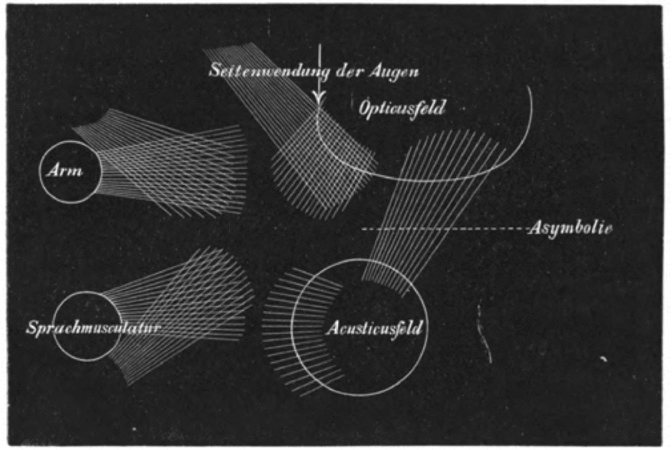
For Meynert the centers were connected through numerous associations. Thus in between the centers there was an area of the brain consisting purely of association fibers. But in Freud's model, association extended into those centers themselves, and thus there was no essential difference between the “centers” and the association system between them. Recast thus, what Wernicke and others had labeled “centers” looked now like the periphery of a larger area that Freud called an “association area,” or “speech territory.”Footnote 68 Freud's speech territory included both the different “centers” of language—the sensory (Wernicke), the motor (Broca), and the optical “centers” (for reading)—and the space between them. Broca and Wernicke's “centers” then appeared as the corners of the speech territory (Ecken des Sprachfeldes); their speech centers were really at the periphery of the speech territory (Fig. 1).Footnote 69
Freud, Zur Auffassung der Aphasien: Eine kritische Studie (Leipzig and Vienna: Deuticke, 1891), 83.

This “mapping” allowed Freud to reinterpret the results of the pathological anatomical method: a lesion at the periphery (the old “centers”) would be more likely to cut off the majority of connections to a particular brain area. For example, if a lesion were located close to the acoustic area, it would cut off its connection to the language territory and thus damage the acoustic elements of speech.Footnote 70 This would result in sensory aphasia. It was not that acoustic Vorstellungen inhabited this area; rather it was the thoroughfare between the auditory and speech areas.Footnote 71
If, on the other hand, the lesion were located in the center of the language territory, an area that the localizationists had ignored because there was no clear correlation with clinical symptoms, its symptoms would be far more diffuse because the separation from any specific field would be less definitive even if the same number of connections were cut.Footnote 72 Thus, while in Meynert's (and his student Wernicke's) model only lesions in the “centers” caused pathological damage, and their theory led them to deny that a lesion between those “centers” could have an effect, Freud's system allowed him to understand how this type of lesion could be debilitating too.
Freud's model of the speech territory also shows that he did not abandon localization altogether. He still believed that the nervous system was the anatomical substratum of mental functions, and damage of those anatomical structures led to a loss of function. But because there were no longer any centers that could be pinpointed, but rather organizations or webs of nerves, one could not draw a direct correlation between damage and function:
This significance [of language centers] holds only for the pathology, and not for the physiology of the speech apparatus, because it cannot be maintained that in these parts other, or more important, processes take place than in those parts of the speech area the damage of which is better tolerated.Footnote 73
Just because a lesion in a particular brain area produced a less clear effect, it did not mean that this area played a smaller role in speech function; its damage might just cause a more diffuse symptom. In a system where connections and processes were all-important, the emphasis on precise location seemed out of place.
THE DISAPPEARING LESION
Freud's model of the ubiquity of associations and his concept of the speech territory were the first steps in his move away from the concept of the lesion. As we have seen, the idea of the lesion and its use in nineteenth-century physiology was strongly connected to the idea of localization through the pathological anatomical method. As Freud moved away from localization, so too the idea that all nervous disease could be traced to a lesion made way for new possibilities. But this development did not happen all at once, and it is instructive to follow the line of Freud's thought.Footnote 74
At first, Freud continued to use the word “lesion,” even as its meaning changed.Footnote 75 For a short period, Freud would appeal to a modified idea of the lesion to explain hysteria. Already in Aphasia, Freud adopted a more functional concept of the lesion.Footnote 76 Because connections were cut rather than centers excised, a lesion no longer performed a precise role, nor did it usually entail a complete destruction. Freud was sympathetic to Bastian's distinction between three types of lesion corresponding to three levels of reduced excitability of a center.Footnote 77 In Bastian's view a lesion was not always absolute but led to a more generalized functional reaction.
Two years later, Freud developed the concept of “functional lesion,” moving further away from anatomical understandings. In his 1893 article “Some Points for a Comparative Study of Organic and Hysterical Motor Paralyses,” which he was asked by Charcot to write after his visit in 1885–6 but only completed writing eight years later, Freud discussed the differences between organic and hysterical paralyses, comparing them to each other.Footnote 78 The problem with hysterical symptoms was that, in contrast to most organic paralyses, they did not correspond to observable lesions in autopsy. To account for this absence, Charcot and his followers insisted that the lesions simply could not be seen. As dynamic or functional lesions they had dissipated by the time of the autopsy. In principle they could be detected, but only if the technological methods were more refined.Footnote 79
Freud, on the other hand, suggested that Charcot was wrong to try to look for hysterical lesions in the autopsy material. Hysterical paralyses could not be explained by reference to anatomy; one needed to consider the “nature of the lesion” rather than its “extent and localization.”Footnote 80 Hysterical lesions were no longer understood purely as physical damage to the brain. To Freud, they were without “concomitant organic lesion—or at least without one that is grossly palpable.”Footnote 81
If there was no palpable damage, why did Freud continue to use the term lesion to describe this problem? The answer lies in the revision of the concept of the lesion that it had undergone in Freud's Aphasia book. We have seen how, in Aphasia, Freud developed a new understanding of the concept of lesion in his notion of the language territory. A lesion consisted not in the damage of a center; rather it consisted in the cutting off of connections—from the auditory cortex, from the motor cortex, etc.—to the speech territory.
This notion of interrupted connectiveness, isolating certain areas of the nervous system, underlay Freud's notion of hysterical lesions as well. A hysterical lesion, to Freud, was an “alteration of a functional property,” for instance a “diminution in excitability.”Footnote 82 As an example, Freud presented the case of a loyal subject who refused to wash his hand that was shaken by his king.Footnote 83 By not washing his hand, he prevented its representation from entering into new associations with other, less valuable, objects, and thereby rendered the idea “inaccessible to association.”Footnote 84 The same mechanism applied to hysterical paralyses:
Considered psychologically, the paralysis of the arm consists in the fact that the conception of the arm cannot enter into association with the other ideas constituting the ego of which the subject's body forms an important part. The lesion would therefore be the abolition of the associative accessibility of the conception of the arm. The arm behaves as though it did not exist for the play of associations.Footnote 85
In “Organic and Hysterical Paralyses,” as in Aphasia, pathology arose from the interruption of connections between areas of association, which meant that a network of nerves was no longer available for excitation.
If the similarities between the idea of a lesion in the two works justified the continued use of the term, the differences are still important. In Aphasia this exclusion from the “play of associations” was caused by a physical lesion, cutting connections, and yet in “Organic and Hysterical Paralyses” the lesion did not have to correspond to physical damage: hysteria occurred without organic lesions, much like, in Freud's example, the concept of the arm that was lost “without being destroyed and without its material substratum (the nervous tissue of the corresponding region of the cortex) being damaged.”Footnote 86 Hysteria, thus, was not a case of pathological anatomy, i.e. a case of damaged structure; it was a different kind of pathological process.
The developments in Freud's conception of the lesion explain, then, why he should become increasingly wary of appeals to “anatomy”; in a world of ever-changing connections, clearly defined and localizable functions were no longer on the cards. But this increasing skepticism of anatomical explanations did not mean that Freud rejected the possibility of a physiological and materialist correlate to hysteria. This becomes nowhere clearer than in his 1888 article “Hysteria.” Having asserted that hysteria was a “neurosis in the strictest sense of the word” because “no perceptible changes in the nervous system [have] been found in this illness,”Footnote 87 Freud continued to assert its physiological nature: “Hysteria is based wholly and entirely on physiological modifications of the nervous system and its essence should be expressed in a formula which took account of the conditions of excitability in the different parts of the nervous system.”Footnote 88 Hysteria, to Freud, was not anatomical, but physiological. As in the simile of the camera presented in the Interpretation of Dreams, nervous changes could not necessarily be seen and mapped, and yet they were still physically instantiated in the machine, somehow causing a picture to emerge.Footnote 89
If one no longer needed physical damage for mental disease, new possibilities for understanding hysteria emerged. With nervous organization at the core, perhaps the absence of association was not the only form of pathology; mental illness might also arise because unhelpful associations had been formed, a situation where the word “lesion” would no longer have any traction. In Freud's Project for a Scientific Psychology (1895), where he developed a thoroughgoing physiology of association to explain normal and pathological states, lesions dropped out of the picture entirely.
The Project for a Scientific Psychology should be understood as the culmination of Freud's physiological investigations. Although the scholarship, for various reasons, has often characterized it as an anomaly, in the context of the previous discussion it is best understood as a continuation of the themes elaborated in Freud's earlier work.Footnote 90
First, in the Project, Freud makes use of an associationist model, like Meynert. As in Meynert's model, Freud explains how stimuli (creating an excitation, Erregung, in the nervous system) were transferred from the periphery to the central nervous system. Parallel to Meynert's projection system, Freud described a structure of “ϕ neurons” bringing quantity Q to a more complicated system of “ψ neurons” at the nervous system's core.Footnote 91 The ψ system was a collection of neurons constituted such that new connections could be made.Footnote 92 It explained the process of association so central to Meynert's model.
As a physiological mechanism for this process, Freud relied on the notion of Bahnung (facilitation), a concept developed by Sigmund Exner. In his chapter on the “experience of satisfaction,” Freud described how this process of Bahnung or facilitation explained the “basic law of association by simultaneity.”Footnote 93 If two neurons α and β were cathected simultaneously (corresponding to two simultaneous stimulations at the periphery) then Freud asserted that it was easier for a quantity Q to pass from one to the other; simultaneous cathexis reduced the resistance of the barriers between cells, such that Q would be more likely to push through and carve a more permanent path. In this way Freud's model explained how “facilitation comes about between two mnemic images.”Footnote 94 In the particular example that Freud gave, the feeling of satisfaction a child experienced on being presented with (and thus perceiving) the mother's breast, and the screaming that preceded that presentation, were linked in the baby's mind such that an association was created between two memory images (of the object wished for and of the screaming). With this physiological connection established, the resurgence of hunger in the future would lead the baby to reenact the action (screaming) that previously led to satisfaction.
But, second, and as before, Freud's appeal to associationism required a thoroughgoing physiologization of the process. One reason why the Project was “scientific” in Freud's mind was that it did not appeal to qualitatively different psychological ideas, which could be “contained” within individual nerve cells.Footnote 95 Freud's model was rather purely “quantitative”: a single and undifferentiated quantity Q determined whether a particular cell was cathected or not. There were no substantial differences between cathected cells (a cell cathected with the idea of the breast, the cell cathected with the idea of screaming). Thus, as in his Aphasia book, to account for the differentiation of Vorstellungen Freud had to extend the process of association from the links between Vorstellungen to the construction of Vorstellungen themselves.Footnote 96Vorstellungen were differentiated not by the content of the nerves that corresponded to them but by their organization. We are thus not surprised to find that Freud explicitly stated several times in the Project that mental states were never localized in just one cell: “For the time has come to remember that perceptual cathexes are never cathexes of single neurones but always of complexes.”Footnote 97 Whenever he did associate the Wahrnehmungsbesetzung (perceptual cathexis) with an individual neuron, he pointed out that this was a simplification. As he reiterated on a number of occasions, “For the sake of simplicity, however, I must now replace the cathexis of the complex perception by that of a single neurone.”Footnote 98
The first chapters of Freud's Project explain this construction of Vorstellungen by showing how a quantity Q that was derived from an external stimulus could carve a particular path through a network of nerve cells. As a quantity Q, which arose from external stimuli, reached the ψ system, the Kontaktschranken (i.e. barriers between cells) impeded its way. Each nerve had Kontaktschranken with numerous other nerves, and, as the Q cathecting the ψ neuron rose, greater pressure would be applied to each one. Eventually one Kontaktschranke would succumb to the pressure and allow a flow between the two cells it divided.Footnote 99 According to the mechanism that Freud described, the flow of Q across a Kontaktschranke would weaken it—“contact-barriers becoming more capable of conduction”Footnote 100—and thus the next time the first cell was cathected with Q it would be more likely to pass through that particular barrier. Over time and with repetitions a path between two ψ neurons (and by extension complex paths across a network of neurons) would become ever more deeply engraved; the brain would form memories. As Freud suggested, this provided a physiological explanation for the “psych[ological] knowledge [that] the memory of an experience (that is, its continuing operative power) depends on a factor which is called the magnitude of the impression and on the frequency with which the same impression is repeated.”Footnote 101
Returning to the process of association between Vorstellungen, it becomes clear that this merely extended the process of Bahnungen, and complex Vorstellungen were not essentially different from so-called “simple” ones, as Meynert previously had suggested. And here again, we see how Freud drew on the resources of Meynert's model while at the same time going beyond it. His model of association was more strictly physiological than Meynert's because it did not rely on the localization of basic psychological functions in individual cells, i.e. it moved away from the elision of elementary Vorstellungen with the basic elements of the nervous systems. Vorstellungen were not unified “things” that could be connected and localized at a single point; they were already complex, already associated, patterns of cathected cells.
Thus, showing that Vorstellungen were more complex than Meynert thought and offering a mechanism to explain their formation, Freud was able to push—third—his critique of localization to its ultimate end. Even as the opposition between ϕ and ψ neurons seems to map onto Meynert's distinction between projection and association systems, in both the essential structure of the nerves was the same: ϕ and ψ neurons were different due to the situation they found themselves in, not because they were substantially different. Freud was adamant that “the nervous system consists of distinct and similarly constructed neurones,”Footnote 102 and that the Kontaktschranken were not essentially different in different neurons: “To assume that there is an ultimate difference between the valence of the contact-barriers of ϕ and of ψ has . . . an unfortunate tinge of arbitrariness.”Footnote 103 Instead, Freud suggested that it was the difference in the level of Q cathecting the neurons that determined their character. The Kontaktschranken of ϕ neurons, which were open to the extreme stimuli of the outside world, offered no real resistance to the flow of Q, while ψ neurons, safely ensconced in the center of the organism, only had to deal with smaller levels and thus were able to direct its flow. If we exchanged “locality and connections” (Topik und Verbindungen) of a ϕ and a ψ neuron, it would make no difference to the functioning of the system: “they retain their characteristics, however, because the ϕ neurone is linked only with the periphery and the ψ neurone only with the interior of the body. A difference in their essence is replaced by a difference in the environment to which they are destined.”Footnote 104
But if the basic structure of Freud's Project can be understood as a continuation and indeed culmination of his earlier physiological investigations, there was one crucial distinction. For though Freud's Project is in one sense thoroughly physiological—because it was even more careful to avoid the “qualitative” psychological distinctions that still inhabited Meynert's presentation of nervous association and because it replaced them with a purely “quantitative” and thus “scientific” model—the key term of his earlier physiology, the “lesion,” is conspicuously absent here.
Freud's analyses in his earlier work on hysteria had shown that pathology could arise not only because brain areas had been damaged, or connections cut, but also through a pathological organization of nervous elements. The term “lesion” was retained in “Organic and Hysterical Paralyses” because Freud still considered pathology to be caused by the absence of associations. But in the Project Freud would suggest that organizational pathology might not only derive from the lack of association or the inability to associate. Rather certain associations themselves, created in the mind through the process of Bahnung explained earlier, might turn out to be pathological. And since Bahnung between neurons arose through the application of different external stimuli, pathology might be caused by lived experiences. In this Freud developed a possibility that had been existent in Meynert, who also had asserted the plasticity of the nervous system and described the way it changed with different experiences. But because Meynert's associationism was so closely tied to the localization project, and thus to the lesion model of mental pathology that had always accompanied it, the notion of pathological nervous organization was never developed in his work; for Meynert mental pathology always referred to physical damage to the nervous system.
The de-psychologization of associationism that allowed Freud to move beyond the lesion paradigm thus led him, ironically, to make room for the etiology of nervous disorder in individual “psychological” experience.Footnote 105 Indeed, it is telling that when searching for a word to describe this pathological experience, Freud turned to a term which, up until then, had mostly been tied to physical damage: trauma.Footnote 106
Freud's Project leads up to a discussion of hysteria that makes use of this new possibility. As Freud explained it, hysteria can be described symptomatically as an “excessively intense idea, which forces its way into consciousness” to an extent not justified by its manifest content (e.g. excessive anxiety at entering a shop).Footnote 107 But analysis reveals that A has this effect because it is associated with another idea B, the two having been connected by a particular event in the patient's history. Hysteria corresponded, then, to what Freud called a “pathological symbol-formation,” i.e. a pathological association.Footnote 108A causes the emotional response that would be understandable for the idea B, but remain incomprehensible when considered with respect to A alone. And, crucially, because of the “association A–B, and B itself plays no part at all in [the patient's] psychical life,” the patient's behavior seems completely incomprehensible.Footnote 109 Mental disease no longer relied on physical damage; rather experiences—and the nervous associations they created—could provide difficulties in a patient's life. For similar reasons, the attempt to rewire the brain through new experiences and the working through of old experiences, allowing Q to redistribute itself across the mind and eventually be discharged, provided new hope for therapy.
THE COLLAPSE OF LOCALIZATION AND THE BIRTH OF PSYCHOANALYSIS
In this essay, we have seen how Freud, step by step, broke down the foundations of the localization project. He did not challenge localization as a scientific practice—indeed, as we have seen in his notion of the speech territory, he developed a model that fully accounted for the evidence produced by the pathological anatomical method. But he did highlight certain tensions within the project of the localization of function, formulated as the Zentrenlehre.
More specifically, he showed how the localization project relied on two assumptions that mutually undermined each other. On the one hand, localization depended on the projection system which produced fixed point-like locations for elementary Vorstellungen on the brain surface. Even if Meynert embraced a nativist model, allowing for the possibility for Vorstellungen to change depending on experience, the connections between periphery and center were fixed. A cell connected to the eye through a projection fiber thus could only carry visual Vorstellungen. On the other hand, Meynert accounted for the production of complex ideas through a process of association that allowed the construction of nervous connections between those cells carrying elementary Vorstellungen. These connections were of physical nature, consisting of association fibers. This appeal to an association system was a necessary correlate to the transfer of sensory-motor principles to higher functions.
We have seen how Freud, by embracing the second aspect of the localization project, and carrying it further by “physiologizing” Vorstellungen, arrived at a critique of the first. There were no real “projections” in the nervous system (except for the connections between periphery and spinal cord); everything was already associated, including the Vorstellungen themselves. Freud's appeal to the physiological framework for localization to criticize the localization project thus sheds light on the inherent aporias of the project: the tension between its substantialist metaphysics and its connective model.
But it is also worth recognizing that in working through the localization paradigm, even as he experienced the limits of it, Freud provided himself with resources for a new project: psychoanalysis. First, following Marcel Gauchet in his book L'inconscient cérébral, we can see how Freud's engagement with the brain sciences allowed him to develop something like the unconscious. Gauchet's book provides a history of the cerebral reflexes. Before Freud, the distinction between higher and lower functions mapped directly onto that between conscious and unconscious activity, for only lower functions such as digestion, heart regulation, and simple reflexes were considered to be nonconscious. By integrating Freud into a tradition of “cerebral reflexes,” Gauchet was able to suggest how Freud could identify the role played by nonconscious processes in higher functions.Footnote 110 The cerebral reflex explained mental acts of which the subject might not be aware. That is, Freud opened up a space for nonconscious higher functions; he broke the traditional identification of the conscious and the psychical.Footnote 111
But as we have seen, Meynert had also developed a theory of cerebral reflexes, and yet the unconscious did not appear as a central part of his theory. In fact, Meynert's example suggests that merely using reflex action to describe mental activity was not in itself sufficient to explain the emergence of the unconscious. Meynert complicated the reflex by adding an association system between the afferent and efferent reflex arcs. Only in this way could the reflex be adequate to the task of performing higher functions; for Meynert association became the distinctive mark of higher functions. Not only was association closely bound up to higher functions, it also remained intimately tied to consciousness. First, associations were created only if two Vorstellungen were conscious simultaneously. Second, though the brain was, in Meynert's terms, always in a state of “partial sleep,” and the majority of Vorstellungen “dimmed down [verdunkelt],” i.e. lying outside the realm of consciousness, the association between two elements entailed that if one was raised into consciousness the other would be too. In Meynert's example of the bleating lamb, if one heard a lamb bleating (thus raising the acoustic image of bleating (B) into consciousness), one could recall the visual image of a lamb (A). Meynert's development of a cerebral reflex, then, did not sever the essential connection between higher functions and consciousness.
Freud's model of brain action was different, and he teased apart Meynert's triple identification of consciousness, association, and higher function. He denied Meynert's excessive topological restriction of the association system. As we saw, Freud extended association into the projection system, and into the realm of gray matter.Footnote 112 For Freud association was sufficiently pervasive in the nervous system that it could no longer mark the distinction between higher and lower functions. At the same time, and in part as a consequence, Freud also broke down the connection between association and consciousness. As we have seen, it was central to his theory of mental pathology that an unconscious element could be associated with one that could remain unconscious even when the other was experienced excessively intensely. The hysterical symptom was a “symbol” for an element that was repressed. The association between the manifest and the latent was both the reason for and the ultimate object of analysis. In this way the radicalization of the association model in Freud's work allowed him to break the relationship between it and consciousness, and consequently to imagine the possibility of higher functions detached from consciousness; the unconscious was born.
Second, as the example of the unconscious shows, Freud's working through of the tensions within localization helps explain his move from a thoroughgoing materialism to a renewed emphasis on psychological factors without assuming an inherent opposition between the two. When writing about the development in Freud's thought, his turn to psychology has often been characterized as a move away from his earlier—in modern terms we would say neuro-scientific—work. Similarly, the Project has been understood as an inessential neurologization of key psychological concepts that were already in place. But as we saw, Freud's extension of the scope of association was intended to “de-psychologize” Meynert's reflex physiology and localization. And it was this de-psychologization of physiology that allowed Freud first to move away from the notion of lesion as physical trauma, casting it in “Organic and Hysterical Paralyses” rather as the isolation of nervous elements, and then in the Project to develop an idea of a “psychological” trauma. Freud was able to provide a psychological etiology of mental disease and thus help forge the science of psychoanalysis, not by rejecting but rather by radically adhering to his physiological roots.