Introduction
Cladonia luteoalba A. Wilson & Wheldon (Wheldon & Wilson Reference Wheldon and Wilson1907) is a recognizable species, characterized by large primary squamules with a yellow cottony-arachnoid lower surface, particularly conspicuous when they dry and recurve. It only rarely forms podetia, which are escyphose or very narrowly scyphose, covered with a yellow cottony hyphal layer (Stenroos Reference Stenroos1990). It is usually found on soil or rocks, growing among other Cladonia species, particularly from the clade Erythrocarpae (former section Cocciferae; Stenroos et al. Reference Stenroos, Pino-Bodas, Hyvönen, Lumbsch and Ahti2019), sometimes even on their podetia. Cladonia luteoalba is rare but distributed worldwide, from Southern Patagonia to Svalbard, mainly with an arctic boreal distribution in Eurasia and North America (e.g. Stenroos Reference Stenroos1990; Elvebakk & Hertel Reference Elvebakk, Hertel, Elvebakk and Prestrud1996; Ahti et al. Reference Ahti, Stenroos and Moberg2013).
Cladonia luteoalba was called enigmatic by Stenroos (Reference Stenroos1990) due to a peculiar pattern in its chemical variability. Remarkably, its chemotype corresponds to the chemotype of the associated Cladonia species. Thalli associated with C. coccifera (L.) Willd. and related species produce zeorin (with accessory compounds, chemotype 1), thalli associated with C. straminea (Sommerf.) Flörke produce squamatic acid (with accessory compounds, chemotype 2) and those associated with C. borealis S. Stenroos produce barbatic acid with accessory compounds (chemotype 3). Stenroos suggested three possible explanations (Stenroos Reference Stenroos1990): mechanical hybridization, a commensalistic symbiosis system of two mycobionts with one photobiont, and a disease that induces morphological changes to other Cladonia species, considering the second option the most plausible. In that scenario, initially lichenicolous C. luteoalba parasitizes an existing Cladonia thallus, then acquires its photobiont and forms a symbiotic thallus of its own. Based on this hypothesis, C. luteoalba has been used as an example of a lichen that obtains its photobiont through theft (Nelsen & Gargas Reference Nelsen and Gargas2009; Dal Grande et al. Reference Dal, Widmer, Wagner and Scheidegger2012; Williams et al. Reference Williams, Colesie, Ullmann, Westberg, Wedin and Büdel2017).
The status of C. luteoalba was doubted, for example by Sandstede (Reference Sandstede1938) who regarded it as a form of C. digitata (L.) Hoffm. The lectotype in BM was revised by Ahti who considered it a synonym of C. sulphurina (Michaux) Fr. (as C. gonecha (Ach.) Asahina) but further field collections convinced him that C. luteoalba was a good species (Ahti Reference Ahti1965). Although the species is generally accepted, the necessity of further studies has been noted (Burgaz et al. Reference Burgaz, Ahti and Pino-Bodas2020; Pino-Bodas et al. Reference Pino-Bodas, Sanderson, Cannon, Aptroot, Coppins, Orange and Simkin2021).
Sequences from a single specimen of C. luteoalba are available in GenBank. A more detailed revision using DNA sequence data could usefully resolve the unknowns. For instance, do the different chemotypes represent a single C. luteoalba species? Is it a well-supported Cladonia species (i.e. not a morphological change induced by external factors)? Is there any evidence for mechanical hybridization? What photobionts does it associate with? Is its photobiont shared with the associated Cladonia thalli?
The aim of this study was to address these questions using multiple approaches. First, we identified the chemotypes of the collected thalli. Second, mycobionts and photobionts of C. luteoalba and its associated Cladonia thalli were characterized by Sanger sequencing. Third, Illumina metabarcoding and mycobiont cultivation were performed in order to reveal minor mycobionts or possible mechanical hybrids.
Materials and Methods
Sampling
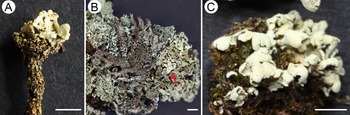
Altogether 38 Cladonia luteoalba thalli (Fig. 1) were collected at 21 sites, 29 in Norway (14 collection sites), eight in Czechia (six sites) and one in Poland. Twenty-five specimens were growing in close contact with thalli of other Cladonia species (Fig. 1B), and two grew directly on the top of C. coccifera podetia (Fig. 1A). In Norway, C. luteoalba was found mostly on acidic soil in open habitats or on the upper horizontal surfaces of large boulders. A single epiphytic specimen was found on the trunk of a pine tree. In Central Europe, it was found exclusively in boulder screes in mountain areas. The most closely associated Cladonia thalli, together with other Cladonia species at certain localities, not in direct contact with C. luteoalba but at a maximum of 30 cm away, were also collected. Three of them were used as controls for metabarcoding (see below). Cladonia luteoalba specimens are encoded LUTxx, the associated Cladonia thalli LUTxx-A and control thalli LUTxx-C. All collection data are presented in Supplementary Material Table S1 (available online); specimens are deposited in PRC.
Cladonia luteoalba thalli. A, C. luteoalba squamule on a podetium of C. coccifera. B, C. luteoalba (arrow) growing among other Cladonia species. C, C. luteoalba with no associated Cladonia thalli. Scales = 5 mm. In colour online.

Secondary chemistry
To determine chemotypes of C. luteoalba thalli, standard thin-layer chromatography (TLC) in solvent systems A, B and C was performed following Orange et al. (Reference Orange, James and White2010).
Sanger sequencing: DNA extraction, amplification and sequence analyses
DNA was extracted using the CTAB protocol (Cubero et al. Reference Cubero, Crespo, Fatehi and Bridge1999), with freezing prolonged to 30 min after isopropanol precipitation and an additional washing step with 96% ethanol. A single Cladonia squamule was used for each extraction. Fungal nuclear ITS rDNA was amplified using the primers ITS1F (Gardes & Bruns Reference Gardes and Bruns1993) and ITS4 (White et al. Reference White, Bruns, Lee, Taylor, Innis, Gelfand, Sninsky and White1990). Algal ITS rDNA was amplified using the forward primers Zeleny_F2 (Moya et al. Reference Moya, Chiva, Molins, Jadrná, Škaloud, Peksa and Barreno2018) or nr-SSU-1780 (Piercey-Normore & DePriest Reference Piercey-Normore and DePriest2001) with the reverse primer ITS4. The PCR conditions were as in Škvorová et al. (Reference Škvorová, Černajová, Steinová, Peksa, Moya and Škaloud2022). PCR products were purified with SPRI AMPure XP paramagnetic beads (Beckman Coulter) and sequenced by Macrogen Europe (Amsterdam, the Netherlands). GenBank Accession numbers of the newly obtained sequences are given in Table 1 and Supplementary Material Table S2 (available online).
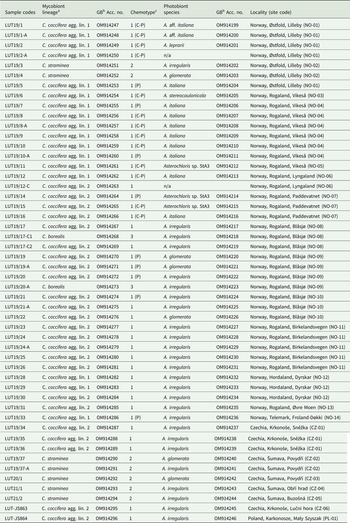
Mycobiont and photobiont identification of Cladonia luteoalba and their associated Cladonia thalli. Samples codes are listed with GenBank Accession numbers of the newly obtained ITS sequences, and respective chemotype and locality data. For more collection data see Supplementary Material Table S1 (available online). Cladonia luteoalba specimens are encoded LUTxx, the associated Cladonia thalli LUTxx-A and control thalli LUTxx-C.

a see Fig. 2;
b GenBank;
c chemotype 1 = zeorin with accessory porphyrillic (P) and conporpyrillic (C) acid, chemotype 2 = squamatic and didymic acid, chemotype 3 = barbatic acid.
Mycobiont ITS sequences newly obtained from C. luteoalba and their associated Cladonia thalli (Table 1) were aligned with the sequences of related species. These were selected based on BLAST searches and included C. straminea and zeorin-containing red-fruited Cladonia species (Steinová et al. Reference Steinová, Stenroos, Grube and Škaloud2013), viz. C. coccifera, C. deformis (L.) Hoffm., C. diversa Asperges. and C. pleurota (Flörke) Schaer., referred to here as the C. coccifera aggregate. The sequences were downloaded from GenBank and additional C. straminea sequences were produced (see Supplementary Material Table S2). The dataset was aligned with MAFFT v. 7 (Katoh et al. Reference Katoh, Rozewicki and Yamada2019), using the Q-INS-I method and manually checked. Ambiguously aligned regions were identified using the program Gblocks v. 0.91b (Castresana Reference Castresana2000) and eliminated. The final alignment consisted of 529 positions and 48 unique sequences, including C. divaricata Nyl. used as the outgroup. Substitution models estimated with jModelTest v. 2.1.4 (Darriba et al. Reference Darriba, Taboada, Doallo and Posada2012) using Bayesian Information Criterion were K80 for ITS1, JC for 5.8S and K80 for ITS2.
The newly obtained ITS photobiont sequences were aligned with Asterochloris Tschermak-Woess sequences downloaded from GenBank (Supplementary Material Table S3, available online), based on the datasets of Škaloud & Peksa (Reference Škaloud and Peksa2010), Kim et al. (Reference Kim, Kim, Nam, So, Hong, Choi and Shin2020) and Vančurová et al. (Reference Vančurová, Muggia, Peksa, Řídká and Škaloud2018, Reference Vančurová, Kalníková, Peksa, Škvorová, Malíček, Moya, Chytrý, Černajová and Škaloud2020). To increase phylogenetic resolution, actin type I sequences were also downloaded from GenBank and processed as above. The two markers gave congruent topologies so they were concatenated. Trebouxia jamesii (Hildreth & Ahmadjian) Gärtner was used as the outgroup. The alignment was processed as above and finally consisted of 71 unique sequences, and 498 ITS and 516 actin positions. The estimated substitution models were K80 + G for ITS1, JC for 5.8S, TrNef + G for ITS2 and K80 + I + G, TrNef + G and K80 + G for the first, second and third actin positions, respectively.
The phylogenetic trees were inferred by Bayesian inference in MrBayes v. 3.2.6 (Ronquist et al. Reference Ronquist, Teslenko, van der Mark, Ayres, Darling, Hohna, Larget, Liu, Suchard and Huelsenbeck2012) using partitioned datasets. Two parallel MCMC runs, with one cold and three heated chains, were carried out, sampling the trees and parameters every 100 generations. Convergence of the chains was verified by the convergent diagnostic of the potential scale reduction factor (PSFR) using the sump option, and it approached 1 in all cases. Convergence of the two cold chains was assessed by the average standard deviation of split frequencies (SDSF). It was 0.005 and 0.001 after 15 million generations for the photobiont and mycobiont, respectively. The first 25% of the trees was discarded as burn-in in each run. A 50% majority-rule consensus tree was obtained using the sumt option. Bootstrap analyses were performed by maximum likelihood (ML) using GARLI v. 2 (Zwickl Reference Zwickl2006) on partitioned datasets, specified as above, consisting of 500 rapid bootstrap inferences with automatic termination. Other GARLI parameters were set to default.
Interaction networks were created using the package bipartite (Dormann et al. Reference Dormann, Frueund, Bluethgen and Gruber2009) in the free software R v. 4.1.0 (R Core Team 2021).
Illumina metabarcoding and bioinformatics
To reveal possible multiple Cladonia mycobionts in C. luteoalba thalli, Illumina metabarcoding of the fungal ITS1 rDNA region was carried out. Six C. luteoalba samples and three control Cladonia samples of various chemotypes and from different localities (Supplementary Material Tables S1 & S4) were included. Amplicons for Illumina MiSeq sequencing were generated using the newly designed barcoded primers ITS1_NGS_Cladonia_forward (5′-barcode-TGC GGA AGG ATC ATT AAT GAG-3′) and ITS1_NGS_Cladonia_reverse (5′-barcode-AGA TCC GTT GAA AGT TTT-3′). These fungal primers were primarily designed to discriminate in favour of Cladonia. In a pilot study (data not shown), they did not amplify Cladonia exclusively but they effectively increased the ratio of Cladonia sequences compared to other fungi. Therefore, the composition of the fungal community obtained using these primers is highly biased and the results obtained mainly serve the purpose of seeking Cladonia sequences.
PCRs were performed in a volume of 20 μl, each reaction containing 10 μl of Q5 High-Fidelity DNA polymerase (BioLabs Inc.), 5 μl of sterile water, 1.5 μl of each primer and 2 μl of DNA. Each sample was run in three replicates and three PCR negative controls (PNC) were included. PCR conditions were as follows: initial denaturation at 98 °C for 30 s, 35 cycles of 98 °C denaturation for 10 s, 52° C amplification for 45 s and 72 °C elongation for 1 min, with a final 72 °C extension for 2 min. The PCR products were purified with SPRI AMPure XP paramagnetic beads (Beckman Coulter), pooled equimolarly and sent for library preparation and sequencing to Fasteris (Plan-les-Ouates, Switzerland). Sequencing was performed on the Illumina MiSeq platform with paired end mode (2 × 300 bp).
Quality control analysis of the Illumina MiSeq paired-end reads was performed using FastQC v. 0.11.8 (Andrews Reference Andrews2010). Raw reads were processed according to the pipeline published by Báilint et al. (Reference Báilint, Schmidt, Sharma, Thines and Schmitt2014), including quality filtering, paired-end assembly, removing primer artifacts, extracting reads by barcodes, reorienting reads to 5′-3′, demultiplexing, dereplicating, OTU clustering (this step carried out using Swarm v. 2 (Mahé et al. Reference Mahé, Rognes, Quince, de Vargas and Dunthorn2015), with denoising set to d = 3) and chimera filtering. Only the OTUs that had more than 100 reads in at least two of the three replicates were considered further. Fungal OTUs were identified by BLAST searches (excluding uncultured/environmental sample sequences) in SEED2 (Větrovský et al. Reference Větrovský, Baldrian and Morais2018).
Mycobiont culturing
In order to capture possible multiple mycobionts in C. luteoalba thalli, isolates for culturing were prepared from selected specimens of both chemotypes. Under a stereomicroscope, tiny pieces of either medulla or the arachnoid lower surface were extracted with a sterile needle and placed onto cultivation media. Sabouraud 2% medium (SAB), malt-yeast extract medium (MYA) and Bold's Basal Medium (BBM) with 1% glucose were prepared following the instructions in Stocker-Wörgötter & Hager (Reference Stocker-Wörgötter, Hager and Nash2008). Fifty plates were inoculated per thallus and were incubated at 16.5 °C with a 12 h of light/dark regime. After six weeks, the plates were checked and morphologically identified mycobiont isolates were reinoculated onto fresh media. Their identity was subsequently confirmed by obtaining ITS rDNA sequences as described above. Three to ten isolates were obtained per thallus, with the exception of LUT-JS863 from which we obtained 21 mycobiont isolates. Twelve of the LUT-JS863 cultures were selected for sequencing, while all the cultures were sequenced from the other specimens.
Results
Chemistry
The Cladonia luteoalba specimens belonged to two chemotypes (Table 1): chemotype 1 containing zeorin was found in 32 specimens, 17 of which contained porphyrillic acid and 10 also conporphyrillic acid, with the majority also containing an unidentified accessory compound; six specimens were of chemotype 2 containing squamatic and didymic acids. All samples contained usnic acid. The chemotype of the most closely associated Cladonia thallus was the same in all cases examined, with one exception (LUT19/20 contained zeorin and the associated thallus barbatic acid, i.e. chemotype 3). No geographical pattern in chemotype occurrence was observed (longitude, latitude or altitude; data not shown).
Mycobionts
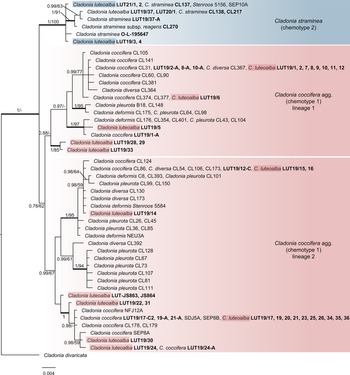
No unique sequence belonging to C. luteoalba that would distinguish it from related Cladonia species was obtained. The ITS rDNA sequences obtained by Sanger sequencing were identical to and grouped with the corresponding Cladonia species or species complex defined by the chemotypes (Fig. 2); specifically, squamatic acid-containing specimens belonged to C. straminea, and zeorin-containing specimens were placed in various lineages of the Cladonia coccifera agg., which includes the morphospecies C. coccifera, C. deformis, C. diversa and C. pleurota that are indistinguishable based on DNA sequence data, as shown previously (Steinová et al. Reference Steinová, Stenroos, Grube and Škaloud2013).
Phylogenetic relationship of Cladonia luteoalba (highlighted) and related taxa obtained by Bayesian inference of ITS rDNA. Values at nodes show statistical support calculated by MrBayes posterior-node probability (PP)/maximum likelihood bootstrap. Only statistical supports with PP > 0.75 are shown. Thick branches represent nodes with full PP support. Newly obtained sequences are in bold. Shaded areas indicate chemotype and lineage information. Cladonia divaricata is the outgroup. Cladonia luteoalba specimens are encoded LUTxx, the associated Cladonia thalli LUTxx-A and control thalli LUTxx-C. For GenBank Accession numbers see Table 1 and Supplementary Material Table S2 (available online). In colour online.

Culturing of mycobionts did not result in unique C. luteoalba cultures either. We successfully obtained Cladonia cultures from six zeorin-containing specimens (LUT19/1, 12, 19, 24, 30 and JS863). Multiple mycobiont cultures obtained from one thallus were always identical in their ITS sequence, which was also always identical to the sequence obtained by Sanger sequencing directly from the lichen thallus.
Illumina metabarcoding did not support the hypothesis that C. luteoalba is the result of mechanical hybridization of more Cladonia species. A total of 7 582 820 reads passed demultiplexing and subsequently 5 814 251 reads passed filtering. Finally, 132 OTUs passed the criterion of occurrence of more than 100 reads in at least two of the triplicates of a sample, and they represented more than 50 genera (Supplementary Material Table S4, available online). The majority of the OTUs were found in one sample only (101 OTUs). The proportion of Cladonia OTUs in each sample is shown in Fig. 3. For each sample, the dominant sequence corresponded to the sequence obtained by Sanger sequencing. An additional Cladonia sequence was detected in seven samples. These were at least one or two orders of magnitude lower in abundance than the dominant mycobiont and they were also found in the PCR negative controls, so they should be considered cross-contaminations. Besides Cladonia, the most frequent OTU (OTU5, found in the three control samples and three out of six C. luteoalba samples) matched an unknown fungus isolated from Quercus montana leaf litter (KX908501, 98.7% similarity) and an uncultured fungus from alpine soil (LS958441, 100% similarity).
Relative abundances of mycobiont sequences in Cladonia thalli as revealed by Illumina metabarcoding. For further details see Supplementary Material Table S4 (available online). In colour online.

All the OTUs that gave relevant BLAST search results belonged to Ascomycetes, with two Basidiomycete exceptions: OTU220 (76.5% similarity to Erythrobasidium sp. LC272890) from a control, C. coccifera CLZ1; and OTU9 (93.1% similarity to Tremella diploschistina Millanes et al., JN790587), recovered from Czech C. luteoalba JS863, LUT19/37 and LUT20/1. Other lichenicolous taxa recovered were Cryptodiscus galaninae Zhurb. & Pino-Bodas (OTU68; 98.7% similarity to KY661636, in LUT20/1), Epithamnolia xanthoriae (Brackel) Diederich & Suija (OTU19; 99.3% similarity to MT028049, in JS863 and LUT19/17-C2) and Lichenosticta alcicornaria (Linds.) D. Hawksw. (OTU7; 97.1% similarity to KY661621, in LUT19/12-C). Also, sequences belonging to various lichen species commonly co-occurring in C. luteoalba habitats were detected (see Supplementary Material Table S4).
Photobionts
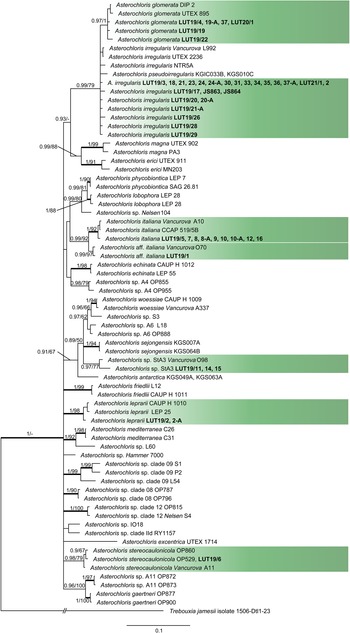
Photobionts belonging to seven lineages of Asterochloris were identified (Fig. 4, Table 1): A. irregularis (Hildreth & Ahmadjian) Skaloud & Peksa (24 samples), A. italiana (P. A. Archibald) Skaloud & Peksa (9 samples), A. glomerata (Waren) Skaloud & Peksa (6 samples), A. leprarii Skaloud & Peksa (1 sample), A. stereocaulonicola Y. J. Kim et al. (1 sample), and two undescribed lineages Asterochloris sp. StA3 (3 samples) and Asterochloris aff. italiana (1 sample), both sensu Vančurová et al. (Reference Vančurová, Muggia, Peksa, Řídká and Škaloud2018).
Phylogeny of Asterochloris obtained by Bayesian inference of concatenated nuclear ITS rDNA and actin type I. Values at nodes show statistical support calculated by MrBayes posterior-node probability (PP)/maximum likelihood bootstrap. Only statistical support with PP > 0.75 is shown. Thick branches represent nodes with full PP support. Lineages with C. luteoalba photobionts are highlighted. Newly obtained sequences are in bold. Trebouxia jamesii is the outgroup. Cladonia luteoalba specimens are encoded LUTxx, the associated Cladonia thalli LUTxx-A and control thalli LUTxx-C. For GenBank Accession numbers see Table 1 and Supplementary Material Table S3 (available online). In colour online.

Cladonia luteoalba shared its photobiont with the most closely associated Cladonia thalli in all cases examined, with one exception (A. glomerata vs A. irregularis in LUT19/37 and the associated Cladonia thallus, respectively).
Chemotype 1 of C. luteoalba associated with all seven Asterochloris species found. Chemotype 2 (C. straminea) associated only with A. irregularis and A. glomerata. Asterochloris irregularis, A. italiana and Asterochloris sp. StA3 were shared by both C. coccifera agg. lineages. Additionally, C. coccifera agg. lineage 1 also associated with A. aff. italiana, A. leprarii and A. stereocaulonicola; whereas C. coccifera agg. lineage 2 also associated with A. glomerata (Fig. 5). This pattern could not be explained by geography, altitude or substratum type (see Supplementary Material Table S1).
Association network between Cladonia mycobiont lineages and Asterochloris photobiont species. Link widths are proportional to the number of samples in the association. In colour online.

Discussion
In the genus Cladonia, species delimitation and taxonomy are particularly problematic. Phenotypic variability within species is wide and similarity to closely related species high, making it difficult to set boundaries. While phylogenetic studies have been beneficial in some taxa delimitations (e.g. Pino-Bodas et al. Reference Pino-Bodas, Burgaz and Martín2010a; Kanz et al. Reference Kanz, Brackel, Cezanne, Eichler, Hohmann, Teuber and Printzen2015; Stenroos et al. Reference Stenroos, Pino-Bodas, Weckman and Ahti2015) they have produced ambivalent results in others. Many taxa have proved to be polyphyletic; however, the authors often discuss the processes underlying low phylogenetic resolution and discrepancies in the molecular data, such as incomplete lineage sorting, unrecognized paralogs, introgression, homoplasy or horizontal gene transfer, and consider their data insufficient to draw taxonomic conclusions (e.g. Piercey-Normore et al. Reference Piercey-Normore, Ahti and Goward2010; Steinová et al. Reference Steinová, Stenroos, Grube and Škaloud2013; Pino-Bodas et al. Reference Pino-Bodas, Burgaz, Martín, Ahti, Stenroos, Wedin and Lumbsch2015). In other cases, phenotypically recognizable taxa were synonymized based on molecular revisions, and differences were attributed to effects of environmental conditions, for example, C. pocillum with C. pyxidata (L.) Hoffm. (Kotelko & Piercey-Normore Reference Kotelko and Piercey-Normore2010) and C. convoluta (Lamkey) Anders. with C. foliacea (Huds.) Willd. (Pino-Bodas et al. Reference Pino-Bodas, Martín and Burgaz2010b). The taxonomic value of lichen secondary metabolites is also inconsistent (e.g. Pino-Bodas et al. (Reference Pino-Bodas, Burgaz and Martín2010a) vs Pino-Bodas et al. (Reference Pino-Bodas, Burgaz, Martín, Ahti, Stenroos, Wedin and Lumbsch2015)).
We collected two out of the four known chemotypes of Cladonia luteoalba (Stenroos Reference Stenroos1990). These chemotypes correspond to the chemotypes of C. straminea (didymic and squamatic acids) and the C. coccifera agg. (zeorin and accessory (con-)porphyrillic acid). Cladonia straminea is a well-defined monophyletic species (see Fig. 2), while C. coccifera agg. includes four morphological species that are indistinguishable based on ITS rDNA and β-tubulin sequence data (Steinová et al. Reference Steinová, Stenroos, Grube and Škaloud2013). The phylogenetic placement of the C. luteoalba samples coincided with their chemistry. Therefore, not only is C. luteoalba polyphyletic, it also appears to be conspecific with Cladonia species of the corresponding chemotypes. It is also indistinguishable from the most closely associated Cladonia thallus. Commonly, the widely accepted fungal barcode marker ITS rDNA provides poor phylogenetic resolution in the genus Cladonia and alternative candidate markers have been suggested (Pino-Bodas et al. Reference Pino-Bodas, Martín, Burgaz and Lumbsch2013). However, within the clade Erythrocarpae even additional markers might not resolve morphologically well-defined species (C. coccifera agg., two loci in Steinová et al. (Reference Steinová, Stenroos, Grube and Škaloud2013), C. coccifera agg. and C. macilenta-C. floerkeana agg., five loci in Stenroos et al. (Reference Stenroos, Pino-Bodas, Hyvönen, Lumbsch and Ahti2019), and C. bellidiflora-C. polydactyla-C. umbricola complex, five loci in Steinová et al. (Reference Steinová, Holien, Košuthová and Škaloud2022)), possibly due to low genetic differentiation resulting from recent speciations (Stenroos et al. Reference Stenroos, Pino-Bodas, Hyvönen, Lumbsch and Ahti2019). Advanced methods, such as microsatellite and RADseq data, are helpful in discriminating closely related species (e.g. Usnea antarctica Du Rietz. and U. auratiacoatra (Jacq.) Bory; Grewe et al. Reference Grewe, Lagostina, Wu, Printzen and Lumbsch2018; Lagostina et al. Reference Lagostina, Dal, Andreev and Printzen2018) and will be essential in building a robust well-resolved phylogeny including a wide sampling of the Erythrocarpae clade that should be the basis for future studies. However, the fact that the C. luteoalba phenotype is found in different, not closely related lineages strictly following the pattern in chemotypes makes it unlikely that involvement of such methods would support its existence as a distinctive species.
Other reasons why morphologically well-distinguishable lichens are not supported by molecular data have been reported. Velmala et al. (Reference Velmala, Myllys, Halonen, Goward and Ahti2009), for example, showed that Bryoria fremontii (Tuck.) Brodo & D. Hawksw. and B. tortuosa (G. Merr.) Brodo & Hawksw., distinguished by the production of secondary metabolites and thus also colour, are conspecific and the difference between them was later attributed to the presence of associated fungi, specifically Cystobasidiomycete yeast (Spribille et al. Reference Spribille, Tuovinen, Resl, Vanderpool, Wolinski, Aime, Schneider, Stabentheiner, Toome-Heller and Thor2016). Even more striking conspecificity was shown between Lecanographa amylacea (Ehrh. ex Pers.) Egea & Torrente (Arthoniomycetes) and Buellia violaceofusca G. Thor & Muhr (previously placed in Lecanoromycetes) and was explained by photobiont switching between Trentepohlia and Trebouxia (Ertz et al. Reference Ertz, Guzow-Krzemińska, Thor, Łubek and Kukwa2018).
The distinctiveness of C. luteoalba was also not supported by mycobiont culturing and DNA metabarcoding. They did not support the hypothesis that C. luteoalba is the result of mechanical hybridization and did not reveal any fungal taxon always associated with C. luteoalba and never with the other related lichens. However, the possibility that the morphotype is caused by a fungal infection still cannot be ruled out. The primers we used were designed to favour Cladonia sequences, thus the PCR bias here is great and the fungal spectrum we obtained cannot be considered representative. Lichenicolous fungi commonly cause morphological changes in the thallus, most conspicuously discolorations or necrotic patches formed by, for example, Lichenoconium species (Hawksworth Reference Hawksworth1977) or colour change of whole Cladonia squamules by Arthrorhaphis aeruginosa R. Sant. & Tønsberg (Santesson & Tønsberg Reference Santesson and Tønsberg1994), and galls induced by, for example, Tremella species (Millanes et al. Reference Millanes, Westberg, Wedin and Diederich2012, Reference Millanes, Diederich, Westberg, Pippola and Wedin2015; Zamora et al. Reference Zamora, Millanes, Etayo and Wedin2018). However, in those cases, the parasite mycelia are visible in cross-sections of the host thalli if fruiting bodies are absent. Galls on lichens are also provoked by invertebrates such as nematodes (Siddiqi & Hawksworth Reference Siddiqi and Hawksworth1982) or mites (Gerson Reference Gerson1973). The increased production of usnic acid that causes the yellow colour of the squamule underside suggests a parasite might be involved, since antibiotic, antiviral, antifungal, anti-insect, antiherbivore and other effects of usnic acid have been shown (reviewed by, e.g. Ingólfsdóttir (Reference Ingólfsdóttir2002)). Therefore, DNA metabarcoding studies targeting a wide range of organisms (i.e. fungi and bacteria, but also viruses) should be the next step in resolving this enigma.
The C. luteoalba morphotype is obviously not linked to photobiont switching. It shares its photobiont with the closely associated Cladonia thalli. Our C. luteoalba samples can be divided into two groups based on the Asterochloris species they associate with (Fig. 5). The first group included the C. straminea genotypes and several representatives of the C. coccifera agg.; it associated with A. glomerata and A. irregularis which are the typical Cladonia photobionts of colder climates and acidic substrata, according to Škvorová et al. (Reference Škvorová, Černajová, Steinová, Peksa, Moya and Škaloud2022: module 2 therein). All Central European samples from higher altitudes and more than half of the Norwegian samples belonged to this group (Table 1). The second group included C. coccifera agg. representatives, which associated with the other five Asterochloris species (see ‘Results’). Among them, only two were included in the study of Škvorová et al. (Reference Škvorová, Černajová, Steinová, Peksa, Moya and Škaloud2022): compared to the first group, A. italiana represents a photobiont of warmer, wetter and more nutrient-rich habitats, while A. aff. italiana is of warmer and drier habitats with higher substratum pH (modules 4 and 1, respectively, in Škvorová et al. (Reference Škvorová, Černajová, Steinová, Peksa, Moya and Škaloud2022)). Given the acidic bedrocks and relative climatic uniformity of our Norwegian collection sites, we suggest that microclimatic differences or minor pH variations, caused, for example, by surrounding vegetation, may also play a role in photobiont choice. In any case, no clear patterns between the mycobiont phylogenetic lineages and their associated photobionts were observed in C. luteoalba.
In conclusion, our data do not support the existence of C. luteoalba as a separate Cladonia species. However, neither the lectotype (BM 000006761) nor the isolectotype (NMW 0000803) contain identifiable associated Cladonia species with which C. luteoalba could be synonymized. The lectotype contains zeorin (Østhagen Reference Østhagen1972) but the taxonomy of the zeorin-containing species of the C. coccifera agg. is unclear and requires further revision. Consequently, C. luteoalba remains a valid name for now.
Acknowledgements
This work was supported by Charles University Science Foundation GAUK no. 1154119. Rebecca Yahr and Graham Hardy (Royal Botanic Garden Edinburgh) provided us with the original description of C. luteoalba. We are grateful to Teuvo Ahti for his advice on possible nomenclatural changes. The long-term research and development project RVO 67985939 of the Czech Academy of Sciences is also acknowledged.
Author ORCIDs
Ivana Černajová, 0000-0001-9526-4647; Jana Steinová, 0000-0003-0229-4535; Zuzana Škvorová, 0000-0002-7020-3888; Pavel Škaloud, 0000-0003-1201-3290.
Competing Interests
The authors declare none.
Supplementary Material
To view Supplementary Material for this article, please visit https://doi.org/10.1017/S002428292200024X.