Representative democracies require citizens to be capable of holding elites to account via the rewarding of good performance and the punishing of bad. It is against the backdrop of this normative claim that recent work on partisan motivated reasoning becomes worrying. Partisans generally try to expose themselves predominantly to partisan friendly messages and vigorously dispute information harmful to their favored party (Druckman, Peterson, and Slothuus Reference Druckman, Peterson and Slothuus2013; Iyengar and Hahn Reference Iyengar and Hahn2009; Stroud Reference Stroud2011). These processes of selective attention and interpretation may result in citizens being unable to accurately perceive elite performance thereby threatening accountability efforts (Druckman Reference Druckman2014; Jerit and Barabas Reference Jerit and Barabas2012; Lebo and Cassino Reference Lebo and Cassino2007; Ramirez and Erickson Reference Ramirez and Erickson2014). These studies raise an important question: what types of contexts constrain partisan motivated reasoning?
Recent reviews have suggested one potential context that may attenuate partisan motivated reasoning: disagreeable political discussion networks (Bolsen, Druckman, and Cook Reference Bolsen, Druckman and Cook2014, 253; Leeper and Slothuus Reference Leeper and Slothuus2014, 144). The motivation to affirm and defend one’s partisan identity is not an unbounded impulse, but one that can be mitigated by the presence of continual streams of party-challenging information (Lavine, Johnston, and Steenbergen Reference Lavine, Johnston and Steenbergen2012; Redlawsk, Civettini, and Emmerson Reference Redlawsk, Civettini and Emmerson2010). While partisans may work to construct news diets so as to minimize their mediated exposure to this type of information, political discussion with friends, family and co-workers may operate as an alternative, and fairly pervasive, source of partisan challenge. Individuals may encounter reasons to question their partisan allegiances via such discussions which, in turn, may prompt them to hold weaker partisan identities and thereby experience a diminished motivation to selectively process political information (Klofstad, Sokhey, and McClurg Reference Klofstad, Sokhey and McClurg2013; Sinclair Reference Sinclair2012). The possibility that social disagreement may attenuate partisan biases is politically and theoretically important, but one that has not received much prior attention.Footnote 1 Our central question is thus: does exposure to political disagreement within one’s political discussion network attenuate partisan motivated reasoning?
We contribute to the literatures on partisan motivated reasoning and interpersonal discussion by exploring their interrelationship with regards to a politically important manifestation of partisan motivated reasoning: citizens’ propensity to evaluate the national economy based on the partisanship of the incumbent government (Bartels Reference Bartels2008; Duch, Palmer, and Anderson Reference Duch, Palmer and Anderson2000; Enns and McAvoy Reference Enns and McAvoy2012; Evans and Andersen Reference Evans and Andersen2006; Evans and Pickup Reference Evans and Pickup2010). Existing work shows that supporters of the incumbent party will discount negative, and opponents positive, information about economic performance. Partisan disagreements over economic performance raise troubling questions regarding the ability of the mass public to discharge its role in holding elites accountable given the important role such evaluations play as a consideration guiding vote choices (Duch and Stevenson Reference Duch and Stevenson2008; Fiorina Reference Fiorina1981).Footnote 2 We will thus explore whether social disagreement disrupts these patterns. In particular, we will investigate whether the level of disagreement within a partisan’s political discussion network is associated with an increased propensity to make partisan-incongruent evaluations of the economy when called for, e.g. for out-partisans to render more positive evaluations of economic conditions during good economic times.
We marshal the best available observational evidence concerning the relationship between interpersonal disagreement and partisan motivated reasoning on economic matters. Specifically, we use evidence from five national surveys from the United States to explore how partisan differences in factual knowledge and subjective retrospective assessments of the economy vary according to the extent of disagreement in partisans’ discussion networks. Our results provide meager support for the claim that interpersonal disagreement attenuates partisan bias in this domain. On the one hand, exposure to disagreement is associated with an increased propensity to correctly answer factual questions about the economy when such facts are incongruent with the respondent’s partisan identity, but the evidence is somewhat mixed across the surveys. On the other hand, we find that network disagreement does little to consistently affect partisans’ subjective evaluations of the economy in a way consistent with an attenuation of partisan reasoning strategies. Our results thus suggest that interpersonal disagreement is not a panacea for partisan motivated reasoning.
Partisanship, Motivated Cognition and Economic Assessments
The past several decades have witnessed a resurgence of work on the motivated bases of human cognition and has resulted in an understanding that human reasoning and information processing is goal-directed (Kunda Reference Kunda1990). In the political realm particular attention has been paid to directional goals (Leeper and Slothuus Reference Leeper and Slothuus2014; Lodge and Taber Reference Lodge and Taber2006; Nir Reference Nir2011b). When directional goals are salient, which appears to be generally, individuals select and process information so as to favor a particular outcome, i.e. to affirm one’s status in, and defend the validity of, one’s partisan identity. Directional reasoning may manifest in selective exposure where individuals seek out attitudinally congruent information (Druckman, Fein, and Leeper Reference Druckman, Fein and Leeper2012; Lodge and Taber Reference Lodge and Taber2006; Stroud Reference Stroud2011). Meanwhile, when discordant information is encountered directional goals stimulate active cognitive efforts to rationalize and reject this information (Lodge and Taber Reference Lodge and Taber2006; Lord, Ross, and Lepper Reference Lord, Ross and Lepper1979; Mullinix Reference Mullinix2016). This work largely supports the argument that partisans often see the world through a partisan perceptual screen (Bolsen, Druckman, and Cook Reference Bolsen, Druckman and Cook2014; Campbell et al. Reference Campbell, Converse, Miller and Stokes1960).
The operation of partisan guided reasoning processes can help explain partisan disagreements concerning economic performance. First, partisans may pay attention to different news sources which report economic news in a divergent manner (Larcinese, Puglisi, and Snyder Reference Larcinese, Puglisi and Snyder2011; Stroud Reference Stroud2011). In addition, partisans may also selectively perceive information about economic performance when it is received (Bartels Reference Bartels2008; Enns, Kellstedt, and McAvoy Reference Enns, Kellstedt and McAvoy2012; Lebo and Cassino Reference Lebo and Cassino2007; Ramirez and Erickson Reference Ramirez and Erickson2014). Finally, partisans may be motivated to selectively report their perceptions so as to maintain the positive value of their identity (Bullock et al. Reference Bullock, Gerber, Hill and Huber2015; Prior, Sood, and Khanna Reference Prior, Sood and Khanna2015).Footnote 3 While partisan disagreements over the economy are not entirely the fault of these partisan biases, economic perceptions appear to be strongly guided by their relevance for the validity of one’s partisan identity.Footnote 4 This recurrent finding raises a politically and normatively important question: what types of political and social contexts constrain partisan motivated reasoning?
Social Networks, Disagreement and The Potential Reduction of Partisan Bias
Individuals do not form political opinions in a vacuum. Rather, political attitudes are greatly influenced by interactions with other citizens and particularly the friends, family and acquaintances that comprise their political discussion networks (Huckfeldt and Sprague Reference Huckfeldt and Sprague1995; Mutz Reference Mutz2006; Sinclair Reference Sinclair2012). Particularly relevant for our purposes are studies demonstrating that the extent of political disagreement within these networks is consequential. In particular, prior work connects exposure to interpersonal disagreement with weaker (e.g. less extreme and more ambivalent) issue and candidate preferences, greater openness to persuasion, enhanced knowledge of the legitimate rationales for opposing viewpoints, and with a greater openness to voting for candidates from different political parties (Bloom and Levitan Reference Bloom and Levitan2011; Huckfeldt, Mendez, and Osborn Reference Huckfeldt, Mendez and Osborn2004; Lupton, Singh, and Thornton Reference Lupton, Singh and Thornton2015; Mutz Reference Mutz2002a; Mutz Reference Mutz2002b; Pattie and Johnston Reference Pattie and Johnston2008; Robison, Leeper, and Druckman Reference Robison, Leeper and Druckman2018; Sinclair Reference Sinclair2012; Visser and Mirabile Reference Visser and Mirabile2004). Individuals situated within discussion networks with high levels of disagreement appear to be more ‘deliberative’ in their political attitude formation processes.Footnote 5
While the foregoing studies are not explicitly focused on partisan motivated reasoning, they nevertheless provide a reasonable basis for suggesting that interpersonal disagreement will also help attenuate partisan reasoning biases.Footnote 6 However, we are aware of only one study that explicitly explores this possibility, Klar’s (Reference Klar2014) experimental study showing that respondents assigned to a mixed discussion setting demonstrated less evidence of partisan bias in reactions to persuasive messages than those assigned to a discussion context consisting only of co-partisans. While important evidence, argumentative discussions in this study occurred in an evenly divided setting (i.e. four Democrats and four Republicans) among individuals who did not know each other, and thus had little expectation of future interactions, which may prevent easy generalization to more common networks wherein peers know each other, broadly expect to interact again in the future and where disagreement is more or less one-sided (Nir 2005, Reference Nir2011a). Moreover, Klar could only look at the responses of Democratic students, leaving open the possibility that effects will vary across partisan groups or among older individuals. Ultimately, a test of the argument that exposure to interpersonal disagreement within discussion networks undermines directional motivated reasoning requires replication with evidence from more naturalistic discussion networks.
Why might an individual’s susceptibility to partisan motivated reasoning vary alongside the level of political disagreement within their political discussion network? Information processing is not only guided by directional goals such as the desire to affirm one’s partisan identity, but is instead a balancing act between directional, accuracy and efficiency goals (Chaiken, Giner-Sorolla, and Chen Reference Chaiken, Giner-Sorolla and Chen1996; Lavine, Johnston, and Steenbergen Reference Lavine, Johnston and Steenbergen2012). The priority given to a directional goal will depend upon the relative strength of this goal. In the current context the directional goal is the motive to defend one’s partisan identity, which is rooted in the strength and relevance of the partisan identity for the individual. As partisan identity strength increases, in other words, so too will an individual’s propensity to act in such a way as to affirm the validity of their partisan allegiance (Huddy, Mason, and Aarøe Reference Huddy, Mason and Aarøe2015; Mullinix Reference Mullinix2016).
Partisan motivated reasoning increases alongside identity strength. Crucially, higher levels of social disagreement are likely to be associated with weaker partisan identities much as they are with issue attitudes more generally (for instance: Klofstad, Sokhey, and McClurg Reference Klofstad, Sokhey and McClurg2013; Lavine, Johnston, and Steenbergen Reference Lavine, Johnston and Steenbergen2012; Sinclair Reference Sinclair2012). The extent of disagreement within a network will influence the type of information an individual receives regarding political affairs. Agreeing partners, i.e. partners with the same partisan identity, provide identity-congruent information that can be used to further bolster the validity of one’s partisan allegiance. Disagreeing partners, i.e. those with dissimilar partisan preferences, may instead provide identity-challenging information. For instance, discussions with disagreeing others provide insight into the legitimate rationales for the other side’s positions which may lead to more positive views of the other side and hence identity ambivalence (Lavine, Johnston, and Steenbergen Reference Lavine, Johnston and Steenbergen2012; Mutz Reference Mutz2002a; Mutz and Mondak Reference Mutz and Mondak2006; Pattie and Johnston Reference Pattie and Johnston2008; Price, Cappella, and Nir Reference Price, Cappella and Nir2002). In addition, partisans tend to believe the other side to be homogeneous in nature, which facilitates perceptions of party polarization and hence an increased likelihood that an individual will self-categorize as a partisan and work to defend their partisan identity (Ahler and Sood Reference Ahler and Sood2018; Druckman, Peterson, and Slothuus Reference Druckman, Peterson and Slothuus2013). However, discussing politics with individuals from the other side can disrupt these stereotypes and mitigate perceptions of polarization, which should thus disrupt partisan self-categorization processes and hence reduce the relevance of the partisan identity to the individual (Buttice, Huckfeldt, and Ryan Reference Buttice, Huckfeldt and Ryan2009; Lyons and Sokhey Reference Lyons and Sokhey2017). Finally, disagreeing others can be a conduit to information contained in media sources a partisan would otherwise ignore, thereby providing a route for party-critical information to reach them (Druckman, Levendusky, and McLain Reference Druckman, Levendusky and McLain2018). Given that interpersonal discussion networks tend to be tilted toward close ties, i.e. friends and family, this incongruent information is potentially more credible, and hence effective, than if it had been encountered from elite out-partisan sources (Huckfeldt Reference Huckfeldt2001; Huckfeldt and Sprague Reference Huckfeldt and Sprague1995; Lupia Reference Lupia2002; Mutz Reference Mutz2006; Sinclair Reference Sinclair2012). And, while exposure to disagreement may inspire efforts to counter-argue, continual exposure to incongruent information, as we might expect to occur in ongoing social relationships, can break down this tendency (Lodge and Taber Reference Lodge and Taber2006; Redlawsk, Civettini, and Emmerson Reference Redlawsk, Civettini and Emmerson2010). Partisans within disagreeable networks may thus possess both the information necessary to come to more accurate understandings of the economy as well as a diminished motivation to resist this information due to weakened (i.e. less extreme or more ambivalent) identities.
If partisan motivated reasoning is rooted in the strength of an individual’s partisan identity, and higher levels of disagreement undermine identity strength, then it is plausible that partisans within more argumentative networks will evince lesser evidence of partisan motivated reasoning. What would this look like? We focus on whether disagreement is associated with an increased likelihood that partisans express party-incongruent beliefs regarding the national economy as it is in this arena that motivated reasoning related biases should be most apparent. Our specific focus is on partisans’ knowledge of facts regarding economic performance and their retrospective economic evaluations. If disagreement undermines partisan motivated reasoning, then it should help promote the expression of these incongruent beliefs when called for.
Hypothesis 1: Increasing levels of political disagreement will be associated with an increased likelihood of expressing partisan-incongruent beliefs about the national economy, all else equal.
To illustrate this hypothesis let us first consider individuals that identify with the same party as the incumbent government, what we will call in-partisans. These individuals will generally be motivated to process information to the advantage of their co-partisans in government. During positive economic conditions this is not too difficult as incoming economic information aligns with that motivation. However, when economic conditions sour there should exist friction between this party defensive motivation and incoming information that will depress the likelihood that in-partisans will correctly answer economy-related knowledge questions and report negative evaluations of the national economy. However, if the level of disagreement within a partisan’s political discussion network attenuates partisan motivated reasoning, then we would expect to see an increased likelihood of correctly answering economy-related factual questions and reporting negative evaluations of the economy among this partisan group even though such beliefs clash with one’s goal of defending one’s partisan team. Our expectations regarding out-partisans are the inverse. We are interested in out-partisan reactions during positive economic conditions as this is when there should exist friction between partisan defensive motivations and one’s incoming information. Our hypothesis holds that disagreement will be associated with increased knowledge and increasingly positive evaluations for this group in such contexts.
Methods
We draw on five national surveys conducted in the United States to investigate our hypotheses. Specifically, we use data from the US version of the 1992 Cross-National Election Project (CNEP), the 2000 ANES Time Series (TS), the panel component of the 2002 ANES Time Series wherein respondents from the 2000 ANES TS were reinterviewed (hereafter 2002 ANES Panel), the 2006 ANES Pilot and several waves from the 2008–9 ANES Panel survey. There are several advantages to using this array of data sources. First, the surveys were conducted in varying economic conditions, which enables us to test our specific in- and out-partisan expectations.Footnote 7 Table A1 in the online appendix provides economic statistics for each survey. Broadly speaking, the surveys conducted in 1992, 2002 and 2008–9 were fielded during negative economic conditions, while those fielded in 2000 and 2006 took place in more positive economic conditions. A second advantage of using this array of surveys is that it enables us to look at contexts where a Democrat or a Republican was President and thus enables variation in which partisan team is considered ‘in-partisans’ and which are considered ‘out-partisans’. Finally, the 2002 ANES Panel and 2008–9 ANES Panel surveys enable us to obtain some distance between the measurement of our independent variables (partisanship and network disagreement) and our dependent variables, as in both cases the former were measured anywhere from one month to two years prior in time to the latter.
Core independent variables: partisanship and network disagreement
We will detail our dependent variables in the sections to come. However, let us first note the nature of our two main independent variables. Partisanship is a binary indicator coded so that partisans that identify with the same party as the incumbent President (in-partisans) are given a score of 1 and partisans identifying with the opposite party receive a score of 0 (out-partisans). Thus, we code Republican respondents as in-partisans in 1992, 2002 and 2006, when a President Bush occupied the White House while Democrats in these survey years are coded as out-partisans. Meanwhile, we code Republican respondents as out-partisans and Democrats as in-partisans in 2000 and the two 2009 panel waves due to the presence of a Democratic President at the time of the survey. Leaning partisans are included in this binary measure while pure Independents are excluded from the analysis, given the focus on difference in response between partisan groups.
Respondents to each survey completed a battery of items concerning their political discussion network. These batteries always began with a name-generator question wherein respondents were asked whether they discussed politics/important matters with anyone or not. Notably, asking individuals about peers with whom they discuss ‘important matters’ versus politics does not appear to elicit different types of responses (Klofstad, McClurg, and Rolfe Reference Klofstad, McClurg and Rolfe2009). On the ANES surveys, the network generators were included on the post-election wave of the 2000 ANES, the 2006 Pilot which occurred after the 2006 mid-term election, and the September 2008 wave of the 2008–9 ANES Panel which began in January 2008. Note that we are focusing here on those individuals that completed the battery, i.e. those that said they discuss politics or important matters with at least one person, as is customary (Mutz Reference Mutz2002b; Sinclair Reference Sinclair2012; Sokhey and McClurg Reference Sokhey and McClurg2012).
Individuals that said yes to this initial question were then asked detailed questions concerning up to five (1992 CNEP), four (ANES 2000 TS/ANES 2002 Panel) or three (ANES 2006, ANES 2008–9) discussants. The types of individuals typically captured by these name generators tend to be relatively strong ties (i.e. close friends, spouses and family members), but co-workers, i.e. generally weaker ties, also represent a significant percentage of discussants as well (see Klofstad, McClurg, and Rolfe Reference Klofstad, McClurg and Rolfe2009, table 2). While these questions, and our resultant measures, focus on respondents’ perceptions of their discussants, prior research suggests that individuals are often quite accurate in these perceptions and that it is the perception, not the reality, that influences individuals (Huckfeldt, Mendez, and Osborn Reference Huckfeldt, Mendez and Osborn2004, 69; Huckfeldt and Sprague Reference Huckfeldt and Sprague1995, 154–5; Mutz Reference Mutz2002b).
On each survey respondents were asked about the political views of their named discussants. Respondents were asked about the Presidential candidate preference of each discussant in the 1992 CNEP and 2000 ANES TS/2002 ANES Panel surveys, while in the remainder of the surveys they were asked about discussant partisanship. Our measure of Network Disagreement was calculated by subtracting the number of discussants with the same PID or candidate preference, i.e. agreeing discussants (A), from the number of discussants with different preferences (D; Network Disagreement=D – A; Lupton, Singh, and Thornton Reference Lupton, Singh and Thornton2015; Lupton and Thornton Reference Lupton and Thornton2017).Footnote 8 The resulting variable ranges from −5 to +5 on the 1992 CNEP, −4 to +4 on the 2000 and 2002 ANES, and −3 to +3 on the 2006 and 2008–9 ANES surveys, with higher scores indicating greater potential exposure to disagreement.Footnote 9 Respondents scoring below 0 are situated within networks with more agreeable than disagreeable partners, while those above 0 experience an overall tilt toward disagreement in the network. While the mean value on this variable is below 0 for all surveys, most respondents nevertheless possess at least one disagreeable partner.Footnote 10
Control variables and dealing with potential selection issues
Our data on social network composition are observational in nature, which necessarily limits our ability to speak to the causality of the relationships shown below. One potential worry is that individuals could plausibly select into networks based on the level of political disagreement. While we cannot remove such concerns we address them in two ways. First, Sinclair notes that social networks typically do not form based on shared political beliefs but instead on other social characteristics (Sinclair Reference Sinclair2012). She thus recommends controlling ‘for the social characteristics that generate homophily’ as one means of reducing endogeneity concerns (Sinclair Reference Sinclair2012, 16). All analyses reported here control for age, gender, education, race, family income, marital status and political interest/news attention for just this reason.Footnote 11 In addition, the ANES analyses contain measures for the respondent’s need for cognition and need to evaluate, which are included as controls because these cognitive style indicators have previously been connected with an individual’s general propensity to engage in directional motivated reasoning.Footnote 12 Second, we leverage the panel nature of the ANES surveys in analyses reported in online Appendix E by replicating our analyses using a measure of disagreement that has been preprocessed using a matching algorithm. Specifically, in each case we can use measures obtained in waves conducted prior to when network disagreement was measured to obtain greater balance between ‘treated’ (i.e. high levels of disagreement) and ‘control’ (i.e. low levels of disagreement) on a variety of predictors that may explain both a respondent’s propensity to engage in partisan motivated reasoning and their selection into disagreeing networks (e.g. cognitive style, prior partisan identity strength and political sophistication). Notably, our substantive conclusions remain the same. While these tactics cannot fully deal with worries concerning self-selection and endogeneity, they are the best tools available to us here. We will return to this point in the conclusion.
Results
Disagreement and knowledge of inconvenient facts
Partisans within disagreeing discussion networks are expected to evince weaker motivations to defend their partisan identity, which should be associated with an increase in knowledge of partisan ‘inconvenient’ facts (Hypothesis 1). We can test this hypothesis using data from the 2000 ANES and 2008–9 ANES Panel surveys. In both cases respondents were asked to indicate whether they believed that the federal budget deficit had grown smaller, larger or stayed the same relative to some prior point in time.Footnote 13 On the 2000 ANES this measure was asked in the post-election wave of the survey and the reference point was 1992, i.e. the beginning of President Clinton’s administration.Footnote 14 Respondents on the 2008–9 Panel, meanwhile, were asked this question in both May and July 2009 with a reference point of January 2009, i.e. the beginning of President Obama’s term in office. In both cases the question admits an unambiguously correct response that is potentially inconvenient for one partisan team. In the former case, a budget deficit in 1992 had turned into a budget surplus by 2000, a fact that out-partisans (i.e. Republicans) should be less likely to report, knowing that it speaks favorably to the economic record of President Clinton. Meanwhile, the year 2009 saw a deficit in January grow larger month by month due to efforts to combat the financial crisis, a fact potentially inconvenient for in-partisans (i.e. Democrats). We thus expect lower levels of knowledge among out-partisans in 2000 and in-partisans in 2009. Hypothesis 1 posits a positive effect of disagreement on answering correctly for partisans in these two groups.
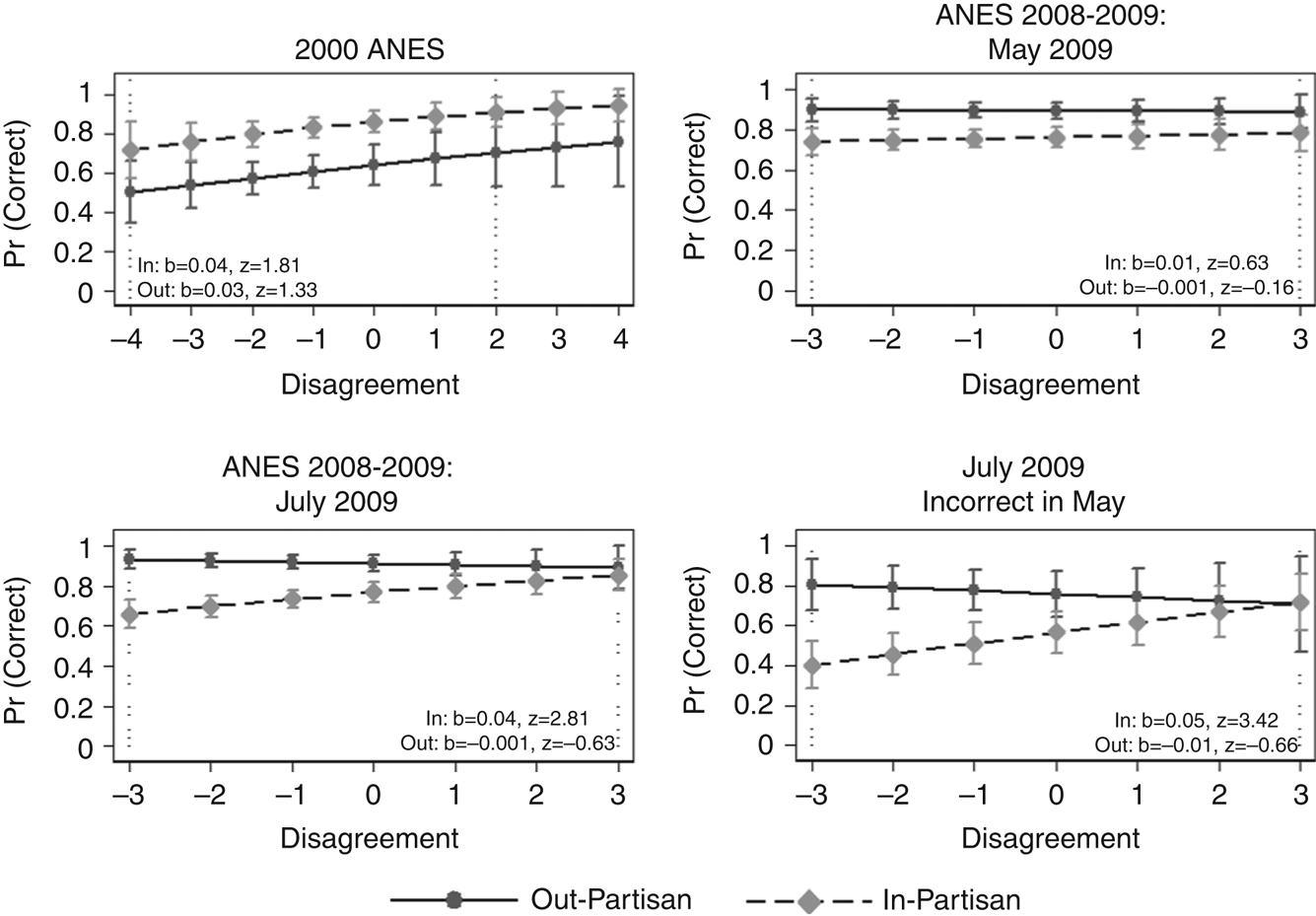
We predict deficit knowledge (1=correct, 0=incorrect) with a logit model that includes the interaction between network disagreement and partisanship and the controls discussed earlier. We present the full results in the online appendix and concentrate on Figure 1, which plots the average predicted probability of a correct response by partisanship and network disagreement. As a first point, we can note that partisanship is related to knowledge as we expected: in-partisans were more likely to answer correctly in 2000 and less likely to answer correctly in May and July 2009. This difference was sizeable in all years, with in-partisans being, on average, approximately 22 per cent more likely to be correct in 2000 but 14 per cent and 19 per cent less likely to be correct in May and July 2009 respectively.Footnote 15 The correctness of a respondent’s perceptions of the deficit is strongly related to their partisan loyalties.
Network disagreement and knowledge of the federal budget deficit. Notes: Markers provide the average predicted probability of a correct answer (w/95 % confidence intervals) by partisanship and network disagreement (x-axis). Information regarding the slope of each line and its statistical significance is provided in each subgraph. Dotted lines represent the 5th and 95th percentile of network disagreement. See Table A6 for the full results. In-Partisans=Democrats, Out-Partisans=Republicans in both waves.

We now turn to the role of network disagreement where we see partial evidence in favor of Hypothesis 1. Disagreement is estimated to have a positive, but statistically insignificant, influence on an out-partisan’s likelihood of answering correctly in the year 2000. The results from the two 2008–9 ANES Panel surveys are likewise mixed. While knowledge does not vary alongside network disagreement for in-partisans in May 2009, a positive and statistically significant relationship between disagreement and knowledge does emerge for in-partisans two months later in July. Notably, the substantive effect of disagreement is sizeable in both 2000 among out-partisans and July 2009 among in-partisans, albeit more precisely measured in the latter instance. The estimated change in the probability of a correct response per one unit change in disagreement is approximately 3–4 per cent in both cases, which yields average predicted gains in knowledge of approximately 20 per cent when moving from the 5th to 95th percentile in disagreement.Footnote 16Figure 1 thus offers some qualified evidence in support of the role of network disagreement in constraining partisan motivated reasoning.
Recall that individuals participating in the July 2009 wave of the ANES 2008–9 panel may also have completed the May 2009 survey.Footnote 17 This offers us the possibility of exploring how network disagreement affects learning via an exploration of July responses among respondents that were incorrect in May. We did this by adding a dummy variable for respondent correctness in May to the July 2009 model and then recalculating the average predicted probability of a correct response among previously incorrect respondents; the final subgraph of Figure 1 provides the results. Out-partisans incorrect in May have a high predicted probability of being correct in July regardless of the level of network disagreement. More intriguingly, we find a strong positive effect of network disagreement among previously incorrect in-partisans consistent with Hypothesis 1. This relationship, moreover, is substantial albeit quite noisy; previously incorrect in-partisans at the 5th percentile of disagreement have a predicted probability of a correct response in July of 0.40 [0.28, 0.52] while those at the 95th percentile are nearly twice as likely to be correct on average (0.72 [0.58, 0.86]). In this case disagreement appears to be facilitating the learning of partisan incongruent beliefs about the economy.
Partisanship, disagreement and economic evaluations
We provide a second, and perhaps harder, test of the argument that network disagreement will be associated with an attenuation of partisan motivated reasoning through an exploration of evaluations of the national economy. We say ‘harder’ because it is possible for partisans to accept facts about the world but nevertheless interpret them in such a way as to deny their negative partisan implications (Bisgaard Reference Bisgaard2015; Gaines et al. Reference Gaines, Kuklinski, Quick, Peyton and Verkuilen2007). Given the important role retrospective evaluations play in vote choices, this relationship is crucial to investigate.
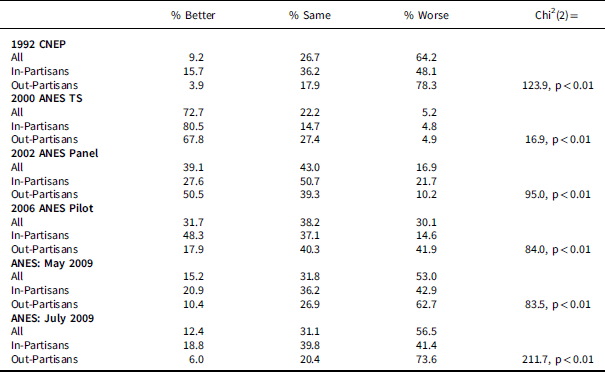
Respondents on all five surveys were asked to indicate whether the economy was better, about the same or worse relative to some reference point in the past, although there was some variation in the wording of the questions. Respondents to the 1992 CNEP survey were asked to evaluate the state of the economy relative to two years prior. Respondents on the 2000 ANES TS, on the other hand, were asked to indicate whether the economy was better/worse/about the same ‘compared to 1992’.Footnote 18 Respondents to the 2002 Panel and 2006 Pilot surveys, meanwhile, were both asked to evaluate the state of the economy relative to a year prior. Finally, respondents to the 2008–9 ANES Panel were asked in May 2009 and July 2009 to evaluate the state of the economy relative to January 2009, i.e. when President Obama officially became President.Footnote 19 In the analyses that follow we code these measures so that higher scores indicate a belief that the economy was doing better than in the reference period. For some of these measures respondents could only answer on a three-point scale (1992 CNEP, 2006 ANES Pilot), while the remainder enabled respondents to also indicate whether the economy was much or somewhat better/worse. All in-text analyses will use focus on a three-point Worse/Same/Better structure. Table 1 provides descriptive statistics for each measure.
Economic evaluations across the surveys

Note: Cells provide the percentage of respondents giving each response. The final column provides the results of a chi-squared test between in- and out-partisans. Republicans=in-partisans in 1992, 2002 and 2006 (out-partisans the other years). Democrats=in-partisans in 2000 and May/July 2009 (out-partisans the other years).
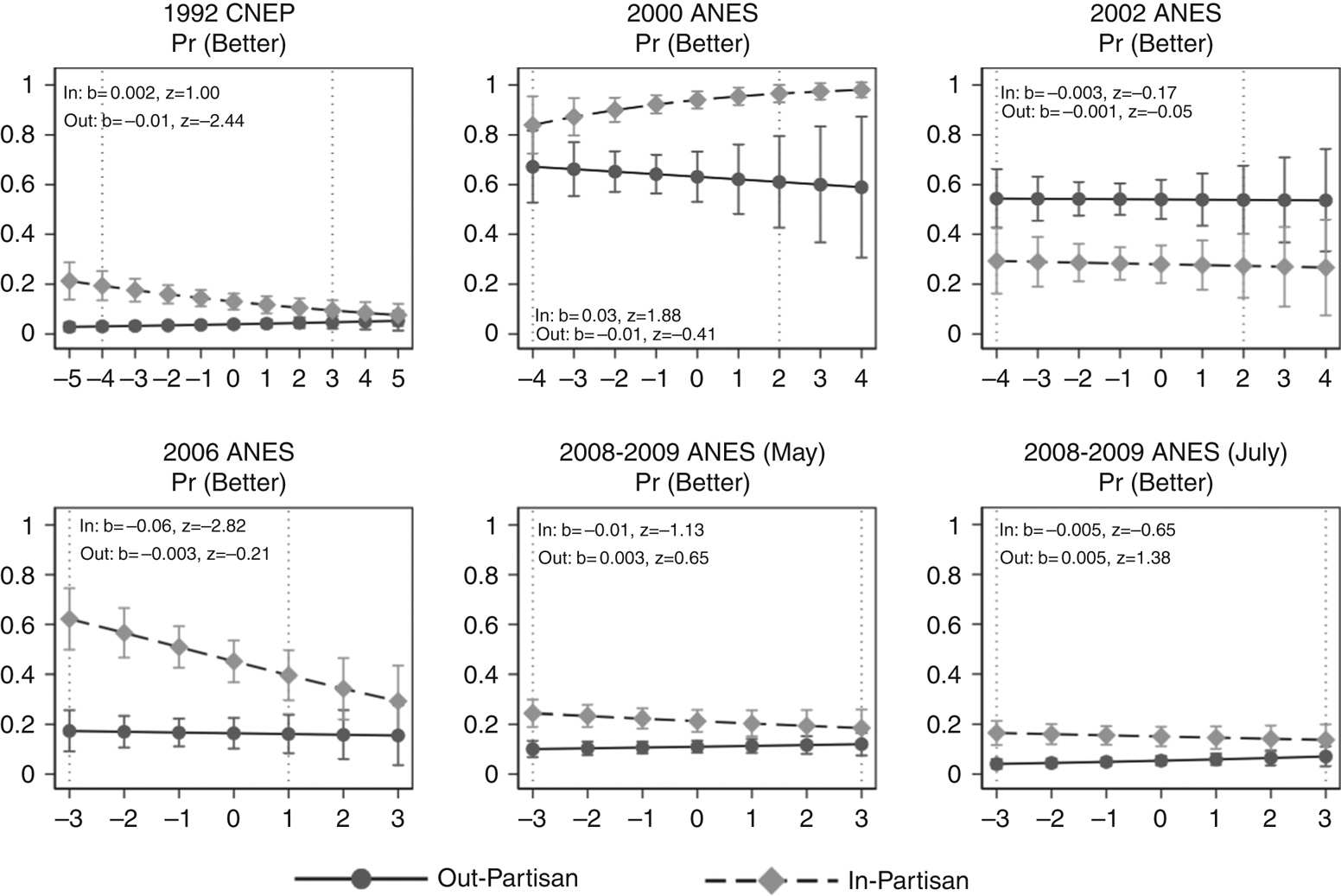
Much as with our earlier analyses we are principally concerned with the evaluations of in-partisans in negative economic conditions and the reactions of out-partisans during good times as these contexts are the ones wherein partisan defensive motivations are perhaps most easily observed. We predicted each retrospective evaluation measure using an ordinal logit model using partisanship, network disagreement, their interaction and the same bevy of control variables as predictors. To facilitate interpretation of these results we focus on Figure 2, which plots the average predicted probability of a respondent saying that the economy is ‘better’ by the level of disagreement in their network (x-axis) and their partisanship. Evidence consistent with Hypothesis 1 would thus take the form of a positively sloped line for out-partisans in the good economic conditions of 2000 and 2006 (e.g. Republicans and Democrats respectively) and negatively sloped lines for in-partisans in 1992, 2002 and in May and July 2009 (i.e. Republicans in 1992 and 2002 and Democrats in 2009).
Network disagreement and partisan differences in economic evaluations. Notes: Markers provide the average predicted probability of the respondent saying the economy is ‘better’ (w/95 % confidence intervals) by partisanship and network disagreement (x-axis). Information regarding the slope of each line and its statistical significance is provided in each subgraph. Dotted lines represent the 5th and 95th percentile of network disagreement. Republicans=in-partisans in 1992, 2002, and 2006 (out-partisans the other years). Democrats=in-partisans in 2000 and May/July 2009 (out-partisans the other years).

As Table 1 shows, in-partisans adopted more positive evaluations of the national economy than out-partisans in all years save for 2002. These differences remain statistically significant in multivariate models. However, Figure 2 provides meager evidence that disagreement affected these differences in the manner hypothesized to occur. We can begin here with an analysis of disagreement during positive economic conditions, i.e. in the years 2000 and 2006 where unemployment was low, consumer confidence high and economic growth positive. The critical test, recall, is whether disagreement is associated with increased positivity in the evaluations of out-partisans as revealed by a positively sloped line in Figure 2, i.e. with whether Republicans (Democrats) are more likely to give President Clinton (Bush) his due for good economic performance. The evidence is not positive on this front; in 2000, out-partisans actually become a bit less likely to say that the economy is ‘better‘ as disagreement increases while in 2006 a flat line emerges for out-partisans across network disagreement. Indeed, the sub-graph for 2006 shows in-partisans become significantly more negative about the economy as disagreement increases, indicating that disagreement for these individuals may be facilitating inaccurate evaluations.Footnote 20 There is thus little evidence that network disagreement facilitates more accurate evaluations among out-partisans in good economic conditions.
The remainder of the surveys occurred in more negative economic contexts. In such conditions out-partisans should readily say that the economy is poor, while in-partisans may be more likely to say it is good to defend their partisan team.Footnote 21 Thus, the key question is whether disagreement breaks down this latter pattern (i.e. leads to more pessimistic evaluations of the economy among in-partisans) as revealed by a negatively sloped line in the figure. Figure 2 provides little evidence in favor of this conclusion outside of the 1992 CNEP survey. In-partisans on this survey do report increasingly pessimistic readings of the national economy as their exposure to interpersonal disagreement increases. For instance, an in-partisan at the 5th percentile of network disagreement, i.e. low levels of disagreement, has an average predicted probability of 0.19 [0.13, 0.25] for saying ‘better’ and 0.37 [0.29, 0.46] of saying ‘worse’. Meanwhile, in-partisans at the 95th percentile, i.e. high disagreement, do appear much more pessimistic, being both less likely to say ‘better’ (0.09 [0.05, 0.14]) and more likely to say worse (0.57 [0.47, 0.68]). However, in none of the other three surveys does disagreement have a significant negative (positive) effect on the probability that in-partisans say the economy is better (worse).Footnote 22 To the extent that partisan groups look similar in these surveys it appears to be the result of the broader economy exerting a reality constraint on respondents. Figure 2 thus provides weak evidence that network disagreement attenuates partisan motivated reasoning when it comes to economic evaluations.
Network disagreement and partisan identity, an interlude
There is inconsistent evidence in favor of the proposition that social disagreement undermines partisan motivated reasoning. Why is this so? One possibility is that our supposition that disagreement weakens partisan identities, and hence the motivation to defend them, may be incorrect. After all, both partisan identities and political discussion networks may be characterized as relatively stable due to the former’s early development and the latter being principally composed of close, and stable, relationships (Campbell et al. Reference Campbell, Converse, Miller and Stokes1960; Klofstad, McClurg, and Rolfe Reference Klofstad, McClurg and Rolfe2009).Footnote 23 Perhaps this link in the causal chain is missing and that is why we fail to see stronger effects. We test this possibility in analyses reported in online Appendix A. Of particular interest are analyses from the 2008–9 ANES Panel wherein we have both temporal distance between disagreement and measures of partisan identity extremity as well as multiple indicators of extremity recorded anywhere from one to ten months later in time. This contrasts with the limited existing work on this subject that tends only to examine a single recording of extremity.Footnote 24 Notably, partisans in highly disagreeing networks in September 2008 report substantially less extreme identities in future survey waves even while controlling for pre-September reports of identity extremity. This pattern also emerges in analyses of the cross-sectional datasets. While partisans in disagreeing networks possess weaker partisan identities and thus putatively possess weaker motivations to defend those identities, they nevertheless do not evince a reduced likelihood of consistently adopting identity-incongruent economic evaluations. We discuss some reasons why in our concluding discussion.
Conclusion
We have investigated whether interpersonal disagreement mitigates partisan differences in economic perceptions by undermining the individual’s underlying motivation to defend their partisan team against negative information. Using the best available observational data we have shown limited evidence in favor of this possibility. On the one hand, we found some evidence that exposure to disagreement may facilitate the learning of inconvenient political facts, but some of this evidence was statistically imprecise (i.e. the 2000 ANES analyses) and the effect failed to manifest in another survey (May 2009 analyses). On the other hand, we found scant evidence that the level of disagreement in a partisan’s network was associated with an attenuation of partisan biases in evaluations of the national economy outside of the 1992 CNEP survey. At the very least, we feel that our analyses suggest that network disagreement is no easy panacea for concerns over partisan motivated reasoning. In the remainder of this article we will discuss some of the implications of our study for future research.
We begin by discussing the potential role of self-selection in this study. As noted earlier, we utilize observational data, which raises the specter that partisans will select into disagreeing or agreeing networks based on background characteristics. It is thus worth considering the potential role these selection pressures may have on the results found in this study. When it comes to our analyses of economic evaluations and factual knowledge, the concern with self-selection is that individuals prone to avoiding directional motivated reasoning will self-select into disagreeable contexts and thus evidence of a reduction in partisan motivated reasoning is spurious. Much as above we cannot fully evade such concerns with observational evidence. However, by controlling for need for cognition and need to evaluate we believe we are capturing some of this process. Moreover, we actually found scant evidence that partisans within disagreeable networks showed lesser evidence of partisan motivated reasoning. Given that selection processes, to the extent that they are present, are likely pushing in the opposite direction, we feel that this further speaks to the validity of our results. However, future work could build on these findings, and those related to partisan identity strength, by leveraging natural experiments that introduce exogenous variation into networks, as in Klofstad’s (Reference Klofstad2010) study of dorm assignments. In the end, we believe that our results offer the most comprehensive available portrait of the relationship between social disagreement and partisan motivated reasoning, self-selection warts and all.
Perhaps the most important question to emerge from this study concerns how we should interpret the rather mixed evidence that emerges in our analyses. We see at least two possibilities here. First, the mixed evidence here may suggest that network disagreement plays little consistent role in undermining partisan defensive motivations, at least in this domain. While interpersonal disagreement may undermine a partisan’s identity strength, and hence their motivation to counter-argue inconsistent information, it may nevertheless be the case that these partisans still have sufficient motivation and resources to rebut party-incongruent information. Moreover, the very act of discussion may prompt individuals to more deeply consider information and, via this enhanced elaboration, formulate issue-specific attitudes more resistant to change even in the midst of weakened partisan identities (Levendusky, Druckman, and McLain Reference Levendusky, Druckman and McLain2016). If this is the case, then scholars interested in understanding the nature of partisan motivated reasoning, and particularly its limits, may be better off exploring broader contextual features of the environment such as elite polarization, the nature of a nation’s political institutions and their resulting influence on partisan identities, or the nature of news discourse, than focusing on interpersonal relationships (e.g. Druckman, Peterson, and Slothuus Reference Druckman, Peterson and Slothuus2013; Lupu Reference Lupu2015; Robison and Mullinix Reference Robison and Mullinix2016).
An alternative interpretation of the results reported here is that the influence of disagreement may in fact be conditional in nature. For instance, it may be no accident that we observed stronger results on measures of factual knowledge than on retrospective evaluations as partisans may come to accept identity-incongruent facts but simply respond by rationalizing them on measures that invite more subjectivity (Bisgaard Reference Bisgaard2015; Gaines et al. Reference Gaines, Kuklinski, Quick, Peyton and Verkuilen2007). Disagreement may thus attenuate partisan motivated reasoning, but do so only in specific domains. Alternatively, perhaps the network batteries explored here do not capture the types of social interactions that matter. The name generator batteries used on the surveys tend to capture close ties, although a fair proportion of reported discussants nevertheless stem from ‘weak’ tie relations (Klofstad, McClurg, and Rolfe Reference Klofstad, McClurg and Rolfe2009). Notably, Mutz and Mondak (Reference Mutz and Mondak2006) show that discussions with weak ties found in the workplace were more effective in fostering political tolerance than was discussion with relatives, i.e. stronger ties. This fits with Klar’s (Reference Klar2014) study which focused on discussion between individuals that did not know each other and thus had little expectation of future interactions. Perhaps, then, we should look to discussions fostered outside of one’s peer networks, for instance on the internet, as a source of attenuation for partisan biases (Wojcieszak and Mutz Reference Wojcieszak and Mutz2009). However, on this last point we can note that incorporating indicators of discussion frequency and tie strength into our measure of network disagreement did not change our conclusions (see online Appendix D). Regardless, one area for future work would be to theorize about potential conditionality for the influence of network disagreement and test it with appropriate data; to the extent that these conditional factors fail, then the first interpretation would gain influence over the latter. Whichever explanation ultimately finds support will have deep political, normative and empirical implications for how we understand the nature and quality of public opinion.
Supplementary material
Data replication sets can be found in Harvard Dataverse at: https://dx.doi.org/doi:10.7910/DVN/CHBAYB CHBAYB and online appendices at: doi: 10.1017/S0007123418000315
Acknowledgements
I am thankful to Martin Bisgaard, Matt Levendusky and participants at the Comparative Politics workshop at the Department of Political Science, Aarhus University, for their helpful comments on a prior version of this manuscript.
The data, replication instructions, and the data’s codebook can be found at https://dataverse.harvard.edu/dataset.xhtml?persistentId=doi:10.7910/DVN/CHBAYB.