


INTRODUCTION
One of the central problems of constitutionalism is how to establish and simultaneously control a government. As James Madison expressed in Federalist 51, “you must first enable the government to control the governed; and in the next place oblige it to control itself.”Footnote 1 Many familiar constitutional features are tools to oblige government to control itself; frequent elections, separation of powers, explicit limitations on government's scope and authority are several of the most prominent examples. In order to maintain, not merely establish, a democratic polity, however, these institutional features alone are insufficient. If members of government, or the temporary majorities whom they represent, can subvert the very mechanisms designed to keep them in check, they can exceed the bounds on their authority without repercussions.
A dominant theme of the constitutional theory literature is that successful constitutions must not only constrain those in power, but must do so over long time horizons, establishing constraints durable enough to bind across generations. This “entrenchment function” (Young Reference Young2008), the ability to create “temporally extended commitments” (Rubenfeld Reference Rubenfeld2008, 73) is often described as a defining feature and central goal of constitutionalism (Waluchow Reference Waluchow2012). By entrenching commitments, constitutions serve as a mechanism for overcoming the inconsistency of preferences over time. One particularly famous metaphor describing this entrenchment function likens constitutional provisions to the ropes that bound Ulysses to the mast of his ship, that is, self-imposed restraints to ensure that we cannot yield to the dangerous temptations we foresee in our future (Elster Reference Elster1979). Waldron likewise describes constitutions as “[p]recautions that responsible rights-holders have taken against their own imperfections” (Waldron Reference Waldron1999, 258). Similarly, economic historians have attributed the origins of modern constitutionalism to monarchs or other elite rulers that attempted to make their commitments more credible by entrenching them. These elites developed constitutionalism as way to confirm the durability of the concessions they were making to maintain the support of essential members of their political coalitions (Acemoglu and Robinson Reference Eskridge and Ferejohn2001; North and Weingast Reference North and Weingast1989).
Constitutional entrenchment has also been described as a mechanism for permanently removing some questions from the political agenda, thereby creating a stable set of rules that allows people to conduct politics in the presence of disagreement (Holmes Reference Holmes1995; Sunstein Reference Sunstein1991). This type of long-term constitutional entrenchment may also allow political parties to form new democracies by reassuring each political faction that the loser in any given battle will never be able to lose too badly (Ginsburg Reference Ginsburg2003). Though all of these theories describe different benefits of constitutional entrenchment, each identifies the intention to entrench (a policy, principle, or bargain) as the animating purpose of constitutionalism.
Members of the U.S. Supreme Court (even those with very different political positions) have also expressed the view that entrenchment is the central purpose of constitutionalism. According to Justice Scalia (Reference Scalia and Gutmann1997, 40) the “whole purpose [of a constitution] is to prevent change—to embed certain rights in such a manner that future generations cannot readily take them away.” Justice Brennan (Reference Brennan1991, 4) likewise notes: “[i]n my view, it is crucial to the durability and efficacy of a charter of personal liberties that it not be subject to easy alteration or suspension. . .robust entrenchment forbidding compromise or requiring supermajoritarian approval for amendments seems to me best.”
As Justice Brennan's recommendation suggests, a stable, or entrenched, text is (almost by definition) necessary for a written constitution to entrench its contents. As Whittington (Reference Whittington2015, 16) explains, “[t]he objective of intertemporal binding suggests the need for deeply entrenched constitutions that are very hard for anyone to change over time.” After all, a text that is often modified can do little to create durable constraints or make constitutional guarantees appear credible well into the future (Cooter Reference Cooter2000, 62–3). Thus, constitutional theorists generally distinguish constitutional documents from ordinary law by their relative rigidity (Eskridge and Ferejohn Reference Eskridge and Ferejohn2001; Waluchow Reference Waluchow2012). Such rigidity can be built into the constitution's design through formal amendment procedures that are more demanding than those of ordinary laws (Lutz Reference Lutz1994).Footnote 2
Entrenched constitutions are typically constructed as spare frameworks, rather than detailed policy directives, since highly specific documents are unlikely to remain relevant over long time horizons (Hammons Reference Hammons1999). As a result, along with rigidity, “generality and abstraction” are also widely considered to be defining features of written constitutions (Marmor Reference Marmor2007, 91–4). Highly specific constitutions, by contrast, are often dismissed as insufficiently majestic, or constitutional, in nature (Gardner Reference Gardner1992, 819–20; Howard Reference Howard1968, 866; Kahana Reference Kahana, Barak, Barak-Erez and Spair2013). As Justice Marshall famously remarked “only [the Constitution's] great outlines should be marked, its important objects designated, and the minor ingredients which compose those objects be deduced from the nature of those objects themselves,” since anything else would “partake of the prolixity of a legal code.”Footnote 3 Others have suggested that specificity indicates that constitution drafters were less concerned with constraining those in power (Ginsburg and Posner Reference Ginsburg and Posner2010) or that it actually imposes harm on majorities (Nardi and Tsebelis Reference Nardi and Tsebelis2014).
The model of an entrenched and spare document, which changes meaning primarily through judicial interpretation, successfully describes the U.S. Constitution. However, it does a poor job of depicting most other national democratic constitutions, or even U.S. state constitutions. As we will demonstrate, specific and unentrenched constitutions developed over the course of the nineteenth and twentieth centuries, and are now the dominant form of constitutionalism across the globe, and within the U.S. states. We argue that these polities’ flexible and detailed constitutional texts embody an alternative model of constitutionalism. Rather than entrenching constraints through spare and stable texts, these constitutions provide officeholders—judges, legislatures and executives—with specific and frequently modified instructions. Although these flexible constitutions do not entrench commitments over long time horizons, we argue that they are nonetheless attempts to constrain the exercise of political power by leaving empowered actors with fewer choices about which policies to pursue.
Entrenched/spare and unentrenched/specific constitutions can be understood as two different solutions to the same problem: enabling people to control their government. Those who conceptualize constitutionalism as a form of contracting describe the people as a “principal,” which, in creating a representative government, has employed “agents” to better realize its ends.Footnote 4 This formulation highlights the fact that agents are often in the position to pursue their own interests over that of the principal. Stable constitutional documents can be seen as attempts to solve this “principal-agent” problem by entrenching durable constraints on agents who, left unchecked, would amend the constitution to reflect their own interest (Aghion and Bolton Reference Aghion and Bolton2003; Buchanan and Tulloch Reference Buchanan and Tullock1962; Ginsburg and Posner Reference Ginsburg and Posner2010; Persson et al. Reference Persson1997). We argue here that specific constitutions are also attempts to solve this principal-agent problem, not by circumscribing the agent's actions through fixed constitutional boundaries (entrenchment), but by limiting the latitude within which agents operate (through specificity) and relaxing the rigidity of the constitutional boundaries (increasing flexibility) to accommodate constitutions’ increased scope and detail. One might describe this design strategy as “constitutional micromanagement.”
In the past decade, scholars have highlighted a variety of trends in constitutional development that, taken together, suggest the ascendance of constitutional micromanagement. Dixon (Reference Dixon2014), for instance, has emphasized that few modern constitutions are the spare frameworks portrayed in a great deal of constitutional theory. In fact, most national constitutions contain a wealth of socioeconomic rights and other highly specific policy provisions (Jung, Hirschl, and Rosevear Reference Jung, Hirschl and Rosevear2014; Versteeg and Zackin Reference Versteeg and Zackin2014). Elkins, Ginsburg, and Melton (Reference Elkins, Ginsburg and Melton2009) have demonstrated that national constitutions are also remarkably flexible: only half survive more than 19 years before they are replaced and most are amended frequently in between. Scholars of U.S. state constitutions have demonstrated that most state constitutions are similarly flexible and specific (Bridges Reference Bridges2015; Dinan Reference Dinan2006; Hammons 2009; Tarr Reference Tarr1998; Versteeg and Zackin Reference Versteeg and Zackin2014). These studies all point to a gap between entrenchment-based constitutional theories and modern constitutional practices. Normative theorists have also suggested departures from the entrenched constitution (Gardbaum Reference Gardbaum2013; Jackson Reference Jackson2008; Tushnet Reference Tushnet2008). Gardbaum (Reference Gardbaum2013, 2) advances a normative theory in which detailed and flexible constitutions help to constrain officeholders, particularly judges. He describes the rise of a “new commonwealth model of constitutionalism,” in which the constitution remains flexible enough for the legislature to pass an amendment when it wishes to reverse a judicial holding (Gardbaum Reference Gardbaum2013, 31). Thus far, however, these different observations have not been synthesized into a single theory of constitutional design.
Using longitudinal data from every democratic country and the U.S. states from the late eighteenth century to today, along with regional case studies, we demonstrate that constitutional drafters increasingly chose specificity over entrenchment as a means to constrain the exercise of political power. In doing so, they embarked on a developmental path that was very different from the course of federal constitutional development in the United States. Scholars of American constitutional development have documented the country's long journey toward judicial supremacy over federal constitutional meanings (Gillman Reference Gillman2002; Graber Reference Graber1993; Whittington Reference Whittington2007), but in other democratic polities, both within and outside the United States, constitution-makers have attempted to restrict the latitude of judiciaries, and even legislatures, in interpreting and applying constitutional documents. The result has been a new model of constitutional design, one that has yet to be fully recognized in constitutional theory.
TWO MODELS OF CONSTITUTIONAL DESIGN
The Entrenched Constitution
Entrenchment, or rigidity, may allow constitutional texts to establish enduring authority over governmental activities. As people come to believe that these constitutional boundaries will remain in place, they may then establish political and economic arrangements premised upon them, creating incentives for the actors involved to continue to preserve these original boundaries (Hardin Reference Hardin1999; Levinson Reference Levinson2011). Constitutional courts may then emerge from these larger political and economic structures and participate in the enforcement (and further entrenchment) of the constitutional commitments upon which these institutions were founded (Hardin Reference Hardin1999; Hirschl Reference Hirschl2004; Law Reference Law2009).
Importantly, entrenchment discourages the inclusion of highly specific policy choices in constitutional documents, since specific policies are unlikely to remain appropriate or popular in the face of changing economic and social conditions. Another reason that entrenchment works against constitutional specificity is that it is generally easier for diverse groups to agree on broad standards or principles than on specific policies (Lerner Reference Lerner2011). We might expect this difficulty to be heightened if those agreements will be difficult to revise (Hardin Reference Hardin1999, 84). Entrenched constitutions, therefore, tend to be narrow in scope, describing only the basic structures of government, the powers entrusted to it, and the rights it cannot violate. They also tend to exclude detailed or technical instructions, employing broad statements of principle in lieu of comprehensive policies.
Entrenched constitutional documents are relatively robust against the possibility that, once in power, political actors may attempt to relax the constitutional constraints placed upon them by amending the document. Thus, procedural requirements that make the constitution harder to amend may help to reduce the cost of monitoring these actors (Fusaro and Oliver Reference Fusaro, Oliver, Oliver and Fusaro2011, 4; Levinson Reference Levinson2011, 679). By requiring amendments to be passed by supermajority, or by requiring the involvement of subnational units, constitution-makers can ensure that amendment is an extraordinary affair. Informal norms dictating infrequent amendment can further serve to defend a constitutional text from agents’ attempts to revise it (Ginsburg and Melton Reference Ginsburg and Melton2014; Levinson Reference Levinson and Levinson1995).
The entrenched and spare constitution makes it harder for both office holders and contemporary majorities to amend the constitution in their favor, but this design strategy imposes other costs. First, constitutional interpreters, including legislatures, executives, and courts, may choose from a vast array of policy choices, and claim that almost any are consistent with the spare constitution's broadly phrased guarantees. As a result, spare texts endow the constitutional interpreters with significant room to make, and potentially change, constitutional meanings. Scholars of the American politics have long emphasized the ability of judges, in particular, to set national policy by determining the Constitution's meaning (Dahl Reference Dahl1957). This invitation for unelected Supreme Court Justices to substitute their own political convictions for those of democratic majorities may, at least in the short term, pose significant problems for democratic self-governance (Bickel Reference Bickel1962).
A second set of costs associated with entrenched constitutions is that elites can use entrenched documents to secure (or entrench) their privilege (Schwartzberg Reference Schwartzberg2013). Beard (Reference Beard1913) famously described the U.S. Constitution, for instance, as a means through which the propertied few entrenched their material advantages against the democratic forces that might have attempted economic redistribution. Parenti (Reference Parenti2011, 8) echoed this critique, dubbing the Philadelphia Convention “a debate of haves versus haves in which each group sought safeguards within the new Constitution for its particular concerns.” Hirschl's (Reference Hirschl2004) comparative research has also demonstrated that elites create constitutions when they fear the strength of their opponents and want to entrench their hegemony against emerging democratic majorities.
In addition to the possibility that political elites may use entrenched constitutions for anti-democratic purposes, the very practice of intergenerational binding raises questions about whether entrenched documents really allow people to control their government. It is difficult to characterize very old and rigid texts as a set of instructions from the existing people, or to justify the authority of the long-dead framing and ratifying generation over those living in the present. A generation that has had little say over a constitution's text therefore can hardly be said to be acting as a principal. This normative critique of entrenched constitutions is most famously associated with Thomas Jefferson,Footnote 5 but many theorists have grappled with this so-called “dead hand problem” (Eisgruber Reference Eisgruber2001; Ely Reference Ely1980; Raz Reference Raz2009).
As an empirical matter, moreover, effective intergenerational binding through a rigid text may be unworkable. Scholars of both American and comparative constitutionalism have shown that when constitutional documents are sufficiently difficult to change, political development often occurs outside and around the formal constitution (Contiades and Fotiadou Reference Contiades, Fotiadou and Contiades2013; Fusaro and Oliver Reference Fusaro, Oliver, Oliver and Fusaro2011; Griffin Reference Griffin1996, 28–9; Klug Reference Klug2015; Levinson Reference Levinson and Levinson1995). Change may occur through the introduction of new legislation (Eskridge and Ferejohn Reference Eskridge and Ferejohn2001), new conventions (Albert Reference Albert2015), or simply because entrenched provisions have been rendered obsolete (Albert Reference Albert2014; Schauer Reference Schauer and Levinson1995). Even when judiciaries attempt to block such extratextual changes, ruling elites can typically overcome these decisions, sooner or later, by revising the composition of the judicial branch (Balkin and Levinson Reference Balkin and Levinson2001; Dahl Reference Dahl1957; Levinson Reference Levinson and Levinson1995).
The Specific Constitution
While constitutional theory has focused on entrenchment, many real-world constitution-makers have found a different solution to some of the agency problems in constitutional design: specificity. By placing a broad range of detailed policies directly in a constitutional text, constitution-makers can attempt to constrain the exercise of political power. In other words, the principal can use a constitutional text to tell its agents exactly what to do and not do. The resulting constitutions tend to emphasize rules over standards, attempting to define much of the content of law ex ante rather than allowing it to be defined by its interpreters ex post (Kaplow Reference Kaplow1992). Since these specific rules leave less room for interpretative disagreement, they can facilitate political coordination to support their own enforcement (Hadfield and Weingast Reference Hadfield, Weingast, Galiani and Sened2013; Weingast Reference Weingast1997). It is relatively easy to agree when a government has violated a detailed instruction and to mobilize opposition around that blatant violation.
A high degree of specificity requires constitutional texts to become unentrenched. While specific provisions might seem attractive at the time of founding, they can quickly grow outdated. Thus, highly specific constitutions typically require frequent updating. Furthermore, if constitutions are updated frequently, this flexibility may encourage people pursue constitutional change in their efforts to advance particular policy goals (Elkins, Ginsburg, and Melton Reference Elkins, Ginsburg and Melton2009, 89). Perhaps more fundamentally, some degree of flexibility is a central part of a constitutional strategy that envisions continuous control over constitutional agents, since flexibility is required for contemporary majorities to correct governmental policies through textual constitutional instructions. Indeed, one of the striking findings presented in our next section is that specificity and flexibility are highly correlated with one another and appeared to have increased together in democratic constitutions.
Specific and unentrenched constitutions mitigate some of the agency costs and normative problems associated with entrenched documents. First, their flexibility allows them to avoid the “dead-hand” problem, since the living generation clearly acts as the principal in its frequent revision of the constitutional text. Second, constitutional detail can guard against judiciaries’ tendency to cater to a small elite by providing policy-oriented instructions to judges about how to (and how not to) interpret the constitution (Dinan Reference Dinan2007). In some cases, these constitutions have become more specific as democratic majorities have added detailed provisions in response to judicial interpretations with which they disagreed (Dixon and Landau Reference Dixon, Landau, Ginsburg and Huq2015; Lupia et al. Reference Lupia2010; Zackin Reference Zackin2013). Third, specific and unentrenched constitutions limit the discretion of those responsible for implementing the constitution. By increasing the scope of constitutional mandates (i.e., including mandates on a wider array of policy issues), citizens can also dictate exactly which policies executives and legislatures must enact and which they must refrain from enacting in manifold areas of governance. Including detail on these policies also allows the principal to exert further control over its agents by including explicit instructions about how they are to carry out their responsibilities. As we will demonstrate below, constitutions have often become more specific because democratizing forces insisted on the inclusion of explicit commitments to particular redistributive policies.
While specific and flexible constitutions reduce some of the agency costs associated with highly entrenched constitutions, they introduce others. Perhaps most troublingly, they are vulnerable to the very actors they purport to control (Bánkuti et al. Reference Bánkuti, Halmai and Scheppele2012). There exists a fine line between the principal adjusting the agent's marching orders, and the agent enshrining its own interests. Thus, a flexible constitution may be more vulnerable to amendment in ways that undermine a polity's democratic character. What is more, constitutions that are sensitive to democratic pressures might be unable to safeguard minority group protections that were enshrined in the constitution at the time of drafting. Where constitutional systems respond readily to majoritarian pressures minority rights can be easily violated (Ely Reference Ely1980).
There are also other potential downsides of specific and flexible constitutions. First, because these constitutions envision an ongoing constitutional micromanagement, they impose significant costs associated with the monitoring of office holders. There are also costs associated with the frequent revisions necessary to ensure that the constitution's highly specific text will remain relevant, especially when those revisions require legislative action or referenda. Second, it is not clear that the strategy is actually successful in practice (Dixon Reference Dixon2014). Specificity is certainly no guarantee of compliance with drafters’ intentions. In fact, since the early twentieth century, legal realists have emphasized the indeterminacy of legal rules (Llewellyn Reference Llewellyn1930), and some scholars believe that judiciaries are unlikely to enforce positive rights against the government (Cross Reference Cross2001). While specificity often represents an attempt to curb judicial discretion, some have suggested that constitutions that are too specific may enhance discretion by requiring judges to balance the competing values that these constitutions contain (Posner Reference Posner2013).
Our goal is not to argue that specific and flexible constitutions are normatively superior to entrenched constitutions. We simply seek to demonstrate that the specific and flexible constitutions currently populating the globe are not simply failures to achieve brevity and entrenchment, but represent a plausible alternative solution to some of the agency problems associated with constitutional design.
EMPIRICAL EXPLORATION OF CONSTITUTIONAL MODELS
We draw on quantitative data from democratic constitutions (drafted from the early nineteenth century to today) to determine which design strategies particular constitutions embody. Our analysis includes the entire universe of democratic national constitutions and all U.S. state constitutions.Footnote 6 We include state constitutions in our analysis because these documents share many similarities with the constitutions of democratic countries other than the U.S. (Gardbaum Reference Gardbaum2008; Versteeg and Zackin Reference Versteeg and Zackin2014). Like most foreign constitutions, state constitutions tend to be highly specific, to grant plenary rather than enumerated powers, to be amended or replaced frequently, and to be fairly unfamiliar to their publics. Indeed, as we will elaborate on in the next section, state constitutions illustrate the design logic of specific and flexible constitutions rather well.
Measuring Entrenchment and Specificity
There are different ways to measure a constitution's degree of entrenchment. Individual constitutions lie somewhere along a continuum from highly entrenched and unchangeable to extremely flexible, and within a single constitution, some provisions may be more entrenched than others. It is not entirely clear how best to determine a constitution's place along this axis. Some studies assess flexibility according to the formal amendment rules of the constitutions (La Porta et al. Reference La Porta2004; Lijphart Reference Lijphardt1999; Lorenz Reference Lorenz2005; Lutz Reference Lutz1994), others count the number of times the constitution has been amended (Ginsburg and Posner Reference Ginsburg and Posner2010), or the frequency with which a single polity adopts entirely new constitutions (Elkins, Ginsburg, and Melton Reference Elkins, Ginsburg and Melton2009).
To describe the level of entrenchment of constitutional texts, we calculate each constitution's entrenchment score, which we define as the total number of years a democratic polity has existed divided by the total number of years in which it witnessed constitutional change (either through replacement or amendment). The resulting measure captures the average number of years that a polity has gone between constitutional revisions. In constructing this entrenchment score, we do not distinguish between amendment and replacement because this distinction is often not a meaningful one: some polities have employed the formal amendment process to overhaul their entire constitutions, while the promulgation of a “new” constitution sometimes reflects no significant differences in content (Arato Reference Arato2014).Footnote 7 Thus, we consider both types of textual changes’ evidence of flexibility. The measure does not rely on formal amendment rules because these rules are mediated so dramatically by political norms (Ginsburg and Melton Reference Ginsburg and Melton2014; Klug Reference Klug2015). For instance, the Japanese constitution, which is widely considered one of the world's most entrenched, contains the same formal amendment rule as most U.S. state constitutions, which are generally understood to be highly flexible. Finally, since our purpose is to reveal how readily those living under a democratic constitution modify its text, our measure excludes nontextual change.
To describe constitutions’ specificity, we simply calculate the number of words they contain. Specificity, however, comes in different forms. A constitution may be specific because it describes many different topics. Many democratic constitutions cover a wide range of topics, including matters such as fiscal policy and economic development, the management of natural resources, animals, matters of cultural significance, and citizen character. This type of specificity is often described as scope (Ginsburg Reference Ginsburg, Sajó and Uitz2010). To capture the scope of democratic constitutions, we calculate the number of unique words in each constitutional text, on the premise that a larger number of unique words reflects the constitution's inclusion of a larger number of unique issues.Footnote 8
A second form of specificity is extent to which each topic is discussed (Elkins, Ginsburg, and Melton Reference Elkins, Ginsburg and Melton2009). We refer to this form of specificity as detail. To measure a constitution's detail, we divide the total word count of the constitution by its number of unique words, thus creating a proxy for how many words are spent on each unique topic.Footnote 9 It is important to note that scope and detail are closely related concepts. For instance, imagine a constitution that grants all citizens a right to education, but subsequently adds provisions on teachers’ pay or the content of the curriculum. These provisions could be regarded as a larger number of topics covered in the constitution (increasing its scope), but could also be viewed as a more exhaustive treatment of the general topic of education (increasing its detail). Because we have measured constitutional scope according to the number of unique words in a constitution, we treat all of these additional policies as an expansion of scope, rather than detail.
Historical Trajectory
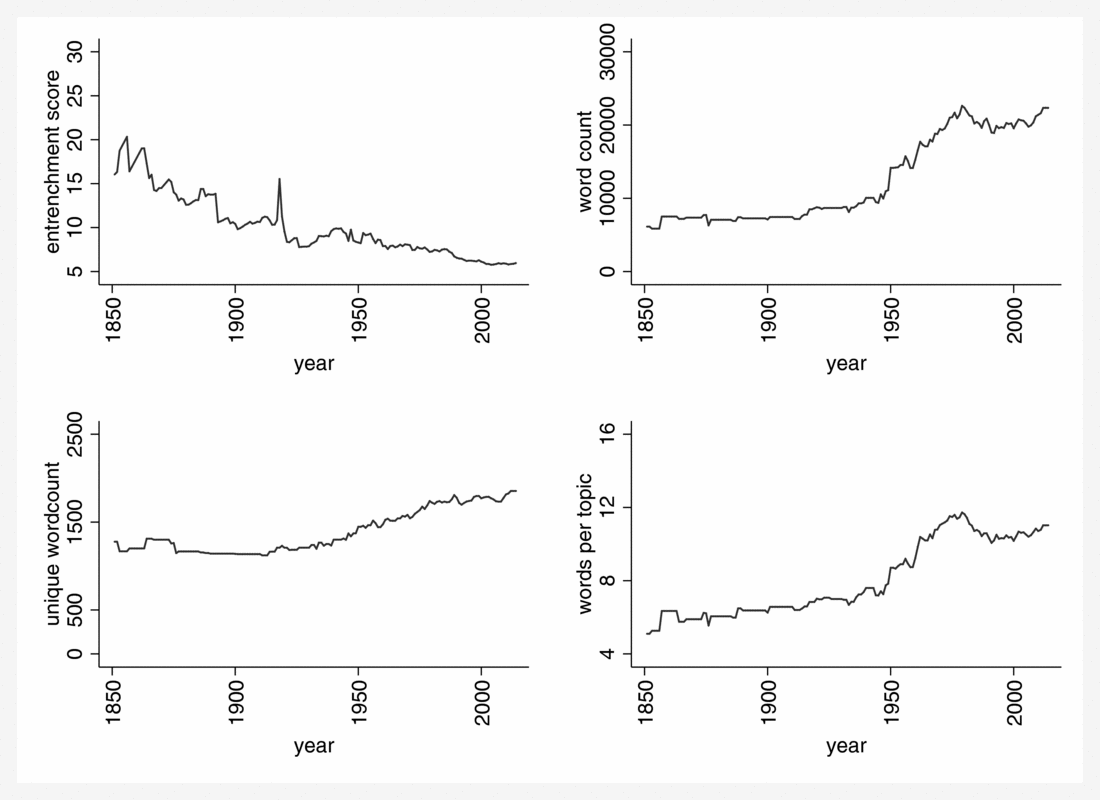
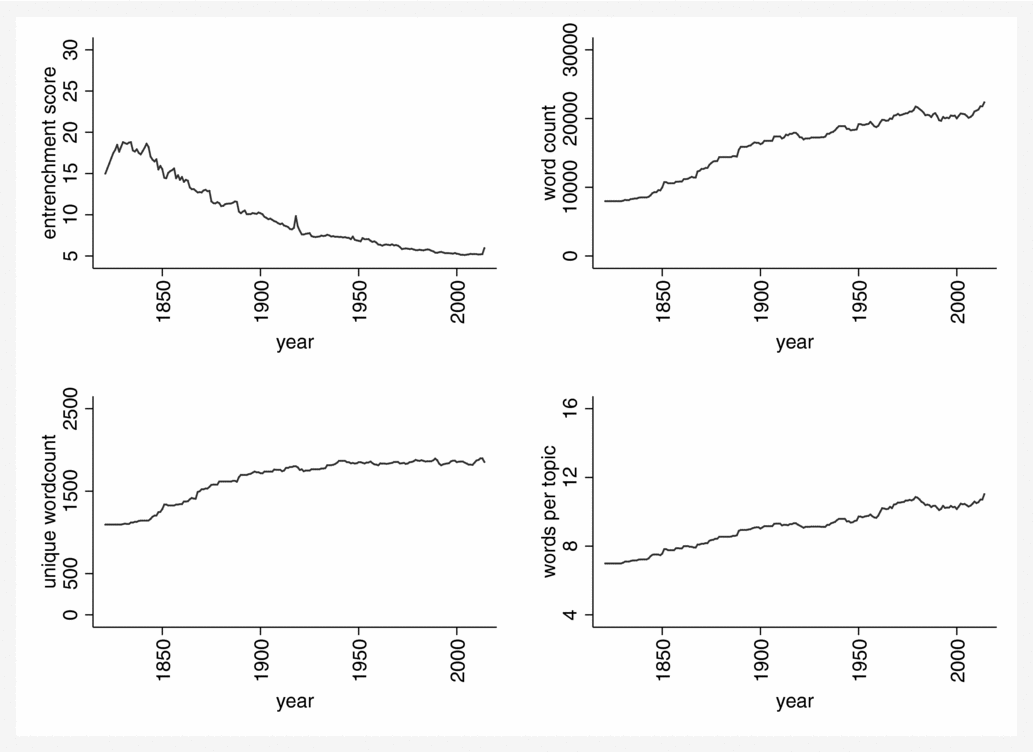
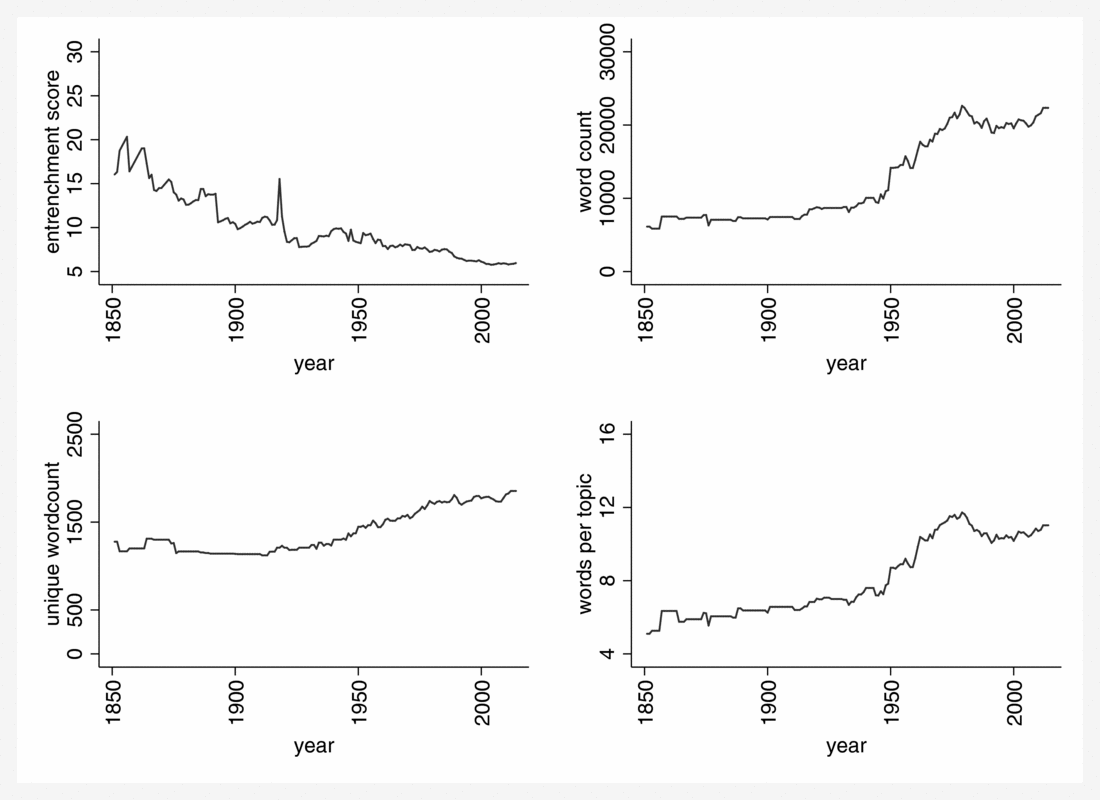
The historical data we have collected suggest that, over the past two centuries, democratic constitutions have become less entrenched, while their specificity has increased. Figure 1a shows the historical trajectory of all democratic constitutions, including both democratic national constitutions and state constitutions. Panel 1 demonstrates that constitutions of democratic polities have become less entrenched over time as witnessed by their declining entrenchment scores.Footnote 10 Panel 2 depicts the average word count of these constitutions (as measured at the time of their adoption) and reveals that democratic constitutions have grown in specificity.Footnote 11 Panel 3 depicts the growth in the scope of these constitutions as captured by their unique word count over time.Footnote 12 Panel 4 depicts their increase in their detail as captured by the number of words they spend on each topic. Overall, Figure 1a depicts a large-scale shift away from sparseness and entrenchment, towards flexibility and specificity. For comparison, Figure 1b depicts the same information for democratic countries only (excluding state constitutions) and reveals the same trends.
Democratic Countries and U.S. States

Democratic Countries Only
Current Constitutions
A systematic comparison of the flexibility and specificity of democratic constitutions in force today reflects a remarkable gap between constitutional theory and practice. Although most accounts of constitutional governance suggest that written constitutions are defined in large part by their stability, the average entrenchment score across all democratic polities is 5.3, which means that the average democratic polity revises its constitution (through either amendment or replacement) roughly every 5 years. India, Georgia (the country), Louisiana, Austria, New Zealand, Germany, Malawi, Texas, and Mexico have revised their constitutional documents the most frequently at least every two years on average. For comparison, the U.S. Constitution has an entrenchment score of 13.3, having been revised on only 16 occasions over the course of its 226-year history. Along with Japan, Denmark, Paraguay, and Vermont it is the most entrenched democratic constitution in the world. For most democracies, however, frequent textual change is part and parcel of ordinary constitutional politics.
Not only are most democratic constitutions not particularly well entrenched, they are not particularly spare either. Instead of limiting themselves to the broad outlines of government's structures and citizens’ rights, they contain highly specific provisions on a wide range of topics. Indeed, the median state constitution is 27,647 words. National constitutions are comparably verbose. On average, the constitutions of democratic nations contain 24,559 words. By contrast, the U.S. Constitution, which is generally described as a model of spare constitutional design, contains 7,644 words, only a quarter of the length of the global average.Footnote 13 The limited scope of the U.S. Constitution is captured by the fact that it contains a mere 1,119 unique words. By contrast, the average democratic constitution today contains 2,217 unique words, while the median democratic constitution contains 2,087 unique words. The average state constitution contains 2,560 unique words. On the far end of the spectrum, Alabama's constitution contains 5,840 unique words, while Brazil's constitution includes 5,073 unique words and Missouri's contains 4,480. Notably, each of these constitutions stands out for the wide range of topics it deals with, such as Alabama's provisions on catfish, cattle, poultry, swine, sheep, and goats; Brazil's provisions on the end-of-year-bonus for rural workers; and Missouri's recent amendment on the right to farm. It is these unique topics that are presumably captured by the unique word measure. The relative lack of detail of the U.S. Constitution is captured by the fact that it contains a mere 6.8 words per topic. By contrast, the average democratic constitution spends 11.9 words on each unique topic. The most detailed constitution is that of Alabama, with 65.9 words per topic, followed by India (28.2 words), and Malaysia (21.1 words).
Constitutional specificity and flexibility appear to go hand in hand. One way to measure the degree to which specificity and flexibility are connected is to simply calculate the correlation between the number of words in the current constitution and the total number of amendments that this same document has witnessed. The correlation between these two measures is 0.535, indicating that longer constitutions have undergone more textual changes.Footnote 14
THE ORIGINS OF UNENTRENCHED CONSTITUTIONS
Our quantitative data reveal that, over the past two centuries, the form of democratic constitutions has undergone a dramatic shift. In this section, we show that, in many parts of the world, this shift arose from a deliberate choice on the part of constitution-makers to employ specificity as a means of controlling their governments. We do so by disaggregating the worldwide data, and identifying the timing of the shift in distinct groups of democratic polities: (1) the U.S. states, (2) continental Europe, and (3) Latin America. Drawing on the primary and secondary literature on constitutional developments in these regions, we show that the shift away from entrenchment coincided with pressure for increased democratization and increased resistance to judicial supremacy. We present evidence that those who wrote flexible, specific constitutions were very much concerned with solving the principal-agent problem, but were employing specificity, rather than entrenchment, as their primary instrument of constraining their governments/agents. More specific constitutions required more frequent revision, but constitutions were also rendered more malleable in the hopes that they would better serve as a vehicle for popular control of government. In each case, therefore, the increase in constitutional specificity was accompanied by an increase in flexibility, and this specific, flexible model of constitutional design was a conscious solution to the perception that democratic governments had become (or might become) unresponsive.
Our approach in this section is necessarily inductive and impressionistic. It does not purport to explain every instance of constitutional design, and since we only examine constitutional groupings that underwent this shift, we cannot test a hypothesis about its causes. Nonetheless, by identifying critical periods of constitutional change in distinct groups of constitutions, we can develop an account of how unentrenched constitutions were designed to operate.
U.S. State Constitutions
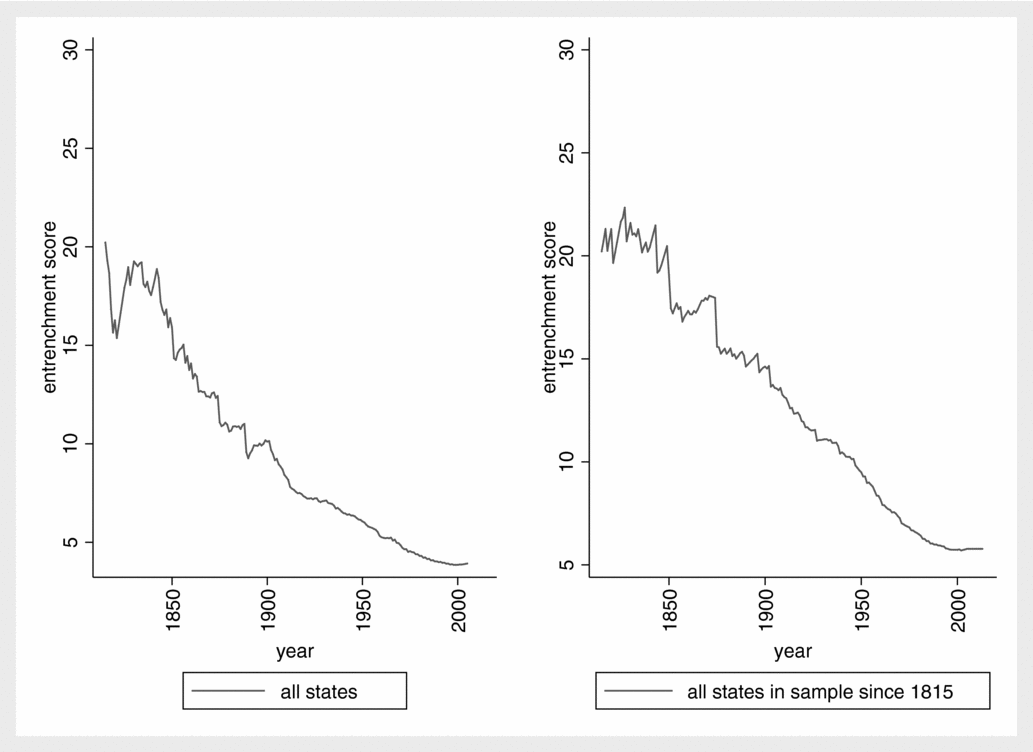
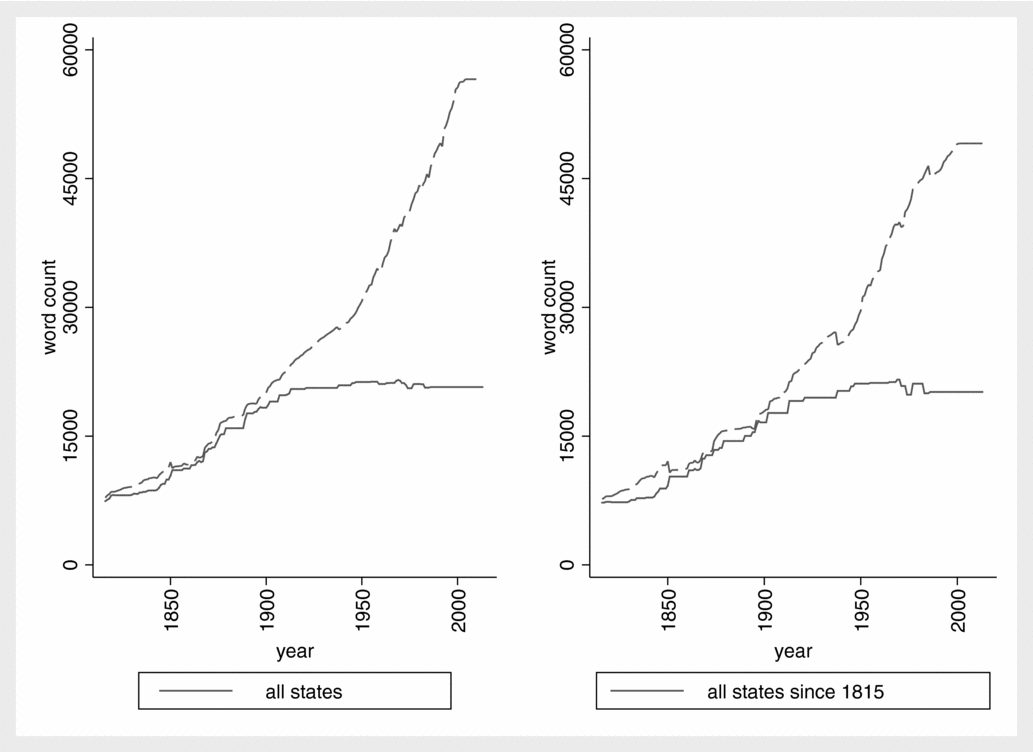
In the U.S. states, the shift away from entrenched, spare constitutions to flexible and detailed documents began in the mid-nineteenth century. Figure 2 depicts the historical development of U.S. state constitutions’ average entrenchment score, while Figure 3 depicts the average word count. The left-hand panels of both figures are based on all states for which we have data, while the right-hand panels are based on those states that have continuously been in our sample since 1815 for each of these measures. Shifts depicted in the right-hand panels do not result from new states entering the sample. Figure 3 shows that the increase in state constitutions’ flexibility first occurs in the late 1830s while the increase in specificity occurs around the same time. Our specificity data depicted by the solid lines in Figure 3 understate the growth of states constitutions, since subsequent constitutional amendments are excluded from our analysis. To give a fuller sense of the dramatic increase in specificity, the dotted lines in Figure 3 show the average word count for state constitutions when including subsequent amendments.Footnote 15
Average Entrenchment Scores of State Constitutions

Average Word Count of State Constitutions (solid lines denote constitutional texts as adopted, the dotted lines take account of subsequent amendments)

As many scholars of U.S. state constitutions have noted, detailed instructions were constitutionalized as part of a nationwide, nineteenth-century movement to enhance popular control over policymaking (Dinan Reference Dinan2006; Dinan Reference Dinan2007; Fritz Reference Fritz1994; Tarr Reference Tarr1998; Versteeg and Zackin Reference Versteeg and Zackin2014; Zackin Reference Zackin2013). Over the course of the nineteenth century, the drafters of U.S. state constitutions also adopted increasingly flexible constitutions. In part, this increased flexibility may have been necessitated by the documents’ mounting detail, but state constitutional drafters also redesigned constitutions to be more flexible so that they could better serve as vehicles of democratic control over courts and legislatures (Dinan Reference Dinan2006, 62–3; Fritz Reference Fritz1994).
The original impetus to include detailed policy instructions in state constitutions is often traced to the economic crisis of 1839, which revealed the fiscal blunders that many state legislatures had made, and motivated a wave of constitutional change designed to prevent legislatures from repeating these mistakes (Tarr Reference Tarr1998, 112). Earlier in the decade, state legislatures had invested heavily in the canals, railroads, and banks, and had financed these investments not through taxation, but through indebtedness. When the economic boom of the 1830s ended with an equally dramatic bust, these schemes proved disastrous. Many heavily indebted states were forced to default on their interest payments, while others only narrowly avoided default. These crises triggered widespread calls to ensure that legislatures would be barred from this type of boom-time policymaking. Between 1842 and 1852, 10 of the 11 states that held constitutional conventions wrote procedural restrictions on the way that states could issue debt directly into their constitutions (Wallis Reference Wallis2005, 219).
Throughout the second half of the nineteenth century and into the twentieth, agrarian reformers and advocates of organized labor pursued constitutional specificity for a similar purpose: to preempt particular policy choices and to force state governments into enacting new slates of popular policies. Agrarian populists, for instance, used constitutions to establish state oversight and regulation of railroad operations, increasing the scope of these documents (Buck Reference Buck1913, 195–8). In many states, labor unions employed a similar strategy, pursuing the insertion of specific labor regulations directly into constitutional documents (Zackin Reference Zackin2013, 106–45). In its endorsement of a constitutional provision establishing an eight-hour workday, for instance, the Montana Labor News explained that the state had already regulated the working hours in a number of industries, but that to ensure democratic control over these policies, it was also necessary to add an eight-hour provision to the state constitution: “[a]ll of these 8-hour laws may be destroyed by the corporations unless you pass this 8-hour amendment. Usually, the courts function in the interests of the corporations; so does the legislature.”Footnote 16 This embrace of constitutional specificity reflected the recognition that judges and legislatures can exert enormous influence over public policy and that highly specific constitutions can curtail the discretion of these agents.
As the twentieth century dawned, it became increasingly apparent that judges were not neutral monitors, overseeing government officials on behalf of the people, but were themselves consequential policymakers. Progressive reformers realized that specific constitutional provisions could check judicial power over the policymaking process by explicitly identifying particular policies as constitutionally permissible. This insight generated a wave of court-constraining constitutional provisions, designed to prevent state courts from invalidating legislation on subjects related to maximum working hours, minimum wages, collective bargaining, workers’ compensation, and other social welfare programs (Dinan Reference Dinan2007).
Contemporaneous observers described enhanced constitutional detail a reflection of drafters’ desires to exert control over those who would later interpret and apply their constitutions. An 1892 article in the Harvard Law Review described newly written state constitutions as products of the pervasive belief that “the agents of the people, whether legislative, executive, or judicial, are not to be trusted; so that it is necessary to enter into the most minute particulars as to what they shall not do” (Eaton Reference Eaton1892, 121). Critics of this new form of constitutionalism recognized that greater specificity reflected a distrust of office holders, and admonished constitutional drafters to avoid constitutionalizing detailed policies. One famous jurist, for instance, addressed North Dakota's constitutional convention with this advice: “[d]on't in your Constitution-making legislate too much. . . . You have got to trust somebody in the future and it is right and proper that each department of government should be trusted to perform its legitimate function” (cited in Leahy Reference Leahy and Dakota2003). As we have seen, however, these calls to preserve spare constitutional documents went largely unheeded.
Successive waves of constitutional drafters not only embraced specificity, but also sought to make state constitutions increasingly flexible so that they could better respond to majoritarian pressure. Since the founding era, some of the state constitutions had provided for periodic referenda to determine whether the state should call for a new constitutional convention to replace the existing constitution (Dinan Reference Dinan2006, 45–6). Throughout the nineteenth century, constitutional drafters further liberalized the amendment procedures in their constitutions, arguing that rigorous amendment procedures were antidemocratic. Some states eliminated the requirement that amendments be passed by successive sessions of state legislatures while others dispensed with the need for a supermajority of the legislature to pass a constitutional amendment. By the end of the twentieth century, four states had even abandoned both restrictions on amendments (Dinan Reference Dinan2006, 41–5). The beginning of the twentieth century witnessed yet further unentrenchment of state constitutions, with the addition of amendment procedures that allowed electoral majorities to amend constitutions through the initiative and referendum. This increase in flexibility was also understood as a way to render these constitutions more responsive to democratic demands and changing economic conditions (Dinan Reference Dinan2006, 63). One champion of the initiative and referendum explained “The initiative and referendum puts the absolute control of affairs into the hands of the people and keeps it there.”Footnote 17 In fact, like constitutional specificity, demands for amendment through initiative and referendum were, in part, reactions to unpopular judicial rulings. Thus, these proposals to adopt the initiative and referendum were often coupled with appeals to equip electoral majorities with the power of direct judicial recall. The debates that ensued reveal that the framers of state constitutions over the course of the nineteenth and early twentieth centuries consciously rejected the model of entrenched, spare constitutional documents in their attempts to secure enhanced popular control over policy (Dinan Reference Dinan2006, 62–3; Fritz Reference Fritz1994).
Continental Europe
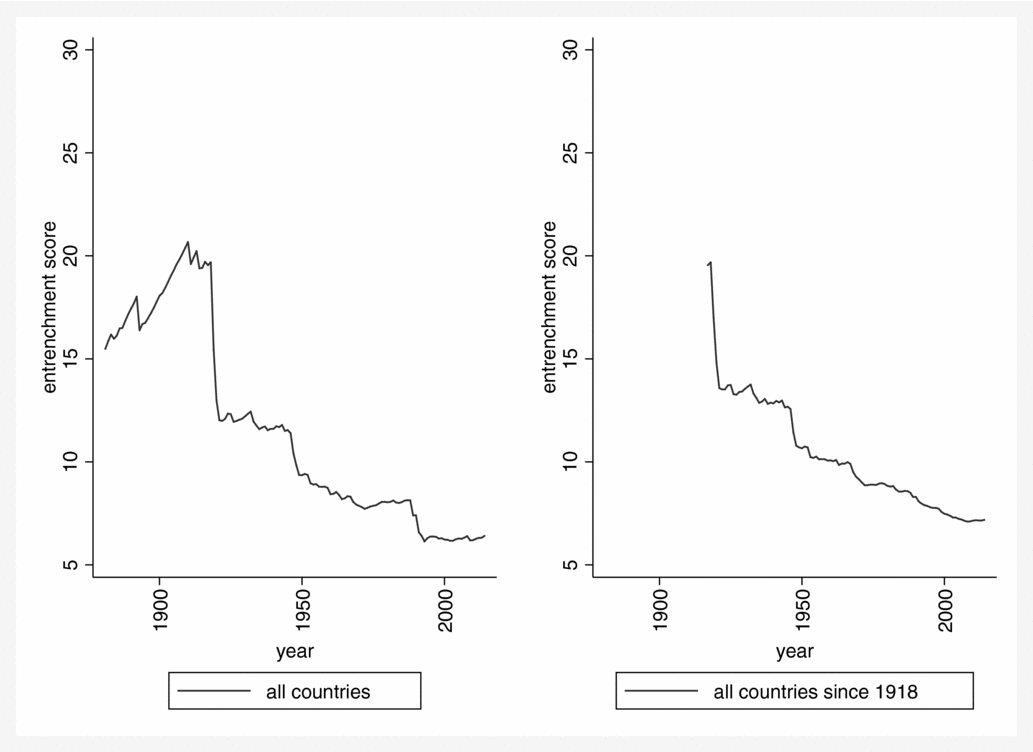
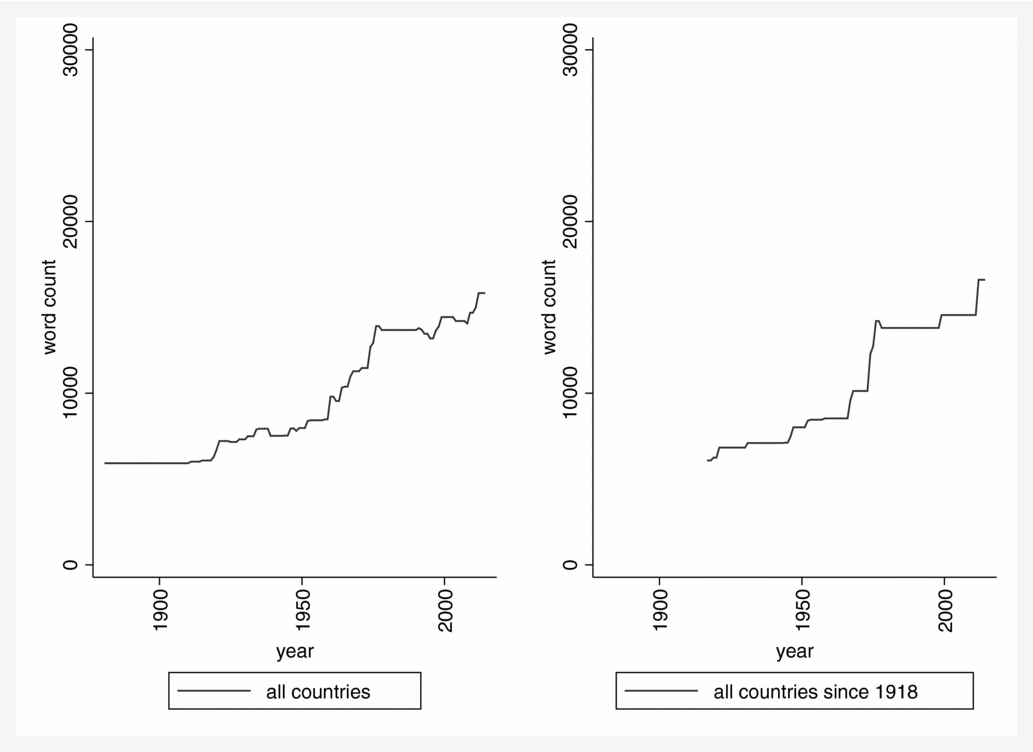
The constitutions of continental Europe have also grown longer and more flexible over time.Footnote 18 Figure 4 depicts the historical development of the entrenchment scores, while Figure 5 depicts the average specificity, as captured by the total word count at the time of adoption. The left-hand panels of both figures are based on all countries for which we have data, while the right-hand panels are based on those countries that have continuously been in our sample since 1918.Footnote 19 Figure 4 shows that the unentrenchment of continental European constitutions began in the 1920s. Figure 5 shows that their increase in specificity also began at the same time, and underwent a more dramatic increase around 1960.
Average Entrenchment Scores of Continental European Constitutions

Average Word Count of Continental European Constitutions

Although relatively elite political actors drafted most European constitutions, their shift from entrenched and spare to specific and flexible documents still seems to have been motivated (at least in part) by a desire to render government more responsive and accountable to democratizing forces. After World War I, ruling European elites extended the franchise to all citizens when the working classes, who had paid the heaviest price for the war, demanded political recognition (Lesaffer Reference Lesaffer and Arriens2009, 495). Constitutional changes were often required simply to expand suffrage, accounting in part for a decrease in constitutional entrenchment. However, in an effort to assure people that they would be able to exert more direct control over government, constitutional drafters also added many detailed policy provisions addressing working class demands. Against the backdrop of the Bolshevik Revolution of 1917, many ruling elites wrote new constitutions and/or new constitutional provisions that addressed working class demands for enhanced control over government and for particular welfare-oriented policies. Perhaps most famous are the socioeconomic policies enshrined in the Weimar constitution of 1919. Yet, between 1914 and 1933, 11 other European countries also adopted constitutional education rights, social welfare policies, and/or workers’ rights.
This dynamic rendered many European constitutions less entrenched. The author of one 1922 study of newly drafted (central) European constitutions argued that class-based movements had rendered European constitutions more flexible, explaining that the new documents were “sufficiently elastic to enable revolutions to be met half way” (McBain Reference McBain and Rogers1922, 157). He went on to note that these documents were not only malleable enough to accommodate working-class demands, but also highly specific. “All of the new constitutions are, of course, definite written documents. Some lacunae are apparent and some obscurities will doubtless cause difficulty, but the attempt has been made to meet all probable contingencies” (McBain Reference McBain and Rogers1922, 155). In the same year, another political scientist, studying the constitutions of Poland, Czechoslovakia, and the Kingdom of the Serbs, Croates, and Slovenes, observed that in these new constiutitons, “provision is made for many of the conventional or statutory practices, methods and principles by means of which the older nations have sought to adapt their governments to the ever-changing needs of modern life” (Ralston Reference Ralston1922, 227). Thus, even before WWII, European constitutions had begun to include “statutory practices” that recognized the “ever-changing needs” of industrial societies. Popular pressure (coupled with elite fears of Bolshevism) resulted in more specific and flexible constitutions.
Europe's detailed constitutions were not only designed to control legislatures, but also to subject courts to popular control. Even as they endowed courts with the power to nullify legislation, Europe's constitutional drafters quite clearly sought to cabin the policymaking potential of these new institutions (Fehrejohn Reference Ferejohn2002, 58; Sweet Reference Sweet2003). Rather than asking judges to interpret ambiguous statements of broad principles the European approach to judicial review has been to increase the specificity of their constitutional texts.
The Austrian Constitution of 1920 exemplifies this use of specificity to curtail judicial discretion. The document is not only very detailed, but also very flexible. The legal philosopher Hans Kelsen is generally recognized as the principal architect of the document, and we can consult Kelsen's own writings to investigate the logic of his design choices. The document established a specialized constitutional court with the power of judicial review, but the design of Kelsen's constitution was informed by the observation that constitutional adjudication is inherently political in nature. In annulling unconstitutional statutes, Kelsen believed that the Court would become a kind of “negative legislature” (Kelsen Reference Kelsen and Vinx1929, 1506), one that, like the positive legislature, would require firm checks on its authority. He therefore designed the court as a separate body, distinct from the ordinary judiciary, whose members had to be elected in a manner that takes account of the court's political nature (Kelsen Reference Kelsen and Vinx1929, 1508). In addition, Kelsen employed constitutional specificity to curb judicial discretion. He noted that:
the norms to be applied by a constitutional court, especially those which determine the content of future statutes, like the provisions concerning the basic rights, must not be formulated too broadly and must not operate with vague slogans like ‘freedom,’ ‘equality,’ and ‘justice,’ and so forth. Otherwise there is a danger of a politically highly inappropriate shift in power, not intended by the constitution, from the parliament to some other institution external to it. . . (Kelsen Reference Kelsen and Vinx1931, 1550).
Indeed, the document that Kelsen drafted for Austria was notably “clear in language” (Stelzer Reference Stelzer2011, 17, 21), and includes “provisions that in many other countries would not considered to be constitutional laws” (Stelzer Reference Stelzer2011, 22).
Although the intellectual movement to create constitutional courts empowered to nullify legislation emerged in Europe in the 1920s (Shwartz Reference Schwartz, Schedler, Diamond and Plattner1999), judicial review only became a widespread constitutional feature in Europe in the 1960s. As Figure 5 demonstrates, continental European constitutions underwent a strong increase in detail during this exact period. Thus, while the first wave of increased flexibility and specificity in Europe might have been directed at legislatures, the increase in the wake of World War II was likely directed at least in part towards Europe's new constitutional courts.
Europe witnessed another wave of national constitution making in the 1990s as the countries of Central and Eastern Europe transitioned to democracy. These countries also drafted highly specific constitutional documents, replete with substantive policy commitments. Unlike the postwar constitutions of Western Europe, this detail does not seem to have been targeted at constraining courts, but like the constitutional detail of the early twentieth century, at controlling legislatures. As Kim Scheppele has explained, in countries with a history of democratic-looking procedures, but authoritarian governments, constitutional drafters sought to secure their countries’ democratic futures not through procedural frameworks, but through substantive constitutional guarantees: “These new constitutions provide[d] answers to questions that are in older constitutional democracies given by legislation. . . Thick [or detailed] constitutions take a great many policy choices out of the hands of the remodeled political institutions, and lodge them instead in a higher law” (Scheppele Reference Scheppele, Czarnota, Krygier and Sadurski2006, 38). Constitutions in this region, therefore, continued the European trend of drafting highly specific constitutional documents. Indeed, if we compare the length of the former Soviet Republic's 1989 constitution to that of the Russian constitution as of 2013, we see that it increased from 8,734 to 11,138 words.
Latin America
Like in the U.S. states and Europe, Latin America's constitutional development reflects the region's particular political history. Most Latin American countries became stable democracies only in the 1980s. Under shifting authoritarian governments, Latin American constitutions were replaced frequently, often to mark changes in political leadership (Negretto Reference Negretto2014, 9). Thus, throughout much of the nineteenth and twentieth centuries, the flexibility of Latin American constitutions reflected the existence of political instability, rather than direct democracy. Nonetheless, we believe that several shifts away from entrenchment and toward specificity in Latin American constitutions were, at least partially, responses to democratic pressure for increased control over policymaking.
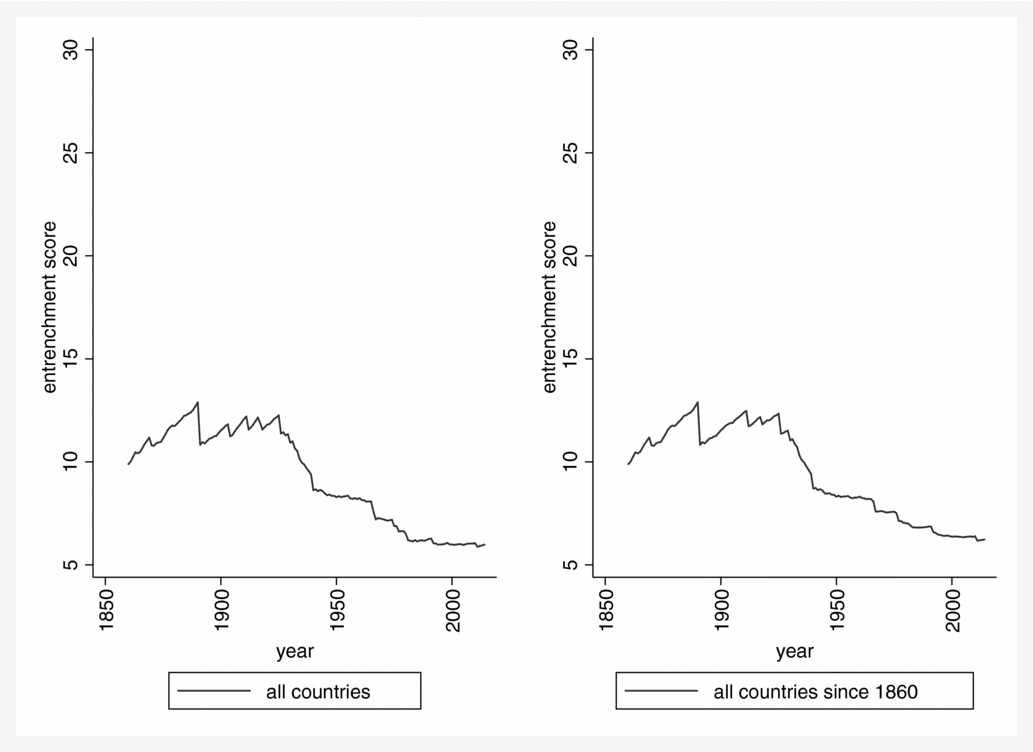
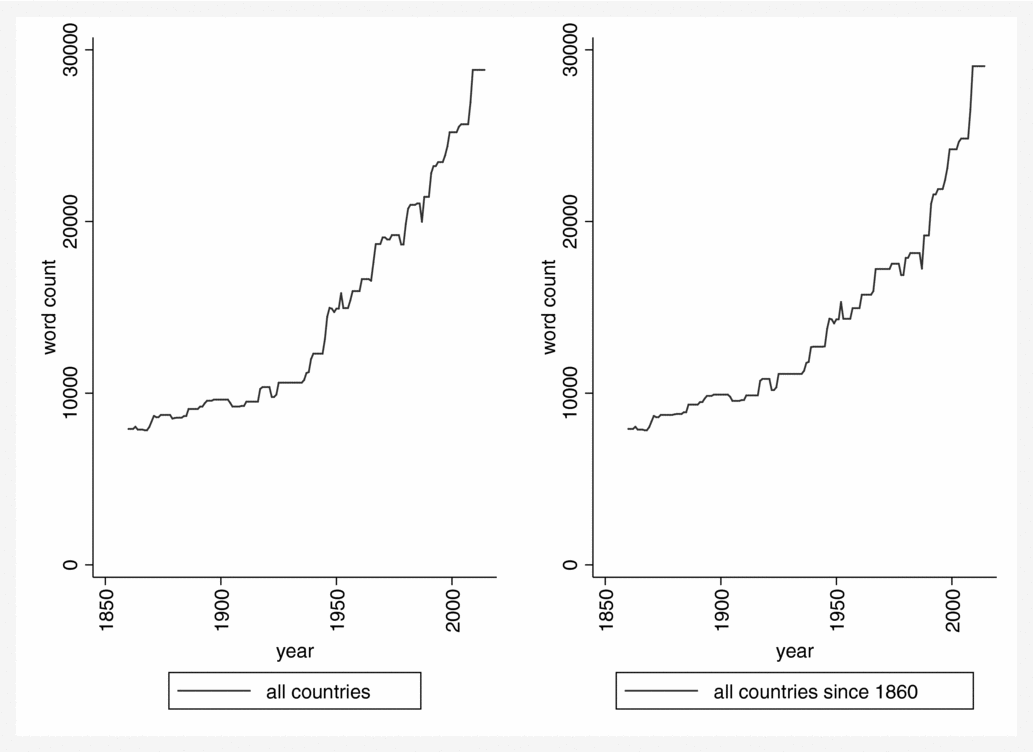
Figure 6 depicts the historical development of the entrenchment scores; Figure 7 depicts the historical development of the specificity of Latin America's constitutions. The left-hand panels are again based on all countries for which we have data, while the right-hand panels are based on a stable sample of all countries for which we have had data since 1860. Figure 6 shows that entrenchment scores have always been lower in Latin America than in Europe or the U.S. states, which presumably reflects the authoritarian instability. However, Figures 6 and 7 depict a marked decrease in entrenchment scores and an increase in specificity in the 1930s. They also reveal a further increase in flexibility and specificity in the 1980s.
Average Entrenchment Scores of Latin American Constitutions

Average Word Counts of Latin American Constitutions

The first shift away from entrenchment was, at least in part, a response to popular demands. The early twentieth century witnessed a wave of radicalism and pressure for democratization (Gargarella Reference Gargarella2013, 91–102). These movements were reflected in the addition of elaborate social policies to Latin American constitutions (Gargarella Reference Gargarella2013, 106). Mexico's constitution of 1917 illustrates this dynamic. A product of the Mexican Revolution, this document included specific protections for laborers, including maximum working hours, minimum wages, and the right to strike. It also mandated agrarian/land reform specifying that “necessary measures shall be taken to divide up large, landed estates,” and explicitly subordinated private property rights to the public interest. The advocates of these specific provisions insisted that those who would later implement the constitution could not be trusted to legislate on behalf of laborers. One delegate to the constitutional convention explained, “I think our Magna Carta ought to be more explicit on this point. . .who will guarantee us that the new Congress will be composed of revolutionaries? Who will guarantee us that. . .the government. . .will not tend toward conservatism?” (quoted in Niemeyer Reference Niemeyer1974, 108).
Beginning with Mexico, Latin American countries began to include a range of socioeconomic rights in their constitutions. By 1945, one political scientist noted that “virtually statutory detail concerning all aspects of labor regulation, prohibition of monopolies, restriction of the competition of foreign labor, social security, and provision for the educational advancement of the working classes are typical of the bold imagination shown by Latin American Constitution-makers. . .in the past quarter-century” (Fitzgibbon Reference Fitzgibbon1945). By 1950, no less than 15 countries in the region had reformed their constitutions to add such policies. Despite the democratic pressures that led to these provisions, Latin American governments were typically characterized by long periods of authoritarian rule throughout much of the century that followed.
When many Latin American countries transitioned to democracy in the 1980s, they ratified new, and even more detailed, constitutions. Many of the changes during this period, particularly in Andean countries, involved the creation of “more inclusive rules for electing presidents and legislatures” (Lalander Reference Lalander, Nolte and Schilling-Vacaflor2012; Negretto Reference Negretto2014, 2). The constitutions of Bolivia and Ecuador, for instance, contain provisions devoted to “popular participation/transparency” and “social control” of the government (Lalander Reference Lalander, Nolte and Schilling-Vacaflor2012, 188). During the 1980s and 1990s, and in the face of sweeping neoliberal economic reforms and in the wake of human rights atrocities, many Latin American constitutions also included enhanced slates of rights (Gargarella Reference Gargarella2013, 151; Rodríguez-Garavito Reference Rodríguez-Garavito2011, Sikkink Reference Sikkink2011).
This increase in constitutional specificity necessitated decreased entrenchment. For instance, Arantes and Couto (Reference Arantes, Couto, Nolte and Schilling-Vacaflor2012) argue that the many explicit policies in the Brazilian constitution forced the legislature to pursue constitutional amendments as part of the legislative process. They note that “the more a constitution embodies public policies, the longer the text is; the longer the text is, the more it forces governments to govern by means of constitutional amendments and the more a constitution is amended, the longer it becomes which tends to trigger the same cycle all over again” (Arantes and Couto Reference Arantes, Couto, Nolte and Schilling-Vacaflor2012, 214).
Finally, the policymaking power of increasingly independent constitutional courts may also account for the increase in the specificity and flexibility of Latin American constitutions. As countries transitioned to democracy, international financial institutions promoted the creation of independent judiciaries, capable of protecting private property rights, and many features of Latin American politics have now been “judicialized” (Angell, Schjolden, and Sieder Reference Angell, Schjolden and Sieder2005, 1). As courts have expanded their influence over policymaking, legislatures have sometimes responded by “implement[ing] formal constitutional changes precisely to confirm or reject judicial rulings” (Negretto Reference Negretto2014, 6). For example, several twenty-first century amendments to the Columbian constitution, addressing policies like the criminalization of drug possession and the mechanics of the civil service system, were designed to overturn the high court's interpretation of the constitution (Dixon and Landau Reference Dixon, Landau, Ginsburg and Huq2015, 16–7). In fact, since 1991, every presidential administration has proposed amending the constitution in response to a judicial ruling (Rodríguez-Raga Reference Rodríguez-Raga, Helmke and Ríos-Figueroa2011, 85).
It is possible to understand this legislative override of judicial decisions as the democratic exercise of the popular will over an elite and unrepresentative court. However, the normative significance of such court-constraining amendments is open to debate (Dixon and Landau Reference Dixon, Landau, Ginsburg and Huq2015, 1–5; Gloppen, Gargarella, and Skaar Reference Gloppen, Gargarella and Skaar2004). As in the post-Soviet transitions from autocracy to democracy, many constitution-makers viewed independent judiciaries as watchdogs, who could help to maintain fragile new democracies by checking the other branches of government (Issacharoff Reference Issacharoff2015). Read in this light, constitutional amendments aimed at constraining the power of Latin America courts may appear less like popular constitutional interpretations and more like retaliation by legislative and executive branches chafing at their constitutional restraints (Kapizweski and Taylor Reference Kapiszewski and Taylor2013, 807–8).
CONCLUSION
We have argued here that the familiar model of constitutions as highly entrenched and spare documents captures neither the form nor function of many present-day democratic constitutions. Our goal in this article is to begin to close the gap between so much of existing constitutional theory and today's actual constitutional practices. The clearest implication of our findings is that constitutional scholars should no longer define constitutional success in terms of the stability (or majesty) of a single constitutional text. Instead, we argue that these features address some of the hazards associated with democratic constitutionalism, but create others.
Ultimately, all constitutional drafters face the paradox that majority rule both defines and threatens democracy. Entrenched constitutional texts may be robust to attempts to undermine constitutional constraints through formal revision, but such documents often allow for markedly antidemocratic governance. Specific constitutions grew out of a desire for tighter democratic control over policymaking, but as a result, they are likely to be far worse at hindering officeholders or tyrannical majorities who attempt to revise them. It is perhaps fortunate, therefore, that the actual practice of constitutional drafting does not require a dichotomous choice between the two models we have described. In fact, many national constitution-makers have inserted eternity clauses, declaring certain basic constitutional principles unamendable, while leaving the rest of the constitution more flexible. By some estimates, forty percent of existing national constitutions employ this strategy (Roznai Reference Roznai2013). Others have adopted tiered amendment procedures, rendering some provisions subject to higher amendment thresholds than others (Dixon and Landau, Reference Dixon, Landau, Ginsburg and Huq2016, 1). These hybrid designs may enable democratic majorities to exert enhanced control over some areas of policymaking, while also allowing constitutions (and judiciaries) to protect fundamental rights from majority factions.
Further research is necessary to determine whether features like eternity clauses and tiered amendment procedures stemmed from drafters’ conscious attempts to overcome the problems associated with each model of constitutionalism. More generally, constitutional scholars may want to investigate the conditions under which popular distrust in government actually results in increasingly specific constitutions. Future studies might ask, for example, whether fear of a powerful judiciary is largely responsible for the global shift away from entrenched documents, or how frequently these shifts are associated with democratization or with movements’ demands for increased provision of public goods. Constitutional scholars might also seek to identify other factors that cause a polity to embrace specificity. For instance, one might test the hypothesis that homogenous communities are more likely than divided societies to adopt specific constitutions (Lerner Reference Lerner2011), or inquire about the influence of supranational structures on the entrenchment of constitutional documents (Ginsburg and Posner Reference Ginsburg and Posner2010).
Finally, our inquiry into the design logic of specific and flexible constitutions has normative implications for the process of constitutional drafting. We have focused exclusively on the origins and logic of unentrenched constitutions. Consequently, this research does not allow us to evaluate the postadoption effects of this design. However, our analysis does suggest that, since unentrenched constitutions are intended to promote tighter control of the citizenry over the policymaking process, it is particularly important to attend to the processes through which these constitutions are written and revised. It is certainly far from straightforward to locate a “people” or identify its “will.” However, if unentrenched constitutions are to promote democratic control over officeholders through frequently updated, specific instructions, then these instructions must issue from recognizably democratic sources. The drafting and revision procedures for unentrenched constitutions should, therefore, be rendered as inclusive and representative as possible. Indeed, recent scholarship suggests that a higher degree of citizen participation in constitutional drafting might produce more inclusive constitutional documents (Ginsburg et al. Reference Ginsburg2009), and does correlate with higher measures of democracy after a constitution's adoption (Eisenstadt et al. Reference Eisenstadt2015). We have been living in a brave new world of un-entrenched constitutions for quite some time. To ask meaningful and relevant questions about it, constitutional theory must fully register this transformation.



Comments
No Comments have been published for this article.