I. INTRODUCTION
7xxx series alloys have been extensively used in automobile and aerospace structures along with many other high strength structural components due to their excellent mechanical properties, high thermal and electrical conductivity, and superior resistance to corrosion. Reference Zhao, Liao and Zhu1–Reference Liu, Peng, Wang, Wang and Li7 A lot of research activities has been paid for obtaining the combination of high strength and stress corrosion cracking (SCC) resistance, since the beginning of the use of the high strength 7075 aluminum alloy for aerospace applications. Reference Liu, Jiang, Li, Yang and Hu8–Reference Li, Li, He, Xue, Zhang and Wang11 Single-aging(T6 temper) has been developed to obtain highest strength, while stress corrosion resistance is very low and susceptibility to stress-corrosion cracking and exfoliation corrosion is quite high. To improve stress corrosion resistance, the two-step aging (T76/T74/T73 temper) has been developed. However, the consideration of two-step aging is at the expense of strength. The main differences between the T6 and T7 tempers are related to the precipitates distribution and dislocation density. Reference Oliveira, Barros, Cardoso and Travessa12–Reference Cina and Talianke15 For the purpose of achieving a better combination of high strength and stress corrosion resistance, triple-stage aging (T77 temper) has been developed. The triple-stage aging is called RRA. Retrogression and re-aging (RRA), developed by Cina and his colleagues in 1974, is an attempt to improve SCC resistance with high levels of both strength. That means 7xxx aluminum alloys treated through RRA have high corrosion resistance equivalent to the T73 temper, together with the T6 strength levels.
This so-called RRA treatment involves taking the 7000 series aluminum alloy in the T6 temper, retrogressing it by heating it to an intermediate temperature between the aging temperature and the solutioning temperature for a short time, quenching and then re-aging the alloy at a low temperature similar to the T6 aging temperature and time. Researchers are still divided so as to the reactions occurring during RRA and the mechanism of improvement of SCC resistance. Reference Wu, Raizenne, Chen, Poon and Wallace16–Reference Xu, Birbilis and Rometsch26 The key characteristic of RRA is retrogression. During retrogression the T6 material's hardness/strength exhibit a fall to a minimum following by a increasing again to a secondary peak, while a further decrease in strength results from continued treatment. Reference Wu, Raizenne, Chen, Poon and Wallace16 During retrogression step the initially present fine and dispersion Guinier-Preston(GP) zones and/or η′ precipitates dissolved followed by coarsening of η′ and η precipitates or transformation to η phase. Previous investigations showed that the improvement of corrosion properties obtained by RRA process is associated with four reasons, such as coarsening of grain boundary precipitates, the copper enrichment of grain boundary precipitates, precipitate free zones (PFZ) adjacent to the grain boundaries, and lower dislocation density.
The differences among researchers' explanation on microstructure evolution during retrogression step are under the control of pre-ageing temper and retrogression temperature. Several investigations carried out on the effects of pre-ageing temperature and retrogression heating rate on the strength and corrosion behavior showed that RRA-treated samples, with an intermediate pre-ageing temperature and a slow retrogression heating rate, can be tailored toward a good combination of both corrosion resistance and strength. Reference Xu, Birbilis and Rometsch26,Reference Feng, Zhang, Liu, Wang, Wu and Guo27 However, the effect of pre-ageing on the revolution of microstructure and performances during RRA is still insufficient. Considering the differences of precipitate microstructures in pre-ageing stage influencing the precipitation behavior during RRA, the control of pre-ageing temper is clearly important.
In the present study, the effect of pre-ageing temperature and time on the mechanical property and electrical conductivity of the RRA treated 7050 has been investigated more systematically. The aim is to report suitable RRA processing parameters for a good combination of strength and corrosion resistance.
II. EXPERIMENTAL DETAILS
A. Material and treatment
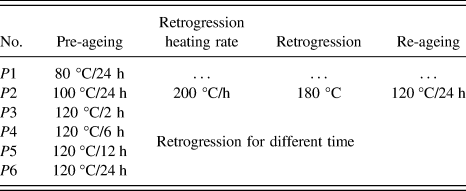
The material used in this study was rolled 7050 45 mm thick plate (5.85 Zn, 2.28 Mg, 2.13 Cu, 0.094 Zr, 0.055 Fe, 0.019 Mn, 0.041 Si and balance Al, in wt%), provided by Northeast Light Alloy Co., Ltd. (Harbin, China). Samples of 15 × 15 × 5 mm3 were cut from the long transverse direction-rolling direction plane of the plate for hardness and electrical conductivity tests. To get various pre-aged microstructures, different pre-ageing temperatures and 120 °C pre-ageing different times were chosen. The samples were solution treated at 475 °C for 2 h and quenched in cold water and then RRA treated with different pre-ageing tempers, as listed in Table I.
Pre-ageing tempers and retrogression used for differently RRA-treated 7050 samples.

B. Microstructural analysis
The microstructures of the samples were examined using a Quanta-200 scanning electron microscope (FEI Corporation, Hillsboro, Oregon) and a transmission electron microscope (TEM), TECNAIG2 20 (FEI Corporation, Hillsboro, Oregon), operated at 200 kV. The TEM specimens were prepared by cutting a small piece from the samples, mechanically grinding to about 40 μm thickness and then electropolished. Differential scanning calorimetry (DSC) was carried on different samples using a DSC Q2000 V24.9 Build 121 instrument (TA Instruments, Shanghai, China). Samples for DSC analysis were punched into small discs with thickness of 1 mm and a diameter of 4 mm. The quality of the Specimens was smaller than 30 mg. Specimens were submitted to DSC under a Nitrogen atmosphere with scanning rates of 5 °C/min, 10 °C/min, and 20 °C/min.
C. Property tests
The electrical conductivity of the samples was measured using a SIGMATESTD 2.068 instrument (Beijing, China). To ensure the reliability of the data, at least three measurements were conducted for each sample. Hardness measurements were performed using a 220HBS-3000 hardness tester (Shenzhen Graigar Technology Co., Changzhou, China) with the load of 294N. At least 5 hardness measurements were done on each sample and then averaged. Mechanical properties test was performed on RRA treated specimens by an Instron5500 testing machine (Norwood, Massachusetts) at room temperature.
III. RESULTS AND DISCUSSION
A. Microstructure of as-quenched alloy
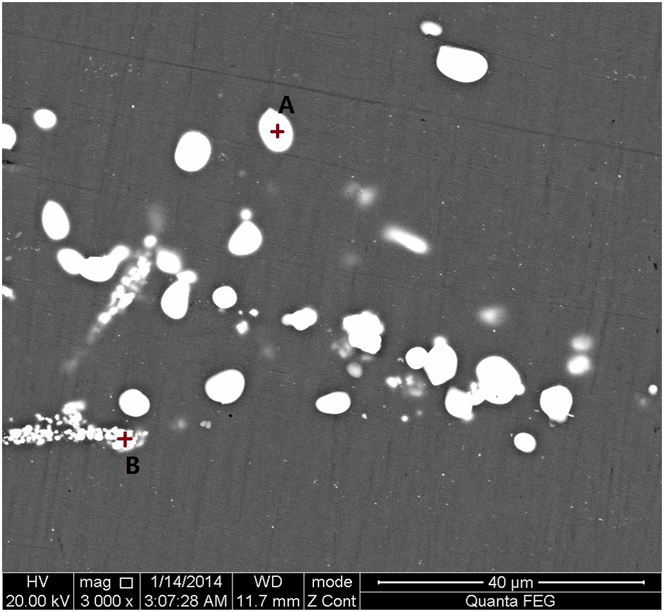
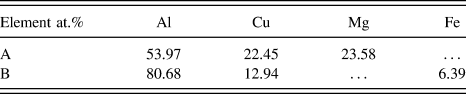
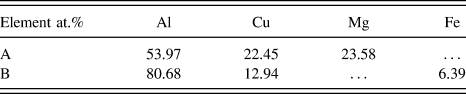
The typical coarse microstructure of the as-quenched 7050 sample is shown in Fig. 1. We can observe two remarkable different types of constituent particles of <1 μm in size exist in the matrix. On the basis of their color and shape (Fig. 1), these particles are respectively labeled as like-round constituents and elongated-broken constituents. Compositions of these constituent particles were analyzed by energy dispersive spectrometer (EDS) in Table II: The like-round particles are Al2CuMg and elongated and broken ones are Al7Cu2Fe particles, respectively. Generally, the residual coarse intermetallic particles of Fe-rich or Cu-rich phases with size larger than 1 μm are generally harmful to the properties, such as the strength, toughness, and fatigue performances. The coarse second phase particles, termed as constituents in aluminum alloys, are the main reason for the low fracture resistance, given that the constituents are usually the void/crack initiators or preferential crack paths.
Typical backscattered electron image of the as-quenched 7050 material.
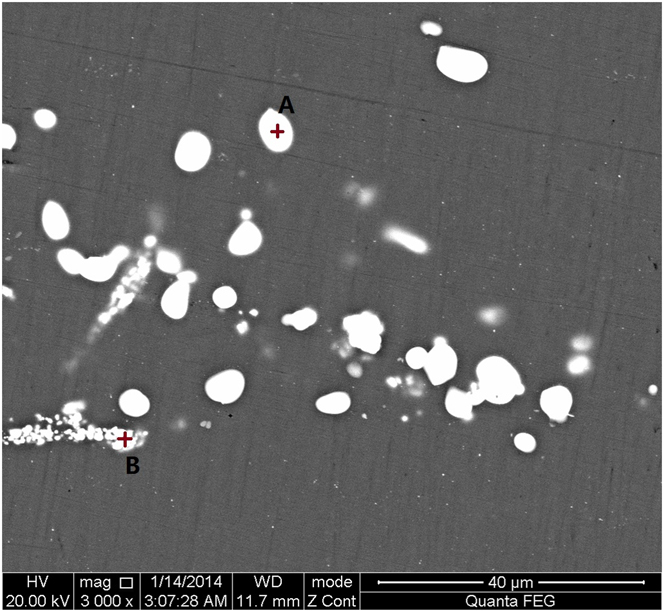
Quantitative EDS results of selected constituent particles highlighted in Fig. 1.
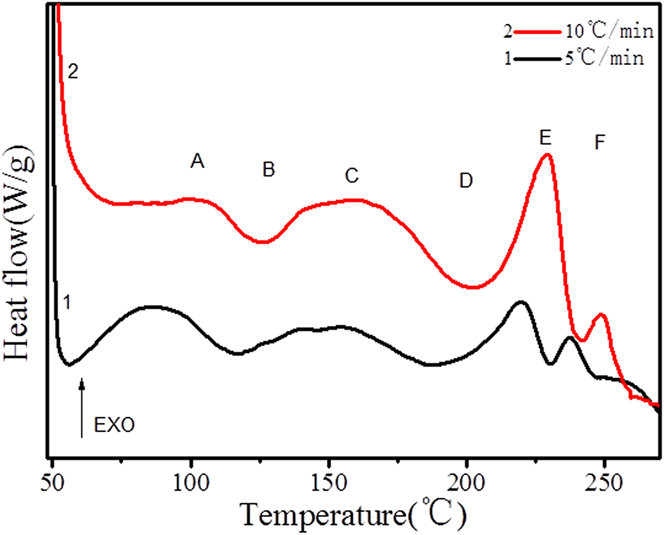
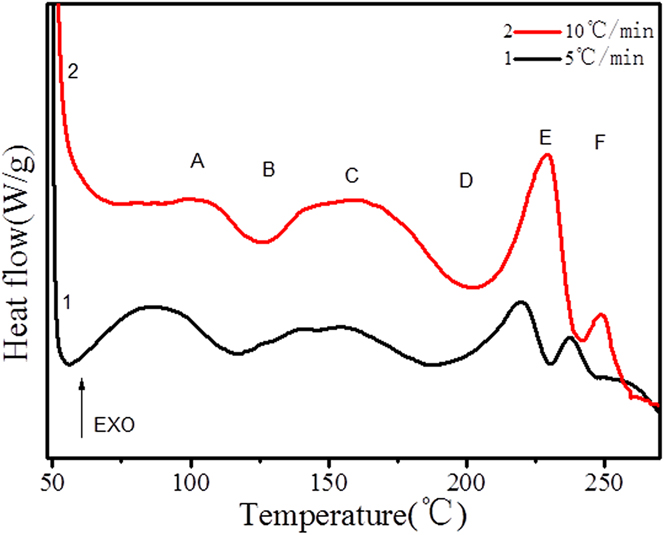
DSC curves calibrated with pure (99.999%) Al for differently as-quenched 7050 samples are shown in Fig. 2. In DSC curves with scanning rates of 5, 10, and 20 °C/min, six distinct peaks from A to F can be observed in the temperature range from 50 to 300 °C. Based on previous literature results, Reference Marlaud, Deschamps, Bley, Lefebvre and Baroux22,Reference Nicolas and Deschamps28,Reference Ungár, Lendvai, Kovács, Groma and Kovács-Csetényi29 the exothermic peak A at about 85 °C is associated with the formation of GP zone, while the endothermic peak B is associated with the dissolution of GP zone. The exothermic peak C at about 150 °C is associated with the transformation of GP zone to η precipitates. The last exothermic peaks E and F from 220 to 240 °C are associated with the growth and coarsen of η′ precipitates and transformation to η precipitates. The maximum temperatures of all reactions shift to a high level with the accelerated heating rate implying that heating rate also has a significant effect on the dissolution or precipitation reactions.
DSC results for the 7050 alloy from as quenched sample.
B. Pre-ageing microstructure evolution
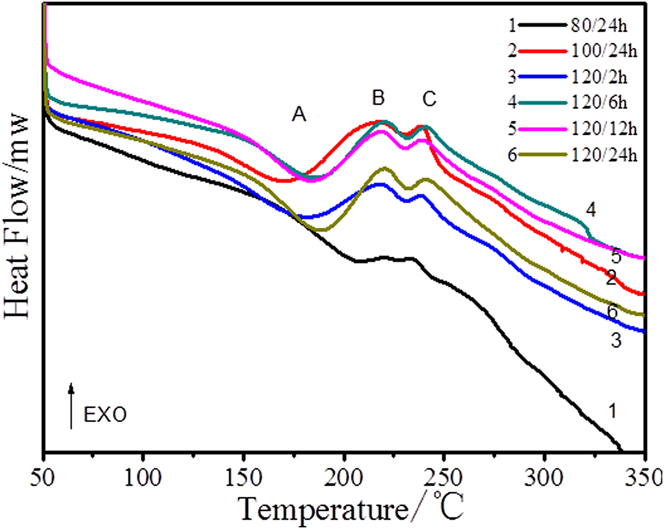
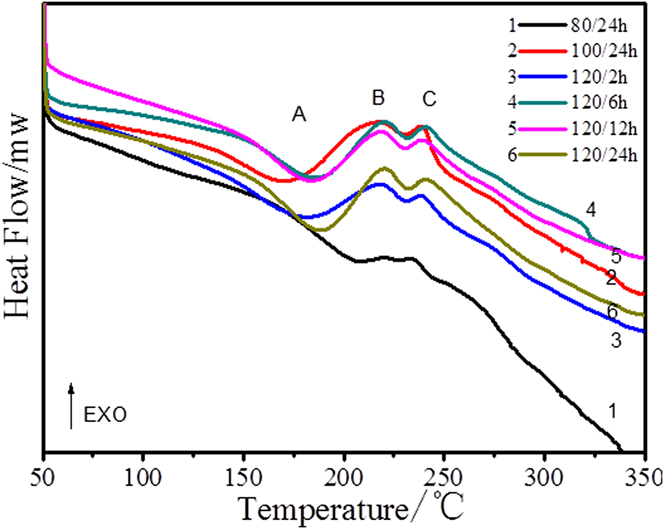
DSC curves for different pre-aged 7050 samples are shown in Fig. 3. Three well-distinguished peaks A, B, and C can be observed in the temperature range from 170 to 280 °C. The endothermic peak A is attributed to the dissolution of GP zone. The last two exothermic peaks B and C are associated with the formation of η′ and η precipitates, respectively. The maximum temperatures and enthalpy of the peak A, B, and C are compared for samples under various pre-ageing tempers. There is almost no difference among the maximum temperatures of the peak A, B, and C. For the sample under P1 pre-ageing, the peaks B and C overlap apparently and the reaction of η′ formation (peak B) almost cannot be observed. Therefore, the tendency of η′ formation reduces under lower pre-ageing temperature. It has been reported that the relative volume fraction of precipitates in artificially aged samples can be estimated by measuring the net area under a DSC trace. Reference Feng, Zhang, Liu, Wang, Wu and Guo27 The enthalpy of the peak A varies with pre-ageing temperature and time, while the enthalpy of peak B and C are almost invariable. That is to say, the relative volume fraction of precipitates increases with the increase of pre-aged temperature and pre-aged time. Thus, it can be demonstrated from the DSC scans, different pre-ageing tempers will lead to various microstructures of 7050 alloy, which may bring about distinguished evolution of microstructures and properties during the same RRA treatment.
DSC curves of different pre-aged 7050 samples measured with heating rates 5 °C/min.
C. Hardness and electrical conductivity
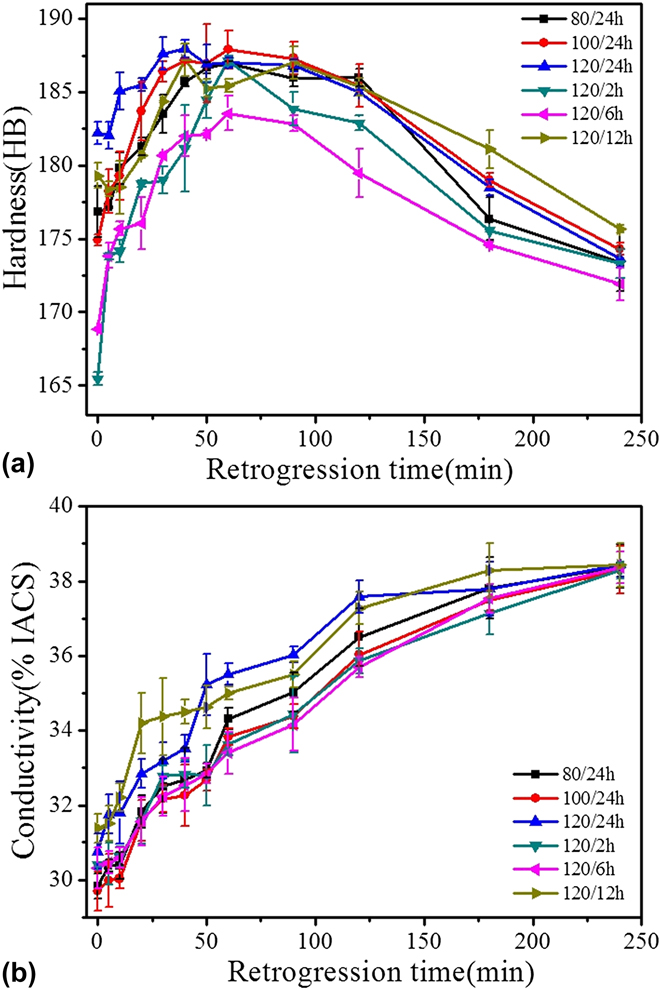
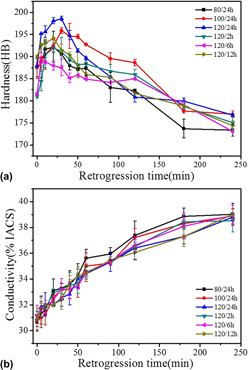
The hardness and electronic conductivity of retrogression treated samples are shown in Fig. 4. The variation of hardness during retrogression depends on the pre-ageing tempers. The retrogression hardness of (near) peak-aged sample, such as P5 and P6, experience three states, which has been found several times in the literature. Reference Wu, Raizenne, Chen, Poon and Wallace16,Reference Li, Birbilis, Li, Jia, Cai and Zheng18 Namely, three stages can be distinguished: during retrogression the samples' hardness exhibit a fall to a minimum following by a increasing again to a secondary peak, while a further decrease in hardness results from continued treatment. However, for under-aged samples, the retrogression hardness appears a stage of hardness increasing followed by a further decrease in hardness results. That is to say, the stage of rapid dissolution of the fine precipitates resulting in a decrease of retrogression hardness vanishes. The peak retrogression hardness increases as the pre-ageing temperature and pre-ageing time increase, while it need longer retrogression time to achieve the peak hardness. Thus, the differences on microstructure evolution during retrogression step are under the control of pre-ageing temper and retrogression heating process. The representation of the stability of precipitated particle can be evaluated by comparing the precipitate radius with the critical radius. Based on previous research, Reference Park and Ardell25 under quick heating condition, the retrogression temperature can be achieved immediately while dissolution cannot take place in the meantime. Under slow heating condition, the rise of temperature may not introduce a sudden increase of critical radius which results in the dissolution of particles or growth during the heating stage occurs simultaneously. The microstructure of initial retrogression stage may depends more on the nature of the pre-aged state. For (near) peak-aged sample, such as P5 and P6, during 200 °C/h retrogression heating process the hardness exhibit a decrease stage resulting dissolution from of fine and dispersion precipitations. However, the hardness of under-aged sample (such as P1) experiences a monotonous increase due to the growth of fine and dispersion precipitations. Thus, owing to slow heating condition the dissolution of particles or growth almost occur during retrogression heating stage.
Changes of hardness and conductivity of the alloy during retrogression as function of retrogression time (a) Hardness; (b) Electrical conductivity.
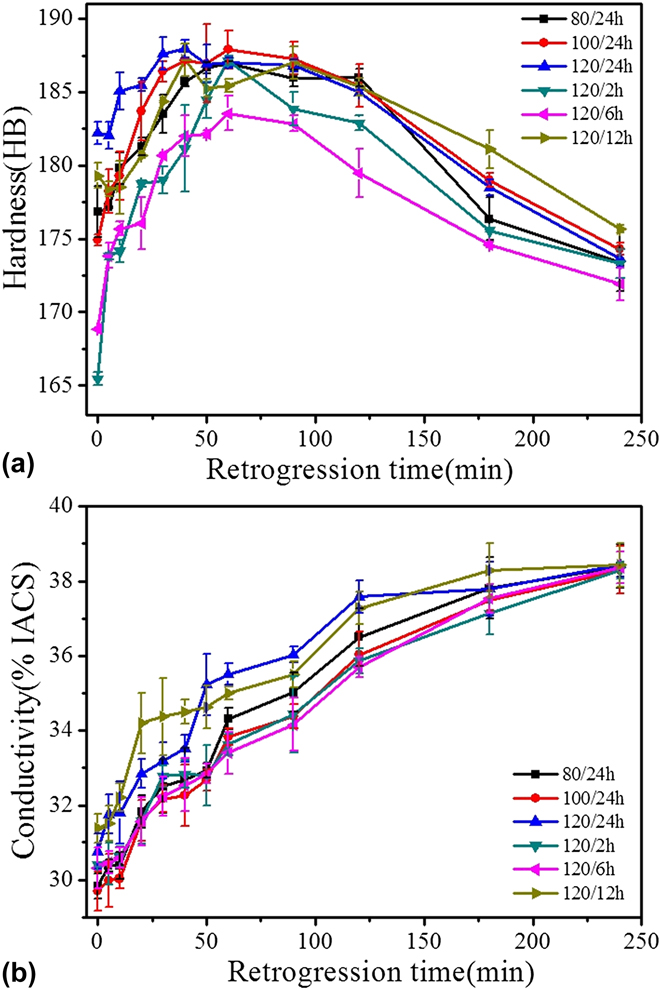
Strength, toughness, and SCC resistance are the three major properties of high-strength Al–Zn–Mg–Cu aluminum alloys. The SCC resistance has been found to increase with increasing electrical conductivity in 7xxx-series alloys, particularly for the over-aged condition. Consequently, the electrical conductivity can be used as a measure of the SCC resistance. The changes of retrogressing electronic conductivity of different pre-aged sample exhibit the same tendency. With prolonging retrogression times, the electronic conductivity increase monotonously. The retrogression electronic conductivity of (near) peak pre-ageing samples is higher than that of under-aged samples.
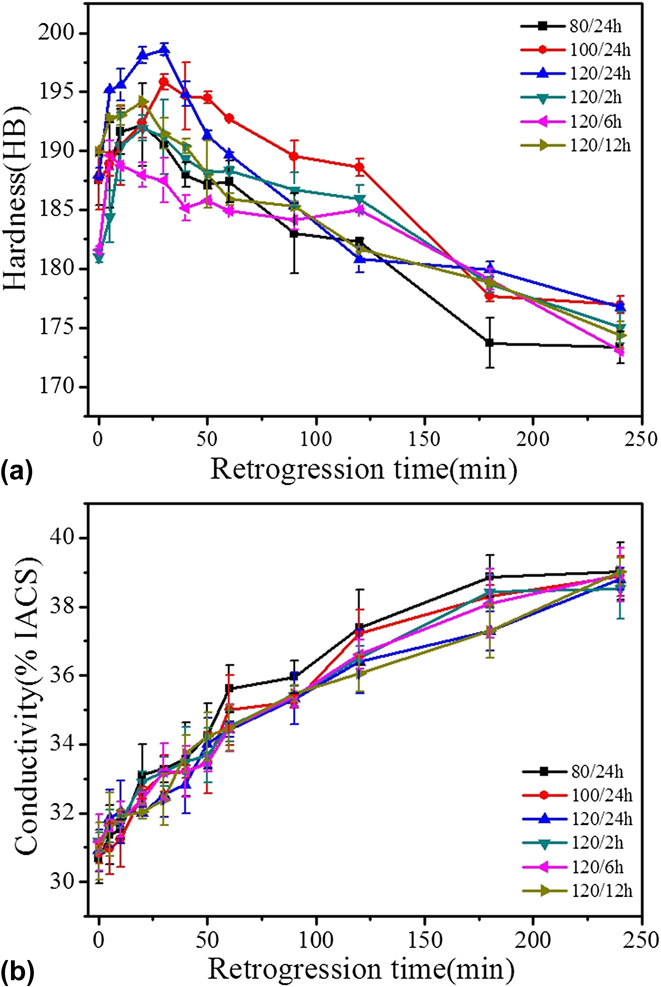
The hardness and electronic conductivity of re-aged samples are shown in Fig. 5. The changes of re-aged electronic conductivity and hardness of different pre-aged sample exhibit the same tendency. With prolonging retrogression times, the electronic conductivity increase monotonously. While the re-aged hardness experience two states: with prolonging retrogression times, the hardness increases to a peak hardness and then exhibit a monotonous fall. The peak re-aged hardness decreased with the reduction of the pre-ageing temperature and pre-ageing time. However, the re-aged electronic conductivity of the sample under P1 pre-ageing get a higher level than P6.
Changes of hardness and conductivity of the alloy during re-ageing as function of retrogression time (a) Hardness; (b) Electrical conductivity.
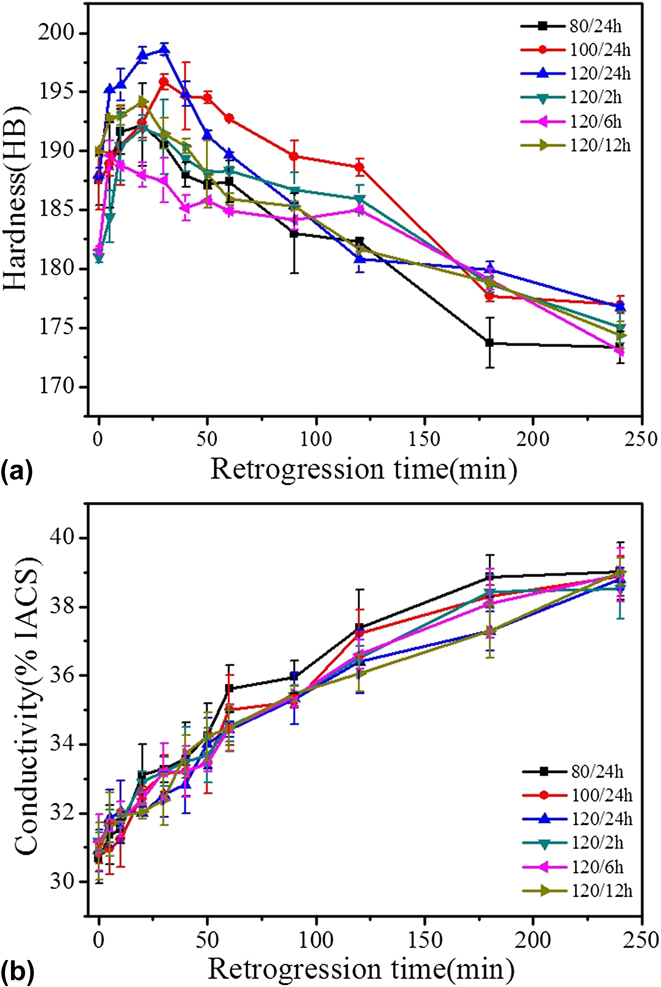
From the changes of hardness and conductivity of the alloy during retrogression and re-ageing as function of retrogression time, it could be concluded that, the variation of properties during RRA depends on the pre-ageing tempers. For the same retrogression situation 180 °C/2 h, the re-aged hardness of different samples are at the same level. While the under-aged samples can obtain higher re-aged electronic conductivity, in other words, the resistance of SCC is excellent.
D. Tensile strength
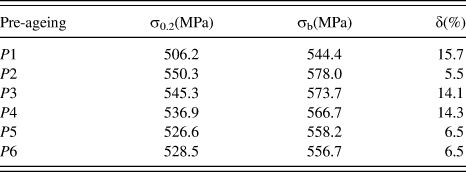
The tensile properties of the alloy at various pre-ageing conditions are summarized in Table III. It can be observed that the strength evolution is consistent with that of the hardness. For the same RRA condition, P1 pre-ageing samples obtain poor strength but higher elongation. Besides, the P3 and P4 pre-ageing samples can achieve both higher strength and elongation. Compared with the customary pre-ageing temper P6, the ultimate tensile strength (UTS) and yield strength (YS) of the P3 pre-ageing samples is increased by 3.05 and 3.18%, respectively. Meanwhile, the elongation of samples under different pre-ageing vary significantly. That means the under-aged condition is beneficial to improve the ductility of 7050 alloy remarkably.
Tensile properties of 7050 alloy under different pre-ageing tempers.

E. Transmission electron microscope
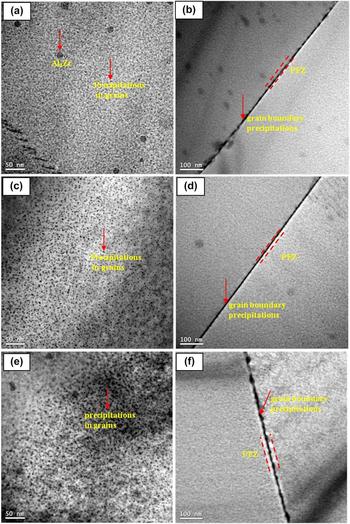
Figure 6 shows the TEM images of the alloys treated by the three different pre-ageing processes. As shown in Figs. 6(b), 6(d), and 6(f) it is observed that the grain boundary precipitates in P2, P3, and P6 are all continuous and chainshaped. The grain boundary precipitates in P6 are the coarsest and the most discontinuous and the PFZ is obvious wider. The PFZ in P2, P3 is very narrow. Figs. 6(a), 6(c), and 6(e) show that there are fine strengthening phases distributed dispersively in the matrix of the alloys in three typical pre-ageing tempers. In comparison, the size of the strengthening phase is the smallest in P2, intermediate in P3, and the largest in P6.
TEM bright field intra-grain and grain boundaries precipitate image of the pre-ageing 7050 alloy (a) (b) 100 °C/24 h (c) (d) 120 °C/2 h (e) (f) 120 °C/24 h.

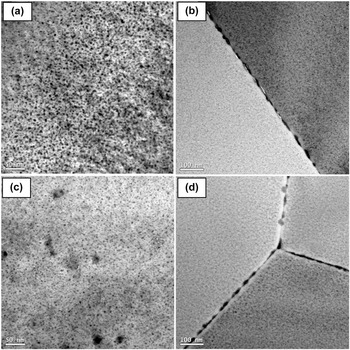
Since the significant transformation of the retrogression hardness property for different pre-ageing treatments is observed, the evolution of microstructure for under-aged and peak-aged samples during retrogression heating stage is analyzed. The P2 and P6 pre-ageing sample under same retrogression heating condition are investigated for comparison in Fig. 7. Compared to the P2 pre-ageing structure, it is evident that the intra-grain and grain boundary precipitate structures appear to grow and coarsen. The grain boundary precipitates coarsen significantly and arrange discontinuously. However, for the P6 pre-ageing structure, there is a tendency that the volume fraction of intra-grain precipitate experienced a significant drop. The smaller GP zone and η′ phase appear to dissolve in the matrix, and the density of intra-grain precipitate is reduced. The larger grain boundary precipitates continue to grow and coarsen and appear discontinuous arrangement.
TEM bright field intra-grain and grain boundaries precipitate image of the retrogression 7050 (a) (b) 100 °C/24 h + 180 °C/0 h (c) (d) 120 °C/24 h + 180 °C/0 h.

The strength of 7xxx series Al alloys is mainly dominated by precipitation. Generally, the precipitation during aging occurs through a complex sequence as follows: supersaturated solid solution→GP zones→metastable η′→stable η (MgZn2). In the decomposition of the solid solution in the temperature range 20–200 °C in an Al–Zn–Mg alloy, the nucleation and growth of GP zones dominate the aging process of approximately 20–100 °C. Reference Ungár, Lendvai, Kovács, Groma and Kovács-Csetényi29 The volume fraction of GP zones increases logarithmically with the holding time between 20 and 70 °C, while linearly with the time in the aging temperature range of 80–100 °C. When the aging temperature is between 100 and 160 °C, the formation of η′ precipitates takes place.
In the pre-aging stage RRA aging, the main process is precipitation of GP zone and semi-coherent η′ phase. Generally, during retrogression stage the GP zone and fine η′ phase dissolve followed by coarsening of η′ and η precipitates. When the pre-ageing temperature reduced the insufficient precipitation condition make GP zone and fine η′ phase growth and coarsening instead of dissolving in matrix during retrogression heating stage. However, higher temperature pre-ageing(P6) sample experiences intra-grain precipitation dissolving and grain boundary precipitation coarsening. Thus, different pre-aging samples present distinct precipitation evolution during retrogression stage.
IV. CONCLUSIONS
To obtain practical processing parameters of RRA for 7050 plates, the effect of pre-ageing conditions for RRA treatment samples were investigated. The results can be summarized as follows:
-
(1) The relative volume fraction of precipitates increases with the increase of pre-aged temperature and pre-aged time.
-
(2) The variation of hardness and electronic conductivity during RRA depends on the pre-ageing tempers. The peak re-aged hardness decreased with the reduction of the pre-ageing temperature and pre-ageing time. While the under-aged samples can obtain higher re-aged electronic conductivity.
-
(3) Compared with peak pre-ageing sample, the UTS and YS of the under-aged samples increased by 3.05 and 3.18%, respectively. The elongation of under-aged samples can be improved remarkably.
-
(4) For under-aged sample, the dissolving stage of fine GP zone and η′ phase vanish due to insufficient precipitation during pre-ageing, so that the retrogression hardness appears a stage of hardness increasing followed by a further decrease in hardness results.