


Introduction
The two medial moraines of the Glacier de Tsidjiore Nouve commence as a series of transverse debris mounds which merge down-glacier to form prominent ridges extending approximately 1 km to the glacier snout (Reference Small and ClarkSmall and Clark 1974). They fall clearly into the category of “beaded” moraines identified by Reference Embleton and KingEmbleton and King (1968). The forms of such moraines pose problems of intrinsic interest (Reference Small, Clark and CawseSmall and others 1979); in the present context, however, the origin of the englacial debris is considered, primarily for the light it sheds on erosive and transportational mechanisms of valley glaciers with large ice falls.
Reference SharpSharp (1949) recognized that englacial debris nourishing medial moraines commonly constitutes longitudinal bands (“septa”) derived at least in part from extraglacial clasts dumped onto the glacier and incorporated within the ice above the firn line. Reference Eyles and Rogerson, Eyles and Rogerson (1978) state that such debris may result not only from frost disintegration of exposed rock faces, but can include a “subglacial” component, the product of glacial erosion sensu striato; this is temporarily released to the glacier surface at the base of ice cliffs in the accumulation zone. Reference BoultonBoulton (1978), in a comprehensive review of sediment paths through glaciers, distinguishes between debris in “high-level transport” (comprising supraglacial clasts from the valley margins) and in the “basal transport zone” (derived at least in part from the valley head-wall). The former sediment will be transported passively; the latter will be modified by intense crushing and abrasion if exposed at the glacier base by bottom melting. Reference PosamentierPosamentier (1978) suggests mechanisms of folding and faulting whereby, in the zone of compression at the base of an ice fall (such as that of the Glacier de Tsidjiore Nouve), sediment from the basal transport zone may be raised to the glacier surface. The role of “shear planes” in upward debris transference close to the glacier snout has been widely inferred (Reference SharpSharp 1949, Reference BoultonBoulton 1978), though the mechanisms of such transport are controversial.
The Form And Occurrence Of The Debris Layers
When viewed up-glacier, the medial moraines of the Glacier de Tsidjiore Nouve are seen to comprise, in their uppermost sections, a series of transverse debris patches and debris-covered ice mounds (Fig.1). Many of the latter are elongated ridges approximately 2 m in length and up to 0.5 m in height; others are irregular in outline as a result of the coalescence of individual ridges, are more extensive (20 by 30 m in one instance), and protrude up to 4.25 m above adjacent bare ice. Down-glacier, the larger mounds merge to form prominent medial moraine ridges (which in the case of the main moraine reaches a maximum height of 25 m). Observations over 3 years have shown that the ridges and mounds persist from year to year, with a tendency to increase in height and extent where close to the heads of the moraine ridges proper.
View of Glacier de Tsidjiore Nouve, showing debris emergence near the base of the Pigne d'Arolla ice fall.

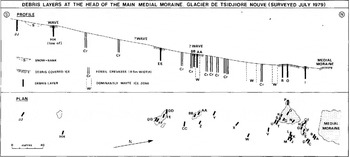
During July 1979 all the mounds and ridges, in a zone extending 360 m up-glacier from the main medial moraine ridge, were wholly or partly cleared of overlying debris, revealing the presence of numerous englacial debris layers, as shown in Figure 2. From the plan view it will be seen that the layers (which range from 1 to 5 m in length) increase in density down-glacier. Only 12 layers crop out in the 260 m below the emergence of the first debris, but 23 layers are concentrated in the final 100 m before the head of the moraine ridge. The debris layers are consistently orientated from south-east to north-west (median bearing 305˚), whilst the centre line of the glacier, lying 100 m to the west, runs south-south-west to north-north-east (bearing 10˚). Owing to the irregularity of the margins and the absence of good sections, true dip of the layers could not be determined precisely; many could be seen to dip at 70–80˚ up-glacier, and some appeared to be vertical (Fig. 3). There is much variation in thickness, both within and between layers. Layer P is particularly rich in debris, and reaches a maximum thickness of 300 mm; many other layers lie within the range 100 to 200 mm. On visual inspection nearly all the layers appear to be overwhelmingly composed of angular debris, including many slab-like clasts with major axes orientated vertically and/or parallel to the margins of the layer, within an admixture of gravel and ccarse-medium sand (Figs. 4 and 5), However, layers 0 and BB are different, comprising thin seams composed largely of fine sand and silt.
Debris layers at the head of the main medial moraine, Glacier de Tsidjiore Nouve.
A view of debris layers DO (left) and EE (right). These possibly constitute a single layer accidentally divided by a former melt-water stream. The layers are approximately vertical.

Debris layer N, which is particularly rich in debris (the width at the summit is 300 mm) and contains large angular clasts orientated vertically. The margins of the band are irregular.

Debris layer N in close-up, showing the coarse nature of included debris and the occurrence of clear ice bands close to the margins of the debris.

The long profile along the centre-line of the debris-layer outcrops (Fig. 2) depicts both debris layers and other structural features. Three possible "waves" on the glacier surface are identified, though these are less prominent than on other glaciers with ice falls in the area. The relationships between these waves and debris emergence (which, according to the Posamentier hypothesis, should be close) are difficult to discern. Debris emerges in large amounts at the crest of the lowest wave (though the wave may be the product of differential ablation rather than folding), but not at the next wave up-glacier. Moreover, a series of debris layers coincides with the trough between these two waves. The most noteworthy structural features are the narrow bands of compact white ice, comprising fine crystals and numerous air cells, Which contrast with the coarsely crystalline ice dominating this zone of the glacier. Reference King and LewisKing and Lewis (1961) argue that such bands represent snow-filled crevasses, formed on the ice fall and compressed and transformed down-glacier. Crevasses developed within the firn basin are likely to show similar characteristics.
Seoimentology Of The Debris Layers
Sediment samples were extracted from 24 of the 35 debris layers at the head of the main Tsidjiore Nouve moraine. For purposes of comparison samples were also taken from four apparent “shear planes”, cropping out on the terminal slope of the nearby Bas Glacier d'Arolla. These dipped up-glacier at approximately 20˚, and were associated with debris-rich horizons comprising material carried up from the glacier base.
Reference BoultonBoulton (1978) argues that grain-Size distributions can provide an indication of genesis and transport paths of sediments through glaciers. Accordingly the 28 samples were dry-sieved in the laboratory, weighed at 0.5ϕ intervals, and calculations made of mean and median particle sizes, skewness, kurtosis, and sorting coefficients. Figure 6 shows (a) mean weight percentages at 0.5ϕ intervals of all debris layers and all “shear planes”, and (b) actual weight percentages of individual debris layers M, X, Z and “shear planes” 1, 2, 3. The relative coarseness of the debris-layer particles is evident; the mean grain size of the debris layers is −1.22ϕ (standard deviation 0.36) and of the "shear planes" −0.30ϕ. In fact this represents an understatement of the true coarseness of the debris layers. In the collection of field samples the larger clasts already described, including fragments of up to small−boulder size, were not selected from the debris layers, and clasts in excess of 32 mm were eliminated from the laboratory analysis. Even in the absence of these larger fragments, the debris layers are dominated by the coarser fraction (largely of pebbles and granules), whilst the “shear planes” contain significantly greater quantities of medium and fine sand and silt. There is some difference in sorting between the two sets of debris. with the debris-layer sediments (sorting coefficient 2.15) being rather better sorted than the “shear plane” sediments (2.51). Individual debris layers 0 and BB require special comment. Mean grain size in each is much reduced (that of 0 is 1.32ϕ. and that of BB −0.15ϕ), sorting is relatively poor (sorting coefficients are 3.03 and 2.52). and both display coarse-skewed distributions.
There is, in fact, a closer resemblance between these two debris layers and the "shear planes" than between the remaining 22 debris layers.
Particle-size distributions for debris layers from Glacier de Tsidjiore Nouve (M, X.Z) and "shear planes" from Bas Glacier d'Arolla (1 , 2, 3).

Discussion
By examining debris layers within the Glacier de Tsidjiore Nouve. answers have been sought to the following questions. What is the source of the debris? How was the debris incorporated within the glacier? Why is the debris concentrated in discrete layers of very limited extent?
Several possible debris sources were revealed in this study. (1) South of the Col de Tsidjiore Nouve (which links the Tsidjiore Nouve and adjacent Cheillon basins) a 100 m high rock face crops out between flanking sectors of an ice fall connecting the upper and lower firn basins. The summit of the face is occupied by an ice cliff which generates small avalanches to the lower basin (Fig. 7). Beneath the face, patches of debris mantle the snow surface; a considerable proportion of this material appears to enter the bergschrund and severa smaller crevasses that occur here. Other similar though smaller rock exposures occupy the western flanks of the Pigne d'Arolla. providing more limited debris sources. (2) On either flank/of the Pigne d'Arolla ice fall, below the lower firn basin, extensive rock faces feed considerable quantities of detritus onto the margins of the glacier. This debris appears to result from subaerial rock distintegration, and covers the prominent lateral moraines which develop at the foot of the ice fall. (3) Subglacial sources of debris are presumed to exist along the entire length of the glacier. However, areas of concentrated debris release possibly occur (i) beneath the ice-fall sectors separating the upper and lower firn basins, which with the exposed rock face described above constitute a head-wall to the lower firn basin, and (ii) beneath the Pigne d‚Arolla ice fall where basal velocities are high. Such debris could be moved into high-level transport only by folds and/or faults (constituting in effect large “shear planes”) at the base of the ice fall, at a point where soundings by Grande Dixence S.A. have shown the glacier to exceed 150 m in thickness (Reference Small and ClarkSmall and Clark 1974).
Possible debris sources and sediment transport through Glacier de Tsidjiore Nouve.

On a priori grounds one would expect the grain-size distributions of particles derived supraglacially from weathering and rock fall to differ from those of particles transported subglacially.The former, if entrained within the glacier as crevasse infillings or sedimentary layers. might experience some modification by crushing but this would be much less than that produced in the high energy environment at the base of the ice.
Particle-size analysis has revealed a possible distinction between debris-layer sedinrents, which are coarse and contain predominantly angular clasts, and “shear plane” debris, which is finer and somewhat more poorly sorted. The debris-layer sediments in fact resemble “moraine debris” (Reference Eyles and WhalleyEyles 1978), which is derived either subglacially in the firn zone and transported passively near the glacier base or (in our view applicable here) results from supraglacial weathering and incorporation within the ice from above. The high-level position of the Tsidjiore Nouve layers supports the latter explanation, with much of the lncluded debris being provided by in situ rock disintegration of exposed faces within the firn basin. The “shear plane” sediment samples, on the other hand, have characteristics of “basal debris” (Reference Eyles and WhalleyEyles 1978): reduced mean grain size, poor sorting, and a coarse-skewed distribution resulting from intense comminution., These conclusions are supported by the work of Reference BoultonBoulton (1978), whose analysis of “high-level transport” and “zone af traction” debris from Breidamerkurjokull and Glacier d‚Argentiere reveals particle-size distributions closely similar to those of Figure 6.
Nevertheless, some reservations need to be made. The debris-layer samples analysed containa sizable element of finer material (sometimes up to 10% or more of fine sand, silt, and clay). Two (0 and BB) are quite distinctive, containing 32% and 20% within this range. It is reasonable to assume either that the debris-layer constituents are of supraglacial origin but that some have not been passively transported at a high level within the glacier, or that the constituents are derived largely from supraglacial sources but that some contain an element of subglacial origin (with a significant concentration of the latter in layers 0 and BB).
Conclusion
The constituents of the Tsidjiore Nouve debris layers are denived from (i) supraglacial debris, resulting from subaerial weathering of rock exposed in the firn basin, and (ii) subglacial debris from the base of the ice standing above rock faces in the firn zone. From the high proportion of sharply angular clasts, none of which was observed to display striations or incipient rounding diagnostic of basal transport, we infer that the supraglacial sources are dominant. The Posamentier hypothesis, with its emphasis on folding and shearing as mechanisms for raising subglacial debris to the ice surface, is rejected for several reasons: (i) in the Posamentier model the debris should be wholly subglacial in character; (ii) the limited lateral extent of the debris layers (2 to 5 m) is inconsistent with massive shearing through a 150 m layer of ice; and (iii) the smoothness of the glacier surface, with its very subdued waves, in a zone where annual ablation is 3 m or less, cannot be reconciled with an hypothesis of largescale isoclinal folding and/or faulting, the surface expression of which would necessarily be so powerful that it could not be effaced so rapidly by weak ablation.
In our view, incorporation of the debris in the firn basin of the glacier is most likely to result from ingestion via crevasses, a process that can actually be observed in the field. The form, dimensions, disposition, and sedimentology of the layers are more consistent with the “fossil crevasse” than the “sedimentary layer” hypothesis. Tilting of surface sedimentary accumulations, from the initial down-glacier slope of the firn surface to a near-vertical dip on the glacier tongue, is theoretically feasible. However, the considerable thickness of the ice between the debris layers (in the study area the mean thickness of the ice exceeds 10 m) cannot easily be explained in terms of annual layering, comprising alternate winter ice and summer sedimentation. Nevertheless, the issue is not wholly clear, and further investigation of debris incorporation is needed.



