Autocratic leaders have long used restrictions on emigration and internal movement to bolster their power. Under feudalism, European monarchs restricted peasant movement to preserve the existing power structure. In the twentieth century, communist rulers strictly prevented citizen exit, while the Shah of Iran and Spain’s Francisco Franco issued passports only to their loyal supporters.Footnote 1 Yet many modern autocracies have allowed or even encouraged emigration. Although on average exit remains more restricted in dictatorships, autocratic regimes in Mexico, Greece, Yugoslavia and North Africa all promoted emigration by signing bilateral labor migration treaties.Footnote 2 Perhaps the starkest contrast is the two Koreas: North Korea tightly regulates both internal and external movement, whereas South Korea encouraged emigration under its military dictatorship.
Despite this substantial variation, we know little about the determinants of emigration policy given scholars’ overwhelming focus on immigration policies in wealthy democracies.Footnote 3 This article shifts attention to sending countries’ policies and the resulting influence of emigration on regime change. As nearly all democracies allow free exit, the key open question is what underlies the variation in autocracies’ emigration policies.Footnote 4 Further, several autocracies have dramatically changed their approaches over the last thirty years, some liberalizing emigration and others increasingly restricting it.Footnote 5 Explaining this variation can fill a major gap in our understanding of the political drivers of global migration.
We argue that autocrats determine emigration policy strategically, encouraging emigration when it aids their survival but restricting it otherwise. Following Hirschman, the conventional view is that the opportunity for exit is a potent source of citizen pressure, especially where voice is limited.Footnote 6 By voting with their feet, emigrants can weaken the regime and potentially trigger its breakdown, as graphically illustrated by East Germany’s fall. This has led many scholars to predict that autocrats should greatly restrict emigration.Footnote 7
Yet numerous modern autocracies have liberalized emigration without falling to East Germany’s fate. To explain this, we contend that emigration can be a boon to autocratic leaders. As about 92 per cent of the world’s emigration is driven by individuals’ economic interests,Footnote 8 our theory focuses on how this economic emigration influences autocratic survival and resulting emigration policies. Emigration brings significant economic benefits, including increased foreign investment, trade and remittances. Allowing citizens to leave can also drive out political opponents and the unemployed, leaving behind a more loyal population. On the negative side, emigration to democracies allows migrants to transmit democratic ideas back home and to return with tools to foster democratic change.
Thus, when determining emigration freedom, autocrats balance the economic and political returns of emigration against the dangers of democratic influence. Which side dominates depends on both a country’s level of emigration and where migrants reside. In sum, this article makes several theoretical advances: an account of the benefits of emigration for autocrats, a consideration of emigrant destinations and a comprehensive theory of how autocrats determine emigration policy.
In our empirical results, we first show that a more open emigration policy increases flows from autocracies, confirming that leaders can control migration. We then examine how emigration influences democratization and the choice of emigration policy in autocracies. To address endogeneity concerns, we adopt an underutilized empirical strategy that uses a gravity model to predict bilateral migrant stocks from exogenous geographic and socio-economic variables. This design follows the logic of an instrumental variables analysis, while allowing us to flexibly calculate both expected levels of migration and the characteristics of likely receiving states.
Using these predicted values, we show that greater populations of economic emigrants stabilize autocracies, whereas larger numbers living in democracies predict democratization. The latter effect is robust to controlling for regional and trade-weighted averages of democracy, which provides strong evidence that migration is a mechanism of democratic diffusion. This supports Levitsky and Way’s argument that democracy spreads not through proximity, but via substantive linkages.Footnote 9 We then show that autocrats choose emigration policy as a rational response to these effects, encouraging emigration if economic migration will be high, but restricting it if emigrants are likely to go to democracies. We also address immigration, other regime breakdowns and policy in democracies.
Our research connects to a larger literature on how autocratic states control their populations to maintain powerFootnote 10 and fills in a critical missing piece of the international migration puzzle: the politics of autocratic sending countries. Bridging the literatures on autocratic institutions and international political economy, we show that emigration policy is a neglected component of how modern autocracies fight for survival. This oversight is surprising given the past focus on capital mobilityFootnote 11 and trade openness.Footnote 12 Further, the literature rarely considers the strategic use of economic foreign policy for autocratic survival, which we treat as central.Footnote 13 A similar framework can be applied to other elements of economic foreign policy.
The findings also demonstrate how globalization’s economic pull has led many autocracies to open their borders, thus unintentionally facilitating democratic diffusion. Additionally, they explain why loosening emigration restrictions in Cuba – leading to emigration to consolidated democracies like the United States – may have different effects than similar reforms in Burma or Egypt.
PAST WORK ON MIGRATION AND POLITICS
Scholarship on migration largely focuses on immigration policies in wealthy democracies.Footnote 14 When scholars address emigration, they often focus on individual choices to emigrate and the local political consequences of migration in specific countries.Footnote 15 Other studies discuss the use of emigration policy for economic purposesFootnote 16 and the effects of remittances on autocratic stability.Footnote 17 However, the literature has generally omitted the state’s strategic role in encouraging or discouraging emigration to suit its needs,Footnote 18 and has neglected the regime-level effects of emigration and the sources of emigration policy.
A few cross-national studies connect migration to democratic change. Spilimbergo shows that students educated in foreign democracies promote democracy at home.Footnote 19 Bearce and Hutnick show that higher net emigration is correlated with democratization.Footnote 20 Docquier et al. find that greater emigration flows to Organisation for Economic Co-operation and Development (OECD) countries predict increases in democracy and institutional quality.Footnote 21 Alemán and Woods show that emigration freedom predicts higher democracy levels.Footnote 22
There are limitations to these and related studies. First, the richness of the data on migration varies considerably. Many analyze only total migration,Footnote 23 and therefore overlook the critical dimension of where migrants move. Others consider only emigration to OECD countries,Footnote 24 which may understate the general effect of emigration and potentially bias the results, as all OECD members are democratic.Footnote 25 Our study employs global bilateral migration data that include all destination countries across a half-century.
Secondly, there is little consideration of regimes’ responses to emigration, one of the many sources of endogeneity in connecting emigration to democracy. While several studies instrument for migration using geography,Footnote 26 spurious results could still arise if countries react to the propensity for emigration. We place the mediating effect of emigration policy at the center of our empirical strategy.
Thirdly, there is little analysis of how effects vary across autocratic regimes. Different autocracies have taken distinct approaches to emigration, with fairly open policies in autocratic Mexico and Taiwan and highly restrictive ones in Cuba and North Korea. Some regimes may also be more sensitive to the political effects of emigration.
Emigration and the Threat of Exit
We argue below that emigration policy in autocracies is motivated by the benefits and threats of the resulting emigration flows. However, a prominent alternative perspective emphasizes the direct effect of exit options on regime stability.Footnote 27 Hirschman famously argues that citizens, customers and the like have two responses when dissatisfied with an organization: voice or exit. Because voice is limited in autocracies, exit can represent the dominant tool of opposition.
Allowing emigration presents two possible threats. First, it may open the door to destabilizing levels of mass exit. By reducing populations, tax bases and legitimacy, mass exit can weaken regimes and even trigger their collapse, as seen in the mass exodus from East Germany in 1989.Footnote 28 Although emigration was both a symptom and a cause of regime fragility, it proved to be an effective tool of opposition for East Germans. Secondly, exit options can give citizens leverage over the regime, regardless of whether they actually move. Economists similarly argue that citizens ‘voting with their feet’ exert competitive pressure on governments to appeal to them.Footnote 29 Although typically applied to local governments, the argument has been extended to the national level.Footnote 30
These dual threats have led many scholars to expect that autocracies will highly restrict emigration.Footnote 31 We agree that this may explain why many regimes historically restricted exit, especially when they depended on the physical repression of labor and populations had easy exit options. Feudalism represents an extreme example in the control of exit and internal movement, as peasants’ threat of exit to towns was particularly damaging to the landed elite.Footnote 32 Restrictions were especially harsh in Eastern Europe, where monarchs strengthened serfdom to gain nobles’ support.Footnote 33
However, mass exit through emigration is much less relevant to modern regimes due to increased control of borders and immigration. Whereas a century ago migrants fleeing repression could move en masse to the New World, today migration is highly regulated and limited by skills and nationality.Footnote 34 When destabilizing numbers of citizens do exit, it is usually through extra-legal channels (and thus unrelated to emigration policy) and it often provokes a backlash (for example, the mass migration of Syrians to Europe). East Germany represents an exception due to its simultaneous state collapse and the unusual receptivity of West Germany to East German immigrants. Although mass exit could occur in some modern states (for example, North Korea), many repressive autocracies with open emigration policies have not seen destabilizing levels of exit (for example, Cambodia and Zimbabwe).
Emigration opportunities are also unlikely sources of leverage against modern autocracies. About 92 per cent of modern emigration is primarily due to economic motives; most of the remaining 8 per cent comprises refugees fleeing civil conflict.Footnote 35 Compared to historical cases, modern emigrants also bring much greater economic benefits due to financial globalization (which allows for remittances, foreign direct investment (FDI) and aid) and higher prospects for return emigration and skills upgrading. Although some emigration is motivated by political opposition, regimes are typically happy to have these dissidents leave.
In sum, we see emigration freedom in modern autocracies as motivated by whether regimes see the resulting economic emigration as beneficial. To support this further, our empirical results show that emigration freedom does not have a direct effect on democratization once its contribution to emigration flows is taken into account.
MIGRATION AND AUTOCRATIC SURVIVAL
Encouraging emigration is a double-edged sword for autocratic leaders. On the positive side, emigration delivers economic benefits and enables those dissatisfied with the regime to leave. On the negative side, the resulting exposure to democracies may facilitate democratic attitudes and political opposition among return migrants. Balancing these motives, we expect autocrats to anticipate likely emigration and determine the emigration policy that maximizes their survival. Figure 2 summarizes our argument. After exploring these motives in greater depth, we theorize how these factors vary in strength across different autocracies, leading to predictions for democratization and emigration policy.
Economic Benefits of Emigration
We begin with three sets of economic incentives for allowing emigration. First, economic emigration brings a large range of growth-enhancing benefits to the economy through trade, investment and aid.Footnote 36 Trade often flows along migrant networks, as migrants have a taste for home goods and provide information about trade opportunities.Footnote 37 Similarly, migration promotes FDI because the diaspora invests at home and provides information to foreign investors.Footnote 38 For example, Chinese emigrés contribute more than half of the nearly $100 billion in annual inflows of FDI to China.Footnote 39 Bermeo and Leblang also find that emigration increases foreign aid from destination countries.Footnote 40
In addition to securing popular support through increased growth, economic activity can increase the regime’s resources for allied elites. Although greater FDI and a smaller workforce may harm some regime insiders by increasing foreign competition and raising domestic wages, leaders can take steps to compensate their allies, such as increasing subsidies or forcing foreign companies to partner with regime insiders.Footnote 41 In addition, emigration often increases reciprocal flows of immigration, which provides cheap and politically powerless labor.
A potential concern is that freer emigration leads to the exit of the most skilled workers, harming the domestic economy and state capacity. While this ‘brain drain’ has indeed reached epidemic proportions in a small number of countries,Footnote 42 recent research suggests that emigration may actually lead to a ‘brain gain’, as the possibility of earning a higher wage abroad increases incentives for education and training.Footnote 43 Further, many developing countries have an oversupply of highly skilled workers relative to available jobs. Without the opportunity to emigrate, the lack of jobs commensurate with skills can lead to increased grievances against the state. Lastly, migrants often return home with valuable technical skills and networks developed in the receiving country.Footnote 44
Secondly, emigration contributes to remittances from foreign workers, which have become a major source of citizens’ income and foreign currency in poor countries, reaching $529 billion worldwide in 2012 and 25 per cent or more of GDP in several countries.Footnote 45 Remittance flows today are much larger than official development assistance and on par with portfolio investment and FDI.Footnote 46
Autocratic regimes benefit from remittances in several ways, despite the money going directly to citizens. Remittances have multiplier effects on the economy and reduce deprivation in the population, which can translate into greater popular support.Footnote 47 Importantly, remittances are counter-cyclical, increasing during economic recessions and after natural disasters, which reduces their potential to undermine the regime.Footnote 48 Further, remittances act as fiscal transfers, helping states avoid financial crises and sudden currency devaluations.Footnote 49 By contrast, a sudden loss of remittances can be highly destabilizing: the mass expulsion of Yemenis from Saudi Arabia in 1990 wiped out $3 billion in annual remittances, exacerbating the economic crisis that culminated in the 1994 civil war.Footnote 50
A potential negative of remittances for autocrats is that they can reduce families’ dependence on patronage and state-provided public goods.Footnote 51 However, this can cut in the opposite direction if remittances are used to provide private forms of public goods or reduce pressures for redistribution.Footnote 52 This can free the state to use scarce funds to neutralize other threats or increase repressive capacity.Footnote 53
Empirical testing of the effect of remittances on regime change has had mixed results.Footnote 54 A possible reason for this disagreement is the lack of controls for emigrant destinations. Ahmed finds that remittances mainly from the Persian Gulf stabilize autocracies, whereas Pfutze finds that remittances from the United States are democratizing.Footnote 55 This suggests that the democracy level of migration-receiving states may act as a confounder, which is in line with our results.
Thirdly, emigration may reduce the pressure for redistribution, as it shifts poorer citizens abroad.Footnote 56 As wages increase and unemployment decreases at home, there may be fewer economic demands and less potential for protest. Mass expulsions have also been engineered to confiscate wealth and reduce grievances, such as the expropriation of white-owned farms in Zimbabwe and the redistribution of property owned by Asians after their expulsion from Uganda.Footnote 57
Our empirical results confirm that emigration has a positive causal effect on trade, FDI and remittances.Footnote 58 On balance, these economic benefits of emigration should strongly appeal to autocratic leaders (especially those already connected to the world economy), as they improve economic growth and average well-being, enhancing autocratic stability.Footnote 59 Although global engagement has distributional consequences, these can usually be managed with the skillful use of economic resources, as autocracies in East Asia have shown.
Emigration and Population Control: The Safety Valve Effect
The flip side of the threat of exit is that autocrats may desire some citizens to leave as a safety valve. Allowing free exit can rid the state of populations unhappy with the regime, including activists, opposition voters and non-allied ethnic groups. Just as importantly, it also selects out those who are not actively opposed to the regime but could become so due to poor economic circumstances (the latent opposition).
Autocratic leaders have long used emigration as a safety valve. In the nineteenth century, states encouraged emigration to their colonies, both to shift the poor abroad and to expel dissidents; for example, Great Britain deported thousands of Irish activists to Australia.Footnote 60 In the early twentieth century, Japan encouraged the emigration of the outcast Burakumin social class from the most politically unstable regions.Footnote 61 Under the Bracero Program in the mid-twentieth century, Mexico disproportionately allocated exit permits to regions with civil unrest and high opposition party membership.Footnote 62 Even the Soviet Union initially allowed free emigration to purge itself of political opponents, ‘judging that hostile elements should be removed from the polity, rather than left to undermine it from within’.Footnote 63 An estimated 1.5–2 million voluntarily emigrated between 1917 and 1922, followed later by six million who were forcibly expelled.
This practice continues today. Millions of politically disaffected citizens have left Zimbabwe and Russia in the past decade, thinning the ranks of the opposition.Footnote 64 More coercive examples include Idi Amin’s expulsion of 80,000 South Asians from Uganda in 1972 and Serbia’s expulsion of 800,000 Kosovar Albanians in 1999.Footnote 65
In addition, a disproportionate number of economic emigrants are unemployed young men, the same group that most protest movements and insurgent groups draw from. For instance, unemployment was a major grievance underlying protests in Egypt during the Arab Spring.Footnote 66 Moving these men out of the country and into jobs overseas, even temporarily, can reduce unemployment and undermine support for the most dangerous opposition movements.Footnote 67 Indeed, higher emigration freedom reduces anti-regime protest in modern autocracies when there are economic opportunities abroad.Footnote 68 Autocrats appear to anticipate this: Morocco, Tunisia and Jordan actively encouraged emigration after independence to reduce unemployment rates of up to 25 per cent. Using bilateral labor migration treaties, Morocco specifically targeted citizen exit from opposition strongholds and regions with little economic potential.Footnote 69 Emigration is thus particularly useful as a safety valve for regimes suffering from a youth bulge.Footnote 70
In sum, emigration can leave autocracies with a more loyal and quiescent population, and is thus one part of the autocrat’s toolkit for managing the opposition. Of course, facilitating the growth of a politically opposed diaspora may be dangerous if these migrants fund the opposition at home, expose regime atrocities or organize overseas to challenge the regime, as in Iran in 1979. However, the alternative of restricting exit and maintaining a large police state to monitor opponents is much more resource intensive. Further, with free emigration increasingly seen as a human right, allowing exit is likely to bolster regime legitimacy at home and abroad.
Migration and Democratic Diffusion
Thus far, we have discussed two positives of emigration for autocrats – economic benefits and the safety valve effect – both of which we believe motivate autocrats to encourage emigration. To explain variation in policies, we turn to a critical danger of emigration: democratic contagion. Several studies demonstrate that the presence of democracies in a country’s neighborhood predicts democratization,Footnote 71 but have struggled to identify the mechanisms.Footnote 72 Levitsky and Way claim that democracies incentivize autocracies to liberalize based not on proximity, but instead on their ‘linkages’ through trade, cultural exchange and travel.Footnote 73
We argue that emigration to democracies should exert an especially strong effect through two main mechanisms. First, even brief periods living in well-functioning democracies can shift migrants’ attitudes in favor of democracy.Footnote 74 Even if they do not return, migrants’ experiences overseas shift the attitudes of their friends and families.Footnote 75 Large migrant populations can then lead to pro-democratic behavior back home. For instance, communities in Moldova with migrants traveling to Western Europe increased their support for democratic parties compared to those sending migrants to Russia.Footnote 76
Secondly, migrants have opportunities for political participation (such as protest and membership in civil society groups and unions) that can build critical political capacity and social capital, which can be used to promote liberalization if they return home. For instance, migrant returnees in Mali improve local electoral participation, including among non-migrants.Footnote 77 These diffusion effects should be especially destabilizing in repressive and totalitarian regimes that rely upon ideological closure and lack co-optative institutions.
Several historical cases illustrate the threat of emigration to democracies. Moses argues that nineteenth-century emigration to the United States was a ‘political crowbar’ used by Norway’s labor movement for political and economic gains.Footnote 78 Emigrants sent back letters reporting greater economic opportunities and freedoms in the United States, causing increased labor agitation and ultimately suffrage reform. Returning migrants also played a critical role in Norway’s labor movement, leveraging their experiences working with unions in the United States.
Portugal’s high level of emigration to Western Europe similarly exerted strong pro-democratic pressure in the early 1970s. Due to the poor economy and the risk of conscription for unpopular colonial wars, hundreds of thousands left Portugal; more than 150,000 emigrated to Western Europe in 1970 alone.Footnote 79 In turn, emigration spread democratic norms.Footnote 80 As Bermeo writes, ‘[C]itizens with experience abroad became a constituency for democracy’.Footnote 81 This support was pivotal for democratization after the 1974 military coup, when elections in 1975 and 1976 revealed overwhelming support for moderate pro-democratic parties.
One option for autocrats worried about democratic influence is to allow emigration, but to channel it toward other autocracies through legal restrictions or bilateral treaties. North Korea, for instance, limits virtually all of its legal emigration to autocracies like Russia and Qatar.Footnote 82 However, control over citizen movement is limited once citizens emigrate, and democracies are often the most attractive economic targets. Thus we do not believe strategic targeting can mitigate the democratic diffusion effect entirely.
Predictions for Democratization and Emigration Policy
Given the disparate effects of emigration, what are the implications for democratization and emigration policy? Allowing freer emigration has mixed consequences for autocratic survival. It brings a range of economic benefits, including increased trade, FDI and remittances, which bolsters autocrats. It also thins the ranks of political opponents and the unemployed, leaving behind a more loyal population. However, emigration can expose citizens to democratic ideas and oppositional tools.
The net effect of emigration, and thus emigration freedom, on autocratic regimes depends on the relative strengths of these effects. We argue that which side dominates depends on two factors: the level of economic emigration and where emigrants move. Both condition the consequences of allowing emigration. Specifically, economic returns rise in proportion to the stock of economic migrants, especially if they migrate to wealthy countries. The safety valve effect is similarly enhanced by the total number of emigrants. In comparison, the spread of democratic ideas and capacities is magnified when emigrants live in more democratic countries.Footnote 83
In turn, the level and targets of emigration differ sharply across autocracies, largely due to geographic, socio-economic and cultural factors. Consider an autocracy surrounded by several populous, wealthy autocracies. Encouraging emigration will bring a high economic return with a low risk of ideological contagion, making an open emigration policy more likely. This describes Egypt well: from the 1970s onward, the country encouraged emigration, leading to large flows to nearby Gulf states (including 1 million emigrants to Saudi Arabia alone in 2006) and sizable economic returns.Footnote 84 In contrast, autocracies surrounded by wealthy democracies, such as Cuba, are forced to balance economic benefits and democratic contagion, making openness less likely.
We leverage these migration patterns to derive exogenous measures of predicted emigration stocks and countries of residence by year, which we use to test emigration’s effect on democratization (see below). As these measures are based on observable characteristics, they should also track autocrats’ expectations about the consequences of allowing emigration.
We now unpack this discussion to present several hypotheses, beginning with the link between emigration and democratization. Our strongest expectation is that emigration will be most likely to promote democratization when citizens travel to democracies, where they are exposed to democratic ideas and organizational tools. In contrast, the level of economic emigration captures economic returns and the safety valve effect. The ensuing economic growth and reduced opposition can help stabilize the regime.
Hypothesis 1: All else equal, when the share of emigrants living in democracies is higher, democratization becomes more likely.
Hypothesis 2: All else equal, when the stock of economic emigrants is larger, democratization becomes less likely.
How do autocracies determine their citizens’ freedom to emigrate? Our central claim is that autocrats strategically adjust emigration freedom to maximize their survival. Specifically, regimes tighten emigration freedom when encouraging emigration is likely to predict democratization. As discussed, this will depend on the resulting level of economic emigration and where emigrants will travel. We expect that autocrats will be aware of the dangers of democratic contagion and the economic potential of emigration. We further expect autocrats to anticipate the consequences of allowing emigration, either based on the country’s past emigration or the geographic patterns that underlie our predicted measures of emigration.
Hypothesis 1 thus implies that emigration will be increasingly restricted when citizens are more likely to move to democracies, thereby blunting the danger of democratic contagion. We further expect the reaction to democracy-focused emigration to be strongest in the most repressive states, which rely on narrow ideological appeals and informational control to maintain power.Footnote 85 Democratic influence may also be a threat in liberalized autocracies, but these regimes hold elections and present a democratic facade, providing institutional means to co-opt pro-democratic citizens.Footnote 86
Hypothesis 3: All else equal, when the predicted share of emigrants moving to democracies is higher, emigration freedom will be more restricted, with a stronger effect in more repressive autocracies.
Hypothesis 2 further implies that emigration will be freer when expected economic emigration is higher, as economic calculations overwhelm concerns about ideological contagion. The benefits of migration are further magnified when emigrants travel to wealthier states (controlling for democracy), which present more valuable opportunities for trade, investment, skills production and higher wages. This leads to our final set of hypotheses:
Hypothesis 4: All else equal, when the predicted stock of economic emigration is higher, the freer emigration policy will be in autocracies.
Hypothesis 5: All else equal, when emigrants are more likely to move to wealthy countries (controlling for democracy), emigration policy will be freer in autocracies.
EMPIRICAL APPROACH AND DATA
Our theoretical argument, summarized in Figure 2, connects emigration freedom, migration flows and autocratic survival. In our empirical tests, we first confirm that our measure of emigration policy affects actual emigrant flows, especially in autocracies with high state capacity. Leveraging exogenous determinants of economic emigration, we then demonstrate that democratic change is predicted by expected emigration levels and destinations, in a pattern consistent with our three mechanisms. Finally, we show that autocrats strategically adjust emigration freedom in response.
Sample and Main Variables
To predict bilateral emigration, we use a directed dyadic panel, consisting of ordered pairs of countries in each year. For emigration freedom and democratic change, we instead use a country-year panel. We focus on autocracies, which are defined as scoring below 6 on the Polity democracy score.Footnote 87 We also replicate the democratization results using Boix et al.’s dichotomous indicator of democracy.Footnote 88
We measure emigration policy using Emigration Freedom (EF), Cingranelli and Richards’ three-point rating of the ‘freedom of foreign movement and travel’, which is available from 1981 to 2010.Footnote 89 In their coding, 0 = ‘severely restricted’, 1 = ‘somewhat restricted’, and 2 = ‘unrestricted’. For ease of interpretation, we recode this to 0, 0.5 and 1. The measure tracks blanket restrictions on exit, passport controls, requirements of special state permits to leave, and limitations on the duration and location of travel and work. It is based on both law and practice, and is largely drawn from US State Department reports on ‘Foreign Travel, Emigration, and Repatriation’. Laos in 1981 receives a 0, for instance, because many citizens trying to leave were imprisoned and ‘sent for short indoctrination seminars’.Footnote 90 The middle category measures restrictions that are limited in nature or target specific groups, such as ethnic minorities or opposition leaders.
Figure 1 displays maps of countries’ EF scores from 1981 to 2010. Once rescaled, EF averages 0.49 in autocracies and 0.89 in democracies. Examples of autocracies with consistently low EF scores include North Korea, the Soviet Union and Syria. Examples of high EF include Mexico, Senegal and Fiji. The measure picks up major legal changes, such as Cambodia’s shift from restricting emigration to promoting it in a 1995 decree that established the right to work abroad and the regulation of international recruiters and job training. This coincides with a shift from 0 to 1 in EF scores from 1994 to 1996. As the maps show, EF has increased gradually, but there remains significant variation within autocracies.Footnote 91
Level of emigration freedom around the world – 1981, 1990, 2000 and 2010 Note: countries in white are missing data. In six cases, data are taken from a consecutive year.

For bilateral migration, we primarily rely on data from the World Bank, which provides migrant stocks for each pair of countries every 10 years from 1960 to 2000.Footnote 92 Using census figures, the data pick up undocumented and refugee flows, account for under-reporting by single countries, and allow for migrants transiting through third countries. We also incorporate two other bilateral datasets: Docquier and Marfouk provide migrant stocks (distinguishing by college education) for 1990 and 2000, and Abel and Sander provide migrant population changes from 1990–2010.Footnote 93 Although these data are much richer than those used in most past studies, they unfortunately cannot distinguish between permanent and temporary migration, legal versus illegal migration, or refugees versus economic migrants.Footnote 94
Theoretical argument of the article Note: the figure shows that emigration freedom influences emigration flows, which simultaneously affect economic outcomes, domestic pressure (through the safety valve effect) and democratic norms. In turn, these mechanisms influence the likelihood of democratization. Autocratic leaders anticipate this, leading to a strategic determination of emigration freedom to maximize survival.

Migration from autocracies has grown dramatically, especially to democracies. As of 2010, there were an estimated fifty-eight million migrants from autocratic countries. Figure 3 shows how migration has varied over time and by regime type.Footnote 95 Both the average number of emigrants from autocracies (circles) and the proportion going to democracies (lines) have increased over time. In 1972, at the start of democracy’s ‘third wave’, only 36 per cent of autocratic emigrants moved to a democracy. In the 2000s, 59 per cent did so.
Emigrant destinations by sender regime type Note: the figure shows the fraction of democratic and autocratic emigrants that move to democracies. Autocracies are defined as scoring below a threshold of 6 on the original Polity rating. The circles are proportional to the average number of emigrants from each regime type. Note the increasing number of autocratic emigrants and the rising fraction who emigrate to democracies.

Identification Strategy
Using actual migration to predict democratic change presents significant endogeneity problems, due to both omitted variables and because liberalizing regimes may choose to open their borders. The problem is even worse for predicting emigration policy due to reverse causation. To address these issues, we adopt an identification strategy that predicts directed bilateral migration from each autocracy to each other country, using exogenous geographic and socio-economic variables. Our approach is similar to an instrumental variables analysis, but differs by using a directed-dyadic sample in the first stage, then aggregating to the country-year level for the second stage. This allows us to predict both total emigration and the characteristics of emigration targets, such as their average democracy level. We then calculate the effects of predicted emigration on democratic change and emigration freedom.Footnote 96
We begin by estimating a regression of the following form:
 $$\eqalignno{ {\rm ln}(Em_{{ijt}} )\,{\equals}\, & \alpha _{0} {\plus}\alpha _{1} \,{\rm ln}(Population_{{it}} ){\plus}\alpha _{2} \,{\rm ln}(Population_{{jt}} ){\plus}\alpha _{3} \,\ln (Distance_{{ijt}} ) \cr & {\plus}{\bf X}_{{{\bf ijt}}} \beta {\plus}{\bf W}_{{{\bf it}}} \delta {\plus}{\bf Z}_{{{\bf jt}}} \lambda {\plus}\gamma _{t} {\plus}{\epsilon}_{{ijt}} $$
where Em ijt is the stock of migrants from country i to country j in year t (measured once per decade). The sample is limited to autocratic sending states, but all receiving states are included. Equation 1 is known as a gravity model, like those used in the trade literature, as it includes logs of distance and each country’s population. X, W and Z are predictors that refer, respectively, to dyadic characteristics, the source country i, and the receiver j. γ t is a linear control for the year.
For dyadic factors, we include the logged distance between capitals and dummies for six categories of contiguity (measuring shared borders and separation by water) to capture the cost of migration; an indicator of colonial history, as migrant networks often form between colonial powers and their former colonies; and a dummy for shared language, which makes migration more feasible. We control for each country’s logged population and logged average income. Finally, we include interactions between the receiving country’s population and distance, population and shared borders, and the same interactions for income, given that large, wealthy neighbors may be especially attractive targets for emigration. These variables were chosen primarily to capture the determinants of economic migration, which is driven by economic opportunities and ease of travel.Footnote 97 The results from estimating Equation 1 are shown in Table A3. As a validation of our model, Tables A4 and A5 show that the resulting measure of emigration strongly predicts FDI, trade and remittances, both cross-nationally and dyadically.
Using the coefficients from Equation 1, we calculate the yearly predicted stock of economic emigration (for all years, 1960–2010) from country i to j as follows:
 $$\eqalignno{ \widehat{{Em}}_{{ijt}} \,{\equals}\, & {\rm exp}(\widehat{\alpha }_{0} {\plus}\widehat{\alpha }_{1} \,{\rm ln}\left( {Population_{{it}} } \right){\plus}\widehat{\alpha }_{2} \,{\rm ln}\left( {Population_{{jt}} } \right){\plus}\widehat{\alpha }_{3} \,{\rm ln}(Distance_{{ijt}} ) \cr& {\plus}{\bf{X}} _{{{\bf{ijt}} }} \widehat{\beta }{\plus}{\bf{W}} _{{{\bf{it}} }} \widehat{\delta }{\plus}{\bf{Z}} _{{{\bf{jt}} }} \widehat{\lambda }{\plus}\widehat{\gamma }_{t} ) $$
After logging,  $$\widehat{{Em}}_{{ijt}} $$
is correlated with actual dyadic emigration at 0.70.
Our identification strategy rests on an assumption (called the exclusion restriction) that predicted emigrant stocks and the variables we construct from them are uncorrelated with the error terms in our outcome equations. Since the sending state’s income and population may directly affect our outcomes, we control for both in our outcome equations. The remaining variables in Equation 1 are all characteristics of external countries and are thus highly likely to satisfy our identification assumptions.Footnote 98 Our design thus works by exploiting exogenous changes in predicted migration when other countries become wealthier or more populous. It also exploits exogenous shifts in the democratic exposure of emigrants when receiving countries become more democratic.
Three other features of our analysis bolster our causal claims. First, to allay concerns that a variable in Equation 1 violates the exclusion restriction, we examine the robustness of our results to removing each variable one by one. If a variable directly predicted any of our outcomes, the test without this variable should strongly change in magnitude. The results are in fact highly consistent (see Figures A1–A2). Secondly, we control for other types of economic exchange that follow a gravity-type relationship, including trade and FDI. This shows both the robustness and the unique effects of our emigration measures. If emigration were simply tracking general international engagement (or opportunities for engagement), we would expect emigration and trade to have similar effects on our variables. In fact, we generally find distinct patterns for emigration. Thirdly, we conduct placebo tests, which demonstrate that the link from predicted emigration to emigration freedom is not replicated for other freedoms.
From  $$\widehat{{Em}}_{{ijt}} $$
, we compute a country’s total expected emigration as a share of its population:
 $$\widehat{{Em}}_{{it}} (Pop.\:\,Share)\,{\equals}\,{{\mathop{\sum}\limits_j \widehat{{Em}}_{{ijt}} } \over {Population_{{it}} }}$$
We also calculate the average democratic rating of country i’s emigration targets, weighted by expected emigration:
 $$\widehat{{Em}}_{{it}} (Polity\,Average)\,{\equals}\,{{\mathop{\sum}\limits_j \widehat{{Em}}_{{ijt}} {\times}Polity_{{jt}} } \over {\mathop{\sum}\limits_j \widehat{{Em}}_{{ijt}} }}$$
The above is computed using Polity scores, which we rescale to run from 0 to 1.Footnote 99
To test for a policy diffusion effect, we repeat the above calculation with the emigration freedom of receiving countries:
 $$\widehat{{Em}}_{{it}} (EF\:Average)\,{\equals}\,{{\mathop{\sum}\limits_j \widehat{{Em}}_{{ijt}} {\times}EF_{{jt}} } \over {\mathop{\sum}\limits_j \widehat{{Em}}_{{ijt}} }}$$
In the same manner, we also calculate the average logged income of emigration targets.
Empirical Models
We begin by showing that EF affects actual emigration flows in autocracies, which confirms the measure’s validity. We examine an expanded version of Equation 1, predicting logged flows instead of stocks to capture the near-term effect of EF. Our estimator is ordinary least squares regression with robust standard errors clustered by country dyad.
To examine Hypotheses 1 and 2, we then test whether predicted emigration totals and targets predict democratic change, using the estimates from Equation 1. Our main dependent variable is the country’s shift in Polity scores over the following five years, covering the years 1981–2014.Footnote 100 The regressions take the following form:
 $$\Delta Polity_{{it}} (5{\minus}year)\,{\equals}\,\alpha _{0} {\plus}\alpha _{1} \widehat{{Em}}_{{it}} (Polity\,Average){\plus}\alpha _{2} \widehat{{Em}}_{{it}} (Pop.\:\,Share){\plus}{\bf X}_{{{\bf it}}} \beta {\plus}\gamma _{t} {\plus}{\epsilon}_{{it}} $$
where Xit is a set of controls (including Polity it). Again, we re-scale Polity to lie between 0 and 1. Hypothesis 1 implies that α 1>0 and Hypothesis 2 implies α 2<0. We further examine interactions between the predicted measures and EF to test when EF is most destabilizing. We also run probits predicting democratization (within the following five years) using the dichotomous measure from Boix et al.Footnote 101
Finally, to test Hypotheses 3 through 5, a similar model structure is used to predict EF in autocracies for the years 1981–2010, using an ordered probit:
 $$EF_{{it}} \,{\equals}\,\alpha _{0} {\plus}\alpha _{1} \widehat{{Em}}_{{it}} (Polity\,Average){\plus}\alpha _{2} \widehat{{Em}}_{{it}} (Pop.\:\,Share){\plus}\alpha _{3} \widehat{{Em}}_{{it}} (EF\,Average){\plus}{\bf X}_{{{\bf it}}} \beta {\plus}\gamma _{t} {\plus}{\epsilon}_{{it}} $$
We also allow the effect of expected emigration to vary by the country’s Polity level. Hypothesis 3 implies α 1<0 and Hypothesis 4 implies α 2>0. Hypothesis 5 implies the coefficient on the income level of expected emigration targets (not shown) should be positive.
An important statistical issue for the latter two models is the inclusion of predicted measures as independent variables, which leads to consistent coefficients but incorrect standard errors due to the uncertainty in the predicted measures.Footnote 102 We follow standard practice and bootstrap the standard errors for all models that include predicted measures.Footnote 103
Control Variables
Our first tests predict actual logged emigration stocks from the sender’s EF. We control for several factors known to influence migrant population sizes: the sender’s Population (logged),Footnote 104GDP/capita (logged, in real 2000 dollars),Footnote 105Urbanization (as percentage of population),Footnote 106 and a 10-point rating of Civil Violence.Footnote 107 The same variables are included for the receiving state, in addition to the receiver’s Polity score.Footnote 108
We control for several dyadic variables as well. Reciprocal Stock is the logged stock of immigration, which captures a reciprocal effect and controls for omitted dyadic characteristics. We include the logged Distance (miles between capitals)Footnote 109 and a dummy for a Shared Border.Footnote 110Colonial History indicates whether one country is a former colony of the other. Shared Language captures whether the countries share an official language.Footnote 111Imports and Exports are trade measures (in billions of US dollars),Footnote 112 which could confound our findings since trade also fits a gravity-type relationship. Lastly, we control for whether the countries share a formal military Alliance Footnote 113 and/or are on opposite sides of an inter-state War.Footnote 114
To predict democratic change, we include the country’s Polity score, population, average income, mean imports and exports, and Economic Growth (the average percentage change in GDP per capita over the past 2 years). We also include the country’s number of neighbors to capture the ease of exit and a measure of regime Durability.Footnote 115 All models control for the year as a linear term.Footnote 116 In checks, we control for other measures of democratic diffusion to isolate the emigration effect.
To predict EF, we include the same controls, plus EF in expected target states $$(\widehat{{Em}}(EF\,Average))$$
, the average income of expected target states
 $$(\widehat{{Em}}(GDP\,/\,capita\,Average))$$
, the surrounding region’s Polity average, Polity weighted by bilateral trade with each other country,Footnote 117 urbanization and Labor Force (the percentage of adults in the workforce).Footnote 118 For both democratic change and EF, we have explored several additional controls with similar results: fuel dependence, literacy, inequality, military size, civil violence, workers’ rights and a communist dummy (see Table A6).
EMPIRICAL RESULTS
Emigration Flows
Table 1 displays the results predicting actual logged dyadic emigration flows. Model 1 is the base model predicting total flows.Footnote 119 Model 2 adds controls. Models 3 and 4 predict flows of migrants without and with a college degree, respectively.Footnote 120 Model 5 returns to total flows, adding a control for State Capacity (a 0–1 aggregate of twenty-five variables capturing administrative and coercive capacity),Footnote 121 plus its interaction with Emigration Freedom (EF). To be clear, these are not the same models used for Equation 1, which includes only exogenous geographic and socio-economic variables. Instead, the models test whether states can affect the flow of emigrants.
Regressions Predicting Actual Emigration Flows

Notes: the table shows regressions predicting directed-dyadic yearly emigration flows from the sample of autocracies to each other country. t statistics (based on robust standard errors clustered by country dyad) are shown in parentheses.*p<0.05, **p<0.01,***p<0.001
As expected, the sender’s emigration freedom (EF) is significantly positive for emigration across all models, demonstrating that autocratic leaders can control emigration flows. Model 1 implies that moving from 0 to 1 on EF increases yearly emigration by about 13 per cent. According to Model 3, the effect is slightly larger for flows of the non-college educated. Model 5 demonstrates that EF has a larger effect in autocracies with high state capacity. When State Capacity equals 0, EF is ineffectual. When it equals 1, moving from 0 to 1 on EF increases emigration by about 46 per cent. The implication is that emigration policy has a greater influence in regimes with an effective state.
Most of the controls yield expected results. Average income in the receiving country strongly predicts emigration, as workers seek out economic opportunities. Income in the sender is also positive, but much smaller in magnitude, which is consistent with the poverty trap literature’s argument that the poorest of the poor lack the human and physical capital needed to move abroad.Footnote 122 The receiver’s urbanization rate is predictive, as industrialized cities (often with ethnic enclaves) can attract emigrants. Reciprocal Flow is positive, indicating that emigration and immigration co-vary. Shorter distance between states, a shared border and exports all predict emigration flows.
The results also point to the relevance of political variables for migration, whereas the field has overwhelmingly concentrated on economic and geographic variables. The receiver’s Polity level is positive, indicating the attraction of more democratic states.Footnote 123Civil Violence is positive for senders and negative for receivers, meaning that migrants move away from civil violence. Military alliance, colonial history and a shared language all robustly predict emigration flows, indicating the relevance of geopolitical and cultural factors.
Democratic Change
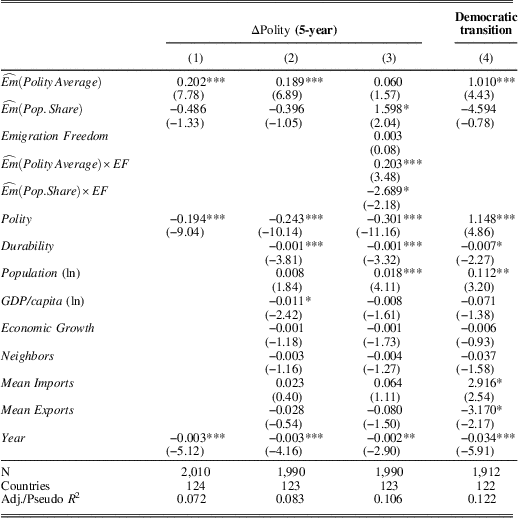
Table 2 displays results predicting democratic change in autocracies. Models 1–3 predict ΔPolity over the succeeding five years and Model 4 predicts democratization within five years.Footnote 124
Models Predicting Democratization

Note: the table displays regressions predicting the five-year change in Polity (Models 1–3) and a probit predicting democratization over five years (Model 4). All models use the sample of autocracies. t statistics (based on two-stage bootstrapped standard errors) are in parentheses. *p<0.05, **p<0.01, ***p<0.001
Consistent with Hypothesis 1, the Polity average of expected emigration targets,  $$\widehat{{Em}}(Polity\:\,Average)$$
, strongly predicts democratic change across all models. Shifting
 $$\widehat{{Em}}(Polity\:\,Average)$$
up its full range increases Polity by nearly one-fifth of its range (Model 2) and multiplies by a factor of seven the likelihood of democratization, from 3.3 per cent to 20.5 per cent (Model 4). Thus, greater emigration to democracies strongly predicts democratization.
Expected emigration as a share of the population,  $$\widehat{{Em}}(Pop.\,Share)$$
, which tracks the economic potential and safety valve effects of emigration, is negative, but not significant, for democratic change in each model. However, the effect size is substantively large. Holding other variables at their means, an additional 10 per cent of the population emigrating lowers the 5-year likelihood of democratization by 6.8 per cent (about one-half proportionally).
We further expect both variables to have a larger effect when EF is most open, since this increases actual flows and thereby magnifies the influence from abroad. Model 3 confirms this by interacting the two predicted variables with EF.Footnote 125 The coefficient on the interaction with  $$\widehat{{Em}}(Polity\:\,Average)$$
is positive and statistically significant, and the interaction with
 $$\widehat{{Em}}(Pop.\,Share)$$
is negative and statistically significant. Thus at higher levels of EF, democracy-focused emigration becomes more democratizing and greater potential emigration becomes more stabilizing. In sum, the results strongly support Hypothesis 1 and provide positive, albeit more mixed, support for Hypothesis 2.
Model 3 also allows us to estimate the conditions under which EF is destabilizing for autocracies, which we argue underlies its determination by regimes. On its own, EF’s coefficient in Model 3 is small and insignificant, implying that any democratizing effect of EF depends on potential emigration flows. Figure 4 displays the estimated marginal effect of EF on Polity change for different values of  $$\widehat{{Em}}(Pop.\,Share)$$
(on the horizontal axis) and three values of
 $$\widehat{{Em}}(Polity\:\,Average)$$
(0, 0.5 and 1). A freer emigration policy most strongly predicts democratic change when the expected receiving states are highly democratic. In contrast, it predicts autocratic stability when these states are autocratic and expected emigration is high.
Effect of emigration freedom on democratization Note: the figure shows the marginal effect of emigration freedom on the five-year change in polity for values of  $$\widehat{{Em}}(Pop.\:Share)$$
(on the horizontal axis) and three values of
 $$\widehat{{Em}}(Polity\:Average)$$
(0, 0.5, and 1), calculated from Model 3 of Table 2. Confidence intervals are omitted for clarity. Emigration Freedom is more destabilizing when expected receivers are highly democratic, but the effect is lessened with a greater expected level of emigration.

An important concern is that the effect of  $$\widehat{{Em}}(Polity\:\,Average)$$
may really be tracking some other form of democratic diffusion, such as contagion from democratic neighbors or through trade networks. To test this possibility, Table 3 shows the results for
 $$\widehat{{Em}}(Polity \,Average)$$
after controlling for other diffusion measures. We capture diffusion using the technique described in Neumayer and Plümper, taking the weighted average of other countries’ Polity scores, with the weights approximating influence.Footnote 126 The top panel extends Model 2 in Table 2 (predicting Polity change) and the bottom panel extends Model 4 in Table 2 (predicting democratization). For each panel, Model 1 controls for the region’s Polity average (excluding the country itself). Model 2 instead uses neighbors’ Polity average, which has been shown to predict democratization.Footnote 127 Model 3 controls for Polity weighted by bilateral trade with each other country,Footnote 128 which proxies for both economic interaction and leverage. Finally, Model 4 includes all three diffusion measures.
Robustness Checks for Democratization Models

Note: the table displays robustness checks for the effect of democratic receiving countries on the five-year change in Polity and democratic transition. All models use a sample of autocracies. t statistics (based on two-stage bootstrapped standard errors) are in parentheses.* p<0.05, ** p<0.01,*** p<0.001
 $$\widehat{{Em}}(Polity\:\,Average)$$
remains significantly positive in all eight models. None of the other diffusion measures is robustly positive, although Neighbor Polity predicts Polity change. Regional Polity does not approach significance, and Trade-Weighted Polity, surprisingly, is negative in all models. Importantly, Neighbor Polity is strongly positive for democratization if
 $$\widehat{{Em}}(Polity\:\,Average)$$
is removed, suggesting that previous findings on democratic contagion may in fact be driven by migration flows. This is consistent with Levitsky and Way’s perspective that democratic diffusion is encouraged not by geographic proximity, but by substantive interaction and linkage with democracies.Footnote 129
Emigration Freedom
What determines how autocrats set emigration policy? Table 4 displays ordered probit results predicting Emigration Freedom (EF) in autocracies. Model 1 includes the main predicted emigration variables, plus Polity, Regional Polity and Trade-Weighted Polity. Model 2 adds interactions between Polity and two predicted variables. Model 3 adds variables testing for economic motives for emigration. Model 4 adds the remaining controls. We predict that EF will be lower when it predicts democratization (values above 0 in Figure 4) and higher when it predicts autocratic survival (values below 0 in Figure 4).
Ordered Probits Predicting Emigration Freedom

Note: the table displays ordered probits predicting Emigration Freedom in autocracies. t statistics (based on two-stage bootstrapped standard errors) are in parentheses. *p<0.05, ** p<0.01, *** p<0.001
The results clearly support this prediction. The coefficient for  $$\widehat{{Em}}(Polity\:\,Average)$$
is significantly negative for EF, implying that autocracies restrict emigration when their citizens are likely to move to democracies. In contrast, Regional Polity and Trade-Weighted Polity are positive, showing the distinct effect of expected emigration destinations. Further, Models 2–4 find a significantly positive interaction with the sender’s Polity level, confirming Hypothesis 3. To interpret this, Figure 5 displays the likelihood that EF equals 0 (the maximum restriction) given
 $$\widehat{{Em}}(Polity \,Average)$$
and two values of sender Polity. When Polity is at its minimum, shifting
 $$\widehat{{Em}}(Polity\:\,Average)$$
up its full range increases the likelihood that EF equals 0 by 37 per cent. However, this effect disappears for higher Polity. Thus, the most repressive dictatorships sharply limit emigration if citizens will move to democracies, but liberalized autocracies do not. This helps explain the freedom of emigration in autocratic Mexico and Taiwan. Both experienced large-scale population exchange with the United States, but did so as electoral autocracies that were not as threatened by democratic ideas.
Effect of emigration targets on emigration freedom Note: the figure shows the estimated likelihood that Emigration Freedom = 0 (the lowest value) given the Polity average in expected emigration receivers ( $$(\widehat{{Em}}(Polity\:Average))$$
) and the sender’s Polity level, calculated from Model 4 of Table 4. Polity scores are rescaled from 0 to 1; the average among autocracies is about 0.3. When likely emigration receivers are more democratic, the most repressive autocracies sharply restrict emigration freedom.

Expected emigration,  $$\widehat{{Em}}(Pop.\,Share)$$
, is significantly and positively predictive of EF in all models, confirming Hypothesis 4. For Model 1, expecting an additional 10 per cent of the population to emigrate decreases the likelihood that EF equals 0 by 20 per cent. Thus, autocrats recognize the danger of democratic influence, but are persuaded to open their borders by the economic and safety valve benefits of emigration.
Both of these effects – the positive of expected emigration and the negative of democratic receivers – are logically consistent with the findings on democratization. The same characteristics that predict democratization also lead autocrats to restrict emigration in response. We can further demonstrate this using the estimated marginal effect of EF on Polity change (plotted in Figure 4). When the anticipated marginal effect of EF is positive – meaning freer emigration predicts democratization – EF is fully restricted 30 per cent of the time. When the anticipated marginal effect is negative – meaning freer emigration should be stabilizing – this drops to 3 per cent.Footnote 130
As a final piece of causal evidence, we conducted several placebo tests, replacing Emigration Freedom as the dependent variable in Model 4 with measures of freedom of speech, association and religion.Footnote 131 Although these may be affected to some degree by migration and its consequences, we expect the link with EF to be strongest. Confirming this helps prove that our results are not spurious. Note that in Model 4 five of six coefficients on our predicted variables are significant for EF. In the placebo tests, by contrast, only two of eighteen total coefficients are significant.Footnote 132 The distinct relationship with emigration freedom is clear.
The results for the controls further support economic motives for freer migration. Confirming Hypothesis 5,  $$\widehat{{Em}}(GDP\,/\,capita\:\,Average)$$
is strongly positive, implying that autocratic leaders are more open to their citizens traveling to wealthier countries (controlling for their democracy level) due to the economic returns. Shifting the average income of expected receivers from $1,000 to $10,000 decreases the likelihood that EF equals 0 by 15 per cent. Further, Labor Force is positive, indicating that surplus labor encourages freer emigration.
 $$\widehat{{Em}}(EF\,Average)$$
is strongly positive, suggesting a diffusion effect or deliberate coordination of migration policies. Polity is positive in Model 1, concurring with Breunig et al. that more democratic countries allow freer emigration.Footnote 133 Surprisingly, more populous countries have stricter emigration policies. Year is negative, indicating a slight tightening over time in autocracies.Footnote 134 Finally, trade has no effect.
Extensions
We now consider several extensions to the above tests.Footnote 135 First, do autocratic regime types matter? We interacted several autocracy categories (military, single-party and personalist) with predicted emigration. For democratic change, total emigration has its largest stabilizing effect in personalist regimes, which also tend to be the most repressive. Democracy-focused emigration is democratizing in all regimes, with the strongest effect in military dictatorships. For emigration freedom, single-party regimes (especially communist dictatorships) have the tightest policies and the strongest reactions to democracy-focused emigration.
Secondly, how does emigration relate to other types of regime change? Autocratic leaders worry about more than democratization, as most regime breakdowns are initiated by other elites. We analyze this by predicting non-democratic regime breakdowns and irregular executive turnovers (mainly coups). We find that democracy-centered emigration has the same destabilizing effect, predicting both breakdowns and irregular turnovers. Total emigration is insignificantly positive for regime change and irregular turnover.
Thirdly, what is the effect of immigration rather than emigration? We extended our results by predicting immigration stocks, again using the World Bank data. Since these are highly correlated with predicted emigration stocks, they display similar results when tested alone: more democratic immigrants predict democratic change and less emigration freedom, while higher expected immigration predicts the opposite. However, when immigration and emigration are tested together, democracy-focused emigration has a greater effect on democratic change and only emigration robustly predicts Emigration Freedom.
Fourthly, what is the effect of actual emigration flows? We replicated all of our measures using actual rather than predicted emigration. Since this is highly endogenous to emigration freedom, democracy and the policies of receiving countries, the results must be interpreted carefully. In particular, predictions for Emigration Freedom are unsound due to reverse causation. However, the results for democratic change are broadly supportive. Using either stocks or flows of emigration, average democracy in receiving states is significantly positive for democratization. The total emigration rate is mostly null, which is consistent with our argument that autocrats strategically adjust emigration flows.
Lastly, how do democracies differ? Using the same predictive strategy, we find that both democracy-centered emigration and expected emigration totals strongly promote democratic survival. The positive effect of democracy-centered emigration on Emigration Freedom, the opposite of that in autocracies, implies that regimes generally prefer that their citizens are exposed to similar regime types. As a result, democratic leaders can embrace the economic returns of emigration, which helps to prevent backsliding.
CONCLUSION
The number of international migrants has more than doubled from ninety-two million in 1960 to more than 200 million today,Footnote 136 with forty-two million emigrating between 2005 and 2010 alone.Footnote 137 Yet we have little understanding of the effect of emigration on politics in sending countries. Most migration scholars examine immigration policies or immigrants’ effect on receiving countries. Other scholars examine how emigration affects local communities and the economy, but rarely regime-level politics.Footnote 138 In this article, we have studied how emigration affects regime type and how autocrats determine emigration policy.
We argue that emigration is a double-edged sword for autocratic leaders. Emigration provides economic benefits and helps to expel potential dissidents, but emigration to democracies is problematic as emigrants learn the advantages of democracy and gain tools to take down the regime. Our results confirm that greater economic emigration predicts autocratic stability, whereas citizens emigrating to democracies predict democratization. Among other implications, this elucidates a clear mechanism for the local diffusion of democracy. In response, autocracies strategically determine emigration freedom given these dangers – greater total expected emigration predicts a freer policy, while democracy-focused emigration predicts the opposite. In general, where migrants move has as much influence as the level of migration.
The strategic choice of emigration policy highlights an institutional tool of autocratic resilience that the autocracy literature has overlooked. Yet as it represents only one tool in a larger toolkit, future work should consider how emigration policy bolsters other techniques of control (such as limits on internal movement)Footnote 139 and substitutes for harsher forms of repression. Future work can also examine how our findings vary with domestic conditions, such as youth bulges, labor repression and elite coalitions. Lastly, scholars can adapt our framework to examine how autocratic leaders strategically manipulate policies governing trade, capital and investment flows.
Our results also help explain the modern shift toward freer emigration in many autocracies, a marked change from feudalism and totalitarianism. The primary motive behind this, we argue, is the growth of economic opportunities abroad, encouraged by easier travel and economic exchange. The pull of globalization has led many modern autocracies to open their borders, but as an unintended consequence, this has facilitated the spread of democratic ideas. Thus, our article illuminates a world-historical shift connecting economic globalization, population exchange and democratic diffusion.
With the steady rise of global economic exchange and transportation technologies, migrants will likely continue to facilitate democracy’s spread. In response, autocrats may attempt to crack down on emigration, especially to democracies, or on communication between emigrants and their families back home. In addition, many democracies are increasingly prioritizing high-skilled immigration. Thus, we may see rising restrictions on migration from both sending and receiving countries, which would limit one of the most powerful poverty reduction tools available today.
These findings suggest that developed democracies have yet another reason to open their doors to immigration. Whereas domestic politics has been pushing democracies toward restrictions, both economics and a desire to spread democracy caution against this. Not only can greater immigration increase economic growth, it can effectively spread democratic norms and capacities. The implication is a more effective and much less expensive way to foment regime change than our current policies.