It's like a—home factory.
I put my faith in capitalism, you know.
This is the new age,
the information age.
—Jaroslaw, Time to Burn Footnote 1During his first mayoral campaign in January 1989, Richard M. Daley insisted that “Everybody talks about bringing manufacturing back. There aren't going to be any more soap factories on Clybourn Avenue[.] … The city is changing. You're not going to bring manufacturing back.”Footnote 2 Although this was a controversial statement at the time and Mayor Daley later embraced promanufacturing policies, it reflected an awareness of a fundamental economic shift in Chicago. By the late 1980s, the city had lost over half of its post–World War II manufacturing jobs, and companies were continuing to leave the city for more space, lower taxes, and a less expensive labor force.Footnote 3 In fact, only months after Daley's comments, Procter & Gamble announced that it would close its fifty-nine-year-old soap plant at 1232 West North AvenueFootnote 4 on the North Branch of the Chicago River, eliminating 275 manufacturing jobs in the process.Footnote 5 Deindustrialization was under way, causing anxiety for politicians and pain for factory workers, but a new economy that was focused on real estate, finance, and culture was emerging in Chicago.
Only blocks away from the old Procter & Gamble plant, one piece of the new culture economy, the Steppenwolf Theatre Company, was preparing to open a new $8 million theatre at 1650 North Halsted Street in 1991.Footnote 6 This move, by a theatre company that had rented or borrowed spaces in small storefronts for more than a decade, represented the beginning of a new phase in Chicago theatre. Some of the companies that grew out of the Off-Loop movement that began in the late 1960s were becoming powerful forces in the cultural and economic life of the city, drawing tourist spending and attracting an educated workforce. By 2002, Chicago's nonprofit theatre industry, including Steppenwolf, was producing an annual economic impact of nearly $3.5 million.Footnote 7 As a part of a broad shift from a manufacturing-based economy to a residential-, financial-, and commercial-based urban economy, amenities, such as theatre, became a crucial part of a strategy to attract young professionals and creative industries to Chicago, a strategy that Terry Nichols Clark has labeled the “entertainment machine” model of urban redevelopment.Footnote 8 This strategy was implemented through the consolidation of the nonprofit theatre sector, but it also included the city's subsidized rehabilitation of old commercial theatre buildings in the Loop, Chicago's central business district, to create a spectacular new North Loop Theater District.
This article examines Steppenwolf's 1997 production of Charles L. Mee's Time to Burn as a play that mourns the loss of manufacturing work in Chicago. I argue that theatre companies play an essential role in the city's postindustrial economy. Set against Chicago's ongoing deindustrialization, the play raises the specter of a city without blue-collar jobs and provides a dystopian representation of the late twentieth-century urban economy. In this city, unskilled workers are left behind to make uncomfortable homes in abandoned factories. Even these homes are temporary, though, as deserted industrial spaces are converted into high-end condominiums and urban playgrounds for the young and wealthy professionals of the creative economy. This bleak representation stands in sharp juxtaposition to the economic fortunes of Steppenwolf and other Chicago theatres that found a central role in the new economic order. In this context, Steppenwolf's production of Time to Burn reveals a deep anxiety about the ways the company benefited from this social change while working to maintain its relationships with diverse artistic and urban communities. This essay tracks the contours of this tension by moving from the geography of unemployment represented in Mee's play to an analysis of the ways theatre companies helped reinvent Chicago at the end of the twentieth century.
Performing Postindustrial Decay
Time to Burn represents the disenfranchised margins of a postmanufacturing urban economy, in which cities magnetically pull individuals together and dreams confront cruel economic realities. In this theatrical world, an abandoned factory serves as a temporary home for individuals with no other options. In the moments between the loss of manufacturing jobs and the inevitable development of trendy loft condominiums, Mee imagines the discarded ruins of industrial work as a place where new communities can form. It is a city where immigrants, the unemployed or underemployed, the homeless, the sick, and other social outcasts make a temporary home in the basement of an abandoned factory. The published text of Mee's play begins with these ruins and two words: “Nighttime” and “America.”Footnote 9 Although the action of the play takes place in a single urban location, we are asked to read this place as America. In this metonymic substitution, it is clear that Mee is aiming for an ambitious representation of the United States at the end of the century. The fact that the play opens at night suggests that we are to see the twilight of empire, the end of America, or at least the end of the American Dream.
After placing us in America, and giving us “the sound of water dripping into buckets here and there,” a visceral symbol of decay and deterioration, Mee takes us on a cinematic tour of the factory/stage: “We are moving very slowly in darkness / through a vast, dead, peeling, rusting, leaking, / disintegrating factory building.” On a dimly lit stage, we begin to notice “huge, useless, abandoned nineteenth- / century machines—big incomprehensible things / no longer capable of giving employment to anyone.”Footnote 10 This reference to employment previews a recurring discussion of work in the play, and it begins to personalize the space—it is a place where people used to work. Zooming in from the vast scale of the abandoned factory, the floor of the building comes into focus: “In the center of this vast room are two rows of cutting tables— / steel frame tables with wooden work surfaces worn smooth— / on which workers once produced things.”Footnote 11 Finally it becomes clear that the space is populated: “Now we see, as we move very slowly through the darkness, / that a dozen or so people are sleeping on these tables.”Footnote 12 This silence and slowness characterizes the space, and the rest of the play is punctuated with extended silences. As the sun rises in the small windows near the ceiling of the factory, the inhabitants wake and the play begins.
This stark image of postindustrial America gathers together the threads of a play that dwells in a space that is out of time. The factory of Mee's play, the engine of an old economy, is helplessly useless in the late twentieth-century city. It is no place worth occupying. The first characters we meet are relics of now-ancient technologies: the tools of industrialization. There is no mistaking their inability to offer employment; there is only a trace of history—“workers once produced things.” The cutting tables are now bunks for the disenfranchised. The factory has been transformed into a lodging house for recent immigrants and social dropouts, victims of capitalism's intensified deployment of creative destruction. In some ways, the plot of Time to Burn is inconsequential. Characters enter and leave the factory, they fight and sing and celebrate, they live and they die, but throughout we are given moments of human encounter, shared moments of hope and despair.
In the play's 1997 Steppenwolf production, director Tina Landau layered the urban landscape of Time to Burn onto the North Side of Chicago. The set, designed by James Schuette, transformed the exposed concrete and steel of the theatre's proscenium stage into a realistic representation of the factory Mee imagined. It was a subterranean space, the basement of a building with rusting stairs on either side of the factory floor, one set leading to the street above and the other terminating in a landing that connects the factory to the landlord's living quarters. The exposed brick wall at the back of the stage, with its small, street-level windows far above the floor, drew an imposing boundary around the space that suggested a prison as much as a factory. The spent and still appearance of the stage reached out to the audience as soot and stink. One reviewer commented on the “[r]ising dust and obnoxious odors” that “assault the audience” as they enter the theatre space.Footnote 13 Another noted, “You smell the fire from the moment you take your seat amid the smoke emanating from an onstage trash can.”Footnote 14 Through this set design, the production created an alternative urban space, a second Chicago superimposed on the corner of North and Halsted on the edge of the so-called Clybourn Corridor.
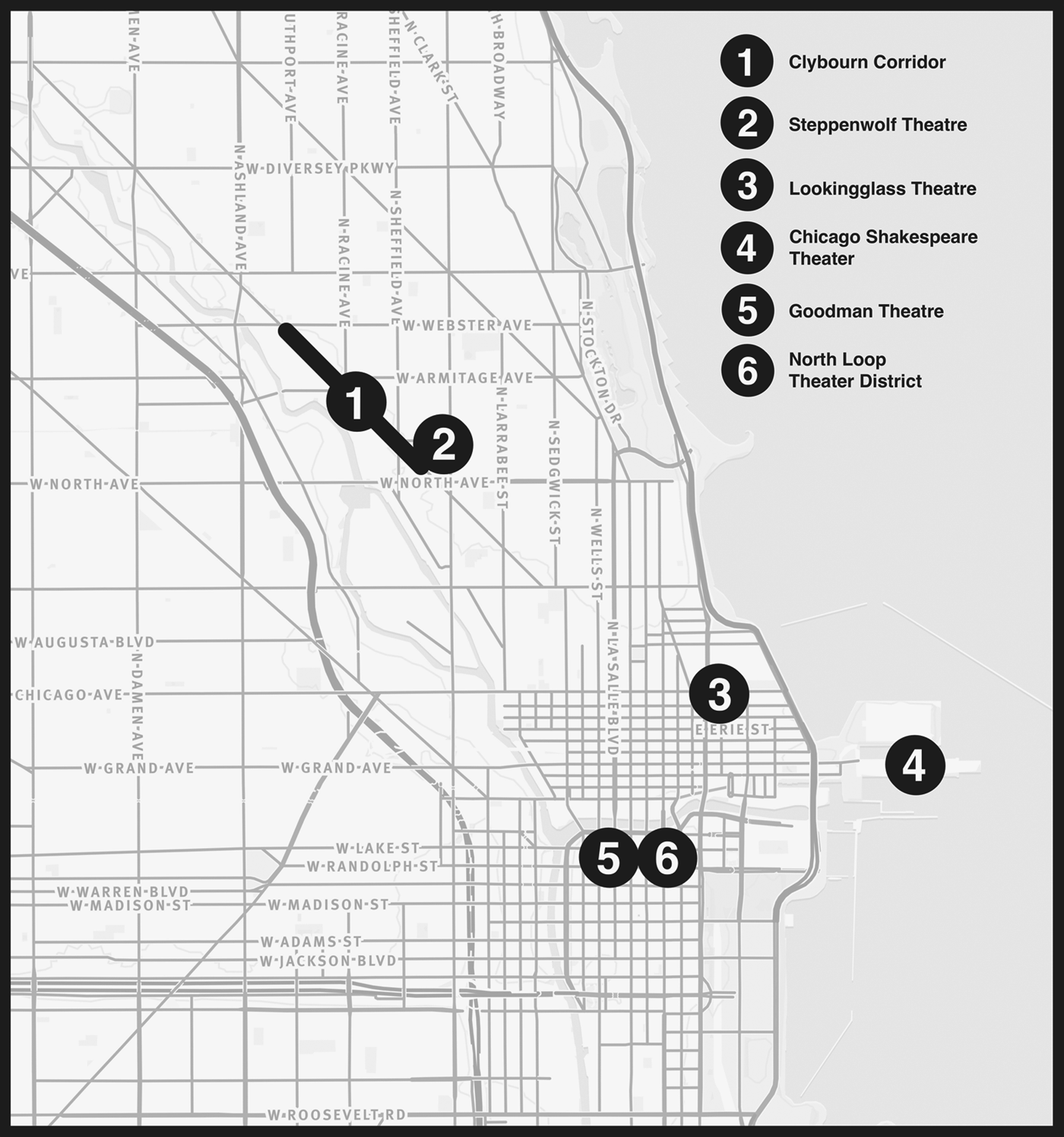
When Steppenwolf produced Mee's drama, a revision of Maxim Gorky's 1902 play The Lower Depths, at their new theatre near the corner of North and Halsted in Chicago, it enacted a vision of the city that closely reflected the neighborhood's recent past. A part of Mee's (re)making project, an ongoing series that reworks and recontextualizes Western history, the play transforms Gorky's depiction of the end of the Russian aristocracy into a critique of the declining social and physical infrastructure of Chicago. Although Steppenwolf's neighborhood is now home to a sparkling Apple Store and a massive new Whole Foods Market, the theatre was built in a historical industrial area on the east bank of the North Branch of the Chicago River. For much of the nineteenth and twentieth centuries, factories lined the stretch of Clybourn Avenue that runs northwest along the river from North Avenue to Webster Avenue (Fig. 1). Joel Rast explains that the area was part of a ring of industrial zones around the Loop that, as late as the 1950s, “provided nearly 25% of Chicago's manufacturing jobs.”Footnote 15 By the end of the 1970s, though, new investments in the Loop made the factory buildings in these districts, such as West Lincoln Park, “desirable properties for alternative uses, as living space for downtown office workers and back office space for downtown businesses.”Footnote 16 The combination of growing commercial and residential demand and the higher taxes assessed on properties zoned for nonindustrial use, Rast argues, “played a key role in the mass exodus of manufacturing firms from the near-downtown area” in the 1970s and 1980s.Footnote 17 Procter & Gamble was pushed out by these pressures in 1989, which opened the door for further residential development and for restaurants, cafés, and other amenities, such as theatres.
Map of the Clybourn Corridor in relation to four Chicago nonprofit theatres that were constructed in the 1990s and early 2000s, and to the North Loop Theater District. Created with Mapbox and OpenStreetData.

During his tenure as mayor of Chicago from 1983 to 1987, Harold Washington, his administration, and other civic leaders initially resisted this change. Marketed as the Clybourn Corridor, the neighborhood was rezoned as a planned manufacturing district (PMD) where city planners hoped to preserve the few thousand remaining manufacturing jobs housed in factories along the North Branch of the Chicago River.Footnote 18 However, the PMDs only slowed the loss of manufacturing jobs. Once a critical mass of industrial companies left the area, residential and commercial development, including the construction of Steppenwolf's new theatre, finished the process. In a 1987 Chicago Tribune article, reporter John McCarron described a “rush to convert inner-city factory buildings into loft apartments and trendy boutiques.”Footnote 19 He explained that although there were still twenty thousand manufacturing jobs in the area, “one by one, factories along Clybourn, some vacant, some not,” had been “snapped up by developers for conversion into apartments, indoor shopping malls, and loft-style offices.”Footnote 20 One of the first conversions was the 1985 development of an abandoned piano factory at 1872 N. Clybourn Ave. into the Clybourn Lofts, which featured lofts “complete with rooftop sun deck, overlook[ing] two scrap-metal yards, a soap factory and a steel mill.”Footnote 21 Mary Sue Crawford, the president of the owners’ association, reported that she loved living there despite “the noise. The smell from the soap factory. And [that] you have to dust every day.” As she explained in the article, “It's a unique space in a unique place. When company comes, we take them to see Finkl Steel.”Footnote 22 Ben Joravsky explains in the Chicago Reader that the neighborhood quickly “became home to upscale stores, restaurants, small malls, movie theaters, even an outdoor beer garden that overlooks a scrap yard.”Footnote 23 While businesses and real estate developers rushed to invest in these riverfront properties, the neighborhood's new residents enjoyed the adventure of so-called industrial tourism, a theatrical urbanism to match the professional theatre on Steppenwolf's stage.
Real estate developers such as Owen Deutsch believed that turning factories into condominiums was the way to revitalize Chicago. As Deutsch explained to McCarron, “this city is full of empty industrial buildings.”Footnote 24 Developers believed that they were “turning obsolete hulks into a big economic plus.”Footnote 25 Factory owners and community activists, however, were more concerned about jobs. Like others, Donna Ducharme, the executive director of the Local Economic & Employment and Development (LEED) Council, notes McCarron, was “alarmed at the city's steady loss of well-paying, unionized jobs and by the simultaneous increase in what they call ‘McJobs’: low-paying service-sector work as a waitress or store clerk, jobs that often pay the minimum wage.”Footnote 26 This was a struggle that pitted young professionals against blue-collar workers. McCarron describes the situation in a 2007 article on the failures of the PMDs to retain industrial businesses:
The late '80s were a time when Chicagoans came to grips with our global, postindustrial future; when employment data showed that the city had lost half its manufacturing jobs during the previous two decades; when, on a cold winter morning, hundreds of the displaced queued up on a sidewalk to apply for work as dishwashers and maids at a fancy new convention hotel.Footnote 27
These were the workers who might have ended up in Mee's factory in Time to Burn.
In this socioeconomic space of the play, where manufacturing jobs have moved offshore or south of the border while downtowns are rebuilt as entertainment districts and shopping centers, we meet those who cannot adapt or who choose to resist. Like the factory itself, these characters are worn, broken, and discarded. They have come to the city, and the factory, from around the world: the Midwest, Mexico, Poland, Eastern Europe, Brazil, Boston, Greece, and Thailand.Footnote 28 They are political refugees, undocumented immigrants, thieves, drug-addicted actors, bag ladies, destitute aristocrats, transvestites, the poor, the elderly, the sick, and the broken survivors of a city without jobs or compassion. This multicultural ensemble emphasizes the multiple levels of cultural difference at play in the hierarchies of global capitalism, but it also works to level difference as the characters struggle to meet the basic needs of human existence.
Throughout the play, we are reminded of the durability—and the fragility—of bodies and the ways that embodiment shapes these characters’ desires, motivations, and actions. The characters’ bodies are on display throughout the play—coughing, stretching, sleeping, fighting, injecting, embracing, and so forth. This attention to bodies was often emphasized during the production through the use of spotlights that illuminated a specific gesture or movement while the rest of the cast momentarily froze. In this way, the physical action of the play was given a poetic language that communicated in addition to, or beyond, the spoken dialogue. One such scene occurs late in the play, when Nguyen, the Thai sister-in-law of the factory's owner, announces from the top of the stairs, “I'm going to turn on the water!” She says they have two minutes. At this, the group begins to remove their clothes and gather under an overhead pipe in one corner of the factory. Mee describes the residents taking a shower “in what must be reminiscent of a prison scene.” Here, the broken bodies of the ensemble are revealed: “Our gaze lingers on each one, stripped naked; / There is no prurient interest here, / Just an interest in human individuality, / And in sagging, out-of-shape human flesh. / There should be something of sadness about this.”Footnote 29 During this time, there is no scripted dialogue. Our attention is focused on a small part of the stage, and we again are confronted with broken bodies engaged in a task that is both mundane and imbued with heightened importance. It is a human moment that captures the characters’ desperate situation, but also their will to carry on.
This concern with broken bodies runs throughout Mee's work. Raised in the suburbs of Chicago in the 1940s, Mee has made a career out of assembling performance texts from the “shattered and fucked up” wreckage of Western civilization.Footnote 30 Drawing on his personal experiences as a polio survivor confined to a wheelchair and his brief career as a twentieth-century historian, Mee's plays focus the aftermath of wars, family crises, and economic disasters. As Erin Mee, Charles's daughter and an acclaimed theatre artist, argues in a special issue of TDR on her father's career, finding meaning in the aftermath of crisis has been a central part of Mee's work as a playwright. She explains, “At this point, when civilization is in ruins, when so many rules have been broken, out of the wreckage, out of the chaos, rise the performance pieces: beautiful, quirky, unique expressions of humankind.”Footnote 31 Thus, we can read the abandoned factories and disordered homes of plays such as Time to Burn as representations of a kind of American ruins and the playwright as a theatrical and cultural outsider who is determined to make beauty, if not order, out of the brokenness of contemporary society. In “Collage Reality (Re)Made,” Kara Reilly uses this idea of brokenness to theorize Mee's work as a postmodern response to Walter Benjamin's modernist angel of history. Whereas Benjamin's angel sees history as “one single catastrophe, which keeps piling wreckage upon wreckage,” Mee writes history by pulling shards from the wreckage and recontextualizing them in theatrical collages.Footnote 32 In doing this, he both acknowledges and celebrates the destructive forces of history. Mee works to make something that is new but is not disengaged from history. His playwriting is about the process of picking through the shards and ruins to make new plays and to point the way forward for new communities. In Time to Burn, this is the project that the residents of the abandoned factory must confront.
We can see Mee's characters making meaning of the shards and ruins of their own histories in depictions of their damaged bodies and in the things they possess. The first interactions between the characters that we see at the beginning of the play are between Billy, a thief and the play's would-be protagonist, and Jessie, an elderly black woman. As the sun rises, Billy returns to the factory. He silently makes his way past his sleeping neighbors to his bunk and empties his pockets of the night's spoils: “some small tools, / a cluster of keys, / and a handful of jewelry.”Footnote 33 Billy soon notices that he is being watched by Jessie, who asks about his jewelry and whether he would like any of her things. She then proceeds to offer an inventory of her possessions. She produces a watch, a tortoiseshell comb, a barometer, an almanac, seashells, a tweezers case, silk garters, and a snuffbox, among other objects (255–6). As Mee notes in the stage directions, “JESSIE is lost in a world of objects, of commodities, yes— / each one precious to her— / but more than that, lost in objects of the past, of a former life, / of history” (257). These are the accumulated debris of people's lives, the fragments that Mee works to reassemble and recontextualize. Jessie explains that “this is the stuff of life on earth” (257). When Billy refuses to take anything because he does not “have any place to keep them,” Jessie is offended. She suggests that her things are “not in fashion” or “just trash” (258). This conversation, which takes several minutes, establishes another thread that runs throughout the play. Like the damaged characters who make a life with each other in the basement factory, the objects they have, and those they have lost, provide markers or references to other lives that are no longer possible.
Once Billy and Jessie wake the rest of the tenants with their conversation and Raul appears with his barbecue grill, we are introduced to the central conflict in the play. When he hears the grill rattle down the stairs and over the railing to the factory floor, Vinnie Pazzi, the landlord of the building, appears at the top of the stairs opposite those that lead to the street. He is an Italian American who “wears yellow rubber gloves (at all times), / polyester satin alligator-patterned trousers, / and a black see-though polyamide tank top, / and sunglasses” (261). This description of grotesque attire indicates that although he is relatively economically secure, Vinnie also exists on the margins of society. He quickly asserts his authority in the factory, though, asking “What's this goddam noise?” and “did you think you'd wreck the place?” This interrogation quickly becomes a series of threats: “You think it can't get worse? / You think I can't get tenants who would appreciate a warm place to sleep? / You people. / A few bucks a month and you think you're being gouged” (261). It is clear that this is an antagonistic tenant–landlord relationship, but it is equally clear that Vinnie works hard to maintain a social distance. In referring to the other characters as “you people,” he erases his likely immigrant status and groups them, despite their differences, as unsavory others. When he refuses to allow a barbecue in the factory, though, Billy objects.
The conflict between Billy and Vinnie is the primary tension in the play, and it leads to much of the action. When Vinnie orders Raul to “pick this junk up and get it out of here,” Billy asserts, “Wait a minute. / [Silence] / The barbecue stays” (262). Vinnie protests, but Billy reveals that the landlord has been involved in selling the thief's stolen goods for him and that he is behind in payments. The division between Vinnie and his tenants, then, is not as clear as it initially seemed. Vinnie tries to continue their conversation in private, but Billy refuses, noting that “I'm busy here, as you can see.” Now on the offensive, Billy presents an alternative set of rules: “Meanwhile, the barbecue stays. … So long as you do whatever you want we will do whatever we want. … And you need to learn to speak to us with some respect” (263). For a moment, Vinnie is silenced, but he quickly turns to attack a weaker target.
Jaroslaw Kacewicz is a Polish immigrant with a dying wife. He is an outsider in the factory community, but he continually asserts his belief in America and capitalism. Much of the play's discussion of work flows through his character, and it is in this direction that Vinnie moves when he is cornered by Billy. In this exchange, Vinnie is stunned to realize that Jaroslaw is using the abandoned factory for work:
Vinnie Pazzi: And you Mister Kacewicz,
I speak to you with all respect,
what is this around your bunk?
Jaroslaw: What?
Vinnie Pazzi: All this shit?
Jaroslaw: All this is my work.
I manufacture computer components.
Vinnie Pazzi: Here?
On my premises?
Jaroslaw: Well, yes.
It's like a—home factory.
I put my faith in capitalism, you know.
This is the new age,
the information age.
People can work from their own homes.
Vinnie Pazzi: Oh, good.
If you're taking up such space for a commercial enterprise,
I guess I'll have to raise your rent.
Say another ten dollars a month. (264)
In his description of late twentieth-century capitalism as “the information age” and in his participation in the production of computer components, Jaroslaw recognizes and embraces the economic forces that have pushed him to the edge of survival. He is an entrepreneur who tries to exploit the spatial collapse of home and work. Vinnie, though, is equally adept at the rules of business. By demanding commercial rent, even though he knows that Jaroslaw is unable to pay it, he demonstrates that ownership of the means of production still matters. When Billy steps up to plead “You know, he doesn't make any money at it,” Vinnie is unmoved: “Well, that's none of my business, is it. / How well you do, what profit comes your way, / that's up to you, isn't it?” (265). He argues that “In the next world, / we'll all be equal” but that the current arrangement “is, in a certain sense, beyond my control” (266). With that assessment of the economic system Vinnie leaves, and Billy offers another vision. He suggests that Jaroslaw should not have to “pay the whole barbecue tax” himself and insists that everyone will “chip in” to pay for his commercial rent (266). This dialectic between cutthroat capitalism and communal responsibility works as the key—and unresolved—tension in the play, reflecting both Mee's political critique of the new economy and Steppenwolf's ambivalence about its position within it.
Building the Entertainment Machine
While Mee's play offers a vision of the perpetual urban underclass, the fortunes of many Chicago theatre companies in the 1990s paint a picture of an emerging creative economy—one in which educated professionals, rather than blue-collar workers, play a pivotal role. The dynamic relationship among culture, the arts, and economic growth that made theatre a crucial component of the project to revitalize Chicago's urban core has been well documented in sociological research. In Neo-Bohemia, for instance, Richard Lloyd argues that emerging artistic scenes helped transform struggling Chicago neighborhoods into thriving (and gentrified) centers for youth consumer culture in the 1990s. He explains that in the context of a growing “leisure economy,” city policies helped integrate decaying “former industrial neighborhoods” into an “entertainment machine,” “satisfying consumer demands made by a young, relatively affluent, and well-educated workforce.” In this way, these neighborhoods have “less in common with the manufacturing that once dominated” the outlying neighborhoods of Chicago “than it does with Hollywood—it is a culture industry, and the contributions made by its workers are significantly, but not only, aesthetic.” Lloyd reads this transformation as the result of the “ongoing decline of heavy industry in U.S. cities” and an accompanying “increase in the scope and impact of tourism and consumption on urban fortunes.”Footnote 34 This economic history suggests that theatre not only supports creative urban communities but also attracts investment and tourist dollars to the city. In an analysis of the relationships between amenities and urban growth, Terry Nichols Clark and his colleagues provide data to support this claim. They argue that Chicago's “number one industry has become entertainment, which city officials define as including tourism, conventions, restaurants, hotels, and related economic activities,” including live theatre.Footnote 35 Through this transformation, the city's theatres were positioned to play a significant role in the redevelopment the city.
For Steppenwolf, the rise of the culture economy offered an opportunity for the company to reflect on its accomplishments and reinvent itself for a new social position. By the end of the 1980s, Steppenwolf was capitalizing on its reputation—a carefully constructed and defended mythology—as a youthful, aggressive, and groundbreaking ensemble company and was establishing itself as one of the primary players in Chicago theatre. Founded in 1976 as part of a second wave of Off-Loop theatres, Steppenwolf built its reputation through a series of energetic and irreverent productions. Richard Christiansen, the theatre critic for the Chicago Tribune during this period, describes the “gonzo” or “rock ‘n’ roll theater” style that Steppenwolf became known for as “a huge, raw outpouring of energy, slammed across with take-no-prisoners force.”Footnote 36 The company's early work, he explains, combined the intensity of a rock concert and the “energy and arrogance of youth” with “gritty, edgy, contemporary works.”Footnote 37 This grittiness and edginess came to stand in as the so-called Chicago style in subsequent decades as other companies emulated Steppenwolf's particular kind of realism. After beginning as a group of friends staging shows in a church basement and other temporary spaces in the 1970sFootnote 38 and gaining local and national attention in the 1980s, including the 1985 Antoinette Perry Award for Regional Theatre Excellence,Footnote 39 Steppenwolf entered the 1990s with momentum.
In 1991, the company built its current home at 1650 N. Halsted in the Clybourn Corridor. The company spent more than $8 million, which was raised from private donors and public subsidies, on the new theatre.Footnote 40 The new complex, which eventually included three separate performance spaces, was “comfortable, utilitarian, and user-friendly … containing an acoustically sound five-hundred-seat auditorium with a Broadway-size stage.”Footnote 41 This was the moment when Steppenwolf asserted its strength as a cultural institution and negotiated a new relationship with city government that included economic subsidies, cultural ambassadorships, and public–private partnerships. Instead of working on the margins of the city in rented storefronts, Steppenwolf was building an alliance with Mayor Daley's administration and contributing to the economic revitalization of the city. By the end of the 1990s, the company had an annual operating budget of $8.3 million and had helped anchor the redevelopment of the West Lincoln Park neighborhood.Footnote 42
In this context, Steppenwolf's production of Charles L. Mee's Time to Burn can be read as a response to the company's new critical and economic success and a reflection on the consequences of a social transformation that assisted young, white-collar professionals at the expense of Chicago's working class. The production also marks an artistic turning point for the company. In the mid-1990s, Steppenwolf partnered with Mee and Tina Landau, who directed the world premiere of Time to Burn in 1997 and, during the following season, Berlin Circle, a revision of Brecht's Caucasian Chalk Circle, itself an adaptation of an ancient Chinese fable, set amid the fall of the Berlin Wall. This fruitful collaboration was an opportunity for Steppenwolf and Landau to explore and critique the company's newfound status as a cultural institution in Chicago. Landau was well positioned for the opportunity. The director had worked on the Viewpoints system with Anne Bogart and was developing a national reputation.Footnote 43 Mee had previously worked with Landau on site-specific outdoor productions for En Garde Arts in New York City, including Orestes in 1993 and The Trojan Women: A Love Story in 1996.Footnote 44 In 1996, Mee was invited to work as a Resident Artist at Steppenwolf, and his collaboration with Landau resulted in Time to Burn, a play that Christiansen hailed as “one of the most carefully staged, and most complex, productions in Steppenwolf history.”Footnote 45 In this moment, Steppenwolf shed its early reputation for gritty and intense storefront theatre and emerged as a world-class theatrical institution, one that was aware of its place in the culture economy and the ways it was changing the city.
While Steppenwolf was working through its changing role in the city, other theatre companies, theatre buildings, and arts organizations in Chicago continued to grow and expand. This expansion was driven as much by financial support from city government and the economic elite as by consumer demand. In the introduction to a special volume of Research in Urban Policy on “The City as an Entertainment Machine,” Terry Nichols Clark explores ways that city governments can productively shape urban economies to capitalize on the economic power of cultural institutions. Recognizing that the entertainment machine model of urban growth can be nurtured and exploited, the mayors of major American cities have focused on “consumption, amenities, and culture as drivers of urban policy.”Footnote 46 Through a series of articles and discussions, Clark's collected work advances a clear thesis: “To grow and compete with cities globally, mayors and public officials must add entertainment to their recipes.”Footnote 47 This is important, he claims, because “entertainment is not just an individualized or private sector process, but centrally involves government and collective decisions. Public decisions about cultural policy shift options for nightlife, restaurants, theatre, and music, as well as schools and museums.”Footnote 48 Drawing on empirical research, he argues that “even if individuals hold very different conceptions of what constitutes entertainment, their choices are not random, but structured by culture and politics.”Footnote 49 From this perspective, it has become crucial that urban policy makers understand how amenities can drive urban growth and how to shape policy that is empowering for cultural organizations rather than restricting.
Richard Christiansen provides a detailed account of the intersection between theatre and the political economy of Chicago at the end of the twentieth century in his history of Chicago theatre, A Theater of Our Own. He argues that this relationship can be traced back at least as far as the administration of Mayor Richard J. Daley in the 1960s. As Christiansen explains, the first Mayor Daley “was not unaware of the value that a flourishing arts scene could bring to the city.”Footnote 50 This passive construction underlies the fact that Daley often publicly positioned himself against the youth culture that was reviving theatre in Chicago. However, the mayor was responsible for a number of policy decisions that had a tremendous effect on the growth of Off-Loop theatre in the 1970s and the companies that would develop from that scene. Among his contributions, Christiansen notes that Daley's administration “paved the way for building code revisions that made it easier for small theatre companies to exist,” “encouraged local big businesses to donate money” to restore the Auditorium Theatre, and publicly celebrated the work of the Chicago Symphony Orchestra.Footnote 51 This connection continued during the administrations of subsequent mayors. Most notably, in 1984 Mayor Harold Washington established the Department of Cultural Affairs “to serve the people of Chicago by nurturing, enhancing, complementing, and marketing Chicago's cultural resources.”Footnote 52 This department actively worked to support and fund arts projects in the city, including theatre companies.
The city's interest in supporting the arts intensified in the 1990s under Mayor Richard M. Daley's administration. Like his father, the second Mayor Daley recognized the importance of the arts, but he also understood that in the changing economy the arts would need to move from the margins to the center. This commitment was driven by numbers. A 2004 Illinois Arts Alliance study of the nonprofit theatre sector found that “between 1996 and 2002 the city's live theatre industry generated about $823 million in direct spending and that in 2002 alone the theatres had a total economic impact (direct, indirect, and induced spending) of $347 million.”Footnote 53 These results were reinforced by a 2007 economic impact study of the Broadway in Chicago commercial production company, which imports Broadway shows to the North Loop Theater District. This study found that “such shows are responsible for an annual economic impact of $635 million.”Footnote 54 Additionally, it demonstrated “that 1.5 million people attend Broadway in Chicago shows every year, and more than 40 percent travel from out-of-state,” and that these theatre patrons “spend more than $75 million at local restaurants and occupy more than 500,000 hotel rooms annually.”Footnote 55 In order to support the industry and encourage its growth, the mayor publicly advocated for the arts and committed significant public funds for theatres. Christiansen notes that Mayor Richard M. Daley “repeatedly called Chicago's artists ‘our best ambassadors,’” regularly attended theatrical performances, and “turned his attention to restoring at least some of the old money-generating bustle and prestige-garnering glamour of the theatre scene in the long neglected Loop.”Footnote 56 While Steppenwolf was profiting from investment in entertainment in the city's neighborhoods, other nonprofit and commercial theatres were developing a presence in the city's center.
Chicago's Off-Loop theatre movement, which was started by an interrelated group of nonprofit theatre companies in the 1960s, referenced both the Off-Broadway theatres in New York City and the primary location of theatre activity outside downtown, largely on the city's North Side. The renewed focus on theatres in the Loop (Goodman Theatre) and in the tourism zones of the Magnificent Mile (Lookingglass Theatre) and Navy Pier (Chicago Shakespeare Theater) in the 1990s, then, was geographically symbolic, pulling the theatrical community from the margins of the city's neighborhoods to the economic center of the city (see Fig. 1). In a 1999 New York Times feature article, Robert Sharoff contends that the future of Chicago's commercial center was tied to its theatre. He begins with an explicit economic assertion: “In an effort to revive the downtown Loop commercial district as an entertainment area and add a substantial new tourist attraction, Chicago is betting heavily on live theater.”Footnote 57 At the end of the twentieth century the city was rebounding from the kinds of loss that are represented in Time to Burn, and much of the new energy was focused on entertainment and tourism. This ambition was largely centered on the revival of the historic theatre district on the north side of the Loop and the restoration of grand old theatre houses. As Christopher Hill, the city's planning commissioner suggested, “The idea is to make the Loop a 24-hour neighborhood, and we think theaters will do that.”Footnote 58 Toward that end, the city committed “about $60 million into the project, much in the form of tax-increment financing.”Footnote 59 In this context, the Loop was to become the center of an official theatre scene in Chicago—a model of late twentieth-century urban renewal.
Several significant nonprofit theatres participated in this move to the center at the end of the twentieth century: the Chicago Shakespeare Theater moved to Navy Pier in 1999; the Goodman Theatre built a new theatre complex in the Loop in 2000; and the Lookingglass Theatre moved into the historic Water Tower Water Works on the Magnificent Mile in 2003 (see Fig. 1).Footnote 60 These theatres capitalized on the development of a dedicated entertainment zone. Richard Lloyd, building on the work of urban theorists such as Dennis Judd and Fredric Jameson, explains that cities designed “consumption districts that operate at a radical disjuncture from the everyday life of residents,” places such as the Loop, Navy Pier, and the Magnificent Mile in Chicago.Footnote 61 This disjuncture is critical to understanding how these spaces work. They attract tourism and consumption by providing a safe and sanitized urban space apart from the places where many city residents live and work. In effect, they counteract narratives of urban violence and unsafe city streets. Lloyd argues that these “consumption districts” do more than mask manifestations of a failing industrial economy; they also represent a radically new economic situation in which entertainment industries replace the industrial districts that once occupied areas such as the Clybourn Corridor in Chicago. The traces of past economic activity, however, are central to this growth strategy. As Lloyd explains, “urban tourism draws upon distinctive features of local history.”Footnote 62 Though we see this kind of connection between Steppenwolf's neighborhood and its production of Time to Burn, the use of historical signifiers is even more clear in the North Loop Theater District's use of old theatres and the spaces where old theatres once stood. The re-creation of place is prefilled with meaning rather than the invention of a new space with homogenized or standardized signifiers. In this way, the North Loop Theater District is based on an organic connection with the past, even as its role in the contemporary economy is radically transformed.
Joel Henning offers an overview of the North Loop Theater District project in a 2000 Wall Street Journal article. He suggests that Lewis Manilow, an “arts patron and real-estate developer,” is the “visionary who, for 25 years, has been urging the redevelopment of the entire North Loop Theater District, which thrived 100 years ago.”Footnote 63 In the 1990s, Manilow's vision was realized as a series of theatre houses, including the Oriental, Chicago, and Palace theatres, was renovated with a combination of commercial and public funds. According to Manilow, “if we want this city to grow in the information age, we have to get the best culture.”Footnote 64 Explicitly connecting culture to capital, he argues that theatre must play a role in attracting talent to and investment in the city. Surveying the fruits of his efforts, Manilow claims that the past decade has proven that public and private leaders in the city agree:
Within walking distance, you can visit the cultural sites for which Chicago people have raised a half-billion dollars in the past six years. We built the Museum of Contemporary Art with $70 million, and the renovations to the Lyric Opera and Chicago Symphony's homes cost at least another $200 million. Then there's the new Shakespeare Theater on Navy Pier, which cost around $30 million. Lookingglass Theatre is moving into the old Water [T]ower landmark. And soon in the new Millennium Park we'll have the Music and Dance Theater, which will house a dozen local companies, and that's another $35 million.Footnote 65
This focus on fund-raising suggests that investors were serious about the need for a culture-based economy. It also demonstrates that the social and economic position of Chicago theatre was transformed in the 1990s.
Beyond the price of creating new venues for theatre and the arts, Henning's article points to the politics of culture in Chicago at the end of the twentieth century. He reports that Mayor Richard M. Daley has been an “unlikely leader without whom the North Loop redevelopment would not have happened” and goes as far as to say that Daley “has become Chicago's answer to the 18th-century Austrian Emperor Joseph II, who funded many public theatres as well as other monuments to art and beauty.”Footnote 66 In addition to verbal support, Daley led the way in allocating public funds for the arts. Using the controversial tax increment financing mechanism, which has been used for urban renewal projects throughout the cityFootnote 67 and which Henning calls a “nifty bit of financial-political manipulation,” the city “kicked in almost $19 million to the new Goodman Theat[re] and came up with another $44 million to support renovation of the Palace and Oriental theaters.”Footnote 68 This investment demonstrates that Daley heeded the advice of urban theorists and that he made significant efforts to build the entertainment machine.
Of course, these investments and the urban transformations they enabled had broad social consequences. Although the fruits of the new culture economy are evident in Chicago's thriving theatre industry, Steppenwolf's production of Time to Burn enacts the uncomfortable consequences of this transformation for many of the city's residents. Much of the play's plot and dialogue revolve around economic inequality and social injustice, but Mee, Landau, and Steppenwolf attempt a kind of resolution in scenes of emotional outpouring—intimate domestic moments where individuals reach out for one another and connections are formed. Working as an extension of the bodies that dominate the play and against the brutality of its economic conditions, these moments of feeling, when the conventions of propriety are dropped, are among the most powerful in the production. They suggest the resilience of humanity and a way to endure inequality and suffering. The residents of the factory find joy in memories, dreams, and songs, and celebrations of excess emotion receive special treatment in the play. Conversations are interrupted and silences are broken by beautiful, poetic utterances from the characters.
After one of Jaroslaw's racist diatribes against lazy, “Third World people,” for instance, Alejandro, a Brazilian transvestite, recites a short monologue about joy: “Joy / makes you open and light. / Joy / counteracts the pull of gravity. / Joy / banishes the consciousness of self. / Joy is more than contentment, / more than happiness. / Joy has something sacred in it, / something we should all have every day” (267–8). This moment is notable not because it interrupts the realism of the play—Alejandro is not breaking the fourth wall of the proscenium space—but because it introduces beauty into what would otherwise be a bleak world of suffering and violence. Alejandro expresses emotion, and the other tenants of the factory silently listen and participate. This is the world of the play: a random group of individuals share a moment they feel deeply. Private emotion is publicly displayed during the mundane tasks of daily life in a way that affirms the value of community and the human spirit.
Unsurprisingly, contemporary theatre critics praised the production's use of heightened emotional scenes and theatrical devices such as the spotlights that were used to isolate and elevate poetic monologues and meaningful gestures. In his review of the play for the Chicago Tribune, Christiansen notes that “[n]ot one second … is randomly presented. Every sound effect and every note of music, … every slight change of lighting, every gasp or cough by the actors has been choreographed.”Footnote 69 Joel Henning, reviewing the play for The Wall Street Journal, describes it as “a postmodern example of theatrical realism” that “transcends realism and becomes poetic and highly theatrical.”Footnote 70 He suggests that Steppenwolf's production “meets and possibly surpasses the company's earlier achievements in the theater of realism, including … The Grapes of Wrath.”Footnote 71 In both reviews, we see an effort to maintain and revise Steppenwolf's reputation for hard-hitting realism, but Christiansen and Henning also point to the artifice of the play as a key to its success.
The critics also commented on the politics of the production. As John Istel describes in his Village Voice review, “Mee's characters live on the margins of the economic power grid” and “try to survive late-stage capitalism.”Footnote 72 This is true in at least two ways: the utilities in the abandoned factory are unreliable at best, but it is undeniable that the characters are also powerless in social terms. The play knowingly contrasts the increased velocity of fast capitalism with moments of silence and extended, slowly enacted rituals in the home these social outcasts make in the abandoned factory. In Henning's terms, as the characters “struggle to accommodate each other and their squalid surroundings, these losers imbue the theatre with a palpable spirit of humanity.”Footnote 73 In this way, the factory is detached from the uncaring economy that is in constant motion outside. Mee's play suggests that it is in these places that traces of humanity, stripped of superficial concerns, might endure, even in an economy that increasingly leaves people behind, like the workers who once filled the empty Procter & Gamble soap plant just down the street from Steppenwolf. Although these moments are insufficient to relieve the real suffering of Chicago's displaced workers and residents in the 1990s, they suggest optimism or hopefulness in their representation of human compassion in the face of struggle. These moments also, however, highlight the tension between art and commerce in Steppenwolf's new relationship with its neighborhood and its city.
Through investment in Chicago's nonprofit theatres and the revitalization and rebranding of the North Loop Theater District, the performing arts played a key role in transforming the city from an aging industrial center to an amenity-filled driver of the creative economy. In response, Steppenwolf's production of Mee's Time to Burn explicitly linked the recent industrial past of west Lincoln Park to its future as a part of the Chicago entertainment machine. In this production, Steppenwolf exploited its new role as a cultural institution recognized by the city government in order to illuminate the costs of deindustrialization. While theatres and other urban amenities worked to attract well-educated, creative young professionals, they also revealed a city that has little use for unskilled, blue-collar workers. In Time to Burn, individuals who could not find a place in the postindustrial economy are left to make a temporary home in an abandoned factory, living in the blind spots of the new economic order. As the development of the Clybourn Corridor suggests, though, even this home is unlikely to last. The growth of amenities in the city center is pushing the poor and marginalized to the edges of Chicago. Steppenwolf's production capitalized on the company's economic clout in order to offer a critique of the entertainment machine.