


Introduction
Schizophrenia is a debilitating psychiatric disorder that typically emerges in late adolescence or early adulthood, profoundly affecting the lives of young individuals.Reference Correll, Arango, Fagerlund, Galderisi, Kas and Leucht 1 Beyond the challenges posed by the disorder itself, patients often face a range of physical and psychiatric comorbidities that can complicate treatment and worsen prognosis.Reference Fond, Falissard and Nuss 2 Schizophrenia is associated with a reduced lifespan of 10–20 yearsReference Chang, Hayes and Perera 3 –Reference Bitter, Czobor and Borsi 5 due to higher rates of suicide and physical health conditions (eg, cardiovascular disease, diabetes, and respiratory issues) and to socioeconomic challenges associated with the disorder.Reference Kugathasan, Wu and Gaughran 6 –Reference Olfson, Stroup, Huang, Wall, Crystal and Gerhard 8
Physical health problems, including cardiovascular, respiratory, and neoplastic disorders, are major contributors to early mortality in patients with schizophrenia.Reference Correll, Solmi and Veronese 9 , Reference Jayatilleke, Hayes and Dutta 10 Ali et al. found that cardiometabolic disorders, such as ischemic heart disease, stroke, and diabetes, are significant factors in premature deaths among these patients (~1.5 million) from Denmark, Sweden, Taiwan, Finland, Australia, the United States, the United Kingdom, and China.Reference Ali, Santomauro, Ferrari and Charlson 11 A Hong Kong cohort study involving 46 896 patients with schizophrenia highlighted that respiratory disorders, cardiovascular diseases, and malignancies are primary causes of death in patients with schizophrenia, with standardized mortality ratios indicating a higher risk compared to the general population.Reference Yung, Wong, Chan, Chen and Chang 12 Additionally, pre-existing chronic physical problems, such as diabetes and cardiovascular disease, double the risk of early mortality rates.Reference Chan, Wong, Yung, Chen and Chang 13 These findings underscore the need for targeted healthcare interventions to address the physical health disparities experienced by individuals with schizophrenia.
The likelihood of suicide among individuals with schizophrenia is considerable, estimated at 4%–13% over the individual’s lifetime,Reference Huete Naval, Galerón Guzmán, Herrero Pellón, Albarracín Marcos and Serván Rendoluna 14 and schizophrenia is correlated with a 10–20 times greater suicide risk.Reference Huete Naval, Galerón Guzmán, Herrero Pellón, Albarracín Marcos and Serván Rendoluna 14 Suicide is a complex public health issue influenced by mental disorders, physical conditions, substance misuse, social factors, and biological factors.Reference Turecki and Brent 15 Physical health conditions, such as cancers, cardiovascular disease, lung disease, diabetes, or chronic pain, exacerbate psychological distress and hopelessness, leading to a lower quality of life and increased suicide risk.Reference Tang, Mehlum, Mehlum and Qin 16 , Reference Bolton, Walld, Chateau, Finlayson and Sareen 17 Extensive research has demonstrated substantial links between physical health problems and suicide, particularly among older individuals.Reference Choi, Choi and Marti 18 Nafilyan et al. conducted a retrospective cohort study involving 47 million British individuals and found that severe physical conditions, including cancer, chronic obstructive pulmonary disease (COPD), heart disease, and neurological disorders, significantly increase suicide risk, especially within the first 6 months following diagnosis.Reference Nafilyan, Morgan and Mais 19
Recent research has highlighted the complex interplay between physical diseases and mental illness, demonstrating how their combined presence can elevate the risk of suicide. The coexistence of physical and mental health disorders often exacerbates each condition, leading to a higher likelihood of severe outcomes, including suicide. Qin et al. analyzed national data from Denmark to explore the relationship between physical illness, psychiatric comorbidity, and suicide risk.Reference Qin, Hawton, Mortensen and Webb 20 Their study found that the risk of suicide in individuals with physical illnesses varies significantly depending on (Reference Correll, Arango, Fagerlund, Galderisi, Kas and Leucht1) the presence of psychiatric comorbidities and (Reference Fond, Falissard and Nuss2) the sequence in which these illnesses develop.
Schizophrenia is associated with a considerably elevated risk of physical ailments due to a variety of factors, such as lifestyle choices, medication side effects, biological factors, and the availability and utilization of healthcare services.Reference Muir-Cochrane 21 However, few studies have examined the effects of specific physical and psychiatric comorbidities on suicide mortality among individuals with schizophrenia. Recent studies have also indicated that individuals under 40 years with schizophrenia experience higher rates of all-cause and suicide mortality relative to their counterparts older than 40 years.Reference Correll, Solmi and Croatto 22 To address this gap in knowledge, we utilized data from the National Health Insurance Research Database (NHIRD) in Taiwan to investigate the influence of physical and psychiatric comorbidities on suicide mortality among young patients with schizophrenia. Additionally, we assessed how these comorbidities, along with their prevalence rates, affect all-cause mortality in this population.
Methods
Data source
The Taiwan Health and Welfare Data Science Center, under the Ministry of Health and Welfare, manages and audits the NHIRD. This database contains extensive healthcare information on over 99.7% of Taiwan’s population and is made available for research purposes upon a formal application. In the present study, we used the specialized data of the NHIRD, encompassing all psychiatric medical records (both inpatient and outpatient data) of insured patients between 2000 and 2011. Disease diagnoses were based on the International Classification of Diseases, 9th Revision, Clinical Modification (ICD-9-CM) codes. The Taipei Veterans General Hospital institutional review board approved the study protocol and waived the requirement for informed consent since this investigation used de-identified data and no human subjects contact was required. The NHIRD has been extensively used in many epidemiologic studies in Taiwan.Reference Chen, Hsu and Huang 23 –Reference Chen, Huang, Chen and Chen 27
Participants and study procedures
Young patients aged 10–44 who had a psychiatrist-given diagnosis of schizophrenia (ICD-9-CM code: 295) between January 1, 2001, and December 31, 2011, were included in the present study. The diagnosis of schizophrenia was confirmed based on both the initial and most recent diagnoses in the database. Only those who had a schizophrenia diagnosis both initially and most recently were identified as patients with schizophrenia. We followed all patients from the date of their schizophrenia diagnosis until their deaths, emigration, or the end of the study (December 31, 2011). Suicide was defined as having ICD-9-CM codes E950 to E959. Additionally, we defined young people as those under 45 years of age because this age cut-off may help reduce confounding factors related to the sharp rise in baseline cerebrocardiometabolic risk and mortality that occurs with advancing age.Reference Sniderman, Thanassoulis, Williams and Pencina 28 Following the previous studies on schizophrenia-related comorbidities and mortality,Reference Richmond-Rakerd, D’Souza, Milne, Caspi and Moffitt 29 –Reference Bendayan, Kraljevic and Shaari 31 we assessed 12 physical diseases and 2 psychiatric disorders among young patients with schizophrenia in our study. Physical diseases were identified using ICD-9-CM codes: malignant neoplasms (140–208), acute myocardial infarction (410.x), chronic kidney disease (585.x), chronic liver disease/cirrhosis (571.x), COPD (490–496), cerebrovascular disease (430–438), diabetes mellitus (250.x), traumatic brain injury (800–804; 850–854; 959.01), iron deficiency anemia (280.x), peptic ulcer disease (531–534), epilepsy (345.x), and severe autoimmune diseases (eg, systemic lupus erythematosus 710.0, systemic sclerosis 710.1, dermatomyositis/polymyositis 710.3–710.4, rheumatoid arthritis 714.0, polyarteritis nodosa/vasculitis 446.x). Psychiatric comorbidities included alcohol use disorder (303.xx; 305.0x) and substance use disorder (304.xx; 305.2x–305.9x). All physical and psychiatric disorders were diagnosed by corresponding specialists at least twice. The study also considered the level of urbanization, ranging from level 1 (most urbanized) to level 5 (least urbanized), income level, and sexes.
Statistical analysis
Demographic analyses were performed for physical and psychiatric comorbidities among young patients with schizophrenia. A time-dependent Cox regression model with adjustment of birth year, sex, income, and level of urbanization was used to investigate the associations between physical and psychiatric comorbidities and all-cause mortality among young patients with schizophrenia. All physical and psychiatric comorbidities were analyzed as time-dependent factors in the above Cox regression model. For example, we coded the myocardial infarct status as 0 before 2006 and as 1 since 2006 if the myocardial infarct diagnosis occurred in 2006 during the study period between 2001 and 2011. We further examined the associations between physical and psychiatric comorbidities and suicide using the time-dependent Cox regression model, with non-suicide mortality as the competing outcome. Specifically, we fitted a cause-specific Cox proportional hazards model in which suicide death was the event of interest and non-suicide death was treated as a competing event. Furthermore, we constructed count variables summarizing each patient’s comorbidity burden by summing the presence of the predefined physical and psychiatric comorbidities. These counts were then categorized into three subgroups (0 vs. 1 vs. ≥2) and entered into the survival models to evaluate dose–response associations between comorbidity burden and all-cause and suicide mortality. Finally, age (<20 vs. ≥20 years)- and sex-stratified analyses were also performed. A two-tailed p value of <.05 was considered statistically significant. All data processing and statistical analyses were performed using the Statistical Analysis Software Version 9.1 (SAS Institute, Cary, NC, USA).
Results
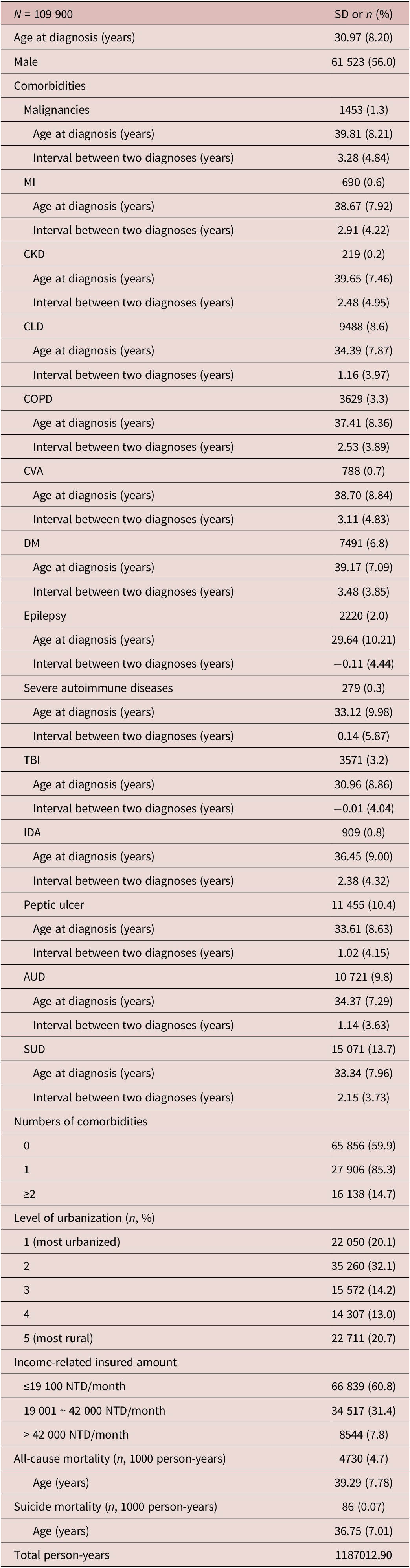
In all, 109 900 young patients with schizophrenia were enrolled in the present study, with a mean age at diagnosis of 30.97 ± 8.20 years and 56% of the patients were male (Table 1). The study population had various comorbidities, with peptic ulcers (10.4%) and chronic liver disease (8.6%) being the most prevalent physical comorbidities. SUD was present in 13.7% of patients, and AUD in 9.8%. The age at which these physical comorbidities are diagnosed occurs after the diagnosis of schizophrenia, with a range of 1.02 to 3.48 years. However, traumatic brain injury and epilepsy were diagnosed slightly earlier, specifically −0.01 and −0.11 years before the diagnosis of schizophrenia (Table 1). The average age of diagnosis for AUD and SUD is 1.14 and 2.15 years, respectively, following the diagnosis of schizophrenia.
Demographic and Clinical Characteristics of Young Patients with Schizophrenia

Table 1. Long description
The table presents data for a total population of N = 109,900.
General Demographics:
- Age at diagnosis: 30.97 years (S D 8.20).
- Male: 61,523 (56.0%).
Comorbidities (Count, Percentage, Age at Diagnosis, and Interval between diagnoses):
- Malignancies: 1,453 (1.3%), age 39.81, interval 3.28 years.
- M I: 690 (0.6%), age 38.67, interval 2.91 years.
- C K D: 219 (0.2%), age 39.65, interval 2.48 years.
- C L D: 9,488 (8.6%), age 34.39, interval 1.16 years.
- C O P D: 3,629 (3.3%), age 37.41, interval 2.53 years.
- C V A: 788 (0.7%), age 38.70, interval 3.11 years.
- D M: 7,491 (6.8%), age 39.17, interval 3.48 years.
- Epilepsy: 2,220 (2.0%), age 29.64, interval minus 0.11 years.
- Severe autoimmune diseases: 279 (0.3%), age 33.12, interval 0.14 years.
- T B I: 3,571 (3.2%), age 30.96, interval minus 0.01 years.
- I D A: 909 (0.8%), age 36.45, interval 2.38 years.
- Peptic ulcer: 11,455 (10.4%), age 33.61, interval 1.02 years.
- A U D: 10,721 (9.8%), age 34.37, interval 1.14 years.
- S U D: 15,071 (13.7%), age 33.34, interval 2.15 years.
Number of Comorbidities:
- 0: 65,856 (59.9%).
- 1: 27,906 (85.3% of those with comorbidities).
- 2 or more: 16,138 (14.7% of those with comorbidities).
Urbanization and Socioeconomics:
- Level 1 (most urbanized): 22,050 (20.1%).
- Level 5 (most rural): 22,711 (20.7%).
- Income less than or equal to 19,100 N T D per month: 66,839 (60.8%).
- Income greater than 42,000 N T D per month: 8,544 (7.8%).
Mortality:
- All-cause mortality: 4,730 (4.7 per 1,000 person-years), mean age 39.29.
- Suicide mortality: 86 (0.07 per 1,000 person-years), mean age 36.75.
- Total person-years: 1,187,012.90.
Abbreviations: AUD, alcohol use disorder; CKD, chronic kidney disease; CLD, chronic liver disease; COPD, Chronic obstructive pulmonary disease; CVA, cerebral vascular accident; DM, diabetes mellitus; IDA, iron deficiency anemia; MI, myocardial infarction; SD, standard deviation; SUD, substance use disorder; TBI, traumatic brain injury.
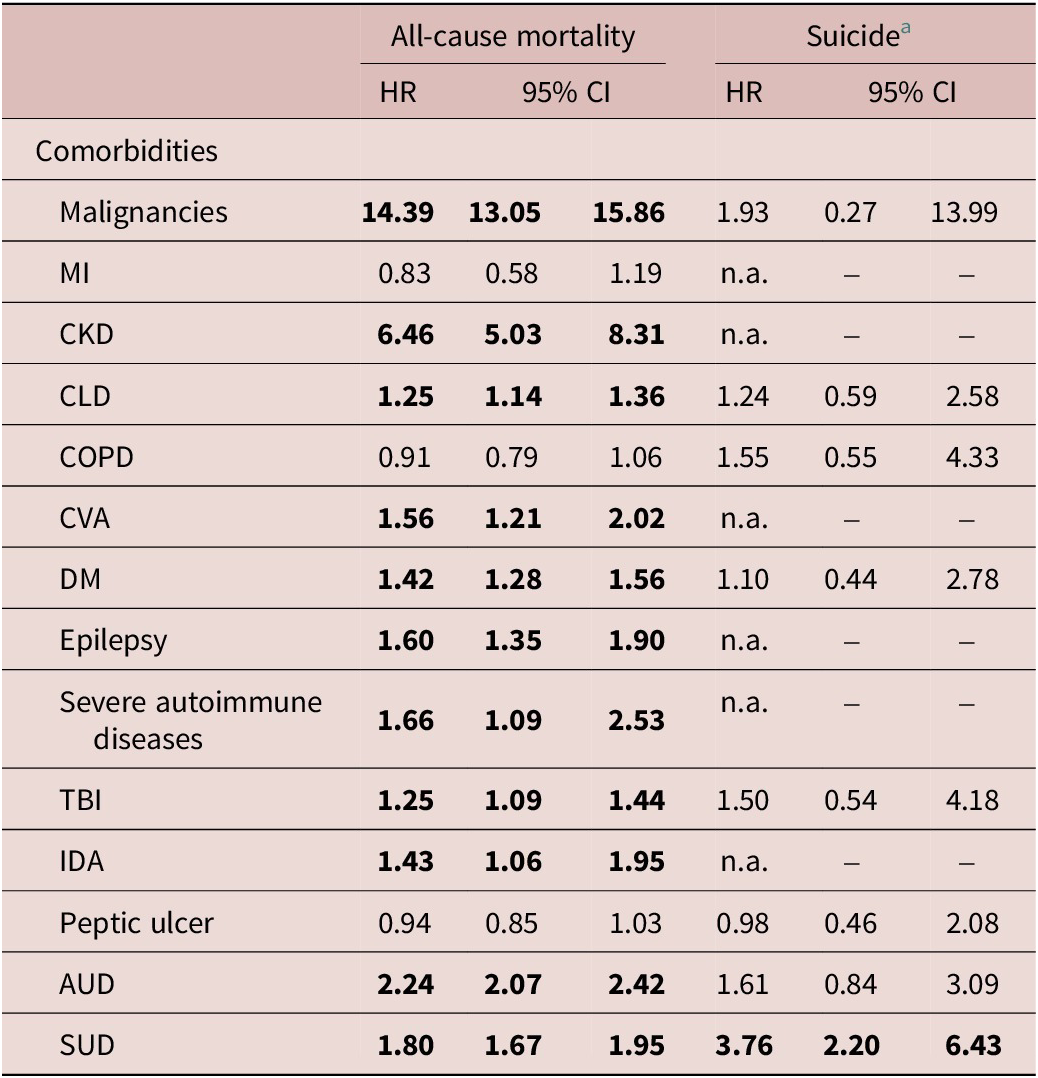
Throughout the follow-up period, the risk of mortality from any cause was 4.3% (4.71000 person-years) (Table 1), exhibiting notable disparities among various comorbidities (Table 2). For example, malignancies had a hazard ratio (HR) of 14.39, indicating a significantly higher risk of death compared to those without malignancies. CKD had an HR of 6.46, also indicating a high risk. Nevertheless, the presence of MI, COPD, and peptic ulcer did not elevate the likelihood of all-cause mortality. In addition, the suicide mortality rate, as indicated in Table 1, was 0.1% (0.071000 person-years). SUD is the sole comorbidity that exhibited a rise in suicide mortality, with an HR of 3.76. This signifies a significant influence of SUD on the risk of suicide in young patients with schizophrenia (Table 2).
Time-Dependent Cox Regression Models for All-cause and Suicide Mortality among Young Patients with Schizophrenia

Table 2. Long description
The table presents Hazard Ratios (H R) and 95% Confidence Intervals (C I) for two outcomes: All-cause mortality and Suicide.
Data for All-cause mortality (H R, 95% C I):
* Malignancies: 14.39 (13.05 to 15.86)
* M I: 0.83 (0.58 to 1.19)
* C K D: 6.46 (5.03 to 8.31)
* C L D: 1.25 (1.14 to 1.36)
* C O P D: 0.91 (0.79 to 1.06)
* C V A: 1.56 (1.21 to 2.02)
* D M: 1.42 (1.28 to 1.56)
* Epilepsy: 1.60 (1.35 to 1.90)
* Severe autoimmune diseases: 1.66 (1.09 to 2.53)
* T B I: 1.25 (1.09 to 1.44)
* I D A: 1.43 (1.06 to 1.95)
* Peptic ulcer: 0.94 (0.85 to 1.03)
* A U D: 2.24 (2.07 to 2.42)
* S U D: 1.80 (1.67 to 1.95)
Data for Suicide mortality (H R, 95% C I):
* Malignancies: 1.93 (0.27 to 13.99)
* C L D: 1.24 (0.59 to 2.58)
* C O P D: 1.55 (0.55 to 4.33)
* D M: 1.10 (0.44 to 2.78)
* T B I: 1.50 (0.54 to 4.18)
* Peptic ulcer: 0.98 (0.46 to 2.08)
* A U D: 1.61 (0.84 to 3.09)
* S U D: 3.76 (2.20 to 6.43)
* Note: M I, C K D, C V A, Epilepsy, Severe autoimmune diseases, and I D A are listed as n.a. for suicide mortality.
Note: Adjusting for birth year, sex, income, and level of urbanization. Bold type indicates the statistical significance (p < 0.05).
Abbreviations: AUD, alcohol use disorder; CKD, chronic kidney disease; CLD, chronic liver disease; COPD, Chronic obstructive pulmonary disease; CVA, cerebral vascular accident; DM, diabetes mellitus; IDA, iron deficiency anemia; MI, myocardial infarction; SUD, substance use disorder; TBI, traumatic brain injury.
a Non-suicide death a competing outcome.
Table 3 shows the impact of the number of comorbidities on mortality. Patients with no comorbidities had an all-cause mortality rate of 3.1%. This rate increased significantly with the number of comorbidities. Patients with one comorbidity had a mortality rate of 5.0% (HR: 1.45), and those with two or more comorbidities had a rate of 8.0% (HR: 2.02). However, the suicide mortality rate did not show a consistent increase with the number of comorbidities. Patients with one comorbidity had a slightly lower risk of suicide (HR: 0.82) compared to those with no comorbidities, while those with two or more comorbidities had a higher, but not statistically significant risk (HR: 1.38).
Numbers of Comorbidities and All-cause and Suicide Mortality among Young Patients with Schizophrenia

Table 3. Long description
The table is divided into two main sections: All-cause mortality and Suicide. Each section includes columns for Event count and percentage, Hazard Ratio H R, and a 95% Confidence Interval C I.
For All-cause mortality:
- 0 comorbidities: 2034 events (3.1%), H R 1 (reference).
- 1 comorbidity: 1406 events (5.0%), H R 1.45, 95% C I 1.35 to 1.55.
- 2 or more comorbidities: 1290 events (8.0%), H R 2.02, 95% C I 1.88 to 2.17.
For Suicide:
- 0 comorbidities: 49 events (0.1%), H R 1 (reference).
- 1 comorbidity: 18 events (0.1%), H R 0.82, 95% C I 0.48 to 1.41.
- 2 or more comorbidities: 19 events (0.1%), H R 1.38, 95% C I 0.80 to 2.36.
Statistical significance (p less than 0.05) is noted for all-cause mortality H R values for 1 and 2 or more comorbidities.
Note: Adjusting for birth year, sex, income, and level of urbanization. Bold type indicates the statistical significance (p < 0.05).
a Non-suicide death a competing outcome.
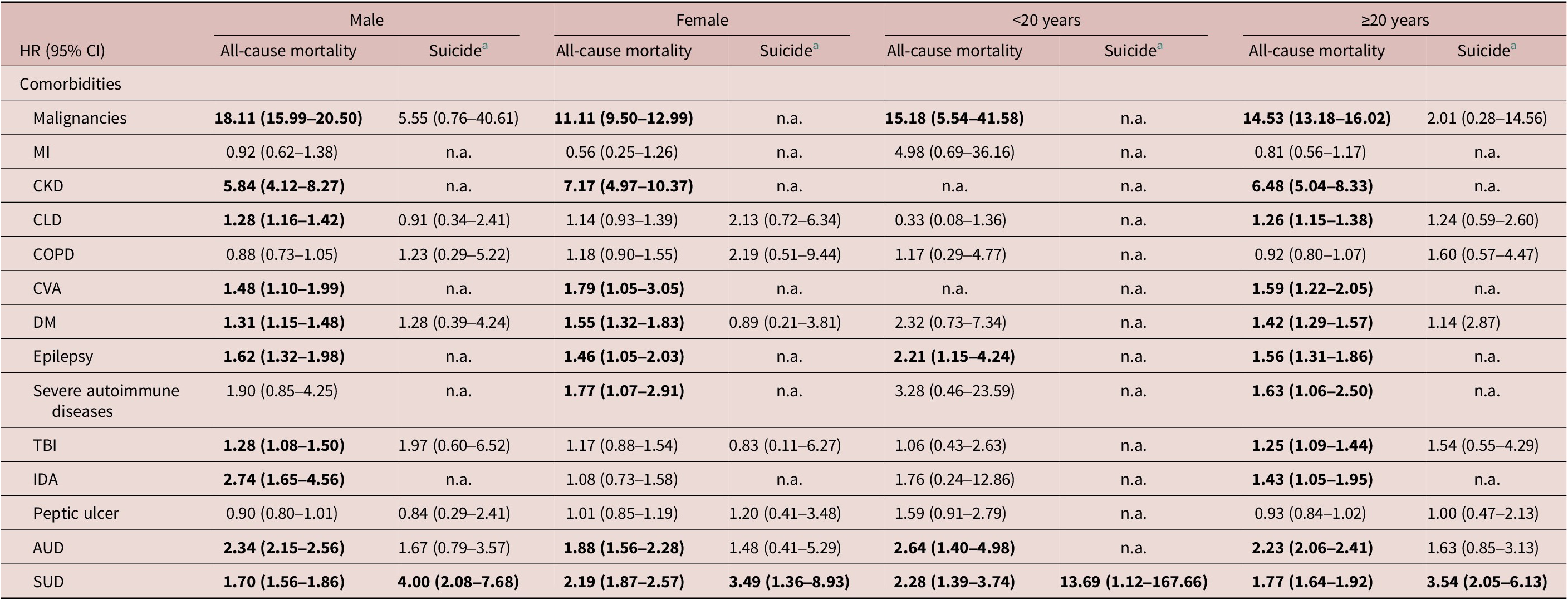
Finally, Table 4 showed the age (<20 vs. ≥20 years)- and sex-stratified analyses on all-cause and suicide mortality among young people with schizophrenia. Consistent with the findings from the entire sample, malignancies had the highest HRs of all-cause mortality in both males (18.11) and females (11.11) with schizophrenia (Table 4). Chronic liver disease (HR: 1.28), traumatic brain injury (1.28), and iron deficiency anemia (2.74) were only associated with increased all-cause mortality in males with schizophrenia, while severe autoimmune diseases (1.77) were only associated with increased all-cause mortality in females with schizophrenia (Table 4). Among physical comorbidities, only malignancies (HR: 15.18) and epilepsy (2.21) were related to increased all-cause mortality in people <20 years with schizophrenia (Table 4). Furthermore, only SUD was associated with suicide risk across four subgroups: males (HR: 4.00), females (3.49), <20 years (13.69), and ≥20 years (3.54) (Table 4).
Time-Dependent Cox Regression Models for All-cause and Suicide Mortality among Young Patients with Schizophrenia, Stratified by Sex and Age

Table 4. Long description
The table presents Hazard Ratios (H R) and 95 percent Confidence Intervals (C I) for two outcomes: All-cause mortality and Suicide. The data is stratified into four main groups: Male, Female, less than 20 years, and greater than or equal to 20 years.
Key findings across comorbidities include:
* Malignancies: Shows the highest H R for all-cause mortality across all groups, ranging from 11.11 in females to 18.11 in males.
* C K D (Chronic Kidney Disease): Significant all-cause mortality risk in males (5.84), females (7.17), and those 20 or older (6.48).
* A U D (Alcohol Use Disorder): Consistently significant all-cause mortality risk across all groups, with H R values between 1.88 and 2.64.
* S U D (Substance Use Disorder): Shows significant risk for both all-cause and suicide mortality. Notably, the suicide H R is 4.00 for males, 3.49 for females, 13.69 for those under 20, and 3.54 for those 20 or older.
* Other comorbidities listed include M I (Myocardial Infarction), C L D (Chronic Liver Disease), C O P D (Chronic Obstructive Pulmonary Disease), C V A (Cerebral Vascular Accident), D M (Diabetes Mellitus), Epilepsy, Severe autoimmune diseases, T B I (Traumatic Brain Injury), I D A (Iron Deficiency Anemia), and Peptic ulcer.
Statistical significance (p less than 0.05) is indicated by bold text in the original table. Several suicide mortality cells are marked as n.a. (not available) due to low event counts.
Note: Adjusting for birth year, sex, income, and level of urbanization. Bold type indicates the statistical significance (p < 0.05).
Abbreviations: AUD, alcohol use disorder; CKD, chronic kidney disease; CLD, chronic liver disease; COPD, Chronic obstructive pulmonary disease; CVA, cerebral vascular accident; DM, diabetes mellitus; IDA, iron deficiency anemia; MI, myocardial infarction; n.a., not available; SUD, substance use disorder; TBI, traumatic brain injury.
a Non-suicide death a competing outcome.
Discussion
Individuals with schizophrenia frequently experience a range of physical comorbidities. In our study, peptic ulcers (10.4%) and chronic liver disease (8.6%) were identified as the most prevalent physical comorbidities among these patients. These findings align with those from a population-based cohort study in Hong Kong, which highlighted gastrointestinal/liver diseases, diabetes, and cardiovascular diseases as the most common physical comorbidities in patients with schizophrenia.Reference Chan, Wong, Yung, Chen and Chang 13
In a recent study, Kugathasan et al. observed that approximately two-thirds of individuals with schizophrenia had physical multimorbidity, which markedly increased their risk of mortality relative to those with no or only one physical ailment.Reference Kugathasan, Wu and Gaughran 6 Our results demonstrate that some but not all physical comorbidities considerably affect all-cause mortality among young patients with schizophrenia. As illustrated in Table 2, malignancies had an HR ratio of 14.39 for mortality. Similarly, a study in Hong Kong reported a positive association between all-cause mortality rate and physical comorbidity status (HR: 2.38), with malignancies having the strongest association (HR: 2.60).Reference Chan, Wong, Yung, Chen and Chang 13 Malignancies generally have a poorer prognosis compared to many other physical conditions, and research suggests that individuals with schizophrenia often experience worse cancer outcomes than the general population. Contributing factors include delayed diagnosis, poor adherence to treatment and lifestyle factors, healthcare disparities, and medication interactions.Reference Irwin, Henderson, Knight and Pirl 32 CKD also had a significant and high HR of 6.46 in our study. Research indicates that individuals with severe mental illness, such as schizophrenia, have a higher likelihood of developing CKD.Reference Cogley, Carswell, Bramham and Chilcot 33 Unfortunately, these individuals often receive inadequate nephrology care, leading to worse health outcomes, including higher mortality rates and increased hospitalizations.Reference Cogley, Carswell, Bramham and Chilcot 33 , Reference Carswell, Cogley, Bramham, Chilcot, Noble and Siddiqi 34 Furthermore, among physical comorbidities in individuals with schizophrenia aged <20 years, epilepsy—apart from malignancy—was the only condition associated with all-cause mortality. Using Danish nationwide register data, Andersen et al. followed individuals who had been diagnosed with epilepsy or schizophrenia before age 25 and showed that comorbid epilepsy plus schizophrenia conferred the greatest all-cause mortality risk (mortality rate ratio: 12.89) over a median follow-up of 15 years, compared with schizophrenia alone (6.79) or epilepsy alone (4.46).Reference Andersen, Petersen, Vestergaard, Pedersen and Christensen 35 Our findings, together with those of Andersen and colleagues,Reference Andersen, Petersen, Vestergaard, Pedersen and Christensen 35 may suggest that shared neurodevelopmental vulnerabilities underlying schizophrenia and epilepsy may contribute to the elevated risk of all-cause mortality among youth with dual diagnoses.
The occurrence of MI, COPD, and peptic ulcer did not significantly increase the probability of death during the follow-up period. The finding that MI did not elevate the risk of death in the follow-up is inconsistent with the previous studies, which identified MI as a primary cause of premature mortality in patients with schizophrenia.Reference Crump, Winkleby, Sundquist and Sundquist 36 Individuals with additional physical comorbidities, along with two other psychiatric comorbidities (AUD and SUD), have a slightly higher risk of all-cause mortality compared to those without these comorbidities. The HRs for these individuals have ranged from 1.25 to 2.24 (Table 2). Our study also found that the risk of mortality increased with the number of comorbidities present. This finding aligns with previous ones, which indicate that nearly two-thirds of individuals with schizophrenia-spectrum disorders experience physical multimorbidity, resulting in a higher mortality risk compared to those with no or just one physical disease.Reference Kugathasan, Wu and Gaughran 6 The presence of multiple comorbidities further exacerbates this risk, underscoring the need for comprehensive healthcare plans that address both psychological and physical health. This is particularly crucial for patients with malignancies and CKD, where the elevated mortality risk is more pronounced.
Sex-stratified analyses of the relationships between physical comorbidities and all-cause mortality have rarely been examined in young people with schizophrenia. The present study identified that chronic liver disease, traumatic brain injury, and iron deficiency anemia were related to a higher risk of all-cause mortality only among males with schizophrenia, whereas severe autoimmune diseases were associated with increased all-cause mortality only among females with schizophrenia. A meta-analysis study involving 2 700 825 people with schizophrenia reported no statistically significant sex differences in relative risk for all-cause mortality or most cause-specific mortality outcomes (eg, injury and liver-related causes).Reference Solmi, Croatto and Fabiano 37 Further research would be needed to clarify whether—and how—sex affects the association between physical comorbidities and mortality risk in young people with schizophrenia.
In this study, 13.7% of young patients with schizophrenia had an SUD, whereas 9.8% had AUD. The comorbidity of schizophrenia with both SUD and AUD is notably frequent. An analysis of data from the Norwegian Patient Register, which focused on individuals born between 1950 and 1989 who were diagnosed with schizophrenia between 2009 and 2013, revealed that 15.6% of these patients had a non-alcohol drug use disorder.Reference Nesvåg, Knudsen and Bakken 38 Furthermore, 4.9% had both a non-alcohol drug use disorder and an AUD. Our findings align with these reports and suggest that SUD but not AUD significantly increases the probability of suicide among young patients with schizophrenia (Table 2). A systematic review of 51 studies on suicide in schizophrenia found a positive association between comorbid substance misuse and increased suicide risk.Reference Hor and Taylor 39 Additionally, a study of 45 476 individuals with schizophrenia indicated that alcohol and multiple drug use are significantly linked to an increased risk of death, particularly from suicide and other external causes.Reference Lähteenvuo, Batalla and Luykx 40 Supporting this, a Danish nationwide, prospective, register-based study revealed that illegal drug use was associated with a two- to threefold higher risk of suicide across various psychiatric disorders, including schizophrenia.Reference Østergaard, Nordentoft and Hjorthøj 41 SUD often exacerbates impulsivity and impaired judgment, which are already heightened in individuals with schizophrenia, leading to a higher likelihood of suicide attempts.Reference Verdejo-García, Lawrence and Clark 42 –Reference Bohnert, Ilgen, Louzon, McCarthy and Katz 44 Moreover, the presence of co-occurring SUD in patients with schizophrenia who have attempted suicide may reduce the likelihood of ongoing treatment, despite their increased suicide risk.Reference Suominen, Isometsä and Lönnqvist 45 These findings underscore the critical importance of incorporating routine screening for SUDs in the management of schizophrenia.
Furthermore, our study revealed that the presence or number of physical comorbidities was not associated with a higher suicide mortality rate among young patients with schizophrenia. This finding contrasts with previous findings in young patients with major affective disorder, indicating that physical illnesses such as cancer are associated with an increased suicide risk relative to the general population.Reference Liu, László and Wei 46 , Reference Kinslow, Kumar and Olfson 47 For instance, patients with cancer have been shown to experience a higher risk of suicide, potentially due to the severity of their illness and the associated psychological burden (eg, depression). However, our findings indicate that malignancies did not significantly elevate the risk of suicide in patients with schizophrenia, which may indicate a unique interaction between physical health and suicide risk in this population. To our knowledge, this study is the first to specifically investigate the influence of physical comorbidities on suicide risk among individuals with schizophrenia. This novel insight underscores the complexity of the relationship between physical health conditions and suicide risk in schizophrenia, although our findings indicate that physical comorbidities do not contribute to higher suicide mortality in young patients with schizophrenia. This discrepancy may reflect differences in how physical and mental health conditions interact with various psychiatric populations. Leveraging a national-level dataset, which includes a substantial number of patients with schizophrenia, our study examines the influence of different physical and psychiatric comorbidities on mortality. This impartial participant selection approach, facilitated by Taiwan’s mandatory National Health Insurance system, ensures that healthcare access is available with minimal copayments and reduced referral biases.Reference Wu, Majeed and Kuo 48
However, this study has several limitations. First, the NHIRD lacks data on therapy adherence and lifestyle practices, such as physical activity, tobacco use, and dietary patterns, which could influence the outcomes. Second, our findings may not be generalized outside of countries without publicly funded healthcare system, which can reduce healthcare disparities between the general population and schizophrenic patients. Third, our study focused exclusively on young patients with schizophrenia. Future research should explore whether these comorbidities have a similar influence on mortality across different age groups. Fourth, the cohort of our database was restricted to 2001–2011, which may limit the generalization to the current clinical practice because the landscape of schizophrenia treatment (ie, the long-acting injectable antipsychotics) and general medical care has evolved significantly since 2011.Reference Akindele and De Alwis 49 Validation in more recent, post-2011 cohorts would be needed to assess the robustness and clinical relevance of our findings. Fifth, suicide was identified using ICD-9-CM external-cause codes (E950–E959), which may incompletely capture events and bias estimates downward. However, physician-given codes improved the validity of suicide. Future work should strengthen outcome ascertainment by linking NHIRD records with Taiwan’s death registry to confirm the robustness of our results and to further elucidate between-group differences in natural-cause and accidental mortality. Sixth, the absence of an increased all-cause mortality risk associated with myocardial infarction (MI) should be interpreted cautiously. Our cohort was restricted to ages 10–44 years, an age band in which fatal MI events are relatively uncommon and overall mortality may be driven more by non-cardiovascular causes. Moreover, simultaneously adjusting for cardiometabolic comorbidities and cerebrovascular disease (eg, diabetes, chronic kidney disease, cerebral vascular accident) may have attenuated the MI estimate through collinearity when estimating the total effect. Seventh, we did not adjust for antipsychotics in the present study. Because treatment is heterogeneous and time varying (switching, polypharmacy, adherence), unmeasured medication effects may confound associations: clozapine can reduce suicide risk, whereas several agents (−pine antipsychotics) increase cardiometabolic risk and mortality. Future studies should model longitudinal medication exposure. Eighth, we could not adjust for prior self-harm, an important predictor of subsequent suicide. ICD-9-CM coding in claims data does not reliably define nonfatal self-harm behaviors, leading to incomplete ascertainment. Residual confounding by unmeasured self-harm history may therefore bias suicide-mortality estimates. Ninth, both young patients with first-episode schizophrenia and chronic schizophrenia were included in the present study. Further studies would be necessary to elucidate whether the long-term mortality risk may differ between patients with first-episode schizophrenia and those with chronic schizophrenia. Tenth, cohort eligibility was defined by an entry age of 10–44 years; however, participants enrolled at age 44 could transition into midlife during follow-up. Thus, a small proportion of the cohort may not strictly represent “young” individuals throughout the observation period, which may limit the interpretability of age-specific inferences. Finally, because only individuals who sought medical and mental health consultations were included, the prevalence of schizophrenia and related comorbidities might be underestimated.
In conclusion, this study underscores the significant influence of specific physical and psychiatric comorbidities on the mortality rates, including suicide, in young patients with schizophrenia. Enhancing early diagnosis, fostering collaboration between psychiatric and physical healthcare services, and implementing comprehensive interventions are critical to reducing premature mortality in this population. The high incidence of SUD among patients with schizophrenia and the substantial link between SUD and increased suicide risk highlight the need for targeted interventions to address substance addiction. Future research should focus on understanding the underlying mechanisms contributing to increased mortality and identifying effective prevention strategies.
Supplementary material
The supplementary material for this article can be found at http://doi.org/10.1017/S1092852926100911.
Data availability statement
Access to the NHIRD is granted via a formal application process managed by the Health and Welfare Data Science Center of the Ministry of Health and Welfare, Taiwan (https://www.apre.mohw.gov.tw/).
Acknowledgements
We are grateful to I-Fan Hu, MA (Courtauld Institute of Art, University of London; National Taiwan University) for continued encouragement and collegial support. We also acknowledge support from the Yin Shu-Tien Foundation–Taipei Veterans General Hospital–National Yang Ming Chiao Tung University Excellent Physician Scientists Cultivation Program. They report no conflicts of interest.
Author contribution
M.-H.C. and S.-J.T. designed the study and wrote the protocol and manuscripts. M.-H.C., S.-J.T., and S.-C.Y. wrote the manuscript draft. S.-J.T. and T.-J.C. reviewed and revised the manuscript draft and revision. M.-H.C. and T.-J.C. performed the statistical analysis and provided the advices on statistical analysis. All authors reviewed and approved the final version of manuscript. S.-C.Y. and S.-J.T. contributed equally to this work.
Financial support
The study was supported by grant from Taipei Veterans General Hospital (V111C-010, V111C-040, V111C-029, V112C-033); Yuli Hospital (YLH-IRP-11406); Yen Tjing Ling Medical Foundation (CI-109-21, CI-109-22, CI-110-30); and Taipei Veterans General Hospital, Taoyuan Branch (TYVH-11302). The funding source had no role in any process of our study. All authors have no financial relationships relevant to this article to disclose.
Disclosures
The authors declare none.



 Open access

