Introduction
Ensiling rehydrated maize is a strategy to improve dietary starch degradability (Ferraretto et al., Reference Ferraretto, Fredin and Shaver2015), especially when maize kernels have a relatively high proportion of vitreous endosperm (i.e. flint hybrids; Correa et al., Reference Correa, Shaver, Pereira, Lauer and Kohn2002). Rehydrated maize has an advantage over high-moisture maize for allowing an extended harvesting window. In Brazil, the period of high-moisture maize production coincides with excessive rainfall that often delays the harvest and jeopardizes maize fermentation (Ferraretto et al., Reference Ferraretto, Taysom, Taysom, Shaver and Hoffman2014). Furthermore, ensiling rehydrated maize provides the option of purchasing maize in periods of low prices (Carvalho et al., Reference Carvalho, Ávila, Bernardes, Pereira, Santos and Schwan2017), can be an alternative way to store maize when grain bins are full and reduces losses associated with insects and rodents.
For dairy cows, the starch availability and nutritional value of maize grain are positively related to the degradation of the protein matrix surrounding starch granules, which is promoted by the ensiling process (Hoffman et al., Reference Hoffman, Esser, Shaver, Coblentz, Scott, Bodnar, Schmidt and Charley2011). Starch utilization is critical for dairy cows as it comprises 210–300 g/kg of lactation diets and is the primary substrate for ruminal propionate production and consequently for gluconeogenesis. Therefore, improvements in starch digestibility will ultimately increase energy availability for milk synthesis (Sutton et al., Reference Sutton, Morant, Bines, Napper and Givens1993). Exogenous amylases have been fed to dairy cows to improve ruminal starch degradability and milk production. However, few studies have reported improvements in starch digestibility (Nozière et al., Reference Nozière, Steinberg, Silberberg and Morgavi2014) and productivity (Tricarico et al., Reference Tricarico, Johnston, Dawson, Hanson, McLeod and Harmon2005; Andreazzi et al., Reference Andreazzi, Pereira, Reis, Pereira, Morais Júnior, Acedo, Hermes and Cortinhas2018) of dairy cows. On the other hand, several studies have provided no evidence that exogenous amylases may improve milk yield of cows (Weiss et al., Reference Weiss, Steinberg and Engstrom2011; Nozière et al., Reference Nozière, Steinberg, Silberberg and Morgavi2014; Vargas-Rodriguez et al., Reference Vargas-Rodriguez, Engstrom, Azem and Bradford2014; Takiya et al., Reference Takiya, Calomeni, Silva, Vendramini, Silva, Consentini, Bertoni, Zilio and Rennó2017). Although feeding amylase directly to animals does not consistently improve performance, evidence suggests that adding amylolytic enzymes during the ensiling process of maize silage improves dry matter (DM) and neutral detergent fibre (NDF) digestibility in ruminants (Lara et al., Reference Lara, Bragiato, Rabelo, Messana and Reis2018).
Starch is composed of amylose and amylopectin polymers, whereas the former is a linear polymer of α-1,4 linked glucose units and amylopectin is a highly branched molecule with α-1,4 linked linear chains connected by α-1,6 branch linkages (Pérez et al., Reference Pérez, Baldwin, Gallant, BeMiller and Whistler2009). The α-amylase (AMY) randomly cleaves α-1,4 glycosidic bonds within the linear chain, whereas glucoamylase (GLU) hydrolyses α-1,4 and α-1,6 glycosidic bonds of starch from the non-reducing ends. It was hypothesized that ensiling rehydrated ground maize either with AMY or GLU would improve maize nutritive value due to an increase in overall enzymatic activity and starch degradation. The objective of the current study was to determine the effects of amylases on fermentative losses, nutritive value, fermentative profile and amylolytic activity of rehydrated ground maize.
Materials and methods
The current experiment was conducted from March to November 2016, at the Department of Animal Sciences – School of Agrarian Sciences of Federal University of Grande Dourados, Dourados, Mato Grosso do Sul, Brazil (450 m asl’: 22°14´S latitude, 54°49´W).
Treatments and silage
Eighty-four experimental silos were used in a completely randomized design with the following treatments: (1) control (CON), with no exogenous enzymes; (2) glucoamylase (GLU), 300 µl/kg ground maize (as-fed) of a commercial product with GLU activity (300 U/ml Kerazyme 4560, Kera Nutrição Animal, Bento Gonçalves, Brazil); and (3) α-amylase (AMY), 300 µl/kg of a commercial product with AMY activity (300 U/ml Kerazyme 4577, Kera Nutrição Animal). A microbial inoculant (KeraSIL grão úmido®, Kera Nutrição Animal) was incorporated to all silos at a dose of 4 mg/kg of fresh material. This additive consisted of Lactobacillus plantarum (4.0 × 10¹⁰ cfu/g) and Propionibacterium acidipropionici (2.6 × 10¹⁰ cfu/g). Enzymes had 300 U/ml amylolytic activity and the dose used was recommended by the manufacturer. The AMY product had an optimal pH around 4.5 (effective in pH 3.5–5.5) and amylase was isolated from Aspergillus niger. Glucoamylase had an optimal pH around 4.3 (effective in pH 3.2 to 5.5) and was isolated from Bacillus licheniformis.
The maize grain (hybrid DKB 330 PRO3, Dekalb, Monsanto, St. Louis, MO, USA) used in the current experiment was harvested during the 2015/2016 season and milled in a stationary industrial crusher to pass through a 4-mm sieve, without additional drying (830 g/kg DM). Afterwards, the ground maize assigned to each silo was weighed, and water (with enzyme preparations and microbial inoculant) was incorporated individually at 0.33 litres/kg (as-fed). Ensiling material had 375 g/kg moisture, 788 g/kg starch, 120 g/kg crude protein (CP), 95.0 g/kg NDF, 47.0 acid detergent fibre (ADF), 50.0 g/kg ether extract, 14.0 g/kg lignin and 17.0 g/kg ash (on DM-basis). Silage was placed in plastic buckets (30 cm height and 30 cm diameter) equipped with Bunsen valves that avoid gas penetration and allow gas escape. Sand (2 kg) was placed in the bottom of buckets separated from the rehydrated maize by a nylon mesh (500 µm). The silage was packed to 950 kg/m3 density, sealed, weighed and stored at room temperature (29 ± 2.3 °C, mean ± sd).
Seven silos from each treatment were weighed to estimate DM and gas losses and opened after 7, 14, 21 and 28 days storage. After opening the silos, rehydrated maize silage from each silo was homogenized and sampled (500 g/silo) to extract silage juice using a hydraulic press. Another sample (500 g) was collected to assess the chemical composition and enzyme activity.
Fermentative losses
Gas losses (GL, g/kg DM) were calculated as the difference of the whole silo weight before and after the ensiling, as follows:

where SWE was the silo weight at ensiling (g), SWO was the silo weight at silo opening (g) and DME was the total DM ensiled [amount of rehydrated ground maize (kg) × DM (g/g)]. The weight of empty silos was considered to calculate effluent loss (EL, g/kg DM), according to the following equation below:

where WSAO was the silo assembly weight after silo was opened (g), WSBE was the silo weight before the ensiling process and DME was the DM ensiled (kg). Dry matter recovery (DMR; g/kg DM) was calculated as:

where DMO was the DM of silage after opening of the silos (g).
Fermentative profile and chemical composition
Silage juice pH was evaluated by submerging the pH meter electrode (MB-10, Marte, Santa Rita do Sapucaí, Brazil) into 50 ml of the fresh sample. Then, 2 ml of silage juice was transferred to test tubes containing sulphuric acid (1 ml at 1 N) for analysis of ammonia nitrogen (NH3-N) concentration using the colorimetric method described by Foldager (Reference Foldager1977). Analyses of organic acids and ethanol concentrations were performed according to the methods described by Rodrigues et al. (Reference Rodrigues, Gomes, Meyer, Borgatti, Franco and Godoy2012). Briefly, 1 ml of silage juice was mixed with formic acid (0.2 ml) in amber glass bottles and frozen until analysis. Ethanol and short chain fatty acid (SCFA) concentrations were determined using a gas chromatograph (Focus GC, Thermo Fisher Scientific Inc., Waltham, MA, USA) equipped with an automatic sample injector (model AS-3000, Thermo Electron Corporation®, Waltham, MA, USA), a glass packed column (2.0 m × 1/5″, 80/120 Carbopack® B-DA/4% Carbowax® 20 M phase; Supelco, Inc. St. Luis, MO, USA) and a flame ionization detector set at 270 °C. The chromatograph oven and injector temperatures were set at 190 and 220 °C, respectively. Hydrogen was used as the carrier gas flowing at 30 ml/min. The lactic acid concentration was measured through high-performance liquid chromatography (LC-10ADVP Shimadzu HPLC system, Shimadzu Inc., Kyoto, Japan) according to Ding et al. (Reference Ding, Koizumi and Suzuki1995). The analytical column (ACE 5 C18, 150 mm × 2.1 mm; ACT, Aberdeen, UK), operated at 20 °C. The mobile phase, 10 mM KH2PO4 to acetonitrile ratio, at pH 2.5, was delivered isocratic, at a flow rate of 0.2 ml/min, in a 10 min run. Detection and identification were performed using a photodiode array detector at 220 nm.
Samples of fresh material before the ensiling and silages after opening were evaluated for DM (method 950.15), organic matter (method 942.05) and CP (N × 6.25; method 984.13) according to AOAC International (2000). Neutral detergent fibre (without sodium sulphite in the detergent), ADF and lignin (sulphuric acid method) were determined according to Van Soest et al. (Reference Van Soest, Robertson and Lewis1991). Starch content was determined by enzymatic degradation (Termamyl® 300L and Amyloglucosidase AMG 300L, Novozymes, Basal, Sweden) and absorbance measured in a spectrophotometer, according to Bach Knudsen (Reference Bach Knudsen1997). Control samples without enzyme were performed to express free-glucose starch content. In vitro DM degradation (48 h) was determined using an artificial rumen incubator (TE-150, Tecnal, Piracicaba, Brazil) by the filter bag method described by Holden (Reference Holden1999). Silage samples were dried at 60 °C for 72 h and ground in a Wiley mill to pass through a 2-mm sieve. The inoculum was sampled from two ruminal cannulated male sheep previously adapted for 7 days to a diet containing (on DM-basis) 650 g/kg rehydrated ground maize, 120 g/kg whole raw soybean, 10 g/kg urea, 20 g/kg mineral mix and 200 g/kg grass hay.
Amylolytic activity
An enzymatic suspension was prepared by mixing 40 ml of distilled water with 5 g of fresh silage for 1 h at 100 rpm. Then, suspensions were filtered through nylon cloth (500 µm mesh) and centrifuged (3000 g for 5 min at 5 °C). The supernatant was considered the enzymatic extract and used for subsequent steps. Enzymatic activity was determined by adding 0.1 ml of enzymatic suspension to 0.9 ml of sodium acetate buffer (0.1 M and pH 5.0) containing 10 g/kg maize starch. After 10 min of reaction at 50 °C, the reducing sugars released were quantified by the 3,5-dinitrosalicylic acid method (Miller, Reference Miller1959). One unit of enzymatic activity was defined as the amount of enzyme required to release 1 µmol of reducing sugars per minute of reaction.
Statistical analysis
Data were submitted to analysis of variance using the PROC MIXED (version 9.3, SAS Institute, Cary, NC, USA) according to the following model:

with $e_{ijk}\,\approx \,N\; (0,\; _i^2 )$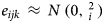 ; where Y ijk is the value of dependent variable, μ was the overall mean, E i was the fixed effect of enzyme or treatment (i = 1–3), T j was the fixed effect of time (j = 1–4), E i × T j was the fixed interaction effect between enzyme and time, e ijk was the residual error, N was Gaussian distribution, and $_i^2$
 was the variance associated with each enzyme level. Degrees of freedom were adjusted by the method of Kenward and Roger (Reference Kenward and Roger1997). The time effect was decomposed into orthogonal contrasts: linear, quadratic and non-quadratic (cubic) effect. The effect of enzymes was decomposed into the following orthogonal contrasts: (1) enzyme treatments (GLU + AMY) v. CON and (2) GLU v. AMY. Enzyme (treatment) and time interaction effect was decomposed into: interaction effect of enzyme (treatment) with: linear time, quadratic time and non-quadratic time effect. Only linear and quadratic effects of time are shown in the tables with the significance level set at P < 0.05.
Results
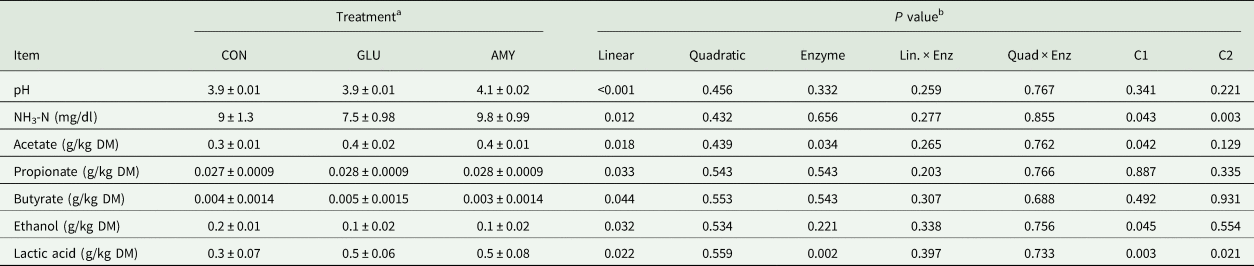
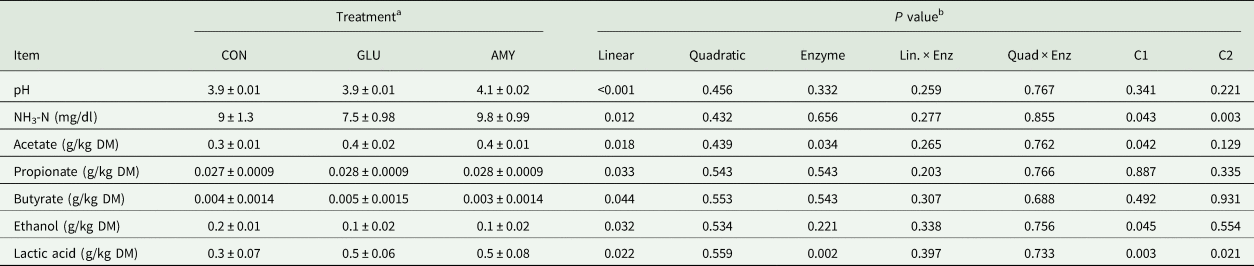
In general, amylolytic enzyme treatments (GLU and AMY) did not affect gas, effluent and total losses (Table 1). Glucoamylase treatment had lower (P < 0.01) DM recovery and greater (P < 0.05) gas and total losses in comparison with AMY. Gas, effluent and total fermentative losses increased linearly (P < 0.05), regardless of treatment, whereas DM recovery decreased linearly (P < 0.05) as the storage length increased. Treatment with amylolytic enzymes increased (P < 0.05) the concentrations of acetic and lactic acid and decreased (P < 0.05) ethanol concentration in silage (Table 2). Glucoamylase treatment had lower (P < 0.01) concentration of NH3-N and greater (P < 0.05) concentration of lactic acid than AMY. Silage NH3-N, acetate, propionate, butyrate, ethanol and lactate concentrations increased linearly (P < 0.05) according to the storage length. Silage pH decreased linearly (P < 0.001) with increased storage time, regardless of treatment.
Effects of amylolytic enzymes on total losses of rehydrated ground maize silage (mean ± s.e.m.)

a Control (CON); GLU, 300 µl/kg of glucoamylase (300 U/ml Kerazyme 4560, Kera Nutrição Animal, Bento Gonçalves, Brazil); and AMY, 300 µl/kg of α-amylase (300 U/ml Kerazyme 4577, Kera Nutrição Animal).
b Linear effect of time, quadratic effect of time, enzyme effect, interaction effect between enzyme and linear time (Enz × Lin), interaction effect between treatment and quadratic time (Enz × Quad), and treatment orthogonal contrasts: CON v. GLU + AMY (C1) and GLU v. AMY (C2).
Effects of amylolytic enzymes on the fermentative profile of rehydrated ground maize silage (mean ± s.e.m.)
a Control (CON); GLU, 300 µl/kg of glucoamylase (300 U/ml Kerazyme 4560, Kera Nutrição Animal, Bento Gonçalves, Brazil); and AMY, 300 µl/kg of α-amylase (300 U/ml Kerazyme 4577, Kera Nutrição Animal).
b Linear effect of time, quadratic effect of time, enzyme effect, interaction effect between enzyme and linear time (Enz × Lin), interaction effect between treatment and quadratic time (Enz × Quad), and treatment orthogonal contrasts: CON v. GLU + AMY (C1) and GLU v. AMY (C2).
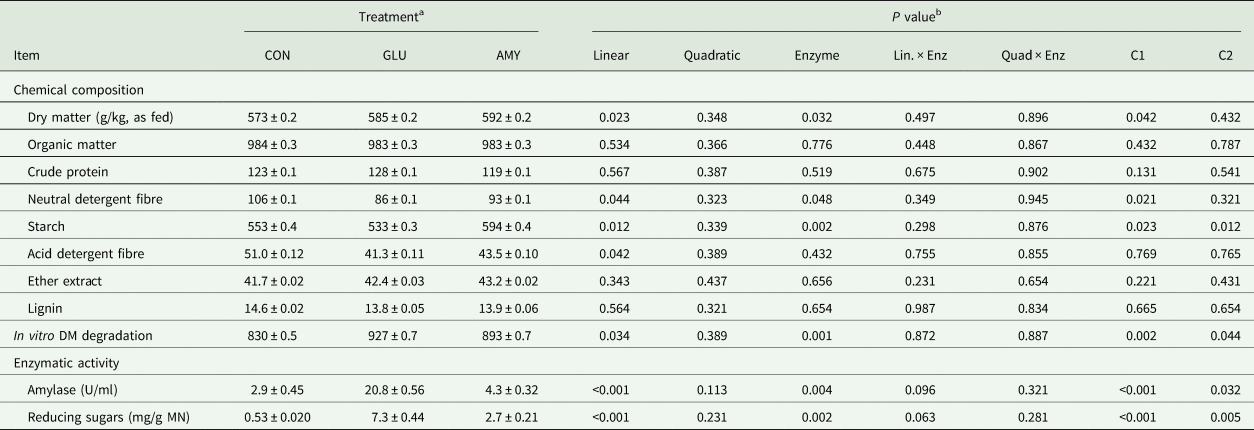
Amylolytic enzymes increased (P < 0.05) DM content and in vitro degradation of silage (Table 3). Silage treated with GLU had lower (P < 0.05) starch content and greater (P < 0.05) in vitro DM degradation in comparison with silage treated with AMY. Storage length linearly decreased (P < 0.05) DM, starch, NDF and ADF content of rehydrated maize, regardless of treatment. In vitro degradation of DM increased linearly (P < 0.05) as the storage time increased. Enzymes increased (P < 0.001) the amylase activity and reduced the sugar content of silage. The GLU-treated silos had greater (P < 0.05) amylase activity and reducing sugar then AMY-treated silos. The increase in storage time linearly improved (P < 0.001) the concentration of reducing sugars and showed a negative linear effect (P < 0.001) on the amylase activity of silage.
Effects of amylolytic enzymes on the chemical composition of rehydrated ground maize silage (g/kg, unless stated otherwise; mean ± s.e.m.)
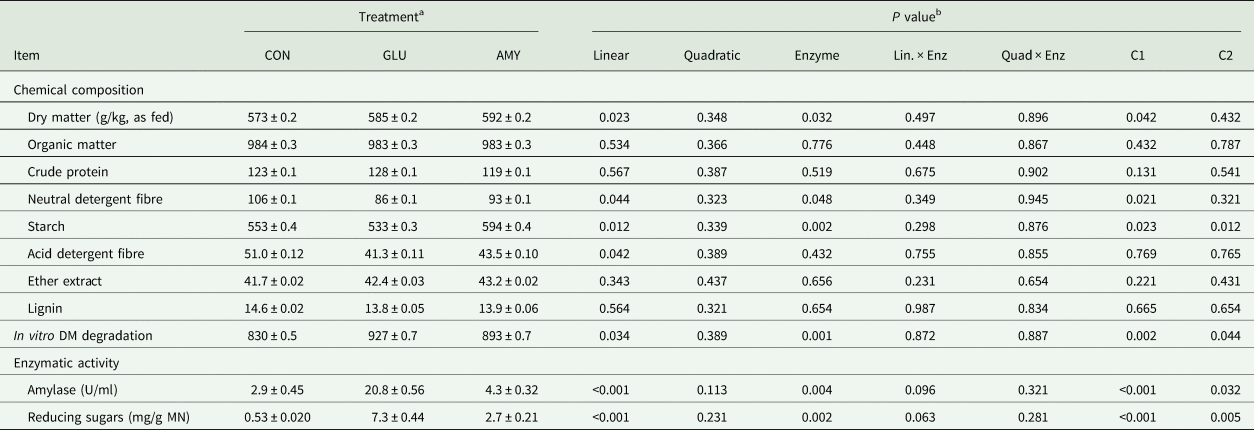
a Control (CON); GLU, 300 µl/kg of glucoamylase (300 U/ml Kerazyme 4560, Kera Nutrição Animal, Bento Gonçalves, Brazil); and AMY, 300 µl/kg of α-amylase (300 U/ml Kerazyme 4577, Kera Nutrição Animal).
b Linear effect of time, quadratic effect of time, enzyme effect, interaction effect between enzyme and linear time (Enz × Lin), interaction effect between treatment and quadratic time (Enz × Quad), and treatment orthogonal contrasts: CON v. GLU + AMY (C1) and GLU v. AMY (C2).
Discussion
Amylolytic enzymes (notably GLU) improved the nutritive value of rehydrated ground maize silage by decreasing NDF content and improving in vitro degradation, without lowering DM recovery. Reports on the losses that occur during rehydrated ground maize fermentation are scarce in the literature. Authors have reported increased DM losses (Fernandes et al., Reference Fernandes, Silva, Gomide, Pereira, Avilas and Pereira2016; Lopes et al., Reference Lopes, Cardoso and Pereira2016) and DM degradation (Lopes et al., Reference Lopes, Cardoso and Pereira2016) with GLU addition (different commercial product from the current study) during the ensiling of rehydrated ground maize. In the present study, GLU only exhibited a marginal increase in DM losses compared with CON. However, gas and total losses averaged 89.4 and 155 g/kg DM, respectively. Silage losses from the current experiment were greater than those observed in other studies with rehydrated maize. For instance, studies reported 18.6 g/kg DM of gas losses (da Silva et al., Reference da Silva, Nascimento, Nascimento, de Resende, Daniel and Siqueira2018) and 33.1 g/kg DM of total losses (Lopes et al., Reference Lopes, Cardoso and Pereira2016). The reasons for differences among studies might be related to maize hybrid, management, particle size, moisture content and packing density. da Silva et al. (Reference da Silva, Nascimento, Nascimento, de Resende, Daniel and Siqueira2018) ensiled rehydrated maize with 350 g/kg moisture at 1085 kg/m3 density and found only 628 g/kg DM at 124 days after ensiling, evidencing greater effluent losses than reported in previously mentioned studies.
The fermentative profile of rehydrated ground maize seems appropriate since silages exhibited greater lactic acid concentration compared to the other organic acids and butyric acid was found in relatively small concentrations. In addition, NH3-N levels were lower than 100 g/kg of total N, which is an indicator of non-excessive protein breakdown in the silage (McDonald et al., Reference McDonald, Henderson and Heron1991; Queiroz et al., Reference Queiroz, Ogunade, Weinberg and Adesogan2018). Enzymes improved the fermentative profile of rehydrated ground maize by increasing acetate and lactic acid concentrations while decreasing ethanol formation. Acetic acid is known for increasing silage aerobic stability and for inhibiting spoilage microorganisms such as Clostridia, whereas lactic acid is the primary acid responsible for most of the silage pH drop. A higher rate of starch degradation by amylolytic enzymes is probably associated with the increase of SCFA concentration, including acetic, which has anti-fungal activity (da Silva et al., Reference Da Silva, Smith, Barnard and Kung2015). In agreement with this hypothesis, Fernandes et al. (Reference Fernandes, Silva, Gomide, Pereira, Avilas and Pereira2016) reported a greater starch degradation (bag wash) in rehydrated maize and sorghum silages treated with GLUs. The greater concentration of acetic acid in silages treated with amylase is also related to their lower ethanol concentration since ethanol production in silages is mainly derived from yeast fermentation. Yeasts can ferment sugars to ethanol and carbon dioxide when trace amounts of oxygen are present, which results in DM losses (Santos et al., Reference Santos, Lock, Mechor and Kung2015). An increase in silage lactic acid and ethanol concentrations has been observed with longer storage periods. Ferraretto et al. (Reference Ferraretto, Taysom, Taysom, Shaver and Hoffman2014) reported decreased pH in high-moisture maize with longer storage periods, which was associated with improved microbial activity.
Regarding the protein breakdown in silage, GLU treatments decreased NH3-N concentration, whereas AMY increased NH3-N concentration. The reasons for the enzyme effects in NH3-N concentration are unclear. It was speculated that lower NH3-N levels in GLU-treated silos are linked with greater lactic acid concentration. Hydrophobic zein proteins in the starch–protein matrix of maize grains could be solubilized to lactic and acetic acids by enzymes, which would increase silage NH3-N concentration. Evidence for this association is the similar linear increase in NH3-N, lactic acid and acetic acid concentrations over the storage time, regardless of treatment. However, because silos containing GLU had greater fermentative losses compared with AMY, NH3-N was probably lost as effluent. Zein proteins of endosperm are hydrophobic and water-insoluble but are soluble in organic acids (Lawton, Reference Lawton2002; Hoffman et al., Reference Hoffman, Esser, Shaver, Coblentz, Scott, Bodnar, Schmidt and Charley2011). The greater lactic acid and acetate concentrations with consequent protein matrix hydrolysis could corroborate the higher in vitro DM degradation observed in AMY-treated silage, whereas the greater in vitro DM degradation found in GLU-treated silage is likely to be associated with increased amylolytic activity throughout the storage period. Differences in enzyme effects are related to their catalytic properties: amylase promotes internal cleavage of the starch molecule, whereas GLU acts on non-reducing ends of the molecule (Wong et al., Reference Wong, Robertson, Lee and Wagschal2007). Glucoamylase hydrolyses 1,4-linked α-D-glucosyl residues successively from the non-reducing end of oligosaccharide and polysaccharide chains with the release of β-D-glucose (Jafari-Aghdam et al., Reference Jafari-Aghdam, Khajek, Ranjbar and Nemat-Gorgani2005). This enzyme can also hydrolyse α-1,6 bonds of amylopectin branching points, thus, providing elevated starch hydrolysis if incubated for extended periods (Karim et al., Reference Karim, Husaini, Hossain, Sing, Sinang, Hussain and Roslan2016). According to Pandey (Reference Pandey1995), pH of 4.5 and temperature below 50 °C favours GLU activity, whereas Hmidet et al. (Reference Hmidet, Bayoudh, Berrin, Kanoun, Juge and Nasri2008) reported greater AMY activity within pH ranging from 5.0 to 10.0 and optimal temperature of 90 °C. During the aerobic phase of the ensiling process, silage pH reaches 6.5, and there is an increase in silo temperature. After this phase, lactic acid fermentation takes place, and a decrease in both pH and temperature occurs, resulting in a rise in GLU activity over AMY in the experimental conditions observed in the present study.
Although Leahy et al. (Reference Leahy, Barth, Hunter and Nicklas-Bray1990) reported no effect of amylase addition in whole-plant maize silage DM, ADF, CP and ash content, an increase in DM content of rehydrated maize silage was found in the current study. Greater enzymatic activity was also observed in silos that received enzymes, resulting in increased concentration of reducing sugars. Higher reducing sugar concentrations could be obtained by starch degradation and acidic degradation of hemicelluloses (Chen et al., Reference Chen, Guo, Yu, Zhang, Shimojo and Shao2015), which agrees with the lower NDF concentration in silos treated with enzymes. There was an increased reducing sugar concentration over storage time, whereas enzymatic activity linearly reduced over time. A more moderate enzymatic activity seems to be linked with lower silage pH and reducing sugar accumulation. These factors explain the trend of treatment and linear time interaction effect: in silages with greater amylase activity (GLU), a higher improvement in reducing sugar concentration over the storage time was observed, and consequently, amylase activity drops faster than CON-silages. Increased organic acids and water-soluble carbohydrates concentration have shown positive effects on DM degradation (Jensen et al., Reference Jensen, Weisbjerg, Nørgaard and Hvelplund2005), as observed with enzyme addition and extended storage periods.
Conclusion
Either GLU or AMY can be incorporated to rehydrated ground maize for improving lactic acid and acetic acid concentrations, amylase activity and in vitro DM degradation. In vivo studies should be performed to evaluate whether this improvement in ground maize nutritive value would reflect in improvements on animal performance.
Acknowledgements
Authors acknowledge Kera Nutrição Animal (Bento Gonçalves, RS, Brazil) for providing the microbial inoculant and enzymes used in the current experiment.
Financial support
This research received no specific grant from any funding agency, commercial or not-for-profit sectors.
Conflict of interest
The authors declare there are no conflicts of interest.
Ethical standards
Experimental procedures were carried out under the approval of the Ethics Committee of the Federal University of Grande Dourados (approval number: 0304/2015).