INTRODUCTION
“Intersectionality” refers to the study of the simultaneous and interacting effects of gender, race, class, sexual orientation, and national origin as categories of difference. This article uses intersectionality as an analytical tool to explore struggles for institutional space in social policy processes in two contexts: republican France and the multicultural United Kingdom. We begin by first explaining our interest in intersectionality and current advances in its study in policy processes, and demonstrate the way our approach builds on existing work. We then outline the ways in which “republican” France and the “multicultural” UK are traditionally considered to be “opposites” with regard to the public role of difference and its recognition, and we contrast this understanding with an emerging literature that deconstructs this opposition. Then, we undertake within-case analysis of two moments of institutional separation, focusing on two policy processes in France and one in the UK.
In France, we first explore the policy frameworks for intégration and antidiscrimination in the context of a republican model, which requires that “private” identity not play a “political” role in the public sphere. The analysis will demonstrate that the separation of intégration from the fight against discrimination depoliticizes claims that challenge the nature of the French Republic and may silence the intersectional claims of women and men simultaneously experiencing multiple forms of discrimination. In the UK, we analyze the language, problem definitions and subject positions constructed in the process of formulating the Single Equality Bill, which achieved Royal Assent in April 2010. While in the French case claims are depoliticized, here the issue appears to be that of definition: “equality” is named and acted upon in specific ways that, in turn, make it difficult to recognize the intersection of gender, ethnicity, and other salient sources of inequality. Focusing on the new Single Equality Bill, this section will demonstrate that institutional processes and actors characterize these multiple sources of inequality as independent and unconnected social phenomena, impeding policy that recognizes and combats the simultaneous and interacting sources of discrimination that shape the lives of minority women and men.
The conclusion that emerges from this comparison of institutional space in France and the UK is that although the “models” for accommodating difference in the public sphere and in institutions are different and even traditionally considered as opposites, and institutional actors and policy processes are by no means identical, institutions fail to recognize intersections in similar ways. Through a process of misrecognition, intersecting axes of disadvantage are separated and in some cases even silenced. The result is that complex demands for equality can be difficult to make and to be recognized in each case.
Why Intersectionality?
The idea of intersectionality forces us to confront and think about women and men in a complex and heterogeneous way. Exploring how gender, ethnicity, race, class, disability, age, religion, and sexuality interact in different ways, depending on different cultural contexts, is crucial in seeking to construct a state that supports and recognizes multiple social justice claims. Intersectionality is a powerful way of understanding the differing outcomes between different types of women and men (for example see Crenshaw Reference Crenshaw, Fineman and Mykitiuk1991; Hancock Reference Hancock2007a; Reference Hancock2007b; Hill Collins Reference Hill Collins1990; Jordan-Zachery Reference Jordan-Zachery2007).
We focus on intersectionality in relation to social structures, specifically the ways in which institutions emphasize some social structures at the expense of others, rather than individual identity. As S. Laurel Weldon (Reference Weldon2006, 239) notes in her elaboration on the work of Iris Young: “[W]e need a structural account of politics because we need to be able to criticize social structures…. Such macro level analysis need not imply shared identities across gender, race or class groups.” This is not to suggest that the study of individual identity does not have value. However, it does not enable us to undertake comparison of institutional practices that directly and indirectly impact on intersecting axes of gender, race, religion, and ethnicity in two very different cultural, social, and political contexts. Furthermore, comparative analysis “is key to illuminating the range of variation in structures of gender, race, class and other axes of domination, the ways in which these structures interact, and the wide array of strategies for resistance and reform” (Weldon Reference Weldon2006, 247). While variation is certainly present in the results of our analysis, we will underscore the similarity of the processes at work despite ostensible differences in the two contexts we examine.
When intersectionality is operationalized, it is important not to problematize the very groups we seek to recognize. We do not think minority women and men are the problem. Instead, we focus on institutions that ought to be accommodating multiple differences, in other words, upon institutional practices rather than the dynamics of identity formation and construction. We therefore seek to compare the processes through which policy actors and institutions do or do not recognize and address intersections and intersecting claims in establishing law and policy, rather than focusing exclusively on the outcomes of policies for individuals with intersecting identities.
Intersectionality and Policy Processes
Our approach differs from current work on the institutionalization of intersectionality in its focus on the process of accommodating intersectional claim making, rather than on evaluating the policy outcomes of recognizing intersectionality (for example, see Bagilhole Reference Bagilhole2009; Lombardo and Verloo Reference Lombardo and Verloo2009; Squires Reference Squires2007, Reference Squires2008; Verloo Reference Verloo2006). Current work appears to be concerned with the successes and challenges of institutional actors in recognizing intersecting inequalities. This work is important as it suggests that “institutions have a potential impact on triggering or discouraging territorial mechanisms that limit civil society's cooperation on inequalities” (Lombardo and Verloo Reference Lombardo and Verloo2009, 2). Promoting multiple social justice claims or intersectionality may inadvertently encourage or promote competition between different groups as they vie for recognition and decision-making power within institutional spaces. Indeed, Judith Squires (Reference Squires2007) notes that this could lead to competition reminiscent of what Elizabeth Martinez terms the “oppression Olympics” (Martinez Reference Martinez1993 discussed in Hancock Reference Hancock2007b, 250), where groups compete for the mantle of “most oppressed” in order to gain the attention and political support of dominant groups as they pursue policy remedies, leaving the overall system of stratification unchanged. In addition, Squires (2008) argues that in the name of intersectionality, institutional actors may seek to avoid difficult political choices needed for structural reform and, instead, focus on less contentious and less effective individualized policy measures to tackle multiple discrimination under the rubric of ‘diversity’. As we shall see, the process of developing the Single Equality Bill in the UK appears to reflect some of Squires's concerns.
While it is important to understand the potential impact of these institutional outcomes on the ability to recognize intersectional claims, we are interested in exploring the earlier process of the creation of institutional space. In this article, we explore two social policy processes explicitly focused on equality and social justice and analyze how the process enacts its self-defined function of redressing equality issues. A comparison of the institutional space that is created by policymakers and policy processes can help us understand how intersections are silenced or privileged, and also sheds light on how intersectional claims can mutate into competing claims due to the “sorting” or “separating” influences of official state actors. A focus on this space can help campaigners and researchers think about the process of coalition building, negotiation, and claim making to render struggles for social justice more plural, inclusive, and effective.
THE FRENCH AND UK MODELS: CLICHÉD OPPOSITES?
The treatment of difference in the public sphere in France and the UK is traditionally considered to be diametrically opposed. Whereas in France the republican model requires that private identity not play a political role in the public sphere, the UK approach has been explicitly multicultural (though increasingly under fire).
Laïcité, which can only be roughly translated as “secularism,” acts as an organizing principle of the French Republic, codifying what is acceptable and unacceptable in public space. The French republican model of intégration is expressly assimilatory, with pluralism explicitly disavowed as a public good (Levinson Reference Levinson1997, 335). The underlying ideology is difference blindness: Each citizen has the same rights and responsibilities in public and is an equal, abstract entity before the law. Specific identities (such as cultural identities) are denied in the public sphere; they are to play only a private role. Integration occurs on the basis of voluntary adhesion to the secular values of the political community, through individual citizenship (which is accessed through birth (droit du sol), rather than on the basis of group identification (droit du sang).
For staunch defenders of the republican “model,” such as sociologist Dominique Schnapper, public accommodation of cultural pluralism must be resisted (1994). Transcendence of particular belonging through the idea and institutions of citizenship, particularly the separation of church and state, is the only political idea that can organize a society where people with different historical references, religions, and conditions of life can live together and feel that their dignity is recognized. According to Schnapper (Reference Schnapper1994, 10), “Public freedoms guarantee the right to freely practice one's religion or to use one's language. But, at the same time, these specificities must not form the basis of a particular political identity, recognized as such within public space. This space must remain the site of political unity and a common political project.”
Adrian Favell describes this kind of position as “neo-republicanism,” a nostalgia for the Third Republic involving a mythical retelling (2001, 64–85). Rules of intégration can be set in strongly republican, citizenship-based terms because they directly continue the nation building of the Third Republic. The “particularity” of France's political and cultural heritage is seen as the most important determining factor of the concerns and emphasis of present-day immigration policy, despite evidence of convergent policy practice cross-nationally, the breaking down of national models, and the effect of transnational institutions and discourses (Favell Reference Favell2001, 45–46).
Legal membership is the basis for autonomy and access to the public sphere, and the political community takes place under republican terms. “Proper” participation within the political community is defined as transcending private interests. This is part of the normative project of intégration that ensures both national unity and the creation of autonomous citizens who identify their interest with the political sphere (Favell Reference Favell2001, 85).
In the UK, citizens' relationships with and obligation to the state and civil society are orientated differently. Traditionally, there has been no fixed idea of what “Britishness” is and how citizenship in Britain should be practiced (Favell Reference Favell2001; Goulbourne Reference Goulbourne1991). Since the UK is not a single entity but a collection of the rival substates of England, Wales, Scotland, and Northern Ireland, “British citizenship” is neither a stable nor unproblematic idea. Furthermore, the idea of citizenship is also problematized by the British imperial legacy of conferring automatic legal status to any subject born in the Commonwealth (Hansen Reference Hansen2000). Thus, citizenship in Britain has been more concerned with creating the spaces for a diverse range of individuals to identify with a flexible and changeable idea of Britishness, rather than prescribing a normative set of values that all citizens must adopt.
The British state has opted for this vague and laissez faire-approach to citizenship because of its grounding in liberal pluralist principles (Bertossi Reference Bertossi2007; Favell Reference Favell2001; Goulbourne Reference Goulbourne1991; Siim Reference Siim2000). Social harmony and stability are not maintained through a process of individual conformity to an abstract notion of citizenship, as some argue is the case in the French tradition. Rather, social harmony and stability are ensured when the rights and liberties of the individual are safeguarded in both private and public spaces. Public space is constructed as a tolerant “free space” where citizens encounter one another as equals and have the right and liberty to express their diverse political, social and cultural beliefs, interests, and identities—with the proviso that this exercise of rights does not infringe on the rights and liberties of others. With the emphasis on the sovereignty and plurality of individual citizens, it is assumed that the state and civil society will be strengthened. With the free associations of a diverse public supported, better political debate, representation, and decision making will be promoted. Thus, the assumption underlying the British idea of citizenship is that liberal pluralism leads to a stronger and more legitimate democracy (Goulbourne Reference Goulbourne1991, 226).
In the context of liberal pluralism, it is clear to see why the incorporation of multiculturalism, though not without its problems, was the logical next step for the evolution of British citizenship (Kymlicka Reference Kymlicka1995; Modood Reference Modood2007). Multiculturalism protects the individual rights and freedoms of minority groups and enables these groups to effectively participate in civil society. Rather than promoting assimilation into the normative values of a state, as in the French model, the focus in the UK is on extending the benefits of citizenship to individuals, thus further strengthening democracy. In contrast to the French model's concept of intégration, here integration is not necessarily a process of acculturation but a process of the individual's self-understanding as a British citizen and enjoying the rights and responsibilities thus afforded. The right to liberty is balanced with the responsibility of tolerance for other ways of doing and being. As Christophe Bertossi (Reference Bertossi2007, 4) argues:
Instead of using the abstract definition of the individual as a source of national citizenship, British policy has demonstrated an approach based on the importance of minority groups and has placed an emphasis on integration, not as a process of acculturation to the nation and civic values, but as a program of equal access to the rights of British society, which itself recognizes multiculturalism as a social and political feature.
This idea of liberal pluralism is being increasingly contested, however. Events ranging from the devolution of decision-making powers from Westminster to the Scottish, Welsh, and Northern Irish administrations to the 2001 Bradford “race” riots to the 2005 London bombings have prompted a popular debate about what it means to be British in the twenty-first century. After 2001, the Labour government focused renewed efforts on issues of community cohesion, citizenship, and language tests and for Muslim groups, in particular, the policy priority of “preventing violent extremism” (Thomas Reference Thomas2009). These measures have adopted some of the language usually found in the French model and focus on promoting civic virtue in terms that proclaim shared British values and active citizenship (which balances individual freedom with collective responsibilities).
The Cliché in Focus
A growing body of scholarship argues that this opposition is, in fact, overstated and that convergence, rather than the divergence, can be observed in key policy fields. Catherine Lloyd discusses the problems of the “two models” approach, which pits the “individual” model of relationship between citizen and state, as in France, against the communitarian or “Anglo-Saxon” model, as exemplified by the United States and Britain (e.g., Schnapper Reference Schnapper1994). Erecting models makes a rigorous analysis of these contexts more difficult because of an unresolved slippage between the model as an ideal type and its direct application in the evaluation of policy, obscuring the complexity of different forms in each (Lloyd Reference Lloyd, Hargreaves and Leaman1995, 39). The two-models approach obscures similarities across contexts, and the gaps within contexts between “ideal types,” implementation, and experience (Favell Reference Favell2001, 45–46; Silverman Reference Silverman1992). Gary Freeman argues that national incorporation frameworks are not fully cohesive. Because they are constantly changing, they can at best be described as belonging to a handful of “loosely connected syndromes” (Freeman Reference Freeman2004). Others document the contestations within national contexts, critiquing the “stereotypes” that have obscured realities on the ground through an overreliance on the “exceptional” character of the French case (Mazur, Brouard, and Appleton Reference Mazur, Brouard and Appleton2008) or the “self-evidently” multicultural nature of the United Kingdom despite a (contested) retreat to “social cohesion” and “integration” (see Meer and Modood Reference Meer and Modood2009).Footnote 1
These claims that question the opposition between the two models resonate with our findings, as we discuss in the next sections. We now turn to explore the fate of intersectional claim making and recognition in relation to institutional space and policy processes in France and the UK.
THE SEPARATION OF INTÉGRATION AND ANTIDISCRIMINATION IN FRANCE
The 2004 law banning the wearing of religious symbols in public (state) schools derives from the republican understanding of public space we discussed previously. The text of the law reaffirms this view (Assemblée nationale Reference Assemblée nationale2004):
In primary school, middle school and secondary school, the wearing of symbols or clothing by which a student shows religious belonging “ostensibly” is forbidden. Internal school regulations require that application of a disciplinary measure be preceded by dialogue with the student.
The “Commission for Reflection on the Application of the Principle of Laïcité in the Republic,” more commonly named the “Stasi Commission” after the head commissioner, Bernard Stasi, was created by French President Jacques Chirac to make concrete recommendations regarding laïcité, which was, in his words, a “non-negotiable” principle (Le Monde, “Le Rapport de la Commission Stasi sur la Laïcité,” 12 December, 2003). The report of the commission directly informed the formulation of the March 2004 law. While the focus was ostensibly on laïcité and religion in general, it was in fact on young veiled women of North African descent. The authors claimed that they heard a “cry for help” from the “silent majority” of young women of immigrant backgrounds, victims of pressure from family, neighborhood, and community. The report sought to protect these young women and to send a strong sign to extremists (they use the term Islamists) that unequal treatment of young women would not be tolerated. According to the authors, the Republic must not remain deaf to this cry of distress. School must remain for these young women a space of freedom and emancipation (Commission de réflexion sur l'application du principe de laïcité dans la République 2003, 58).
There were only two brief half-line references to the possibility that some young girls or women “wear the headscarf voluntarily” and that the headscarf could represent a “personal choice” (Commission de réflexion 2003, 47, 57). Young Muslim women were predominantly seen as victims in need of protection, an understanding that translated into the 2004 law.
A “logic of separation”Footnote 2 was at work in the commission's report and in the French government's formulation of the law. The project of intégration through which individuals voluntarily adhere to the secular values of the political community and transcend private interests and identities (Costa-Lascoux Reference Costa-Lascoux1989; Reference Costa-Lascoux and Dewitte1999; Favell Reference Favell2001) was separated from issues of discrimination. This separation was evident during the hearings of the commission, when some participants attempted to articulate different, intersecting claims. Saïda Kada, the coauthor of L'une voilée, l'autre pas (One veiled, the other not) (Bouzar and Kada Reference Bouzar and Kada2003) and an activist in the association French Women and Politically Engaged Muslims, attempted to break with the logic of separation by asking that discrimination and economic vulnerability be considered, as well as oppression within the family/community (Le Monde, “Nadia, Saïda et Fatiha, avec ou sans voile devant la commission Stasi,” 6 December, 2003). Nadia Amiri, a former nurse now pursuing a doctorate in sociology, took the position opposite to Kada's with respect to the headscarf and demanded a ban in all public services of the state. However, she also asked that discrimination and economic vulnerability be considered and connected to issues surrounding the headscarf (Le Monde, “Nadia, Saïda et Fatiha”). Finally, the movement Ni Putes, Ni Soumises (NPNS) (Neither whores nor submissive) fiercely opposed the headscarf and supported the law banning religious signs in schools as part of extensive protests against the gendered forms of violence endured at the hands of men within their communities,Footnote 3 while also making the connection to social and economic exclusion in its claims.Footnote 4 Two leaders of this movement, Mohamed Abdi and Fadela Amara, gave evidence at the commission.Footnote 5
While Kada defended the wearing of the headscarf, and Amiri and NPNS opposed it, all three made the connection between issues surrounding veiling, discrimination, and economic vulnerability. However, the logic of separation was evident in the way in which the commission defined the needs of the women in question and in the French government's formulation of the March 2004 law. Claims to address the causes of these forms of violence and broader concerns of social and economic exclusion were ignored. The need for protection was considered in isolation, and the only subject position recognized was of young women as victims of their communities.
The commission's report made some references to “social” and “urban” discrimination, with the argument that laïcité will only have meaning and legitimacy with égalité des chances (Commission de réflexion 2003, 52). However, combating racial and religious intolerance or discrimination on the basis of one's place of residence was to be the mandate of a new entity: the High Authority for the Fight against Discrimination and for Equality (HALDE), which was created by the law of December 30, 2004, as a result of the pressure of European Union legislation (the European Commission directives of 2000 on Racial Equality and Employment Equality [European Commission, n.d.]). Consequently, these forms of discrimination were set aside rather than integrated into analyses of the headscarf, laïcité, and the terms of inclusion in the political community more broadly.
The nature and significance of this institutional separation of intégration from antidiscrimination require further exploration. What are the consequences for the recognition of complex claims for equality? As the following analysis will demonstrate, the process of institutional separation results in an either/or situation in which either limited claims could be articulated within the intégration-laïcité debate, as demonstrated previously, or (limited) claims can be articulated regarding the application of the existing law. However, laïcité itself as a principle can no longer be challenged within the institutional spaces used and created in the process, nor can women participating in these processes gain recognition as political subjects. Overall, politics is displaced.Footnote 6
In order to understand the nature of this separation and the implications of allocating these issues to the HALDE, its mandate and powers must be investigated further. The powers of the HALDE are primarily restricted to investigation, and it acts as a lever in implementing the law. It has no enforcement power and only makes recommendations (and arguably can mobilize publicity if these are not followed). It is able to make representations before the courts and also focuses on education initiatives, particularly with respect to indirect discrimination. Gender inequality is addressed within this body, though it is not clear that intersections with other forms of discrimination are explored.Footnote 7
The institutional separation between intégration and antidiscrimination is not as clear-cut as the report of the Stasi Commission might suggest. While the laïcité debate consigns questions of discrimination to the HALDE, cases relating to laïcité at the intersection of religion and gender are, in fact being addressed by the HALDE. However, the HALDE's recommendations in these cases are confined to addressing discriminatory applications of the 2004 law, rather than its content. In this sense, the HALDE addresses the separate issue of discrimination—the (mis)application of the 2004 law—and not intégration, which would involve the substance of the law.
In the analysis of relevant deliberations that follows, we can observe that the HALDE offers a limited form of redress for misapplication of the 2004 law, though this “redress function” is selective and inconsistently applied, depending on which religious sign is at stake (e.g., the headscarf versus the burqa). Yet we argue that a more fundamental critique is demanded. The question of whether the HALDE has “correctly” required that the misapplication of the law be redressed or deemed that its scope and intention have been respected in banning a religious sign (as we shall see in the case of the burqa) is a moot point in more fundamental political terms.
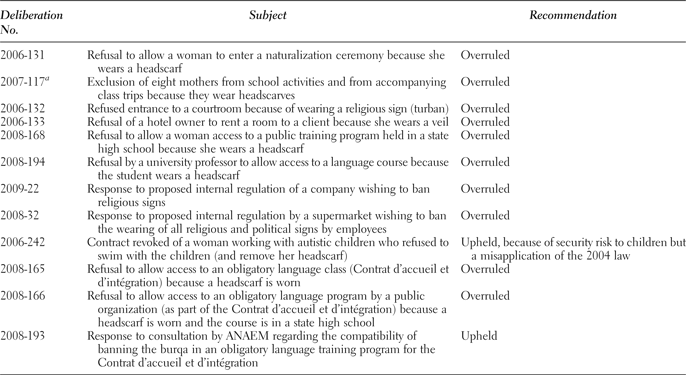
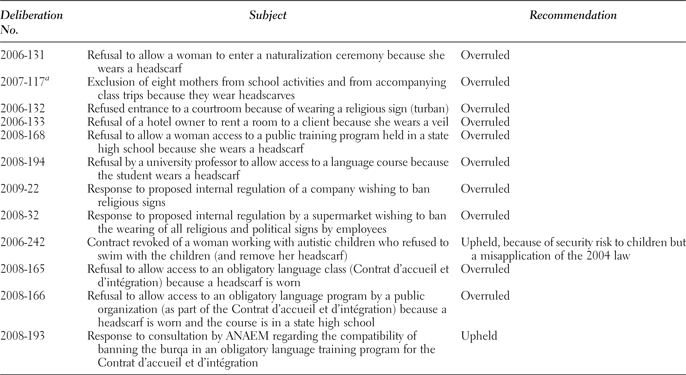
To support these claims, we discuss 12 relevant deliberations/recommendations issued by the HALDE between 2006 and 2009 (outlined in Table 1), raising issues of intégration and the ways in which the 2004 law is applied.Footnote 8 In some instances, women, or associations, have taken their cases to the HALDE; in others, businesses/organizations consulted the HALDE for advice on a practice or regulation.
HALDE Deliberations
aHere the HALDE issued a general deliberation about the principle of laïcité (2007-117). See: http://www.halde.fr/IMG/pdf/Deliberation_principe_de_laicite_6_juin_2007.pdf (December 3, 2009).
Information in the Table above contains the author's translations.
Of the 12 deliberations examined here, 10 overrule what are deemed to be discriminatory applications of the 2004 law, and one upholds the revoked contract of a woman working with autistic children who refused to swim with the children and remove her headscarf because of the security risk to the children (2006-242); in only one case was a ban on wearing a religious sign upheld, in the case of the burqa in an obligatory language training program (2008-193).
This suggests some possibilities for redress, where social actors are restricted and reprimanded for interpreting the 2004 law incorrectly. This redress takes place in a range of ways: in drawing on European Conventions,Footnote 9 particularly Article 9 pertaining to freedom of religion, Article 14 ensuring nondiscrimination, and Protocol 1, Article 2, which protects the right to education;Footnote 10 in addressing the problem of “gray zones,” or internal regulations, where power has been exercised to exclude women and men from public spaces in ways that would otherwise fall below the radar (and here the HALDE plays a valuable role in making these exclusions visible and redrawing the boundaries “correctly,” that is, consistently with the 2004 law);Footnote 11 in the careful insistence that the headscarf alone does not constitute an act of proselytism, which requires a further act or behavior that causes a problem with reference to relevant case law;Footnote 12 and in the reinforcement not just of where boundaries can be drawn but also who draws them—it is only the legislator who can determine when considerations of discrimination can be overridden in cases of disruption of “public order,” or, in the context of a business, a problem concerning security and health.
In sum, the recommendations of the HALDE address discriminatory applications of the 2004 law. As these examples illustrate, its role concerns discrimination rather than intégration and laïcité inasmuch as the substantive content of the latter are not the subject of contention. Instead, the boundaries of the existing law are policed.
The extent of this policing function can be questioned, and this is a limited story of redress. In the last three decisions regarding the Reception and Integration Contract, two bans are overruled when headscarves are at stake (2008-165, 2008-166), but the third case in which the National Agency for Reception of Foreigners and Migration (ANAEM—part of the Office Français de l'immigration et de l'intégration) consulted the HALDE regarding the compatibility of banning the burqa in obligatory language training, the ban was endorsed by the HALDE (2008-193).
The symbolic and legal stakes in these three cases are high; this contract is the key piece of the new integration policy, and since January 2007 it has been obligatory for any person from outside of the European Union who is either entering France for the first time or has entered legally between the ages of 16 and 18 and would like to remain in France.Footnote 13 The purpose of the contract is to prepare “republican integration” into French society, which includes a requirement to take free language courses in cases where the individual is not proficient in French. Failure to attend regularly can compromise the renewal of one's residence permit, and attendance must be proven when renewing the permit. The ANAEM commissions and finances these training programs from a range of public and private institutions, and it oversees attendance.
In the two decisions that were overruled, the HALDE rejected the reasons provided by the language-training providers.Footnote 14 The training providers were told to modify internal regulations and to readmit the students in question. Yet the HALDE shifted its position when it came to the case of a woman wearing the burqa and attending the same obligatory language training (2008-193). Here, the HALDE invoked the case of Faiza M., in which the Council of State upheld immigration officials' refusal to grant nationalité française to a woman in full-body veil by saying that “she did not meet the conditions of assimilation.” According to the Council of State “Mme M … adopted a radical practice of her religion incompatible with the essential values of the French community, notably with the principle of the equality of the sexes and thus she does not fulfill the condition of assimilation required by …the Civil Code as a requirement for gaining French nationality.”Footnote 15 This Moroccan woman is married to a French man with three children born in France.
Following this decision, in June 2009 French President Nicholas Sarkozy declared that women wearing the burqa are “not welcome in France” and set up a parliamentary commission to determine whether the burqa poses a threat to the secular nature of the French constitution. This commission produced a report recommending a partial ban on face coverings in public services (e.g., hospitals, public administration, school exits), and these proposals were put to a vote in Parliament (Assemblée Nationale 2010). At the time this manuscript was finalized, (October 2010), the law prohibiting “covering (dissimulation) the face in public space” had been adopted by the lower house in the National Assembly in July 2010, by the Senate's vote in September 2010 and, finally, deemed to be constitutional by the Conseil Constitutionnel in October 2010 with one reservation: the ban must not restrict religious freedom in sites of worship that are open to the public.Footnote 16
The HALDE invoked the case of Faiza M. to support the argument that the burqa is opposed to the values of a democratic society and equality between the sexes. Therefore, this refusal of French nationality is not a violation of freedom of religion. Furthermore, in the other two cases (2008-165, 2008-166), the HALDE had argued that because the training program is a legal obligation that affects the ability to remain in France, access should not be restricted. In this deliberation, however, it argued that the Reception and Integration Contract is precisely the tool through which foreigners are to prepare their integration into French society and that the burqa poses a problem in this regard with respect to equality of the sexes. Indirect discrimination and the disproportionate impact on women wearing burqas is also no longer a legitimate consideration, in contrast to the first two decisions. Finally, the rights of others must be protected, namely, by shielding other students and the teacher from pressure. Religious freedom, hitherto protected, is outweighed by other considerations: Religious freedom is guaranteed so long as public order is not disturbed, and preserving public order is a constitutional value or objective. Consequently, individual freedom must be balanced with this collective good; the requirements of public security and the need to be able to identify people will not be met. Therefore, the HALDE concludes, this ban does not violate nondiscrimination principles in European Convention Articles 9 and 14, and the right to education. The parliamentary commission, in turn, cited this deliberation by the HALDE in support of its proposed ban (Assemblée nationale Reference Assemblée nationale2010, 153, 155, 629, 634).
This varied application of the policing function of the HALDE, which is in turn celebrated by the parliamentary commission, is quite revealing of the displacement of politics. Certainly, there appears to be little institutional counterweight or check on this exercise of power in and of itself. However, a discussion of the justice or injustice of the HALDE's deliberations misses the more fundamental critique of the displacement of politics. The institutional spaces for groups to go beyond simply challenging the application of the law to contesting the underlying values of the republican model of citizenship are severely restricted. The HALDE deliberations provide some limited space for redress that is selective: It does not apply when the burqa is at stake rather than the headscarf, or turban. Ultimately, the 2004 law is reinscribed and its boundaries (selectively) policed.
It could, however, be argued that this is to be expected from a body such as the HALDE, which ought to perform precisely such a policing function and no more. The thrust of the critique here, however, is not exclusively regarding the HALDE in and of itself but of the partitioning of political space that results in the denial of alternate, multiple subject positions.Footnote 17 It matters that questions of discrimination are not included in the laïcité debate, that this separation takes place, which in turn leaves the HALDE with a (questionable) policing function because separation results in a closure of the subject position and reduction of the space for the exercise of agency. In the debate over laïcité, it is only possible to participate as Muslim women who are victims of the men in their communities, as opposed to participating who are political agents challenging cultural and institutional discrimination. Muslim women are only too visible as headscarf-wearing victims but are not able to articulate other subject positions that problematize the separation of these issues and demand that the laïcité debate be recast in order to redefine the public sphere and the nation-state.
THE SEPARATION OF SUBJECT POSITIONS IN THE UNITED KINGDOM: THE CASE OF THE SINGLE EQUALITY BILL
Turning to the operation of institutions in the UK, this section analyzes a landmark development in antidiscrimination legislation: the Single Equality Bill. Analysis of the language and proposed institutional practices of the Equality Bill provides an important insight into how institutional actors, structures, and practices separate various subject positions and, in doing so, misrecognize the nature and dynamic of inequality in the United Kingdom.
Introduced in June 2008 by the then-Labour government, the Single Equality Bill was its attempt to harmonize recent EU directives regarding antidiscrimination on the basis of age, sexual orientation, gender reassignment, religion, and belief with existing UK domestic antidiscrimination legislation on race, ethnicity, gender, and disability with regards to employment practices and access to goods, facilities, and services. For the Equality Bill, one central policy problem is identified. The bill seeks to “declutter” existing equality law; it proposes a new instrument in order to integrate the “new” equality strands of sexual orientation, age, religion, and belief into the existing institutional framework already in operation for race, ethnicity, gender, and disability.
The Equality Bill is interesting in that it is primarily concerned with the reorganization of institutional practices, rather than with seeking to reassess the way the government defines, practices, and enforces equality and antidiscrimination. For example, when discussing the need for new legislation, the Government Equalities Office (GEO), which steered the bill through Parliament under the direction of Harriet Harman, the former leader of the House of Commons and the current Deputy leader of the Labour Party, states:
Our discrimination laws have helped us make progress on equality, but because they have developed over more than 40 years, they have become extremely complex…. The Bill will declutter what has become a thicket of legislation and guidance (Government Equalities Office 2008, 6).
The recognition of new forms of discrimination, it seems, has made the practice of equality more complex and difficult for private and public bodies, and this prompted the government to develop a new instrument for measuring multiple forms of equality and discrimination. The so-called Single Equality Duty will
require public bodies to consider how their policies, programs and services affect different disadvantaged groups in the community…. The new Equality Duty will be more effective than the existing three separate duties [on race, gender and disability] because there will be one streamlined process instead of three different ones (Government Equalities Office 2008, 13–14).
More specifically, the new Duty will require public bodies to do three things: have “due regard for the need to eliminate unlawful discrimination,” promote equal opportunities, and encourage good relations between different groups (Government Equalities Office 2009a, 85).
Superficially, the government sought to take an intersectional approach to policy problems and solutions with regards to discrimination. With Labour previously setting up a single equalities body, the Equality and Human Rights Commission in 2002, and now with the enactment of the Single Equality Duty, it seems that this “single equalities approach” might represent a new emphasis and recognition of intersectional inequalities.Footnote 18 However, we see instead a continuation of a dominant institutional process of separating and isolating different subject positions. Treating these axes as independent and unrelated categories results in the construction of institutional spaces that misrecognize inequalities and limit articulation and action to address structural discrimination.
For example, when discussing labor market discrimination, the GEO constructs the problem in independent and separate spheres of gender, race, and disability, rather than as a problem that is determined by the intersections among them:
We know that across the country, there is a full-time pay gap between men and women of 12.6%; if you are from an ethnic minority you are one-fifth less likely to find work than if you are white, and if you are disabled you are two and a half times more likely to be out of work. (Government Equalities Office 2008, 18)
This is a very simplistic construction of labor market discrimination, which does not accurately represent the intersections among gender, ethnicity, and disability that structure lived experiences in the workforce. While a pay gap exists, women's and men's ethnicities and class positions determine it. Pakistani and Bangladeshi women, for example, are less likely to be represented in professional jobs, thus exacerbating income and wealth inequalities for these groups. Unlike their female counterparts, black African and black Caribbean men—regardless of their class positions—are underrepresented in professional occupations and are more likely to be unemployed or underemployed. While some ethnic minority groups face discrimination in the labor market, middle-class Indian and Chinese groups are performing just as well as middle-class whites (Emejulu Reference Emejulu, Ridge and Wright2008). While people with disabilities experience significant labor market discrimination, these experiences are patterned on broader attitudes to gender, race, ethnicity, and class (for an extended discussion of these issues, see Kenway and Palmer Reference Kenway and Palmer2007; Modood et al. Reference Modood, Berthoud, Lakey, Nazroo, Smith, Virdee and Beishon1997; Pilkington Reference Pilkington2003; G. Scott Reference Scott, Ridge and Wright2008). Thus, in the Single Equality Bill's construction of the policy problem of labor market discrimination, what we see is the misrecognition of important intersectional dynamics that helps to determine the unequal outcomes for various groups. As a consequence, the institutional space that is created by this policy process is highly problematic because “discrete forms of oppression shape and are shaped by one another, and a failure to recognize this results in both simplistic analyses and ill-conceived policy interventions” (Squires Reference Squires2007, 514).
When discussing the importance of political representation, the Single Equality Bill again constructs subject positions as separate rather than relational, stating that “[i]t is important to ensure that Parliament and our other democratic institutions properly reflect the make-up of our society, including women as well as men and people from ethnic minorities” (Government Equalities Office 2008, 28). It seems that we should assume that the “women” and “men” constructed in the text are white, while the subject position of “ethnic minorities” appears not to be gendered. This is surprising given that earlier in the text, the Single Equality Bill points out that “not a single member of Parliament is an Asian woman” (p. 27).Footnote 19
Although not identical, what we see in the UK is similar to what we demonstrated in the French case: A logic of separation is at work that partitions off different social structures and identities, making it difficult to both articulate intersectional claims and take policy action that might effectively address intersectional inequalities. With subject positions assumed to be isolated from one another, it is not clear how comprehensive action can be undertaken by the institutional space that is created through the Single Equality Bill to tackle various forms of intersecting institutionalized discrimination. Part of this logic of separation stems from the particular way in which campaigners and policymakers have sought to respond to discrimination in the UK. Since the first Race Relations Act was passed in 1964, antidiscrimination laws have implemented homogeneous “group-based remedies” in which race, gender, disability, and so on were treated as unique and self-contained phenomena with few links among the different forms of legislation to create a holistic approach to antidiscrimination for various marginalized groups (Squires Reference Squires2007). The Single Equality Bill, despite its language, does little to challenge or problematize this logic of separation.
Because of this dominant approach to separating different subject positions, when the issue of intersectionality is discussed, the Single Equality Bill is unable to respond effectively. For example, when the bill was first proposed in the summer of 2008, the issue of intersectionality was constructed as being so complex and difficult that the GEO was unsure about how to structure the bill in order to address these problems. For example, when discussing the modernization of the employment tribunal system, the Equality Bill correctly identifies the challenge of the intersection of gender and ethnicity in discrimination cases:
Currently, people can only bring a claim that someone has treated them unfairly because of one particular characteristic, for example, their race, sexual orientation or gender. However, there are situations where people are discriminated against because of a particular combination of characteristics. For example a black woman may suffer prejudice or harassment that is not faced by a black man or a white woman. We want to allow multiple discrimination claims to be brought on combined multiple grounds. This is a very complex area and we are exploring this further (Government Equalities Office 2008, 31).
However, after consultation in the summer of 2009, the GEO has included a new provision within the bill in order to address and respond to issues of “multiple discrimination” and intersectionality—but only within the specific institutional space of the employment tribunal system. The GEO (2009b, 8) now recognizes that:
[p]eople are complex, with many different characteristics making up who they are. This can affect the opportunities open to them and how they are treated… . It is increasingly recognized that some people can experience particular disadvantage because of a combination of protected characteristics… . Currently the law does not always provide a remedy for an individual who experiences multiple discrimination.
In an attempt to recognize multiple identities and multiple discrimination, the Single Equality Bill was amended to include a provision for taking multiple discrimination cases to an employment tribunal. While it is important not to downplay the significance of this development, there are real problems embedded in this change. Intersectionality and multiple discrimination are only recognized in an extremely limited way: “The provision [to] enable multiple discrimination [is] to be made in relation to direct discrimination only and combining no more than two …protected characteristics [race, gender, disability, age, religion, sexual orientation and gender reassignment]” (Government Equalities Office 2009b, 14). In other words, individuals will have a new right to take multiple discrimination cases to employment tribunals (however, only for cases of direct discrimination), and they must now choose two parts of their identity when bringing a case. Thus, intersectionality has been institutionalized in the UK but in such a way that the institutional space that has been created appears to undermine the project of recognizing difference and the multiple claim making of particular groups.
By only recognizing multiple discrimination in the context of direct discrimination, this bill has the potential to de-emphasize analysis and action on structural discrimination. UK law states that direct discrimination is “treating one person less favorably than another on the grounds of sex, race, disability, sexual orientation, religion/belief, or age” (EHRC 2010). The Single Equality Bill may seek to protect groups from multiple forms of discrimination, but it individualizes and ghettoizes intersectionality by constructing it as a by-product of an isolated incident of direct discrimination in the workplace. The institutional space for understanding and practicing intersectionality more broadly as a fusion of social structures that creates specific social positions that are either privileged or devalued has been marginalized within the bill. As a result, the bill appears to weaken the ability of marginalized groups to make multiple claims in their interactions with institutional structures. As Squires (2008, quoting Mabbett Reference Mabbett2008, 46) has warned, the logic of equality developed via judicial mechanisms is limited to an individualized model of equality, where courts seek to combat discrimination arising from unfair practices, but are “poorly equipped to implement a group-based concept of equality and to tackle more complex structural aspects of discrimination.”
Thus, as we showed in the French case, the spaces for articulating complex and intersectional justice claims have been extended, but in a limited sphere that appears to undermine attempts for broader political and policy recognition and action with regards to intersectional inequalities. This new provision within the Single Equality Bill is particularly curious because it contradicts the government's earlier efforts to recognize and tackle institutionalized discrimination as set out in the 1999 MacPherson Report and as embedded within the 2001 Race Relations (Amendment) Act.
Because the bill is primarily concerned with institutional reform, rather than with rethinking the way it considers equality and antidiscrimination, it appears to be unable to subvert dominant understandings and treatments of unequal subject positions, thereby rendering invisible the dynamic between various subject positions and even misrecognizing the experiences of a variety of marginalized groups.
CONCLUSIONS: THE LOGIC OF SEPARATION AND LIMITED INSTITUTIONAL SPACE
In this analysis, we have demonstrated how in ostensibly different contexts of republican France and the multicultural United Kingdom, a logic of separation is embedded in various social policy processes that undermines intersectional claim making by limiting the institutional space for both recognition and the political struggles of marginalized groups. When we analyze the different institutional processes in France and in the UK, we find that institutional actors employ similar (though not identical) practices in relation to intersections that have similar outcomes for minority groups on either side of the English Channel. The nature of this process of institutional separation is different in France and in the UK. We focused on the mandate of institutions and the division of space in the French case and on the language of the Single Equality Bill in the UK, and the same types of intersections have not been compared across cases in this article. Instead, a comparison of the results of within-case analysis has helped us identify the precise nature of the separation in each case.
Within-case analysis in the UK demonstrates the separation of various marginalized subject positions through institutional processes and actors that characterize these axes as independent and unconnected social phenomena whereas analysis of the French case shows the separation of intégration and antidiscrimination and, consequently, the silencing or reduction of space for intersecting claims. The point of similarity is the fact of separation (and the underlying misrecognition) in both cases, rather than its nature, and this separation can be identified through an intersectional approach.
In France, we saw a “logic of separation,” where issues of discrimination are separated from those of intégration in relation to minority groups. What this means is that minority religious groups, and in particular Muslim women who wear the foulard (or headscarf), are unable to make intersecting claims for social justice while participating in a republican model of citizenship that does not recognize difference. In many ways, these women are in a catch-22 where they are accorded the rights of citizenship divested of difference but cannot make claims for antidiscrimination in the debate over the nature of citizenship, that is, in debates over intégration, because of the way citizenship in public space in France is defined. The “cost” here is the reduction of the space for voice: Intersecting, agonistic challenges cannot be articulated in the debate that defines the French Republic, precisely where the nation is being challenged. Instead, the available options are those of being a victim or being invisible. The alternative body, the HALDE, which handles antidiscrimination, provides limited (and arbitrary) scope for challenging dominant notions of victimhood because of its policing function and selective redress in its recommendations regarding the application of the existing 2004 law. The result is the restriction of the struggle over institutional space, particularly the attempt to redefine the nature of this space.
In the UK, the process of separation is different. In defining policy problems in relation to equality, institutional actors separate subject positions and define them as independent and static social categories. Thus, what we see is women and men defined without ethnicity (or sexuality, class, disability, and age) and minority ethnic groups that are not gendered (or classed, disabled, sexed, or aged). In addition, in the name of intersectionality and multiple identities, we also see individuals having to arbitrarily choose portions of their identity in order to seek justice for direct discrimination. The result is that the potential of intersectional social-justice claim making within the context of the institutional space created by the Single Equality Bill is drastically curtailed. Ironically, in the name of equality and intersectionality, this policy process actually reduces the space for practicing this form of politics. As a consequence of this separation, there is a real danger of implementing misguided policy programs that do not effectively address the realities of discriminatory practice or respond to the social justice claims of various groups.
By analyzing intersectionality in relation to institutional practices, we are able to identify this similarity while still recognizing variations in its particular manifestation in each case. Despite the different contexts and histories of identity formation, we are able to examine how the policy processes of institutional actors can undermine minority ethnic groups' abilities to make simultaneous social justice claims, and how the interests and experiences of minority ethnic groups can be misrecognized in the policymaking process. This is possible by defining intersectionality in relation to social structures and institutions rather than identity. Consequently, the perception and treatment of difference by institutional actors is brought to the fore, rather than the nature of difference itself.
Recognizing and creating space for difference is a highly complex practice. From our analysis, the question remains as to whether it is possible to have an open-ended process that recognizes and accommodates a diverse array of subject positions. We think it is possible, and the process must first be grounded in democratic politics. As we have demonstrated in both France and the UK, the way in which groups are constructed in social policy discourses matters inasmuch as it sets the context for understanding minority ethnic women and men as active subjects and authors of their lives and experiences. Creating spaces for groups to define their experiences and their interests for themselves goes a long way to recognizing difference. This democratic politics can then be mapped on the policymaking process, whereby the voices and experiences of groups inform and are embedded in policymaking. Indeed, as we have seen in both the UK and France, when claims are ignored (as in the Stasi Commission) or when some forms of discrimination are arbitrarily selected as composing the intersections that matter (as in the Single Equality Bill), policy outcomes are at best problematic and at worst undermine the raison d'être of the policy. Opening up the policy process—by creating the institutional space for democratic politics—may help to create better social policy and may help to democratize decision making on social justice issues.