Needlestick injuries with the concomitant risk of transmission of bloodborne viruses are still a major risk for healthcare personnel.Reference Rice, Tomkins and Ncube 1 Various safety-engineered protection mechanisms have been introduced to solve this problem. Several studies have shown a marked reduction in needlestick injuries after the introduction of safety-engineered protection mechanisms.Reference Mendelson, Lin-Chen, Solomon, Bailey, Kogan and Goldbold 2 – Reference Hoffmann, Buchholz and Schnitzler 4 The effect was yet stronger when combined with a thorough training program.Reference Yang and Mullan 5 Nevertheless, needlestick injuries still occur, even after training with devices containing safety-engineered protection mechanisms.Reference Tosini, Ciotti and Goyer 6 – Reference Lu, Senthilselvan, Joffe and Beach 11
Current regulations include detailed specifications for safety-engineered protection mechanisms, such as the ability to activate the device with 1 hand. 12 – 14 Instruction and training are likewise regulated. 12 – 14 To date, a wide range of devices with safety-engineered protection mechanisms have been introduced, including blood collection needles, winged blood collection needles, and peripheral intravenous catheters. Several studies have been conducted to evaluate different types of safety-engineered protection mechanisms.Reference Mendelson, Lin-Chen, Solomon, Bailey, Kogan and Goldbold 2 , Reference Tosini, Ciotti and Goyer 6 , Reference Asai, Hidaka, Kawashima, Miki, Inada and Kawachi 15 – Reference Menezes, Bandeira, Quintana, de Lima, Silva, Calvet and Brasil 17 These investigations repeatedly found that most injuries occur before or even during activation of the safety-engineered protection mechanism.Reference Mendelson, Lin-Chen, Solomon, Bailey, Kogan and Goldbold 2 , Reference Tosini, Ciotti and Goyer 6 , Reference Black, Parker and Jagger 8 , Reference Black 9 , Reference Lu, Senthilselvan, Joffe and Beach 11
For winged blood collection needles, the impact of the safety-engineered protection mechanism on the reduction of injury rates in healthcare personnel has been demonstrated.Reference Mendelson, Lin-Chen, Solomon, Bailey, Kogan and Goldbold 2 , Reference Lamontagne, Abiteboul and Lolom 18 , Reference Hotaling 19 In a previous study, more than 90% of the winged steel needles involved in injuries had sharps injury prevention features, yet the sharps injury rate remained at approximately 2 per 1,000 full-time employee equivalents in the study period.Reference Laramie, Pun, Fang, Kriebel and Davis 7 This was possibly due to flaws in design.Reference Laramie, Pun, Fang, Kriebel and Davis 7 One study has shown an 88% reduction in needlestick injuries with winged blood collection needles when retractable devices were used instead of devices with a sheath safety mechanism.Reference Hotaling 19 However, detailed specific evaluation data are not provided in this study and a recent meta-analysis did not include this study owing to insufficient data points.Reference Lavoie, Verbeek and Pahwa 20 Despite available frameworks for implementation of sharp injury prevention programs, 12 , 14 , 21 a systematic model-based user evaluation of devices with safety-engineered protection mechanism prior to clinical implementation is not described. 22 , Reference Ford and Phillips 23 To date, only a few user-acceptability studies prior to introduction of needle-protective devices into the clinical area have been published.Reference Adams and Elliott 16 , Reference Hotaling 19 , Reference Pugliese, Germanson and Bartley 24 Recently, a model-based study was conducted to evaluate blood splashing from safety devices.Reference Wittmann, Köver, Kralj, Gasthaus, Tosch and Hofmann 25 Moreover, a video analysis has been introduced for evaluation of the instruction in sharp handling practices during surgical hernia repair.Reference Tso, Langer, Blair and Butterworth 26
In this randomized model-based study, we hypothesized that inexperienced healthcare personnel would reveal significant differences in product characteristics and user preferences of safety-engineered protection mechanisms of winged blood collection needles.
METHODS
The study was approved by the local medical research ethics committee. Third-year medical students from the University Medical School Freiburg (Germany) were selected randomly using a standard random generator and invited to participate in the study. Exclusion criteria included prior routine experience with venipuncture and safety-engineered blood collection needles (eg, prior employment as a nurse, physician assistant, or paramedic). The participants had to give their informed written consent to be tested and analyzed.
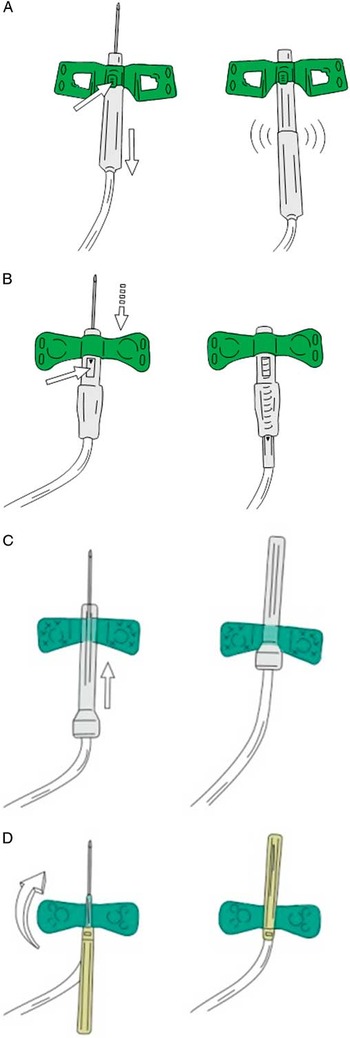
Four different winged blood collection needles representing 4 different safety-engineered protection mechanisms were tested (Figure 1): (a) Venofix Safety (B. Braun Melsungen) = withdrawal of the plastic hub and needle into the housing, (b) BD Vacutainer Push Button (BD Deutschland) = retraction of the needle into the winged blood collection device, (c) Safety-Multifly (Sarstedt) = needle protector pushed over the needle, and (d) Surshield Surflo (Terumo Deutschland) = protector closed with a snap over the needle.
Winged blood collection needles with different safety-engineered protection mechanisms: (A) Venofix Safety, (B) BD Vacutainer Push Button, (C) Safety-Multifly, and (D) Surshield Surflo.

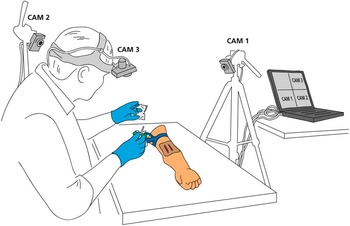
The experimental set-up for venipuncture included a simulation model (IV Arm Model; Laerdal) surrounded by a commercial video documentation and analysis system (D-Link DCS-932L/D-Link DCS-942L + D-Link DIR-615; D-Link) with 3 different observer directions for detailed post hoc analysis of each puncture attempt (Figure 2). At first, all participants were instructed to perform each venipuncture as follows: donning of gloves, preparation of the winged blood collection needle, skin disinfection, tourniquet application, venipuncture, tourniquet removal, decannulation, and subsequent activation of the specific safety-engineered protection mechanism. Three consecutive attempts were recorded: an uninstructed first handling, followed by instruction according to the manufacturer’s operating manual, followed by a first and a second trial. The order of the 4 different winged blood collection needles was randomized for all participants. For the uninstructed first handling, participants were asked to perform a venipuncture immediately after randomization. This shows whether the safety-engineered protection mechanism is self-explanatory. After the second trial, participants were asked to deactivate the safety-engineered protection mechanism. Subsequently, the participants had to answer a questionnaireReference Adams and Elliott 16 on their experience with each safety-engineered protection mechanism of the 4 winged blood collection needles using a Likert scale (1= strongly agree, 2= agree, 3= neutral, 4= disagree, 5= strongly disagree).
Experimental set-up for venipuncture in a simulation model using a multicamera video documentation and analysis system. CAM, camera.

End points analyzed by video included the successful activation of the safety-engineered protection mechanism, the time required for activation, the ability to execute single-handed activation, the correct activation of the safety mechanism, the risk of needlestick injury, the possibility of deactivation, and the preferred safety-engineered protection mechanism. The time required for activation was defined as the time required from decannulation of the needle tip outside the skin (Venofix Safety, Safety-Multifly, and Surshield Surflo) or contact of the fingers with the push button (BD Vacutainer Push Button) until complete activation of the safety-engineered protection mechanism. Correct activation was defined according to the manufacturer’s instruction. Risk of possible needlestick injury was defined as 1 finger coming within a distance of less than 1 cm next to the tip of the needle prior to activation of the safety-engineered protection mechanism. Blood splashing was defined as visually detectable blood on the participant’s gloves, the simulation model, or the table (Figure 2). Possible deactivation was defined as a free needle tip after maximum manipulation of the activated safety-engineered protection mechanism.
Statistical Analysis
Nonparametric data were tested for differences using the Cochrane Q test followed by the McNemar exact test and the Friedman test, followed by the Wilcoxon rank sum test if indicated. Data from “not possible activation of safety-engineered protection mechanism trials” were excluded from calculation of activation times. GraphPad Prism 5 for Microsoft Windows (GraphPad Software) and MedCalc, version 15.11.4, for Microsoft Windows (MedCalc Software) were used for statistical analysis. P<.05 was chosen as the level of significance.
RESULTS
From 300 third-year medical students 33 were randomly selected to participate in this study. Of the participants, 20 were women. The average age was 25 years.
Video Analysis
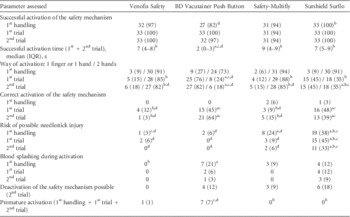
Results from the venipuncture simulations are summarized in Table 1. The overall successful activation rate for uninstructed first handling was best for Surshield Surflo (100%), followed by Venofix Safety (97%), Safety-Multifly (94%), and BD Vacutainer Push Button (82%). The overall successful activation rate improved during the second trial for Venofix Safety (100%) and BD Vacutainer Push Button (97%, P<.05). The median time required for safety mechanism activation was shorter for BD Vacutainer Push Button compared with the other 3 devices (P<.05). Compared with the other devices, activation with 1 finger or 1 hand during the second trial was significantly higher with BD Vacutainer Push Button (82%) (P<.05) and also higher for Surshield Surflo (45%) compared with Venofix Safety (18%) and Safety-Multifly (15%) (P<.05). Correct activation of the safety mechanism during the second trial was higher for BD Vacutainer Push Button (64%) and Surshield Surflo (39%) compared with Venofix Safety (3%) and Safety-Multifly (15%) (P<.05) and increased only for BD Vacutainer Push Button and Surshield Surflo after instruction compared with first handling (P<.05). Risk of possible needlestick injury during the second trial was significantly higher with Surshield Surflo (33%) compared with the other 3 devices (P<.05). There was no difference in blood splashing during activation between the 4 devices during the second trial. Deactivation of the safety mechanism was possible with BD Vacutainer Push Button (12%), Safety-Multifly (9%), and Surshield Surflo (18%) but not with Venofix Safety (0%). Premature activation occurred only with Venofix Safety during first handling (1%) and BD Vacutainer Push Button during first handling (6%) and second trial (1%).
Summary of the Results From the Venipuncture Simulation by 33 Participants

NOTE. Data are no. (%) of tries unless otherwise indicated. IQR, interquartile range.
a P<.05 vs Venofix Safety.
b P<.05 vs BD Vacutainer Push Button.
c P<.05 vs Safety-Multifly.
d P<.05 vs Surshield Surflo.
Individual Written Evaluation
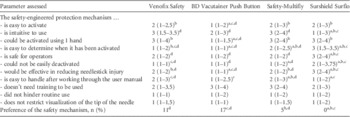
Results from the questionnaire are summarized in Table 2. Compared with the other devices the BD Vacutainer Push Button was rated best for ease of use, activation with 1 hand, ease of determination when it had been activated, and effectiveness for reduction of needlestick injuries (P<.05). Surshield Surflo was rated best for intuitive to use but worst for safety for operators and ease of deactivation compared with the other 3 devices (P<.05). No differences were found between the devices regarding the need of instruction and training, clinical usability, and visualization of the needle’s tip. Eleven medical students preferred the Venofix Safety needle, 17 the BD Vacutainer Push Button, 5 the Safety-Multifly, and none the Surshield Surflo (Table 2).
Summary of the Results From the Questionnaires of 33 Participants on Safety-Engineered Protection Mechanisms of 4 Winged Blood Collection Needles

NOTE. Results are taken as Likert scale (1= strongly agree, 2= agree, 3= neutral, 4= disagree, 5= strongly disagree). Data are median (interquartile range) unless otherwise indicated.
a P<.05 vs Venofix Safety.
b P<.05 vs BD Vacutainer Push Button.
c P<.05 vs Safety-Multifly.
d P<.05 vs Surshield Surflo.
Overall text comments for preference of 1 of the 4 winged blood collection needles included most comprehensive safety-engineered protection mechanism (n=31), the winged blood collection needle is best to handle (n=8), and best venipuncture with the winged blood collection needle (n=2).
DISCUSSION
The main findings of this study can be summarized as follows: (1) the overall successful activation rate during the second trial was equal for all devices, (2) the median time required for safety mechanism activation was shortest for BD Vacutainer Push Button, (3) single-handed activation during the second trial was best for the BD Vacutainer Push Button, (4) the risk of possible needlestick injury during the second trial was highest with Surshield Surflo, and (5) users preferred the most comprehensive safety-engineered protection mechanism and a mechanism that retracts the needle.
As shown in previous studies,Reference Mendelson, Lin-Chen, Solomon, Bailey, Kogan and Goldbold 2 , Reference Asai, Hidaka, Kawashima, Miki, Inada and Kawachi 15 the overall successful activation rate was high and equal for all devices. However, the median time required for safety mechanism activation was shortest for BD Vacutainer Push Button with 2 seconds versus 7–9 seconds for the other devices. Furthermore, single-handed activation during the second trial was best for BD Vacutainer Push Button with 82% versus 15%–45% for the other devices. These characteristics may constitute an additional safety aspect during routine clinical use. The better rate of correct activation of the safety mechanism for BD Vacutainer Push Button and Surshield Surflo suggest that the other 2 safety mechanisms may need more comprehensive instructions for correct use. We were able to identify a possible weakness of the BD Vacutainer Push Button in terms of inadvertent premature activation if used without instruction. Therefore, none of the examined safety mechanisms was fully self-explanatory.
Several studies have shown that percutaneous injuries using devices with safety-engineered protection mechanism occurred before or during activation of the safety-engineered protection mechanism.Reference Mendelson, Lin-Chen, Solomon, Bailey, Kogan and Goldbold 2 , Reference Tosini, Ciotti and Goyer 6 , Reference Black, Parker and Jagger 8 , Reference Black 9 , Reference Lu, Senthilselvan, Joffe and Beach 11 We identified 1 shielding safety-engineered protection mechanism (Surshield Surflo) with an increased risk for possible needlestick injury. Although statistical significance was not reached, only 1 safety-engineered protection mechanism (Venofix Safety) showed no blood splashing during activation and could not be deactivated. These findings are important for novel designs and for further development of the existing safety-engineered protection mechanism.
Today, all healthcare personnel, including students and trainees, should be educated and trained in locally available safety-engineered protection devices.Reference Yang and Mullan 5 , 14 However, in case education and training have not been performed, safety-engineered protection mechanisms should be as self-explanatory as possible. We identified several problems during uninstructed first handling: the activation with 2 hands in most cases, a possible risk of needlestick injury with 1 device, and several premature activations with 1 device. This information is helpful for design optimization and for the identification of self-explanatory safety-engineered protection devices.
In a recent commentary, Jagger and PerryReference Jagger and Perry 27 emphasized the critical role of healthcare workers in safety-engineered device selection. Adams and ElliottReference Adams and Elliott 28 recommended an evaluation of safety-engineered needle devices prior to introduction because no device may fulfill all requirements and meet the preferences of all healthcare workers. Our findings suggest that healthcare personnel are able not only to evaluate different devices with safety-engineered protection mechanism as shown before,Reference Asai, Hidaka, Kawashima, Miki, Inada and Kawachi 15 , Reference Adams and Elliott 16 but also to provide detailed information about which device is preferred for what reasons. Furthermore, our study suggests that devices using needle retraction (Venofix Safety and BD Vacutainer Push Button) were preferred to devices with shielding of the needle (Safety-Multifly and Surshield Surflo). These findings are consistent with a previous study, where participants preferred winged blood collection needles with retractable instead of sheath safety mechanisms.Reference Hotaling 19 Furthermore, our detailed specific evaluation may be a useful complement to the implementation strategy suggested in this study.Reference Hotaling 19 , Reference Lavoie, Verbeek and Pahwa 20
One limitation of the study is the model used for venipuncture. As in other simulation studies,Reference Onia, Wu, Parvu, Eshun-Wilson and Kassler-Taub 29 complicating factors such as different nature of skin quality, bleeding, patient behavior such as withdrawal of the extremity during venipuncture, or stress of the inexperienced users during the procedure cannot be simulated reliably. We did not study possible further training effects of more than 3 attempts with each winged blood collection needle or the effect on preference caused by an accompanying education and training program as recommended. 14 We did not examine the effect on needlestick injury rates; therefore, our study cannot and does not establish actual safety performance of the different devices. Rather, we focused on the characteristics of the safety-engineered protection mechanism itself and its usability, especially when applied by inexperienced and briefly trained healthcare personnel.
In conclusion, we have shown that inexperienced healthcare personnel demonstrate significant differences regarding product characteristics of safety-engineered protection mechanisms of winged blood collection needles. We have also shown that the most comprehensive safety-engineered protection mechanism was the main reason for individual preference and devices with retraction of the needle were preferred versus devices with shielding of the needle. Therefore, we suggest our model-based study as 1 possible product evaluation tool that would be helpful in the assessment of new devices under consideration in healthcare facilities before clinical implementation. It may make a contribution to the integration of safer needle designs into the healthcare workplace.
ACKNOWLEDGMENTS
We thank D. Hauschke, PhD (Department of Medical Biometry and Statistics, University Medical Center Freiburg, Freiburg, Germany), for support in statistical analysis and interpretation of data; and H. Pahl, PhD (Division of Molecular Hematology, University Medical Center Freiburg, Center for Clinical Research), for revision of the manuscript.
Financial support. None reported.
Potential conflicts of interest. All authors report no conflicts of interest relevant to this article.