Introduction
Turf mounds occur in a variety of Arctic and sub-Arctic periglacial alpine contexts, and commonly are associated with boulders, trail markers and anthropogenic rock cairns, structures and features. Archaeologists may not be permitted to excavate or disturb certain associated rock structures, such as burial rock cairns; however, the age and cultural affiliation of other boulder features, where detailed investigations may be permitted, such as the Canadian inuksuit, are of interest. In the Norra Storfjälett region of northern Sweden, turf mound development was observed around both natural boulders, anthropogenic stone burial cairns, and other stone structures, such as boulder (meat) storage caches. However in this situation we only investigated and excavated one unusually lush turf mound to view the stratigraphy and understand soil development; and although this was clearly a natural boulder we did uncover an artifact, and a radiocarbon history, suggesting that these turf mounds may be usefully studied in other contexts.
Turf mound deposits, with thick lush grass overlying the base, occur primarily in the lee of larger boulders and rock structures, often streaked with bird droppings and lichens, and situated opposite the prevailing wind direction. Several hypotheses for the developmental process of these turf mounds are considered, including: 1) aeolian deposition, 2) natural bird perches and guano (bird droppings) accumulations, 3) physical weathering and thermo-fractionation of the boulders and 4) increased soil development from snow bank melt and surface run-off fertilising the soils in these specific protected microenvironments. Excavation and 14C dating of a natural boulder turf mound in the Norra Storfjälett indicated that turf (peat) development occurred in the late middle Holocene (Sub-Boreal/Sub-Atlantic Chronozone boundary in Scandinavia; Mahaney and others Reference Mahaney, Earl, Kalm and Julig1995b). The core sediments of the deposits behind rock structures indicate they are not ‘rat's tails’ type glacial deposits (Flint Reference Flint1971: 90), but rather organic (peat) and fines. Results suggest that for the Norra Storfjället example, guano accumulation from ptarmigans (Lagopus mutus) or other bird species, may have contributed significantly to turf mound development and that such turf-mounds may be sectioned and dated to provide minimum age estimates for associated rock structures.
Anthropogenic rock structures and features are found in circum-polar regions around the world, and are known as inuksuit in the Canadian Arctic, dorazy chelovekan in Siberia, and seite by the Saami in Fennoscandia (Hallendy Reference Hallendy2000). Researchers from various disciplines are curious concerning the age of these structures, but they are difficult to date. As with natural boulders many are favoured roosts of birds and the rich guano encourages a luxuriant growth of Xanthoria (Hallendy Reference Hallendy, Morrison and Pilon1994). There may also be development of turf deposits at the base of such anthropogenic rock structures, often but not always in association with lichen plumes on their surfaces. Bird roosts with lichen plumes are known from many mountain locales including the Italian Alps (Mahaney Reference Mahaney2008) and Mt. Kenya (Mahaney Reference Mahaney1990).
Field area
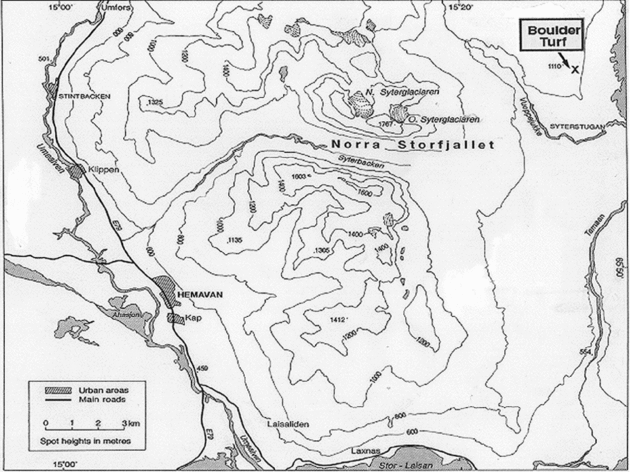
Located to the lee of the Caledonian Mountains of northern Sweden, just south of the Arctic Circle, the field site, situated at approximately 900 m (Fig. 1), is within the alpine tundra vegetation zone. Presently, birch forest is found below elevations of 700 m but in the past timberline extended to an elevation of around 900m during the mid-Atlantic Chronozone (Mahaney and others Reference Mahaney, Earl, Kalm and Julig1995b). This is approximately the elevation of where the turf-mound bird-perch SKI4 site was found.
Norra Storfjallet area just south of the Arctic Circle in the Swedish Mountains.

The present vegetation belt is composed principally of heath, comprising dwarf birch (Betula nana), bilberry (Vaccinium myrtillus L.), and crowberry (Empetrum hermaphroditum) with a maximum height in sheltered locations of 0.5 m. Above 900 m, the heath blends in with fellfield vegetation.
The mean annual temperature (MAT) at Hemavan (475m) is –0.4°C. Mean annual precipitation (MAP) is 681 mm (Sveriges Meteorologiska och Hydrologiska Institute 1980). The MAT and MAP are not known with precision, but applying a lapse rate of 0.6°C/100 m (Vegetationskarta över de svenska fjällen 1978) would give an MAT of −3.0°C and most probably an MAP of close to 1m.
Bedrock outcropping in the study area comprises of the Storfjället Nappe Complex of Ordovician age consisting of quartz-rich mica, graphitic and mica schist, calcareous and quartz phyllite, mixed felsic and mafic volcanite, greenstone and mylonite (Sandwall Reference Sandwall1981). Occasional veins of quartz are present, which were utilised for toolstone by the prehistoric Saami and earlier occupants of the area (Holm Reference Holm1991; Julig Reference Julig1993).
Soils are developed in ground moraine and range from Inceptisols and Entisols, mainly Cryochrepts and Cryorthents, above timberline to scattered enclaves of relict Spodosols (NSSC 1995), mainly Orthods, from the mid-Atlantic Chronozone when timberline reached far up on the massif (Earl-Goulet and others Reference Earl–Goulet, Mahaney, Hancock and Milner1997, Reference Earl–Goulet, Mahaney, Sanmugadas, Kalm and Hancock1998). Below timberline, Spodosols dominate in the landscape along with occasional Histosols (compare Cryofibrist) such as the one described in this paper. We used the designation ‘L’ for organic matter accumulations and different symbols for fibrous and finely disseminated peat with a depth of ~50cm over parent material.
Research on lichenology and lichenometry is relatively limited in the field area although a rich lichen flora of crustose, foliose and fructose lichens are found across the landscape. Research on the effect of airborne pollutants on lichen growth, specifically Rhizocarpon section Rhizocarpon, previously undertaken by Mahaney and others (Reference Mahaney, Boyer, Wilson and Hancock1995a), showed the deleterious impact of acid rain on lichen longevity in the field area.
Previous research
Previous research on such guano enhanced turf mounds, adjacent to large boulders, is limited mainly to unpublished observations by many workers. The example reported on here is not the same as bird dropping mounds ‘on top of boulders’ as may be caused by some raptors such as owls and hawks. Benedict (Reference Benedict1967, Reference Benedict1968), however, mentions lichen plumes of Rinodina oreina on boulders and attributes these clusters to fertilisation by marmots and birds. Spence and Mahaney (Reference Spence and Mahaney1988) attribute plumes of Xanthoria to fertilisation by birds on Mt. Kenya, although no observations of birds perching on boulders were made and no further excavations were carried out to support this hypothesis.
Results
Holocene stratigraphy
The eastern flank of the massif is bordered by the Tärnaån River and Lake Tärnasjön at 606 m (Fig. 2). Soils on the massif have developed in moraine deposits (till and glaciofluvial sediment) deposited between 6000 and 8000 14C yr BP during the deglaciation of the region. The north-south trending valley of the Umeälven was free of ice starting around 8000 yr BP just after the breakup of the Scandinavian Ice Sheet. At the same time the Tärna Valley was covered with ice as far south as Tärnaby (Mahaney and others Reference Mahaney, Earl, Kalm and Julig1995b). During the mid-Atlantic Chronozone valley glaciers retreated to 700–800m with nunataks appearing at the highest level on the massif. During this event the field site was covered with ice that was beginning to thin and continuing to recede to the north. The field site (Fig. 1) was probably ice free by mid-Atlantic time (6500 yr BP), or slightly thereafter (Mahaney and others Reference Mahaney, Earl, Kalm and Julig1995b), as the Tärna Glacier was in full retreat and the mountain ice was receding into the higher cirques.
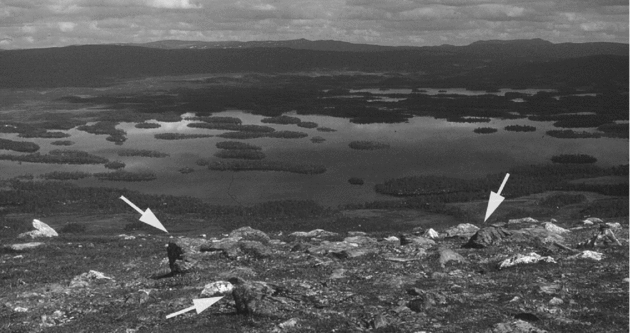
Røgen moraine area in the foreland of the Tärna Glacier, northern Sweden. Bird-perch boulder, festooned with lichen, to left of centre. View is to the east. Prevailing wind has ice crystal blasted the windward side of the boulder so that lichen cover, mainly Rhizocarpon is low <15%. Note the Xanthoria is on the eastern side of the boulder (out of view), the downwind side.
The till at the field site dates from the mid-Atlantic Chronozone. According to radiocarbon dates from the field site an unconformity exists between the till and the overlying peat succession. Most probably the till surface, exposed as a broad swell, was subjected to the prevailing westerly winds and may be largely windswept in winter which, in turn, may have inhibited weathering and soil formation. In any case the hiatus between 6500 and 2200 yr BP, largely encompassing the Sub-Boreal Chronozone was a time of colder/drier climate, for which we have no sediment record. The contact between the peat and till is sharp and clear and the underlying till is fresh, with a color of 2.5Y 6/3 (dull yellow) indicating the absence of weathering. In all probability the peat accumulation, starting at 2200 yr is the first stage of soil development at this site following deglaciation, although older soils have been documented elsewhere on the massif in other publications (Mahaney and others Reference Mahaney, Earl, Kalm and Julig1995b; Earl-Goulet and others Reference Earl–Goulet, Mahaney, Sanmugadas, Kalm and Hancock1998).
Stratigraphy of turf mound
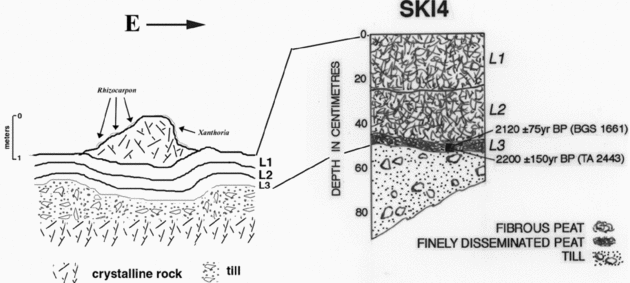
The turf mound boulder (Fig. 3) rests in ground moraine deposited by Atlantic-age ice as it retreated (deglacial stage one) toward the high Norra Storfjället Massif after it separated from the main Tärnaån Glacier (Mahaney and Kalm Reference Mahaney and Kalm2012). The boulder is one of many possible bird roosts, some with well established lichen plumes, principally Xanthoria spp.? Key to identifying the bird roost is the turf bank swell deposit located to the lee of the boulder, peat dominating the upper horizons.
Cross-section of the bird-perch boulder showing two layers of undecomposed peat and a lower layer (horizon) of finely disseminated peat from which the two 14C dates were obtained. The underlying till belongs to the last glacial oscillation or advance in the Late Boreal/Early Atlantic.
Rock structures and boulders
A variety of anthropogenic rock structures and features were observed in the field area, including meat caches, and probable burial cairns, but they are difficult to date. Of several boulder turf mound sites in the area, only one was sampled, the results described above. The local Saami refer to some of the boulders as seite (Ehrhardt Reference Ehrhardt1964) and they are interpreted by some as essentially similar to the inuksuit of the Canadian Arctic (Hallendy Reference Hallendy, Morrison and Pilon1994). Included in this category are both distinct natural stone objects (special boulders) as well as placed, shaped and constructed stone objects (Hallendy Reference Hallendy, Morrison and Pilon1994) which are commonly used to direct caribou to hunters in drives (Maxwell Reference Maxwell1985), and others to mark trails and special locations. The observed structures are similar in form to game drive structures described by Benedict (Reference Benedict1967, Reference Benedict1968), and in the Front Range of Colorado, with some of the Swedish structures likely to be of considerable antiquity based on lichen growth patterns. Lichen cover is often over 50% and is composed of Rhizocarpon and the presence of Xanthoria streamers, the maximum diameters of Rhizocarpon often exceeding 100 mm. However, many do not have much lichen growth and do not appear to be too ancient, but this may be due to boulder lithology or location, or other unspecified growth limiting factors such as ice crystal blasting or excessive snow cover (Spence and Mahaney 1985). Included in this group of rock structures are hearth features, trail markers, and two types of rock cairns on crests of mountains and ridges. The arrangement of such stone structures often indicates specific information about landscape features, fishing and hunting locations, in addition to being trail markers.
A rectangular stone setting was recorded on a level terrace in moraine topography, near hunting pits and the stalo type Sammi site north of Stor-Laisan. This was not excavated but probably represents a row of hearths (Julig Reference Julig1993). Bergman (Reference Bergman and Kvist1991) has reported similar rectangular stone hearths elsewhere in the region, and this location has a spatial association of similar hearths, with hunting pit falls and dwelling sites, similar to those reported by Mulk (Reference Mulk and Kvist1991).
Stone piles, or cairns, of two types were recorded in the upper Tärnaån mountain region. On the tops of some mountains are circular cairns of one to two metres in height and several metres in diameter. Some appear to be of considerable antiquity based on the lichen growth and accumulation of turf and peat deposition around their bases. These were not excavated or tested but they may represent burial rock cairns (Julig Reference Julig1993).
The accumulation of turf and peat around the bases of rock cairns, and some boulders, appears to be due in part to their being used by birds for perches and shelter from the prevailing wind. Ptarmigan droppings are often noted around their bases and in the lee of such structures, along with organic accumulation promoting turf growth, which helps retain moisture and assists in the development of a fine peat soil at these locations (Fig 2). We have also noticed other small mammal faeces in the thick turf grass of such turf mounds in the field area. A boulder perch at site SKI4 was investigated primarily because of a prominent plume of Xanthoria, probably X. elegans, draped over the eastern flank (that is downwind side) of the boulder, the flank that is protected from the prevailing wind and the highest part of the boulder surface, and the occurrence of the thick turf mound behind the boulder. The microtopographic situation here is essentially similar to lichen encrustrations on bedrock described by Timoney and Marsh (Reference Timoney and Marsh2005) for the Peach River district of Canada, Pielou (Reference Pielou1995) for the Arctic in general, and Mahaney and others (Reference Mahaney, Boyer, Wilson and Hancock1995a) for the Norra Storfjället Mountains. Lichen analysis revealed a composition of Rhizocarpon, Xanthoria, and Alectoria (spp.?). The eastern side appears to be the preferred portion of the boulder for bird perching (and fertilisation), as most of the droppings were in the turf grass on top of the mound deposit, adjacent to the boulder. Presumably the birds, such as the rock ptarmigan, face the wind when strutting or perched on such boulders, ridding themselves of faeces. Birds also may defaecate just prior to or on take-off (presumably to lose weight for the most part) as they taxi into the wind on the highest boulder shoulder unloading as they take off.
Three other circular cairns of two to three metres diameter are present along the crests of ridges in the upper Tärnaån River (Julig Reference Julig1993). These were interpreted as cold-weather reindeer meat caches. The functional interpretation and age determination of such features as archaeological may be provided by sectioning of overlying turf mounds, and may also provide relative or absolute dating evidence. Certainly the organic-rich soils and peat deposits may be directly dated. Similar inuksuit features are present in the Canadian Arctic (Hallendy Reference Hallendy, Morrison and Pilon1994), where such stone structures are considered a type of temporary site. Cairn site SKI3 was on the crest of a ridge and the rocks had been removed from the centre, so that a flat circular structure remained. Reindeer bones and teeth were preserved under the flat rocks of this structure. Reindeer bones (faunal remains) were also recovered from near the site SKI5, another cache cairn in the birch forest zone near Skiratjakke Mountain (the 1110 m summit on Fig. 1). In such cases rock cairn caches could also be directly dated by 14C methods on the faunal remains; however, this was not done for SKI5. In such cases a comparison of the basal turf peat dates may be usefully compared to any dates on faunal remains, and may indicate a range for the feature from construction to final use.
Quartz artefacts
Isolated culturally modified quartz artefacts were recovered from peat deposits at two sites, the Turf Mound site SKI4 and TARNA17 while excavating soil pits. Both of these recoveries were in the Upper Tärnaän region; TARNA17 was in a small peat bog between two moraines, in the upper limit of the birch zone. Approximately 105 cm-thickness of peat was excavated, overlying a silt-clay base, to determine the beginning of organic sedimentation by 14C and amino acid dating (Mahaney and others Reference Mahaney, Earl, Kalm and Julig1995b). The artefact was recovered from the woody peat layer at about 70 cm depth. The woody peat layer is from the climatic optimum and this recovery could date to circa 5500–6500 BP. Two small springs in the bog may have been the focal point of a larger habitation site at this location indicating early occupation in this region (Holm Reference Holm1991; Knutsson Reference Knutsson1993).
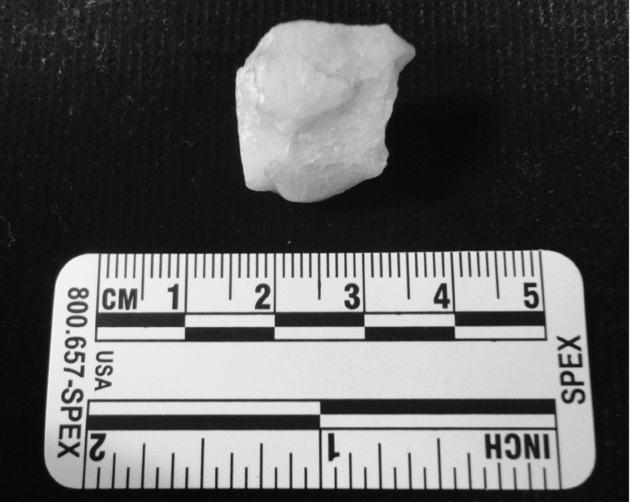
The quartz artefact recovered from the turf mound at site SKI4 was located during the excavation of a soil test pit adjacent to a large boulder on the crest of a ridge at approximately 900 m elevation (Fig. 3). The artefact was recovered at a depth of 18 cm near the contact of the fibrous peat (L-1) and fine peat material (L-2), which had accumulated adjacent to the boulder, and from which the soil is derived (Fig. 3). The formation of these turf/peat deposits to the lee of boulders and rock cairns used by birds has been discussed in the previous section. The recovered artefact appears to be the fractured end of a quartz ‘keeled scraper’, with some unifacial flaking along one edge (Fig. 4). Such basic unifacial tools are not too diagnostic as to cultural occupation because they are fairly common, and rather than a site, this may be considered an isolated find. Basic cutting and scraping tools on such vein quartz raw materials were used by prehistoric populations here, as elsewhere, in the north of Sweden (Broadbent Reference Broadbent1979; Forsberg Reference Forsberg and Kvist1989). It appears that the quartz tool was fractured, possibly in use-related activities. Since it was recovered at a depth of 18 cm, just above the base of the L1 stratum (fibrous peat), with basal dates on the L2 peat at 40–45 cm at circa 2200 yr BP (Fig. 3), and assuming fairly uniform rate of deposition, the artefact may have been deposited at about 800–1000 yr BP. The turf mound at SKI4 is a very attractive patch of grass on the mountain top, and the artifact (an isolated find) may have been discarded or lost in a short-term visit, as there were no other artefacts or quartz lithic debitage recorded at this site.
Quartz keeled scraper artefact (broken), from Turf Mound SK14.
Artefact raw materials and quarry sites
There are no massive bedrock deposits of useable flint, quartzite or other readily knappable materials in the Norra-Storfjället (Julig Reference Julig1993), in contrast to the outcrops and boulders of brecciated quartz available further to the west in the Rana-Tärna mountains around lakes Överuman and Gressvatet, nearer the Swedish/Norwegian border (Holm Reference Holm1991). While large deposits of knappable materials are not available in the three areas surveyed, small amounts of vein quartz and quartzite are present in the mica schist, mica gneiss and amphibolite bedrock, and outcrops across the field area in small veins. Past prehistoric populations utilised the type of raw material described here, as well as elsewhere in the north of Sweden (Broadbent Reference Broadbent1979; Forsberg Reference Forsberg and Kvist1989), to manufacture tools. While geoarchaeological survey was not the major focus of the overall programme of geomorphology surveys undertaken between 1989 and 1993 (Mahaney and others Reference Mahaney, Earl, Kalm and Julig1995b), only clearly evident culturally modified quartz and chipping areas were noted during the last year of field work. Such vein-quartz debitage, lithic tools and evidence of material extraction were found at workshops and raw material sites within two of the three geological survey areas in the Norra-Storfjället (Julig Reference Julig1993).
Above the timberline at Hemavan (Fig. 1), between 750 and 900 m elevation, several small lithic workshops and raw material sites were found, generally associated with narrow bands of vein quartz that could be easily quarried. Small amounts of tan-coloured brecciated quartz were also available and used to manufacture tools, although some of the larger blocks may have been glacially transported. White milky quartz, present in veins, boulders and cobbles, was used in small quantities in this area. Scattered stone artefacts such as isolated cores were also recorded across the landscape, up to 1100 m elevation. Surface finds of some culturally modified artefacts and raw material extraction sites at some veins and outcrops were present along the existing trails within the Vindelfjällen Nature Reserve, suggesting considerable antiquity for the trail system and some long-term continuity in land use. The artefacts associated with the quarries and workshop sites were generally typologically non-diagnostic, but bipolar technique was evident and quartz keeled scrapers were recovered similar in style to the lithic recovered at SKI4 (Julig Reference Julig1993).
In the upper Tärnaån River a similar pattern was evident above the timberline, with small lithic quarry/working sites based on whitish vein quartz and some use of dark quartz derived from boulders. Some slate is present but no finished artefacts were recovered; this type of material has poor archaeological visibility in surface survey. It appears that the artefact from the Turf mound (SKI4) was made of the whitish vein quartz, with similar material recovered from quarry contexts in the upper Tärnån River.
Discussion
The wind direction in this part of northern Sweden is predominately from the west. In the lee of the boulder, fines were trapped and the finely disseminated peat (L3) contained a small aeolian component. The source of the aeolian materials may in part be fairly local, mostly from deflation and erosion in the upland region of the Norra Storfjället, as some exposed surfaces are evident on the mountain ridges above the timberline. The snow bank that developed in the lee of the boulder each year upon melt out would deposit its aeolian components, picked up from deflation from exposed mineral soils elsewhere on the ridges and mountains off to the west (Fig. 1). In earlier times when the timberline was higher during Stage 4 (Mid-Atlantic chronozone 6000–5000 BP; Mahaney and others Reference Mahaney, Earl, Kalm and Julig1995b), and approached 900 m, this field site around the turf-mound boulder would have been nearly within the dwarf birch/pine forest of the timberline, and aeolian deposition may have been somewhat reduced. It may have also been less attractive to the rock ptarmigans, which prefer open terrain.
During the subsequent Sub-Boreal (Stage 5) and Sub-Atlantic (Stage 6) chronozones lower temperatures and reduced precipitation may have reduced the vegetation density and decreased weathering rates. Based on the 14C uncalibrated dates of ca. 2100–2200 yr BP, obtained from the base of the peat (turf mound), the deposition began during the later part of Stage 5 and continued into Stage 6, during this time of increased precipitation and cooler temperatures. It appears that the bird perch boulder site (SKI4) may have become a favoured roosting location for rock ptarmigan at this time when timberline was lower, and the beginning of peat accumulation had begun. Peat accumulation may have favoured loess accumulation, which may have led to turf mound development with vegetation protected by snow accumulation in the lee of the boulder.
In addition, the domestication and ranching of reindeer in the region by the earlier Saami (Forsberg Reference Forsberg and Kvist1989) may have contributed to this aeolian deposition. This is currently an area that the reindeer herds frequent, including the annual round-ups by the Saami, and there are many trails and patches of open ground with the reindeer herds contributing to reduced frequency of vegetation distribution, and some open exposed soil. Reindeer and wild caribou (in the past) would frequent these upland ridges above the timberline to avoid insects. There is also evidence of continuity with the past as rock caches for reindeer meat are recorded, and ancient hunting pits are common along ridges in the Norra Storfjället region (Julig Reference Julig1993).
Guano deposits
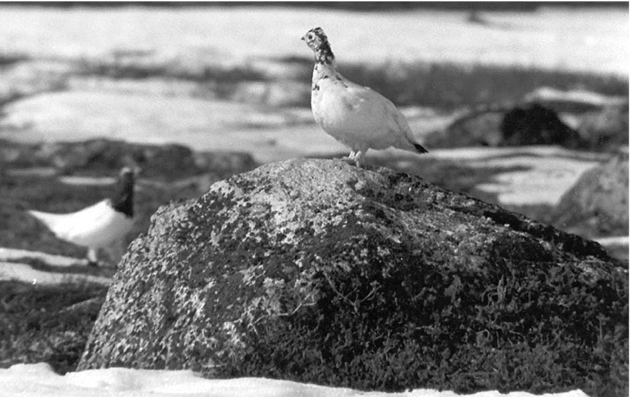
The hypothesis that guano (bird droppings) was a major contribution to the organic (peat deposits) formation has considerable supporting evidence. Evidence of bird droppings was noted on both the top surface of the boulder and on the turf mound to the lee of the boulder, and this would fertilise the turf, promoting growth and enhanced organics/peat deposition. In addition there was extensive lichen growth (Xanthoria spp.?) observed on top of the boulder that may have been caused by the bird droppings, although Xanthoria elegans is known to exhibit increased metabolic activity in cold climates (Murtagh and others Reference Murtagh, Dyer, Furneaux and Crittenden2002). The presence of gallinaceous grouse birds such as ptarmigan was noted in the immediate location of the boulder, both from their droppings and the observation of several individuals that were feeding in the area around the ridge near SKI4. Such types of birds have elaborate courtship displays, often involving roosting on boulders when calling (Fig. 5).
Ptarmigan roost boulder with rock ptarmigans, from the Canadian Arctic. These birds are in the moulting stage, in the spring season. Note abundant lichen on top of boulder.
In the area of northern Sweden and the Norra Storfjället there are two grouse species that are reported present, the rock ptarmigan (Lagopus mutus) and the willow grouse or willow ptarmigan (Lagopus lagopus) (Bruun Reference Bruun1975). The ptarmigan disperse in pairs in summer and group together as flocks in winter. At least one pair was around the area during our fieldwork, and appeared to use the boulder for roosting. They tend to nest on open gravel patches, where they have excellent camouflage from predators. The rock ptarmigan is more common above the timberline and we believe that the species present in this area was L. mutus; also known as the rock ptarmigan (Chandler and others Reference Chandler, Bruun and Zim1983) in the North American Arctic regions.
Ptarmigan were certainly present at the SKI4 site, as their droppings were present in the grass in the lee of the boulder at SKI4, and their guano contributed to lush grass vegetation and turf mound in the lee of the boulder. However, the fact that this turf mound did not develop until around circa 2000 years ago indicates that multiple factors were probably involved. These include the greater presence of aeolian sediments and a climate conducive to grass development. Also, the entrapment of a minor amount of aeolian sediment, growth of tuft grass and development of peat may have assisted in moisture retention from snow bank melt. It may be that the boulder in question became a favoured roosting perch around this time, while earlier it may have been in the forest fringe.
Palaeoenvironmental inferences
Environmental changes over the last 2000 years in the field area appear to have favoured the formation of turf deposits in the lee of both natural (boulders) and anthropogenic rock structures such as cairns and trail markers; however, their occurrences may have been restricted to the regions above the timberline. Deposition includes both organics (peat and guano) and loess materials, the combination of which may be related to greater human use of the upland regions for reindeer herding. However, many of the turf deposits appear to be correlated with Xanthoria and other lichens related to natural (guano) fertilisation of bird perches. These upland swales and some swells carry putative Spodosols (Podzols) developed during the Atlantic Chron, many still in existence during the Early Neoglacial (Sub-Boreal Chron), replaced sometime after 5ka (Mahaney and Kalm Reference Mahaney and Kalm2012). While we cannot be definitive about the exact age of the moraine sediment or the time of lichen colonisation of the boulder in question, we can say the first peat deposition occurred about or just after the transition between the Sub-Boreal and Sub-Atlantic chrons (2.5 ka; Mahaney and others Reference Mahaney, Earl, Kalm and Julig1995b).
Conclusions
Bird perches on the tops of boulders and cairns, may be recognised by plumes of Xanthoria draped over the lee flank of rock structures. In one instance, at SKI4 site, the turf mounds located to the lee side of the perch contained a record of stratigraphic and geoarchaeological significance, which when unraveled, provides important information about the paleoenvironment and insight into human adaptation within this region. Without a lichen plume signature, turf mound accumulations are unobtrusive and are likely to escape notice and excavation.
In the field area studied most of the rock cairns and trail markers had turf mound deposition development at their bases, typically on the lee (down-wind) side. While we did not excavate and date the turf mound deposits associated with anthropogenic rock structures, as we were conducting mainly glacial geology and not archaeological excavations, the 14C dated example from the boulder turf mound indicates this feature to be a relatively late Holocene phenomenon that characterises the environment above the timberline, in this part of the Swedish Arctic.
The study of turf deposits, stratigraphically overlying the placement of stone structures such as the Saami seite and the Canadian inuksuit may become a valuable geoarchaeological approach to provide minimum dates for the construction of such structures. The peat in the turf mounds is relatively dry, may be accurately dated by 14C methods or they may provide relative age information by their soil stratigraphy. Such deposits may also contain archaeological remains, including artefacts, as they have relatively high rates of deposition for upland regions in the Arctic. Since these turf mounds are covered with lush grass vegetation, often in a relatively protected location behind boulders, it is not surprising that humans, such as the Saami, used such spots as short-term sites. We observed unique lush grass, with ptarmigan droppings, and were not surprised when we excavated it and found an artefact. Archaeologists have shown that basic human behaviour patterns have long-term continuity. A good place (site) to have lunch in past centuries is often a good place currently, because it has the thickest grass to rest on in this part of the mountain top, and out of the wind.
Acknowledgements
This research was carried out with funding from Quaternary Surveys, Toronto, from Laurentian University Research Fund (to PJ), and from Estonian Basic Research, grant no 0182530s03 (to VK). We thank three referees for critical comments on the manuscript and Ian Stone for putting up with numerous changes at near-proof stage.