INTRODUCTION
An ongoing debate continues regarding whether treatment using selective serotonin reuptake inhibitors (SSRIs) is associated with increased suicidality, which refers to both suicidal behaviors and ideation. Initial meta-analyses of placebo-controlled trials for the treatment of depression, bulimia, and obsessive-compulsive disorder did not demonstrate a signal for an increase in suicide-related adverse events (AEs) and fluoxetine treatment compared with placebo (Beasley et al. Reference Beasley, Dornseif, Bosomworth, Sayler, Rampey, Heiligenstein, Thompson, Murphy and Massica1991, Reference Beasley, Potvin, Masica, Wheadon, Dornseif and Genduso1992; Wheadon et al. Reference Wheadon, Rampey, Thompson, Potvin, Masica and Beasley1992). Other reviews though have suggested a significant association between SSRI treatment and suicidal behaviors. Fergusson et al. (Reference Fergusson, Doucette, Glass, Shapiro, Healy, Hebert and Hutton2005) reviewed data from 702 published randomized controlled trials; however, only 345 of their eligible trials provided data regarding suicidality as an AE. Within the available data, the SSRI treatment group was associated with an increase in odds ratio for suicidal behaviors, but no difference in risk was found when focusing only on fatal suicide attempts. Notably, though, a greater number of suicide attempts was observed in patients without severe depression. Gunnell et al. (Reference Gunnell, Saperia and Ashby2005) also conducted a meta-analysis of 477 randomized controlled trials across a number of indications with different SSRIs. Their data suggested a protective effect for suicidal thoughts with SSRI treatment, but also showed a possible increase in risk for non-fatal self-harm. However, as the authors noted, they did not have access to individual patient data, and the summary data for some trials did not separate out ideation from behavior.
In 2004, concerns regarding suicidality and the use of SSRIs for the treatment of pediatric psychiatric illness intensified following a Food and Drug Administration (FDA) analysis of 23 clinical trials and one NIMH study; in total covering nine different SSRIs and five different treatment indications (Hammad et al. Reference Hammad, Laughren and Racoosin2006). For their review, the FDA searched at the individual patient level for any suicide-related AEs, and they examined changes in ratings on the suicide item from depression rating scales. Although the rating scale data did not demonstrate a worsening or emergence of suicidality associated with SSRIs, the FDA found an increase in risk for suicidality based on adverse events, which subsequently led to their requirement of a ‘black box warning’ on all SSRI packaging inserts. This warning states a need for close monitoring due to possible worsening of depression or suicidal ideation in pediatric patients (US Food and Drug Administration, 2004).
Expanding upon this action, the FDA conducted a subsequent examination of clinical trials across antidepressants for all indications in adults, which entailed a dataset of 372 trials comprising 99 231 patients (Laughren, Reference Laughren2006). In that analysis, the FDA confirmed that the risk of emergent suicide-related AEs did not differ between antidepressants and placebo across all adult age groups, but they did find higher risks associated with SSRI treatments within the young adult population (18–24 years), a equivocal risk for adults between 25–64, and possible protective effect (less risk with SSRI treatment) within older adults (>65 years).
The Eli Lilly and Company corporate fluoxetine trial database represents the largest compilation of placebo-controlled randomized trials for an individual SSRI treatment. With nearly 15 900 patients, the fluoxetine study database comprised 16% of the overall FDA database (Laughren, Reference Laughren2006). Therefore, the breadth of the dataset provides an opportunity to examine specific factors that may affect the risk of emergent suicidality in the course of SSRI treatment while controlling for the specific treatment intervention. Major depressive disorder (MDD) is associated clearly with thoughts of death and suicide as these symptoms are part of the diagnostic criteria (APA, 1994). The use of an overall non-MDD database could provide clarity to the risk relationship by removing the confounding influence of this psychiatric symptom associated with MDD. The objective of the analyses in this paper was to use the non-MDD database to examine the risk difference for emergent suicide-related AEs between fluoxetine and placebo treatments. A secondary objective was to examine the risk of suicidality-emergent AEs between fluoxetine and placebo within subgroupings based on age or indication.
METHODS
Data sources
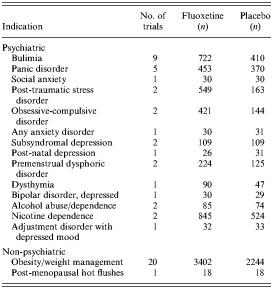
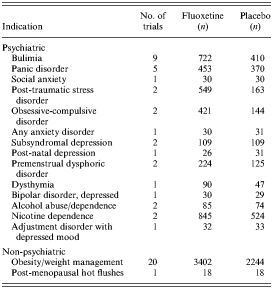
The dataset consisted of double-blind placebo-controlled trials of fluoxetine that were sponsored by Eli Lilly and Company, resided in the corporate database as of 15 June 2006, and were conducted for any other indication besides MDD. Trials were excluded if they had fewer than 30 patients, or if they were open-label, were non-blind extensions, or were pharmacokinetic studies. Based on these criteria, the database consisted of a total of 53 trials for 16 different indications (14 psychiatric, two non-psychiatric; Table 1). The majority of trials were for fluoxetine treatment of 60 mg/day or allowed 60 mg/day, with a range of 10–80 mg/day across the trials. Five trials include other active comparators (one bupropion, one mianserin, two clomipramine, and one benzphetamine). Twenty-five of the 53 trials had specific exclusion criteria regarding suicidality at baseline. None of the trials included co-morbid MDD.
Summary of double-blind, placebo-controlled clinical trials within the overall fluoxetine trial database for indications other than major depressive disorder
Assessment of suicidality-related adverse events
Potential suicide-related ideation or behaviors were identified using a computerized text-string search of all investigator-recorded verbatim and dictionary-coded AE terms recorded in the adverse event modules of case report forms for the 53 trials. In addition, searches identical to those used for AE terms were conducted on free-text narrative comments of the case report forms to ensure capture of relevant events (even if not specifically identified as an AE by investigators). The list of text strings used for these searches were as follows:
accident, attempt, cut, gas, hand, hung, injur, jump, mutilate, overdos, self damag, self harm, self-harm, self inflict, self-inflict, shoot, slash, suic, poison, asphyxiation, suffocation, firearm, burn, drown, gun, immolat, monoxide.
Potential events identified by these search criteria were reviewed manually to determine whether they were suicide-related ideation or behaviors. All reviews were performed blinded to treatment. Patient data for each occurrence from the identified terms were evaluated by a Lilly healthcare professional to identify and exclude false positive potential events (example: ‘die’ in San Diego). Remaining potential events were manually reviewed by another two Lilly healthcare professionals, at least one of whom was a physician. Reviewers independently assigned each event to one of nine FDA codes (FDA Suicidality Classification Project; www.fda.gov/ohrms/dockets/ac/04/slides/2004-4065S1_06_FDA-Posner.ppt):
FDA code 1:completed suicide,
FDA code 2:suicide attempt,
FDA code 3:preparatory act towards imminent suicidal behavior,
FDA code 4:suicidal ideation,
FDA code 5:self-injurious behavior – intent unknown,
FDA code 6:fatality – not enough information,
FDA code 7:self-injurious behavior – no suicidal intent,
FDA code 8:other (accident), and
FDA code 9:non-fatality – not enough information
Results of categorization were compared to obtain consensus, with a third person providing arbitration if necessary. All analyses were based only on treatment-emergent adverse events, which were defined as events occurring after the first dose and within 24 hours of the final dose; they also were either not present at pre-treatment or became more severe during treatment. All events occurring before randomization or more than 24 hours after the last dose in the acute treatment period were excluded.
The following outcomes were analyzed: completed suicides, suicide attempts, suicidal acts (fatal and non-fatal attempts), preparatory suicidal behavior, suicide behavior (acts plus preparatory behaviors), suicidal ideation, all suicidality (behavior plus ideation), and all possible suicidality (all suicidality plus FDA codes 5, 6, and 9).
Statistical methods
The pre-specified primary analysis was a comparison of the proportion of patients (trial incidence) with a suicide-related AE (FDA codes 1–4) in the entire database of 53 trials involving fluoxetine-v.-placebo-treated patients, using the Mantel–Haenszel Incidence Difference (MHID) method (Greenland & Robins, Reference Greenland and Robins1985; Sato, Reference Sato1989) stratified by trial. The risk difference is the average of individual trial incidence differences (fluoxetine minus placebo) weighted by the number of patients in each trial. The 95% confidence intervals (CIs) and associated p values were determined for the MHID values. Cochran's test was used to examine homogeneity of treatment group differences across the trials. If treatment group differences were not homogeneous, the adjusted DerSimonian and Laird random effects incidence difference stratified by trial was used to determine treatment group differences (DerSimonian & Laird, Reference DerSimonian and Laird1986).
For sensitivity analyses, we also calculated risk ratios (fluoxetine/placebo) using the Mantel–Haenszel (MH) method, weighted by the number of events and sample size (MHRR). Unlike the risk difference analyses, these ratios include only trials with an event. If an event occurred in only one treatment arm, the constant value of 0·5 was added to each cell as recommended by Agresti (Reference Agresti1984). In accordance with the objectives of this study, information from comparator treatment arms was excluded from analyses so that comparisons were made solely between fluoxetine and placebo treatments.
A priori specified subgroup analyses were performed to determine whether incidence of suicidality-related AE differed between fluoxetine and placebo by indication. Subgroupings of trials were determined a priori based on the primary treatment indications for fluoxetine. Trials were grouped into the following categories: bulimia (nine trials), obsessive-compulsive disorder (two trials), all other psychiatric conditions (21 trials), and non-psychiatric indications (21 trials). For each subgroup analyses, comparisons in the incidence of suicidality-related AE were compared between fluoxetine and placebo treatments using the MHID and MHRR methods.
Additional analyses were conducted to determine whether the incidence of suicide-related AEs differed between fluoxetine and placebo based on age for the entire database. Patients were categorized into four age groups: 18–24 years, 25–30 years, 31–65 years, and ⩾65 years. Risk difference and ratio comparisons were made for each suicide-related AE between treatment groups within each age category.
RESULTS
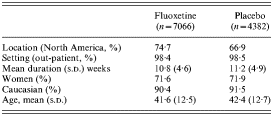
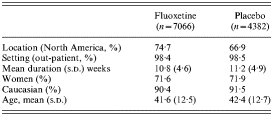
Within the overall database of 53 trials, patients were randomly assigned to receive either fluoxetine (n=7066) or placebo treatment (n=4382). The total number of investigative sites involved in these trials was 438. Demographics of patients are shown in Table 2, with the majority of the patients being female Caucasians who were treated in an out-patient setting. Mean age was 41·9 (s.d.=12·6) years. The mean treatment exposure for patients treated with fluoxetine was 75·8 days (s.d.=32·2) compared with 78·3 days (s.d.=34·6) for the placebo group.
Summary of patient demographics in overall fluoxetine trial database for indications other than major depressive disorder
Suicidality-related adverse events in overall database
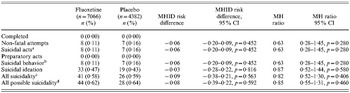
Patients who were treated with fluoxetine did not differ significantly in the frequency of any suicide-related AE compared with patients who were treated with placebo in this database of 53 trials for indications other than MDD (Table 3). For each outcome of completed suicide, non-fatal attempts, preparatory acts, or suicidal ideation, treatment groups did not differ significantly in their MHID risk difference; a positive risk difference would indicate a greater risk for the occurrence of the AE for patients treated with fluoxetine compared with placebo. Similarly, the MHRR values were also not significant, indicating that treatment groups had similar risks for the occurrence of a suicide-related AE; a ratio value >1 would indicate risk associated with fluoxetine compared with placebo whereas a risk value <1 would indicate a protective effect of fluoxetine, i.e. reduced risk compared with placebo. When incidents that could not be classified definitively due to insufficient information (FDA codes 5, 6, 9) were added for the outcome of ‘all possible suicidality,’ groups still did not differ significantly in either the incidence difference or risk ratio.
Incidence of treatment-emergent suicidality adverse events within overall fluoxetine trial database for indications other than major depressive disorder

MHID, Mantel–Haenszel Incidence Difference; MH, Mantel–Haenszel; CI, confidence interval.
a Suicidal acts: summary of all suicide attempts (FDA codes 1 and 2).
b Suicidal behaviors: summary of all suicide-related behaviors (FDA codes 1–3).
c All suicidality: summary of suicide behaviors and ideation (FDA codes 1–4).
d All possible suicidality: summary of FDA codes 1–6 and 9 (includes self-injury events with not enough information, unknown intent).
Suicide-related adverse events in overall database by age group
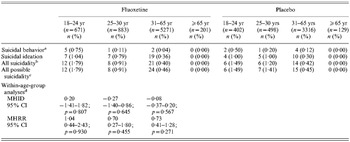
The post hoc analyses of suicide-related AE by age group did not show any statistically significant difference between treatments within the different age groups for any of the outcomes (behaviors, ideation, all suicidality, or all possible suicidality). There were no statistically significant differences between treatment arms. No suicide-related adverse events occurred in the oldest age group. For the outcome of ‘suicide behavior’, in the three remaining age groups (18–24, 25–30, and 31–65 years), the MHID risk difference between fluoxetine and placebo was 0·26, 0·03, and −0·10, respectively and, the MHRR risk ratio was 1·14, 1·16, and 0·34, respectively). For the outcome of suicide ideation, the MHID risk difference in the three age groups was −0·06, −0·29, and 0·02, respectively and the MHID risk ratio was 0·85, 0·64 and 0·86, respectively. When summarizing across behavior and ideation, there continued to be no significant differences among the age groups for all suicidality (Table 4).
Frequencies of suicide-related adverse events in overall fluoxetine trial database for indications other than major depressive disorder by age group

MHID, Mantel–Haenszel Incidence Difference; CI, confidence interval; MHRR, Mantel–Haenszel risk ratio.
a Suicidal behaviors: summary of all suicide-related behaviors (FDA codes 1–3).
b All suicidality: summary of suicide behaviors and ideation (FDA codes 1–4).
c All possible suicidality: summary of FDA codes 1–6 and 9 (includes self-injury events with not enough information, unknown intent).
d Statistical values for outcome of all suicidality for fluoxetine compared with placebo within each age group.
Suicide-related adverse events by subgroups
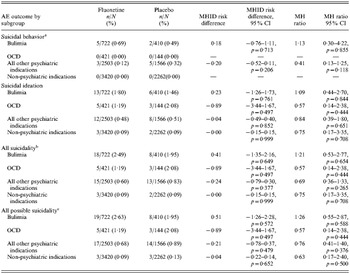
Analyses of the incidence of suicide-related AEs between patients treated with fluoxetine and patients treated with placebo failed to find any significant differences within the subgroupings of different treatment indications (Table 5). The total number of patients that were in each subgroup was as follows: bulimia (n=1132), obsessive-compulsive disorder (n=565), all other psychiatric indications (n=4069), and non-psychiatric indications (n=5682). For each suicide-related outcome (behavior, ideation, all suicidality, and all possible suicidality), the MHID and MHRR were non-significant for comparisons of the incidence between the fluoxetine and placebo groups. Overall the incidence of all suicidality-related AEs was higher in the psychiatric trials, with an incidence of 1·1% (62/5766) compared with the non-psychiatric trials 0·09% (5/5682).
Incidence of suicide-related adverse events (AEs) in overall fluoxetine trial database for subgroups of other indications (excluding major depressive disorder)

MHID, Mantel–Haenszel Incidence Difference; MH, Mantel–Haenszel; CI, confidence interval; OCD, obsessive-compulsive disorder.
a Suicidal behaviors: summary of all suicide-related behaviors (FDA codes 1–3).
b All suicidality: summary of suicide behaviors and ideation (FDA codes 1–4).
c All possible suicidality: summary of FDA codes 1–6 and 9 (includes self-injury events with not enough information, unknown intent).
DISCUSSION
Our findings from this fluoxetine database, which encompassed clinical trials across multiple indications, mirror the primary conclusion of the FDA from their analyses; namely, within the adult population, antidepressant treatment is not associated with increased risk for the induction of suicidality as an AE. In particular, within this current study, the risk ratio of 0·82 for the overall category of ‘all suicidality’ was remarkably similar to the FDA risk ratio of 0·86 (active drug compared with placebo across antidepressants for all indications including MDD) (Laughren, Reference Laughren2006). Consistently, the risk differences and ratios were not statistically significantly different between fluoxetine and placebo treatment arms for the outcomes of suicidal behavior, suicidal ideation, or their combinations.
When the database was examined by different trial groupings, the emergence of suicide-related AEs did not differ between placebo and fluoxetine treatments. Although the overall database could have been subdivided in multiple ways, we chose our groupings to examine specifically the primary indications associated with fluoxetine other than MDD; our MDD trial findings will be reported elsewhere, but they also show a lack of a significant risk relationship for suicidality (Beasley et al. unpublished data). Our grouping method parallels the FDA subgroups in their briefing report, with the major difference being the handling of the nicotine trials. For the FDA, these trials were placed within their behavioral disorders (non-psychiatric) groups whereas we specified them as part of our psychiatric group. In either case, the incidence within the nicotine trials was so low (one event) that these trials have little influence in the pooled analyses. Among the different trial subgroupings, only for the bulimia trials was the risk difference numerically greater than zero and the risk ratio numerically greater than 1, favoring the placebo arm, but these values for suicidality-related AE were nonetheless not significantly different between fluoxetine and placebo treatments.
An examination of the risk of suicidality associated with treatment according to indication provides additional insight into the influence of diagnosis-related psychopathology in determining the emergence of suicidality. In a recent published observational study of rates of self-harm following antidepressant prescriptions, the apparent risk of self-harm associated with SSRI treatment was negated after controlling for covariates directly associated with suicide risk, such as age, gender, depression (Didham et al. Reference Didham, McConnell, Blair and Reith2005). In our large sample of 5766 patients who were treated for non-psychiatric indications, the incidence of suicidality occurred in 0·09% and was entirely based on suicidal ideation. Similarly, the FDA analyses showed an overall suicidality incidence of 0·08% among their sample of 22 457 patients treated for behavioral or other disorders, with only one event being a suicidal behavior. Although the rarity of suicide-related AEs in these large meta-analyses is problematic from a statistical analytic viewpoint (e.g. power), altogether they suggest that the risk for emergent suicidality is conferred by the diagnosis rather than by the treatment.
Another confounding variable that has been implicated in the risk relationship is age. As noted, the FDA analysis reported interactions between age and the emergence of suicidality across the different classes of antidepressants. Within a combined analysis of their pediatric and adult databases, they noted a declining risk associated with antidepressant treatment from children younger than 12 years through adults older than 65 years (Laughren, Reference Laughren2006). Although the current meta-analysis cannot attend to pediatric cases, we did not find an increased risk for emergent suicidality and fluoxetine treatment in young adults. When subdivided into four age groups, we observed a pattern of mixed numerical risks among the young and middle-aged groups, and there was no occurrence of any events in the oldest age group. For pharmacological treatments, meta-analysis of events from clinical trials provides a wider perspective of the risks associated with the treatment. Strengths of the present database were that it consisted of double-blind placebo-controlled studies for multiple indications from over 11 000 patients that allowed searches to be conducted at the individual patient level. Another consideration of our results is that we used one statistical approach (Mantel–Haenszel with continuity corrections) to determine the risk estimates rather than the multiple methods (Mantel–Haenszel with and without correction, exact method, logistic regression) that were used for the FDA analysis. Despite the use of these different models, the FDA results were similar across the different methodologies, and we also found the same outcome based on either risk differences or ratios. Additional limitations are as follows: only one source of information (adverse events) was available to examine the risk relationship; there were no specific measures of suicidality, as these trials were not designed to evaluate suicidality; and the database is limited to fluoxetine trials sponsored by Eli Lilly and Company. With regard to this latter concern, the corporate fluoxetine database has approximately a 79% overlap with the FDA fluoxetine database based on subject numbers (Laughren, Reference Laughren2006).
The debate regarding the risk relationship between the emergence of suicidality and antidepressant treatment will likely continue because of diverse perspectives on the definitive methods to examine this important safety question (Simon, Reference Simon2006). Given both methodological and ethical constraints, the risk relationship between antidepressants and suicidality cannot be addressed with direct, experimental designs. Rather, multiple methods are being used to infer the most likely outcome. Besides meta-analyses of clinical trials, other studies have relied on epidemiological or post mortem analyses. For example, increasing rates of antidepressant prescriptions have been associated with declining suicide rates in some countries, although not in all (e.g. Isaacson, Reference Isaacson2000; Gibbons et al. Reference Gibbons, Hur, Bhaumik and Mann2005; Barak & Aizenberg, Reference Barak and Aizenberg2006). Similar to the clinical trial meta-analyses, epidemiological studies are also limited by methodological confounds. Nonetheless, the findings from any study can only address what is the most likely outcome for a group and cannot serve to predict the absolute outcome for any specific individual. Therefore, the recommendation to monitor psychiatric patients for suicidality is laudable and would seem clinically prudent for any type of psychiatric intervention. Clinical decision-making is ultimately a personalized experience in which potential benefit is weighed against potential cost for the individual patient. Within this debate, the breadth of evidence that denotes the lack of risk for emergent suicidality following antidepressant treatment in indications other than major depressive disorder should be reflected upon as well when determining this risk profile.
DECLARATION OF INTEREST
This research was funded by Eli Lilly and Company. All authors are current employees and/or shareholders of Eli Lilly and Company.