Introduction
Toxicology studies analyze the harmful effects of chemical interactions within the organism. They are performed through acute toxicity tests, which assess the effects experienced by organisms exposed to chemical agents alone or in mixtures in a short period of time. In general, they analyze the mortality or the effectiveness of the tested agent, immobility or some type of behavior exhibited by organisms. The greatest advantages of this assay are the fact that it is easy to implement, its short duration and its low cost (Birge et al., Reference Birge, Black and Westerman1985; Chasin & Pedrozo, Reference Chasin, Pedrozo, Azevedo and Chasin2003).
In acute toxicity tests, the objective is usually to estimate the concentration that causes an effect on 50% of the exposed population over an estimated period of time. This concentration corresponds to the effective concentration (EC) or lethal concentration (LC50) obtained from binary data, such as the number of live and dead (Buratini et al., Reference Buratini, Bertoletti and Zagatto2004).
In a study with Penaeus japonicus, Gwo & Lin (Reference Gwo and Lin1998) analyzed glycerol, ethylene glycol (EG), polyethylene glycol 300, methylic alcohol (MET) and dimethyl sulfoxide (DMSO) for toxicity, relative ability to protect against injuries caused by the freezing process, and various methods of freezing embryos, nauplii and zoea. Among the various substances analyzed, MET was shown to be the most effective cryoprotectant.
Some studies have been conducted in order to uncover the potential toxicity of cryoprotectants used in cooling and cryopreservation of fish embryos (Streit Jr, Reference Streit2005; Ninhaus-Silveira et al., Reference Ninhaus-Silveira, Foresti and Azevedo2006; Streit Jr et al., Reference Streit, Digmayer, Ribeiro, Sirol, Moraes and Galo2007; Neves, Reference Neves2008). However, there are few studies involving the application of cooling protocols, toxicity of cryoprotectants and cryopreservation of freshwater prawn embryos.
In Brazil, Macrobrachium amazonicum receives more emphasis for both research and farming. Those animals show rustic larvae, strong resistance to pathogens, are easy to maintain in captivity and display accelerated growth. This species is widely distributed in South America from the Orinoco basin through the Amazon River to the basin of the Paraguay River. (Maciel & Valenti, Reference Maciel and Valenti2009). In these species of genus Macrobrachium, fully developed ovaries are supported dorsally in the stomach and hepatopancreas, just behind the eyes, and may enter through the first abdominal segment (Ling, Reference Ling1969). Thus, the ovaries of this species develop toward the rear of the carapace, and when mature they become easily identifiable by their transparent carapace, like a large orange mass due to accumulation of vitellogenin, which contains the type carotenoid pigments. (Cavalli et al., Reference Cavalli, Montakan, Lavens and Sorgeloos2001).
During embryogenesis, there is a notable increase in the complexity of embryonic structures, followed by structural reorganization of the vitelline reserves and eggs (Green, Reference Green1965). The gradual incorporation of the embryonic yolk in the egg cell provides space for the development of body appendages, abdomen growth and organization of the organs of the cephalothorax (Müller et al., Reference Müller, Nazari and Simões-Costa2003).
Prawn farming is one of the fastest growing areas in the aquaculture world, thus, requiring constant production of larvae to supply nurseries. Therefore, embryo cooling and cryopreservation techniques may be a viable alternative to provide a continuous supply. This in turn makes the toxicological investigation of cryoprotectants used in the process relevant (Sansone et al., Reference Sansone, Nascimento and Leite2005; Maciel & Valenti, Reference Maciel and Valenti2009).
Hence, this study aims to test the toxicity of the following cryoprotectants on embryos of M. amazonicum: MET, DMSO and EG.
Materials and methods
Collection location
Prawns used in this study were collected in the Sapiranga Lake, located in Fortaleza, Ceará (03°47′54.79′′S, 038°27′28.73′′W), from July to December 2013. A capturing trawl with mesh aperture of 12 mm was used. Prawn were transported in coolers to the Laboratory of Prawn Farming of State University of Ceará in Fortaleza, Brazil.
Triage of animals
In the laboratory, ovigerous females presenting all thoracic and abdominal appendages were separated, in addition to eggs in their final stages of embryonic development, that is those that were clear or gray-green colour. Then, females were placed in a solution of formaldehyde at 25 ppm for 30 min in a 10-liter tank with constant aeration.
After the disinfection step 15 females were selected for the removal of eggs, forming a pool and for use in toxicity tests.
Cryoprotectant agent (CPA) toxicity in embryos of Macrobrachium amazonicum
The following internal cryoprotectant agents (CPA) were tested in the analysis of toxicity: MET, EG and DMSO at the following concentrations in duplicate 10, 5, 3, 1, 0.5 and 0.1%. Internal CPA were diluted in 10‰ seawater, with a total volume of 10 ml for each tested concentration. In addition, a control group with seawater at 10 ‰ was also used. Five tests were performed for each substance, conducting daily monitoring of pH, salinity, ammonia and nitrite.
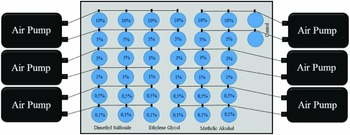
For the toxicity tests an aeration system was designed comprising 38 Falcon® pipes of 50 mL with evenly distributed aeration in all pipes, and for each repetition (fig. 1).
Diagram of the aeration system designed for the toxicity test with the Amazon prawn (M. amazonicum).

In each test tube containing 10 ml of CPA received 10 μg of M. amazonicum embryos at stage VIII of embryonic development. Weight was measured on an analytical SHIMADZU® AY220 scale, accurate to 0.0001 g. All test tubes were maintained with aeration for 24 h and after this period, randomized samples of embryos or hatched larvae were removed for morphological analysis in a stereoscopic Leica DFC 295 microscope, using the LAS V3.6 program. Dead embryos in each test solution as well as those which did not show internal organ movement were also counted.
Statistical analysis
The lethal concentration for 50% of the larvae (LC50 – 24 h), with a confidence interval of 95% was determined for each test substance according to the Trimmed Spearman-Karber Analysis (Hamilton et al., Reference Hamilton, Russo and Thurston1977). The test was considered valid in the following conditions: mortality percentage of test organisms in controls lower to 10% and when the LC50 – 24 h of toxic was in the established concentration range. To investigate the occurrence of significant differences between the results, an analysis of variance (ANOVA) was performed, followed, where appropriate, by Tukey's HSD test with a significance level of 5% in GraphPad Prism 5 software.
Results
Parameters of the seawater used as a diluent for cryoprotectant solutions remain within acceptable limits. Average pH was 7.2 ± 0.7 and the average temperature was 25.1°C ± 0.8. Ammonia and nitrite levels had an average of 0.3 ± 0.3 and 0.3 ± 0.1, respectively.
Toxicity tests
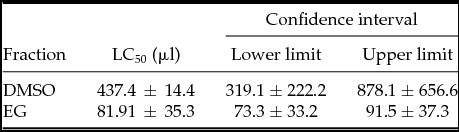
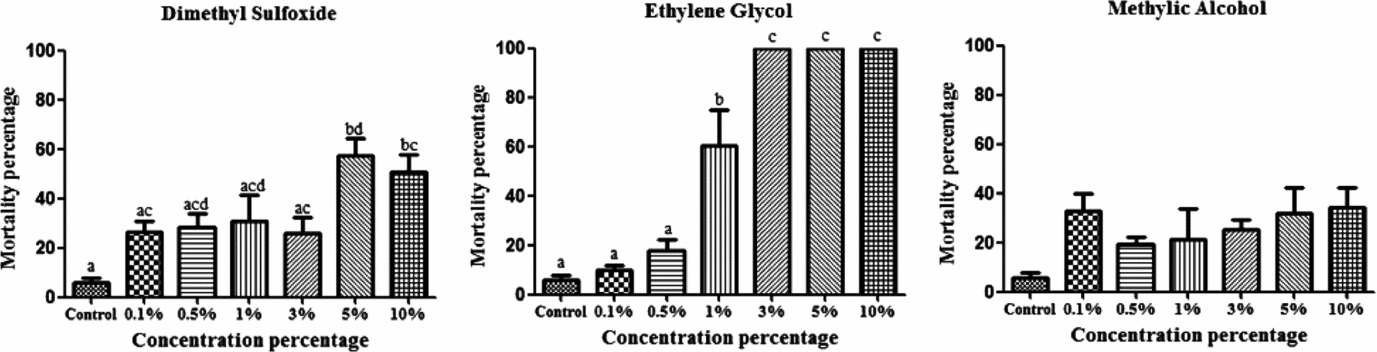
For the DMSO toxicity test, researchers observed that concentrations of 5 and 10% showed no statistically significant difference (P > 0.05) between them, but both differed from the control (P ≤ 0.05). The lowest concentrations tested were below 31% of mortality. The concentration of 5 and 10% had a mortality of 57 and 50%, respectively (fig. 2). Average LC50 was 437.4 ± 14.4 μ;, with an average confidence interval ranging from 319.1 ± 222.2 to 878.1 ± 656.6 μl (Table 1).
LC50 – 24 h of the CPA tested and their 95% confidence intervals

Acute toxicity test at different concentrations of dimethylsulfoxide (%), ethylene glycol and methylic alcohol percentage of mortality. a,b.c.dAverages with no common letters in columns differ from each other by Tukey HSD test at 0.05%.

For the EG toxicity test, it was observed that treatments with 3, 5 and 10%, showed no significant statistical difference (P > 0.05) between them, with a mortality rate of 100%, but differed from the other treatments and the control (P ≤ 0.05). Treatment with 1% was statistically different from all other treatments (P ≤ 0.05), with a mortality rate of 60%. In 0.5 and 0.1% treatments, mortality was below 20% (Fig. 2). Average LC50 was 81.91 ± 35.3 μL, with an average confidence interval ranging from 73.3 ± 33.2 to 91.5 ± 37.3 μl (Table 1).
For the MET toxicity test, it was observed that none of the treatments showed significant statistical differences (P > 0.05) (Fig. 2). The mortality rate for all treatments was less than 34% and it was not possible to determine the LC50, because mortality in this treatment was low at all concentrations tested.
Morphological analysis
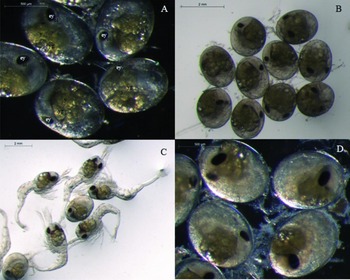
During morphological analysis in a stereoscopic microscope, typical coloring of embryos was observed in advanced stages of embryonic development, full movement of internal organs, and the presence of large amount of yolk and intense beats on the cardiac region in the control group (Fig. 3).
Embryos from M. amazonicum submitted to toxicity tests. (A) Embryos subjected to control treatment. (B) Embryos submitted to a test with 10% dimethyl sulfoxide. (C) Embryos submitted to a toxicity test with 0.5% methylic alcohol. (D) Embryos submitted to a toxicity test with 5% methylic alcohol. (ey) eye; (ol) optic lobe; (y) yolk; (yg) yolk granule; (cr) cardiac region.

In the test involving DMSO, there was a significant amount of non-viable embryos, that is, with opaque coloring and without movement of internal organs. Even with the high mortality rate, approximately 60%, viable embryos were observed on the highest concentration tested (Fig. 3).
In the MET toxicity test, tested concentrations caused low mortality. The presence of non-viable embryos were observed, but most of the tested embryos remained alive after the tests. In all tested concentrations the presence of larvae with active swimming behavior was also observed (Fig. 3).
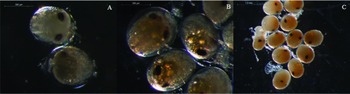
Of all tested CPA, EG showed the highest toxicity. The three highest concentrations caused the death of all tested individuals and gradually, up from the concentration of 3%, it was possible to observe the color change from dark gray to deep orange (Fig. 4).
Embryos from M. amazonicum submitted to tests with ethylene glycol. (A) Embryos tested with 3% ethylene glycol. (B) Embryos tested with 5% ethylene glycol. (C) Embryos tested with 10% ethylene glycol.

Discussion
The results of water parameters found in this study differed from those in other studies. According to Zimmermann (Reference Zimmermann and Valenti1998), the range of optimum temperature for M. rosenbergii's maximum metabolic rate is between 26 and 32°C and can vary to extremes of 19 and 34°C. In their study performed with emphasis on larval development of M. amazonicum, Caramalac and Hayd (Reference Caramalac and Hayd2010) obtained an average temperature of 29.9 ± 0.08°C in experiments. Although the average temperature of 25.1°C ± 0.8 in this paper differs from that observed in other studies with this species, no interference of this in the results was observed.
According to Boyd & Zimmermann (Reference Boyd, Zimmermann, New, Valenti, Tidwell, D’Abramo and Kutty2010), ideal cultivation water pH levels range from 7 to 8.5; ammonia and nitrite parameters were within the levels recommended by the manufacturer of colorimetric kits; therefore, the parameter remained at levels considered adequate.
DMSO is characterized by a molecular weight of 78 g/mol (Carpenter et al., Reference Carpenter, Angel and Morgan1994) and freezing temperature of 18.5°C (Brayton, Reference Brayton1986), highlighting its use in cryopreservation (Lovelock & Bishop, Reference Lovelock and Bishop1959). The effects on various biological systems and metabolic pathways followed by DMSO are not fully known. In general, however, DMSO is oxidized into dimethyl sulfone (Me2SO2), a major metabolite used as a source of sulfur in the synthesis of methionine (Otsuki et al., Reference Otsuki, Quina, Ishihara and Kae2002). A study conducted with men highlighted that Me2SO2 can be eliminated via urine (Hunter et al., Reference Hunter, Bernard, Fuller, Amso and Shaw1991) or can be reduced by DMSO reductase into dimethyl sulfur (DMS), a volatile product that is eliminated by the lungs (Mendez, Reference Mendez2003). According to Gaylor (2007) and Aye et al. (Reference Aye, Giorgio, Mo, Botta, Perrin and Courbiere2010), DMSO and its metabolites have low toxic potential and compared with EG did it did not induce chromosomal abnormalities, even at high concentrations. In contrast, Zampolla et al. (Reference Zampolla, Spikings, Zhang and Rawson2009) showed that oocytes from zebrafish (Danio rerio) increased the number of mitochondrial DNA when exposed to a concentration of 2 M of DMSO for 30 min in an attempt to repair the damage caused by the addition of that substance. At concentrations above 3 M, oocytes were unable to perform the replication of mitochondrial DNA, causing cellular levels of adenosine triphosphate (ATP) to drop immediately.
In human ovarian tissue, EG has been widely used as intracellular CPA for having low molecular weight (62.07 g/mol) and a low melting point (–15.6°C) (Newton et al., Reference Newton, Fisher, Arnold, Pegg, Faddy and Gosden1998). However, its metabolization in the cellular system generates toxic metabolites, such as glycolic acid and oxalate (Corley et al., Reference Corley, Bartels, Carney, Weitz, Soelberg, Gies and Thrall2005). Depending on the amount of metabolized EG, formed glycolic acid exceeds the natural buffering capacity of the cell, reducing pH and causing cellular acidosis (Carney, Reference Carney1999). According to McMartin & Wallace (Reference McMartin and Wallace2005) in a study of kidney cells, effects of calcium oxalate monohydrate were observed, resulting from the combination of oxalic acid derived from the metabolism of EG with calcium ion. This suggests that the accumulation of this metabolite can change mitochondrial permeability causing inhibition of the respiratory chain, resulting in death due to inhibition of ATP synthesis. This may explain not only high mortality at the highest tested concentrations of EG, but also changes in colour of M. amazonicum embryos in this study.
When compared with DMSO and EG, MET has the lowest molecular weight (32.04 g/mol) and the lowest melting point (–97.8°C) (Methanex, 2008), highlighting its relatively low toxicity (Barceloux et al., Reference Barceloux, Bond and Krenzelok2002). Its toxic effects refer to metabolism via alcohol dehydrogenase into formaldehyde and then into formic acid (Barceloux et al., Reference Barceloux, Bond and Krenzelok2002). These characteristics and the results of this study will enable future experiments at higher CPA concentrations in M. amazonicum embryos.
In studies of Penaeus indicus conducted by Newton & Subramoniam (Reference Newton and Subramoniam1996), they observed that its tolerance to toxicity varies with the phases of embryonic development. In this study, researchers noticed that in the latter stages of embryonic development, which showed resistance and tolerance, toxicity varied according to tested CPA. This difference is due to the fact that female M. amazonicum prawns, as members of the family Palaemonidae, show incubation of eggs on their ventral region, which provides greater protection to offspring, unlike what happens with the members of Penaeidae, which do not incubate their eggs and release them in their initial stages of embryonic development directly into the water (Carvalho, Reference Carvalho1997).
Researchers also observed that survival of embryos submitted to toxicity tests with DMSO and MET at their highest concentrations was higher compared with the same concentrations of EG. According to Niemann (Reference Niemann1991), MET is an intracellular action cryoprotectant in several studies with fish, such as red drum (Sciaenops ocellatus), rohu (Labeo rohita), bakhur (Catla catla), major Carp (Cirrhinus mrigala) and zebrafish (Danio rerio) (Robertson & Laurence, Reference Robertson and Laurence1988; Zhang & Rawson, Reference Zhang and Rawson1995; Ahammad et al., Reference Ahammad, Bhattacharyya and Jana1998). It shows less toxicity, which was similarly observed with M. amazonicum in this study.
For DMSO, Pitombeira et al. (Reference Pitombeira, Nilin and Costa-Lotufo2009) performed an analysis of toxicity of organic solvents in Artemia sp. and found that among the solvents used, DMSO, MET, ethanol and acetone, DMSO showed the lowest toxicity to Artemia nauplii. EG proved to be the most toxic CPA tested, while the same is not observed in studies that involve mainly cryopreservation in other species, such as equines (Alvarenga et al., Reference Alvarenga, Landim-Alvarenga, Moreira and Cesarino2000; Kotyagina et al., Reference Kotyagina, Platov and Rombe1963).
Several authors (Zhang & Rawson, Reference Zhang and Rawson1995; Hagedorn et al., Reference Hagedorn, Kleinhans, Wildt and Rall1997; Urbányi et al., Reference Urbányi, Baranyai, Magyary and Dinnyés1997; Dinnyés et al., Reference Dinnyés, Urbányi, Baranyau and Magyary1998) suggest that in fish, features such as resistance to mechanical shock, cryoprotectant toxicity and sensitivity to low temperatures may be related to the stage of embryo development. A study of curimba (Prochilodus lineatus) conducted by Ninhaus-Silveira et al. (Reference Ninhaus-Silveira, Foresti, Azevedo, Agostinho and Verissimo-Silveira2008) supports the fact that embryos are more or less susceptible to toxicity and low temperatures depending on the stage of embryonic development.
Research on M. rosenbergii, in an attempt to create a protocol for cryopreservation of spermatophores in the long term, found that EG and glycerol were used as CPA. Another study conducted by Akarasanon et al. (Reference Akarasanon, Damrongphol and Poolsanguan2004) highlights that post-toxicity test survival rates of CPA in spermatophores of M. rosenbergii are not statistically different from the control treatment without any CPA. Akarasanon et al. (Reference Akarasanon, Damrongphol and Poolsanguan2004) emphasize the use of 20% EG for long-term cryopreservation of spermatophore of this species.
In conclusion, M. amazonicum embryos submitted to toxicity tests with MET and DMSO experienced less damage in relation to the effects of CPA. In the case of MET, considering the low mortality observed at all tested concentrations, more experiments must be conducted in order to define its LC50. EG showed the highest toxicity of tested CPA. Data obtained in this study may be used as a preliminary study for the development of a protocol for cooling and cryopreservation of embryos of M. amazonicum.
Acknowledgements
We would like to thank Coordenação de Aperfeiçoamento de Pessoal de Nível Superior (CAPES) for their financial support.
Conflict of interest
The authors declare there are no conflicts of interest.