An Encouraging Environment: Pauline Viardot's Salon
Gabriel Fauré met with Parisian high society as a student at l’École Niedermeyer in the 1850s, when he was invited to sing at soirées for the institution's benefactors.Footnote 1 Acquiring politesse and confidence, Fauré also grasped patronage in mid-nineteenth-century Paris, then the music capital of Europe. This early exposure to the social, personal and practical sides of music, complemented by thorough training at the Niedermeyer school and generous mentoring from Camille Saint-Saëns, initiated a career that would span seven decades in the City of Light.Footnote 2
After the Franco-Prussian War (1870–71), certain Parisian social circles cultivated creativity via ‘artistic salons’.Footnote 3 Within these private affairs, connoisseurs appreciated sophisticated music, while receptive audiences welcomed new and even challenging works.Footnote 4 Of course, lighter offerings might be heard too, though it is unlikely that anything insipid would be welcome, as diversity and intellectuality was valued. Among the more notable of these artistic salons were those of Pauline Viardot, Élisabeth Greffuhle, Marguerite de Saint-Marceaux and Winnaretta Singer, the Princesse de Polignac.Footnote 5 As a young man starting his career in Paris, Fauré attended the gatherings of Mmes Viardot, Greffuhle, and Saint-Marceaux in the 1870s and 1880s, and those of the Princesse in the following decade.Footnote 6
Introduced to the coterie of Pauline Viardot by Camille Saint-Saëns in 1871, Fauré became a regular at her ‘Thursdays’, as well as her Sunday matinées, the latter of which favoured music.Footnote 7 Her encouragement was crucial to his development as a composer, as well as determinative to his establishment as an artist, at a most critical time.Footnote 8 And of course, cordial admission to her circle of distinguished friends represented recognition of his potential.Footnote 9
The composer's nascent efforts were heard by businessmen and politicians in addition to aristocrats and socialites, plus artists and authors as well as talented amateur musicians and professional peers who gathered in Pauline Viardot's home. In this gracious setting, where charades and games mixed with playlets and poetry, all surrounded by stimulating conversation about the latest cultural affairs and civic events in Paris, creative opportunities arose for younger artists like Fauré.Footnote 10 Music appears to have been essential within this milieu, where the offerings could be quite diverse, performances could be both formal and informal, and an attentive audience could be anticipated.Footnote 11
In response to this stimulating and nurturing environment, Fauré's music developed a distinctive duality.Footnote 12 Distinguished by an engaging surface that appealed to all willing listeners, including those with limited listening experience, Fauré's contributions also held intriguing depth that appealed to musically trained colleagues.Footnote 13 Both sides of his bidirected style drew on the principle of allusion, assuring that his compositions were inviting, distinctive and consistent. Footnote 14 This was art that could be appreciated both intuitively and analytically.
Gabriel Fauré's stylistic duality animates certain works written for members of Pauline Viardot's family between 1872 and 1877.Footnote 15 In this music, seductive surfaces conceal and complement sophisticated structuring.Footnote 16 For us, abandonment of inherited misconceptions and preconceived prejudices about the composer's music, as well as about nineteenth-century salon music in general, is essential to full apprehension of the sophistication within this remarkable yet refined art. Ideally, one would aim to experience this art as did Madame Viardot's guests.
Three compositions will be examined here: the mélodies ‘Chanson du pêcheur’ and ‘Au bord de l'eau’, and the Romance pour violon.Footnote 17 I begin with a song dedicated to Pauline Viardot which is likely to have been heard in her salon before its public première.Footnote 18
Interiority Made Manifest: ‘Chanson du pêcheur (Lamento)’
Fauré's sombre ‘Chanson du pêcheur (Lamento)’ could not be more antithetical to the innocuous entertainment traditionally associated with the term ‘salon music’.Footnote 19 Avant-garde for its time in 1872, this song suggests some of the variety and novelty characteristic of the offerings heard in the home of Pauline Viardot. Its text, a poem by Théophile Gautier (1811–1872), had already been set by Berlioz, Offenbach, Gounod and Saint-Saëns.Footnote 20 With such precedents, Fauré needed to innovate, and he did so by setting Gautier's Romantic poetry using musical techniques inspired by the Symbolist aesthetic, then still emerging in the poetry of Paul Verlaine and Stéphane Mallarmé. In ‘Chanson du pêcheur (Lamento)’, a fisherman whose beloved has died expresses profound anguish before experiencing life-changing insight. A mélodie, the song distinguished itself from the lighter genre of the romance by its gripping drama and integrated structure, as well as its avoidance of sentimentality and its exploitation of suggestion.Footnote 21 Directly engaging and convincingly sincere, ‘Chanson du pêcheur (Lamento)’ would affect any but the most insensitive soul in an immediate, intuitive manner, communicating the interiority of its central character. Simultaneously, certain technical and structural features would have captured the attention of trained musicians on a more consciously analytical level. It is this ability to appeal to both amateur and professional listeners that justifies the attribution of stylistic duality to ‘Chanson du pêcheur’.
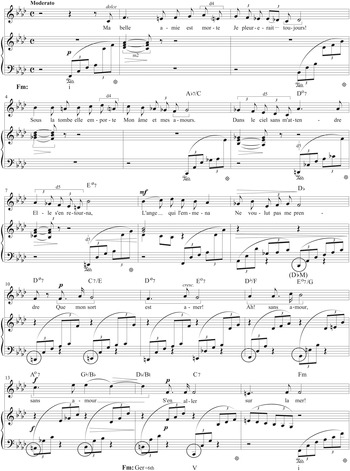
We may observe stylistic duality immediately in its opening section (Ex. 1).
Gabriel Fauré, ‘Chanson du pêcheur (Lamento)’, Op. 4 No. 1 (1872), bars 1–15

As Example 1 suggests, Fauré's song engages and enthrals the listener as it introduces the character of the grief-stricken fisherman. Its initially spare and seemingly improvisatory accompaniment establishes a narrative context and a forlorn atmosphere that elicits empathy. Supporting the vocal line, the piano part's rhythmic, motivic and harmonic features mirror the singer's gradually intensifying interiority. We may note, for instance, how its triplets convey a rolling, wave-like foundation that occasionally conflicts with the determined duplets of the voice. Also apparent are the motivic descending minor 2nd intervals in bars 2 and 4 of the piano (D♭4–C4, and G♭4–F4), which are immediately echoed by descending semitones in the voice (F4–E4 and B♭4–A4) and then echoed in reverse by rising 2nds at the ends of the vocal phrases in bars 3 and 5 (C4–D♭4 and F4–G♭4). As all of this unfolds, the accompaniment's harmonic rhythm quickens while its level of dissonance rises, thus conveying a rush of emotion.
In turn, the voice's melody is primed to move the listener. Thus, the descending diminished 4th skips in bars 2 and 4 and the filled-in diminished 5th spans in bars 6 and 7 – each of which is followed by the introduction of a compound harmonic element – all convey restless desolation. Only in bar 8, with the image of an angel summoned within the text, does the gloomy mood relax somewhat, its brief respite marked by an authentic cadence on D-flat major. The first main section of the song subdivides at the end of bar 9, with the second syllable of ‘pren-dre’ overlapping into the space occupied by what will prove to be the mélodie's refrain. There, the voice undertakes a determined melodic rise. Starting on F4, it is frustrated in that ascent, failing to reach the high tonic F5 and settling for the ‘jazzy’ subtonic E♭5 in bar 13 on the text ‘sans amour’ – ‘without love’. Its melancholy effect is moving.
At the same time, certain technical features of the first main section of ‘Chanson du pêcheur (Lamento)’ surely would have captured the attention of the musically educated among those at Pauline Viardot's salon. For instance, the dissonant sonorities in bars 5–7 of Example 1, none of which resolves as prescribed in traditional harmony texts, disrupt the tonality of F minor implied by the first four bars, this disruption appearing surprisingly early in the setting.Footnote 22 The ever-so-brief tonicization of D-flat major by an authentic cadence in bar 9, followed in bar 10 by abandonment of that key – a procedure that might more normally be associated with the interior portion of a fugue by J.S. Bach, but that would be uncommon in the lighter genre of romance – also would have elicited admiration.Footnote 23
Transient tonicization – the fleeting allusion to a tonality other than a composition's prevailing tonic – would emerge as a Fauréan ‘fingerprint’, and this instance in the composer's seventh published song represents a classic example.Footnote 24 Yet the refrain in bars 10–15 surely would have earned the most esteem and approbation. As bar 10 suggests, D-flat major is disrupted by the D♮ on the downbeat, and a series of dissonant, chromatic, and unconventionally resolved harmonies ensues, creating apparent ambiguity – if not atonality as we know it today – until the augmented-6th and dominant sonorities of bars 14 refocus attention on F minor. Supporting a surge that communicates welling emotion, the ascending bass line guides the musical fabric back to the primary tonality while serving as a duet partner with the voice, producing a series of 10ths. And finally, it seems likely that at least some auditors would have attributed the unity of the refrain's vocal line to its ‘skip up–step down’ melodic motive, whose variants appear in bars 10, 11, 12 and 13. Clearly, there is much to hear in just the first 15 bars of ‘Chanson du pêcheur (Lamento)’, though one might just as easily be captivated by the changing tone and timbre of the singer's voice. Let us now examine the mélodie more comprehensively.
Jean-Michel Nectoux declares:
‘La Chanson du pêcheur’ … is one of the best of Fauré's early works. The form of this extended mélodie is fairly complex: A – Refrain – A′ – Refrain – B – Refrain. At the same time the vocal writing develops from recitative at the beginning into the sweeping curves of the last verse. The style of the song and its intensity of expression bring it close to being a French operatic aria and it was entirely logical for Fauré to orchestrate it (not something he normally did and in this case he was probably encouraged by the song's dedicatee, Pauline Viardot).Footnote 25
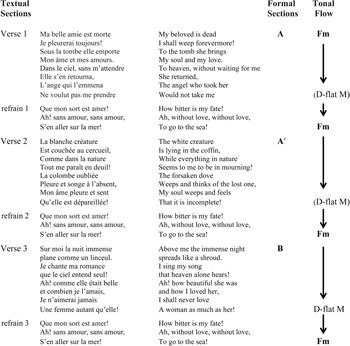
Figure 1 presents the complete text and my translation of Gautier's poem, ‘Chanson du pêcheur (Lamento)’ as appropriated by Fauré. As this illustration suggests, its three verses and three refrains project an AA′B structure, animated by alternation between heavily emphasized F minor and briefly suggested D-flat major.
Théophile Gautier, ‘Lamento – Chanson du pêcheur’, text and translation

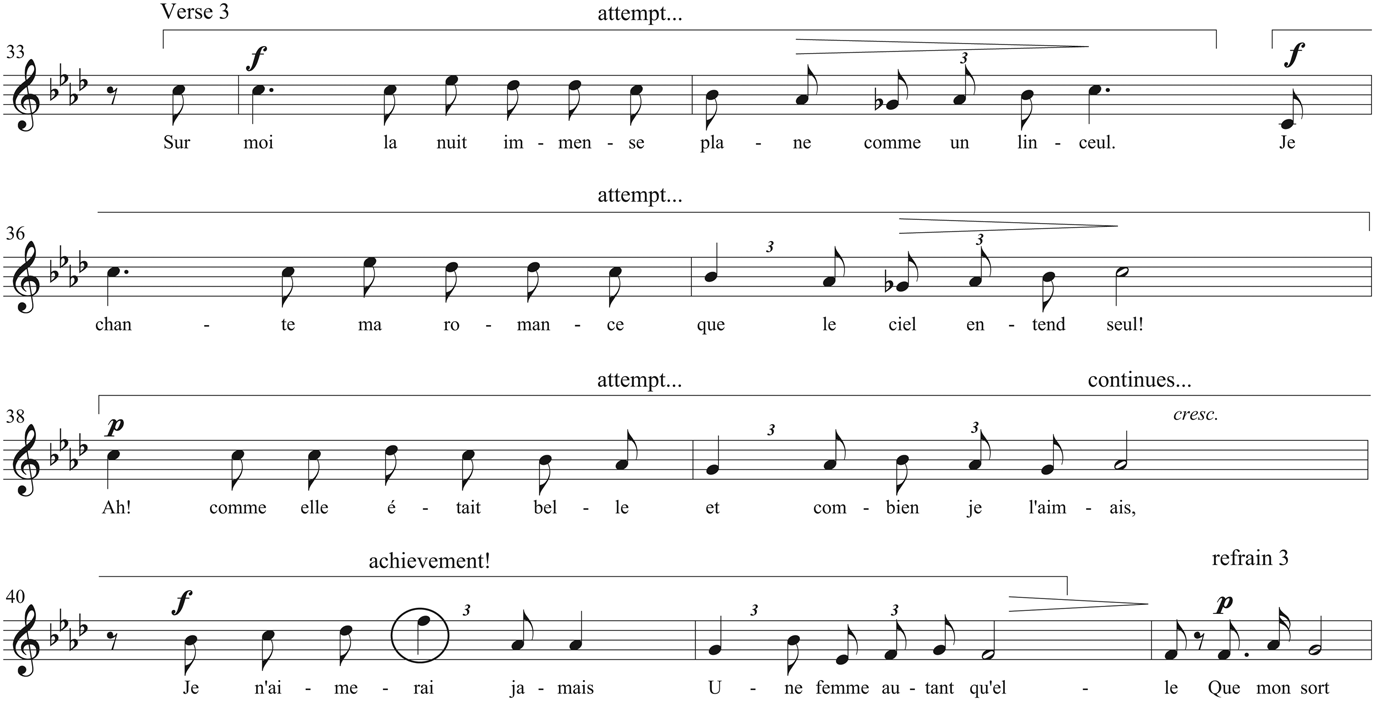
As Nectoux suggests and Figure 1 illustrates, the first two primary sections of ‘Chanson du pêcheur (Lamento)’ (Verse 1 & refrain 1 + Verse 2 & refrain 2) essentially have the same music but different verse texts. Thus, they initially convey the impression of a strophic form unified by a recurrent refrain. Further, they also express the same tonal flow – an oscillation between F minor and D-flat major – a gesture that is anticipated by the first three harmonies heard in the piano part of bars 1–2 (F minor – D-flat major – F minor). But Fauré's mélodie escapes the repetitive scheme traditionally associated with the simpler romance – strophic form – by introducing unfamiliar music in its setting of the poem's third stanza, whose contrasting and conclusive material nevertheless shares the refrain heard in the first two primary sections. Surely with this more complex and less predictable design, Fauré impressed his peers. Yet the new music in the third verse of the song (see Ex. 2) contains a dramatic climax that may be appreciated by amateur and professional alike.
Fauré, ‘Chanson du pêcheur (Lamento)’, bars 33–42, vocal line only, with analysis

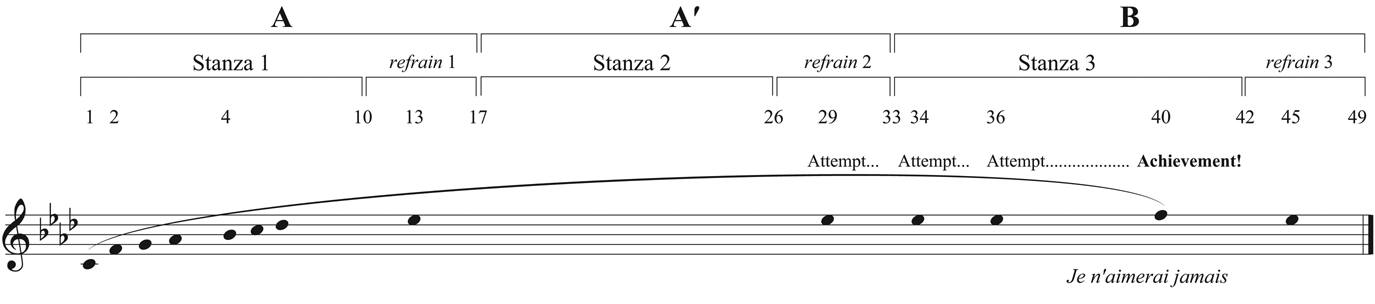
A series of three vocal gestures, each proceeding from the tone C5, simulates the impression of attempting to reach beyond the high pitch E♭5, which up to this point had seemed to be an upper limit for the voice. This contextual process, an instance that represents what I have called the ‘attempt–attempt–achievement paradigm’, communicates an almost physical impression of striving.Footnote 26 Established as a ‘ceiling’ pitch in bar 13 of the first refrain, and reinforced as such in bar 29 of the second refrain, E♭5 would seem to be an impenetrable barrier in context. As Example 2 shows, the first two attempts to exceed this barrier are frustrated, stopping at E♭5 as if somehow prevented from ascending further. However, the elongated third ‘attempt’ to exceed that limit, starting in bar 38, leads to a ‘breakthrough’ in bar 40 with the attainment of the high F5. As Example 3 illustrates, this musical representation of ‘pushing beyond’ the previously established ceiling completes a comprehensive registral process that starts with the low C in the first bar and concludes when the high tonic F sounds in bar 40, an octave and a 4th higher.Footnote 27
Fauré, ‘Chanson du pêcheur (Lamento)’, contextual registral process

There, the achievement of the high F5 coincides with the revelatory declaration, ‘Je n'aimerai jamais une femme autant qu'elle!’ – ‘I shall never love a woman as much as her!’ Adding impact to that crucial line of the text, the climactic musical breakthrough also communicates recognition of a truth that the fisherman had not been prepared to accept. Coincident with the most decisive turn yet to the key of D-flat major – previously associated with the fleeting images of an absconding angel and a weeping soul – he renounces earthly love in favour of memories of past joy and unspoken hopes for joining his beloved in the afterlife. As Example 4 illustrates, the crucial phrase, bars 38–42, features fluid harmonies that are either dissonant or inverted, or both, until D-flat major is tonicized in bar 41.
Fauré, ‘Chanson du pêcheur (Lamento)’, bars 38–42

Indeed, at the point of breakthrough in bar 40, the unstable second-inversion sonority (D♭/A♭) offers little consolation and no relief – for the climactic event represents no triumph to be savoured, but recognition to be assimilated. This dramatic dénouement elevates ‘Chanson du pêcheur’ well above the superficial sentimentality once commonly associated with ‘salon music’, marking it as a true mélodie. Appropriating the poetic content of Gautier's poem, Fauré's setting grips any engaged listener on a direct and immediate level via the interiority it communicates. Yet it also demonstrates intriguing structural sophistication that would appeal to a music professional musician.
The genre of the mélodie may have been initiated with the songs of Les nuits d’été by Berlioz in 1841, and later furthered by certain settings by Gounod and Saint-Saëns in the following decades. However, its formal definition appears to have occurred around 1870 with instances like Fauré's ‘Lydia’ and Duparc's ‘L'invitation au voyage’, as well as this song. And it is safe to say that the Parisian salons, like that of Pauline Viardot, nurtured the genre at a most crucial time in its development. Indeed, through avid interest in Symbolist poetry, the salons guided the mélodie toward concentrated expression and transcendent topics, and from there, on to Modernism. Another of Fauré's early mélodies, ‘Au bord de l'eau’, portrays some of this evolution, as well as the composer's ingenuity.
Atemporal Flow: ‘Au bord de l'eau’
Composed in 1875, ‘Au bord de l'eau’ is dedicated to Pauline Viardot's second daughter Claudie.Footnote 28 Jean-Michel Nectoux suggests that Fauré may have seen Sully Prudhomme's verse in a newspaper or magazine, since the song existed before the poem appeared within a collection.Footnote 29 Philippe Fauré-Fremiet avers that with ‘Au bord de l'eau’, his father had arrived at his personal conception of the mélodie.Footnote 30 Charles Koechlin declared that its progressions ‘were daring for their time, and have never dated’.Footnote 31 Indeed, to twenty-first century ears, the opening section's chords are reminiscent of jazz, so it should not be surprising that some of that genre's artists have emulated Fauré's harmony. Vladimir Jankélévitch describes ‘Au bord de l'eau’ as a ‘delicious song, full of slyness and nonchalance’.Footnote 32 Most remarkably, Fauré's song suggests more than it states, demanding a listener's imaginative contribution for its expressive success. Simulation of dynamic flow within a static moment – a paradox – is its aesthetic goal.
Fauré appears to have composed ‘Au bord de l'eau’ for a talented amateur. Although its vocal line consists mostly of readily manageable steps and skips, its interpreter must negotiate occasional ascending and descending 4ths, 5ths, and 6ths, as well as instances of ascending and descending diminished 5ths (bars 24 and 25, respectively) and even a descending 7th (bar 39), all within a range encompassing an 11th.Footnote 33 However, its interpretative requirements are more demanding than its technical challenges.
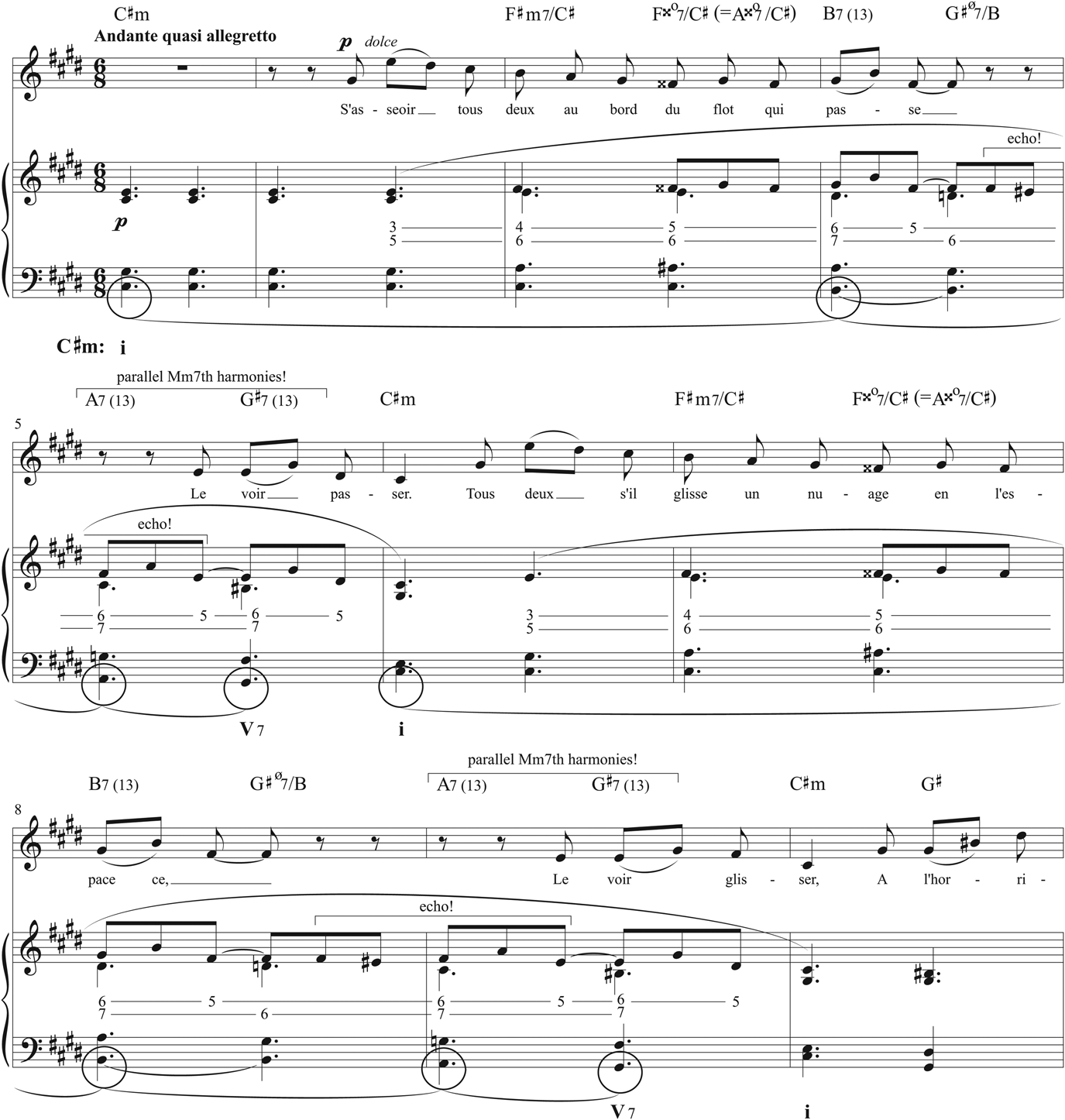
Set in C-sharp minor, the opening bars of ‘Au bord de l'eau’ (Example 5) convey no hint of sadness or regret.
Fauré, ‘Au bord de l'eau’, Op. 8/1 (1875), bars 1–10

At its core, Fauré's music remains fundamentally tonal. However, at its surface, chromaticism, harmonic and non-harmonic dissonance, and modal allusions give ‘Au bord de l'eau’ a lush yet elusive nature.Footnote 34 The leading tone B♯ is suppressed, appearing only briefly within the accompaniment at the authentic cadences of bars 5 and 9, while B♮s sound more prominently in bars 3, 4, 7 and 8, where they impart suggestions of the Aeolian mode. Such richness within the musical fabric enables its repetition, stimulating the listener's imaginative interpretation. And with strong tonal markers thus saved for the articulation of structural points, subtly guided flow serves the expressive message of the poetry.
The evocative text of this passage translates as ‘Sitting together beside the passing stream, To watch it pass, Together, if a cloud glides through space, To watch it glide’. A sense of the flow corresponding to the images of a passing stream and a gliding cloud is readily perceptible here, attributable to the Fauréan ‘long line’ incorporated within the ten-bar passage.Footnote 35 Here Fauré's line essentially consists of two stepwise descents through the interval of the 10th from E♭5 to C4, lightly embellished by neighbour motion and consonant skips, unfolding in bars 1–10 and linked by two quick leaps in bar 6.Footnote 36 Despite the rests in bars 4 and 5, an impression of momentum continues through the very first phrase and into its complement, sustained by the brief echoing countermelody in bars 4 and 5 of the piano as well as the dissonant harmonies, to complete the first 10th-descent in bar 6. And despite the melodic/harmonic cadence in bars 5–6, this impulse continues into the second pair of the poem's phrases with no divisive caesura, linked by the immediate ascending leaps of a 5th and then 6th in bar 6, the shape traced with new words as if still propelled by the song's initial impetus. This wide-ranging vocal gesture certainly could beguile all listeners with its melodic continuity and suppression of internal segmentation, yet in performance the semantic and sonic units of the poetic text are individuated through pronunciation, articulation and inflection according to their meaning and implications.Footnote 37 Furthermore, its inherent timbral and tonal fluctuations are readily perceptible in their own right, with the gradual darkening and thickening of the singer's tone as his or her voice descends, creating a timbrally modulating gesture.Footnote 38 But above all, this ten-bar unit serves its unfolding text, which lacks full stops in its structure and speaks of the notion of timelessness, a theme developed throughout the song.
Appropriate articulation and pronunciation are essential to this music and would have been qualities appreciated by any guest hearing it at Pauline Viardot's salon. These are complex elements: a few specific issues may be identified. Although French poetry is essentially syllabic verse by nature, in that it emphasizes fixed numbers of syllables per line – in contrast to accentual verse, like that of English and German poetry, which emphasizes fixed numbers of stresses per line – the initial lines of this poem feature numerous subtle duplets with iambic implications: ‘S'as-seoir | tous deux | au bord | du flot | qui pas-se | Le voir | pas-ser | Tous deux | s'il glisse | un nuage | en l'es-pace | Le voir | pas-ser’. Here, such implied duple patterning, superimposed over the compound duple pulse of the music, enhances its flow, and in turn, if very lightly articulated, reinforces its ‘long line’. Alliteration and assonance (like the ‘s’ sounds in ‘S’as-seoir’ and ‘s’il glisse’, or the rolled ‘r’ sounds of ‘S'as-seoir’ and ‘voir’, and the ‘o’ sounds in ‘bord’ and ‘flot’, or the ‘i’ sounds of ‘s’il’ and ‘glisse’), as well as rhyme (as in ‘pas-se’ and l'es-pa-ce’), all play important roles, creating aural connections among adjacent and non-adjacent syllables that would be cultivated by the singer and caught by the auditor. Yet there are also compositional aspects to be appreciated by the connoisseur.
As Koechlin asserted, Fauré's harmony always attracted attention among his colleagues, and here his 7th chords move with a notable smoothness and freedom, their voice-leading featuring mostly stepwise motion as the annotation to the example shows. The sonorities attracting most attention in Example 5 are the successive 7ths in bars 5 and 9, which nevertheless hold no forbidden 5ths or octaves. Some are lightly embellished by melodic dissonances (complete and incomplete neighbour tones, as well as suspensions), producing in bars 5 and 9 what might be called 13th chords. Yet even more subtlety may be heard here by trained ears.
As the circled bass tones reveal, bars 1–9 incorporate two instances of the pitch pattern known as the ‘lament tetrachord’ – here, C♯3– B2–A2–G♯2 – a ground bass familiar in its chromatic form from Dido's Lament in Purcell's Dido and Aeneas, as well as the Crucifixus from Bach's B minor Mass.Footnote 39 While these step progressions do not communicate obvious sorrow here, they do contribute a serious undertone that listeners may sense. The inclusion of this archaic intertextual reference within an apparently uncomplicated context represents the kind of sophistication that could possess historical resonance for the trained listener. Before turning to a more comprehensive survey of the song, let us examine just one more instance of Fauré's harmonic virtuosity.
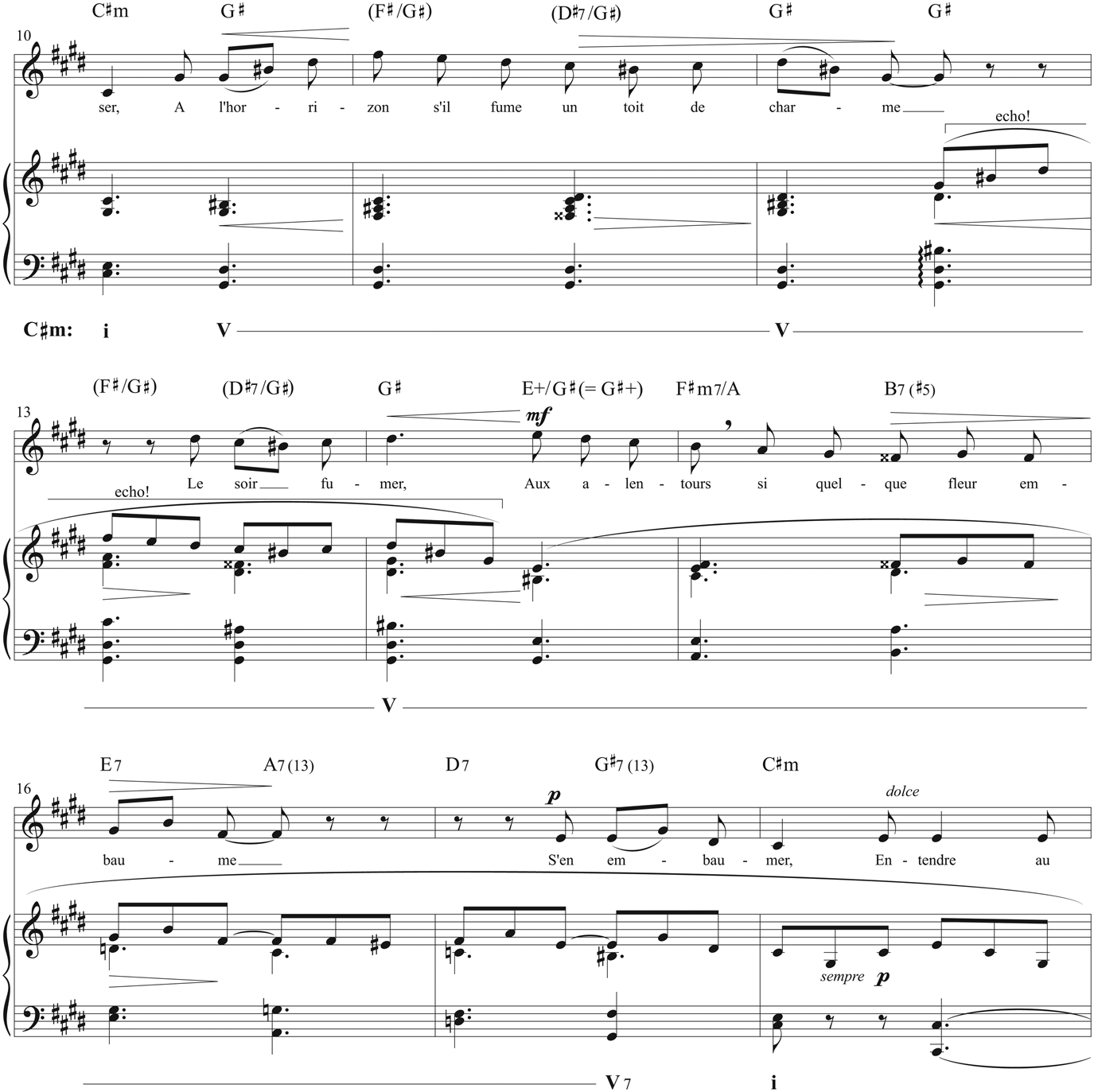
As Example 6 illustrates, bars 10–14 introduce contrast, with the voice reaching up to F♯5, supported by repeated double pedal tone 5ths on G♯ and inner voice passing motion, and with a more extended ‘echo’ – in sum representing a prolongation of the dominant. What would have appealed to the connoisseur happens next: the (already twice- heard) ‘long line’ consisting of the lightly elaborated and still mostly stepwise descent through a 10th (E5–D♯5–C♯5–B4–A4–G♯4–F♯4–E4–D♯4–C♯4) is re-harmonized by means of a descending circle-of-fifths progression (whose pitch-class roots are F♯–B–E–A–D♮–G♯) within the dominant prolongation. As even more chromatic variation on the opening thematic material, subtly slipping in after four bars of more static music, this intricate passage demonstrates compositional technique that may be both aurally appreciated and analytically admired.
Fauré, ‘Au bord de l'eau’, bars 10–18

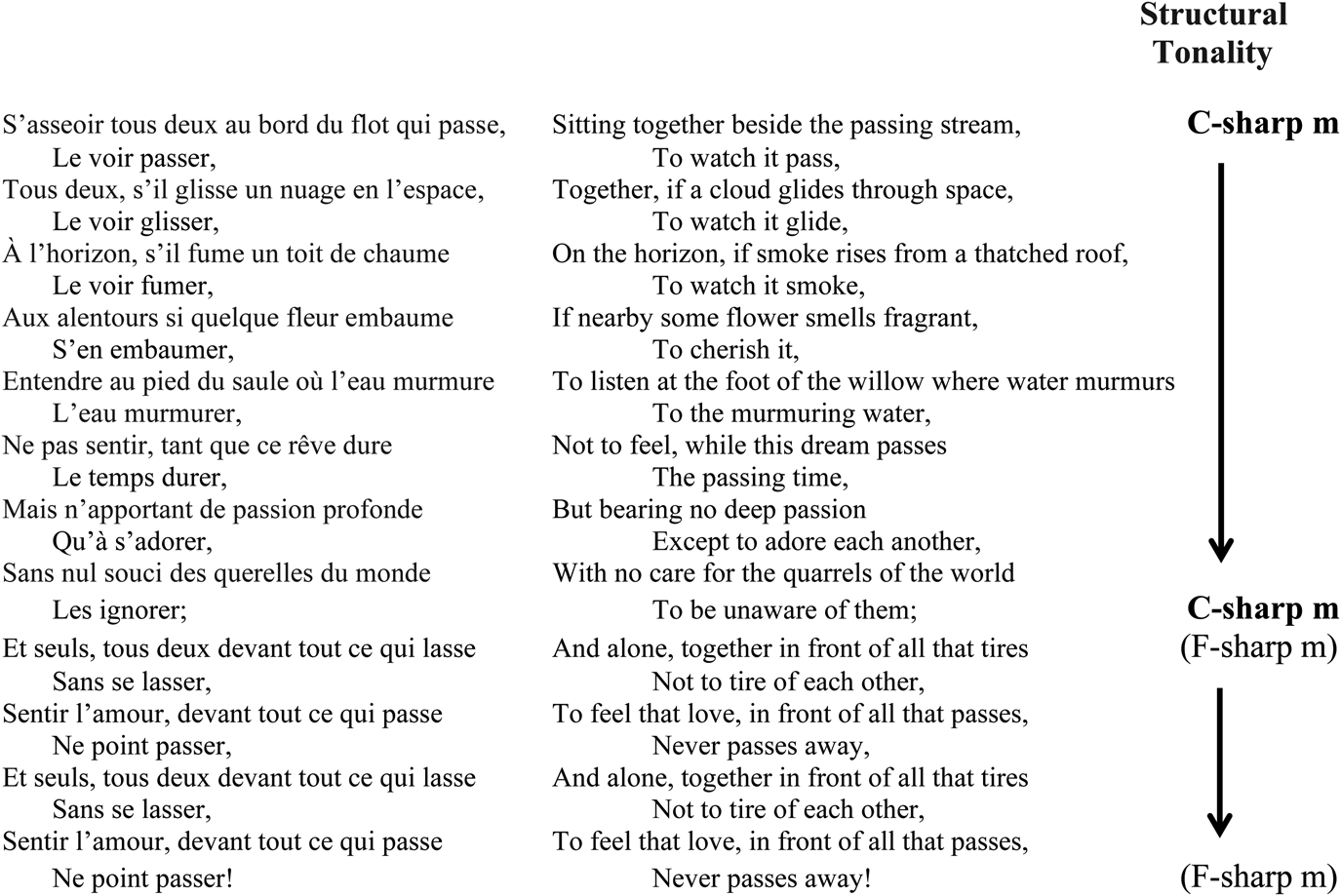
Figure 2 presents the full text of ‘Au bord de l'eau’, taken from Sully Prudhomme's then recently published collection, Les vaines tendresses (1875), along with my translation. Filled with exquisite and extensive descriptive detail, characteristic of its Parnassian aesthetic, Prudhomme's poem presents an apparently paradoxical perception of continuous flow within the experience of a single moment existing outside the passage of time. This gradually revealed and carefully realized poetic conceit is underscored by Fauré's treatment of tonality, which was inspired by the allusive nature of the Symbolist aesthetic. As Example 7 indicates, the tonality of C-sharp minor holds sway for the first two-thirds of the song, while in the last third, F-sharp minor is suggested yet remains tantalizingly unconfirmed and just out of reach. Here, tonal implication communicates impressions of emerging possibility, and perhaps even eternity. Yet it also conveys an inescapable shadow of doubt.
Sully Prudhomme, ‘Au bord de l'eau’, text and translation

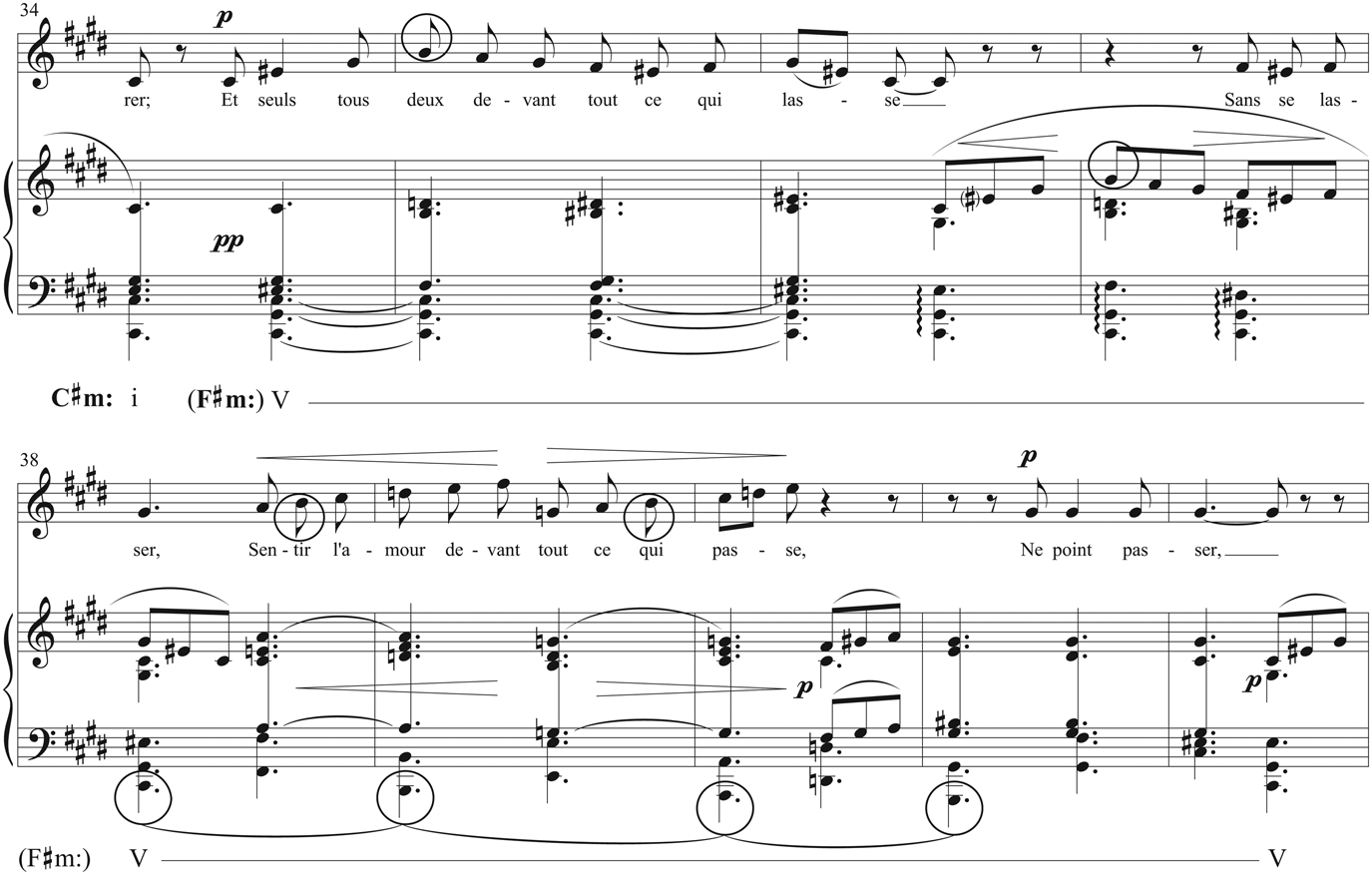
Fauré, ‘Au bord de l'eau’, bars 34–42

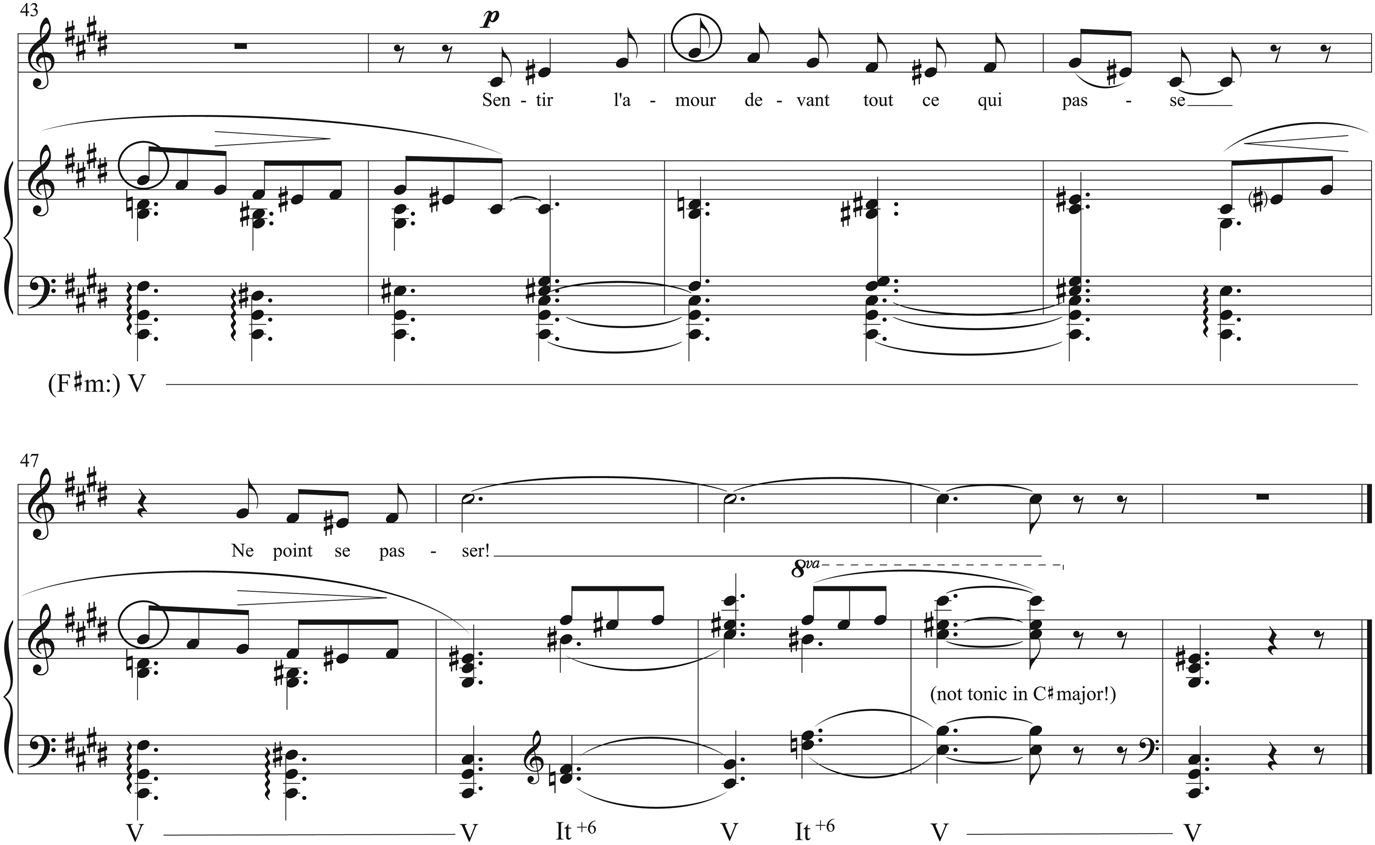
The conclusion of a cadence on C-sharp minor in bar 34 (Ex. 7) reaffirms the initial primary tonality of Au bord de l'eau for the last time. It also returns to familiar material (compare Ex. 6, bars 10–14), though here that music is transposed down a 5th, harmonized by an accompanying mutation of the C-sharp minor harmony to C-sharp major, apparently (and effectively) changing its function from tonic within the key of C-sharp minor to dominant within the key of F-sharp minor. Prolonged throughout that passage, the C-sharp major harmony implies an apparently forthcoming tonality of F-sharp minor, yet never confirms it via cadence as a new key. The instances of B♮4 in the voice of bar 35 and the piano of bar 37, plus those in the voice of bars 38 and 39, serve as reinforcing signals of its contextual function as a dominant. In the second system, one more instance of the ‘lament’ tetrachord – composed out via descending 5ths and the extended secondary dominant of bar 41 – leads back to reaffirm the C-sharp major harmony as the dominant of F within a tonicized half cadence, contributing a serious, possibly dire, undertone. Fauré's allusion to F-sharp minor here elicits expectation and thus creates anticipation. With its subtle reference to the past via the ‘lament’ tetrachord, this passage produces a paradoxical yet captivating state of timelessness.
In the closing phrases of ‘Au bord de l'eau’ (Ex. 8), the C-sharp major harmony remains prolonged to the very end, as the analytical overlay shows, never resolving, ever sustained, yet not convincing as tonic. Passing and neighbour motions enhance anticipation for what never comes. The B♮s of bars 45 and 47 serve as signals that reinforce the harmony's contextual function, as do the Italian 6th sonorities of bars 48 and 49, whose voice-leading focuses attention on C♯ via its upper and lower semitones, all identifying the C-sharp harmony as a dominant. As a result, the contextually implied tonality of F-sharp minor remains teasingly unattained. Through these economical yet effective means, Fauré portrays both motion and immobility, unfolding eternity and the frozen present. Like all great art, this mélodie may be approached in multiple ways and appreciated on multiple levels, as well as experienced and enjoyed simply for the language, lyricism, counterpoint and colour.
Fauré, ‘Au bord de l'eau’, bars 43–51

Inapparent Technique: The Romance pour violon
Fauré's preference for the verse of contemporary poets like Sully Prudhomme and Paul Verlaine was encouraged by the salon of Pauline Viardot, where it was recited and discussed within an intellectual environment. Fauré would continue to compose mélodies until 1921, and we may safely say that the creative environment of Parisian artistic salons determined their development. Even so, instrumental music was by no means neglected there.
Gabriel Fauré's Romance for violin and piano (1877) was composed for Paul Viardot, Pauline's youngest child and only son, and it reflects the then-twenty-year-old's considerable skill.Footnote 40 Its ternary design, A (Andante molto moderato, bars 1–38) – B (Più mosso, bars 39–89) – A′ (Andante molto moderato, bars 90–132), embodies contrast. Opening and closing sections in B-flat major feature long, lyrical lines with no internal rests, while a much more vigorous central section in G minor projects abrupt, brief, and even violent gestures, concluding with a seven-bar cadenza before the return of familiar material. Begun in early September of 1877 while Fauré was ‘taking the waters’ for throat problems at a spa in Cauterets in the southwest of France, the Romance was performed two weeks later for the Viardot family at their summer home in Bougival outside of Paris. It appears that the Viardots warmed to it only very slowly, as Fauré reported: ‘At the first hearing I successfully got teeth grinding; at the second the light went on a little and at the third the limpid stream that courses in the green meadow served as a term of comparison. What a pity that one cannot always begin with the third hearing!’Footnote 41Apparently, Fauré's Romance was more challenging than the Viardots expected.
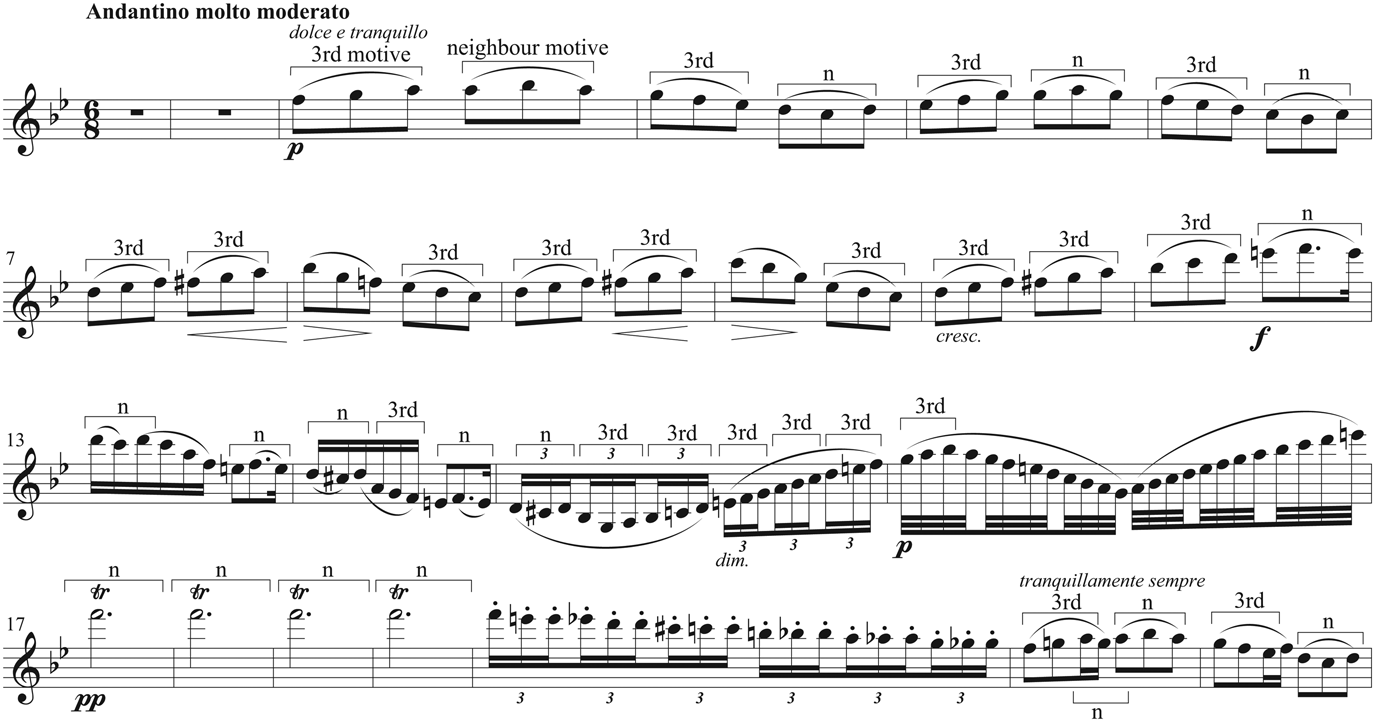
‘Meandering’ aptly describes the opening melody; Fauré revealed that it was inspired by the mountainous horizon formed by the Pyrenees, which was visible from the spa-town of Cauterets.Footnote 42 Covering three full octaves including the high G of the last line's trill, it progresses from languid, to dramatic, to virtuosic, to playful in just these 20 bars, charming any but the most indifferent of ears. With the tone of the violin changing considerably over its range, becoming brighter, thinner and more piercing as it rises, and darker, broader and more rich as it falls, this passage enables display of three octaves of its tonal palette from low G3 to high G6 (allowing for the trill on F6 in bars 17–20, which highlights the note above to considerable aural effect). And as the last two bars of the excerpt suggest, a variation of the opening material returns, distinguished by surface embellishment and a more active accompaniment, offering an elaborated reprise.
Close examination of the violin's melody reveals concentrated motivic development. As Example 9 shows, two three-note motives, each initially delineated by a slur, appear in its first bar. There, what may be referred to as the Romance's ‘3rd motive’ – which may be major or minor – fills that interval with steps. The composition's ‘neighbour motive’ – whose intervals also may be major or minor – steps from and back to a starting pitch. Varied repetitions of these two musical ideas involving techniques of transposition, inversion, interversion,Footnote 43 rhythmic alteration, separately or in combination, appear throughout the excerpt (as the bracketing indicates). Indeed, nearly all of the violin part within the A section of the Romance seems to grow out from these two motives. While such motivic saturation is not typical of Fauré's style, the resultant melodic unity surely should have impressed any musician among the listeners at Pauline Viardot's summer home.
Fauré, Romance pour violon, Op. 28 (1877), bars 1–23, violin melody

In striking contrast, the initial melody of the central section of the Romance is passionate, strident, and even angry at times – almost the opposite of the first, and certainly not exemplary of the once-common conception of French ‘salon music’ – as Example 10 suggests.
Fauré, Romance, bars 39–47

A listener's attention would be arrested by the sudden fury of this passage, caught and carried by its momentum. But this theme also is quite motivic in its construction, featuring particularly striking instances of the melodic interval of the perfect 5th, as well as that interval's inversion, the perfect 4th, which may be heard both ascending and descending. The sounds of these two melodic intervals dominate the central portion of the Romance, their angularity animated by a determined rhythm, and their impact enhanced by the rest following the second note, which gives the gesture's resonance a distinctive quality of decay – all of which imparts a remarkably fervent tone to the B section of the Romance. However, no less remarkable are the many instances and variations of the ‘3rd motive’ embedded within the low-pitched triplets of the accompaniment and articulated by the pianist's thumb. This combination of motives is plainly dramatic, producing a ‘conversation’ of sorts between the essential thematic material of the serene A section and that of the volatile B section, as well as subtly unifying. The flow from the first into the second section would seem logical to any listener, even if the source of that connection – motivic superimposition – had not been analytically discerned.
Surely what would also have impressed a connoisseur, composer or performer who heard the Romance would be Fauré's use of hemiola, which contributes mightily to this section's charging momentum. As the dotted brackets of Example 10 reveal, an impression of triple metre emerges in the violin part, conflicting with the compound duple of the piano part.Footnote 44 This ‘metric dissonance’ continues until briefly fading at the end of the phrase.Footnote 45 Resuming at the start of the next passage, with the disjunct melody transferred to the pianist's right hand, the ‘three against two’ metric effect drives the central section of the Romance until its energy subsides within the extended solo cadenza. whose tempo gradually abates in advance of the coming reprise.
Yet Fauré's Romance may be readily apprehended and appreciated without awareness of any of these technical subtleties. As Example 11 suggests, the internal sectionalization of the ternary form's constituent parts exploits variation technique, which aids the listener in following the sectional form as it unfolds.
Fauré, Romance, formal structure

Subsections a1 and a2 (see Ex. 11) present essentially the same material with superficial changes (as is the case with the subsections in the middle), and the reprise brings further variation on now quite familiar material. Of course, all of this repetition invites reinterpretation by the soloist, with subtle changes in emphasis and phrasing that would be readily appreciated in a salon setting. Beyond all this, the structural half cadences, indicated by the commas on my sketch, represent clear cues that signal those returns, maintaining the listener's engagement.
While the Romance offers different attractions for its diverse audience, every listener could take delight in the violin melody of its coda (see Ex. 12).
Fauré, Romance, bars 123–132

A sense of serene calm reigns as the composition ends, brought about via musical reconciliation. As Example 12 reveals, the main motivic elements of the two primary themes combine at close quarters. The step-filled 3rd and neighbour-note motives of the A theme sound in each bar, framed by the B theme's perfect 5ths and 4ths, now ascending, leading to the long-held tonic pitch, the very highest in the piece, whose arrival may be savoured by one and all.
That final violin tone provides satisfying closure at the end of the Romance because of a comprehensive contextual process involving register. As Example 13 illustrates, the violin's registral ceiling gradually rises in the first A section, culminating in the high B♭6 in bars 37–8, which lasts in the score but a single bar plus a quaver, as if to communicate qualified achievement.
Fauré, Romance, registral process

The B section's registral rise moves more slowly and almost deliberately, apparently aiming for the same goal of B♭6, albeit within the relative minor mode. As Example 13 shows, the violin reaches G6 at the start of the cadenza in bar 84, and teasingly touches A6 just a little later, but rises no higher in the section, stopping short – B♭6 proves tantalizingly out of reach. A third registral rise unfolds in the A′ section, stalling again on G6 in bar 104, before vaulting over A6 to the goal of B♭6 in bar 129, which is held for three full bars plus a minim to symbolize certain success. Fauré's treatment of register in the Romance manipulates expectation in a readily and intuitively perceptible way that will communicate a sense of sustained striving to any engaged listener. Yet perhaps only professional musicians would fully appreciate the technical challenge of sustaining the high, delicate, exposed, pianissimo B♭6 so very long at the end!
Conclusion
Stylistic duality within Gabriel Fauré's mélodies ‘Chanson du pêcheur (Lamento)’ and ‘Au bord de l'eau’, plus his Romance pour violon, enabled these early works to appeal to both novice and expert listeners who gathered at Pauline Viardot's home in the 1870s. Each demonstrates engaging expression and structural sophistication characteristic of the ‘artistic’ salons that nurtured innovative creativity among Parisian composers of that era. Each encourages us to look below the surface of other works within the composer's œuvre, unconstrained by the inherited preconceptions that misconstrued and marginalized French music during the twentieth century. Below their charming surfaces, remarkable richness and intriguing interiority await all amenable to appreciate Fauré's originality and diversity.