Postsurgical periprosthetic joint infection (PJI) remains among the most common and serious complications of hip and knee arthroplasty.Reference Gravel, Taylor and Ofner 1 – Reference Lamagni 3 Consequences of PJI include multiple reoperations, prolonged hospital stay, higher readmission rates, increased healthcare costs, increased mortality, and lower quality of life.Reference Grammatico-Guillon, Rusch and Astagneau 2 , Reference Peel, Cheng and Liew 4 – Reference Cahill, Shadbolt and Scarvell 10 Surgical site infection surveillance is an important quality assurance initiative, allowing for comparison of trends in infection rates, estimates of burden and cost, identification of modifiable risk factors, and provision of infection rates to individual surgeons.Reference Grammatico-Guillon, Rusch and Astagneau 2 , Reference Gaynes, Richards and Edwards 11 – Reference Gastmeier, Brauer, Forster, Dietz, Daschner and Ruden 17 The postoperative surveillance period following the implantation of prosthetic devices has recently changed from 1 year to 90 days in the United States 18 and in some European surveillance systems.Reference Koek, Wille, Isken, Voss and van Benthem 19 Given the significant resource implications of prolonged surveillance periods, there is increasing interest from other countries to adopt this approach. While several studies confirm that the majority of hip and knee PJIs are detected within 90 days,Reference Koek, Wille, Isken, Voss and van Benthem 19 – Reference Yokoe, Avery, Platt and Huang 21 others have found that approximately 25% of these infections occur after 2 years and up to 10 years post arthroplasty.Reference Ong, Kurtz and Lau 22 , Reference Kurtz, Ong, Lau, Bozic, Berry and Parvizi 23 Thus, the optimal surveillance period following hip and knee implantation has been debated.Reference Davies and Patel 24
In Canada, published data on national rates of hip and knee PJIs are scarce. The Canadian Nosocomial Infection Surveillance Program (CNISP) is a collaborative effort between the Public Health Agency of Canada (PHAC) and sentinel hospitals across the country that participate as members of the Canadian Hospital Epidemiology Committee (CHEC) to collect national-level data on selected healthcare-associated infections. The objectives of this study are to report the first pan-Canadian hip and knee PJI rates for benchmarking purposes and to describe the implications of reducing the postoperative surveillance period from 1 year to 90 days.
METHODS
Surveillance Network
CNISP conducts hospital-associated infection surveillance in 56 urban, acute care hospitals from 10 Canadian provinces, most of which are secondary or tertiary care centers.Reference Rutledge-Taylor, Mitchell, Pelude, AbdelMalik and Roth 25 Prospective surveillance for hip and knee PJI began in 2011. All hospitals that are part of the CNISP network and perform hip and knee arthroplasty procedures were invited to participate on an annual basis. Of the 32 CNISP hospitals that perform hip or knee arthroplasty, 12 hospitals participated in 2011, 20 in 2012, and 22 in 2013. All participating sites are included in the descriptive analyses; however, 2 sites were excluded from incidence rate calculations because their denominator data were unavailable.
Surveillance Definitions
PJIs were classified as superficial, deep incisional, or organ space in accordance with the Center for Disease Control and Prevention (CDC) National Healthcare Safety Network (NHSN) definitions. 18 All primary total and hemiarthroplasties were included. Procedures were stratified using the NHSN risk index.Reference Culver, Horan and Gaynes 26 The following procedures were excluded: revisions and resurfacings, procedures in which the patient died during or within 24 hours of surgery, and procedures in which the skin incision was not entirely closed. Postoperative surveillance for PJI continued for 1 year in accordance with past NHSN surveillance definitions for procedures involving implantation of prosthetic material.Reference Horan, Andrus and Dudeck 27 During 2014, most CNISP sites transitioned to a 90-day postoperative surveillance period as specified by current NHSN protocols. 18
Case Finding
Patients with a PJI following either hip or knee arthroplasty were identified through prospective review of hospital records from the initial admission, subsequent clinic and emergency department visits, and readmissions within a year of the procedure. In this study, we reviewed admission diagnoses, microbiology laboratory results, physician and nursing notes, operative records, and pharmacy reports.
Data Analysis
Anonymized numerator and aggregate denominator data were submitted quarterly to the Public Health Agency of Canada. Data were entered into an Excel database (Microsoft, Redmond, WA) and analyzed using SAS EG, version 5.1 (SAS Institute, Cary, NC) to generate descriptive statistics. Missing data were excluded from the analysis. For bilateral procedures, the total procedure length was divided in half to obtain a procedure length for each joint. Mann-Whitney test, t test, and Pearson’s χ2 test were used as appropriate. Statistical significance was defined as P<.05.
RESULTS
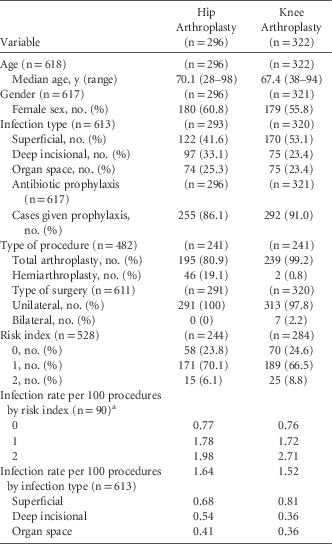
From 2011 through 2013, 618 infections were identified, including 296 hip and 322 knee PJIs. Descriptive data for patients with a PJI are shown in Table 1. Deep incisional or organ-space infections accounted for 58.4% of hip PJIs and 46.9% of knee PJIs. Administration of antibiotic prophylaxis was documented for 88.7% of procedures complicated by infection. Cefazolin was used in the majority of cases (83.7%), followed by vancomycin (8.6%), and clindamycin (5.0%). Most arthroplasties were total, unilateral procedures.
Descriptive Data for Patients with a Periprosthetic Joint Infection following Hip or Knee Arthroplasty, 2011–2013

a Excludes procedures for which risk index score and denominator data were not available.
Among participating hospitals that provided denominator data, 17,850 hip arthroplasties and 21,104 knee arthroplasties were performed over the 3-year surveillance period. The overall hip and knee PJI incidence rates were 1.64 and 1.52 per 100 procedures, respectively (Table 1). For hip arthroplasties, deep incisional and organ-space PJI incidence was 0.96 per 100 procedures, and for knee arthroplasties, deep incisional and organ-space PJI incidence was 0.71 per 100 procedures. Hip PJI rates per 100 procedures ranged from 0.77 for procedures with a risk index of 0 to 1.98 for procedures with a risk index of 2. Knee PJI rates per 100 procedures ranged from 0.76 for procedures with a risk index of 0 to 2.71 for procedures with a risk index of 2. There were no risk index 3 procedures because no procedure had a wound classification of “contaminated” or “dirty.”
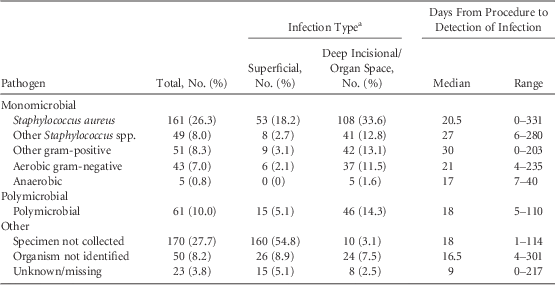
Staphylococcus aureus was the most commonly identified pathogen; it was isolated from 26.3% of infections, followed by other staphylococcal species and gram-positive microorganisms (8.0 and 8.3%, respectively) (Table 2). However, gram-negative (7%) and polymicrobial (10%) infections were also reported. A specimen was not obtained for culture in 27.7% of infections, and no microorganism was identified in 8.2% of infections; most of these were superficial infections. Compared with superficial infections, deep incisional and organ-space infections were 5.5 times more likely to yield gram-negative microorganisms (95% CI, 2.59–15.0), 4.7 times more likely to yield non-aureus staphylococci (95% CI, 2.40–11.33), and 4.2 times more likely to yield non-staphylococcal gram-positive organisms (95% CI, 2.27–9.94). No fungal infections were identified.
Number and Proportion of Pathogens for Hip and Knee Periprosthetic Joint Infections by Infection Type, 2011–2013 (N=613)Footnote a

a Infection type was missing for 5 cases.
Differences were noted in the length of time from procedure to identification of infection by pathogen type (Table 2). Where a pathogen was identified, anaerobic and polymicrobial infections had the shortest median time from procedure to detection of infection (17 and 18 days, respectively). Polymicrobial infections had a significantly shorter median time to detection compared to infections due to S. aureus (20.5 days; 95% CI, 19–22; P=.03), other Staphylococcus spp. (27 days; 95% CI, 20–43; P=.001), or other gram-positive microorganisms (30 days; 95% CI, 21–50; P<.0001). Similarly, infections due to gram-negative microorganisms (21 days) had a significantly shorter median time to detection than non-staphylococcal or other gram-positive infections (95% CI, 14–26; P=.01).
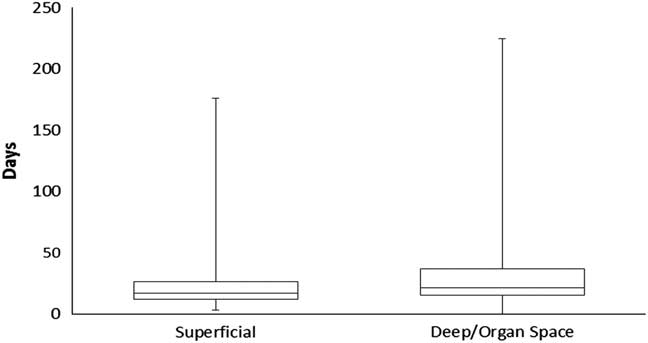
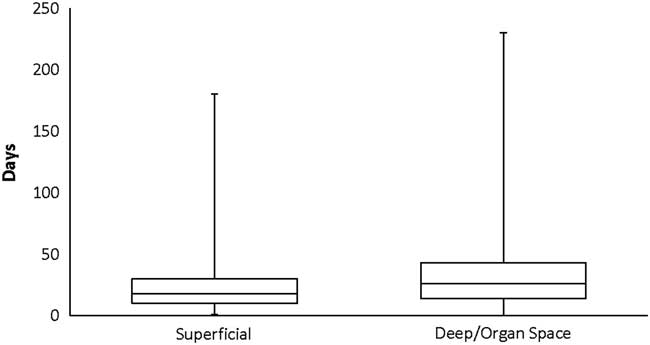
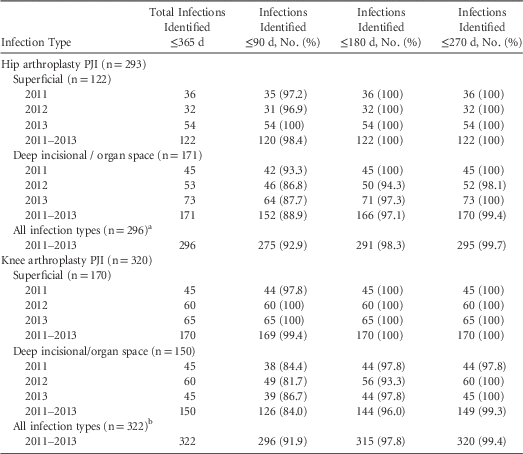
All hip and knee arthroplasty procedures during this surveillance period were followed for 1 year. The median time from initial procedure to detection of PJI for hip arthroplasty was 20 days (range, 0–301 days) (Figure 1) and median time from initial procedure to detection of PJI for knee arthroplasty was 21 days (range, 0–331 days) (Figure 2). Whereas 92.9% of hip and 91.9% of knee PJIs were identified within 90 days, additional infections were identified within 180 days, 270 days, and 365 days (Table 3). Superficial hip PJIs were significantly more likely to be identified within 90 days (98.4%; 95% CI, 94.2%–99.6%) compared with deep incisional and organ-space infections (88.9%; 95% CI, 78.2%–93.4%; P=.002). Similarly, superficial knee PJIs were significantly more likely to be identified within 90 days (99.4%; 95% CI, 96.7%–99.9%) compared with deep incisional and organ-space infections (84.0%; 95% CI, 77.3%–89.0%; P<.0001). However, 98% of all hip and knee PJIs were detected within 180 days post procedure.
Box plot of time from initial hip arthroplasty to detection of prosthetic joint infection.

Box plot of time from initial knee arthroplasty to detection of prosthetic joint infection.

Time from Arthroplasty to Detection of Periprosthetic Joint Infection (PJI) by Infection Type, 2011–2013 (n=293)

a Includes 3 procedures for which infection type was missing.
b Includes 2 procedures for which infection type was missing.
DISCUSSION
Overall infection rates following hip and knee arthroplasty in Canada were higher than those reported in Europe 28 but lower than those reported to the International Nosocomial Infection Control ConsortiumReference Rosenthal, Richtmann and Singh 29 over a similar time period. Conversely, deep incisional (including organ space) PJI rates were lower than rates reported in FranceReference Grammatico-Guillon, Baron and Rosset 5 and similar to rates reported to the US National Healthcare Safety Network (NHSN). 30 Notably, differences in national surveillance systems limit direct comparison of PJI rates.Reference Grammatico-Guillon, Rusch and Astagneau 2 While surveillance definitions in most countries are based on CDC NHSN definitions, 18 considerable differences have been noted in the postoperative surveillance period, the intensity of case finding and postdischarge surveillance, and the reporting of overall versus deep incisional and organ-space infection rates.Reference Grammatico-Guillon, Baron and Rosset 5 , Reference Lower, Dale, Eriksen, Aavitsland and Skjeldestad 31
The recent decrease in the postoperative surveillance period in some countries to 90 days has many advantages, including a reduction in the human resources required for surveillance, more timely feedback of infection rates to the surgeon, reduced dependence on postdischarge surveillance to identify infections, and lower risk of capturing infections that are not directly related to the surgical procedure.Reference Yokoe, Avery, Platt and Huang 21 , 32 However, this change has been met with some controversy.Reference Davies and Patel 24 , Reference Koek 33 Davis and PatelReference Davies and Patel 24 suggest that reduced reimbursement rates for procedures complicated by infection in the United States serve as a strong incentive to change surveillance definitions to reflect lower infection rates. They also note that it will be more difficult to measure significant changes in the rates of infections following interventions given the already low incidence rates.
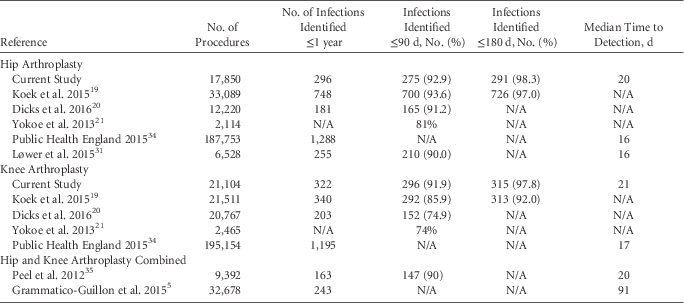
In our study, we found that >90% of PJIs following hip or knee arthroplasty are captured within a 90-day follow-up period. This rate is considerably higher than the initially predicted detection rate of 70% 32 and is similar to 90-day detection rates reported in recently published studies (Table 4).Reference Koek, Wille, Isken, Voss and van Benthem 19 – Reference Yokoe, Avery, Platt and Huang 21 , Reference Lower, Dale, Eriksen, Aavitsland and Skjeldestad 31 , 34 , Reference Peel, Cheng, Buising and Choong 35 However, these studies combined all infection types, while our data demonstrate that deep incisional and organ-space infections are significantly less likely than superficial infections to be detected within 90 days (ie, only 88.9% vs 98.4% for superficial infections). Thus, despite a high 90-day PJI detection rate, a word of caution is in order for jurisdictions considering a reduction in their postimplant surveillance period. The lower detection rate of deep incisional and organ-space infections in this study suggests that national surveillance data using a 90-day follow-up period cannot be used to accurately estimate the healthcare and societal impact of infections following hip and knee arthroplasty. Deep incisional and organ-space infections are associated with longer length of hospital stay, increased readmission rates, additional costs, and higher mortality compared to superficial infections.Reference Coello, Charlett, Wilson, Ward, Pearson and Borriello 8 , Reference Kapadia, McElroy, Issa, Johnson, Bozic and Mont 36 Countries considering a shorter postimplant surgical site infection surveillance period should be aware of the possibility of underestimating deep incisional and organ-space infections following hip or knee arthroplasty.
Length of Time to Detection of Periprosthetic Joint Infection (PJI) Following Hip and Knee Arthroplasty, Summary of Comparable Studies

A limitation of this study is that the postoperative surveillance was limited to participating CNISP sites and may not have been representative of all Canadian hospitals. In particular, CNISP hospitals tend to be larger and to provide a higher complexity of care than hospitals that do not participate in CNISP.Reference Rutledge-Taylor, Mitchell, Pelude, AbdelMalik and Roth 25 In addition, surgical site infection rates may be underestimated because postdischarge surveillance was limited to outpatient visits, emergency visits, or readmission to participating CNISP hospitals, and the intensity of postdischarge surveillance may vary between hospitals. This risk is partially mitigated by the fact that participating CNISP hospitals represent Canada’s large tertiary care referral centers where patients are more likely to be admitted with postoperative complications,Reference Yokoe, Avery, Platt and Huang 21 and they often serve as the only center within a region offering postoperative orthopedic care.
In summary, our national surveillance system suggests that a shorter postoperative surveillance period of 90 days following hip and knee arthroplasty will detect the majority of infections and will facilitate the monitoring of trends over time. However, >10% of deep incisional and organ-space infections may be missed, and extending the surveillance period to 180 days may allow for a more accurate estimate of disease burden. Finally, these data provide the first Canadian benchmark by which hospitals and health regions can measure their performance and focus on reducing rates further through process improvement efforts.
ACKNOWLEDGMENTS
Financial support: This study was conducted with support from the Public Health Agency of Canada.
Potential conflicts of interest: All authors report no conflicts of interest relevant to this article.