Influenza is an acute respiratory infection caused by the influenza virus.Reference Cox and Subbarao1 Every year, 5%-20% of people contract influenza, which interferes with daily life, such as schooling and employment. Among them, the older adults and those with underlying medical conditions are forced to visit the emergency room or be hospitalized.Reference Uyeki, Hui and Zambon2, Reference Tokars, Olsen and Reed3 Most patients have mild illnesses; however, some require hospitalization, and hospitals are often overwhelmed during epidemics.Reference Tokars, Olsen and Reed3, Reference Iuliano, Roguski and Chang4 In addition, some patients die from complications such as myocarditis, pneumonia, and encephalitis.Reference Kalil and Thomas5 Therefore, influenza is a serious problem for both the patients and society.
Physical and mental stress, air pollution, and poor sanitation are known risk factors for viral infections, including influenza.Reference Ciencewicki and Jaspers6, Reference Perez, Uddin and Galea7 Natural hazards have also been reported as risk factors for viral infections.Reference Waring and Brown8 With regard to influenza in the event of a natural hazards, there have been reports of influenza outbreaks among earthquake victimsReference Kamigaki, Seino and Tohma9 and a positive correlation between the occurrence of floods and influenza infection.Reference Cite Kontowicz, Brown and Torner10 In addition to the stress of natural hazards and extreme weather, there are concerns that the living environment of evacuation shelters could lead to the spread of influenza.Reference Izumikawa11 However, we conducted a thorough search of past literature, but we found no studies that had identified victims and non-victims on an individual level and evaluated the relationship between natural hazards and influenza; thus, it is difficult to say that the evaluation of the relationship between being a victim of a disaster and influenza is sufficient. As the magnitude and frequency of natural hazards increase yearly worldwide,Reference Douris and Kim12 it is important to assess the relationship between natural hazards and influenza, an annual pandemic and social problem. Another significant consideration is that influenza virus shares similar modes of transmission with other pandemic-causing viruses such as coronavirus. Therefore, understanding how influenza spreads during natural hazards enables the anticipation of the epidemiological dynamics that other viral diseases, including coronavirus disease 2019 (COVID-19), may exhibit in analogous situations.
Using a government-owned comprehensive database, this study examined the association between natural hazards and anti-influenza drug prescribing by comparing victims and non-victims of the 2018 western Japan heavy rain disaster, the nation’s second-largest hydrological catastrophe. The present study assumed that the number of influenza cases would increase among disaster victims, and that this would result in an increase in the prescription of anti-influenza drugs. Anti-influenza drugs include neuraminidase inhibitors, which inhibit the release of viruses outside the cell, and cap-dependent endonuclease inhibitors, which inhibit the transcription of RNA viruses.Reference Świerczyńska, Mirowska-Guzel and Pindelska13 In Japan, anti-influenza drugs are commonly used for all patients, not just infants, the elderly, or patients with underlying diseases.Reference Sako, Gu and Masui14, Reference Nakajima, Akebo and Tsugihashi15 Anti-influenza drugs are prescribed for patients with a positive influenza antigen test result or for those with clinically suspected influenza.Reference Sako, Gu and Masui14 The cost is reduced for patients under Japan’s health insurance system, and this is one of the reasons why anti-influenza drugs are used more than in any other country in the world.Reference Zaraket and Saito16 Therefore, in Japan, there is a tendency for anti-influenza drugs to be prescribed for patients with influenza. We hypothesized that victims of natural hazards are more prone to influenza infection and therefore use anti-influenza drugs more frequently than non-victims.
Methods
Study Setting
This was a retrospective longitudinal cohort study of the torrential rains and associated flooding and landslides that occurred from June 28-July 8, 2018 in western Japan. This was the second largest natural disaster after the Great East Japan Earthquake; 263 deaths (238 in Hiroshima, Okayama, and Ehime prefectures), 484 injured, 2 million evacuees, and 6783 destroyed houses were recorded.Reference Miho and Naoko17 The National Health Insurance Claims Database (NDB), one of Japan’s administrative claims databases, was used to identify the victims directly affected by the 2018 western Japan disaster.
Definition of disaster victims
Victims in this study were officially recognized by local governments based on the following government definitions, and others were classified as non-victims. A disaster victim was defined as a person whose family members were either (1) dead, injured, missing, unemployed, underemployed, or without income, or (2) whose house was totally or partially destroyed, flooded, or burned down.
Data collection
The NDB contains all information on medical services covered by public health insurance, which covers the entire population of Japan, except for medical service claims for the population receiving public income assistance, which comprises less than 2% of the population, and services for traffic injuries and workplace-related injuries, which are covered by other insurance schemes.Reference Ikegami, Yoo and Hashimoto18 Data from the NDB were used with permission from the Ministry of Health, Labour and Welfare, Japan (permission number 1223-2).
Study population and extracted items
All patients treated in Hiroshima, Okayama, and Ehime prefectures for a 2-year observational period spanning 1 year before and 1 year after the disaster (July 2017-June 2019) were included in this study to evaluate anti-influenza drugs prescribing during the period. Influenza usually spreads from early winter to early spring, and the cycle is 1 year, so we set the observation period as 1 year before and after the disaster.Reference Moriyama, Hugentobler and Iwasaki19 Information on sex, age group (≤20 years, working age [21-64 years], older adults [65-79 years], and late-stage older adults [≥80 years]), and prescriptions was extracted from the NDB. The age groups were classified into 4 categories based on the higher incidence in pediatric patients and that older adults (especially those aged >80 years) are more susceptible to severe disease and recommended for immunization.Reference Iuliano, Roguski and Chang4, Reference Monto20 In addition, data on anti-influenza drugs approved for use in patients with influenza under Japan’s public medical insurance system were extracted. The approved anti-influenza drugs were oseltamivir, zanamivir, peramivir, laminamivir, and favipiravir.Reference Sako, Gu and Masui14
Statistical Analyses
The baseline characteristics of the study population are presented using descriptive analysis. Continuous variables are summarized as medians (interquartile range) and categorical variables as numeric (percentage). The primary outcome was anti-influenza drug prescribing in the year following the disaster. A multivariate mixed-effects logistic regression analysis was used to calculate the risk ratio [RR] and 95% confidence interval [CI] to assess the association between victims and anti-influenza drug prescribing. Age and sex were treated as explanatory variables. Given that the incidence and severity of the disease vary with age, a subgroup analysis was performed by age category.Reference Iuliano, Roguski and Chang4, Reference Świerczyńska, Mirowska-Guzel and Pindelska13 Additionally, a difference-in-differences analysis was performed to compare the changes in outcomes over time between victims and nonvictims. The difference-in-differences analysis is a quasi-experimental approach that compares the before-after difference in the prescription rate of the victims with the non-victims. This analysis theoretically cleans all the baseline differences, including potential confounders, between the 2 populations, in addition to all time-varying factors. First, a graph was created to confirm parallel trends in pre-disaster anti-influenza medication use between disaster victims and non-victims. The years before and after the disaster were divided into 4-month periods, and 3 4-month periods (July-October 2018, November-February 2018, and March-June 2018) were compared with the 4 months immediately before the disaster (February-June 2018) and every 4 months thereafter (July-October 2018, November-February 2018, and March-June 2018). The observation period was 1 year, and because the influenza epidemic usually occurs in winter (November–February), the period was divided and evaluated every 4 months.Reference Moriyama, Hugentobler and Iwasaki19, Reference Lagacé-Wiens, Rubinstein and Gumel21
All analyses were performed using STATA/MP Parallel Edition version 16.1 (Stata Corp 2019; StataCorp., LLC, College Station, TX, USA). Statistical significance was set at P<0.05.
Results
Study Population
In total, 6 176 300 individuals living in the study area were registered in the NDB, of whom 36 076 (0.60%) were disaster victims (Figure 1). Their basic characteristics are shown in Table 1.
Study flowchart.

Baseline characteristics of study subjects

Anti-influenza drugs were prescribed to 2573 people (7.1%) in the victim group and 458 157 people (7.5%) in the non-victim group, with the prescription rate before adjustment for age and sex being higher in the non-victim group. Regarding age distribution, anti-influenza drugs were prescribed at a rate of approximately 3% in the 0-19 and 20-64 years age groups, and at a rate of approximately 1% in the 65-79 and 80+ years age groups (Table 1). In the age- and sex-adjusted multivariate logistic regression analysis (Table 2), significantly more victims than non-victims were prescribed anti-influenza drugs (adjusted RR 1.18; 95% CI 1.12-1.26).
Risk ratios for anti-influenza drug for disaster victims

As age increased, the use of anti-influenza drugs decreased. In the subgroup analysis, the use of anti-influenza drugs was significantly higher in the victim group in all age categories.
Difference-in-differences analysis
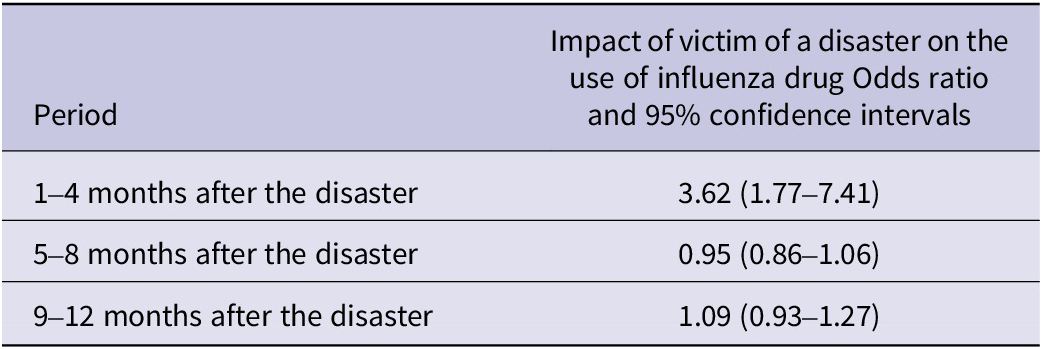
The results of this analysis are presented in Table 3. The use of anti-influenza drugs in both groups before and after the disaster showed similar trends (Figure 2). However, upon closer examination restricted to the immediate 4 months following the disaster (July-October 2018), the affected group showed a significantly higher use rate of anti-influenza drugs than the unaffected group, based on the trend just before the disaster (February-June 2018) (adjusted odds ratio 3.62; 95% CI 1.77-7.42). For the other periods (November-February 2018 and March-June 2018), there were no statistically significant differences between the victim and non-victim groups.
Difference-in-differences analysis compared to 4 months immediately prior to the disaster (February-June 2018)

Percentage of influenza prescriptions per month from 1 year before to 1 year after the disaster.
Figure 2 shows a graph of the proportion of prescriptions for anti-influenza drugs in the year before and after the disaster (which occurred in June 2018), divided into the groups of victims and non-victims. Only in the 4 months immediately after the disaster, there was a statistically significant increase in the number of prescriptions for anti-influenza drugs in the group of victims.

Discussion
Main Study Findings
We found that anti-influenza drugs were prescribed more frequently to victims, defined as the physical or financial loss of any member of the family, or the loss or destruction of a house, than to non-victims immediately after the disaster, and the phenomenon disappeared 4 months after the disaster.
What is already known on this topic
Although there have been several reports on the ecological association between viral infections, including influenza and natural disasters, to date, no studies have compared disaster victims and non-victims as far as we know.
What this study adds
We proved an association between natural disaster and the use of anti-influenza drugs using the NDB to ensure a sufficient sample size and data to identify the victims. A subgroup analysis by age was also conducted, and disaster victims were found to be at risk of influenza in all age categories. Our results suggest that health care providers and policymakers should be aware of the possibility of increased influenza incidence after a disaster and take appropriate action.
There are 2 main reasons influenza infection was significantly more common in the disaster victims immediately after the disaster. First, the victims were forced to live in shelters and many had to live in unoccupied spaces with poor sanitary conditions, which may have facilitated the spread of the infection.Reference Uyeki, Hui and Zambon2, Reference Izumikawa11 Second, the victims were exposed to psychological and physical stress, fatigue, and irregular life rhythms, which may have compromised their immune system and increase their susceptibility to viral infections.Reference Perez, Uddin and Galea7, Reference Godbout and Glaser22 Financial hardship can also cause mental stress, which can increase the risk of infectious diseases. Past reports have warned of the spread of influenza in evacuation centers.Reference Waring and Brown8, Reference Izumikawa11 Early transfer from evacuation centers to temporary housing, sanitation in evacuation centers, and ensuring appropriate spacing between disaster victims are essential for preventing infection. Reducing the physical and mental stress experienced by victims is also important in preventing infection.
In the difference-in-differences analysis, the year after the disaster was divided into 4-month periods, and anti-influenza drug use between victims and non-victims was examined. There were no significant differences between the 2 groups after the first 4-month period. It has been previously reported that chronic conditions such as migraine and irritable bowel syndrome required significantly more treatment interventions in the victim group, even after the immediate period.Reference Okazaki, Yoshida and Kashima23, Reference Okazaki, Yoshida and Kashima24 For influenza, there was no difference in the rate of infection between victims and non-victims, possibly because victims have been able to return from shelters to temporary housing and their original lives. A previous study reported that respiratory infections, including influenza, are more common in the acute phase immediately after a disaster, and resolve over time,Reference Izumikawa11 consistent with the findings of the present study. This reaffirms the importance of infection control measures in evacuation centers. It is necessary to strengthen measures to prevent the spread of infection in evacuation centers, such as vaccination, securing space for individuals and families to the extent possible, thorough preventative measures for evacuees and relief workers, improving hygiene, adequate supply of nutrients, and interventions by microbiologists.Reference Izumikawa11, Reference Carrel, Clore and Kim25–Reference Viswanathan, Chakrabarty and Basu28
The number of influenza prescriptions per season was higher in winter and several months after the disaster than immediately after the disaster (Figure 2). This may reflect that seasonal influenza outbreaks are usually more prevalent in winter. In addition, because the 2018 heavy rain disaster occurred in the summer, when influenza infection rarely occurs, the difference in anti-influenza medication use in the 4 months immediately following the disaster was statistically significant in the victim group, but the clinical impact was weak due to the low incidence (Figure 2). Fortunately, regarding infection control, the disaster occurred in this season. The difference-in-differences analysis showed that the presumed incidence of influenza in the disaster-affected population was more than 3 times higher than that in the unaffected population. If the disaster had occurred during the influenza epidemic season, there would probably have been a staggering number of cases. Furthermore, this expectation may be applicable to viral infections other than influenza, such as COVID-19. In studies of the impact of natural hazards on the spread of COVID-19, it has been reported that natural hazards may contribute to the spread of the COVID-19 when they occur.Reference de Vries and Rambabu29 Further investigation, including observation of disasters that occur during a pandemic, is needed to measure the true impact of disasters on respiratory infections.
Study Limitations
Our study had several limitations. First, information on diagnosis was not included in the NDB, and only patients treated with anti-influenza drugs were included. Therefore, some patients may have been treated with anti-influenza drugs without a definitive diagnosis of influenza.
Second, the NDB assigned victim codes only to those who applied for disaster certification from the local government and visited a medical institution. Therefore, there may have been victims who neither applied for disaster certification nor visited a medical institution, although the number would have been quite small considering the financial benefits gained from applying for the certification
Third, other confounding factors such as the presence or absence of comorbidities and the economic status of the affected region should be adjusted for, but the absence of such information in the database made such adjustment impossible. In addition, there have been reports of the risk of delayed or missed vaccinations among disaster victims,Reference Mulcahy, Whaley and Gizaw30 and another limitation of this study is that it is not possible to take into account the vaccination status of each individual, as there is no information on this in the NDB. To minimize the effect of potential confounders, we performed a difference-in-differences analysis and showed that our results were robust even with some unadjusted factors.
Another important limitation is the inability to distinguish between patients who suffered direct damage and those who suffered indirect damage. This is because the definition of victims in this study covers those who suffered direct damage and even those considered victims due to their family’s health problems or unemployment (indirect damage).
Finally, anti-influenza drug use may have increased among victims because they no longer had to pay for medications once they were certified as victims. However, given that all drug prices in Japan are determined by the government and are much lower than in other countries,Reference Sawano31 and that the price elasticity of outpatient care in the Japanese health insurance system is quite weak (-0.125 to -0.07619),Reference Moriyama, Hugentobler and Iwasaki19 the effect of the co-payment exemption in Japan is limited. Hence, it is unlikely that the exemption contributed to an increase in the use of influenza drugs.
Despite these limitations, we were able to use the NDB, a big dataset of millions of units, and difference-in-differences analysis to demonstrate the robustness of the relationship between natural hazards and anti-influenza drug use. COVID-19 infection, which has caused a pandemic since 2020,Reference Zhu, Zhang and Wang32 is also highly likely to spread at natural hazards sites in the future. We believe that this study will be a step toward developing countermeasures against influenza and other viral infections in a disaster. In the future, it would be desirable to conduct research not only on influenza but also on other respiratory infections, considering the patient’s medical history and financial situation.
This study revealed that the disaster victims used anti-influenza drugs more frequently than did non-victims. Prevention of influenza infection among disaster victims may require careful attention, and rapid assessment and response may be important during a disaster. Important issues for the future include the recommendation of influenza vaccinations at evacuation centers, thorough implementation of infection prevention measures at the individual level, and rapid responses, such as securing living environments to enable people to leave evacuation centers as soon as possible.
Key messages
Anti-influenza prescriptions are increased among victims of the torrential rain disaster compared to non-victims.
What is already known on this topic
It was noted that victims of natural hazards may be at risk for respiratory infections such as influenza.
What this study adds
The study was the first to distinguish between affected and unaffected individuals and to conduct a large-scale survey, which revealed that heavy rainfall was associated with an increase in prescriptions of anti-influenza medications.
How this study might affect research, practice, or policy
It was found that prescriptions of anti-influenza drugs are increasing in the affected groups due to the torrential rain disaster. This study will help medical professionals and policy makers to prepare for influenza pandemics in the event of a disaster by improving sanitary conditions in evacuation centers, moving people to temporary housing as soon as possible, and establishing a medical system that can provide an adequate supply of anti-influenza medications and accept them when needed.
Data availability statement
The data from this study can be made available with permission from the Ministry of Health, Labour and Welfare: https://www.mhlw.go.jp/stf/seisakunitsuite/bunya/kenkou_iryou/iryouhoken/reseputo/index.html.
Author contribution
Dr Shu Utsumi conceptualized and designed the study, conducted the initial analyses, drafted the initial manuscript, and critically reviewed and revised the manuscript. Dr Shuhei Yoshida conducted the initial analyses and critically reviewed and revised the manuscript. Dr Shinichiro Oshimo conceptualized and designed the study and critically reviewed and revised the manuscript and is responsible for the entire study. Prof Nobuaki Shime critically reviewed and revised the manuscript for important intellectual content. Prof Masatoshi Matomoto coordinated and supervised data collection and critically reviewed and revised the manuscript for important intellectual content. All authors approved the final manuscript as submitted and agreed to be accountable for all aspects of the work.
Funding statement
None.
Competing interests
None declared.