Introduction
Lidocaine hydrochloride 5 per cent weight/volume (w/v) and phenylephrine hydrochloride 0.5 per cent w/v topical solution is a commonly used anaesthetic preparation in ENT practice. The manufacturer (Aurum Pharmaceuticals, UK) currently recommends its use as a single-use disposable pack. However, this advice is not stringently followed in clinical practice. Common practices include changing the actuator between different patients but using the same container and solution, or alternatively, combining the contents of two or more bottles in one single container and then using it as a multi-use spray, changing the actuator between patients. The common reasons cited for such practices are significant cost reduction and conflicting evidence in the medical literature regarding possible cross-contamination from the multiple use of the nasal sprays.Reference Bossart and Wolfe1–Reference Wolfe, Hillman and Bossart5 Although it reduces cost, this method of using the solution as a multi-use spray has the potential for cross-contamination because of a suck back effect.Reference Coakley, Arthurs and Wilsher6
This study evaluates the potential for cross-contamination of the lidocaine hydrochloride 5 per cent w/v and phenylephrine hydrochloride 0.5 per cent w/v topical solution delivery system if used as a multi-dose vial in clinical practice. The study aimed to determine whether the pump and contents of the bottle were contaminated following a single use in patients (in vivo) and in the laboratory setting (in vitro), and to assess the cost implication if used as a single-use topical anaesthetic spray.
Materials and methods
This study was conducted by the ENT and microbiology departments of a district general hospital (Royal Hampshire County Hospital). The study did not require ethical approval as the methodology did not warrant any deviation from normal clinical practice.
The study was divided into two arms: in vivo and in vitro. In the in vivo arm, lidocaine hydrochloride 5 per cent w/v and phenylephrine hydrochloride 0.5 per cent w/v topical solution was used as a single-use spray on 10 patients attending a general ENT clinic, prior to undergoing nasal endoscopy, as part of their routine clinical care. Aseptic precautions were undertaken to reduce any contamination whilst handling the bottle and actuator. The topical solution assembly (i.e. the pump and the bottle with the remaining solution) was transferred to the microbiology laboratory for bacteriological analysis. Under strict aseptic conditions, using a sterile safety cabinet, 1–3 drops of the lidocaine hydrochloride 5 per cent w/v and phenylephrine hydrochloride 0.5 per cent w/v topical solution were extracted from the pump and the contents of the bottles. The samples were cultured on blood, chocolate and MacConkey agar plates, and then incubated for up to 48 hours using the Health Protection Agency's standard operating procedures for bacterial growth and identification.7 These were later checked by a consultant microbiologist for any bacterial growth.
The in vitro arm of the study was carried out within a sterile safety cabinet to ensure the operator's safety and avoid potential environmental contamination. A standard inoculum of one colony of Staphylococcus aureus in 10 ml normal saline was inoculated on a blood agar plate and incubated aerobically at 37°C for 24 hours, and a semi-confluent culture was obtained. Samples were also taken from the sterile assembly of the lidocaine hydrochloride 5 per cent w/v and phenylephrine hydrochloride 0.5 per cent w/v topical solution (i.e. the pump and bottle) prior to its in vitro application to the culture plate. This was to exclude any baseline contamination of the solution. Using pre-sterilised nozzles, the sterile spray was then applied to the S aureus culture plate twice, from a distance of 1 and 2 cm (one spray each time, avoiding direct contact of the pre-sterilised nozzle with the plates). After each application, 1–3 drops of lidocaine hydrochloride 5 per cent w/v and phenylephrine hydrochloride 0.5 per cent w/v topical solution were extracted from the pump and bottle contents to assess for bacterial growth using the techniques described above.
Results
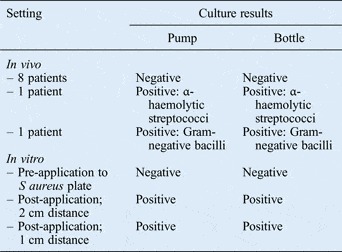
The results are tabulated in Table I. In the in vivo setting, 2 of the 10 samples from both the pump and the bottles were positive for cultures. In the in vitro setting, the pump and the contents of bottles were contaminated after a single use when the sterile solution was sprayed from distances of 1 and 2 cm.
In vitro and in vivo culture results

S aureus = Staphylococcus aureus
Discussion
This study demonstrates that multiple uses of intended single-use lidocaine hydrochloride 5 per cent w/v and phenylephrine hydrochloride 0.5 per cent w/v topical solution results in contamination of the solution and presents a risk for spreading infection.
The cultures from both in vitro and in vivo samples were positive. This can be explained as follows: despite the sterile precautions taken when using the spray in the nose, the suck back effect of the nasal spray actuator can withdraw bacterial contents from the nasal cavity into the actuator, and thus contaminate the bottle and its content.
Royal Hampshire County Hospital is a tertiary rhinology centre and has a large cohort of patients who are on regular follow up for complex sinonasal problems. These patients often require some intervention in clinic (suction clearance of the operative site, irrigation, removal of crust and so on). Some patients may carry bacterial biofilms in the nasal cavity. These areas can be a source of contamination for the solution.
Venturi principle atomisers have long been used in ENT to deliver drugs. Many studies have demonstrated the potential for contamination of the delivery system because of the suck back effect.Reference Spraggs, Hanekom, Mochloulis, Joseph and Kelsey4–Reference Coakley, Arthurs and Wilsher6 This led to the development of positive displacement atomisers to deliver drugs into the nasal cavity.Reference Bossart and Wolfe1, Reference Wolfe, Hillman and Bossart5 Positive displacement pumps use the non-compressible properties of fluid to atomise medication. In positive displacement atomisers, manually applied force on the nozzle is transmitted through a spring-driven pump system to the fluid, which causes an increase in the pressure of the fluid in the reservoir. This increase in pressure drives the fluid through the pump lumen and out of the tip. A one-way valve system prevents the suck back of fluid. This design theoretically lowers the risk of contamination.Reference Aydin, Hizal, Akkuzu and Azap8 Wolfe et al. compared the risk of contamination between Venturi type devices and positive displacement pumps, and found that positive displacement atomisers never became internally contaminated.Reference Wolfe, Hillman and Bossart5 In addition, a recent study by Rashid and Karagama found no evidence of contamination with a multi-use xylocaine spray using spectrophotometer and culture analysis.Reference Rashid and Karagama9 This is contrary to the findings of our study.
Various other strategies have been demonstrated to decrease the risk of infection transmission.Reference Dubin, White, Melroy, Gergan, Rutala and Senior2, Reference Visosky, Murr, Ng, Dentoni, Weir and Haller10 This includes: avoidance of any direct contact of equipment with nasal mucosa; use of a bacteriostatic preservative in the nasal spray; use of a nozzle tip; use of a nasal speculum; application of continuous, less than 1 second spray to the nasal cavity; and wiping the nozzle of the atomisers with an isopropyl alcohol pad after each use.
All of these pragmatic approaches have resulted in reducing bacterial load. However, there is still a potential for contamination, as demonstrated by our study. Two previous studies recommended the use of a single-use disposable topical anaesthetic spray to significantly reduce the possibility of contamination of an anaesthetic agent.Reference Spraggs, Hanekom, Mochloulis, Joseph and Kelsey4, Reference Coakley, Arthurs and Wilsher6 Lidocaine hydrochloride 5 per cent w/v and phenylephrine hydrochloride 0.5 per cent w/v topical solution is one such commercially available, single-use topical anaesthetic spray commonly used in the UK.
The practice of multiple uses of the single-use lidocaine hydrochloride 5 per cent w/v and phenylephrine hydrochloride 0.5 per cent w/v topical solution results in significant cost reduction. This topical solution costs the Royal Hampshire County Hospital £9.98 (plus value added tax) if used as a single-use spray. This is reduced to £4.99 or less if used in more than one patient. The Royal Hampshire County Hospital has spent £5479.00 in the last financial year on this topical solution. This amount is projected to increase significantly if the single-use practice (for the disposable spray) is stringently followed.
• Lidocaine hydrochloride and phenylephrine hydrochloride topical solution is a common topical anaesthetic in ENT
• It is a single-use disposable pack, but advice regarding its use is not strictly followed
• This study demonstrated contamination of the topical solution after single use in both in vivo and in vitro settings
• The topical solution unit should be used strictly as a single-use disposable unit to prevent cross-contamination
• This is likely to have significant cost implications for the ENT department pharmaceutical budget
Current clinical evidence questions the routine use of topical anaesthetic spray in flexible laryngoscopy.Reference Sunkaraneni and Jones11 However, it is often required when rigid nasal endoscopy is used for minor interventions in out-patient settings or when the patient makes a choice.
Conclusion
Our assessment revealed that the lidocaine hydrochloride 5 per cent w/v and phenylephrine hydrochloride 0.5 per cent w/v topical solution assembly was contaminated in 2 out of 10 patients following a single use. This indicates the potential for contamination, which was further confirmed by an in vitro study. We therefore recommend following the manufacturer's advice of using the solution as a single-use disposable unit. This advice should be strictly adhered to in order to prevent cross-contamination, albeit with significant cost implications for the pharmaceutical budget of the ENT department.
Acknowledgements
We would like to acknowledge help of Mrs Patricia Butler, Specialist Biomedical Scientist at the microbiology department of the Royal Hampshire County Hospital, Winchester for her microbiology laboratory support and input to this work.