INTRODUCTION
The deep sea is considered to be the largest biome on Earth and the benthic fauna represents the most abundant component of life in the deep sea (Priede et al., Reference Priede, Bergstad, Miller, Vecchione, Gebruk, Falkenhaug, Billett, Craig, Dale, Shields, Tilstone, Sutton, Gooday, Inall, Jones, Martinez-Vicente, Menezes, Niedzielski, Sigurðsson, Rothe, Rogacheva, Alt, Brand, Abell, Brierley, Cousins, Crockard, Hoelzel, Høines, Letessier, Read, Shimmield, Cox, Galbraith, Gordon, Horton, Neat and Lorance2013). Deep oceanic benthic species live mostly within soft sediments, although they include assemblages living on hard rocks of continental slopes, seamounts and mid-oceanic ridges. Mid-ocean ridges (MOR) are underwater chains of mountains that constitute the largest topographic feature on this planet, extending to 75,000 km in length (Garrison, Reference Garrison1993), and have attracted considerable attention for their enhanced biodiversity, fisheries and mineral resources (Fowler & Tunnicliffe, Reference Fowler and Tunnicliffe1997; Clark et al., Reference Clark, Rowden, Schlacher, Williams, Consalvey, Stocks, Rogers, O'Hara, White, Shank and Hall-Spencer2010; Priede et al., Reference Priede, Bergstad, Miller, Vecchione, Gebruk, Falkenhaug, Billett, Craig, Dale, Shields, Tilstone, Sutton, Gooday, Inall, Jones, Martinez-Vicente, Menezes, Niedzielski, Sigurðsson, Rothe, Rogacheva, Alt, Brand, Abell, Brierley, Cousins, Crockard, Hoelzel, Høines, Letessier, Read, Shimmield, Cox, Galbraith, Gordon, Horton, Neat and Lorance2013). Earlier biological studies on MOR mostly focused on chemosynthetic environments (Van Dover, Reference Van Dover2000), while comparatively few studies addressed heterotrophic fauna (Felley et al., Reference Felley, Vecchione and Wilson2008; Molodtsova, Reference Molodtsova2013). However, the recent multinational project on ‘Patterns and process of the Ecosystem of the Northern Mid-Atlantic’ (MAR-ECO) (Bergstad & Godø, Reference Bergstad and Godø2003; Bergstad et al., Reference Bergstad, Falkenhaug, Astthorsson, Byrkjedal, Gebruk, Piatkowski, Priede, Santos, Vecchione, Lorance and Gordon2008), part of the global Census of Marine Life (CoML) programme (McIntyre, Reference McIntyre2010), has greatly increased knowledge of MOR environments.
The Carlsberg Ridge, the north-western limb of the Indian Ocean Ridge system, is one of the least studied oceanic ridge systems. Several geophysical and hydrographic surveys have been carried out (Laughton, Reference Laughton and Hersey1967; Murton et al., Reference Murton, Baker, Sands and German2003; KameshRaju et al., Reference KameshRaju, Chaubey, Amarnath and Mudholkar2008; Ray et al., Reference Ray, Mirza, Prakash, Kaisary, Sarma, Rao, Somayajulu, Drolia and KameshRaju2008, Reference Ray, KameshRaju, Baker, Rao, Mudholkar, Lupton, Prakash, Gawas and Kumar2012) in different segments of Carlsberg Ridge. However, there have been very few investigations of regional benthic fauna. Glasby (Reference Glasby1971) explored the biological communities associated with the non-vent regions of the Carlsberg Ridge but no attempts have been made to quantify benthic faunal abundance or to link biological information with the environmental settings. Biological studies have mostly focused on the Kairei and Edmond fields near Rodriguez Triple Junction (Gamo et al., Reference Gamo, Chiba, Yamanaka, Okudaira, Hashimoto, Tsuchida, Ishibashi, Kataoka, Tsunogai, Okamura, Sano and Shinjo2001; Hashimoto et al., Reference Hashimoto, Ohta, Gamo, Chiba, Yamaguchi, Tsuchida, Okudaira, Watabe, Yamanaka and Kitazawa2001; Van Dover et al., Reference Van Dover, Humphris, Fornari, Cavanaugh, Collier, Goffredi, Hashimoto, Lilley, Reysenbach, Shank, Von Damm, Banta, Gallant, Götz, Green, Hall, Harmer, Hurtado, Johnson, McKiness, Meredith, Olson, Pan, Turnipseed, Won, Young and Vrijenhoek2001).
The aim of this investigation was to quantify the megafaunal assemblages and to assess patterns in density between the depths and different seabed substrata in the CR region. In this article, we use broad-scale information on seafloor habitats and their associated megafaunal communities quantified from underwater video images collected in the CR region. This study was the first in the Carlsberg Ridge area to produce underwater images of benthic megafaunal communities in a quantitative manner.
GEOLOGICAL SETTING OF THE STUDY AREA
The Carlsberg ridge, demarcating the north and north-western part of the Indian Ocean ridge system, is accreting at the divergent plate boundary between the Somalia–India and Arabian plates (McKenzie et al., Reference McKenzie, Molna and Davie1970). This is a typical slow spreading (half-spreading rate of 11 to 16 mm y−1) ridge having a V-shaped well-defined deep (>4000 m) rift valley with a wide valley floor, steep sidewalls and several transform faults. Between 62°20′E and 66°20′E the Carlsberg Ridge has rugged topography with steep valley walls, ridge-parallel topographic fabric and axial volcanic ridges (KameshRaju et al., Reference KameshRaju, Chaubey, Amarnath and Mudholkar2008). Seabed depths along the CR range from 1600 m to more than 4000 m and likely represent a variety of ecological zones. The present investigation focuses on two ridge segments that include areas of an unusually large episodic event plume (CR-2003) between 5°10′ and 6°00′N (Murton et al., Reference Murton, Baker, Sands and German2003; Ray et al., Reference Ray, Mirza, Prakash, Kaisary, Sarma, Rao, Somayajulu, Drolia and KameshRaju2008) and potential hydrothermal activities between 3°30′ and 4°00′N (Ray et al., Reference Ray, KameshRaju, Baker, Rao, Mudholkar, Lupton, Prakash, Gawas and Kumar2012).
MATERIALS AND METHODS
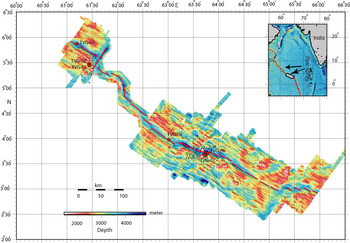
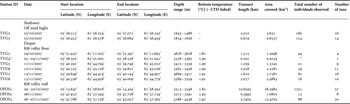
In November 2007, the RV ‘Sonne’ (RVS-2) was used to survey two segments of the Carlsberg Ridge. As a part of this programme, we investigated benthic megafaunal communities and their distribution patterns among different geological settings (e.g. off-axial highs or mounds, valley wall and floor) of these two ridge segments (Figure 1). During the cruise, a TeleVision Gripper (TVG) and Ocean Floor Observation System (OFOS; Römer et al., Reference Römer, Kopiske, Linse, Marcon, Little and Wu2013) were operated over eight and three transects respectively (Table 1). EM120 multibeam bathymetry data were obtained on the same cruise and used to determine the survey locations. Three TVG transects (TVG 1, 2 and 3) were carried out to different parts of a large event plume area in the northern segment. The first survey (TVG 1) was along the deep valley floor while two others (TVG 2 and TVG 3) were on the corner highs near a transform fault. Another five surveys (TVG 4, 5, 6, 7 and 8) were in the southern segment, mostly over the deep valley floor (depth >3000 m). All three OFOS transects were located close to the rift valley wall near the valley floor. Owing to time limitations on the cruise video transect lengths were different (OFOS 1 and OFOS 3 were longer than OFOS 2 and TVG 3). All transects were included in quantitative analysis.
Transect locations of the study area: Shallower transects TVG 2 and 3 and deeper transects TVG 1 and OFOS 1 located in the northern segments; other all deeper transects TVG 4, 5, 6, 7, 8 and OFOS 2 and 3 located in the southern segments in the Carlsberg Ridge.

Details of underwater video observations and their geographic locations along with total number of fauna observed at each transect in Carlsberg Ridge, Indian Ocean.

* Owing to technical problems the video was not clear for all of TVG 4. Two individuals were seen but we did not use the data for analysis of video transect TVG 4.
The benthic megafaunal communities were observed using video transects collected with TVG and OFOS. Both were operated from the starboard side of the ship. The OFOS seabed imaging platform was flown with a real-time video link to the surface (digital through a fibre optic lightweight launcher (LWL) cable). The position of OFOS was recorded continuously with reference to an Ultra-Short Baseline Navigation transponder. OFOS has three cameras: one PHOTOSEA 5000 stereo-camera (that obtains two simultaneous photographs), one colour video (DSPLMSC 2000 colours with parallel red lasers, mounted 100 mm apart, used for scaling) and one monochrome video camera (OSPREY 0111-6006 B/W) and lighting (4xROS QL 3000 and/or 2xDSPL Arc-light). The TVG system had a similar capacity to OFOS and had two video cameras (1xDSPLMSC 2000 colour, and 1xOSPREY OE 1390 monochrome digital video), lighting (4xROS QL 3000) and telemetry. All the still photographs and video images were collected on digital versatile disc (DVD) at the surface. TVG was towed along the predefined track at a speed of ~0.5–0.7 knots while OFOS was operated at 0.2–0.5 knots. The cameras of both the systems obtained images at a height (altitude) of 1 to 5 m (depending on the seabed substratum) above the seabed. We have identified and quantified the faunal assemblages that are >1 cm in size and observed from an altitude less than 2.5 m from the seabed.
Image processing and data analysis
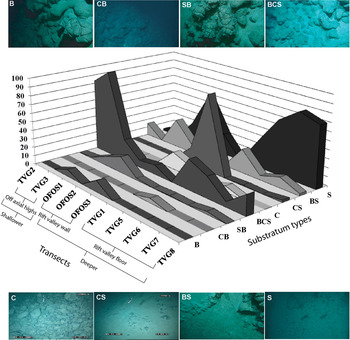
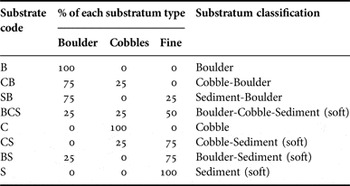
All megafauna were identified from images to a highest possible taxonomic resolution with additional help from experts (see acknowledgements). Owing to the nature of the image material, it was not possible to identify all animals to species level. Morphologically distinct organisms were identified and labelled with unique names referring to the taxon, such as Hexactinellida sp.1, Hexactinellida sp.2 or Holothuroidea sp.1 etc. Seabed substratum was classified into distinct ‘substratum types’, which may represent benthic habitats. Substratum types were identified based on seabed morphology and composition, such as rock type and sediment nature (Figure 2) and quantified by estimating the percentage of boulders, cobbles or fine sediment present, following the description of Hoff & Stevens (Reference Hoff and Stevens2005) (Table 2).
Representative photographs of each substratum type and their distribution pattern along the transects in the study area. Y-axis represents percentage cover.

Composition of substratum types viewed from seafloor video images of the Carlsberg Ridge.

The substratum type, identity and number of all organisms were recorded along each transect. Positional information for each photograph was obtained from the navigation data. After analysing the navigational data, total transect length was measured manually in ArcGIS software. This measured length was used for subsequent area calculations. The width of the transect was ascertained from the laser scalers visible in each image (for OFOS) and from camera altitude (for TVG). For OFOS, the distance between laser scalers in 25–50 randomly selected frames was measured for each transect and the mean used to estimate the transect width. For TVG, transect width was calculated from mean camera altitude using the following equation:
 $$\hbox {Width of transect},\;W = 2 \times {\rm tan}\left( {\displaystyle{\alpha \over 2}} \right) \times \hbox {camera altitude}\left(H \right)$$
where, α is the angle of focal length (20°) of the camera.
The area coverage of each transect was estimated from the total length (L) and width (W) as follows:
 $${\rm Area} \left(A \right) = L \times W$$
Based on the area calculated and after recording the individuals on the entire track, we estimated the faunal density at each transect.
Statistical analysis
Only those morphotypes that could be confidently identified were included in the analysis. To investigate how similarity between assemblages changes with the substratum type and bathymetric gradients in the Carlsberg Ridge, several multivariate analyses were conducted using PRIMER v6 (Clarke & Gorley, Reference Clarke and Gorley2006). Following the general recommendations of Clarke & Gorley (Reference Clarke and Gorley2006), the Bray–Curtis similarity measure was employed to assess multivariate similarity and dissimilarity between transects based on log-transformed faunal abundance data. The differences between transect groups of substratum type were assessed with multivariate analysis and visualized using hierarchical clustering based on Bray–Curtis similarities of square root transformed data. The organisms that contributed most to the observed similarity within and dissimilarity among groups were assessed using SIMPER (similarity percentage).
RESULTS
Distribution of substratum types
Substratum variability was greatest in the deeper areas of the rift valley, with substratum types varying from exposed pillow basalts to fine sedimentary cover on the rocky substratum. A total of eight different substratum types were classified over 10 TVG and OFOS transects located within our study area (Table 2). Substratum type distribution patterns and the percentage occurrence of substratum types for each transect (Figure 2) were variable.
Two shallower transects (TVG 2 and TVG 3), located on off-axial highs, have a seabed comprised of mostly basalts covered with sediments. The seafloor along the TVG 2 transect was predominantly the sedimented base of a basalt wall (BS), with some areas covered with sediment only. Transect of TVG 3 was mostly comprised of pillow/basalt blocks with sediments on a gradual slope (type BCS) with a small percentage of cracked pillow basalts with sediments (FB) observed.
All eight substratum types were found within the deeper areas. Most of the substrata in the region were sediment (S). Other seabed types were also fairly common, including gradually sloping sedimented seabed with basalt blocks (BCS), the sediment covered bases of basalt walls (BS), tallus on broken pillow fragments at the base of a scarp or small hillock (C) and basalt walls with sediment cover on ledges. Rarely there were thick mounds of pillow basalts with little sediments (SB). A maximum of seven substratum types were observed along the rift valley wall (at OFOS 3) while a minimum of two types were found at rift valley floor (at TVG 1).
Abundances and composition of megafaunal assemblage
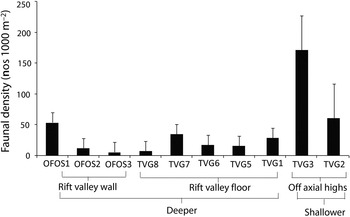
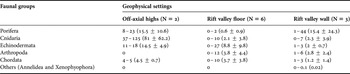
A total of 2088 individuals from 90 taxa, representing seven phyla, were observed in the underwater video and still images in the two segments of the CR (Table 1; Supplementary Table 1). The population density varied between 5.7 and 171.3 animals 1000 m−2 with a mean of 38.0 ± 3.3 animals 1000 m−2 in the study area (Figure 3). A total of 272 individuals from 19 taxa were seen on an off-axial high observed in the shallower transects, and the remaining 1632 (69 taxa) and 186 (22 taxa) were observed on the rift valley wall and rift valley floor respectively. However, megafaunal densities were higher at shallower transects than deeper transects. Density varied from 60.8 to 171.3 animals 1000 m−2 (mean 116.1 ± 55.3) in the shallower transects on off-axial highs. In the deeper transects density varied from 5.7 to 53.5 animals 1000 m−2 (mean 23.8 ± 15.0) on the rift valley wall and 7.6 to 34.7 animals 1000 m−2 (mean 21.0 ± 4.9) on the valley floor. The highest density was observed along the off-axial highs transect of TVG 3, while the lowest was at the rift valley wall transect OFOS 3, which was the deepest transect of the study area (Figure 3). On average the megafaunal assemblage was dominated by cnidarians followed by poriferans and echinoderms. The cnidarians were mostly observed in shallower transects located in off-axial highs (Table 3). In both shallow transects the cnidarians were predominantly a black coral, Stichopathes sp., and the substratum type was mostly basalt blocks with cobbles and sediments (BCS). In contrast, the deeper transects contained a maximum of six megafaunal groups and were dominated by echinoderms followed by arthropods, poriferans, chordates, cnidarians and others (Table 3). Poriferans mostly appeared on pillow basalts on escarpments (B) and pillow basalts with sediments (BS), while cnidarians were found in higher densities on basalt blocks with sediments on a gradual slope (BSC). Echinoderms, arthropods and chordates were found in higher densities on the BCS substratum as well as sediment (S) rich areas. Other megafaunal groups, such as xenophyophores and annelids, were occasionally observed in both the segments.
Megafaunal density along the Carlsberg Ridge with different depths and geophysical settings.

Abundance range (mean ± SD) of benthic megafaunal groups per 1000 m2 area in the Carlsberg Ridge area.

Multivariate analysis: substratum types and faunal assemblages
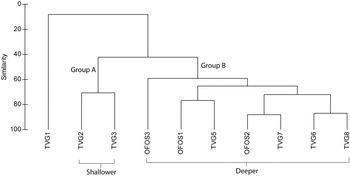
The sites formed two distinct groups (Figure 4) when evaluated in terms of their substratum composition with 40% similarity from hierarchical clustering. Shallower transects (TVG 2 and TVG 3), located on the off-axial highs, formed Group A, where the boulder block with cobbles and fine sediments (BCS) substratum type contributed the highest similarity percentage (Supplementary Table 2) at this region. Substratum types that had mostly mixed sediments (e.g. BCS, BS, S) formed another cluster (Group B) with deeper transects on the rift valley wall and floor areas. The dissimilarity between the groups was observed principally because of differences in mixed substratum type BCS and S (sediments) substratum types, where BCS made the highest contribution at shallower depths and S highest contribution was at deeper depths (Figure 2).
Cluster analysis of substratum types at each transect along the CR.

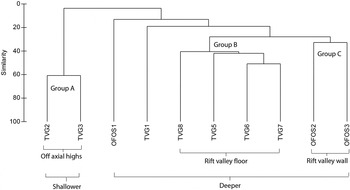
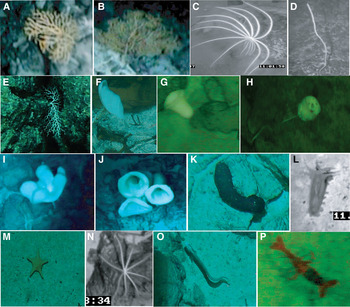
The sites formed three distinct groups when analysed in terms of their megafaunal similarity (Figure 5). The multivariate analysis showed a clear distinction between the depths, geophysical settings, transects distances and substratum composition. One group (Group A) comprised the shallower transects (TVG 2 and TVG 3), the deeper transects on the rift valley floor (TVG 5, 6, 7 and 8) and on the rift valley wall (OFOS 2 and 3) made Group B and Group C respectively. Overall cnidarians Stichopathes sp. (Figure 6D), Brisingidae sp.2 (Figure 6C), Isididae sp.1 (Figure 6A), Actinaria sp.3 and poriferans Hexactinellida sp.9 were restricted to shallower transects in off-axial highs and responsible for >80% of the differences which separated Group A (Supplementary Table 3). The Arthropod Cerataspis sp. (Figure 6P) and holothurians Peniagone sp. (Figure 6L) and Benthodytes sp.2 were restricted to the rift valley floor transects (TVG 5, 6, 7 and 8) and were the major contributors (total 78%) to the similarity in Group B (Supplementary Table 3). The third group (Group C) was made by transects OFOS 2 and 3 owing to similarities in the density of Cerataspis sp., Elpidiidae sp.1 and Enypniastes exima (contributed to 89% similarity). OFOS 1 and TVG 1 were the most remote deeper transects (a distance of OFOS 1 and TVG 1 from other deeper transects was over 50 km away from the southern segment).
Cluster analysis of megafaunal assemblages at each transect along the CR.

Underwater images of benthic megafauna along the Carlsberg Ridge. Shallower: (A) Isididae sp.1; (B) Isididae sp.2; (C) Brisingidae sp.2; (D) Stichopathes sp.; Deeper: (E) Stylasterine sp.; (F) Aulocalycidae glass sponge; (G) Hyalonema sp.; (H) Bolosominae sponge; (I) Crateromorpha sp.; (J) Rossellidae glass sponge; (K) Benthodytes sp.; (L) Peniagone sp.; (M) Asteroid sp.1; (N) Brisingidae sp.1; (O) Anguilliformes sp.2; (P) Cerataspis sp.

DISCUSSION
All transects observed had basalts present. Some observations, for example, the C substratum types, included talus or broken pillow basal fragments at the base of small mounds, which may suggest tectonic activity in the area. Multibeam mapping of the Carlsberg Ridge between 62°20′E and 66°20′E (KameshRaju et al., Reference KameshRaju, Chaubey, Amarnath and Mudholkar2008) revealed rugged topography with steep valley walls, structures such as ridge-parallel topographic fabric and axial volcanic ridges, which correspond with features observed here. In this study, some substrata, such as sediments (S) and exposed basalts in thick sediment-covered plain (CS), were mostly covered with pelagic sediments, reworked by benthic fauna (such as observed at transect TVG 7). Similar types of substratum and suggested benthic activity have previously been observed in underwater photographs along the Carlsberg Ridge (Laughton, Reference Laughton and Hersey1967) and along the Mid-Atlantic Ridge (Bell et al., Reference Bell, Jones and Alt2013, Reference Bell, Alt and Jones2016). The general morphology of the Carlsberg Ridge sections used in the present study is similar to the Mid-Atlantic Ridge (MAR) between the Kane and Atlantis transform (KameshRaju et al., Reference KameshRaju, Chaubey, Amarnath and Mudholkar2008).
In the present study higher mean faunal density was observed in shallower transects located at off-axial highs, while comparatively lower density and higher diversity were observed at the deeper transects. The western flanks of the Carlsberg Ridge around 300 km east of the study area and a little deeper (3472–3990 m) have extensive biological activity, characterized by large-scale burrowing of sediment and the appearance of worm casts, ophiuroids and holothurians (Glasby, Reference Glasby1971). However, no quantitative benthic megafaunal data are available to compare with the present study. Comparatively fewer species are recorded in the present study than on the MAR, probably owing to the relatively low sampling effort on the CR. More than 650 species of benthic invertebrate megafauna were recorded by physical sampling and underwater images on the MAR, of which 112 cnidarians and 35 poriferans were found specifically on hard substrata (Vecchione et al., Reference Vecchione, Bergstad, Byrkjedal, Falkenhaug, Gebruk, Godø, Gislason, Heino, Høines, Menezes, Piatkowski, Priede, Skov, Søiland, Sutton, Wenneck and McIntyre2010). In the present study, density decreased with increasing depth. This is expected as decreases in faunal abundance with depth occur in most deep-sea communities investigated (e.g. Carney, Reference Carney2005; O'Hara, Reference O'Hara2008; Williams et al., Reference Williams, Althaus, Dunstan, Poore, Bax, Kloser and McEnnulty2010), probably as a result of the exponential decline in food supply with depth (Lutz et al., Reference Lutz, Caldeira, Dunbar and Behrenfeld2007).
In the present study Cnidarians, such as Stichopathes sp. (a sessile organism), were predominantly observed on rocks at shallower transects respectively, which mostly comprised basalt with cobble and sediments substratum BCS. Deep-sea poriferans and cnidarians are suspension feeding sessile fauna, often found on hard substrata, and typically live in areas with locally enhanced water currents to increase supply of food particles (Hogg et al., Reference Hogg, Tendal, Conway, Pomponi, van Soest, Gutt, Krautter and Roberts2010). These factors, with the availability of hard substratum habitat, determine their abundance and distribution (Rice et al., Reference Rice, Thurston and New1990) here and on the MAR (Felley et al., Reference Felley, Vecchione and Wilson2008).
At the deeper sites, where substrata were mostly sediments (particularly Sand CS substratum types at the deep valley floor), echinoderms and arthropods were common. Small-scale distribution patterns of deep-sea megafauna in the region of the Charlie-Gibbs fracture zone of the MAR showed holothurians mostly occurred on sediment-covered plains (Felley et al., Reference Felley, Vecchione and Wilson2008; Alt et al., Reference Alt, Rogacheva, Boorman, Hughes, Billett, Gooday and Jones2013). Holothurians are deposit feeders reworking sedimentary particles (Gray, Reference Gray1974; Rowe et al., Reference Rowe, Keller, Edgerton, Staresinic and MacIlvaine1974), so this is not surprising.
The multivariate analysis revealed differences in megafaunal assemblages that appear to be associated with depth (or covariates such as food supply; Lutz et al., Reference Lutz, Caldeira, Dunbar and Behrenfeld2007) and geophysical setting, as has been found on other topographic features in the deep sea (Jones & Brewer, Reference Jones and Brewer2012; Jones et al., Reference Jones, Mrabure and Gates2013; Priede et al., Reference Priede, Bergstad, Miller, Vecchione, Gebruk, Falkenhaug, Billett, Craig, Dale, Shields, Tilstone, Sutton, Gooday, Inall, Jones, Martinez-Vicente, Menezes, Niedzielski, Sigurðsson, Rothe, Rogacheva, Alt, Brand, Abell, Brierley, Cousins, Crockard, Hoelzel, Høines, Letessier, Read, Shimmield, Cox, Galbraith, Gordon, Horton, Neat and Lorance2013; Durden et al., Reference Durden, Bett, Jones, Huvenne and Ruhl2015; Bell et al., Reference Bell, Alt and Jones2016). There are also distinct differences in the megafaunal assemblages present on different substratum types. It is not possible to determine if the differences between the shallower and deeper areas are as a result of different substrata or other depth-related differences, such as differences in food supply (Lutz et al., Reference Lutz, Caldeira, Dunbar and Behrenfeld2007).
SUPPLEMENTARY MATERIAL
The supplementary material for this article can be found at http://dx.doi.org/10.1017/S0025315416000515.
ACKNOWLEDGEMENTS
We thank the Director of NIO (Goa) for the facilities. We are grateful to the captain and crew of RV ‘Sonne’ for collecting the underwater video images and samples. Sabyasachi Sautya wishes to thank InterRidge/ISA Endowment Fund Postdoctoral Fellowship 2011 for the opportunity to carry out video data analysis at the National Oceanography Centre, Southampton, UK. Our special thanks to Prof. Paul Tyler, Dr David Billett and Dr Andrew Gates for their important inputs during benthic faunal identification and data analysis at NOC, UK and Dr K. Tabachnick, Institute of Oceanology, Russian Academy of Sciences, Moscow for significant comments on deep-sea sponge identification. Comments and suggestions from four anonymous reviewers helped in improving the manuscript.
FINANCIAL SUPPORT
The authors wish to express their gratitude to the CSIR for financial support to the Net-Work project ‘Indian Ridge studies’. The author Sabyasachi Sautya wishes to express sincere gratitude to CSIR, India for his Senior Research Fellowship Award (Dec 2008–Dec 2011). Additional support was provided by the UK Natural Environment Research Council Marine Environmental Mapping Programme (MAREMAP) and the European Union Seventh Framework Programme (FP7/2007-2013) project Managing Impacts of Deep-seA reSource exploitation (MIDAS), grant agreement 603418. This is contribution No. 5874 of CSIR-NIO, Goa.