Introduction
Inconsistency in naticid taxonomy
Members of the family Naticidae Guilding, 1834, commonly known as moon snails, are extant and exclusively marine prosobranch gastropods. One of the oldest genera of this family, Natica Scopoli, Reference Scopoli1777, is the most common gastropod genus after Turritella Lamarck, Reference Lamarck1799 in the Paleobiology Database (see Plotnick and Wagner, Reference Plotnick and Wagner2006; Klompmaker et al., Reference Klompmaker, Nützel and Kaim2016). From the Miocene onwards, more than 1500 naticid species have been reported from different parts of the world (Marincovich, Reference Marincovich1977; Majima, Reference Majima1989; Kabat, Reference Kabat1991, Reference Kabat1996; also, www.paleobiodb.org). In modern seas, naticids are cosmopolitan in distribution, with diversity and abundance increasing towards the tropics (Marincovich, Reference Marincovich1977; Taylor and Taylor, Reference Taylor and Taylor1977).
Numerous studies of the taxonomic classification of the members of the family Naticidae have been made by paleontologists and malacologists. Paleontologists have typically used a small number of hard-part characters for classification: (1) characters of the protoconch, e.g., total number of whorls (maximum up to 3.5 whorls), size (commonly reaching 1 mm diameter; Bandel, Reference Bandel1999; Bandel and Dockery, Reference Bandel and Dockery2012), and ornamentation (e.g., sub-sutural ribbon for the genus Gyrodes); (2) apertural shape (Marincovich, Reference Marincovich1977; Majima, Reference Majima1989; Pastorino, Reference Pastorino2005); (3) overall shell shape (based on height and width; Marincovich, Reference Marincovich1977; Majima, Reference Majima1989); (4) nature of umbilicus (covered versus open; dentate or non-dentate; Majima, Reference Majima1989); and (5) operculum (composition and surface ornamentation; Kilburn, Reference Kilburn1976; Marincovich, Reference Marincovich1977; Majima, Reference Majima1989; but see Powell, Reference Powell1933; Dell, Reference Dell1990; Bandel, Reference Bandel2000a). Most of these characters are readily preserved in the fossil record, and therefore are the essential contributors for placing extinct naticid taxa into the robust phylogeny of this extant group.
Malacologists, on the other hand, have typically used soft-part morphological characters, such as reproductive organs, egg mass collars, etc. (see Aronowsky, Reference Aronowsky2003 for a detailed discussion). A combination of both shell and soft part morphology-based taxonomic schemes has also been used to classify Recent and fossil naticid taxa by some workers (see Kabat, Reference Kabat1991; Bandel, Reference Bandel1999 for review). Recently, many workers have used molecular data (for example, Histone 3 [H3], cytochrome oxidase subunit I [COI], 16S rRNA [16S], and 18S rRNA [18S]; Huelsken et al., Reference Huelsken, Marek, Schreiber, Schmidt and Hollmann2008) for the same purpose.
For paleontologists, simple shell forms and lack of many diagnostic shell morphological characters make analysis of the group especially difficult. Many naticid genera are clearly homeomorphs or convergent (Kowalke and Bandel, Reference Kowalke and Bandel1996; Bandel, Reference Bandel1999). As a consequence, we do not know the major homogeneous morphological characters (sensu Raup and Stanley, Reference Raup and Stanley1978, p. 139) that can be used to classify extinct and extant forms. Bandel (Reference Bandel1999) suggested that the protoconch characters could be confidently used to resolve the intrigues of naticid phylogeny, although many characters have been identified by other workers to be useful for the same purpose. Among these, shell shape and umbilicus other than protoconch morphology are conservative for the family Naticidae, whereas the operculum character is critical to distinguish among the subfamilies (Carriker, Reference Carriker1981; Majima, Reference Majima1989; Bandel, Reference Bandel1999; Carriker and Gruber, Reference Carriker and Gruber1999; Aronowsky, Reference Aronowsky2003). However, for fossil taxa, it is always difficult, if not impossible, to rely only on the protoconch and operculum characters because these are rarely preserved. As a consequence, the taxonomic status of the members of this family is still equivocal, especially when dealing with the extinct forms. This confusion has resulted in the fact that many extinct or extant, morphologically look-alike forms were dubiously placed within the genus Natica. For this reason, many workers consider that the genus Natica is a catch-all genus (Klompmaker et al., Reference Klompmaker, Nützel and Kaim2016) and not a real biological entity (Nützel, Reference Nützel2005).
Uncertainty regarding origination time
Like the taxonomic disparity, there are plenty of uncertainties regarding the time of origin of the family Naticidae. Two independent ways can resolve this problem—by studying the body-fossil record of the group (i.e., direct evidence), or by analyzing their ecological signatures (trace fossils) preserved in the fossil record (i.e., indirect evidence). The modern representatives of the family Naticidae are carnivorous, drilling their prey shells to get access into the soft parts of the victims, which leave characteristic drill holes with a circular outline and parabolic wall (ichnospecies, Oichnus paraboloides Bromley, Reference Bromley1981). Sometimes the drilled prey shells may co-occur with the naticid culprits mostly in the Cenozoic. However, such co-occurrence is generally absent from the early Mesozoic forms. Therefore, the exact time of origin of the family is contentious and workers have proposed several geological ages.
Kowalewski et al. (Reference Kowalewski, Dulai and Fürsich1998) compiled a database of gastropod drilling predation, which includes possible gastropod predatory borings in the Mesozoic. Harper et al. (Reference Harper, Forsythe and Palmer1998) and Harper and Wharton (Reference Harper and Wharton2000) reported drill holes on different prey taxa from various stratigraphic levels within the Jurassic and Early Cretaceous in U. K. and Ireland. Drilling intensity even attained high value (20.40%) comparable to Recent gastropod drilling intensity. Because they were unable to find any co-occurring possible gastropod driller, they attributed the drill holes to some “unknown” gastropods. Bardhan et al. (Reference Bardhan, Chattopadhyay, Mondal, Das, Mallick, Roy and Chanda2012a) reported drill holes on various bivalve taxa from the Upper Jurassic (Oxfordian) of Kutch, India. Drill holes are mostly parabolic, naticid-like, and concentrated on the infaunal bivalve Neocrassina subdepressa Blake and Hudleston, Reference Blake and Huddleston1877. Drilling intensity is also very high (30.53%). They also recorded many naticid-like forms (e.g., Ampullina Férussac, Reference Férussac1822 and Globularia Swainson, Reference Swainson1840) co-occurring with the drilled bivalves. They were aware that these genera do not belong to the family Naticidae sensu stricto and refrained from assigning them as the possible drillers.
The report of the oldest naticid occurrence came from the Late Triassic Cassian Formation of Italy, where workers found characteristic naticid drill holes on bivalves (Koken, Reference Koken1892; Fürsich and Jablonski, Reference Fürsich and Jablonski1984). They also found several coeval naticid gastropod species, for example, Natica substriata Münster, Reference Münster1841 (Lunatia sensu v. Zittel); N. pseudospirata Münster, Reference Münster1841; N. limnaeformis Münster, Reference Münster1841; N. tyrolensis Laube, Reference Laube1868; N. subhybrida Münster, Reference Münster1841; and N. haudcarinata Münster, Reference Münster1841. Later, Zardini (Reference Zardini1985) also recorded drilled bivalve specimens from other localities within the same formation and claimed that the naticids Amauropsis paludinaris (Münster, Reference Münster1841), A. sanctaecrucis Laube, Reference Laube1868, and A. subhybrida (d'Orbigny, Reference d'Orbigny1849) were responsible for the drill holes. Fürsich and Jablonski (Reference Fürsich and Jablonski1984) also found similar drill holes in other prey bivalve taxa and attributed them to the naticid genus Ampullina Férussac, Reference Férussac1822. However, later revisionary works revealed that neither Amauropsis nor Ampullina are actually naticids and might represent Neritoidea or unknown Mesozoic families (Kabat, Reference Kabat1991). Koken's (Reference Koken1892) probable members of Naticidae, Natiria de Koninck, Reference De Koninck1881 or Naticopsis M'Coy, Reference M'Coy1884, are not naticoids but belong to Neritimorpha Golikov and Starobogatov, Reference Golikov and Starobogatov1975, whose modern representatives do not drill (Bandel, Reference Bandel1999; Klompmaker et al., Reference Klompmaker, Nützel and Kaim2016). The ampullinid genera mentioned by Fürsich and Jablonski (Reference Fürsich and Jablonski1984) as the purported driller of the Cassian prey taxa are, in fact, caenogastropod species and convergent on true naticids: their protoconchs differ fundamentally from those of naticids (Bandel, Reference Bandel1992; Hausmann and Nützel, Reference Hausmann and Nützel2015). Protoconchs of recent naticids have a characteristic large globular shape with weakly developed collabral and spiral ornaments (Bandel, Reference Bandel1999; Bandel and Dockery, Reference Bandel and Dockery2012). The previous report of the earliest known naticids with this type of protoconch came from the early Late Cretaceous (Kollmann, Reference Kollmann1982; Taylor et al., Reference Taylor, Cleevely and Morris1983; see also Tracey et al., Reference Tracey, Todd, Erwin and Benton1993; Bandel, Reference Bandel1999; Kiel and Bandel, Reference Kiel and Bandel2003).
The oldest naticid gastropods?
In the present study, numerous specimens of gastropods were collected from the Oxfordian horizons of Kutch, western India. Bardhan et al. (Reference Bardhan, Chattopadhyay, Mondal, Das, Mallick, Roy and Chanda2012a) reported only naticid drill holes from a coeval section of the same Oxfordian member, which is exposed a few kilometers away from the present study area (see below). A detailed taxonomic study is performed here to resolve both the taxonomic disparity and uncertainty regarding the timing of true naticid appearance. Detailed analyses reveal that these gastropods consist of three species of two different genera: Gyrodes Conrad, Reference Conrad1860, and Euspira Agassiz in Sowerby, Reference Sowerby1837. More interestingly, many gastropod and bivalve species with characteristic naticid drill holes also co-occur in these assemblages. In addition, another new naticid species, Euspira lakhaparensis n. sp., albeit a single specimen, has been found from the latest Tithonian oolitic bed in Kutch, western India. Considering all these aspects, we propose that naticids appeared no later than the Late Jurassic.
Materials and methods
The present naticid gastropod species come from the Dhosa Oolite Member of the Chari Formation, which belongs to the Oxfordian horizons of Kutch, western India (Fürsich et al., Reference Fürsich, Oschmann, Singh and Jaitly1992; Roy et al., Reference Roy, Bardhan, Das, Mondal and Mallick2012). The Dhosa Oolite Member is spatially distributed throughout the mainland of Kutch (Biswas, Reference Biswas1977), although its litho- and bio-facies vary extensively from the west (towards the paleo-sea) to the east (towards the land). Ammonites, which provide precise stratigraphic age control, suggest that the naticid assemblages come from the early Oxfordian age (Mitra and Ghosh, Reference Mitra and Ghosh1979; Roy et al., Reference Roy, Bardhan, Das, Mondal and Mallick2012; Das et al., Reference Das, Saha, Bardhan, Mallick and Allmon2018). The assemblages come from a pond section situated one km south-east of Jhura village in the mainland of Kutch (see Das et al., Reference Das, Saha, Bardhan, Mallick and Allmon2018, fig. 1). The Dhosa Oolite Member in the pond section consists of heterolithic facies comprising oolitic limestone, coarse-grained sandstone, and shale. The Dhosa Oolite Member is a time-averaged unit and represents the maximum flooding zone (MFZ) (Singh, Reference Singh1989; Fürsich and Pandey, Reference Fürsich and Pandey2003). Most of the naticid specimens come from the shale-sandstone alternation in the upper part of the section (for full detail of faunal association, lithostratigraphy and age data, see Mitra and Ghosh, Reference Mitra and Ghosh1979; Das et al., Reference Das, Saha, Bardhan, Mallick and Allmon2018). The naticid specimens are found in a “turritelline-dominated assemblage” (TDA; Allmon, Reference Allmon2007) along with many other gastropod and bivalve species.
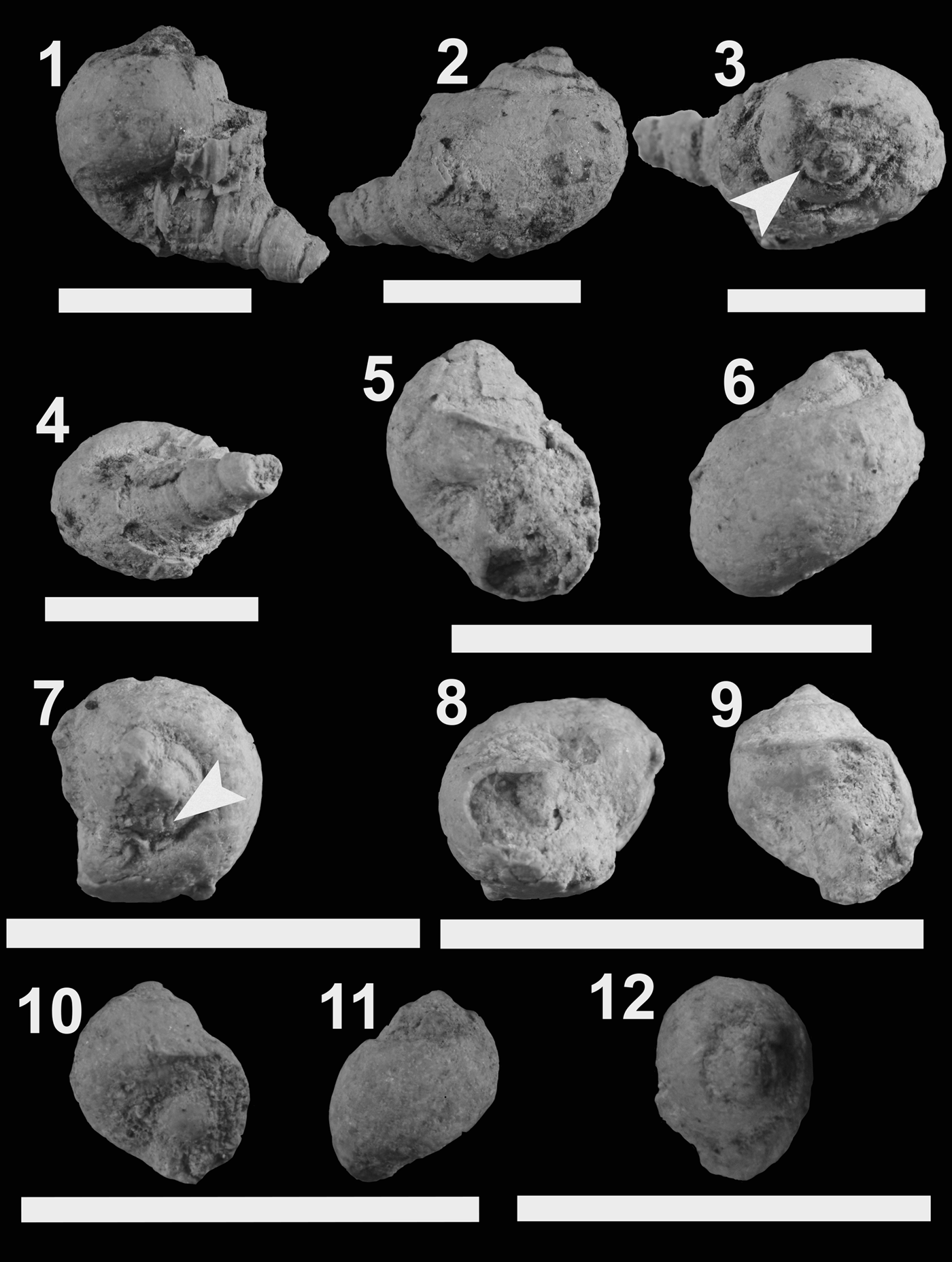
(1–12) Gyrodes mahalanabisi n. sp. (1–4) Apertural, abapertural, apical, and basal views (holotype no. ISI/g/Jur/N 1); note Turritella jhuraensis Mitra and Ghosh, Reference Mitra and Ghosh1979, is attached at the base (1, 4) and the presence of subsutural wrinkle (3, indicated by arrow); (5–8) apertural, abapertural, apical, and basal views (paratype no. ISI/g/Jur/N 8); note (7) showing subsutural wrinkle (arrow); (9) apertural view (paratype no. ISI/g/Jur/N 21); (10–12) apertural, abapertural, and apical views (paratype no. ISI/g/Jur/N 13). Scale bars = 1 cm.

The other solitary naticid specimen comes from another oolitic bed near Lakhapar (~2.5 km north-east of Lakhapar village). The presence of time-diagnostic ammonites suggests latest Tithonian age for the naticid specimen-bearing oolitic bed (Bardhan et al., Reference Bardhan, Shome, Roy, Landman, Davis and Mapes2007; Shome and Bardhan, Reference Shome and Bardhan2009). The oolitic bed marks the Jurassic-Cretaceous boundary and belongs to the Umia Member of the Bhuj Formation (Shome and Bardhan, Reference Shome and Bardhan2009). The Umia Member consists mainly of sandstone along with shale and locally persistent green oolitic limestone. The sandy facies has been interpreted as storm-induced tidal sediments in shoreface environment (Bose et al., Reference Bose, Ghosh, Shome and Bardhan1988). The upper shale-oolite alternation indicates deepening of the basin below fair-weather wave base. The naticid specimen comes from the top-most oolitic band.
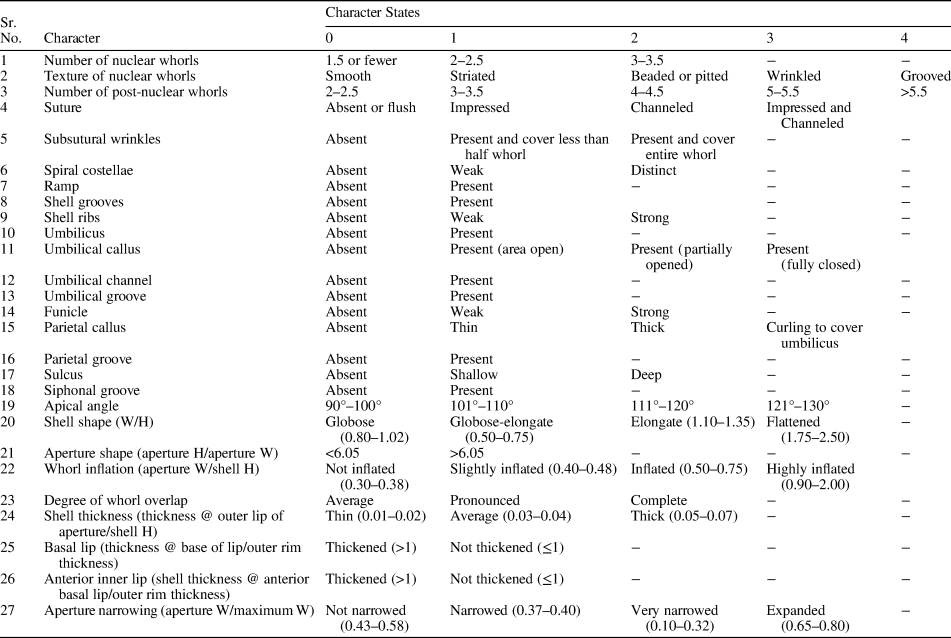
Most of the collected specimens are not well preserved, but most have shell remains. Not a single operculum is preserved. To resolve the taxonomic status of the specimens, specifically when opercula are absent, we have to rely upon only the shell morphological characters, for which we have made a comprehensive list of all the essential hard-part morphological characters ever used by previous workers (Table 1). The character matrix is mainly built upon the work of Aronowsky (Reference Aronowsky2003) and other works by Marincovich (Reference Marincovich1977), Majima (Reference Majima1989), and Bandel (Reference Bandel1999), among others. However, we excluded some of the characters used by Aronowsky (Reference Aronowsky2003). For example, we excluded growth-line characters because in many fossil examples it is not easily discernible. Similarly, shell resorption, which can only be recognized in shell cross-section, is excluded because of preservational state and small sample size. Moreover, we added to the list two new characters absent in Aronowsky (Reference Aronowsky2003), because of their frequent use in naticid taxonomy papers: (1) ramp, which is defined as abapically inclined flattened area running below the upper suture and restricted adaxially by a ridge or angulation; and (2) apical angle, defined as the angle between two tangents running down opposite sides of the apex of the shell (Table 1). Another character—shape of the nucleus whorl—may be an important character in naticid taxonomy (Bandel, Reference Bandel1999). However, we could not include it in our character list (Table 1) because almost none of the previous workers mentioned the shape of the protoconch in their works, and in many cases, they did not even provide the photographs of protoconchs for individual species (e.g., Majima, Reference Majima1989). Our final table thus has a total of 27 characters, with a minimum of two and a maximum of five character states.
List of characters and character states used for the identification of the usable and excellent characters of the four subfamilies of the family Naticidae, and to distinguish them from the outgroup Ampullospirinae.

Based on this table, we constructed a character matrix chart so that the major homogeneous characters of the subfamilies, as well as the family Naticidae, can be identified (Supplementary Table 1). To do so, several extinct and extant species of 17 naticid genera have been restudied using the following steps: (1) selection of several undoubtedly naticid genera (see Bandel, Reference Bandel1999) belonging to the four subfamilies of the family Naticidae: Naticinae Forbes, Reference Forbes1838; Polinicinae Finlay and Marwick, Reference Finlay and Marwick1937; Sininae Woodring, Reference Woodring1928; and Gyrodinae Wenz, Reference Wenz and Schindewolf1941; in addition, three genera within the subfamily Ampullospirinae Cox, Reference Cox1930 are also included as out group; (2) at least one extant and one extinct (in many cases, more than one) species of each of these genera are identified from the previous taxonomic publications (Supplementary Table 1); and (3) their character states are noted. We could have constructed a cladogram based upon these characters, but the same analysis, using Recent naticid data, has already been done by Aronowsky (Reference Aronowsky2003). Moreover, extensive homeomorphism and convergence exist within the naticid phylogeny, as mentioned earlier (see also Kowalke and Bandel, Reference Kowalke and Bandel1996; Bandel, Reference Bandel1999), which makes the phylogenetic analysis difficult (Foote et al., Reference Foote and Miller2007). Therefore, these characters should be excluded for the phylogenetic analyses (see Jana et al., Reference Jana, Bardhan and Halder2005). In the present case, exclusion of these characters from our character matrix significantly reduced the total number of characters and made the analysis less rigorous. For this reason, we refrained ourselves from making such an attempt. Also, the present study does not attempt to focus on the phylogenetic relationship of the common naticid genera, but is intended to identify major hard-part morphological characters of the family Naticidae, which could be applied to both extinct and extant genera. Finally, for the description of the present oldest naticid specimens, all of these characters are studied for taxonomic assignments. The present species have been compared with several species from different geological periods and continents, but the intention was to show extent of homeomorphism and not to establish any phylogenetic relationship.
Repository and institutional abbreviation
All specimens are stored in the museum of Geological Studies Unit, Indian Statistical Institute, Kolkata, India. Specimens are numbered following the institutional abbreviation ISI/g/Jur/N.
Systematic paleontology
Class Gastropoda Cuvier, Reference Cuvier1797
Subclass Caenogastropoda Cox, Reference Cox1960
Order Mesogastropoda Thiele, Reference Thiele, Kükenthal and Krumbach1925
Superfamily Naticoidea Guilding, Reference Guilding1834
Family Naticidae Guilding, Reference Guilding1834
Subfamily Gyrodinae Wenz, Reference Wenz and Schindewolf1941
Genus Gyrodes Conrad, Reference Conrad1860
Type species
Natica (Gyrodes) crenata Conrad, Reference Conrad1860; = Rapa supraplicata Conrad, Reference Conrad1858, by subsequent designation (Gardner, Reference Gardner, Clark, Goldman, Berry, Gardner, Pilsbry, Bassler and Stephenson1916, p. 496).
Gyrodes mahalanobisi new species
Figures 1–3
Holotype
Specimen no. ISI/g/Jur/N 1.
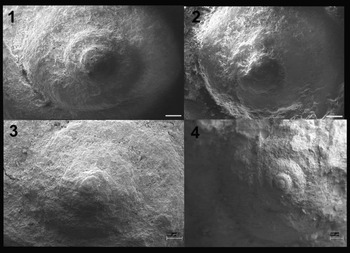
(1–4) Scanning electron micrographs of the apical part of different specimens of Gyrodes mahalanabisi n. sp. (1) Depressed and smooth protoconch (paratype no. ISI/g/Jur/N 5); (2) depressed protoconch (paratype no. ISI/g/Jur/N 7); (3) depressed and smooth protoconch (paratype no. ISI/g/Jur/N 8); (4) smooth and globular protoconch comprising about two whorls (paratype no. ISI/g/Jur/N 26). Scale bars are (1) 200 μm; (2–4) 300 μm.

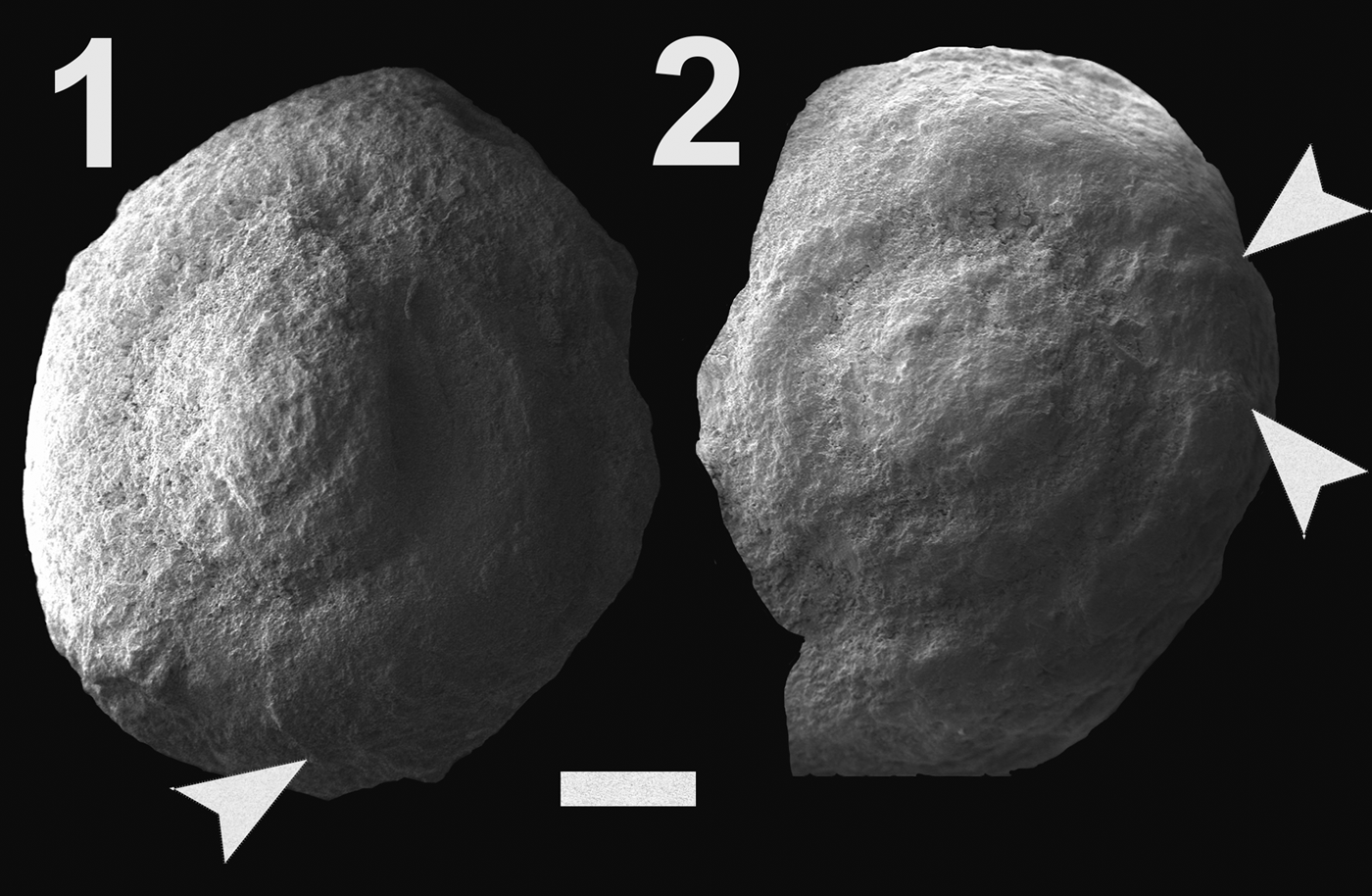
(1, 2) Scanning electron micrographs of the apical part of two specimens of Gyrodes mahalanabisi n. sp. (1) Apical view showing presence of subsutural wrinkles at shoulder, indicated by arrow (paratype no. ISI/g/Jur/N 42); (2) apical view showing presence of subsutural wrinkles at shoulder, indicated by arrows (paratype no. ISI/g/Jur/N 46). Scale bar = 300 μm.

Diagnosis
Shell small; protoconch comprises 1.75 whorls; spire depressed; shoulder broadly rounded with distinct subsutural wrinkles.
Occurrence
Present species is known only from the Oxfordian beds of Kutch, western India, ~1 km south-east of the Jhura village in a pond section (23°24′47.57′′N, 69°36′09.26′′E).
Description
Shell small in size, globose to slightly oblong, and phaneromphalous. Maximum observed height and diameter 12 mm and 10 mm, respectively. Spire depressed to slightly elevated, consisting of two whorls and occupies about one-sixth to one-ninth of shell height. Protoconch smooth, globular, and about two whorls. Whorls mostly convex with distinct adaxially inclined ramp. Suture impressed. Shoulder broadly rounded with distinct subsutural wrinkles. Apical angle obtuse (95°–110°). Umbilicus open and moderately wide; umbilical margin obscurely biangulate and parietal callus absent. Shell surface other than shoulder area smooth. Aperture (height = 9 mm, width = 7 mm) axially elongated. Outer lip and basal lip thin, anterior inner lip relatively thick.
Etymology
The species name is after Prasanta Chandra Mahalanobis, a noted statistician and the founder of the Indian Statistical Institute, Kolkata, India.
Materials
Holotype (ISI/g/Jur/N 1) and 75 paratype specimens ISI/g/Jur/N 2-76.
Remarks
Popenoe et al. (Reference Popenoe, Saul and Susuki1987) reported Gyrodes (Sohlella) quercus from the Late Cretaceous Chico Formation of California (p. 81, fig. 5.3, 5.4, 5.7, 5.12–5.14, 5.17, 5.18, 5.22, etc.). The present species is closely comparable with the American species in having a small-sized shell, obscurely biangulate umbilical margin, and convex whorl profile. Gyrodes (S.) quercus, however, has more whorls. Popenoe et al. (Reference Popenoe, Saul and Susuki1987) also mentioned that G. (S.) quercus has tabulate and angulate shoulder and prosocline growth lines, whereas the shoulder is broadly rounded and growth lines are not discernible in G. mahalanobisi n. sp. The spire in G. (S.) quercus occupies 0.25 of the total height and the aperture is obliquely teardrop shaped, whereas G. mahalanobisi n. sp. has a characteristically semi-circular aperture and the spire occupies ~0.16 of the total height.
Gyrodes mahalanobisi n. sp. may be compared with Gyrodes (?Gyrodes) robustus Waring (Reference Waring1917, p. 84, p1. 13, figs. 11, 12; also see Popenoe et al., Reference Popenoe, Saul and Susuki1987, p. 77, fig. 4.2, 4.8) from the Paleocene of Lower Santa Susana Formation of Simi Hills, California, in having similar whorl profile, aperture, and spire height. However, the Paleocene species attains a large size compared to the present species. In G. mahalanobisi n. sp., the shoulder is broadly rounded with suture impressed and open umbilicus, whereas in G. (?G.) robustus the shoulder is tabulate, angulate with adpressed suture. In addition, G. (?G.) robustus growth lines are slightly prosocline, whereas growth lines are unknown in the Kutch species.
The present species is comparable with the Cretaceous species, Gyrodes (Gyrodes) garudamangalami from southern India described by Bandel (Reference Bandel2000b, p. 87, pl. 3, figs. 8, 9) in their overall shell shape, but the Kutch species is smaller (maximum observed height is 12 mm and diameter is 10 mm) than the Cretaceous species (having more or less similar height and diameter, i.e., 25 mm). Besides, the umbilical inner wall of the Cretaceous species, G. (G.) garudamangalami, has distinct growth lines that cannot be studied in the present species because of preservational state. Also, the present species has a rounded shoulder, whereas the Cretaceous species has a concave flattened shoulder.
Subfamily Polinicinae Finlay and Marwick, Reference Finlay and Marwick1937
Genus Euspira Agassiz in Sowerby, Reference Sowerby1837
Type species
Natica glaucinoides Sowerby, Reference Sowerby1812 (non Deshayes, Reference Deshayes and Bélanger1832).
Holotype
Specimen no. ISI/g/Jur/N 77.
Diagnosis
Shell large; narrow umbilicus and low-developed funicles; protoconch comprises 1.5 whorls; suture weakly impressed; orthocline growth lines; aperture large, ear-shaped.
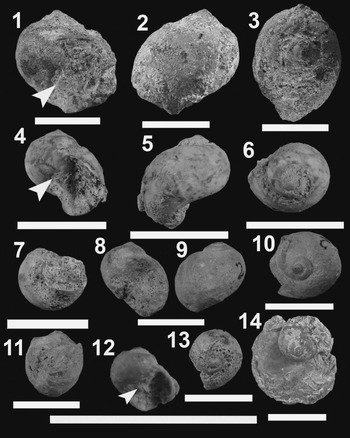
(1–14) Euspira jhuraensis n. sp. (1–3) Apertural, abapertural, and apical views (paratype no. ISI/g/Jur/N 80); (4–7) apertural, abapertural, apical, and basal views (holotype no. ISI/g/Jur/N 77); note moderately open umbilicus, distinct semicircular callus with low funicles (see arrows in 1, 4); (8–11) apertural, abapertural, apical, and basal views (paratype no. ISI/g/Jur/N 82); note large, ear-shaped aperture (8); (12) apertural view (paratype no. ISI/g/Jur/N 83); note semicircular callus with low funicles (arrow); (13) apical view (paratype no. ISI/g/Jur/N 92); (14) apical view (paratype no. ISI/g/Jur/N 89); note an oyster bivalve is attached at the base. Scale bars = 1 cm.

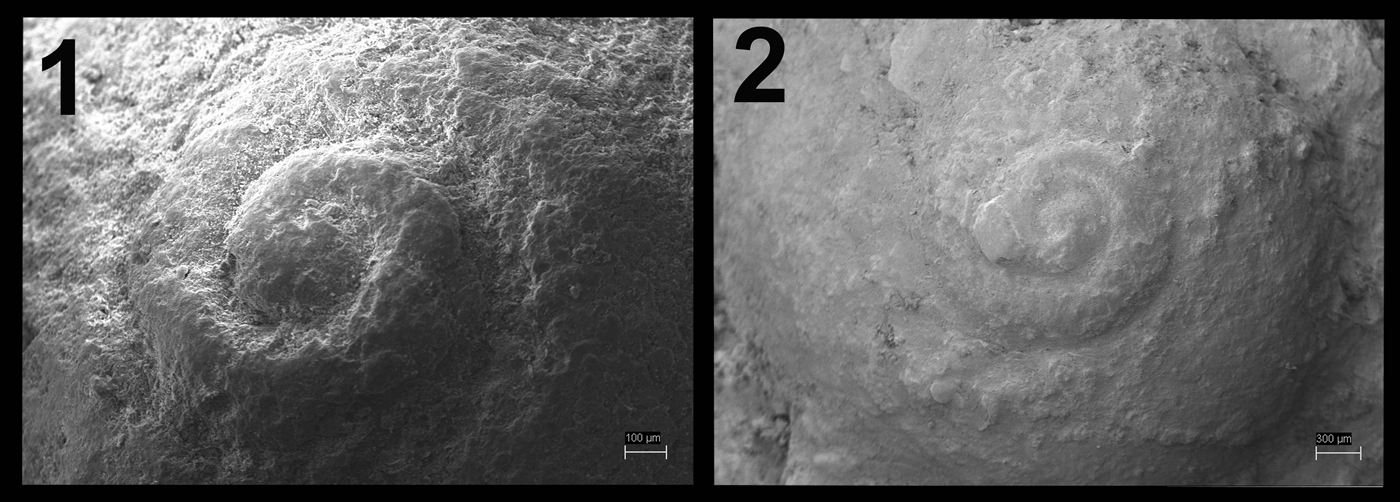
(1, 2) Scanning electron micrographs of the apical part of Euspira jhuraensis n. sp. (1) Smooth and depressed protoconch (paratype no. ISI/g/Jur/ N 84); (2) smooth, globular, and depressed protoconch comprising about two whorls (paratype no. ISI/g/Jur/ N 88). Scale bars are (1) 100 μm; (2) 300 μm.

Occurrence
Euspira jhuraensis n. sp. is known only from the Oxfordian beds of Kutch, western India, ~1 km south-east of Jhura village in a pond section (23°24′47.57′′N, 69°36′09.26′′E).
Description
Shell large and axially oblong, with the maximum observed height 27 mm and diameter is 22 mm. Spire very low, consisting of two whorls and occupying about one-eighth to one-tenth of shell height. The last whorl expanded very rapidly. Protoconch smooth, globular, and is about two whorls. Whorls mostly convex, separated by weakly impressed suture. Apical angle is obtuse (92°–121°). Umbilicus moderately open; callus distinct, semicircular in shape with low funicle developed at the middle of the moderately thickened inner lip. Parietal callus weakly to moderately thickened, with weakly developed anterior lobe. Sulcus is shallow and umbilical channel also well developed. Shell surface otherwise smooth, except some closely spaced, orthocline growth lines present near apertural margin. Aperture (maximum observed height = 22 mm, maximum observed width = 14 mm) ear-shaped, axially elongated, and covering maximum height of the shell. Outer lip and basal lip thin.
Etymology
The species name refers to Jhura village of Kutch, western India, from where the species comes.
Materials
Holotype (ISI/g/Jur/N 77) and 21 paratype specimens (ISI/g/Jur/N 78-98).
Remarks
Perrilliat et al. (Reference Perrilliat, Vega and Corona2000) reported Euspira rectilabrum (Conrad, Reference Conrad1858) from the Lower Maastrichtian of the Mexcala Formation, southern Mexico (p. 14, fig. 6.9, 6.10). Both species have similar shell shape and less-impressed sutures. Euspira rectilabrum, however, has a small-sized and moderately thickened shell and large number of whorls, which the present species lacks. Perrilliat et al. (Reference Perrilliat, Vega and Corona2000) also mentioned that E. rectilabrum has a subovate aperture and prosocline growth lines, whereas a perfectly ear-shaped aperture and orthocline growth lines are present in E. jhuraensis. In the case of E. rectilabrum, the presence of thick callus on the parietal lip produces a narrow umbilicus, whereas E. jhuraensis is characteristically moderately umbilicate with the parietal callus having a variable thickness.
Euspira lakhaparensis new species
Figure 6
Holotype
Specimen no. ISI/g/Jur/N 99.
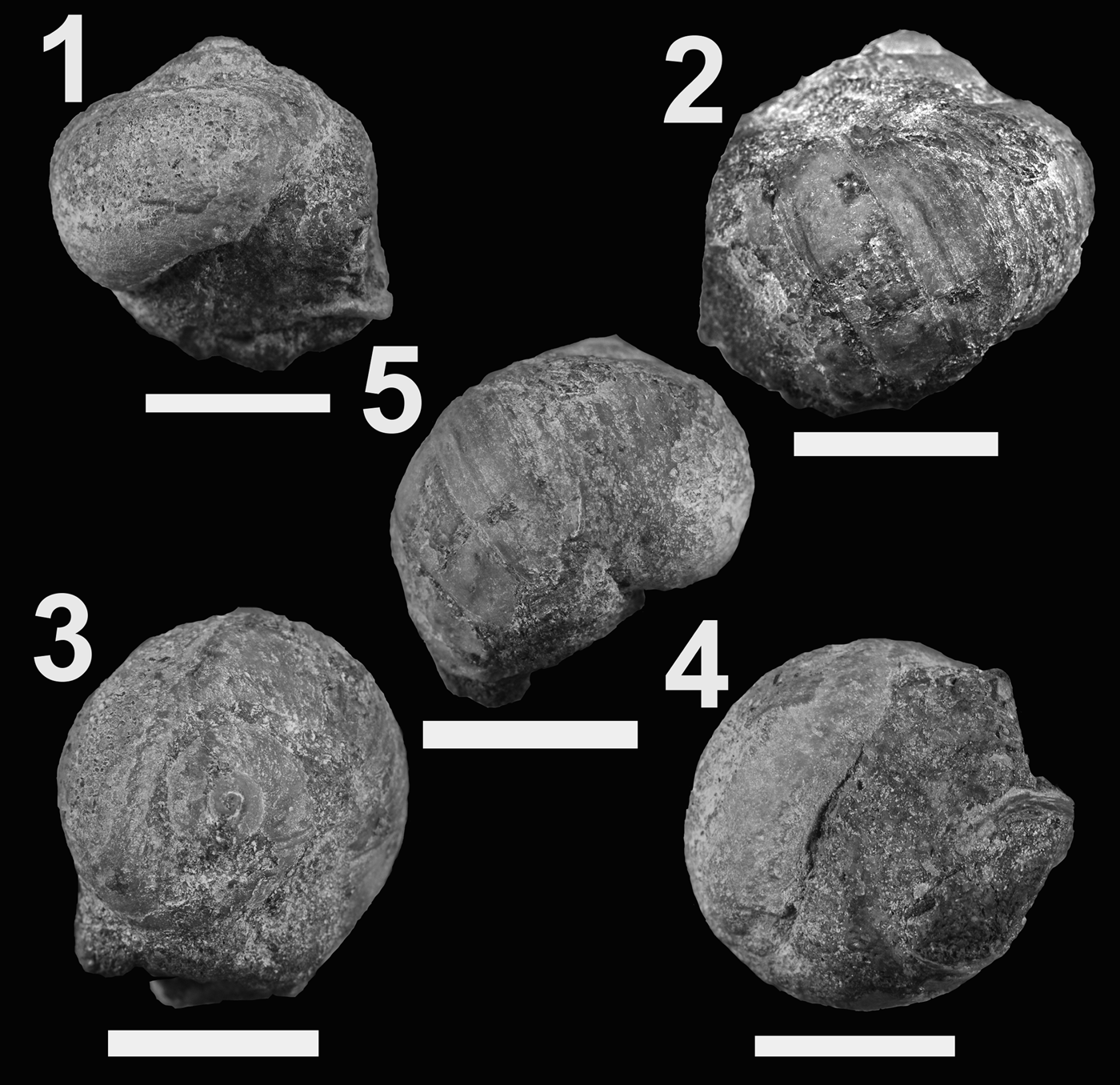
(1–5) Euspira lakhaparaensis n. sp. (holotype no. ISI/g/Jur/N 99). (1–4) Apertural, abapertural, apical, and basal views; (2, 5) abapertural and slightly tilted abapertural views showing closely spaced slightly prosocline to straight growth lines. Scale bars = 1 cm.

Diagnosis
Shell medium-sized; protoconch comprises 1.75 whorls; spire slightly elevated; whorls with a prominent ramp; slightly prosocline to straight growth lines.
Occurrence
Euspira lakhaparensis n. sp. is known only from the latest Tithonian bed of Kutch, western India, ~2.5 km north-east of the Lakhapar village (23°42′51.3′′N, 68°57′52.2′′E).
Description
Shell medium-sized, phaneromphalous and globose, maximum observed height 18 mm and diameter 17 mm. Spire slightly elevated, containing about two whorls and occupies about one-fifth of shell height. Protoconch smooth, globular, comprising about two whorls. Whorls are mostly convex with prominent ramp, which gradually curves into outer face of whorl. Suture weakly impressed. Apical angle obtuse (108°). Umbilical elements not well discernible. Shell surface smooth except some closely spaced prosocline-to-straight growth lines, which are well discernible near aperture. Aperture is broken (height 17 mm), occupying the maximum height of the body whorl.
Etymology
The species name refers to Lakhapar village of Kutch, western India, from where the species has been collected.
Materials
One Holotype specimen (ISI/g/Jur/N 99).
Remarks
Euspira jhuraensis n. sp. from the Oxfordian horizons of Kutch has a large-sized shell, whereas E. lakhaparensis n. sp. has a medium-sized shell and comes from the younger Tithonian bed. In E. jhuraensis n. sp., the spire is very low and consists of two whorls, whereas in E. lakhaparensis n. sp., the spire is slightly elevated and consists of three whorls. These two species also differ in growth line patterns: E. jhuraensis n. sp. has orthocline growth lines, but they are slightly prosocline to straight in E. lakhaparensis n. sp.
Euspira lakhaparensis n. sp. closely resembles E. rectilabrum (Conrad, Reference Conrad1858) from the lower Maastrichtian of the Mexcala Formation, Mexico (Perrilliat et al., Reference Perrilliat, Vega and Corona2000; p. 14, fig. 6.9, 6.10) in having a globose shell and impressed suture. But E. rectilabrum has a moderately thick shell and larger number of whorls in the teleoconch. These two species also differ in shell size and growth lines patterns: E. lakhaparensis n. sp. has a medium-sized shell and slightly prosocline-to-straight growth lines, whereas in E. rectilabrum, the shell is small and growth-line pattern is prosocline.
Discussion
The naticid baüplan is very simple, but it is hard to analyze phylogenetically. Morphologically naticids are generalists, but ecologically they are specialists. The problem of taxonomic classification is further compounded by widespread homoplasy and convergence (Kowalke and Bandel, Reference Kowalke and Bandel1996; Bandel, Reference Bandel1999). Consequently, many classificatory schemes have emerged (Powell, Reference Powell1933; Kilburn, Reference Kilburn1976; Marincovich, Reference Marincovich1977; Majima, Reference Majima1989; Dell, Reference Dell1990; Bandel, Reference Bandel1999, Reference Bandel2000a; Pastorino, Reference Pastorino2005), and a consensus is still elusive. Similar to this taxonomic disparity, the time of origination of the family Naticidae is also uncertain. Reported time of origin ranges from Early Jurassic (Carriker and Yochelson, Reference Carriker and Yochelson1968) to Early Cretaceous (Bandel and Riedel, Reference Bandel and Riedel1994). However, close scrutiny reveals that many of the so-called ‘naticids’ belong to groups such as Ampullospirinae (Kabat, Reference Kabat1996; Bandel, Reference Bandel1999) or Pseudamauridae (Kowalke and Bandel, Reference Kowalke and Bandel1996; Bandel, Reference Bandel1996, Reference Bandel2000a). The real reason for the controversy is lack of a proper taxonomic scheme, which should include the diagnostic characters of the family and its subfamilies.
Bandel's (Reference Bandel1999) seminal paper played a pivotal role in the conservative traits of the monophyletic naticid clade. His paper helped taxonomists resolve the taxonomic status of many Recent and fossil naticids, and provided insight about the origin of the clade. Moreover, his work also provided an example to use protoconch characters as a phylogenetically conservative trait, which also could be used in other gastropods. However, the protoconch characters of the naticid gastropods could not always be used to identify fossils naticids, especially when the preservation is poor. For this reason, other hard-part morphological characters should be used to identify members of the family Naticidae, as well as to group their members into the several subfamilies. Here, we have attempted to offer a potential solution to this problem.
Our analysis of characters of 63 species within 17 genera of the four subfamilies reveals that only a few characters can be used as conservative traits for the family Naticidae: (1) very few numbers of nucleus whorls, (2) relatively large aperture, and (3) presence of umbilicus (Supplementary Table 1). Contrary to previous studies, no other characters could be used as a conservative character for this family. This result once again implies that naticids are taxonomically a difficult group to study, mainly because of the lack of distinct morphological characters. It further implies that many of the taxa previously reported by many workers as naticids are not naticids at all. Probably, for this reason, naticids have even been reported from the Cambrian (www.paleobiodb.org; Supplementary Table 2)!
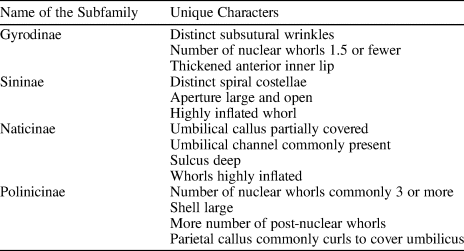
However, we have identified several characters that can be used to distinguish among the subfamilies (Table 2). The subfamily Gyrodinae can be identified by the presence of distinct subsutural wrinkles, which are entirely absent in other subfamilies (Table 2). Moreover, other ‘excellent’ characters (sensu Raup and Stanley, Reference Raup and Stanley1978) include the presence of a thickened anterior inner lip, parietal callus, parietal grooves, and the complete absence of spiral costellae. Moreover, members of the subfamily Gyrodinae have very few nucleus whorls (1.5 or fewer). In comparison, members of the subfamily Sininae have distinct spiral costellae, very large and open aperture, and highly inflated whorls, whereas the umbilical channel is entirely absent (Table 2). Subfamily Polinicinae is larger, with at least three nucleus whorls, and in almost all cases the parietal callus curls to cover the umbilicus. In comparison, Naticinae has a tightly coiled shell, and a partially open umbilicus with a funicle and umbilical channel at its abapical part and sulcus at its adapical part. In some cases, the umbilicus may be plugged with a semi-circular callus. These characters can be used to identify both extinct and extant naticids without much reliance upon the operculum and protoconch characters.
Several excellent characters for the four naticid subfamilies, as identified from the character matrix in Supplementary Table 1.

In comparison to all of these four subfamilies, the other phylogenetically distant clade, subfamily Ampullospirinae, is distinct because its members do not possess funicles, umbilical callus, or sulcus. However, other characters of Ampullospirinae strongly resemble Naticidae (Supplementary Table 1). Probably for this reason, Marincovich (Reference Marincovich1977) recognized subfamily Ampullospirinae as a subfamily of Naticidae, and McLean (Reference McLean, Scott, Blake and Lissner1996) accepted his classification. Our analyses of shell morphological characters also reveal strong similarity of Ampullospirinae with the naticid subfamilies. Protoconchs of Ampullospirinae differ from those of most naticids (Bandel, Reference Bandel1999). These comparisons indicate that the subfamily Ampullospirinae is a close sister group of the family Naticidae, and it is recently reasonably included within Campaniloidea (see Bouchet et al., Reference Bouchet, Frýda, Hausdorf, Ponder, Valdés, Warén, Bouchet and Rocroi2005).
In addition to this taxonomic reappraisal, we identify three Upper Jurassic naticid species belonging to two genera, Gyrodes and Euspira. Comparison of morphological characters based on the newly constructed character matrix (Table 1; Supplementary Table 1) reveals that the three species from Kutch are morphologically very close to the established and unambiguous naticid subfamilies rather than Ampullospirinae. They also satisfy all the essential and conservative characters of the family, including characteristic protoconch features and funicles. Even so, these species show subfamily-specific characters (see Supplementary Table 1 and Table 2).
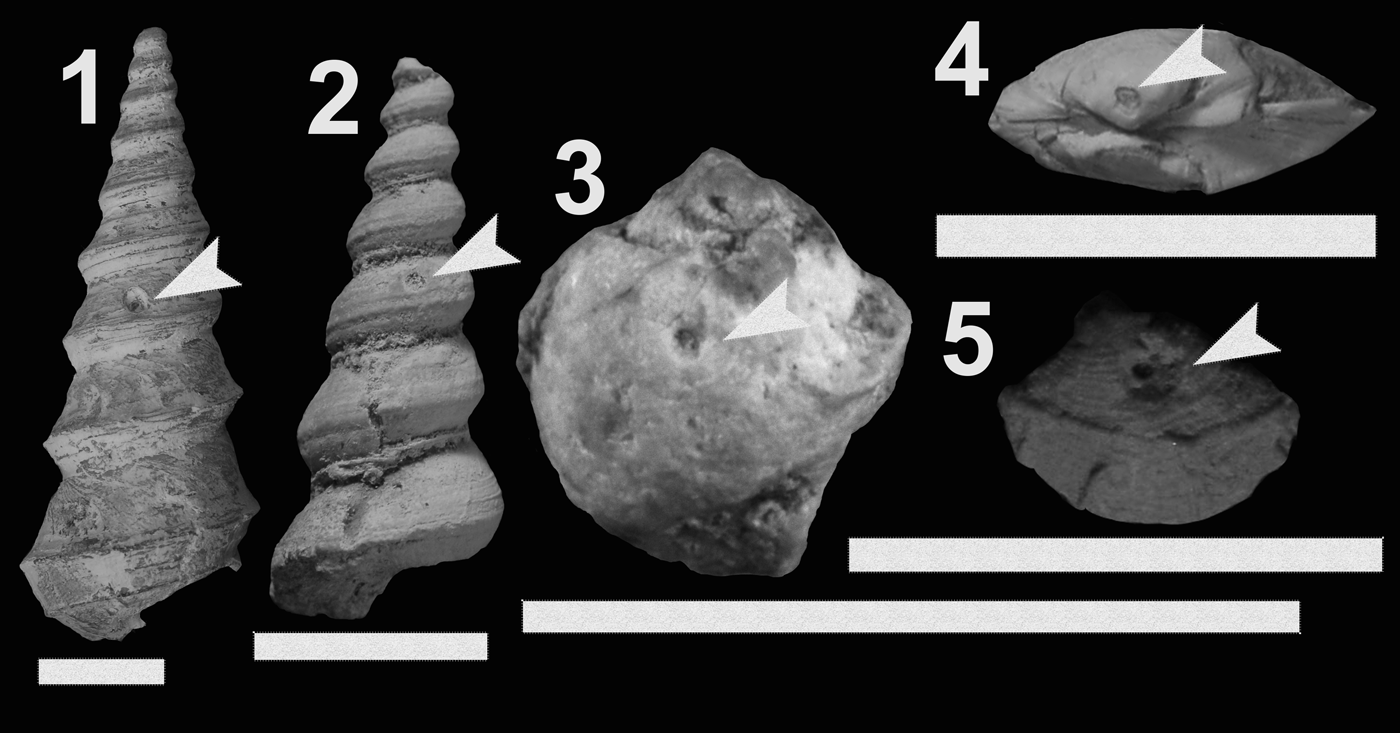
Circumstantially, our identification of the oldest naticids from the Jurassic of India is strengthened by the fact that many coeval molluscan taxa bear characteristic naticid drill holes (Fig. 7; see also Bardhan et al., Reference Bardhan, Das, Mallick, Mondal and Dutta2012b). Interestingly, Bardhan et al. (Reference Bardhan, Chattopadhyay, Mondal, Das, Mallick, Roy and Chanda2012a) described intense naticid drilling on bivalve taxa from the same Dhosa Oolite Member, which is exposed in the eastern part of the Jhura dome at Bhakri. In the absence of naticid body fossils, Bardhan et al. (Reference Bardhan, Chattopadhyay, Mondal, Das, Mallick, Roy and Chanda2012a) could not ascertain the nature of the gastropod driller. Unlike Bhakri, in the present pond section, turritelline gastropods (see Das et al., Reference Das, Saha, Bardhan, Mallick and Allmon2018) and some bivalves are drilled by the naticids (see Fig. 7). This drilling phenomenon suggests that the predator-prey interaction between naticid predator and turritelline prey was established right from the Late Jurassic (manuscript in preparation). The typical behavior of cannibalism (Mondal et al., Reference Mondal, Goswami and Bardhan2017) by naticids is also evidenced by the presence of drill holes on some of the naticid specimens (see Fig. 7.3).
Complete naticid drill holes (see arrows) on various gastropod and bivalve prey from the Upper Jurassic Dhosa Oolite Member at Jhura pond section. (1) Turritella jadavpurensis Mitra and Ghosh, Reference Mitra and Ghosh1979, abapertural view; (2) Turritella jhuraensis Mitra and Ghosh, Reference Mitra and Ghosh1979, abapertural view; (3) confamilial naticid drill hole on Gyrodes mahalanobisi n. sp., abapertural view; (4) Lenticorbula sp., dorsal view; (5) Corbula sp., lateral external view. Scale bars = 1 cm.

Conclusions
Naticiform gastropods of unrelated phylogeny are common in the Mesozoic fossil record. However, mostly because of the absence of clearly defined morphological criteria, true naticids are difficult to recognize, and the origin of this family remains unresolved until recently. Although Bandel's (Reference Bandel1999) seminal works helped us resolve this controversy, his criteria for distinguishing and classifying naticids were not always applicable to fossils having inadequate preservation. All these led previous authors to entirely rely upon well-preserved body fossils to infer the origin of this clade (i.e., late Early Cretaceous). Unfortunately, many authors neglected the presence of true naticid fossils that came from the time intervals older than the late Early Cretaceous. Many workers have also ignored the ecological signature of these naticid gastropods—the presence of typical drill holes—obtained from pre-late Early Cretaceous rocks. We here provide detailed schematic criteria of distinguishing naticid gastropods. Most of these morphological features readily can be identified in fossils as well as in the extant groups, therefore they have greater applicability in reconstructing naticid phylogeny. Based on these criteria, supplemented by the associated occurrences of naticid drill holes, we here report three species of naticid gastropods–Gyrodes mahalanobisi n. sp., Euspira jhuraensis n. sp., and Euspira lakhaparensis n. sp. from the Upper Jurassic rocks of Kutch, India. We conclude that naticid gastropods are probably present from the early Mesozoic and we perhaps have ignored many true records.
Acknowledgments
K. Bandel and W. D. Allmon critically reviewed the manuscript and provided many valuable suggestions. S.S.D., S.B., and S.M. acknowledge the Indian Statistical Institute, Kolkata, for financial support. S.S. acknowledges DST (SERB), DST-INSPIRE for providing funds to pursue the field work. S.S. also acknowledges the Indian Statistical Institute, Kolkata, for providing infrastructural facilities. S.B. acknowledges DST (SERB) for providing partial funds. S.M. acknowledges University of Calcutta Research Grant for Teachers (RGT 2017) for partial funding. R.S. acknowledges DST-INSPIRE for providing funds. S. Mallick from T. D. B. College, Raniganj; P. Goswami from Durgapur Government College, Durgapur and R. Dutta from Jadavpur University helped during the fieldwork. D. Sarkar, IIT Kharagpur helped in photography. Thanks are due to S. Mukherjee (Department of Geological Sciences, Jadavpur University) for logistic help. Thanks are due to D. Saha, ISI, Kolkata, a native speaker, who kindly reviewed the manuscript, especially for improvement of the English language.
Accessibility of supplemental data
Data available from the Dryad Digital Repository: https://doi.org/10.5061/dryad.f8n8p13.