Introduction
The chondrichthyan fossil record from Antarctica is scant and patchy. It is restricted to some Devonian primitive sharks (Young Reference Young1982), a palaeospinacid tooth from Early Cretaceous beds (Kriwet Reference Kriwet2003), some sharks, rays, and holocephalan from late Cretaceous beds of Ross, Vega, and Seymour Islands, and especially the diverse record of the Eocene La Meseta Formation of Seymour Island (Cione et al. Reference Cione, Valle, Rinaldi and Tonni1977, Welton & Zinsmeister Reference Welton and Zinsmeister1980, Cione & Medina Reference Cione and Medina1987, Grande & Chatterjee Reference Grande and Chatterjee1987, Richter & Ward Reference Richter and Ward1990, Long Reference Long1992, Reference Long1994, Cione & Reguero Reference Cione and Reguero1994, Reference Cione and Reguero1998, Klug et al. Reference Klug, Kriwet, Lirio and Núñez2005).
Hexanchiformes present a single dorsal fin without preceding spine, more than five branchial slits, and peculiar teeth. We here follow the definition of Carvalho (Reference Carvalho1996) which includes Clamydoselachus in the order. Hexanchiformes ranges from the Sinemurian (lower Jurassic) to the Recent (Underwood & Ward Reference Underwood and Ward2004). Presently, they are distributed almost worldwide but in the lower Cretaceous they are known from very few localities in Europe and Australia (Cappetta Reference Cappetta1987, Reference Cappetta1990, Thies Reference Thies1987, Siverson Reference Siverson1997). According to Thies & Reif (Reference Thies and Reif1985), Hexanchiformes (excluding Clamydoselachus) are the first true “meat-cutters” among the neoselachians and its appearance could have been stimulated by the rise of the big amphibious and marine reptiles during the Triassic. In this paper, a peculiar hexanchiform tooth from Early Cretaceous beds of the James Ross Island is described.
Stratigraphical and geographical provenance
James Ross Island is near the north-eastern part of the Antarctic Peninsula. During the Mesozoic to Tertiary a volcanic arc was located in the Antarctic Peninsula, while a back-arc basin (the James Ross Island or Larsen basin) developed to the east. Cretaceous strata on James Ross Island comprise a thick succession divided into two major lithostratigraphic units: the Gustav Group (Ineson et al. Reference Ineson, Crame and Thomson1986) and the Marambio Group (Olivero et al. Reference Olivero, Scasso and Rinaldi1986).
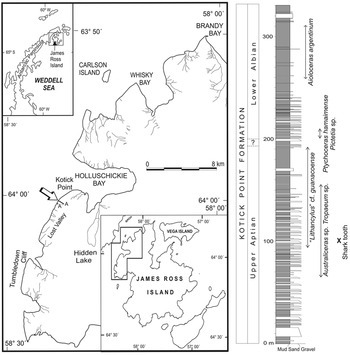
The Cretaceous deposits of the Gustav Group are exposed in western James Ross Island forming a belt of about 50 km in length (Fig. 1). The group includes, from base to top, the following stratigraphic units: Lagelius Point Formation, Kotick Point Formation, an unnamed unit, Whisky Bay Formation, and Hidden Lake Formation (Ineson et al. Reference Ineson, Crame and Thomson1986, Medina & Riccardi Reference Medina and Riccardi2005). The group is characterized by thick sequences of conglomerates, breccias, sandstones, and mudstones that show marked lateral and vertical facies variations.
Maps showing the position of the section measured (A, A′) through the Kotick Point Formation. The arrow indicates the level where the shark tooth was found.

The tooth here described was collected about 2.1 km south-west of Kotick Point. In this locality two sections (Fig. 1, A′ & A) have been measured along a succession, about 330 m thick ascribed to the Kotick Point Formation (Fig. 1). The base is not exposed.
The lowest 170 m, studied along Section A′ and the lower part of the succession exposed in Section A, are characterized by grey silty mudstones and conglomerates with minor fine sandstone intercalations. Late Aptian ammonoids are present in different levels. Sanmartinoceras sp. and Pseudosilesites russoi (Leanza) occur between 124–160 m, “Lithancylus” cf. guanacoense (Leanza) between 94–192 m, and species of genera Australiceras and Tropaeum between 65–156 m. The shark tooth level is located at 102 above the base of the section (Fig. 1).
The following 75 m (170–245 m) are composed by mudstones and siltstones, with subordinate intercalations of fine sandstones and conglomerates. The overlaying 85 m (245–330 m) comprise massive dark grey siltstones and mudstones with intercalations of fine-grained sandstones and occasional thin conglomerates. The upper fauna (197–330 m) of the Kotick Point Formation is dominated by molluscs. They are locally abundant but occur in low diversity. Some of the molluscs, figured and described by Medina et al. (Reference Medina, Rinaldi, Del Valle and Baldoni1983, Reference Medina, Riccardi and Ghiglione2003), Medina & Riccardi (Reference Medina and Riccardi2006), and Medina (Reference Medina2007), are characteristic of the Lower Albian.
Age
The shark tooth described here from Kotick Point is certainly of Late Aptian age. Species of the genus Australiceras and Tropaeum are characteristic of the Aptian. All of these taxa occur in the section where the tooth was found. This interval is securely dated as Late Aptian by the occurrence of the heteromorph ammonite “Lithancylus” cf. guanacoense which is particularly important because it is restricted to the Upper Aptian Australiceras hallei Assemblage Zone and Peltocrioceras deeckei Assemblage Zone in Patagonia (Medina & Riccardi Reference Medina and Riccardi2005).
Systematics
Neoselachii
Hexanchiformes
Family indeterminated
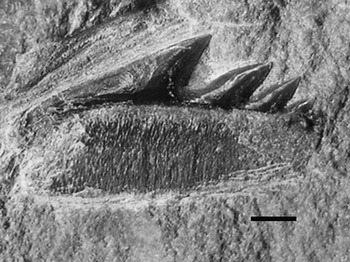
MLP 98-XI-20-1. Lower right lateral tooth. The line is 2 mm.

Material and repository: MLP 98-XI-20-1. An almost complete lower right lateral tooth. Departamento Paleontología de Vertebrados, Museo de La Plata, 1900 La Plata, Argentina.
Geographic and stratigraphic provenance: James Ross Island, Antarctic Peninsula; Kotick Point Formation, Upper Aptian.
Collector: The material was collected by Francisco Medina in 1997.
Description: Total length (TL): 13.8 mm, maximum height (MH): 7.3 mm, maximum root height (MRH): 3.8 mm (TL/MRH = 3.6, TL/MH = 1.9).
The crown is labiolingually compressed and the enameloid is smooth. There is a large distally inclined main cusp followed by three (perhaps four) distally inclined cusplets. Main cusp and distal cusplets present the same angle what indicates that it is a lower tooth. The main cusp has a long mesial smooth cutting edge. The upper part of the main cusp mesial cutting edge is convex, the middle part of the mesial cutting edge and the distal cutting edge are concave. The anteriormost part of the tooth is missing but there are not mesial cusplets or serrations of any kind. Distal cusps decrease gradually in size and present convex mesial and distal cutting edges.
The analaucorhize root is labiolingually compressed, tabular and deep. The lingual longitudinal protuberance is straight and well developed. Root-crown junction occurs in the thickest part of the tooth and it is gently convex.
Discussion
The following combination of characters allows us to distinguish the present material from teeth of other recent and fossil Hexanchiformes such as Notidanodon, Pachyhyexanchus, Heptranchias, Notorynchus, Clamydoselachus, Weltonia, Welcommia, “Eonotidanus” serratus (Kriwet & Klug Reference Kriwet and Klug2004), Paranotidanus, Notidanoides pockrandti, and typical Hexanchus (see Cappetta Reference Cappetta1987, Ward & Thies Reference Ward and Thies1987, Cione & Reguero Reference Cione and Reguero1994, Cione Reference Cione1996, Underwood & Ward Reference Underwood and Ward2004): reduced mesiodistal length; crown labiolingually compressed; absence of mesial cusplets or serrations; moderately developed main cusp; three or four distal cusps, gradually decreasing in size and with convex mesial and distal cutting edges; deep, tabular, and compressed root; lingual longitudinal protuberance straight and well developed, close to the root-crown junction. It also differs from the Jurassic–Cretaceous Pseudonotidanus, which combines characters of Hexanchiformes and Synechodontiformes (Underwood & Ward Reference Underwood and Ward2004, Kriwet & Klug Reference Kriwet and Klug2004).
MLP 98-XI-20-1 shows putative apomorphic characters such as a deep, quadrangular (TL/MRH = 3.6) and compressed root with primitive characters such as few cusps and no serrations. The crown is relatively similar to that of Notidanoides muensteri figured by Kriwet & Klug (Reference Kriwet and Klug2004) from the Tithonian of Germany. However, the root is not similar to coeval sharks such as Notidanodon lanceolatus and Notidanoides pockrandti and Jurassic species. On the contrary, the root is similar to that of some teeth of Notorynchus aptiensis, and other younger genera. Actually, except for the small number of cusps, it resembles Hexanchus lower teeth. Hexanchus has not been certainly recognized in beds older than Cenomanian (Underwood & Mitchell Reference Underwood and Mitchell1999). Previous Jurassic records appear to have been misidentifications.
The material is the oldest record of Hexanchiformes from the Southern Hemisphere. There has been some argument as to whether the Devonian shark Mcmurdodus from Antarctica and Australia belongs in Hexanchiformes (Young Reference Young1982, Turner & Young Reference Turner and Young1987). However, this assignment was discarded by Burrow et al. (Reference Burrow, Hovestadt, Hovestadt-Euler, Turner and Young2008). The oldest certain record of Hexanchiformes is early Jurassic (de Beaumont Reference de Beaumont1960). The oldest reliable record of a recent genus is represented by the species Notorynchus aptiensis from the lower Cretaceous. Siverson (Reference Siverson1997) described the occurrence of Notidanodon lanceolatus from the Albian of Australia. This is the only other hexanchiform (although younger) report from southern continents from the lower Cretaceous. Besides, the only other record of a shark from Early Cretaceous beds of Antarctica is a tooth from the Spartan Glacier Formation of the Fossil Bluff Group of Alexander Island, Antarctic Peninsula which was assigned to Palaeospinacidae, an extinct group of neoselachian sharks (Kriwet Reference Kriwet2003). This tooth was previously supposed to have been recovered from Middle Jurassic strata. However, sedimentation of the Spartan Glacier Formation was from the Valangian to Aptian. Consequently, an Early Cretaceous age was assigned to the specimen although its exact stratigraphical horizon is unknown (Kriwet Reference Kriwet2003).
Thies (Reference Thies1987) suggested that the Early Cretaceous cow sharks were distributed according to temperature: Notidanoides pockrandti and Notorynchus aptiensis were presumably Tethyan faunal elements whereas Notidanodon lanceolatus would be a Boreal faunal form. Jurassic hexanchiforms were found also in these areas. Notwithstanding that the Jurassic and Early Cretaceous elasmobranch record for the Southern Hemisphere is extremely reduced (e.g. Siverson Reference Siverson1997, Cione Reference Cione1999, Perea et al. Reference Perea, Ubilla, Rojas and Goso2001, Cione et al. Reference Cione, Mennucci, Acosta and Cocca2002, Kriwet Reference Kriwet2003), the occurrence of N. lanceolatus in Australia (Siverson Reference Siverson1997) would confirm the bipolar biogeographical pattern for Notidanodon hypothesized by Cione (Reference Cione1996).
Acknowledgements
We would like to thank the Agencia Nacional de Promoción Científica y Tecnológica, Consejo Nacional de Investigaciones Científicas y Técnicas, and Universidad Nacional de La Plata, for permanent financial support. To Dr C.A. Rinaldi, former Director of the Instituto Antártico Argentino, and Fuerza Aérea Argentina, for field support. We also thank the reviewers John Long and Jürgen Kriwet for valuable comments.