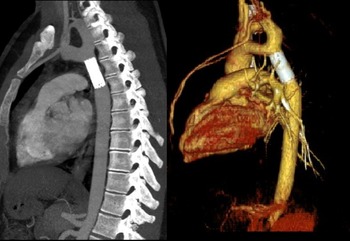
Coarctation of the aorta is a CHD that can present from the neonatal period to adulthood and usually requires treatment at the time of diagnosis. It is seen in approximately 0.04% of all live births and accounts for between 5 and 7% of CHDs.Reference Fyler, Buckley and Hellenbrand1 Cases diagnosed in the first 3 months after birth usually require surgery, whereas interventional procedures may be preferred for older children.Reference Suradi and Hijazi2 Balloon angioplasty is preferred for interventional treatment in young children, while endovascular stenting is preferred for older children and adolescents.Reference Suradi and Hijazi2
The use of an endovascular stent to treat aortic coarctation was first described in 1991.Reference O’Laughlin, Perry, Lock and Mullins3 Many bare-metal stents such as the Palmaz (Johnson & Johnson Interventional Systems Co., Warren, NJ), Palmaz Genesis (Cordis/Johnson and Johnson), Cheatham-Platinum (NuMed, Hopkinton, NY), and Andrastents (Andramed, Reutlingen, Germany) have been used in the treatment of coarctation. Although bare stents provide good results in the treatment of aortic coarctation, they can also cause complications such as aortic rupture, dissection, and aneurysm formation. This led to the introduction of Cheatham-Platinum stents covered in expanded-polytetrafluoroethylene in 1999.Reference Gunn, Cleveland and Gaines4–Reference Qureshi, Zubrzycka, Brzezinska-Rajszys, Kosciesza and Ksiazyk6 Although covered stents were initially used as a rescue procedure for aortic complications, they have recently been adopted as a first-line treatment option for adolescents and young adults in some centres, including ours. Covered stents are especially preferred for patients with more complex and narrower stenosis, concomitant patent ductus arteriosus, high risk of aortic wall complications, and aneurysm. In addition to the covered Cheatham platinum and Advanta V12 large-diameter stents (Atrium Medical, Hudson, USA) previously used to treat aortic coarctation, the BeGraft covered aortic stent graft, which has been CE-certified since 2016, is now also used in endovascular treatment. The BeGraft aortic stent (Bentley Innomed, Hechingen, Germany) is a stent graft consisting of a microporous polytetrafluoroethylene tube over an expandable cobalt-chromium wire mesh mounted on a semi-compliant balloon. However, there have been few studies on the use of this new covered stent in the endovascular treatment of aortic coarctation.
Here we present our first experiences with BeGraft aortic stenting in the treatment of aortic coarctation in older children and young adults.
Methods
Patient selection
The study included 11 patients with aortic coarctation who underwent BeGraft aortic stent graft implantation in the paediatric cardiology department of İzmir Dr. Behçet Uz Children’s Hospital, University of Health Sciences between November 2018 and November 2020. Haemodynamic outcomes and details about the procedures were obtained retrospectively from the catheterisation archive. Systemic arterial hypertension was detected in all patients, and coarctation was suspected in patients with an upper- and lower-limb systolic blood pressure difference of 20 mmHg or greater. The diagnosis of coarctation was based on transthoracic echocardiography and confirmed by cardiac CT, MRI, or conventional angiography. Systemic hypertension was defined as systolic/diastolic pressure higher than 140/90 mmHg in patients aged 18 years and older, and as systolic/diastolic blood pressure values above the 95th percentiles according to age, height, and sex in patients younger than 18 years.7
Although covered stents are especially recommended for complex and tight stenoses and those with a high risk of aortic wall injury or aneurysm, our clinical policy is to use a covered stent for stenoses that are not in close proximity to the left subclavian artery or any aortic branch. In the last 2 years, the BeGraft aortic stent was implanted as a covered stent in all patients who met this criterion.
Patients with a transverse aortic arch diameter to ascending aorta diameter ratio of 0.6 or lower were diagnosed as having aortic arch hypoplasiaReference Machii and Becker8 and stenting was not performed. Approval for the study was obtained from the Clinical Research Ethics Committee of University of Health Sciences, İzmir Dr. Behçet Uz Pediatric Diseases and Surgery Training and Research Hospital.
BeGraft aortic stent graft system
The BeGraft aortic stent has an open-cell stent design and is made of cobalt-chromium, which enhances its flexibility. Stent diameter is between 12 and 24 mm and length ranges from 19 to 59 mm. Stents 12–14 mm in diameter can expand to a maximum of 20 mm, stents 16–18 mm in diameter to a maximum of 24 mm, and stents 20–24 mm in diameter to a maximum of 30 mm.
Introducer sheaths range from 9 to 14 French (Fr), which enables the use of a smaller sheath compared to other stents, and there is less foreshortening compared to other covered stents. The ends of the BeGraft stent are also covered with expanded-polytetrafluoroethylene. Covered CP stent has an expanded-polytetrafluoroethylene membrane which is secured with a biodegradable adhesive. The unique clamping technique used in Begraft at stent ends avoids polytetrafluoroethylene-cover dislodgements and allows to seal aneurysms and stenotic lesions with confidence. BENTLEY Innomed GMBH [DE]/[DE] has received a patent for this specific clamp technique in 2012 (https://patentscope.wipo.int/search/en/detail.jsf?docId=WO2012084202&tab=PCTBIBLIO). The invention relates to a stent graft comprising a stent having a plurality of juxtaposed and interconnected annular segments and at least one membrane. The disclosed stent graft has an inner stent and an outer stent coaxially arranged around this first one, between which a flexible, expandable membrane is arranged. The end regions of the stents with the membrane, arranged in between, are fused. Consequently, by capping the ends of the stent, the expanded-polytetrafluoroethylene membrane is firmly attached to the stent and cannot be detached from the stent during delivery or implantation. The polyamide semi-compliant balloon uses a 0.035-in percutaneous transluminal angioplasty over-the-wire catheter system. According to stent diameter, the balloon is inflated with nominal pressure of 4–7 bar and rated burst pressure of 6–10 bar.
Procedural technique
All interventions were performed under general anesthesia and fluoroscopic guidance in the cardiac catheterisation laboratory.
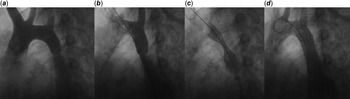
Intravenous ampicillin was administered twice, before and 6 hours after the procedure. After femoral artery cannulation, intravenous 50 IU/kg (maximum 5000 IU) heparin sulfate was administered. If necessary, an additional dose of heparin intravenous was administered to achieve an activated clotting time of 200–300 s. Using a flexible 0.035-in guidewire, a right Judkins catheter/multipurpose catheter was passed retrogradely across the coarctation. A pigtail catheter was also used in some patients for contrast injection. Angiography was performed in the left anterior oblique and lateral positions to visualise the stenotic area (Fig 1a). The selected stent diameter was equal to or 1–2 mm larger than the diameter of the aortic isthmus but not exceeding the diameter of the aorta at the diaphragm. Stent length was selected so as to completely cover the stenotic area without protruding into the subclavian artery. To stabilise the stent/balloon assembly, the flexible guidewire was exchanged for an Amplatz Super StiffTM 0.035-in wire, which was then secured in the ascending aorta or right subclavian artery. A Mullins sheath (9–14 Fr) of suitable length was advanced over the wire and positioned in the area of coarctation. The BeGraft aortic stent graft mounted on the semi-compliant balloon was used in all patients. After the appropriate position was determined with selective contrast injections, a portion of the stent was removed from the long sheath and the stent was positioned. Contrast agent was injected through the long sheath to verify stent location (Fig 1b). After confirming the stent’s exact location, the balloon was inflated, deploying the stent (Fig 1c). The balloon was deflated and retracted through the stent, and measurements and aortography were repeated (Fig 1d). At the end of the procedure, manual compression was applied to the femoral incision until the bleeding stopped. All patients received acetylsalicylic acid at a dose of 3–5 mg/kg/day for 6 months after the procedure.
( a ) Lateral angiography showing the coarctation distal to the origin of left subclavian artery. ( b ) An injection of contrast agent through the long sheath is seen to verify the location of the stent. ( c ) After confirming the exact location of the stent, the balloon is inflated and the stent is fixed to the vessel wall. ( d ) The final aortogram showed completely resolved stenosis.

Complications were evaluated in three categories: aortic wall complications (dissection, aneurysm, rupture), stent-related complications (stent migration, embolism, and fracture), and peripheral vascular complications (femoral pulse loss, thrombosis).
The patients were evaluated before discharge and again at 1 week, 1 month, 3 months, and 6 months after the procedure and at 6-month intervals thereafter. Blood pressure measurements, chest X-ray, electrocardiography, and echocardiography were performed at follow-up visits. Re-intervention was planned for patients with hypertension and systolic blood pressure difference of ≥20 mmHg between the upper and lower limbs and patients in whom the aortic diameter at the stent was less than 50% of the aortic diameter at the diaphragm on MRI, CT, or invasive angiography. We routinely prescribe beta-blockers (propranolol 2 mg/kg) to patients who are being followed up after undergoing surgery or interventional procedures for aortic coarctation. If blood pressure values are found to be high, we also add an angiotensin-converting enzyme inhibitor to their treatment.
Statistical analysis
Data were analysed with SPSS (Statistical Package for the Social Sciences) version 18 (SPSS Inc, Chicago, IL, USA). Results were expressed as median with minimum and maximum values.
Results
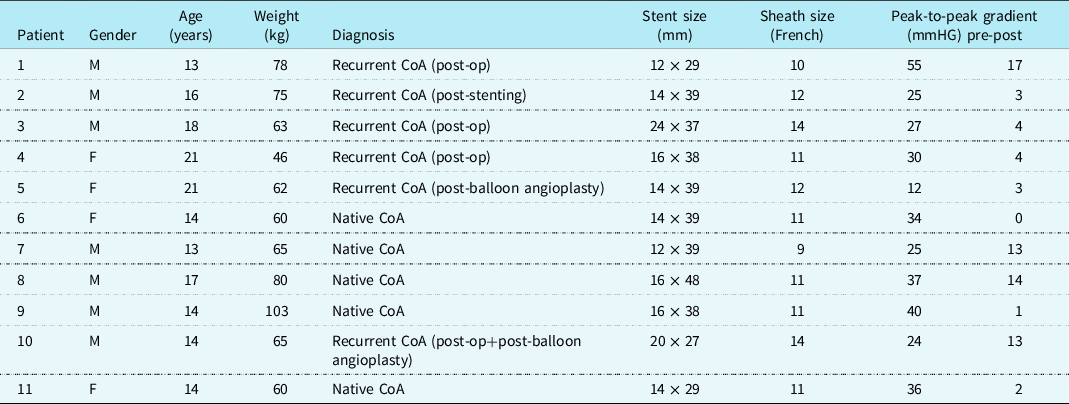
A total of 11 patients (7 male and 4 female) underwent BeGraft stenting (Table 1). The median age was 14 (13–21) years and the median weight was 65 (46–103) kg. Five patients who underwent the procedure had native coarctation and six had recoarctation (after surgery only in three patients, surgery followed by balloon angioplasty in one, previous balloon angioplasty in one, and aortic coarctation stenting in one patient). Nine patients underwent cranial MRI and intracranial aneurysm was not detected.
Procedural details of 11 patients treated with BeGraft aortic stent.

CoA = coarctation; F = female; M = male.
The median diameter at the narrowest part of the coarctation was 7.1 mm. Median stent diameter and length were 16 mm and 38 mm, respectively, and the median peak-to-peak pressure was 30 (12–55) mmHg before the procedure and 5 (0–17) mmHg after the procedure. The median stent diameter was 16 mm (12–24 mm) and the median stent length was 38 mm (27–48 mm). The median post-procedural narrowest diameter was 15 mm (10.90–21.9 mm). The median stent length after post-procedural foreshortening was found to be 35 mm (23.8–45 mm).
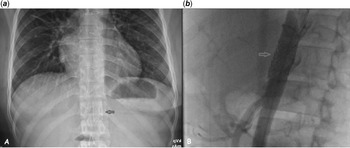
BeGraft aortic stenting was successful in 10 of the 11 patients. In our 21-year-old patient, who had previously undergone surgical repair of ventricular septal defect and balloon angioplasty of the coarctation, stent migration to the abdominal aorta was observed on X-ray performed on post-procedure day 1 (Fig 2a). The patient was taken back to the catheterisation room. A balloon of the same size was advanced and inflated in the stent, and the stent was moved together with the balloon back to the coarctation. After maximum reinflation of the balloon, it was exchanged with a balloon 2 mm larger in diameter and the stent was redilated. However, after this procedure, the stent migrated to the abdominal aorta again while the patient was still in the catheterisation room. After making sure that the stent was not obstructing any of the aortic branches, it was fixed in its position in the abdominal aorta, above the celiac trunk (Fig 2b) and the patient was placed under follow-up. In this patient, the pressure gradient was measured as less than 10 mmHg in catheterisation following stent migration. This decrease in the stenosis gradient can be explained by the dilation with a larger balloon to restabilise the stent. Hypertension was not detected in the subsequent follow-up of the patient, and the decision was made to perform reintervention or surgical repair in the future if necessary.
( a ) Chest X-ray showing stent migration into the abdominal aorta at T12 level (arrow). ( b ) The stent is fixed in the abdominal aorta proximal to the celiac trunk (arrow).

The coarctation pressure gradient decreased to less than 20 mmHg in all patients after the procedure (<10 mmHg in seven patients and >10 mmHg in four patients) (Table 1). The first of the latter four patients was the first to undergo BeGraft stenting in our centre and had previously undergone subclavian flap aortoplasty. The stenosis was located in the posterior region of the distal transverse aorta immediately distal to the common carotid artery, and a 12/29-mm stent was selected according to the patient’s measurements. We observed that the stenosis was effectively opened after inflating the balloon at nominal pressure. When withdrawal pressure was obtained, we saw that the gradient had decreased from 55 to 17 mmHg. We followed the patient, planning to perform redilation later if necessary. In the other three patients, the pressure gradient was 13–14 mmHg after the procedure. As our case experience with the BeGraft aortic stent accrued, we found that leaving a small residual waist was effective for stabilising the stent on the aortic wall and preventing dislocation. Therefore, we did not redilate during the procedure to further reduce the gradient in these three patients and decided to perform redilation if necessary based on follow-up.
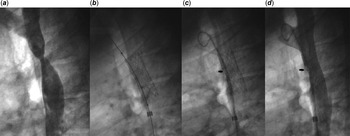
In a 17-year-old male patient, balloon retrieval caused strut distortion in the metal mesh after stent deployment. This patient had a very tight stenosis (Fig 3a), and although the 16- mm balloon was inflated at the recommended pressure (nominal 6 atm, burst 9 atm), we saw after deflation that the balloon remained attached to the section of the stent within the coarct (Fig 3b). We attempted to retrieve the balloon under negative pressure but observed deformation and strut distortion in the metal structure of the stent where the balloon had detached (Fig 3c). Control angiography demonstrated good patency of the coarcted segment (Fig 3d) and a decrease in the pressure gradient from 37 to 14 mmHg. Therefore, the procedure was completed and the patient was placed under follow-up. Cardiac CT at 1-year post-procedure showed that there was no marked restenosis or aneurysm in the stented area (Fig 4).
( a ) The aortogram showing a tight stenosis distal to left subclavian artery. ( b ) It is seen that the stent is not distorted before balloon retrieval. ( c ) Strut distortion (arrow) was observed in the metal structure of the stent that occurred during the retrieval of the balloon by applying negative pressure. ( d ) Control angiography showing a dilated coarctation segment with a patent stent.

( a and b ) Cardiac CT with 3-D volume rendering image at 1-year post-procedure showing no restenosis or aneurysm formation in the stented area.

One of our patients had aortic coarctation with patent ductus arteriosus (patient 7), and the patent ductus arteriosus was also closed successfully after BeGraft stent implantation.
One patient developed reactive hypertension after the stenting procedure (patient 1). The patient was treated with a 24-hour intravenous esmolol infusion. Blood pressure stabilised after 24 hours, and the patient was started on dual antihypertensive therapy (beta-blocker and angiotensin-converting enzyme inhibitor) and admitted for another 8 days of inpatient follow-up. The patient was also very overweight, but blood pressure values were controlled with the dual antihypertensive therapy, and no in-stent restenosis was detected on transthoracic echocardiography evaluation.
After the procedure, all patients received heparin infusion with a dose of 10 IU/kg/h for 4–6 hours. In 2 of the 11 patients, heparin infusion was continued for 24 hours due to loss of femoral pulse after the procedure. In the first of these patients (patient 2), we used a 12-Fr long sheath, and aorta-iliac CT showed 40% stenosis of the lumen (secondary to intervention) in an approximately 20-mm long section of the right external iliac artery. As no thrombus was detected, we discontinued the heparin and continued low-dose acetylsalicylic acid therapy. The femoral artery stenosis regressed within 1 month of follow-up. The second of these patients (patient 3) had a 14-Fr long sheath and was treated with low-molecular-weight heparin for 3 months after a thrombus was detected in the right femoral artery. At a 3-month follow-up, lower extremity Doppler ultrasound demonstrated normal flow and the low-molecular-weight heparin therapy was discontinued.
Follow-up
The median follow-up time was 14 months (4–25 months). Six patients had severe hypertension before the procedure and these patients were receiving angiotensin-converting enzyme inhibitor in addition to beta-blocker therapy. The other patients were receiving only beta-blocker therapy.
Beta-blocker therapy was continued in all patients during post-procedure follow-up, while four of the seven patients discontinued angiotensin-converting enzyme inhibitors and two patients continued angiotensin-converting enzyme inhibitor therapy. The patients received acetylsalicylic acid at a dose of 3–5 mg/kg for 6 months after the procedure.
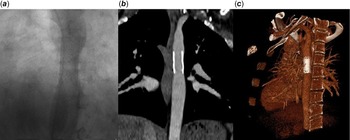
During follow-up, one patient (patient 9) was found to have high upper-extremity blood pressure values, but in-stent restenosis was not observed on transthoracic echocardiography examinations. The patient was evaluated with cardiac CT angiography and no stent narrowing was detected (Fig 5). It was noted that this patient had become morbidly obese and had not adhered to beta-blocker and angiotensin-converting enzyme inhibitor therapy. The patient was followed-up with dietary modification and adjusted drug dosage.
( a ) The aortogram showing relieved coarctation segment after successful stent implantation. ( b ) Cardiac CT imaging showing no narrowing in the stent lumen. ( c ) The three-dimensional volume rendering cardiac CT image demonstrating patent stent.

None of the patients were evaluated as requiring stent redilation during follow-up.
Discussion
Despite being initially used as a rescue procedure for aortic wall complications, the indications for covered stents were expanded in the following years, and they have become increasingly preferred for complex and tight stenosis and patients with aneurysm, concomitant lesions such as patent ductus arteriosus, and potential aortic wall injury.Reference Qureshi9–Reference Golden and Hellenbrand11 Although the absolute indications are not well defined, covered stents are now used safely and effectively in many centres as first-line treatment in elective stenting procedures for native and recurrent coarctation. The most important point to consider in this procedure is ensuring that the stent does not obstruct the aortic branches, especially the left subclavian artery. Another issue to note is that the use of covered stents in stenosis that extends to the thoracic aorta may carry the risk of spinal cord injury due to the possibility of spinal artery or Adam Kiewicz artery occlusion. If the coarctation is observed in the thoracic aorta at a lower level than normal, the origin and distribution of these arteries must be demonstrated in advance in order to determine the lowest thoracic level at which a covered stent can be used safely.Reference Pedra, Peirone, Costa and Bruckheimer12
The covered Cheatham platinum stents that were first introduced required the use of larger long sheaths than bare-metal stents and could not reach adult diameters due to the small redilation diameters, which limited their use.Reference Tzifa, Ewert and Brzezinska-Rajszys10 However, later developments in this field resulted in the production of stents that can be redilated up to 30 mm. The BeGraft aortic stent graft with pre-loaded balloon requires a smaller long sheath compared to other coated stents, and its other most prominent feature is its low profile. This provides an important advantage and increases its utility, especially in the paediatric population.
The results of our study showed that BeGraft aortic stent grafting was effective in reducing the coarctation gradient in native and recurrent cases. Stent implantation was successful in 10 of the 11 patients included in the study. In all patients, the pressure gradient was significantly reduced and the aortic diameter at the coarctation was increased. In previous studies, a residual peak systolic pressure difference ≤10–20 mmHg after stent implantation is accepted as a successful outcome.Reference Golden and Hellenbrand11,Reference Moltzer, Roos-Hesselink and Yap13 In the present study, the peak systolic pressure difference after stent implantation was <10 mmHg in seven patients, 10–15 mmHg in three patients, and 17 mmHg in one patient. The case with residual peak systolic pressure difference of 17 mmHg after stent implantation was the first coarctation we treated with the BeGraft aortic stent graft. This patient had previously undergone subclavian flap aortoplasty and had stenosis in the region corresponding to the distal transverse aorta. A 12-mm diameter stent was selected according to measurements. After the stent was deployed, we observed that the stenosis was largely eliminated and the shape of the aortic arch was preserved. Therefore, the patient was followed up without redilation. As we gained experience with the BeGraft aortic stent, we observed that leaving a minimal indentation at the waist helped stabilise the stent on the aortic wall and prevent dislocation. We believe that this residual indentation caused the pressure gradient difference to remain above 10 mmHg after the procedure. We did not perform redilation with a larger balloon in these patients to further reduce the pressure gradient, opting to perform redilation later if deemed necessary according to follow-up.
Traumatic aortic dissection, rupture, and aneurysm are major complications of stenting procedures.Reference Golden and Hellenbrand11,Reference Chessa, Carrozza and Butera14–Reference Qureshi, McElhinney, Lock, Landzberg, Lang and Marshall18 Covered stents are used to treat these complications, but ruptures and aneurysm formation have also been reported in patients receiving covered stents.Reference Kenny, Margey, Turner, Tometzki, Walsh and Martin19–Reference Pedra, Fontes and Esteves22 In another study utilising the BeGraft aortic stent, Promphan et al reported that a patient with stent strut distortion observed during the procedure developed asymptomatic pseudoaneurysm at 1-year follow-up and was treated with two covered stents.Reference Promphan, Han Siang and Prachasilchai23 In our study, no aortic wall complications were observed in any of our patients. Stent distortion occurred in one patient during balloon retrieval. Regarding this issue, we recommend ensuring that the balloon is inflated to or slightly above nominal pressure during implantation, and if the balloon still does not dissociate from the stent, inflating the balloon further without exceeding rated burst pressure and applying strong negative pressure during removal. Otherwise, we observed that withdrawal of the balloon before complete separation can cause distortion of the stent. However, if the balloon is overinflated in this way, it also causes the problem of having no residual waist in the stenotic area to secure the stent more stably to the wall. In our patient with stent distortion, no recurrence of coarctation was observed during follow-up, and no aneurysm formation was detected on 1-year cardiac CT.
In a multicentre retrospective study, the incidence of stent migration was 5% and it was most commonly caused by the use of balloon catheters that were oversized or undersized relative to proximal aorta diameter, or balloon rupture during deployment.Reference Forbes, Garekar and Amin24 Although most migrated stents can be repositioned and do not require any further intervention, there are also patients in which other stent(s) are used to cover the actual lesion due to suboptimal placement. Stent migration was not reported in two studies that used the BeGraft aortic stent graft.Reference Promphan, Han Siang and Prachasilchai23,Reference Popovici, Liuba and Surev25 In our study, stent migration occurred the day after the procedure in a patient who had previously undergone balloon angioplasty for aortic coarctation. Although this patient had a low-pressure gradient, stenting was performed due to the presence of hypertension and left ventricular hypertrophy. After the stent migrated, the patient was taken back to the catheterisation room and a balloon was advanced to the stent for repositioning. Despite using a larger balloon, the stent could not be fixed at the coarctation site. Upon remigration to the abdominal aorta, the stent was fixed in place after ensuring it did not obstruct any major aortic branches. Because the stenosis was directly opposite the subclavian artery in this patient, the stent had to be positioned slightly distal to prevent subclavian artery obstruction and was therefore not exactly centred within the stenosis. In addition, during balloon removal, we also observed that the balloon disrupted the stent’s fixation to the aortic wall. Although having polytetrafluoroethylene covering the ends of the BeGraft stent is advantageous when moving the stent for repositioning due to the lower risk of vessel wall damage, we believe that this feature also makes it difficult to fix the stent to the aortic wall in some cases. Moreover, we found that in some cases, withdrawal of the deflated balloon could cause the stent to move after being fixed the stent to the aortic wall. We attribute this to the fact that the whole body of the stent is covered with polytetrafluoroethylene, as well as the stent’s low profile. For this reason, it is safer to fix the stent to the vascular wall very carefully and, as we mentioned earlier, to leave a small waist at the coarctation site after inflating the balloon.
Promphan et al reported that the BeGraft stent was effective in tortuous coarctation due to its low profile and flexible structure.Reference Promphan, Han Siang and Prachasilchai23 Especially in tortuous coarctations, choosing a longer stent than normal may prevent stent slippage from the coarctation site and facilitate fixation to the vascular wall. However, such structures may not be fully eliminated with the first deployment and may require redilation later. In fact, subsequent implantation of another higher profile stent within the original stent may be considered.
In the literature, the incidence of peripheral vascular injury after stenting was reported as 2–5%. This complication is associated with the size of the arterial access sheaths used and the patient’s age. Larger arterial sheaths and lower patient age and weight increase the risk of complication.Reference Tanous, Collins, Dehghani, Benson and Horlick20,Reference Promphan, Han Siang and Prachasilchai23,Reference Carr26 Covered CP stents in particular require the use of larger long sheaths compared to bare-metal stents. The smaller long sheath used with the BeGraft aortic stent is a significant advantage in this regard. Recently, Balushi et al also reported their experience with the BeGraft aortic stent in five patients who had near-atretic or severe coarctation.Reference Al Balushi, Pascall, Jones, Qureshi and Butera27 According to their experience, the use of a small introducer did not affect the treatment results, and it also reduced the possibility of vascular complications.Reference Al Balushi, Pascall, Jones, Qureshi and Butera27 Moreover, when a small sheath is used, manual compression could prevent post-procedure bleeding from the puncture, and no additional vascular repair is needed. Balushi et al used the Perclose system as a hemostatic method after the procedure; however, we preferred manual compression in all of our patients.
Mullins long sheaths in small sizes are not always available in our catheter lab. Therefore, we had to use larger sheaths (1 Fr larger) in patients 1, 2, and 5. Since these patients had adequate body weight, the larger sheaths did not lead to any complications. However, if the cover CP stent was used, 12 Fr should have been preferred instead of 10 Fr in patient number 1, while the same size sheaths (12 Fr) would be used in the other two patients.
In our study, a 14-Fr long sheath was used in two patients. In one of these patients, Doppler ultrasound was performed due to weak femoral artery pulses after the procedure revealed a thrombus in the femoral artery. This patient was started on low-molecular-weight heparin and followed up. After approximately 3 months of low-molecular-weight heparin therapy, the thrombus resolved and femoral pulses returned to normal.
Blood pressure regulation is one of the main goals of aortic coarctation treatment. Chang et al reported that 84% of their patients were normotensive after covered CP stent implantation for aortic coarctation.Reference Chang, Jiang and Xu28 Erdem et al reported in their study of paediatric and adult groups that one patient with a bare-metal stent and four patients with covered stents continued to receive antihypertensive therapy during post-procedure follow-up.Reference Erdem, Akdeniz and Saritas29 In their study with the BeGraft aortic stent graft, Promphan et al reported that they achieved blood pressure regulation in 92% of the cases and detected recoarctation and performed redilation in one patient at 1-year follow-up.Reference Promphan, Han Siang and Prachasilchai23 Routine practice in our clinic is to administer prophylactic beta-blocker therapy to all stent-treated coarctation patients, regardless of their blood pressure levels. If hypertension is detected during follow-up despite the absence of in-stent stenosis, an angiotensin-converting enzyme inhibitor is initiated in addition to beta-blocker therapy. Stenosis pressure gradients were substantially reduced in all 10 patients who had successful stenting. Two of our patients continued to need antihypertensive therapy during follow-up. Cardiac CT examinations revealed no marked stenosis in these patients, but both had obesity as comorbidity. These patients were prescribed dietary modifications and continued receiving combined beta-blocker and angiotensin-converting enzyme inhibitor therapy. In-stent stenosis requiring redilation has not been detected during follow-up in any patient to date.
Limitations
This was a single-centre and retrospective study. Due to our small series and relatively short follow-up, further studies with larger patient samples and longer follow-up periods are needed. Moreover, the lack of a control group consisting of patients with coarctation who had previously undergone stenting with different types of stents or balloon angioplasty can be regarded as a limitation.
Conclusion
Our initial results demonstrated that BeGraft aortic stent implantation was effective in reducing the coarctation gradient in selected native and recurrent cases. Advantages of this stent are that it is deployed through a smaller sheath and has a low profile and adequate radial power, and the ends are covered with polytetrafluoroethylene, and it is flexible (important for tortuous stenosis), comes mounted on a balloon, and has a low shortening ratio. However, its main disadvantages are that separating the balloon from the stent during the retrieval may be difficult, and forceful withdrawal can cause distortion of the metal stent structure when the balloon separates. Moreover, the use of negative pressure for balloon retrieval can disrupt stent fixation to the aortic wall and lead to stent dislocation. This may be due to the balloon or may indicate poor fixation of the stent to the aortic wall. Because they are completely covered with expanded-polytetrafluoroethylene, these stents appear to become less embedded in the aortic wall compared to bare-ended covered stents. However, the full polytetrafluoroethylene cover also allows the stent to be repositioned easily.
Acknowledgements
None.
Financial support
This research received no specific grant from any funding agency in the commercial or not-for-profit sectors.
Conflicts of interest
None.
Ethical standards
Approval for the study was obtained from the Clinical Research Ethics Committee of University of Health Sciences, İzmir Dr. Behçet Uz Pediatric Diseases and Surgery Training and Research Hospital.