Introduction
Megaplatypus mutatus (Chapuis) (Wood, Reference Wood1993, Reference Wood2007) is an ambrosia beetle native to South America that is a serious problem in poplar Populus sp. commercial plantations (Achinelli et al., Reference Achinelli, Liljersthröm, Aparicio, Delgado, Jouanny and Mastrandrea2005; Alfaro et al., Reference Alfaro, Humble, Gonzalez Audino, Villaverde and Allegro2007). It has recently been introduced in Italy (Tremblay et al., Reference Tremblay, Espinosa, Mancini and Caprio2000; Allegro & Della Beffa, Reference Allegro and Della Beffa2001; Allegro & Griffo, Reference Allegro and Griffo2008), raising concerns about its possible economic impact on poplar plantations.
Unlike most ambrosia beetles M. mutatus attacks only living trees, penetrating into the xylem of its host by boring large tunnels. This weakens the stem, making the tree more vulnerable to breakage during wind storms. Males excavate a tunnel through the bark and build a crown-shaped rim around the gallery entrance with boring dust (Santoro, Reference Santoro1962) from which they emit their sex pheromone blend in order to attract females (González Audino et al., Reference González Audino, Villaverde, Alfaro and Zerba2005). A similar behaviour has been reported for Platypus apicalis White and P. gracilis Broun in New Zealand (Milligan & Ytsma, Reference Milligan and Ytsma1988).
In previous studies we reported that volatile emissions from males are composed of (S)-(+)-6-methyl-5-hepten-2-ol ((+)-sulcatol), 6-methyl-5-hepten-2-one (sulcatone) (González Audino et al., Reference González Audino, Villaverde, Alfaro and Zerba2005) and 3-pentanol (Gatti Liguori et al., Reference Gatti Liguori, Zerba, Alzogaray and González-Audino2008). Individual tests of these compounds showed that sulcatol and sulcatone elicited antennal responses in electroantennogram recordings and were attractive to beetles in an olfactometer, however 3-pentanol did not elicit response in olfactometer (González Audino et al., Reference González Audino, Villaverde, Alfaro and Zerba2005; Gatti Liguori et al., Reference Gatti Liguori, Zerba, Alzogaray and González-Audino2008). In our previous field work we tested the blend of sulcatol and sulcatone both released from their own dispensers with release rates selected based on the release rate of commercial bubblecaps (Funes et al., Reference Funes, Zerba and González-Audino2009). Also, in a single field test we compared sulcatone plus sulcatol with the three components blend and found that 3-pentanol increased catches (unpublished results).
Other platypodids (Renwick et al., Reference Renwick, Vite and Billings1977; Shore & Mc Lean, Reference Shore and Mc Lean1983) and scolytids (Byrne et al., Reference Byrne, Swigar, Silverstein, Borden and Stokkink1974; Borden & Mc Lean, Reference Borden and Mc Lean1979; Fletchmann & Berisford, Reference Fletchmann and Berisford2003) are also attracted to sulcatol but not to sulcatone. 3-Pentanol has not been found in other platypodids but it is part of the pheromonal blend of Metamasius hemipteris (Oliv.) (Perez et al., Reference Perez, Campos-Piedra, Chinchilla, Oehlschlager, Gries, Gries, Castrillo, Giblin-Davis, Peña, Duncan, Gonzalez, Pierce, McDonald and Andrade1995)
Pheromone-baited traps could be used in detection and management of low level populations of M. mutatus in infested plantations. Past research has focused on optimal trap design (Gatti et al., Reference Gatti Liguori, Zerba and González Audino2007; Funes et al., Reference Funes, Zerba and González-Audino2009) and the influence of translucent vs. black colour (González Audino et al., Reference González-Audino, Gatti and Zerba2011) but not on optimal pheromone ratio and release rate . Considering that non-natural ratios or isomers can make the attractant less active than natural sources (Borden, Reference Borden, Ridgway, Silverstein and Inscoe1990), our goal was to test different pheromone release rates and component ratios in order to optimize blend proportions for field attraction.
In addition, since the commercial racemic mixture of (±)-sulcatol is significantly less expensive than the pure (+)-isomer, it made sense from an economic perspective to evaluate whether attraction to the racemic mixture of (±)-sulcatol is similar to the attraction to the natural isomer (+)-sulcatol. A series of field trials testing pheromone dose, blend and enantiomer composition were performed in Argentina and Italy to evaluate attraction in the field.
Materials and methods
Field trials were conducted to test total pheromone release rates (Experiment 1), blend ratios (Experiments 2 and 3) and enantiomeric composition of sulcatol (Experiment 4).
Pheromone dispensers
Analytical grade (98%) sulcatone, (±)-sulcatol, and 3-pentanol (Aldrich, Saint Louis, MO, USA) were added to reservoir-type dispensers.
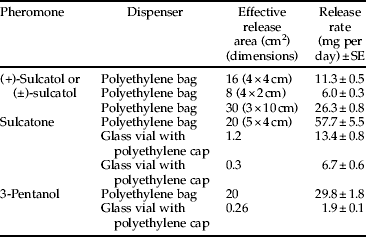
The dispensers were polyethylene bags made with a non-permeable side (high-density polyethylene of 80 μm; PBB Polisur, Buenos Aires, Argentina) and a semi-permeable side (low-density polyethylene of 40 μm), or polyethylene bags with two semi-permeable sides (low-density polyethylene of 40 μm), and/or glass vials with polyethylene semipermeable caps (table 1).
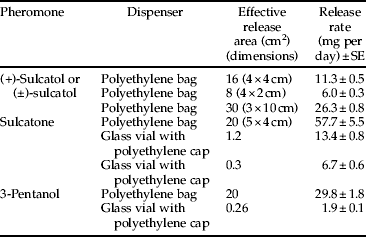
Effective release area and daily release rate (mg per day ±SE) of pheromone lures containing (+)-sulcatol, (±)-sulcatol, sulcatone and 3-pentanol at 27–28 °C and 0.5 m s−1 in a laboratory wind tunnel (n=3).
The bags were filled with 0.5–2 ml of pheromone component and carefully sealed with heat. They were each loaded with only a single compound, and two or three dispensers were placed in a single trap to make up blends. Release rates were measured in the laboratory, as weight loss per day in a wind tunnel (27–28 °C, 0.5 m s−1) (Funes et al., Reference Funes, Zerba and González-Audino2009, Reference Funes, Griffo, Zerba and Gonzalez-Audino2011). These dispensers had a constant release rate (zero-order kinetics) until total consumption as is usual for diffusion-controlled membrane-moderated reservoir systems (Tojo, Reference Tojo1985), and also as we showed in our previous work (Funes et al., Reference Funes, Zerba and González-Audino2009, Reference Funes, Griffo, Zerba and Gonzalez-Audino2011). Pheromone dispensers were suspended inside traps.
To obtain different release rates we modified the sizes of the semipermeable surfaces, according to the correlation between pheromone release rate and permeable surface of the dispensers previously studied (Funes et al., Reference Funes, Griffo, Zerba and Gonzalez-Audino2011).
Trap setting
The traps used were Lindgren multiple funnel traps (eight funnels) (Lindgren, Reference Lindgren1983), CIPEIN – CV cross vane (Funes et al., Reference Funes, Zerba and González-Audino2009) and Mastrap® (Isagro S.R.L. Milan, Italy) cross vane traps. Lindgren is a multiple funnel trap made of eight black funnels of diameter 18.5 cm (Contech, BC, Canada). Total height of the trap is 1.5 m. CIPEIN-CV is a cross-vane trap of two black acrylic panels in a cross arrangement above a funnel. The diameter of the funnel is 20 cm, the total height 70 cm. Mastrap is L® A version (Isagro S.R.L, Milán, Italia) is a grey cross-vane trap, with effective surface 630 cm2. Total height of the trap is 15 cm and width 28 cm.
Baited and empty control traps were hung from trees with their top at 1.8 m above ground level and were set 30–40 m apart in parallel lines separated by 45–50 m throughout each treatment plot. A previous detailed survey of the plantation showed that the distribution of M. mutatus galleries was homogeneous in the field (unpublished data) and consequently allowed us to use setup traps in random distribution. In addition, M. mutatus is a primary pest attacking vigorous trees, which also ruled out the selection of plots where the heterogeneity of soil characteristics causes different types of growth rates between trees in the same plot. Five identical control traps were set up for each experiment.
Traps were repositioned randomly and dispensers were checked and replaced before complete pheromone emission every one or two weeks, depending on access to the field site.
Field trial locations
The experiment to determine the influence of total pheromone release rate (Experiment 1) was performed between 10 October 2009 and 9 March 2010, in a commercial poplar (Populus deltoides) plantation located in Alberti, Province of Buenos Aires, Argentina (35°10′S, 60°29′W) at an elevation of 50 m above sea level. The experimental area consisted of 8 ha of a 10 year-old plantation, with a tree density of 1111 trees ha−1 (3 m×3 m spacing) and a mean diameter at breast height (DBH) of 23.2 cm±0.5 (SE).
The experiments to determine the influence of pheromone release rates and ratios (Experiments 2 and 3) were conducted between 30 October 2009 and 17 December 2010 (Experiment 2) and from 8 January to 4 May 2010 (Experiment 3). The field site was a commercial poplar (Populus deltoides, Australiano clone l29/60) plantation located in Morse, Junín, Buenos Aires, Argentina ((S) 34°43′56,3″, (W) 60°51′11,5″) at an elevation of 59 m above sea level. The field plot was a 12 ha 11 year-old plantation with a tree density of 625 trees ha−1 (4 m×4 m spacing) and a mean DBH of 32.6 cm, ±0.2 (SE). The experiment to study the influence of pure vs. racemic sulcatol (Experiment 4) was conducted in Caserta, Campania Region, Italy, during the 2008 season between 19 May and 19 September at a poplar plantation located in Falciano del Massico (41°09′07″N, 13°57′54,3″E and 38 m above sea level). The plantation (Populus×euroamericana (Dode) Guinier Louisa Avanzo clone) consisted of 1 ha of 11 year-old trees at a density of 494 trees ha−1 (4.5×4.5 m spacing) and a mean DBH of 26.6±1.0 cm (SE).
The pest is thought to have been introduced into Italy recently from Argentina (Tremblay et al., Reference Tremblay, Espinosa, Mancini and Caprio2000).
Pheromone treatments
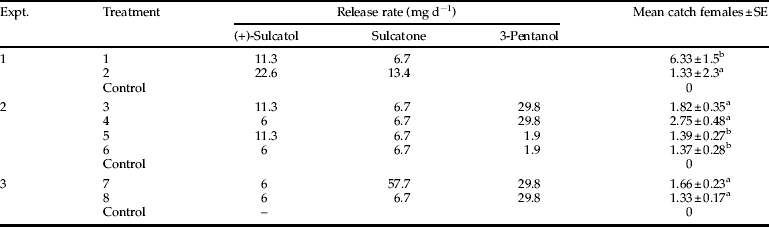
Experiment 1 investigated the influence of total pheromone release rate. We tested two release rates of (+)-sulcatol plus sulcatone in a proportion of 2:1 (table 2, Experiment 1, Treatments 1 and 2): one lower based on our previous results (Funes et al., Reference Funes, Zerba and González-Audino2009) and the other doubling the rate. Five replicates were performed for each treatment and five identical traps without lures were considered control. Treatments were rotated weekly or every two weeks according to the possibility of accessing the field.
Release rate (mg per day±SE) of pheromone lures containing (+)-sulcatol sulcatone, or 3-pentanol used in field experiments (release rates at 27–28 °C and 0.5 m s−1 in a laboratory wind tunnel) and mean±SE number per trap per week of M. mutatus captured with different release rates and ratios of (+)-sulcatol, sulcatone and 3-pentanol. Different letters within each experiment indicate significant differences (P<0.05). Controls: unbaited traps. There were no insects caught in any of the control traps.
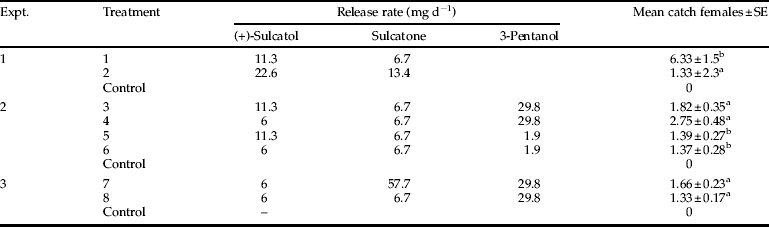
Experiment 2 on the influence of (+)-sulcatol and 3-pentanol release rates in the pheromone blend. We tested two release rates for sulcatol and 3-pentanol respectively, holding the sulcatone release rate constant. The component 3-pentanol, was tested at two concentrations that differed by a factor of 16 (table 2, Experiment 2, Treatments 3–6); the component (+)-sulcatol was tested in 6 and 11 mg day−1 according to the results of Experiment 1, and also based on optimal release rate information reported for another Ambrosia beetle (Yong-Biao & Mc Lean, Reference Yong-Biao and Mc Lean1989). The release rate of sulcatone was chosen according to previous studies (Funes et al., Reference Funes, Zerba and González-Audino2009, Reference Funes, Griffo, Zerba and Gonzalez-Audino2011). There were five replicates per treatment and five identical traps without lures were used as blank controls.
Experiment 3 investigated the influence of sulcatone release rate in pheromone blend. Based on the results of treatments 3–6, we held sulcatol and 3-pentanol release rates constant and varied the release rate for sulcatone (table 2, Experiment 3, Treatments 7 and 8). There were six replicates per treatment. Five identical traps without lure were used as blank controls.
Experiment 4 determined the influence of enantiomeric composition of sulcatol in pheromone blend. Traps were baited with sulcatone (6 mg per day), 3-pentanol (29.8 mg per day), and either (+)-sulcatol (6.6 mg per day) or racemic sulcatol (11.2 mg per day). The release rate of racemic sulcatol was twice that of (+)-sulcatol so the total amount of (+)-isomer released was the same in both treatments. Fifteen replicates were set for each treatment and five traps without lures were used as blank controls.
We recorded the number of M. mutatus adults captured per trap per week during each period for Experiments 1–3 and females per trap per day for Experiment 4. Differences between treatments were analysed by one way analysis of variance (ANOVA) followed by Duncan´s multiple range (Experiments 2–4) or χ2 test (Experiment 1). Data were tested for homoscedasticity by Levene's test along with Shapiro–Wilks test for normality and no transformations of data were necessary. In Experiment 1, the traps used were Lindgren multiple funnel traps. In Experiments 2 and 3, the traps used were CIPEIN – CV cross vane. In Experiment 4, the traps used were Mastrap traps.
Results
Table 2 shows the mean number of female M. mutatus caught per trap per week for Experiments 1–3 using different pheromone release rates. No insects were caught in the unbaited control traps for any of the experiments.
In Experiment 1 on the influence of overall pheromone release rate, significantly more insects were captured in traps baited with (+)-sulcatol and sulcatone at a total release rate of 18 mg per day compared with traps baited with double the release rate (36 mg per day) (χ2: 17.9, df=2,57, P=0.0367) (table 2).
In Experiment 2 on the influence of (+)-sulcatol and 3-pentanol release rates in pheromone blend with sulcatone at fixed rate, (+)-sulcatol released at 6 mg day−1 (table 2, exp. 2, treatments 4 and 6) and 11 mg day−1 (+)-sulcatol (table 2, exp. 2, treatments 3 and 5) had the same attractive effect when combined with both high and low release rate of 3-pentanol (F=2.75, dF=4111, P=0.26 and F=1.8, dF=3112, P=0.39, respectively)
However, 3-pentanol released at 29.8 mg d−1 (table 2, exp. 2, treatments 3 and 4) was more attractive than 1.9 mg day−1 (table 2, exp. 2, treatments 5 and 6), when combined with (+)-sulcatol released at 6 or 12 mg day−1, P=0.045 and P=0.022, respectively).
Catches with treatments 3–6 of Experiment 2 were shown to be independent (according to multiple effects ANOVA), as there were no interactions between them (P=0.322). This fact allowed us to use the results obtained for sulcatol and 3-pentanol in Experiment 3.
In Experiment 3, there was no significant difference in number of beetles captured in traps baited with sulcatone released at 6.7 and 57.7 mg day−1 (table 2, exp. 3, treatments 5 and 6, P=0.24), indicating that both low and high sulcatone release rates have similar attractiveness for capturing M. mutatus females. No insects were caught in the unbaited control traps and zero catches values were not included.
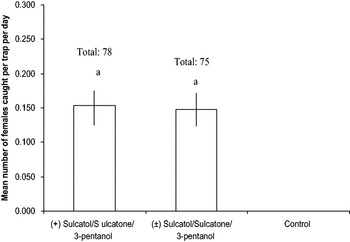
In Experiment 4 on the influence of enantiomeric composition of sulcatol in pheromone blend, the number of beetles captured in traps baited with racemic sulcatol released at 12 mg day−1 was not significantly different from the number captured with the (+)-isomer with release rate of 6 mg day−1 (fig. 1, P=0.89). The presence of the (−)-sulcatol isomer did not cause an inhibitory behavioural response when combined with the bioactive isomer component.
Experiment 4. The mean number of females of M. mutatus captured per trap per day in traps baited with sulcatone (6 mg d−1), 3-pentanol (29.8 mg d−1) and either (±)-sulcatol 11.2 mg d−1 or (+)-sulcatol 6.6 mg d−1. Caserta, Italy, 2008. Treatments did not differ significantly (P=0.89). Controls: unbaited traps. There were no insects caught in any of the control traps.

Discussion
In these experiments, traps baited with pheromones caught significant numbers of female M. mutatus and no beetles were caught in unbaited traps, confirming previous results on attractiveness of the proposed pheromone components (Funes et al., Reference Funes, Zerba and González-Audino2009). Doubling the release rate of the two component blends of sulcatol and sulcatone from 18 mg d−1 to 36 mg d−1 resulted in a drop of >80% in the trap catch (Experiment 1), whereas increasing the release rate of sulcatone caused no effect (Experiment 3). This might suggest that the beetles are highly sensitive to the release rate of sulcatol, but relatively insensitive to the release rate of sulcatone. This fact correlates with the fact that sulcatone is less active than sulcatol in individual laboratory bioassays and that sulcatol, but not sulcatone, is an active pheromone component of other ambrosia beetles.
The two (+)-sulcatol and sulcatone rates captured a similar number of insects indicating that it is not necessary to increase costs by using higher release rates. However, the higher release rate of 3-pentanol tested (30 mg per day) demonstrated higher efficacy than the lower one (2 mg per day). These results suggest that the optimal release ratio for the three pheromone components is 6, 6 and 30 mg d−1 (ratio 1:1:5) of (+)-sulcatol, sulcatone and 3- pentanol, respectively. These release rates are much larger than the amounts produced by male beetles, which are in the range of micrograms per day per beetle (Gatti Liguori et al., Reference Gatti Liguori, Zerba and González Audino2011). However, the beetles produced (+)-sulcatol and sulcatone at similar rates (Gatti Liguori et al., Reference Gatti Liguori, Zerba and González Audino2011), as found in the optimal blend of synthetic compounds proposed above. Yong-Biao & Mc Lean (Reference Yong-Biao and Mc Lean1989) found that mg d−1 doses of sulcatol seem to be optimal for catching Gnathotricus sulcatus, with 1.5 mg day−1 more efficiency than lower (0.5 mg d−1) and higher release rates (5 and 10 mg d−1).
The racemic sulcatol mixture is as effective as the (+)-isomer for capturing M. mutatus, suggesting that the (−)-isomer has no discernable biological activity, either positive or negative. Also, Hoover et al. (Reference Hoover, Lindgren, Keeling and Slessor2000) found that response of Tripodendrum lineatum to lineatin is independent of the enantiomeric ratio, and depends only on the content of (+) lineatin and the (−) isomer is inactive. This is important because it enables the use of low cost racemic sulcatol instead of (+)-sulcatol. In this case, the release rates should be 12, 6 and 30 (ratio 2:1:5) mg per day of (±)-sulcatol, sulcatone and 3-pentanol, respectively.
Two factors contribute to the promising success of pheromones for monitoring or controlling this species: the components of the pheromone blend of male M. mutatus are inexpensive, and traps can be easily made with low cost plastic translucent materials that perform better than commercial traps (González Audino et al., Reference González-Audino, Gatti and Zerba2011). However, other factors influencing the final cost of pheromone-based programmes like deploying and maintaining large arrays of traps should also be considered. The results of our work contribute to the development of pheromone-based local technologies with low environmental impact and low cost for control or monitoring of an important pest.
Acknowledgements
We are very grateful to Carlos Urionaguena and Daniel Sama from Establecimientos San José, Aserradero Euskadi, SA, Junín, Buenos Aires, Argentina. This study received financial support from the ANPCyT of Argentina and the Servizio Fitosanitario Regionale Se.S.I.R.C.A. Napoli, Regione Campania. PGA and EZ are members of the CONICET and of University of San Martin (UNSAM). HF had a grant from the ANPCyT.