Introduction
Deaths from fires and burns are the fifth most common cause of all unintentional injury deaths in the United States. In 2006, US fire departments responded to 412,500 house fires that claimed the lives of a total of 2,580 persons and injured an additional 12,925.1 Most of these fatalities are due to inhalation of smoke and toxic gases.Reference Hall2
Accurate description of the toxic threats associated with the enclosed-space smoke inhalation is difficult because the composition of the environment is quite complex. The amount of oxygen or other oxidizer available for combustion or pyrolysis, the nature and origin of the fuel sources, the fire temperature, the size and nature of the fire space, as well as the complex interplay of all of these factors create a highly variable and changing environment, with the potential to release or generate a wide variety of toxic substances, including carbon monoxide and cyanide.Reference Chaturvedi3–Reference Symington, Anderson and Thomson6
The acute medical management of victims of smoke inhalation focuses primarily on airway management, oxygenation, and managing hemodynamic instability using intravenous volume support and vasopressor agents.Reference Miller and Chang7 Although thermal injury, oxygen depletion, and carbon monoxide have been known to be significant causes of smoke inhalation injury and toxicity, recent studies have found that hydrogen cyanide and respiratory tract irritants such as hydrogen chloride are major toxicants.Reference Alarie8
The prehospital and emergency department management of potential cyanide exposure in smoke inhalation victims has been problematic for several reasons. There is no readily available method to diagnose cyanide poisoning in smoke inhalation victims in the prehospital setting or in the emergency department. Once absorbed, cyanide rapidly disappears from the blood, with a half-life of one to three hours, and terminal elimination is estimated at 44 hours, making it difficult to accurately measure peak cyanide concentrations. Also, as it takes several days to confirm levels, treatment must be based on clinical suspicion alone. The literature describing the incidence of cyanide exposure due to smoke inhalation, as well as co-toxicity with carbon monoxide also is conflicting. Cadaver-based studies have suggested that cyanide is variably present in post-mortem studies of victims of smoke inhalation.Reference Barillo, Goode and Esch9–Reference Gill, Goldfeder and Stajic10 Other studies of fire victims have shown that elevated cyanide levels are common in those with smoke inhalation and in some instances, may be the primary toxicant.Reference Silverman, Purdue and Hunt11–Reference Baud, Barriot and Toffis12 There also is conflicting evidence about a correlation between carboxyhemoglobin levels (or carbon monoxide concentrations) and cyanide concentrations. In a prospective study of 18 deaths from building fires, Linquist et al found that 17 of 18 cases had detectable cyanide levels, although only nine were considered toxic. Sixteen of 18 victims had blood carboxyhemoglobin concentrations >20%. However, there was no correlation between carboxyhemoglobin and cyanide levels.Reference Lindquist, Rammer and Sorbo13 Likewise, an analysis of 364 fire deaths found only a weak correlation between carboxyhemoglobin and cyanide levels.Reference Barillo, Goode and Rush14 Collectively, these studies show that while cyanide exposure in smoke inhalation is common (ranging from 78–100% of cases), and carbon monoxide poisoning may be concomitant, carboxyhemoglobin levels cannot be used to predict cyanide toxicity.
The mechanism of cyanide toxicity has been long known: cyanide induces oxidative cell death by binding to cytochrome oxidase and arresting cellular respiration. The organs most vulnerable to cyanide poisoning are those most dependent on high levels of oxygen delivery, including the brain, heart, and lungs. This manifests clinically as hyperventilation, headache, confusion, cardiac dysrhythmias; severe toxicity results in cardiovascular collapse and obtundation. Acidosis ensues as oxygen no longer is available to bind with hydrogen to form water.Reference Warburg, Posener and Negelein15
Accordingly, plasma lactate levels ≥10 mmol/L in smoke inhalation victims correlate with the presence of a significant cyanide poisoning component.Reference Hall, Shannon, Borron and Burns16–Reference Baud, Borron and Bavoux18 A small series of acute cyanide poisonings excluding smoke inhalation demonstrated that a plasma lactate concentration of >8 mmol/L was associated with a sensitivity of 94%, a specificity of 70%, a positive predictive value of 98% and a negative predictive value of 98%, for cyanide blood concentrations greater than ≥1.0 mg/L.Reference Baud, Borron and Megarbane19 In contrast, in a study of pure carbon monoxide poisoning of varying severity in 183 patients, Benaissa et al showed that while lactate levels did correlate with carboxyhemoglobin levels, there only were mild increases in plasma lactate concentrations (median 2.3 mmol/L) even in victims with severe neurological impairment (coma or transient loss of consciousness (LOC)) and blood carbon monoxide concentrations usually considered toxic.Reference Benaissa, Mégarbane and Borron20
Although confirming cyanide exposure from fire smoke is difficult, serious cyanide toxicity may be more common than initially appreciated. In March 2006, an unusual cluster of cyanide poisonings in firefighters was reported. While working a fire at a fast food restaurant, a firefighter began complaining of headache, dizziness, difficulty breathing, and cough, and began to speak incoherently. He was transported to a hospital, and subsequently found to have a whole blood cyanide level of 57 ug/dl (≥20 ug/dl toxic).Reference Varone, Warren and Jutras21 The following day, another firefighter suffered a heart attack and collapsed at the scene of a working fire. His whole blood cyanide level was 66 mg/dl. Based on these two incidents, 28 other firefighters who were involved in three industrial and residential fires were tested for whole blood cyanide levels. Eight demonstrated toxic (≥20 ug/dl) whole blood cyanide levels.
Once cyanide toxicity from smoke inhalation is suspected, prompt administration of antidotes are recommended. Historically, commonly used antidotes include 4-dimethylaminophenol (4-DMAP), and amyl or sodium nitrite which function as methemoglobin inducers. Methemoglobin reverses the cyanide inhibition of cytochrome oxidase activity by complexing with cyanide to form cyanmethemoglobin. (Cyanide has a greater affinity for binding with methemoglobin and thus, is displaced from cytochrome oxidase). When combined with the sulfur donor, sodium thiosulfate, cyanide is released from cyanmethemoglobin, forming the non-toxic compound thiocyanate, and is excreted in the urine.22 However, the induction of non-oxygen transporting methemoglobin in victims of smoke inhalation who often have concomitant carbon monoxide poisoning, is less than desirable, as they already have decreased oxygen transport from formation of carboxyhemoglobin. Fatalities due to hypoxia from over-production of methemoglobinemia have been reported with the use of sodium or amyl nitrite. In addition, if sodium nitrite is administered too rapidly intravenously, it acts as a potent vasodilator resulting in hypotension, which can lead to serious adverse outcomes and further compromise the hemodynamic status in subjects already hypotensive due to cyanide toxicity. Reference Hall, Shannon, Borron and Burns16 On its own, sodium thiosulfate has the potential use for treatment of cyanide poisoning in smoke inhalation, but contradictory conclusions about efficacy in animal models and concerns about a slow onset of action in humans have limited any recommendations for empiric use.Reference Hall, Dart and Bogdan23
Hyperbaric oxygen therapy (HBO) occasionally has been administered to patients with severe cyanide poisoning, and anecdotal results indicate that it may be efficacious.Reference Hall, Shannon, Borron and Burns16 However, transporting an unstable patient for the sole purpose of HBO therapy generally is considered to be unwarranted, as long as 100% normobaric oxygen can be provided at the initial treatment hospital. The role of hyperbaric oxygen for the management of carbon monoxide poisoning in smoke inhalation continues to evolve with conflicting conclusions. The American College of Emergency Medicine clinical policy on hyperbaric oxygen for acute carbon monoxide poisoning is given a Level C recommendation.Reference Wolf, Lavonas and Sloan24 Likewise, the Cochrane Review concluded that there was no evidence to support hyperbaric oxygen for treatment of patients with carbon monoxide poisoning.Reference Juurlink, Buckly and Stanbrook25
Hydroxocobalamin (vitamin B12a) is a cyanide antidote that detoxifies cyanide by binding with it and forming cyanocobalamin, which is then excreted in the urine. It has been used in France for pre-hospital and emergency in-hospital treatment of suspected cyanide poisoning from smoke inhalation since the 1980s.Reference Fortin, Giocanti and Ruttimann26–Reference Borron, Baud and Barriot27 In the retrospective review by Fortin et al, patients treated with hydroxocobalamin had improvement or reversal of neurologic compromise, and restoration of hemodynamic parameters with average systolic blood pressure rising 15 mmHg and diastolic rising 10 mmHg within 30 minutes of infusion. However, despite an initial favorable return of spontaneous circulation, a majority of patients who presented in shock later died due to multiorgan failure or sepsis.Reference Fortin, Giocanti and Ruttimann26 In a prospective, empiric treatment trial by Borron et al, survival was 67% in patients subsequently proven to have had toxic cyanide levels (>39mmol/L), with no serious adverse side effects. Minor adverse effects included transient chromaturia, alterations in renal function, reddish skin discoloration, hypertension, and rarely allergic reactions.Reference Borron, Baud and Barriot27 Results of normal human volunteer safety studies suggest that the safety profile of hydroxocobalamin is favorable for prehospital or emergency department use in smoke inhalation victims with cyanide toxicity.Reference Forsyth, Mueller and Becker28–Reference Uhl, Nolting and Gallemann30
Methods
The objective of this study was to review published and recently presented studies on the empiric prehospital and emergency department treatment of suspected cyanide poisoning in smoke inhalation victims and to develop treatment protocols for clinical use in the US.
It was hypothesized that although hydroxocobalamin is FDA-approved for use, the lack of familiarity or use in prehospital settings, coupled with scant outcomes data, demanded a critical analysis and on-site observation in order to reach a consensus on when to use it empirically. All of the authors previously have participated in meetings of the Cyanokit® Advisory Board and/or Speakers’ Bureau for the two previous US Distributors, EMD Pharmaceuticals, Inc. and Dey, LP. In addition, two of the authors (DW, AH) participated in a fact-finding group that traveled to Paris for meetings with the Brigade de Sapeurs-Pompiers de Paris (Paris Fire Brigade), including spending time accompanying mobile intensive care unit (ICU) personnel during prehospital care of patients.
Results
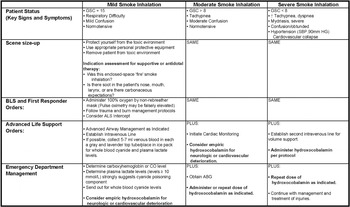
Based on the analysis of the literature, as well as the French experience with the use of specific antidotes for smoke inhalation toxicity, and the fact-finding visit to the Brigade de Sapeurs-Pompiers de Paris (Paris Fire Brigade), the authors developed prehospital and emergency department protocols for the treatment of victims with enclosed-space fire smoke inhalation, based on the presenting signs and symptoms and patient history, such that the relative risks of significant cyanide exposure and toxicity may be identified (Figure 1; please see online supplemental material). Treatment protocols emphasize injury severity and patient selection in order to optimize outcomes and reduce potential treatment side effects.
Suggested management protocol

Recommended Treatment for Mild Smoke Inhalation
Victims extricated from an enclosed-space fire who present awake and normotensive or hypertensive with non-specific symptoms that include confusion, tachypnea, headache, dyspnea, nausea, and/or vomiting with the presence of soot around the mouth or nose may have symptoms of smoke inhalation, but may not warrant empiric antidotal treatment for cyanide toxicity. These patients should be managed with basic and advanced life support measures as necessary, to include high-flow oxygen, monitoring for progressive airway compromise, evaluation for associated trauma-related conditions, and transportation to definitive emergency department and hospital care. When possible, it is recommended that a blood sample for carboxyhemoglobin (or carbon monoxide concentration), as well as a plasma lactate levels be obtained.
Recommended Treatment for Moderate Smoke Inhalation
Victims of smoke inhalation who present mildly obtunded (Glasgow Coma Scale [GCS] score >8) with similar signs and symptoms as described for mild smoke inhalation, with the presence of soot around the mouth or nose and carbonaceous expectorations may have more significant toxicant exposure, but may not yet warrant empiric antidote treatment for cyanide poisoning in the field. However, at any sign of neurological or cardiovascular deterioration (e.g., dropping blood pressure or increased confusion) hydroxocobalamin should be administered empirically by trained personnel. It also is recommended to obtain blood samples for the measurement of cyanide and plasma lactate levels. Upon arrival to the emergency department, reassessment for empiric treatment or administration of a repeat dose of hydroxocobalamin will depend on the victim’s cardiovascular and neurological status or the presence of acidosis.
Recommended Treatment for Severe Smoke Inhalation
Victims of smoke inhalation who present severely obtunded (GCS score <8) with mydriasis, seizures, hypotension or cardiovascular collapse, or with non-cardiogenic pulmonary edema, and with the presence of soot around the mouth or nose or in the larynx and carbonaceous expectorations following extrication from an enclosed-space fire scene warrant empiric treatment for cyanide poisoning. Patients should be managed with basic and advanced life support measures to include high flow oxygen, monitoring for progressive airway compromise, evaluation for associated trauma-related conditions, and transportation for definitive emergency department or hospital care. Prehospital treatment should include 100% oxygen by mask or endotracheal tube as necessary, especially when carbon monoxide poisoning is suspected. Due to the red color of hydroxocobalamin, modest interference with colorimetrically determined laboratory tests may occur; therefore, it is recommended that blood specimens be collected before the antidote is infused.Reference Curry, Connor and Raschke31–Reference Gourlain, Caliez and Laforge32
Hydroxocobalamin is administered intravenously in adults at a dose of 5 grams in 200 mL solution, at 15 mL/minute.33 Faster administration rates have sometimes been used for patients with severe cyanide poisoning. If the clinical response to the initial 5 gram dose is incomplete, a second dose of 5 grams may be administered in the same manner up to a maximum of 15 grams for adults. While pediatric doses have not been established, a dose of 70 mg/kg has been recommended based on a small number of pediatric clinical cases and extrapolation from adult doses and animal studies.Reference Breton, Jouvet and de Blic34–Reference Geller, Berthold and Saires36
Recommended Treatment for Smoke Inhalation with Cardiac Arrest
Victims of enclosed-space fire smoke inhalation who present in pulseless-apneic arrest represent the most critical subset of this patient population. It is reasonable to establish an airway and to provide oxygenation. Standard advanced cardiac life support (ACLS) drugs should be administered as indicated.
Although data do exist on the administration of hydroxocobalamin to patients in cardiopulmonary arrest and do suggest some efficacy, data are limited.Reference Fortin, Giocanti and Ruttimann26 However, given the generally favorable risk:benefit of hydroxocobalamin, it should be administered as described above. It must be remembered that confirmed brain-dead cyanide poisoning victims have been successful organ donors.Reference Swanson-Bierman, Krenzelok and Snyder37–Reference Hantson, Mahieu and Hassoun38
Hydroxocobalamin Administration Instuctions (Package Insert, 2006)33
The Cyanokit® contains two clear glass 250 mL vials, each containing 2.5 grams of lyophilized hydroxycobalamin (a dark red crystalline powder) plus two sterile transfer spikes, one sterile intravenous (IV) infusion set, one quick infusion guide, and one package insert. A diluent such as 0.9% sodium chloride (normal saline), is not provided in the Cyanokit®. If normal saline is not available, D5W or Ringer’s Lactate solutions may be used. Each hydroxocobalamin vial has a line demarcating the level for 100 mL of diluent. The transfer spike is used to transfer 100 mL of diluent from a small IV bag to the 2.5 gram hydroxocobalamin vial. Once reconstituted by at least 30 seconds of gentle inversion, swirling, or rocking, hydroxocobalamin solution is ready to be infused. Caution is advised to avoid shaking the vials, as bubbles may form rendering the antidote unsuitable for IV administration.
Conclusions
Smoke inhalation occurs when partially burned or pyrolized products of combustion are breathed during a fire, producing a myriad of inhaled toxicants. Although the exact composition of fire smoke cannot be predicted, a significant cyanide poisoning component from enclosed-space fires is becoming increasingly recognized as contributing to morbidity and mortality in these patients. Generally, there are no available laboratory methods to emergently confirm the presence of cyanide poisoning in this setting. Prehospital and emergency department personnel must suspect the diagnosis of a cyanide poisoning component in smoke inhalation victims by awareness that the enclosed smoke-fire environment may contain cyanide gas, and by knowledge of the signs and symptoms most suggestive of cyanide poisoning.
The decision of whether or not to administer a specific cyanide antidote must be made on clinical grounds. Elevated plasma lactate levels (≥10 mmol/L) are correlated with the possibility of a cyanide poisoning component. While it may take days to confirm toxic serum cyanide levels, obtaining them pre-treatment will help clarify the diagnosis and add to our understanding of the incidence of cyanide poisoning from enclosed space fire smoke inhalation.
In the US, there are two available cyanide antidotes: Kits containing the combination of amyl nitrite or sodium nitrite with sodium thiosulfate (not FDA-approved), and hydroxocobalamin. The available literature suggests that only hydroxocobalamin is proven to be safe for cyanide poisoning due to smoke inhalation. Specifically, unlike the nitrate based antidotes, hydroxocobalamin does not induce methemoglobin, and does not compromise oxygen delivery. Also, the transient hypertension caused by hydroxocobalamin through induction of nitric oxide Reference Gerth, Ehring and Braendle39–Reference Greenberg, Xie and Zatarain40 may be advantageous for patients suffering the ill effects of hypotension due to cyanide toxicity. Accordingly, hydroxocobalamin was approved as an orphan drug by the FDA in 2006 for use in “proven” or “suspected” cyanide toxicity under the Animal Efficacy rule, which allows for drug approval based on effectiveness in animals when adequate human clinical trials cannot be conducted for ethical reasons 41. Additionally, there are more published data regarding potential efficacy for hydroxocobalamin than for the other antidotes.Reference Fortin, Giocanti and Ruttimann26–Reference Uhl, Nolting and Gallemann30,Reference Fortin, Desmettre and Manzon42
Despite the safety and feasibility of administration of hydroxocobalamin demonstrated in the French studies, the lack of controlled efficacy data for the empiric use of hydroxycobalamin in smoke inhalation victims has led some to suggest that such administration may be unwarranted,Reference Erdman43 or at least not indicated for all victims of enclosed-space fire smoke inhalation.Reference Shepard and Velez44 Opponents to empiric use suggest cautiously considering use only for patients who are comatose, or in extremis, rationalizing that treatment risks will be outweighed by potential benefit in these patients. However, any antidote might be predictably less efficacious when given late in the clinical course, as the downstream effects of hypoxia and tissue necrosis causing liberation of endotoxin and inflammatory cytokines may result in irreversible injury.
Therefore, the empiric use of hydroxocobalamin in victims of enclosed space smoke inhalation and suspected cyanide toxicity, with signs and symptoms of neurologic or cardiovascular deterioration is advised (Figure 2). It is most predictable that benefit from hydroxocobalamin will be achieved if given as early as possible, especially to patients who are not moribund. Any hesitation in the empiric use may have the unintended consequence of missed opportunity to save additional lives. Although randomized controlled trials of empiric use will remain very challenging, efficacy can be extrapolated from additional well-designed prospective, observational studies: such trials would emphasize severity of presentation, presence of acidosis, and verification of cyanide levels, in addition to treatment response with outcomes compared to historical controls or control patients who do not receive the antidote. Until such studies are available, absent any immediate means to objectively determine and document the presence of cyanide toxicity in smoke inhalation victims, it appears justifiable to administer hydroxocobalamin empirically to subjects with a high likelihood of cyanide poisoning. Coordination of academic medical centers and on-scene emergency care providers is essential for effective prehospital management of smoke inhalation victims. Consensus opinion derived treatment protocols should serve to guide the empiric use of hydroxocobalamin.
Smoke inhalation treatment protocol

Potential Conflict of Interest Statement: No financial support was received by any of the authors for preparation of this article for submission. Doctors O’Brien, Walsh, and Hall have previously served as members of the EMD Pharmaceuticals and Dey, LP (former US Distributors) Cyanokit® (Hydroxocobalamin 5 grams) Advisory Board and Speakers’ Bureau. Dr. Terriff was a member of the Dey, LP Speakers’ Bureau. Dr. Hall is a consultant to Merck Serono, Lyon, France, manufacturer of Cyanokit®.
Abbreviations:
ABGs = Arterial blood gases
ACLS = Advanced cardiac life support
AED = Automatic external defibrillator
ALS = Advanced Life Support
BLS = Basic Life Support
BP = Blood Pressure
CN = Cyanide
CO = Carbon monoxide
CPR = Cardiopulmonary resuscitation
D5W = Five percent dextrose in water solution
FR = First Responders
GCS = Glasgow Coma Scale
HBO = Hyperbaric oxygen therapy
ICU = Intensive Care Unit
IV = Intravenous
LOC = Loss of consciousness
PEA = Pulseless electricity acitivity
PPE = Personal Protective Equipment
SBP = Systolic blood pressure
VF = Ventricular Fibrillation
VT = Ventricular Tachycardia