Introduction
Early research studies suggested that a modest proportion of individuals experience non-specific, but clinically relevant, symptoms of anxiety and depression while not meeting diagnostic criteria for particular Axis I disorders (for a review, see Wittchen & Essau, Reference Wittchen and Essau1993). In order to acknowledge its potential public health significance, ‘mixed anxiety–depression’ (MAD) was introduced as a new clinical syndrome in the International Classification of Diseases (ICD)-10 (World Health Organization, 1992) and recommended for inclusion in the Diagnostic and Statistical Manual of Mental Disorders, fourth edition (DSM-IV; American Psychiatric Association, 1994) appendix as a category for further study based on an initial field trial (Zinbarg et al. Reference Zinbarg, Barlow, Liebowitz, Street, Broadhead, Katon, Roy-Byrne, Lepine, Teherani and Richards1994). Exploratory factor analyses were conducted using that field trial data collected from 666 patients over five clinical sites. The study reported that the modal presentation of patients not meeting existing diagnostic criteria for Axis I disorders consisted of a non-specific admixture of symptoms of negative affect, depression and anxiety. These patients were at least as common as those with full Axis I disorders and experienced similar levels of distress and impairment. A preliminary set of diagnostic criteria for MAD was proposed based upon symptoms of negative affect most commonly observed in this group.
Since its introduction into ICD-10 and the DSM-IV appendix, several studies have attempted to determine the validity and clinical utility of MAD, with conflicting findings. A small US study of systematically assessed primary care patients found tentative support for a MAD syndrome (Stein et al. Reference Stein, Kirk, Prabhu, Grott and Terepa1995) while a larger, multi-site study did not (Weisberg et al. Reference Weisberg, Maki, Culpepper and Keller2005). Barkow et al. (Reference Barkow, Heun, Wittchen, Bedirhan, Gansicke and Maier2004), using data from the large World Health Organization (WHO) Collaborative Project on Psychological Problems in General Health Care, identified 85 ICD-10 MAD patients among 1183 with various anxiety and depressive disorders. After 1 year, only 1.2% of MAD patients persisted with that syndrome, 49% had remitted, and the other 50% developed other Axis I disorders, suggesting that subjects who exhibit a MAD syndrome are either only transiently affected or experiencing a prodromal or residual pattern of symptomatology. Similar findings were reported for DSM-IV-defined MAD from the population-based Netherlands Mental Health and Incidence Study (Spijker et al. Reference Spijker, Batelaan, de and Cuijpers2010). This is in contrast to a study conducted in 400 psychiatric out-patients, finding MAD to be moderately stable on 12-month follow-up (Usall & Marquez, Reference Usall and Marquez1999). Some authors have attributed such variability in findings to the use of differing definitions for MAD, since the optimal criteria set for MAD has not been firmly established.
Exploratory analyses, akin to those conducted using the original DSM-IV field trial data (Zinbarg et al. Reference Zinbarg, Barlow, Liebowitz, Street, Broadhead, Katon, Roy-Byrne, Lepine, Teherani and Richards1994), have attempted to use the structure of the available data to guide further understanding of MAD. Piccinelli et al. (Reference Piccinelli, Rucci, Ustun and Simon1999) used fuzzy clustering algorithms to characterize 1617 patients attending primary care clinics from the WHO study cited above. Among those with no current ICD-10 disorders, a MAD ‘pure type’ emerged, although some of these individuals met criteria for other lifetime diagnoses. Taxometric analysis using a wide range of symptom items assessed in a sample of 706 adolescents identified a MAD group with 12–13% membership; the MAD taxon predicted the incidence of full mood and anxiety disorders over the subsequent 14 months (Schmidt et al. Reference Schmidt, Kotov, Bernstein, Zvolensky, Joiner and Lewinsohn2007). Das-Munshi et al. (Reference Das-Munshi, Goldberg, Bebbington, Bhugra, Brugha, Dewey, Jenkins, Stewart and Prince2008) applied latent class analysis (LCA) to depressive and anxiety syndromes in the large community-based Great Britain National Psychiatric Morbidity survey. They identified five classes of individuals characterized by increasing severity and decreasing prevalence; non-specific symptoms of negative affect predominated in those with MAD. However, these exploratory studies did not implement the DSM-IV requirement that MAD could not be diagnosed if the subject had met prior lifetime criteria for a full mood or anxiety disorder. This is critical to fully validating MAD as a clinical syndrome distinct from subthreshold, residual or re-occurring symptoms of another disorder. The Scientific Review Committee for DSM-5 determined that insufficient data exist to include MAD in the current classification system. However, it has being considered as a relevant condition in primary care for ICD-11 (Lam et al. Reference Lam, Goldberg, Dowell, Fortes, Mbatia, Minhas and Klinkman2013). Thus, more definitive studies are critical in determining the potential place for MAD in future psychiatric nosology and clinical practice.
In the current study, we address the following questions regarding potential MAD syndromes. (1) Among a sample of unselected individuals, can a group that is subthreshold for depressive or anxiety disorders but meet criteria for MAD be reliably identified? (2) Is this group different from those with threshold disorders qualitatively (i.e. distinctly different patterns of symptomatology) or quantitatively? (3) How stable are these symptoms in this group of individuals? In other words, does this group exhibit overall improvement, persistence, or progression of their symptom burden over time? (4) What clinically relevant validators characterize this group compared with those meeting thresholds for full disorders?
Method
Sample and assessment procedures
The data in this study derive from the population-based Virginia Adult Twin Study of Psychiatric and Substance-Use Disorders (VATSPSUD) (Kendler & Prescott, Reference Kendler and Prescott1999). Female–female (FF) twin pairs, from birth years 1934–1974, became eligible if both members previously responded to a mailed questionnaire in 1987–1988. They were approached for four subsequent waves of personal interviews conducted between 1988 and 1997. The male–male and male–female (MMMF) twin pairs, covering the birth years 1940–1974, were ascertained in a separate study and were approached for two waves of interviews from 1993 until 1998. Zygosity [monozygotic (MZ); dizygotic (DZ)] was determined by a combination of standard questions (Eaves et al. Reference Eaves, Eysenck, Martin, Jardine, Heath, Feingold, Young and Kendler1989), photographs and DNA analysis (Kendler & Prescott, Reference Kendler and Prescott1999). After an explanation of the research protocol, signed informed consent was obtained prior to all face-to-face interviews and verbal informed consent prior to all telephone interviews.
The last-year (LY) data used in these analyses came from the first two successive assessment waves for each sample, separated in time by a mean interval of 17 months. The mean (s.d.) ages of the FF and MMMF samples at their first interview were, respectively, 29.3 (7.7) and 35.5 (9.0) years. We analysed data from wave 1 and wave 2 separately but combined data across the FF and MMMF samples. The total numbers of subjects with data available for analysis were 8952 for wave 1 and 7605 for wave 2.
Measures
We included the disaggregated symptoms occurring in the 12 months prior to each interview according to DSM-III-R (American Psychiatric Association, 1987) for major depression (MD) (14 symptoms including stem questions for depressed mood and anhedonia) and generalized anxiety disorder (GAD) (two anxiety stems plus 18 associated symptoms). Each MD symptom was assessed in all subjects, whereas the GAD symptoms were only asked if subjects endorsed either of the following probes: ‘worry, nervousness, or anxiety’ or ‘feeling jumpy or shaky inside’. In order to place both sets of symptoms on the same basis, we set MD symptoms to missing if neither of the two stems was endorsed. This also made sense clinically, since the relevance of associated symptoms of, for example, insomnia or fatigue, in the absence of depressed mood or anhedonia is questionable. We applied (1) DSM-III-R criteria to assign diagnoses for LY and lifetime MD and (2) modified DSM-III-R criteria for LY and lifetime GAD and panic disorder (Hettema et al. Reference Hettema, Prescott and Kendler2001; Kendler et al. Reference Kendler, Gardner and Prescott2001). We constructed an ordinal index of clinical significance for each subject based upon whether they reported distress and/or impairment associated with the symptoms (=1), had sought treatment (=2), or neither (=0).
We selected a range of potentially relevant clinical validators and established risk factors associated with mood and anxiety disorders to aid in differentiating and understanding the latent class structure. Lifetime substance use disorders were examined, given their high co-morbidity with anxiety and depression and resulting increased disability. Alcohol dependence and illicit drug use/dependence were diagnosed according to DSM-III-R and DSM-IV criteria, respectively. Nicotine dependence was defined as a score ⩾7 on the Fagerstrom Tolerance Questionnaire (Fagerstrom & Schneider, Reference Fagerstrom and Schneider1989). In the domain of childhood adversity, we included reports of childhood parental loss (Kendler et al. Reference Kendler, Neale, Kessler, Heath and Eaves1992) and childhood sexual abuse (Kendler et al. Reference Kendler, Bulik, Silberg, Hettema, Myers and Prescott2000). An ordinal variable coded for the number of lifetime trauma items experienced prior to the wave 1 interview, including physical assault, natural disaster, combat experience (males), abortion (females), etc. Past-year dependent and independent stressful life events and ‘difficulties’ were assessed and scored as described previously (Kendler et al. Reference Kendler, Karkowski and Prescott1998).
Statistical analysis
As discussed by Leoutsakos et al. (Reference Leoutsakos, Zandi, Bandeen-Roche and Lyketsos2010), latent variable methods provide a flexible but powerful modeling framework to test and evaluate hypotheses regarding psychiatric nosology through the empirical identification and validation of subtypes in the population. Latent variable models such as factor analysis (continuous), LCA (categorical) and factor mixture modeling (both), each offer different analytic perspectives on organizing and testing hypotheses about associations among observed variables purported to define disorder phenotypes. For the current study LCA was chosen since the primary research question involved empirically determining if a subtype of individuals could be identified that expressed a mix of LY depression and generalized anxiety symptomatology but had no lifetime history of depressive or anxiety disorders. To accomplish this, a conventional exploratory LCA model is not adequate. To implement theory-informed constraints, a confirmatory approach is needed (Hoijtink, Reference Hoijtink2001; Finch & Bronk, Reference Finch and Bronk2011). There are two types of LCA parameters – item and class level. Conditional probabilities (CPs) given class membership provide estimated item responding profiles that characterize each latent class. They indicate the likelihood of endorsing each symptom criterion given being in the class. Latent class proportions are an estimate of the relative prevalence of each class in the population. Together, these two sets of parameters are used to characterize and interpret the nature of the latent heterogeneity in the population.
LCA
LCA was conducted in Mplus version 6.1 (Muthén & Muthén, Reference Muthén and Muthén2010). Rather than imposing working definitions of MAD, we initially fit baseline exploratory models to the full set of LY MD (14) and GAD (20) symptoms. Next, restricted conditional latent class models were fit. This was accomplished by systematically imposing the constraint that, for a given number of latent classes, certain combinations of subclasses were allowed conditional on imposing (1) near-zero probability of having any LY or prior lifetime MD, GAD or panic disorder (any lifetime diagnosis; ALTDX) versus (2) a complementary number of subclasses conditional on a near-certain probability of having had ALTDX. These constraints were implemented by fixing thresholds in subclasses to extreme values (high or low) for the binary diagnostic history variable. For example, the notation 4[2(0)–2(1)] denotes a four-class solution where two latent subclasses were extracted for twins with no prior history and two for those with a past history. In general, for every latent class k, there were k − 1 possible subclass combinations. These conditional restrictive models explicitly implemented the DSM requirement that subjects with MAD could not have any prior depressive or anxiety disorders.
To evaluate models with different numbers of classes, current recommendations for comparing LCA models were followed (Nyland et al. Reference Nyland, Asparouhov and Muthén2007). In conventional LCA modeling, Akaike information criterion, Bayesian information criterion, Lo–Mendell–Rubin, and bootstrap likelihood ratio tests and an index of entropy are often consulted to evaluate the ‘best’ number of latent classes. However, in the current application, because within each number of latent classes we systematically varied how many subclasses were allowed for twins with or without ALTDX, some of the straightforward k versus k − 1 latent class comparison indexes could not be unambiguously implemented. For example, when examining a four-class model allowing a single class for those with no diagnostic history and three for those with a history, it is unclear what three-class model should serve as the comparison model [e.g. a 3(1–2) model or a 3(2–1) model]. Hence, the standard k versus k − 1 latent class comparison tests were not performed. Clinical relevance and interpretability were given a stronger emphasis when deciding which class structure best described the data.
To examine and account for the twin clustering structure, tests were performed to determine the degree of invariance of the latent class structures across twin 1 and twin 2. This also provides cross-validation of the solutions. The various clinical validators and risk factors described above were used to test for possible differential prediction of the wave 1 LCA class assignment using multinomial regression in SAS (SAS, 2010) with the ‘normal’ (NOR) class designated as the reference. Sex and age were included in each regression.
Twin analysis
As another risk domain for MAD, we examined the familial aggregation and heritability for a three-level hierarchical MAD phenotype, comparing the NOR class with MAD with those with ALTDX. First, we tested for similarity of this phenotype within twins in a family as estimated by polychoric correlation. Twice the difference of these correlations between MZ and DZ pairs provides an estimate of heritability. Next we examined whether this similarity was stable longitudinally and predicted future risk by comparing these estimates within and across waves 1 and 2. Finally, we conducted formal twin modeling in Mx (Neale et al. Reference Neale, Boker, Xie and Maes2003) of the wave 1 data.
Longitudinal analysis
We examined the stability of, and changes between, the mutually exclusive class assignments obtained from the separate wave 1 and wave 2 assignments.
Ethical standards
All procedures contributing to this work comply with the ethical standards of the relevant national and institutional committees on human experimentation and with the Helsinki Declaration of 1975, as revised in 2008.
Results
LCA
Initially, we conducted unconditional exploratory LCA for two- to six-class solutions separately in twin 1 and twin 2 at waves 1 and 2. For models containing three or more classes, a class was always identified with subjects reporting no or very few LY symptoms (NOR), another with a moderate burden of symptoms but few subjects meeting diagnostic criteria for MD or GAD (MAD), and one or more classes expressing more severe LY or lifetime symptomatology. This was followed by restricted conditional latent class modeling. The results looked quite similar across twin 1 and twin 2 regarding (1) fit of the model, (2) proportions of subjects in each class, and (3) probability of each symptom endorsement by class. To formally test this, saturated and invariant models for each class structure were fit to the twin 1–twin 2 data, with support for invariance across twins.
Online Supplementary Table S1 displays the model fit indices at each wave for the combined twin samples. For all solutions with four or more classes, the model in which two subclasses were forced to have a near-zero probability of ALTDX provided the best or closely next best fit. Based upon multiple fit indices and interpretability, we selected the four-class solution with two subclasses each for those with and without ALTDX. In particular, several of the fit indices exhibited an inflexion point between the three- and four-class solutions. Although more complex solutions with varying subclass configurations fit the data equivalently or marginally better, the characteristics of the NOR or MAD latent classes were not appreciably altered, tending to merely partition the more severe classes into somewhat more homogeneous subgroups.
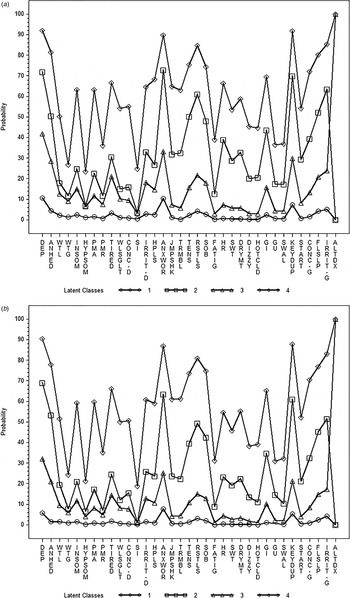
Fig. 1 displays the CPs of endorsement given class membership for each of the 34 MD and GAD LY symptom criteria by class (Fig. 1a , wave 1; Fig. 1b , wave 2). As indicated, the 4(2–2) subclass configuration exhibited clinically interpretable CP class profiles: class 1 corresponds to a NOR group (class prevalence 55% and 49% for waves 1 and 2, respectively) with very low probabilities of any LY symptoms (circles) and no history of lifetime disorders; class 2 (squares) is consistent with a MAD group definition (class prevalence 11% and 9%, respectively) with a high probability of reporting depressed mood, low to moderate probabilities of most other MD and GAD symptoms, and no lifetime disorders. Classes 3 and 4 represent individuals with a history of lifetime disorders who differ substantially on their presentation of LY symptomatology: class 3 (triangles) is a nominally ‘partially remitted’ group (class prevalence 23% and 30%, respectively), with lower symptom burden (‘low LY’) than class 2 (MAD) and a low prevalence of full LY disorders, while class 4 (diamonds) is a highly affected group (class prevalence 11% and 12%, respectively) with broad and severe symptomatology (‘high LY’).
Conditional probabilities of major depression (MD) and generalized anxiety disorder (GAD) symptom criteria for four-class, 2(0)–2(1) solution. (a) Wave 1, n = 8978; latent classes: (○), class 1 (normal, 54.7%); (□), class 2 (mixed anxiety–depression, 11.5%); (Δ), class 3 (low levels of last-year symptoms, 22.8%); (◊), class 4 (high levels of last-year symptoms, 11.0%). (b) Wave 2, n = 7625; latent classes: (○), class 1 (normal, 49.4%); (□), class 2 (mixed anxiety–depression, 8.8%); (Δ), class 3 (low levels of last-year symptoms, 29.9%); (◊), class 4 (high levels of last-year symptoms, 11.9%). DEP, Depressed mood; ANHED, anhedonia; WTL, weight loss; WTG, weight gain; INSOM, insomnia; HYPSOM, hypersomnia; PMA, psychomotor activation; PMR, psychomotor retardation; TIRED, feeling tired; WLSGLT, worthlessness or guilt; CONC-D, poor concentration assessed in MD section; SI, suicidal thoughts; IRRIT-D, irritability assessed in MD section; HPLS, hopelessness; ANXWOR, GAD screen for excessive anxiety or worry; JMPSHK, GAD screen for muscles feeling jumpy or shaky; TRMBL, feeling tremulous; TENS, muscle tension; RSTLS, restlessness; SOB, shortness of breath; FATIG, feeling easily fatigued; HR, increased heart rate; SWT, increased sweating; DRYMT, dry mouth; DIZZY, dizziness; HOTCLD, hot or cold flushes; GI, gastrointestinal problems; GU, genitourinary problems; SWAL, difficulty swallowing; KEYDUP, feeling keyed-up; START, easily startled; CONC-G, poor concentration assessed in GAD section; FLSLP, difficulty falling asleep; IRRIT-G, irritability assessed in GAD section; ALTDX, any lifetime diagnosis of MD, GAD or panic disorder.

Fig. 1 also indicates that the latent classes tended to be characterized more by quantitative rather than qualitative differences. In general, the conditional endorsement probabilities across classes follow a rather uniform profiling for both the MD and GAD criteria. The main exceptions are the autonomic symptoms of anxiety, which show up as a more integral part of the symptom spectrum for the more severe class 4. The most common symptoms in the MAD group (with >40% prevalence at both wave 1 and wave 2, values averaged over both waves) were: depressed mood (70%), anhedonia (52%), anxiety/worry (68%), muscle tension (45%), restlessness (55%), shortness of breath (45%), feeling keyed-up (66%), difficulty falling asleep (49%) and irritability (58%).
Validators
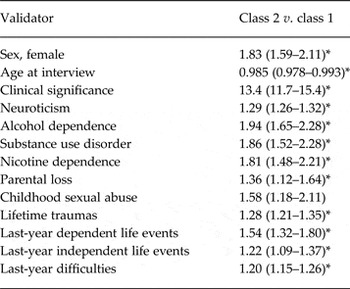
Table 1 presents the results of fitting multinomial regressions for selected validators predicting MAD class membership in wave 1 using NOR as the reference group. Given the multiple, potentially correlated, tests performed, both 95% confidence intervals and more highly significant associations (p < 0.001) are shown. Baseline models indicated that the effects of age at interview and sex were significantly associated with classes 2–4, so they were included as covariates in subsequent analyses. All of the validators had significantly elevated odds ratios in the MAD class compared with NOR. In particular, clinical significance was strikingly elevated for MAD.
Association of validators with class 2 (MAD) at wave 1 from multinomial logistic regression controlling for sex and age

Data are given as odds ratio (95% confidence interval) with class 1 (NOR) as reference.
NOR, Normal; MAD, mixed anxiety–depression.
* Odds ratio significantly >1.0 (p < 0.001).
Twin analysis
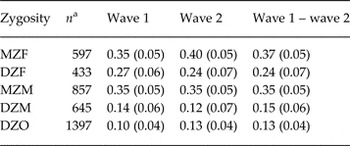
A logically ordered classification variable was created to take into account both class assignment and clinical diagnoses in a hierarchical manner: NOR subjects (=0), MAD subjects (=1) and subjects with ALTDX (=2). The distribution of this phenotype for each twin significantly varied by co-twin score (Cochran–Mantel–Haenszel p values all <0.0001), supporting this hierarchy. For both MM and FF pairs, the correlations in MZ twin pairs were about twice those in DZ pairs, suggesting that this aggregation is primarily associated with genetic factors. Twice the MZ–DZ difference estimates the heritability as roughly 20–40%. In addition, the cross-twin cross-time correlations (i.e. between twins across waves 1 and 2) are nearly the same as they are within wave 1, suggesting that twin similarity for this phenotype is stable over this time interval and this stability is primarily attributable to genetic factors (Table 2). The best-fit twin model estimated the heritability as equal to 36% in females and males, with genetic correlation less than unity (online Supplementary Table S2).
Cross-twin (twin 1–twin 2) correlations by zygosity for three-level ordinal phenotype NOR: MAD: ALTDX within waves 1 and 2, and between waves 1 and 2

Data are given as polychoric correlation (asymptotic standard error).
NOR, normal (class 1); MAD, mixed anxiety–depression (class 2); ALTDX, any lifetime diagnosis of major depressive disorder/generalized anxiety disorder/panic (classes 3 and 4); MZF, monozygotic female–female pairs; DZF, dizygotic female–female pairs; MZM, monozygotic male–male pairs; DZM, dizygotic male–male pairs; DZO, dizygotic opposite-sex pairs.
a Number of twin pairs by zygosity group included in wave 1 calculations.
Longitudinal analysis
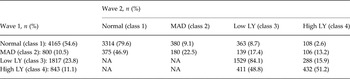
Table 3 displays the cross-classification comparisons based on the 4(2–2) latent class assignments obtained for the separate wave 1 and 2 analyses. Reviewing the MAD-relevant outcomes for stability versus change: 9% of NOR (class 1) transitioned into MAD; 22% of MAD (class 2) remained in this class, 47% remitted to NOR, and the remaining 31% progressed into the more severe classes. Given membership in MAD at wave 1, the odds of remaining in the MAD class at wave 2 versus transitioning out is (0.225/0.775) = 0.29. The relative risk for developing first-onset MD or GAD by wave 2, given membership in MAD versus NOR at wave 1, is 3.4.
Wave 1 by wave 2 across time class assignments (total wave 2 n = 7625)

Data are given as number (percentage).
MAD, Group with subsyndromal mixed anxiety–depression; low LY, group with low levels of last-year symptoms; high LY, group with high levels of last-year symptoms; NA, not allowable (since class 1 and class 2 cannot include individuals with prior lifetime diagnoses).
Discussion
To investigate whether the characteristics of the MAD syndrome could be empirically discerned, we conducted LCA on 34 disaggregated symptoms of depression and anxiety in a large population-based adult twin sample. Restrictive constraints were imposed in the LCA models to explicitly introduce a key feature of the clinical presentation of MAD – the absences of any prior history of anxiety or depressive disorders. We sought to address four major questions and now review our findings in turn.
-
(1) Among a sample of unselected individuals, can a group that is subthreshold for depressive or anxiety disorders but meets criteria for MAD be reliably identified? LCA produced solutions for three or more classes that always included at least one class of individuals with subsyndromal levels of MAD symptomatology with a prevalence of around 10%. When implementing the lifetime history constraint, the solution with good fit and interpretability included four classes: for the two classes with no prior diagnostic history, a ‘normals’ (NOR) subclass with prevalence 50–55% was present, and a MAD subclass with prevalence 9–11% showing relatively elevated LY symptomatology. For the other two subclasses constrained to have some past diagnostic history, one displayed the highest levels of LY symptomatology whereas the other was characterized by relatively low levels of LY symptoms – higher than the ‘normals’ but notably lower than the MAD class.
-
(2) Is this group different from those with threshold disorders? Symptom endorsement patterns between classes differed primarily in a quantitative rather than qualitative manner, suggesting MAD symptomatology may be better represented as a dimensional continuum, as has been suggested previously (Solomon et al. Reference Solomon, Haaga and Arnow2001; Haslam, Reference Haslam2003). Some have argued that MAD is a subclinical form of an anxious major depressive episode rather than a separate clinical disorder (Goldberg, Reference Goldberg2014). The most common symptoms in this class were dysphoric (depressed/anhedonic/anxious) mood plus non-specific symptoms of negative affect such as tension, restlessness, irritability and insomnia.
-
(3) How stable are these symptoms? The latent class structure and symptom endorsement frequencies were remarkably similar across twins and across two assessments 17 months apart, supporting the validity of these class characterizations. Longitudinally, a large proportion (47%) of individuals assigned to the MAD group at wave 1 improved over time, as evidenced by their assignment to the asymptomatic group at wave 2. However, about one-quarter of the wave 1 MAD group persisted in this group at wave 2 while the remaining 30% progressed to the more severe classes associated with lifetime internalizing diagnoses. Surprisingly, about 9% of those initially in NOR transitioned to MAD by wave 2.
-
(4) What clinically relevant validators characterize this group? The MAD group was significantly associated with many potentially clinically relevant validators, including childhood adversity, poor parenting, lifetime traumas, recent life events, high neuroticism, co-morbid substance use disorders, and familial aggregation. In particular, those assigned to the MAD group were highly likely to meet clinical significance criteria indexed by distress, impairment or treatment seeking.
Limitations
There are several potential limitations that might affect these results and their interpretations. First, the assessment of depressive versus anxiety symptoms differed due to the skip out implemented for the GAD criteria. Modeling this type of conditional missing data structure relied on the robust algorithm available in Mplus. Since the items responsible for generating the missing data were included in the analysis, the algorithm's assumptions were deemed to be reasonably satisfied. We imposed the same skip-out procedure to generate an analogous missingness structure in the MD items. Second, these results are predicated upon the statistical methods used. Applications of mixture modeling such as LCA are not without their estimation caveats and potential for erroneous interpretations (Bauer & Curran, Reference Bauer and Curran2004). However, each restricted LCA model was refit up to n = 3000 times using different sets of random starting values to check for possible local minimum convergence conditions. Also, we did not retain the maximum number of classes as determined exclusively by model fit criteria due to the nature of the restricted conditional LCA model specifications that we fit. Others who have conducted LCA of large samples, including this one (Sullivan et al. Reference Sullivan, Prescott and Kendler2002), have identified more than four classes of depressive subtypes alone. Since our goal was to identify a distinct MAD class, if present, our cut-off was based more heavily on a minimal set of interpretable classes (four) that fit the data with the imposed constraints.
In conclusion, our results support the hypothesis that there is a group of individuals in the general population that exhibit a mixed syndrome of anxiety and depressive symptomatology without a prior history of full disorders. Their symptom burden distinguishes them from unaffected individuals in terms of clinical significance as well as established risk factors for anxiety and depressive disorders. While many of them recover in the subsequent 1- to 2-year period, a substantial fraction either persists in this state or progresses to more severe psychopathology. Thus, MAD warrants further study for possible inclusion in future nosologic systems.
Supplementary material
For supplementary material accompanying this paper visit http://dx.doi.org/10.1017/S0033291715001038
Acknowledgements
The authors would like to thank the Mid-Atlantic Twin Registry (MATR), which is supported by the National Institutes of Health (UL1TR000058). Carol Prescott, Ph.D., provided critical help in the collection of the VATSPSUD sample. This work was supported by the National Institutes of Health (K.S.K., MH-40828 and MD/DA/AA 49492) and the American Psychiatric Association.
Declaration of Interest
None.