Traumatic injury remains a leading risk of mortality and morbidity in the world population. 1 Even though emergency physicians are well-experienced with the more proliferated mechanisms of injury, such as road traffic accidents and some types of interpersonal violence, they could be not as familiar with other, less frequent types of injury that are no less dangerous to human lives. Reference Rozenfeld, Givon and Peleg2,Reference Almogy, Kedar and Bala3
One such injury mechanism is explosion-related injury, which has several very important distinguishing characteristics. First, explosions are known to cause multi-trauma, injuring multiple body regions in numerous injury mechanisms (blast, penetrating, blunt, burn, etc). Reference DePalma, Burris, Champion and Hodgson4,Reference Reade5 Second, they may result in difficult to detect internal injuries due to blast trauma. Reference Champion, Holcomb and Young6,Reference Almogy, Luria and Richter7 Third, they have a potential to cause a mass casualty event (MCE) due to the non-targeted, propagating nature of the explosion. Reference Reade5,Reference Tadmor, Feigenberg, Aharonson-Daniel, Elsayed and Atkins8 Last, and most important epidemiologically, explosive events could differ greatly due to (1) the vast differences in the specific parameters of the explosive events, such as the type of explosive material and device; (2) the type of physical space where the explosion takes place; (3) the contextual circumstances of time and place of the explosion; (4) the availability of protective equipment to the victims; and (5) an explosion being an accident or a deliberate attack. Reference Reade5,Reference Rozenfeld, Givon and Shenhar9–Reference Byard12 This vast variety in explosive event circumstances creates significant differences between explosion events in the injuries they produce.
The issue is further complicated by the fact that explosion-related injuries may be caused in completely different context, whose characteristics may interact with the epidemiological factors. For example, in a military context the victims would be subjected to attacks by high-explosives delivered by munitions especially designed to cause maximum physical harm, but this would be somewhat alleviated by the soldiers‘ training and protective equipment, by sirens warning civilians to go into shelters immediately before shelling, and by a more open environment, in general. Reference Reade5,Reference Peleg, Jaffe and Trauma Group11 Civilian and terror explosions, on the other hand, happen without any warning and usually in an enclosed space, either urban, industrial or inside vehicles Reference Reade5,Reference Rozenfeld, Givon and Shenhar9 . Additionally, while most intentional explosions will be targeting a maximally possible volume of potential victims, in a criminal context explosions are frequently used to target a specific person or group of persons. Reference Reade5,Reference Byard12 It is thus clear that the civilian/military/terror and intentional/unintentional distinctions may play a significant part in predicting the expected injury pattern. The resulting differences may mean that acquiring clinical experience with 1 type of explosion-related injury will not necessarily translate into being able to successfully deal with other types, as clinicians will have to operate in a vast spectrum of contexts, dealing with significantly different injury profiles and patient loads.
The question to ask therefore is: Are differences between various explosive scenarios great enough to suggest that the clinical experience of dealing with 1 explosion type is not directly transferable to dealing with the other types? Are some types more similar than the others? In order to answer these questions, a thorough comparison of main explosion types is required. To make such a comparison would be the goal of this study.
Methods
Study Design
A retrospective cohort study of trauma patients who sustained an explosion-related injury between January 1997 and December 2018 was carried out. Patients’ data were obtained from the records of the Israel National Trauma Registry (INTR) maintained by Israel’s National Center for Trauma and Emergency Medicine Research, in the Gertner Institute for Epidemiology and Health Policy Research, Tel HaShomer, Israel.
Data Collection and Processing
The Registry contains information concerning trauma patients hospitalized in 21 hospitals, including all 6 Level I trauma centers in Israel. The INTR records contain data from all trauma patients with an ICD-9-CM diagnosis code between 800 and 959.9, who were hospitalized due to injury, following an emergency department (ED) visit, including those who died in the ED or were transferred to another hospital. The INTR documents more than 90% of all trauma casualties and 98% of the severely injured trauma casualties. The INTR does not include patients who were declared dead at the scene or on arrival at the hospital or discharged from the ED. The data are collected at the hospitals by dedicated trauma registrars, monitored by the trauma coordinator, and are under the responsibility of the trauma unit director. The data are entered into a computerized system and transmitted with no identifying details to the central database managed by the Israel National Center for Trauma and Emergency Medicine Research at the Gertner Institute. After the data are received from the hospital and entered into the central database, logic and other tests are performed to ensure quality and completeness. Missing, unclear, or erroneous data are corrected and completed. When missing information is detected, a query is sent to the hospital to fill it in. For each patient in the Registry, there are approximately 150 variables providing demographic data, detailed injury data (circumstances, mechanism), information on prehospital treatment, treatment in the department of emergency medicine, operations, diagnosis (according to the ICD-9-CM and AIS), and destination upon discharge.
This study was approved by the Institutional Ethical Committee of The Sheba Medical Center, No.: 5138-18-SMC.
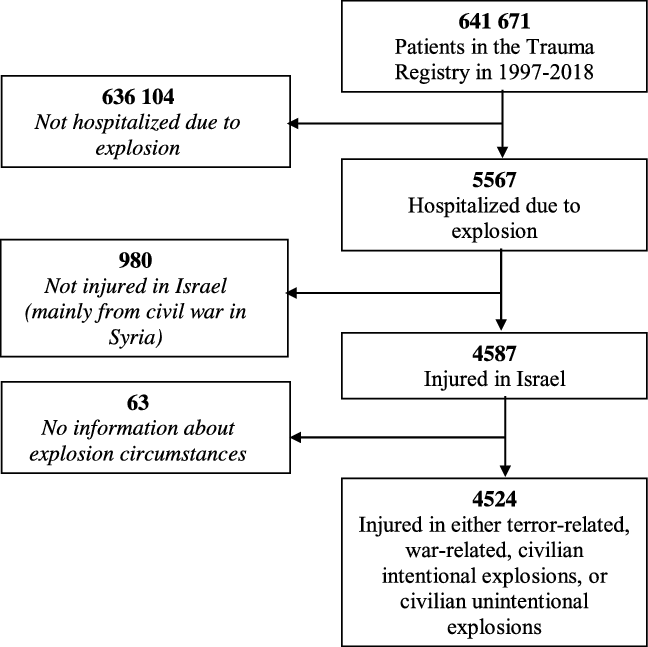
The study population included INTR cases hospitalized due to explosion-related trauma injuries in Israel. These were identified in the Registry by the following ICD E-codes: E890, E891, E921, E923, E955.5, E965.5-E965.9, E971, E979, E990-E999. In total, 4587 cases were identified. Sixty-three cases were excluded due to not having full information regarding explosion circumstances. Of the remaining patients (n = 4524), 4 categories were identified, based on specific ICD E-codes, dates, and open-text description of injury events: terror-related events (TRE; all terror-related explosions in the study period, mainly suicide bombers and car bombs), war-related events (WRE; all non-civilian explosive events during periods defined as war), civilian intentional explosions (CIE; mainly cars rigged with explosives for assassination of the person inside and criminal grenade throwing), and civilian unintentional explosions (CUE; a wide variety of explosive accidents, including fireworks, flammable gases and liquids, pressurized containers, electric, and industrial equipment). Logic tests were performed comparing ICD E-codes with AIS diagnoses and performed clinical procedures.
The case finding was conducted by the researchers at the Gertner Institute. After all the mentioned E-codes were obtained, they were checked vis-à-vis open text descriptions of the same cases.
Figure 1 presents the process of study sample selection.
Study sample selection process.

Primary Data Analysis
The comparison of the 4 explosion type categories was based on (1) demographic characteristics (gender, age); (2) context of injury event (location, time); (3) injury profiles and clinical parameters, including GCS (Glasgow Coma Scale), lowest systolic blood pressure recorded in the ED, Abbreviated Injury Scale (AIS), Injury Severity Score (ISS), type of trauma, injured body regions; and (4) overall number of injured body regions and hospital resources utilization (admissions to surgery and Intensive Care Unit [ICU], length of stay [LOS], and clinical outcome in-hospital mortality).
Data analysis included both descriptive and statistical inference analyses. Chi-square tests with a Bonferroni correction for multiple comparisons were used for group comparisons: The presented significance is for the group most different from the others. Odds ratios and 95% confidence intervals were calculated for factors related to mortality. A logistic regression model for predicting in-hospital mortality by most relevant clinical factors was calculated and stratified by the 4 study groups, in order to detect potential differences in the influence of the factors in each group.
Statistical analyses were performed using SAS software version 9.4 (SAS Institute, Cary, NC, USA).
Results
During the study period, 4508 explosion victims were hospitalized due to injury by 1 of the 4 explosion mechanisms and registered in the INTR. Of the total number, 1650 patients were hospitalized as a result of TRE, 883 as a result of WRE, 1774 as a result of CUE, and 201 as a result of CIE.
Demographic and Circumstantial Characteristics
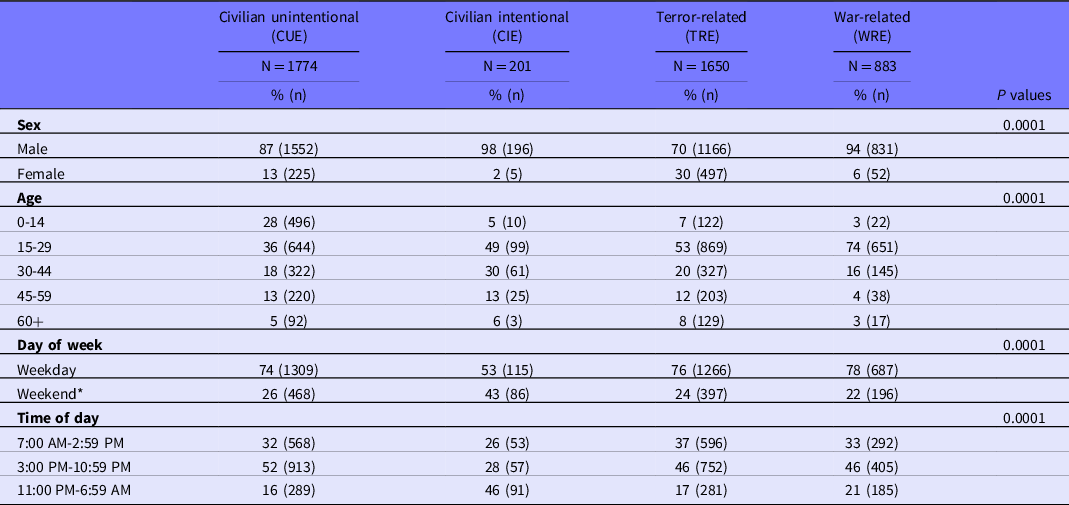
A comparison of basic demographic and circumstantial characteristics of 4 study groups uncovered significant variance between the groups in some parameters and similarities in others (Table 1). All groups were mostly male, especially CIE and WRE with 94–98%; however, TRE included a significantly higher proportion of females (30%). In terms of age composition, CIE and TRE were very similar, with about half of patients ages 15–29 years old, as compared to 74% among WRE and only 36% in CUE. The latter also had a higher proportion of children (28%), compared to 3–7% only among other groups. All groups had a very low proportion of victims older than 60. CIE differed from other groups in time of event, much more frequently taking place during weekdays (Sunday to Thursday in Israel) and at nighttime (11:00 PM–6:59 AM).
Demographic and circumstantial characteristics of terror-related injury mechanisms

* In Israel, a weekend is on Friday and Saturday.
Injury Characteristics
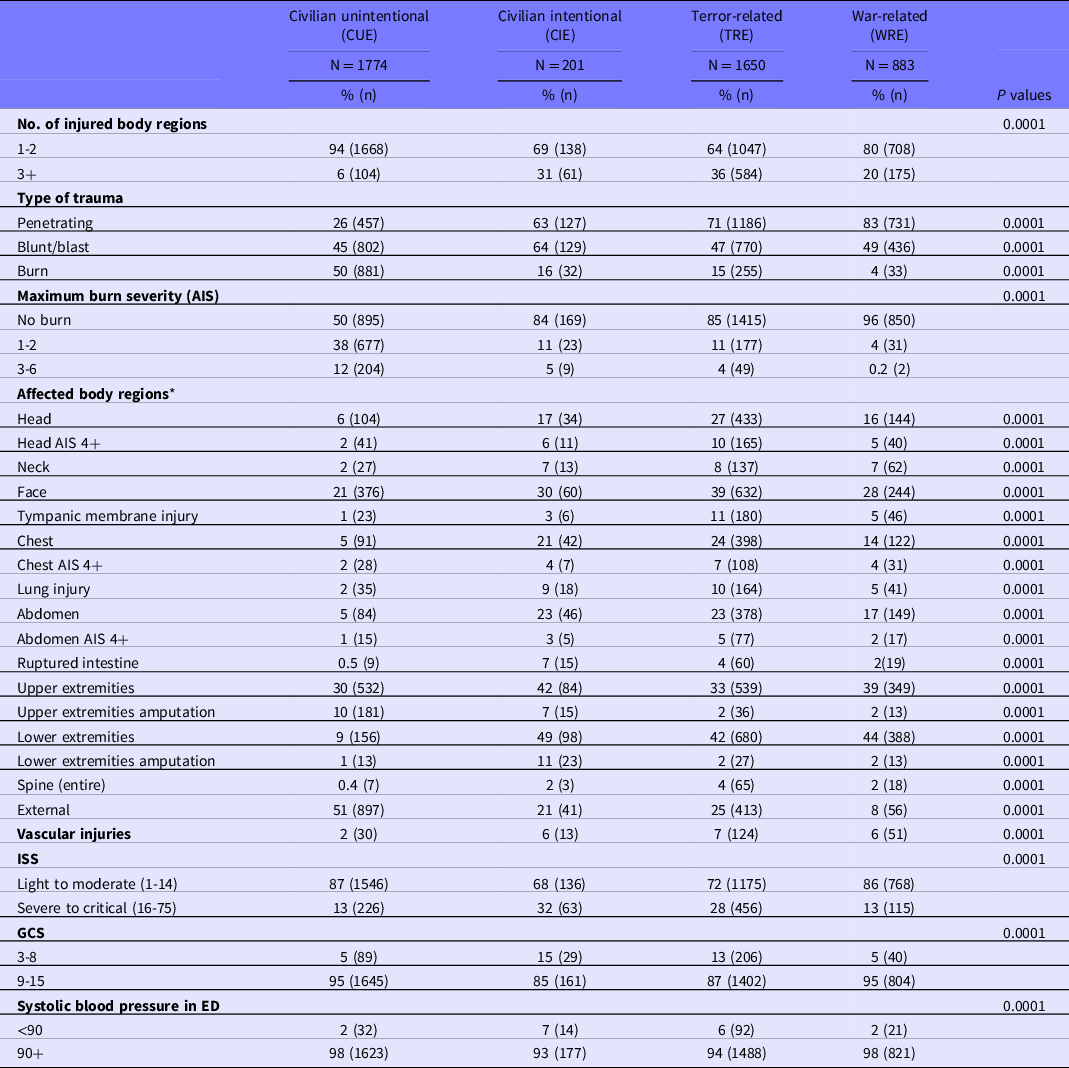
The 4 groups had multiple differences in terms of their injury profiles (Table 2). These differences were especially evident in the trauma mechanisms involved in the injury: All groups differed in the proportion of penetrating trauma; however, this measurement was lower in the CUE group than in the other groups with only 26% prevalence. In contrast, burns were very rare in most groups except for CUE, in which it accounted for 50% of injuries. Similarly, burn severity patterns were consistent with this finding. CIE was similar to TRE in terms of burns but had significantly higher proportions of blunt/blast trauma than the other groups.
Injury profiles and overall injury severity of different terror mechanisms

AIS = Abbreviated Injury Scale; GCS = Glasgow Coma Scale; ISS = Injury Severity Score.
* Affected individuals may be injured in more than 1 region.
About a third of TRE and CIE victims (each) had injuries to multiple body regions, while CUE mostly led to isolated injuries. TRE and CIE victims also had similar levels of chest, abdomen, and external injuries. In terms of head injuries, TRE was the highest with a prevalence of 27%, while CIE and WRE were similar with 16–17%. All groups included injuries with significant damage to upper extremities; however, CUE had much less lower extremity injuries than other groups (9% vs 42–49%). CUE also had less head, chest, abdomen, and vascular injuries than the other groups, yet more external injuries. WRE had only 8% of external injuries. Face injuries were common all around, especially among TRE victims (39%). Spine and neck injuries were relatively rare in all groups.
Several potential indicators of blast injury, such as lung and tympanic membrane injury, ruptured intestine, and extremity amputations, were compared between the categories. CIE and TRE had similarly high (9–10%) proportion of lung injury; however, tympanic membrane injury was frequent only among terror victims (11%). Ruptured intestine was most frequent among CIE victims (7%) but less than 1% among CUE victims. On the other hand, both categories of civilian explosion events had a higher proportion (7–10%) of upper extremity amputations, compared to only 2% in 2 other categories. CIE category also had an order of magnitude higher proportion of lower extremity amputations.
In terms of injury severity, both CUE and WRE had only 13% of severe or critical injuries (ISS 16+), while TRE and CIE were much higher, with 28% and 32%, respectively, of severe or critical injuries. Other parameters of injury severity, such as GCS and systolic blood pressure, followed the same pattern.
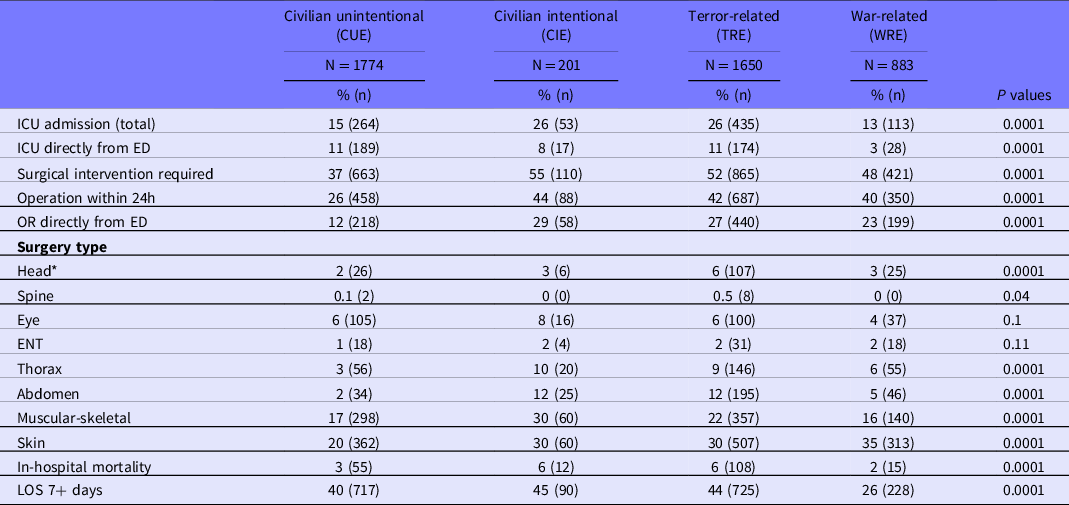
This pattern of injury severity was only partially followed by the patterns of hospital resource consumption (Table 3). ICU admissions were in accordance with injury severity: CIE and TRE with 26%, and CUE and WRE with 15% and 13%, respectively. However, similar to TRE, 11% of CUE patients were transferred to ICU directly from the ED, with only 3% among WRE. CUE patients required significantly less surgical interventions than other groups. TRE and CIE had similar levels of chest (9–10%), abdomen (12%), and skin (30%) surgeries. CUE and WRE had a similar proportion of musculoskeletal surgeries (16–17%).
Hospitalization resources and outcomes in different terror mechanisms

ED = Emergency Department; ENT = Ear Nose Throat; ICU = Intensive Care Unit; LOS = Length of Stay; OR = Operating Room.
* Head surgeries are related to the skull, brain, and cerebral meninges.
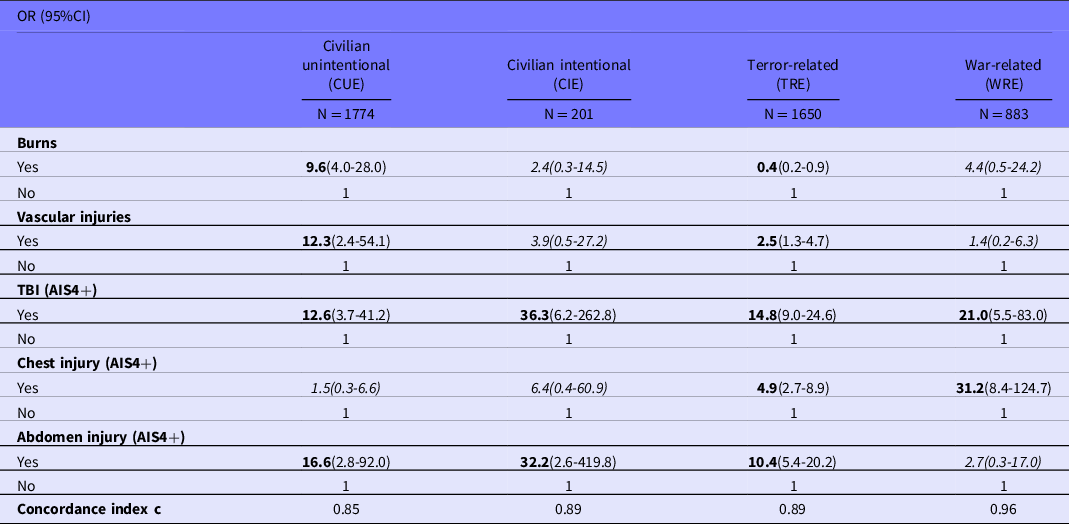
The length of hospital stay was lowest among WRE victims (26% hospitalized for longer than 7 days), but similar between other groups (40–45% staying longer than 7 days). In-hospital mortality followed the pattern of injury severity and was 6% in TRE and CIE, and 2–3% in CUE and WRE. Factors most associated with mortality of explosion victims on the sample level were found to be burns; severe head, chest, and abdomen injuries; as well as vascular injuries. Table 4 presents the differences in the influence of these factors on mortality in every group.
Factors associated with mortality of explosion victims.*

AIS = Abbreviated Injury Scale; TBI = Traumatic Brain Injury.
* Adjusted for age as a continuous variable.
For TRE victims, all studied factors had significant impact of patient survival, with all injury parameters increasing mortality, except for burns, which had a protective influence. In contrast, burns increased mortality among CUE patients, as well as head, abdomen, and vascular injuries (chest injuries had no significant impact). Among CIE victims, only severe head and abdomen injuries increased mortality. In the WRE group, the increase in mortality was only due to severe head and chest injury.
Discussion
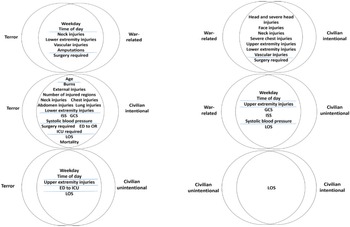
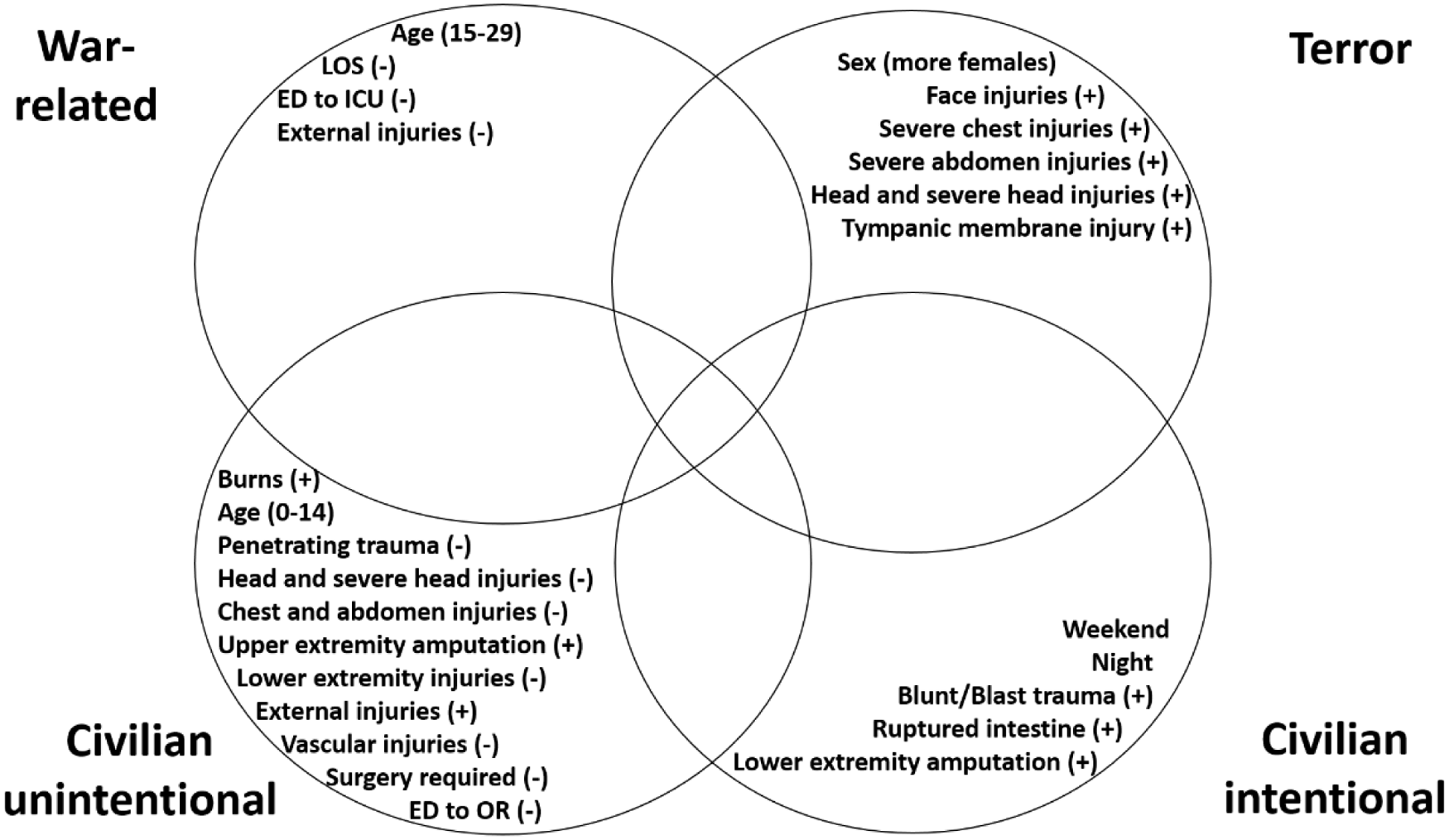
The goal of this study was to compare patients injured in different types of explosions in order to establish whether clinical experience with 1 type could be relevant to other types. Interestingly, the data suggest that, despite significant differences in many clinical aspects, there are also some similarities that may suggest at least some degree of experience transferability. These are summarized in Figures 2 and 3. Nevertheless, these findings have to be put into context of what is already known regarding explosion-related injuries.
Similarities between 4 categories of patients injured in explosions. ED, Emergency Department; GCS, Glasgow Coma Scale; ICU, Intensive Care Unit; ISS, Injury Severity Score; LOS, Length of Stay; OR, Operation Room.

Differences between 4 categories of patients injured in explosions.* ED, Emergency Department; GCS, Glasgow Coma Scale; ICU, Intensive Care Unit; ISS, Injury Severity Score; LOS, Length of Stay; OR, Operation Room. * The (-) signifies comparable lower values; (+) signifies comparable higher values.

The first insight from the direct comparison of the study groups is the extreme similarity between terror-related and intentional civilian explosions. These categories were found to be similar in most aspects, including age, injury profile and severity, hospital resources use, and clinical outcomes. The most likely explanation for this similarity is related to circumstances of the explosion: In both scenarios, high explosives are intentionally placed in the maximal proximity to the potential victims; therefore, a significant part of the explosive energy is transferred to them via different trauma mechanisms. Reference Reade5,Reference Noji, Lee, Davis and Peleg13 Additionally, a large portion of incidents from both scenarios happens in an enclosed space, such as a private car in case of attempted assassinations or a bus in case of terror attacks. Enclosed spaces are known to increase the impact of the explosion by redirecting the pressure wave back onto the victims inside. Reference Rozenfeld, Givon and Shenhar9,Reference Kosashvili, Loebenberg and Lin14
On the other hand, when factors influencing mortality were compared between these 2 groups, a different picture emerged: All factors were found to be significant for terror victims; however, only traumatic brain injury (TBI) and severe abdomen injuries were found to contribute to mortality of targets of assassination (CIE). The obvious explanation for this is the higher heterogeneity of terror attacks, that is, a wider spectrum of attack scenarios leading to more factors being involved. Reference Rozenfeld, Givon and Shenhar9 Most importantly, however, is the fact that civilian intentional explosions very rarely result in a mass casualty event (MCE), while in the case of terror attacks MCEs are more frequent. In an MCE scenario, factors other than clinical may come into play, such as suboptimal care caused by the multitude of casualties presented at the same time, leading to a greater threat to the survival of MCE casualties. Reference Frykberg15–Reference Peleg and Rozenfeld17 A recent study concurs with this study’s findings, noting the similarities between terror-related and criminal explosions, but designating CIE as a distinctive group, based on the higher prevalence of leg amputations and ruptured intestines among criminal explosion victims, as well as much lower number of patients from the same event and greater frequency during weekends and after hours. Reference Miller, Epstein and Givon18
Another important insight from this study’s comparison is the lack of almost any similarity between civilian intentional and unintentional explosions. A large part of this dissimilarity likely stems from a significant internal variance of the civilian unintentional group. While most civilian intentional explosions mainly involve rigging cars with high explosives and throwing grenades, the unintentional explosions include a wide list of scenarios, such as gas and gasoline explosions, fireworks incidents, rupture of pressurized containers, and explosions of electric equipment. Reference Reade5,Reference Patel, Tan and Dziewulski19–Reference Mohan, Nolan and Jain22 The variety of the unintentional explosive accidents, in terms of the nature of the explosive device and the circumstances of the explosion, makes it very different from the more homogeneous intentional attacks. This has important epidemiological implications, as with such degree of internal variance one cannot lump all “civilian” explosions into a single group in order to compare them against any type of “non-civilian” explosions. Unintentional injuries were also the most different from the other groups, having fewer severe injuries of different body regions and a smaller demand for hospital resources. One important exception was in regard to burns, especially severe burns—the volume was much higher, and this was the only group where they were found to contribute to mortality. Reference Patel, Tan and Dziewulski19,Reference Kulla, Maier and Bieler20 Interestingly, for terror victims, burns actually had a protective effect. A potential explanation is that victims closest to a terrorist explosion usually receive most of the blast’s energy and therefore those who do present to a hospital with burns were likely shielded from the pressure wave and penetrating trauma by those who did not survive. Reference Almogy, Belzberg and Mintz23
Other comparisons were less conclusive. Terror-related explosions did not have very much in common with either war-related or civilian unintentional explosions. They had more severe injuries to critical body regions and a higher proportion of females than the other groups. Reference Peleg, Jaffe and Trauma Group11,Reference Peleg, Savitsky and Trauma Group24 War-related explosions had some parallels with both groups of civilian injuries; however, in the case of civilian intentional explosions, the many similarities in the injury patterns did not translate into equal levels of injury severity and need for hospital resources, while in the case of accidents the match in injury severity was not due to similar injury patterns. War-related explosions were also noted by its small proportion of external injuries, most likely due to proliferation of protective equipment among soldiers. Reference Reade5,Reference Peleg, Jaffe and Trauma Group11 It is also notable that most victims of war-related explosions were young adults ages 15–29 (most of them being military personnel), while an exceptionally high proportion of children ages 0–14 were injured in unintentional accidents. With some unintentional explosion scenarios, such as firework explosions targeting mostly children, this is hardly surprising. Reference Boissiere, Bekara and LucaPozner21,Reference de Faber, Kivelä and Gabel-Pfisterer25
It is thus possible to suggest that, in most cases, clinical experience received with 1 type of explosion will not be directly transferable to dealing with other types, as they influence different demographics and produce completely different injury profiles. This is especially true for the 2 groups of civilian explosions. The only exclusion from this rule concerns terror-related and civilian intentional explosions; however, one must remember that the clinicians will encounter these patients in completely different contexts.
Limitations
This study has several limitations. First, restricting the analysis only to hospitalized patients may be seen as a limitation of this study, since our data did not include an indication of on-scene mortality or the total volume of the wounded. However, as this study focuses on the performance of the clinical staff at the hospital, the exclusive focus on the patients presenting to a hospital may be sufficient. An additional limitation of our study is related to the fact that it did not consider the average volume of victims from each type of explosive event, thus ignoring their innately different potential to cause an MCE. However, our focus here was less on the overall patient load and more on the injury-related clinical aspects, and therefore we do not consider this a critical limitation.
The authors also acknowledge that the patterns of explosion-related injuries in other parts of the globe may be different from what was found in our study of explosive events in Israel.
Conclusions
While consistent similarities between explosion casualties exist, especially between victims of intentional civilian and terror-related explosions, the general rule is that clinical experience with 1 type of explosion cannot be directly transferred to other types due to the uncovered significant differences.
Author contributions
Israel Trauma Group (I.T.G.): A Acker, N Aviran, M Bala, H Baphouth, A Bar, A Becker, M Ben Ely, D Fadeev, I Grevtsev, I Jeroukhimov, A Kedar, A Korin, A Lerner, M Qarawany, AD Schwarz, G Shaked, W Shomar, D Soffer, M Stein, M Venturero, M Weiss, O Yaslowitz, I Zoarets.
Funding statement
This study did not receive any dedicated funding.
Conflict(s) of interest
No conflicts of interest to declare for any author.