

Introduction
It has been established that time to the first cigarette after waking (TTFC) is a useful indicator of nicotine dependence, smoking cessation success, and relapse to smoking following cessation (Borland, Yong, O’Connor, Hyland & Thompson, Reference Borland, Yong, O’Connor, Hyland and Thompson2010a; Heatherton, Kozlowski, Freckler, Rickert & Robinson, Reference Heatherton, Kozlowski, Freckler, Rickert and Robinson1989; TTURCs, 2007). More recently, investigators have also examined whether waking at night to smoke can also serve as an indicator of dependence (Bover, Foulds, Steinberg, Richardson & Marcella, Reference Bover, Foulds, Steinberg, Richardson and Marcella2008; Rieder, Kunze, Groman, Kiefer & Schoberberger, Reference Rieder, Kunze, Groman, Kiefer and Schoberberger2001; Riemerth, Kunze & Groman, Reference Riemerth, Kunze and Groman2009; Scharf, Dunbar & Shiffman, Reference Scharf, Dunbar and Shiffman2008). This is typically conceptualized as awakening during sleep, having a cigarette (presumably to satisfy nicotine cravings), then returning to sleep. Waking at night to smoke is a marker of interest because three published studies have shown that night smoking is both common among treatment-seeking samples and associated with poor treatment outcomes, independent of other traditional predictors of relapse (Bover et al., Reference Bover, Foulds, Steinberg, Richardson and Marcella2008; Riemerth et al., Reference Riemerth, Kunze and Groman2009; Scharf et al., Reference Scharf, Dunbar and Shiffman2008). Night smoking may also be coincident with sleep problems, as sleep disturbance is a commonly reported symptom of nicotine withdrawal (Hughes & Hatsukami, Reference Hughes and Hatsukami1986). Moreover, Peters, Fucito, Novosad, Toll & O’Malley, (Reference Peters, Fucito, Novosad, Toll and O’Malley2011) found that night smoking is associated not only with sleep disturbance (as assessed by the Pittsburgh Sleep Quality Index (PSQI; Buysse, Reynolds, Monk, Berman & Kupfer, Reference Buysse, Reynolds, Monk, Berman and Kupfer1989)), but that their co-occurrence is associated with particularly poor cessation outcomes. However, few published studies have examined the frequency of night smoking in non-treatment-seeking smoker samples. Additionally, few studies have examined whether night smoking is associated with other features of smoking behaviour, such as non-daily smoking patterns (Schane, Glantz & Ling, Reference Schane, Glantz and Ling2009), past quit attempts, or quit intentions.
The aim of this study was to examine whether night smoking is associated with features of smoking behaviour, such as non-daily smoking patterns, past quit attempts, or quit intentions in non-treatment seeking adult smokers.
Methods
The study protocol was reviewed and approved by the Roswell Park Cancer Institute Institutional Review Board. Data for this study come from 1,062 current smokers obtained from an opt-in online panel who completed a web-based survey in July 2010 (for more information, see O’Connor et al., Reference O’Connor, June, Bansal-Travers, Rousu, Thrasher and Hyland2014). Participants completed an approximately 45-minute survey primarily designed to examine whether viewing ads for smokeless tobacco products influenced intentions of use, controlling for other factors. This portion of the study will not be discussed here (O’Connor et al., Reference O’Connor, June, Bansal-Travers, Rousu, Thrasher and Hyland2014), and all data considered in the current paper was collected prior to the study manipulation. Participants provided demographic information, tobacco use history, and completed items regarding their beliefs about tobacco products. Nicotine dependence was assessed using the (FTND; Heatherton, et al., Reference Heatherton, Kozlowski, Frecker and Fagerstrom1991).
Night smoking was assessed by two items: Do you wake up at night to smoke (i.e., after you go to bed)? (Yes/No; based on Scharf et al., Reference Scharf, Dunbar and Shiffman2008); and If I wake up during the night, I feel I need a cigarette (1–5 scale), drawn from the Nicotine Dependence Syndrome Scale (NDSS; Shiffman, Waters & Hickcox, Reference Shiffman, Waters and Hickcox2004). The former question was regarded as a more direct assessment of behaviour, while the latter was viewed as more related to craving. The ‘need’ question was dichotomized as 1 (not at all true) vs. 2–5 (at least somewhat true).
Analyses were completed using SPSS 21 (IBM, Armonk, NY). Patterns of night smoking and correlates were initially examined using descriptive statistics. Relationships of night smoking to FTND were assessed using linear regression. Night smoking relationships to quit intentions and making at least one quit attempt were assessed using logistic regression. We also examined the number of quit attempts using negative binomial regression under the generalized linear model function (negative binomial distribution, log link function) with an offset value representing the natural log of the number of days in the year, allowing us to calculate incidence rate ratios (IRR).
Results
Demographics and Smoking Behaviours
Detailed characteristics of the online sample are presented elsewhere (O’Connor et al., Reference O’Connor, June, Bansal-Travers, Rousu, Thrasher and Hyland2014). Most participants were white, female, aged >35 years, had incomes >$25,000 yr−1, and had at least some college education. Eighty-six per cent of participants smoked daily and the remaining 14% of participants reported smoking some days. The median number of cigarettes smoked per day was 15 (Range: 1–70), and the median time to first cigarette was 15 min (Range 1–1,380). The median FTND score was 5 (Range: 0–10). Participants reported a median of one serious quit attempt (lasting at least 24 hours) in the past year (Range: 0–60) and 79.7% reported an intention to quit in the future.
Frequency of Night Smoking
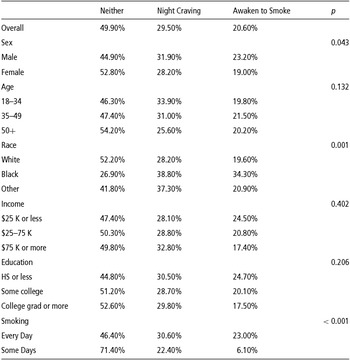
When taken as two separate variables, 20.6% of all smokers in the sample reported that they woke at night to smoke, while 20.3% reported that if they woke at night, they felt a need to smoke. When taken together, 50% of smokers reported neither, and responses were significantly interrelated [χ2(1) = 262.6, p < 0.001]. Twenty-nine per cent of smokers (or 37% of those reporting no night smoking) said that while they did not wake at night to smoke, if they did wake at night, they felt a need to smoke. Only n = 3 smokers reported the converse (i.e., awoke to smoke, but felt no need to smoke). For further analysis, we created a 3-level indicator variable — No night smoking or craving (n = 530), Crave at night but don't smoke (n = 313), and Awaken to smoke (n = 219).
Correlates of Night Smoking
We saw a number of demographic factors were related to night smoking (Table 1). Women were significantly less likely to report night smoking or craving. Black smokers were substantially more likely to report night cravings and awakening to smoke. Awakening to smoke was also substantially more common among daily smokers. Night smoking did not appear to differ by age, income, or education.
Demographic factors associated with night smoking. n = 1,026

Night Craving: Waking up at night and experiencing a craving for a cigarette — measure of craving.
Night Smoking: Waking up at night specifically to smoke a cigarette — measure of behaviour.
Relationship of Night Smoking to Dependence, Quit Intentions, and Quit Attempts
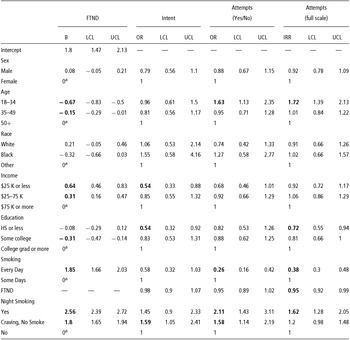
Table 2 shows results from regression models of FTND scores, intention to quit, and past year quit attempts as a function of participant demographics and night smoking. For dependence, we see that younger smokers have significantly lower FTND scores [B18–34 = −0.67 (−0.83, −0.50); B35–49 (−0.29, −0.01)], while those with low or moderate incomes and daily smokers tend to have higher FTND scores [Blow income = 0.64 (0.46, 0.83); Bmoderate income = 0.31 (0.16, 0.47)]. Both smoking at night and reporting night cravings were associated with higher FTND scores. For intention to quit, controlling for FTND, we noted that low income smokers and those with a high school or less education were significantly less likely to report quit intentions [ORlow income = 0.54 (0.33, 0.88); ORHS or less = 0.54 (0.32, 0.92)].
Regression models of factors associated with nicotine dependence, quit intentions, and past year quit attempts

LCL – lower confidence level.
UCL – upper confidence level.
OR – odds ratio.
HS – high school.
FTND – Fagerstrom Test for nicotine dependence.
Interestingly, those who reported night cravings were more likely to report quit intentions [ORcraving, no smoke = 1.59 (1.05, 2.41)], but the similar effect for those who awoke to smoke did not achieve statistical significance. For past-year quit attempts, smokers aged 18–34 years were significantly more likely to report making at least one attempt in the past year [OR18–34 = 1.63 (1.13, 2.35)]. Daily smokers were substantially less likely than some day smokers to report a past-year quit attempt [ORDaily smokers = 0.26 (0.16, 0.42)]. Finally, those who awoke to smoke and who craved at night were both significantly more likely to report a past year quit attempt [ORnight smoking = 2.11 (1.43, 3.11); ORnight craving = 1.58 (1.14, 2.19)]. Looking at the broader scale (i.e., attempts per year), younger smokers had a 72% higher rate of quit attempts than the oldest smokers. Those with high school or less education had a lower rate of quit attempts (IRR = 0.72).
Dependence emerged as a factor for quit attempt rates — for each one unit increase in FTND, quit attempts per year dropped by about 5%. Finally, those who reported waking at night to smoke had a 62% higher rate of quit attempts than those who did not. Night smokers made 3.6 attempts (95% CI: 2.8, 4.5) per year, adjusted for other model factors, compared to 2.7 (2.2, 3.2) attempts for night cravers and 2.2 (1.8, 2.7) attempts for smokers who reported neither.
Discussion
Awakening at night to smoke is an emerging indicator of nicotine dependence. In the current study, we examined a non-treatment seeking panel of current smokers of broad age and smoking behaviours and confirmed that night smoking is associated with indicators of nicotine dependence. Overall, 20.6% of all smokers in the sample reported that they woke at night to smoke. Those who reported night cravings were more likely to report quit intentions. However, night smokers made more actual quit attempts per year, adjusted for other model factors, compared to night cravers and smokers who reported neither night smoking nor craving.
Those who awaken at night to smoke showed higher scores on the FTND, yet made more quit attempts over the past year. While these relationships may initially appear to be counterintuitive, this association might be rooted in the chronic relapsing nature of nicotine dependence; smokers who report night smoking are highly dependent on nicotine, as measured by the FTND, but they may also be more likely to report a high number of [failed] quit attempts, having relapsed after each attempt due to their high dependence. Additionally, predictors of quit attempts are not necessarily those that predict relapse, suggesting different mechanisms drive making an attempt and sustaining abstinence (Borland et al., Reference Borland, Yong, Balmford, Cooper, Cummings and O’Connor2010b). Coupled with other data suggesting lower treatment success in night smokers, results from this study suggest a distinct treatment outreach may be required for a subgroup of highly dependent smokers, perhaps by also addressing sleep disturbance (Peters et al., Reference Peters, Fucito, Novosad, Toll and O’Malley2011).
While there was substantial overlap with reports of awakening at night to smoke, a distinct measure of craving to smoke if one wakes during the night also added significantly to the analysis. Future research on night smoking may want to include both ‘waking at night to smoke’ and ‘experiencing need to smoke if awoken’. Overall, experiencing night cravings if awoken seems to be an indicator of intent to quit, while waking at night specifically to smoke correlates with actual quit attempts. Future research would benefit from looking at both measures to gain a more comprehensive understanding of night smoking behaviour and how it pertains to dependence, quit intentions, and behaviours.
The current study is limited by a number of factors. First, night smoking was assessed only by self-report, which may be influenced by recall bias. Second, the measure does not place a time frame on night smoking, so we cannot distinguish whether smokers do this all nights, some nights, or only infrequently. We also cannot distinguish what time of the night (i.e., soon after going to bed, in the middle of the night, close to the time they normally wake) the night smoking takes place, or how many times in the night they wake to smoke. Third, because this was a cross-sectional survey, we cannot look prospectively whether night smoking was related to quit outcomes from expressed intentions.
Overall, the current study adds to a growing literature pointing to the importance of overnight smoking as an important indicator of nicotine dependence. Future research should incorporate both behavioural and craving indicators related to night-time smoking to assess their influence on smoking cessation behaviours. The implications of this work occur at the intersection of night smoking, dependence, and quitting. People who are more dependent wake up to smoke at night, but also are more likely to try to quit (which may seem counterintuitive). These findings may support efforts to develop targeted interventions to increase quit attempts and successful cessation among this group.
Financial Support
This work was supported by a grant from the U.S. National Cancer Institute (R01CA141609).
Conflict of Interest
None.
Ethical Standards
The authors assert that all procedures contributing to this work comply with the ethical standards of the relevant national and institutional committees on human experimentation and with the Helsinki Declaration of 1975, as revised in 2008. All procedures were reviewed and approved by the Roswell Park Cancer Institute Institutional Review Board.