Introduction
Most of the 826 million people still suffering from malnutrition and approximately 1,200 million people living on less than one US$ a day (UNDP, Reference UNDP2007) are to be found in developing countries, especially in the arid zones of Africa and Asia. Family poultry (FP) represent an appropriate system for supplying the fast growing human population with high quality protein and providing additional income to resource-poor small farmers, especially women. Although requiring low levels of inputs (i.e. housings, cages, feeds, breeds, vaccines, drugs, equipment and time/attention), FP contribute significantly to food security, poverty alleviation and the ecologically sound management of natural resources. Moreover, FP constitute an important component of the agricultural and household economy in the developing world, a contribution that goes beyond direct food production as well as employment and income generation for small farmers, especially women (Guèye, Reference GUÈYE2002b). They also serve as a means of capital accumulation and as a barter product in societies where there is no circulation of currency. These birds, which make up around 80% of poultry stocks in many developing countries of Africa and Asia (Guèye, Reference GUÈYE1998, Reference GUÈYE2002a; Goodger et al., Reference GOODGER, BENNETT and DWINGER2002; Pym et al., Reference PYM, GUERNE BLEICH and HOFFMANN2006), are also valued in the religious and socio-cultural lives of local communities. However, constraints facing FP production systems are related to high mortality (mainly due to Newcastle disease, and at present, to the avian influenza also in many countries since its outbreak in Asia in late 2003), housing, feeding, breeding, marketing, training/education and credit. Significant improvements in FP production systems can be achieved through well-designed and implemented information dissemination programmes that endow those involved in FP (i.e. FP-keeping farmers, extension workers, communicators, planners, policy makers, etc.) with necessary knowledge and skills.
Poultry networks have been set up in order to enable FP farmers to acquire and share knowledge, views, experiences as well as research and development (R&D) results in the FP sub-sector in developing countries. Taking into account the socio-cultural and economic environments of targeted FP farmers is essential to improve the efficiency of information dissemination through these poultry networks.
Why disseminate information?
In most developing countries, the FP sub-sector does not receive due attention from agricultural policy makers (including livestock specialists). Small-scale poultry farming is not yet regarded by many researchers, development or extension workers as an area of importance in terms of political significance or scientific prestige (Guèye, Reference GUÈYE2000). As a result of this, livestock population statistics do not encompass specific figures relating to the FP sub-sector. Yet, there is a strong need for governments, non-governmental organizations, international agencies and donors to provide all people interested or involved in the FP sub-sector with institutional support by promoting easy access to relevant information relating to FP, which is important for at least two reasons. First, it is the main way in which FP farmers can develop and change their knowledge and attitudes. Second, FP farmers need information to take decisions. On the other hand, policy makers need also to be sufficiently and properly informed to help them see how current policies and regulations affect FP farmers, and how change in policies and regulations might improve their situation. This process can be greatly facilitated when detailed data and information about the FP sub-sector are gathered at local community and national levels, and made available to staff of national and international institutions. The data collected from the FP sub-sector must be included in the data on the national economy as a whole, and FP development in developing countries must be seen as an integral part of the national development policy. There are no arguments better than figures!
Because of the inevitable gaps in FP farmers’ indigenous knowledge, due to lack of scientific expertise and isolation (Sonaiya et al., Reference SONAIYA, BRANCKAERT and GUÈYE1999; Branckaert et al., Reference BRANCKAERT, GAVIRIA, JALLADE and SEIDERS2000; Guèye, Reference GUÈYE2003a), there is a need to provide them with comprehensive and objective information about all aspects of different FP production and marketing systems, even if the exiting information exchange systems are quite informal and poorly developed. Therefore, it is important to collect baseline socio-economic data, to conduct gender research and to gather local knowledge from husbandry to marketing practices. The work must be done by multi- and trans-disciplinary teams to ensure that the FP sub-sector is fully understood and their constraints clearly identified along the whole FP value chain. Furthermore, detailed information will help to develop appropriate interventions in areas such as disease prevention and control (e.g. avian influenza), predator control, poultry housing, feeding and watering systems, genetic improvement, marketing of poultry products, training, credit and information exchange systems.
Sustainable development in FP requires well-designed research at all levels (i.e. from various scattered stakeholders to all types of research institutions, and vice versa). There should be full co-operation between scientists and FP farmers (Guèye, Reference GUÈYE2003a). Research can only have a real positive impact on the FP value chain if gathered information is disseminated not only to FP farmers but also to all other people interested or involved in this poultry sub-sector, and feedback information is crucially important for successful interventions aimed at developing FP sustainably. Unfortunately, only few FP farmers in developing countries have direct contact with researchers/technicians. The main reasons include the following:
• there are very few researchers/technicians dealing with issues relating to FP value chains compared with the number of FP farmers;
• FP farmers are numerous and often dispersed, and they manage small poultry numbers;
• the transport system is poor;
• there is a large social distance between researchers/technicians and FP farmers;
• there is a difference in the economic environment under which researchers and FP farmers operate.
Goals, opportunities, needs, problems and constraints of FP farmers must be thoroughly identified before the initiation of any R&D programme. Mutual trust between FP farmers and scientists/technicians is a prerequisite for success. Achieving the full participation and close collaboration of relevant members of the community requires scientists/organizers to spend a lot of time with potential beneficiaries, to inform them thoroughly of the details of any FP R&D programme, and to respect their values and beliefs. Information dissemination can help FP farmers to reach their goals by:
• making them aware of a particular (various) problem(s);
• increasing the range of alternatives from which they can make a(several) choice(s);
• allowing them to decide which goal(s) is(are) of the highest importance;
• allowing them to make decisions, either as individuals or as members of a group;
• informing them about the expected consequences of each(several) alternative(s);
• allowing them to learn from other views, experiences and results (successes, but also failures). This can contribute to avoiding unnecessary duplications, repeating errors and the ineffective use of continually dwindling resources (Guèye, Reference GUÈYE2002b). Spreading information on successful FP actor innovations and getting access to new knowledge are also essential for sustainable FP;
• stimulating them to share their knowledge with and acquired information from others;
• giving them opportunities to make choices about development options, for example, to move from small-scale to large-scale operations, or from extensive to intensive enterprises, when required increased levels of resources and inputs (i.e. housings, cages, feeds, breeds, vaccines, drugs, equipment, finances and time/attention) are available.
How to disseminate information?
Training, education and extension in FP are channels for spreading information on new technologies among FP-keeping farmers (Kassal, Reference KASSAL1998; Branckaert et al., Reference BRANCKAERT, GAVIRIA, JALLADE and SEIDERS2000; Guèye, Reference GUÈYE2003a). Information gathered by structures is used to instruct extension workers to spread it to FP farmers so that they, in turn, may bring about appropriate changes in their farm management. Little efforts have been made to inform other FP farmers. Unfortunately, extension services in many developing countries are not effective, when they exist. Training and education in FP are difficult and time-consuming tasks (Guèye, Reference GUÈYE2002b), although they are essential if FP farmers’ skills are to be improved (Huque, Reference HUQUE1996; Branckaert and Guèye, Reference BRANCKAERT and GUÈYE2000).
FP farmers, especially women producers, tend to be fluent only in local languages (i.e. their mother tongues and, in some cases, other local languages) and generally cannot write. In addition to being illiterate, many of them are also innumerate (Guèye, Reference GUÈYE2003c). Women's needs for information are to be structured according to their gender roles and responsibilities (Aitkin, Reference AITKIN1998). All these factors should be taken into account in deciding which information dissemination methods to use.
conventional methods of information dissemination
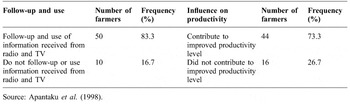
FP farmers in developing countries have limited access to mass media for several reasons. Newspapers mostly do not contain information about FP. In addition, they are mostly not distributed in rural and remote areas, and, when available, are too expensive for most resource-poor families. Television is also too expensive for almost all of them. Radio may however be available to most FP farmers. In rural areas, there are no electric power supplies, or, when available, there may be many blackouts or current fluctuations which damage the apparatus. Besides, in villages, it is difficult to repair the apparatus, and batteries are usually considered to be too expensive. Participatory development programmes increasingly use rural radio, television and other mass media as tools for farmer-to-farmer exchange. A survey carried out in Oyo State, Nigeria (Apantaku et al., Reference APANTAKU, APANTAKU and OYESOLA1998), revealed that radio is the only source of electronic mass media agricultural information for 51.7% of the 60 surveyed FP farmers, while 1.6% mentioned television only and 46.7% said both radio and television. Seventy-three percent of the farmers indicated that the follow-up and use of information received from the electronic mass media contributed immensely to increase the level of productivity and performance of their poultry flocks (Table 1). The resulting increased income can help FP-keeping farmers to better maintain their radio and television.
Use of electronic mass media by FP-keeping farmers and level of productivity in rural areas of Oyo State, Nigeria.

Source: Apantaku et al. (Reference APANTAKU, APANTAKU and OYESOLA1998).
The physical availability of mass media is not the only most important factor. The extent to which their messages are phrased and programmed for rural and peri-urban audiences is also to be considered. Most newspapers and television stations are located in cities, and they direct their information to urban audiences in most cases. They very rarely address issues relating to FP. Community or rural radios may be set up and used to overcome this problem. It should be borne in mind that the target groups are the less educated rural and peri-urban audiences. Moreover, there are numerous languages and dialects in some developing countries.
New advanced communication tools using electronic media re being increasingly used for disseminating information about FP, e.g. video conferences, electronic conferences, electronic journals, CD-ROMs and websites (Waltham, Reference WALTHAM1999; Guèye, Reference GUÈYE2002b, Reference GUÈYE2003a, Reference GUÈYE2003b). Unfortunately this information does not usually reach the majority of potentially interested persons living in developing countries, especially those dwelling in rural and remote areas.
unconventional methods of information dissemination
Local communities are mostly familiar with poultry, and poultry keeping is a traditional activity. In the traditional societies, it is common that messages (e.g. thoughts, advices, warnings and encouragements) are delivered and feelings (e.g. appreciation, reprobation) expressed using proverbs and sayings. Weakening the roughness of messages as well as delivering messages and expressing feelings only to the target audience (excluding children as they cannot get the meanings of the used proverbs and sayings) are among the advantages of this way of communication. Thus, poultry and eggs are made use of in many proverbs and sayings. Information dissemination tools suitable for adoption should take into account socio-cultural and economic environments of target groups. Although women, and secondly children, should be the target groups for meetings to share information, it is recommended that the whole family or special interest groups also be informed (Guèye, Reference GUÈYE2003b).
Unconventional methods such as word-of-mouth, theatres, songs, traditional communicators/singers/troubadours and ‘learning by doing’ are to be preferred, and simple extension messages must be used. Some interesting results from this approach have been obtained in Mozambique (Alders and Bagnol, Reference ALDERS and BAGNOL2000). Other historically alternative methods must continue to be explored and promoted in order to achieve broad dissemination of information and the effective uptake of the most suitable innovations/interventions. Mass media communicators must closely collaborate with all other FP farmers involved.
Since FP farmers, especially women producers, undertake a great many other activities, meetings to share information must be brief and frequent. They must be scheduled in those periods of the year when target groups are not involved in other duties, although this is a challenging exercise. Furthermore, campaigns for the elimination of illiteracy are to be recommended whenever possible.
Networking for sustainable FP
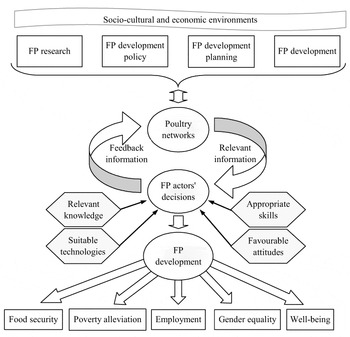
Several networks have been established to enable an exchange of views, experiences and R&D results between people engaged in FP keeping in developing countries (Branckaert et al., Reference BRANCKAERT, GAVIRIA, JALLADE and SEIDERS2000; Branckaert and Guèye, Reference BRANCKAERT and GUÈYE2000; Guèye Reference GUÈYE2002b, Reference GUÈYE2003a; Guèye and van't Hooft, Reference GUÈYE and VAN'T HOOFT2002). Figure 1 gives a simplified information flow to FP farmers illustrating the role played by poultry networks. The access to and exchange of information can help FP farmers to make appropriate decisions.
Information dissemination to family poultry (FP) farmers through poultry networks.

The FAO encouraged and supported, together with other international organizations such as CTA (Technical Centre for Agricultural and Rural Co-operation, Wageningen, The Netherlands) and IDRC (International Development Research Centre, Ottawa, Canada), the setting-up of the ANRPD (African Network for Rural Poultry Development) in November 1989 in Ile-Ife, Nigeria. This typical Information Exchange Network has been renamed INFPD (International Network for Family Poultry Development, www.fao.org/ag/againfo/subjects/en/infpd/home.html) or RIDAF (‘Réseau International pour le Développement de l'Aviculture Familiale’, in French; or ‘Red Internacional para el Desarrollo de la Avicultura Familiar’, in Spanish), and appropriate resolutions were adopted by the ANRPD General Meeting held on 13 December 1997 in M'Bour, Senegal. The network is an independent voluntary association supported by FAO and administered by a seven-member Executive Committee. Members include researchers, policy makers, educators, staff of non-governmental organizations (NGOs) and development agencies, aid donors and smallholder farmers. Information collected by members is disseminated through a trilingual (English, French and Spanish) newsletter, which is produced twice a year and distributed electronically with a printed version for members without e-mail facilities. Since 1990, the preparation, publication and distribution of the newsletter have been financially supported by FAO through annual authors’ contracts. In September 2002, INFPD was accepted as the first Global Working Group within the World's Poultry Science Association (WPSA) without changing its name, logo and acronym. Since March 2007, some relevant, well-designed and well-written articles published in the INFPD Newsletter have also been published in the World's Poultry Science Journal (WPSJ), either as full articles or summaries. These contributions are published twice a year in a new section of WPSJ called “Small-scale Family Poultry Production”. The advantages of doing this include: reaching wider readership, motivating scientists to publish their works on FP, providing more prestige for the work on FP, and attracting more scientists in this field. The INFPD Newsletter, a peer-reviewed scientific publication, has changed its title and become ‘Family Poultry’ or (‘Aviculture Familiale’, in French; or ‘Avicultura Familiar’, in Spanish) in January 2008. Moreover, INFPD/FAO run successful electronic conferences on FP, with the themes “The Scope and Effect of Family Poultry Research and Development” (from December 1998 to July 1999) and “The Bangladesh Model and other Experiences in Family Poultry Development” (from May to July 2002). Furthermore, the INFPD Directory for FP Development is regularly updated and made available to INFPD members and non-members. This facilitates contacts and collaboration among members as well as between members and non-members. The current subscriber list reveals that there are presently 800 members from 102 countries in five continents. Out of these members 62.8% are from Africa, 16.0% from Europe, 7.9% from Asia, 7.0% from Middle/South America and the Caribbean, 3.1% from Oceania, 2.1% from North America and 1.1% from the Middle East. We note, with pleasure, increasing memberships from Asia, Middle/South America and the Caribbean. It can however be assumed that the readership of the newsletter is much larger, as the newsletter is also available on the Internet.
NESPOD (Network for Smallholder Poultry Development, www.poultry.life.ku.dk) of the University of Copenhagen in Frederiksberg, Denmark, was established in 1997 as a multidisciplinary network of development experts and researchers using poultry as a tool for reducing poverty and empowering women. The vision of the Network is to unlock the potential of poultry as a tool in rural development by strengthened interdisciplinary and inter-institutional partnerships and networks. Since 1999, the NESPOD has developed, implemented and assessed programmes in close collaboration with DANIDA (Danish International Development Agency) in Bangladesh, Benin, Bolivia, Burkina Faso, Eritrea, Kenya, Malawi, Mozambique, Senegal, Tanzania and Vietnam; in collaboration with IFAD (International Fund for Agricultural Development) in Senegal and with national NGOs in Ghana, India, Nigeria, Senegal and Togo. Thorough analysis of the problems and prospects of the well-known Bangladesh model are well documented by NESPOD-supported research, and adjustments to future village poultry production activities are developed and have been tested. The website of the Network provides information resources that can be downloaded for non-commercial and educational purposes only. It contains literature, experiences, pictures, references, workshop proceedings, Avian Influenza Updates, M.Sc. and Ph.D. publications, manuals and selected links relating to works on FP R&D.
IRPC (International Rural Poultry Centre, www.kyeemafoundation.org/irpc.php), a subsidiary entity within the KYEEMA Foundation, aims to improve the livelihood and standard of living of rural families by
(i) promoting cost-efficient, sustainable improvements to village poultry production by working with government staff, community livestock workers and farmers and their families;
(ii) ensuring a sustainable supply of the thermotolerant I-2 ND vaccine master seed; as well as providing monitoring and training in its effective production, quality control and field use; and
(iii) providing appropriate training for all groups involved with village poultry production from farmers to researchers, both internationally and in Australia.
The IRPC provides virtual and actual technical assistance across a broad range of issues dealing with village poultry R&D, including the evaluation and development of appropriate information, education and communication materials and methods.
Other important networks and organisations with a networking function devoted to poultry R&D include:
• ‘Fowls for Africa’ of the Agricultural Research Council of South Africa (www.arc.agric.za/home.asp?pid=2611);
• ‘Poultry Information Network Online’ (www.stii.dost.gov.ph/sntpost/frames/julytosept04/pg37b.htm); and
• ‘Poultry Diseases Network’ (www.poultrydiseases.net/online/index.php?option=com_content&task=view&id=68)
Information dissemination efforts can help FP farmers to make appropriate decisions and interventions to optimise low-input/low-output FP husbandry systems and the management of their flocks. FP keeping has been a traditional and integrated component of rural, many peri-urban and some urban households or small farms, and is likely to continue as such in the foreseeable future. Appropriate assessment of FP farmers’ information needs is that which adopts participatory, holistic as well as multi- and trans-disciplinary approaches. The socio-cultural and economic circumstances of FP farmers should be taken into account before information is properly disseminated to them. In addition, it is demonstrated the potential and importance of networking and disseminating information, for example, by publishing newsletters and organizing conferences or symposia or workshops.
It is worth mentioning that effective networking for sustainable FP requires self-motivation, voluntary collaboration and philanthropic ideals among network members, who must feel a sense of ownership to enable an active and consistent exchange of information or communication about FP. This must be a collaborative process through which receivers (FP farmers) have also to provide senders (information managers) with their inputs (not only their knowledge, views, experiences, results obtained, but also feedback information).
Conclusions
Despite efforts to develop intensive poultry production, FP remains important in the developing countries of Africa, Asia, the Near East, Middle/South America and the Caribbean, Europe and Oceania. FP are a valuable asset to local populations as they contribute significantly to food security and poverty alleviation, especially in disadvantaged groups and less-favoured areas. Additionally, FP constitutes an appropriate tool for promoting gender equality. Unfortunately, the FP sub-sector is facing various constraints. This situation is exacerbated by the fact that all FP farmers are not provided with comprehensive and objective information about all aspects of the different FP husbandry systems and types of flock management. Yet, wide dissemination of views, experiences and results is essential for sustainable FP development, which should be backed by well-designed research. Relevant information materials should start with the existing knowledge base and practices of the target audience. These information materials should be integrated into the existing local channels of information dissemination, poultry networks in particular.
With FP farmers as end beneficiaries, exposure to information can be seen as a behavioural indicator of people's disposition
• to share and accept new ideas, practices, innovations and technologies (for FP farmers),
• to provide FP farmers with new messages and advice (for extension workers, technicians, poultry or livestock advisers, etc.),
• to explore new research themes (for researchers, scientists, etc.),
• to implement new policies (for planners, policy makers, etc.), and
• to launch new FP development initiatives (for governments, NGOs, international agencies and donors).