I. INTRODUCTION
Owing to their high specific strength and exceptional creep and corrosion resistance, titanium alloys are widely used in aerospace, automotive, and petroleum industries. Reference Banerjee and Williams1 As well, due to the excellent compatibility and nontoxic property to human tissues, titanium is also attractive and used in dental implant and bone replacement. Reference Geetha, Singh, Asokamani and Gogia2 Today, there are a great number of Ti alloys from low strength and high corrosion resistance pure Ti to high mechanical performance alloys available in the market. A wise choice of these products depends on the purpose of their applications. For example, applications in automobile and aerospace structures require light weight and high strength and toughness, and sometimes also require high thermal resistance when used in turbine engine. Reference Bewlay, Weimer, Kelly, Suzuki and Subramanian3,Reference Chen, Peng, Zheng, Qi, Wang, Yu, Dong and Liu4 On the other hand, safety and nontoxicity should be the priority for Ti applications in medical fields. It has been well-known that commercially pure Ti (CP-Ti) and Ti–6Al–4V alloys have been widely used as implant materials. Yet, it has been reported that, in Ti-based biomaterials, the toxicity of alloying elements to living cells from the most to least can be listed as Cu, Al = Ni, Ag, V, Mn, Cr, Zr, Nb, Mo, Ta, Sn, and CP-Ti. Reference Khorasani, Goldberg, Doeven and Littlefair5 In this regard, debates on using Ti alloys for medical implant have emerged with respect to the potential biological hazards of alloying elements used in the alloys. Thus, CP-Ti is considered as an excellent choice for medical use, Reference Özcan and Hämmerle6 and other Al and V-free alloys were also developed to substitute Ti–6Al–4V as implant materials. Reference Kuroda, Niinomi, Morinaga, Kato and Yashiro7 Nevertheless, most of the Ti alloys are consisting of expensive chemicals, such as Ta and Nb. Reference Geetha, Singh, Asokamani and Gogia2 It is the same case for Ti alloys available for structural applications, which usually contain chemical elements V, Co, Cr, Ni, and Mo. Reference Kang, Yang, Wang, Li, Zhu, Zhang, Chen and Huan8–Reference Williams and Starke10 Those chemicals are very expensive and increase the already high cost of Ti products. As such, using cheap and nontoxic chemicals in high performance Ti is a reasonable and appealing choice to materials scientists.
Oxygen, nitrogen, and carbon have long been reported to have a substantial hardening effect when residing in Ti matrix as interstitials. Reference Williams, Sommer and Tung11–Reference Lefebvre, Baril and de Camaret14 Nevertheless, only until recently was the origin of such strong strengthening effect being elucidated for oxygen interstitials, which was associated with a strong but short-range repulsion created by the core of screw dislocation for oxygen. Reference Yu, Qi, Tsuru, Traylor, Rugg, Morris, Asta, Chrzan and Minor15 In spite of the promising strengthening effect, these elements were strictly limited for use in Ti alloys, attributing to the embrittlement problem. Many results demonstrated that, with only a small amount of either oxygen, nitrogen or carbon, the ductility of Ti alloys dropped dramatically. Reference Jaffee, Ogden and Maykuth16 It was documented in a recent review that, to maintain a room temperature tensile elongation of 10%, the oxygen content could not exceed 0.5 wt% for all types of Ti alloys including α, α + β, and β-phase Ti. Reference Yan, Xu, Dargusch, Tang, Brandt and Qian17 As for Ti alloys fabricated via sintering or additive manufacture, the allowable O-limitation even becomes less than 0.3 wt%. Reference Yan, Dargusch, Ebel and Qian18 By referring to Yu et al.’s argument Reference Yu, Qi, Tsuru, Traylor, Rugg, Morris, Asta, Chrzan and Minor15 that the created immobile dislocation segments near the oxygen interstitials are responsible for the strong strengthening effect, the dramatically reduced ductility with increasing oxygen content in pure Ti is then also reasonable. Yet, CP-Ti with much higher oxygen and nitrogen contents than the commonly accepted values has been produced through powder metallurgy (PM) methods, which demonstrated both high strengths and tensile elongation. Reference Sun, Li, Imai, Mimoto, Umeda and Kondoh19–Reference Mimoto, Umeda and Kondoh21 Those work inspired us that oxygen and nitrogen may have a potential to be used for producing high performance Ti-based materials.
In this study, we made a series of trial experiments by doping oxygen up to a content far beyond the commonly recognized limit into pure titanium, so as to produce advanced mechanical properties in CP-Ti materials. The PM method including steps of mainly powder pretreatment, sintering, and hot extrusion was applied to produce the samples, where the oxygen was introduced via two different ways. The oxygen contents of the initial powders and final products were examined along with their microstructures, while the mechanical properties of the final products were assessed via uniaxial tensile tests. The results are presented in the following text with an in-depth discussion of the effect of oxygen on the strength improvement and ductility.
II. EXPERIMENTAL PROCEDURE
A. Materials processing
Two commonly used titanium powders that one produced by a gas atomizing process and the other by hydride-dehydride process were used in this study. They are supplied by Osaka Titanium Technologies Co. Ltd. (Osaka, Japan), labeled as TILOP-45 and TC-450, with a particle size of both under 45 μm. Titanium dioxide (rutile) powders of ∼2 μm were used as one of the two ways to bring in oxygen element. The rock milling process was applied to mix the rutile powders with Ti powders uniformly, which was carried out at a frequency of 60 Hz for 1 h with a ball-to-powder ratio of 2 using alumina balls of 2.0 mm diameter. This batch of mixed powders were then consolidated using a spark plasma sintering system (Dr. Sinter, SPS1030 Fuji Electronic Industrial Co., Ltd., Tsurugashima, Japan), where the sintering temperature was 1000 °C with a heating rate of 20 °C/min at a pressure of 30 MPa. The sintering time at the target temperature was controlled for 1 h, followed by cooling with the chamber. The entire process was carried out at a vacuum condition of <6 Pa. The SPS process was used to consolidate the composite powders into an almost fully densified billet. Certainly, we believe any other methods that can achieve this goal may substitute the SPS method. The as-sintered billets were heat treated at 1000 °C for 8 h with a vacuum of <10 Pa, then followed by hot extrusion at the same temperature with an extrusion ratio of ∼37 and ∼17, respectively, for the samples made from TC-450 and TILOP-45. The heat treatment is aimed to accomplish complete decomposition of the rutile powders and also to achieve a homogeneous distribution of the solid solution atoms. For sure, the time and temperature could be varied so as to obtain an optimum combination in regard to cost saving. As the grain size is more than hundreds of microns after heat treatment, the hot extrusion is therefore used to reduce the grain size of the materials.
The other way to bring in oxygen was by self-diffusion during high energy planetary ball milling (HE-PBM). This was learned from a fact that an oxygen-free environment was hardly achieved during the HE-PBM process, although an argon gas atmosphere was used to protect the powders from oxidation. By controlling the milling condition, a series of oxygen contents can be absorbed into the Ti matrix. In this batch of samples, two ways were used to produce oxygen-doped Ti powders. The first was to use the TC-450 powders that were milled by HE-PBM at 200 rpm with a ball-to-powder ratio of 5:1 for a series of times. The second was to use the TILOP-45 powders for HE-PBM at 150 rpm using the same ball-to-powder ratio, but with a milling time of 80 h. For all the HE-PBM processes, zirconia balls of 10 mm diameter were used, which were preciously coated by pure Ti by milling the corresponding powders. Before starting the HE-PBM process, the container was filled with flowing argon gas for two minutes. After milling, the Ti powders were compacted at room temperature using a compression pressure of 600 MPa, then followed by hot extrusion at 1000 °C with an extrusion ratio of ∼37.
B. Materials characterization
The oxygen, nitrogen, and hydrogen contents of all samples were measured using an O/N/H analyzer (EMGA-930, Sigmatech Inc., Huntsville, Alabama) with an accuracy better than 10 ppm. As the first batch samples were made from pure Ti and rutile mixed powders, both the powders and final products were examined by X-ray diffraction (XRD) to assure that no rutile powders were remained in the materials. The microstructures of all the Ti products were characterized by an electron backscatter diffraction (EBSD) equipment attached to a field emission scanning electron microscope (JEM-6500F, JEOL Ltd., Tokyo, Japan), where a step size of 0.5 µm was used. The EBSD samples were first mechanically polished to 2000 grit, then followed by electrochemical polishing at a voltage of 20 V for 1 min using a solution consisting of 5 vol% perchloric acid and 95 vol% acetic acid.
The mechanical properties of the materials were evaluated by uniaxial tensile tests at a nominal strain rate of 5.0 × 10⁻⁴/s. The tensile specimens were cut along the extrusion direction with a dimension of 1.2 × 1.0 mm at the cross section. The tensile tests were performed on a Shimadzu’s AG-X universal testing machine (50 kN, SHIMADZU Corp., Kyoto, Japan). At least three repeatable tests were performed for each material to guarantee the reproducibility.
III. EXPERIMENTAL RESULTS
In what follows, the microstructures and mechanical properties of all the samples are presented. The results are demonstrated in two sections with respect to the process that the specimen was produced.
A. Oxygen introduced by rutile powders
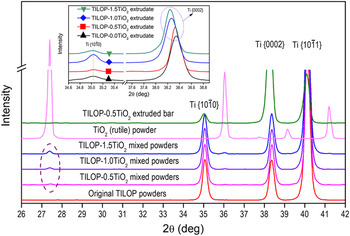
For this batch of samples, a series of rutile contents were added into TILOP and TC-450 pure titanium powders, respectively. As the results are similar for both of the samples, here we only display the results for the specimens made from TILOP powders in detail, whereas for the samples made from TC-450, only the oxygen content and related tensile properties are demonstrated. Figure 1 displays the XRD profiles for the TILOP Ti and rutile powders, as well as the final product made from TILOP powders. It can be seen that the peaks indicating the rutile are evident in the mixed powders, which however is invisible in the as-extruded high oxygen content specimen. Moreover, only α-phase Ti diffraction peaks are noticeable from a wide-range (20°–80°) XRD profile for all the samples made from TILOP-45 mixed with different contents of rutile powders. This suggests that firstly the rutile powders were completely decomposed in Ti matrix and secondly the Ti samples were consisted of purely α-Ti phase. The insert in the figure displays the XRD diffraction peaks at a range of 34.6°–38.8° for these samples containing 0.0, 0.5, 1.0, and 1.5 wt% rutile powders. These two peaks represent the diffraction for planes
 $\left\{ {10\bar 10} \right\}$
and
 $\left\{ {0002} \right\}$
that are solely associated with lattice parameters a and c, respectively. It is clear that the diffraction angle for Ti
 $\left\{ {10\bar 10} \right\}$
was hardly changed with increasing the rutile percentage, whereas that for Ti
 $\left\{ {0002} \right\}$
shifted to a lower angle value gradually. These results indicate a nearly invariant a and a gradually increased c in the α-Ti lattice, due to the increase of rutile percentage. The details will be discussed in the following section and are related to a uniform distribution of solid solution oxygen.
The XRD profiles for pure TILOP-45 powder, mixed powders with 0.5, 1.0, and 1.5 wt% rutile, rutile powder, and as-extruded TILOP-1.5TiO2 sample from the bottom to top. The inset displays the XRD profiles for the as-extruded TILOP-xTiO2 samples showing the peaks only corresponding to lattices a and c, respectively.

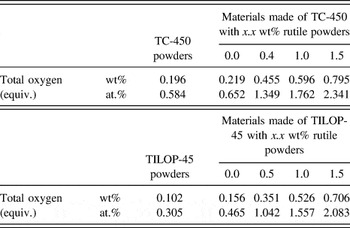
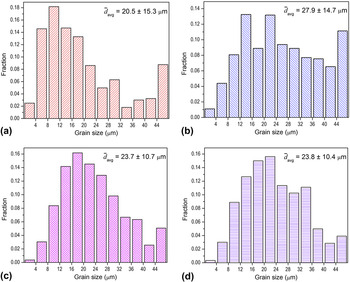
The oxygen, nitrogen and hydrogen contents of all the samples and original powders were measured. Table I summarizes the equivalent oxygen contents for all the samples and powders. As the nitrogen and hydrogen contents were approximately 0.015 and 0.01 wt%, respectively for all the samples and powders, which are trivial in comparison to the oxygen content and thus are converted into equivalent oxygen content. It is clear that the initial oxygen content was higher in TC-450 than that in TILOP-45, which then resulted in a higher oxygen content in the Ti samples made from TC-450 while mixing with the same amount of rutile powders. On the other hand, the results are consistent well with the expectation that the oxygen content increases with the rutile addition. What is more, large oxygen content Ti samples far beyond the commonly recognized oxygen limit (0.5 wt%) were produced. For the representative EBSD inverse pole figures of the as-extruded Ti samples made from TILOP-45 with an increasing rutile percentage, please refer to the supplementary figure, where the corresponding pole figures indicating an obvious basal texture are also shown. It is clear that, with increasing the oxygen content, the texture was merely changed for the samples. Figure 2 displays the grain size spread of the same samples collected from multiple areas. It can be seen that the mean grain size was similar in spite of the oxygen content. A similar result was actually obtained for the samples made from TC-450, only that they exhibited a mean grain size around 8 μm, instead of ∼24 μm for the samples made from TILOP-45 due to the different extrusion ratios.
The total equivalent oxygen content measured for the powders and the Ti products produced by mixing with rutile.

The grain size spread of samples (a) TILOP-0.0TiO2, (b) TILOP-0.5TiO2, (c) TILOP-1.0TiO2, and (d) TILOP-1.5TiO2.

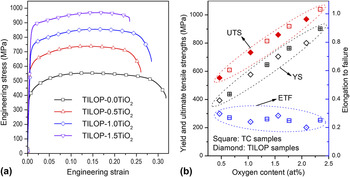
Figure 3(a) shows the representative tensile stress–strain curves for the TILOP samples, while figure (b) summarizes the 0.2% offset yield strength (YS), ultimate tensile strength (UTS), and elongation to failure (ETF) for both the TILOP and TC samples as a function of oxygen atom percentage. It is obvious that the strengths (both YS and UTS) increase dramatically and linearly with the fraction of oxygen, while the ETF is merely reduced. Disregard the different mean grain sizes in these two types of materials, it seems that the linear relationship between the strengths and oxygen is irrelevant to the powder type used to produce the samples. This interesting observation will be discussed further in relation to the role of various strengthening mechanisms.
(a) The representative engineering stress versus engineering strain curves for the TILOP samples mixed with various contents of rutile; (b) a collection of the engineering strengths and ETF for all the TILOP and TC samples mixed with rutile versus the oxygen atom percentage.

B. Oxygen introduced by self-diffusion
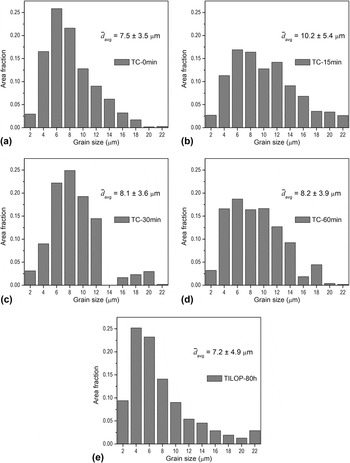
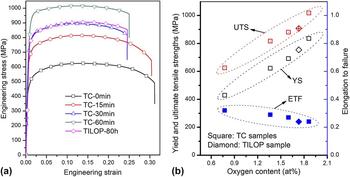
In this section, the experimental results obtained from the Ti materials produced by oxygen self-diffusion are demonstrated. Figure 4 shows the grain size spread of the samples subjected to different milling times. The samples made from TC-450 are simply named as TC-x min, where x indicates the milling time, while the sample made from TILOP-45 was named as TILOP-80 h. It can be seen from the histograms that the majority of grains are slightly less than 10 μm for all these samples. The mean grain sizes are also shown in line with the histograms, which indicate an almost similar grain size value for these samples. It is probably worth to note that the TC samples produced by mixing rutile powders also exhibited a mean grain size of around 8 μm, where the samples were also extruded using an extrusion ratio of ∼37. This may imply that the extrusion ratio had an influence on the grain size of the as-extruded samples. However, by using either an extrusion ratio of ∼17 or ∼37, the texture was almost consistent where the majority of grains oriented their basal plane normal perpendicular to the extrusion direction, as shown by the schematic inset in the supplementary figure. The equivalent oxygen contents in this batch of samples are shown in Table II. It is clear that the oxygen content increases with the milling time obviously, except for that of the TILOP-80 h specimen where a relatively low energy was used in comparison with that for TC samples in the milling process. Figure 5(a) demonstrates the engineering stress–strain curves for all the samples produced by HE-PBM, where the strengths and ETF are shown in figure (b) against the percentage of equivalent oxygen atoms. It again suggests that the strengths increased nearly linearly with the oxygen atom percentage, while the ETF was decreased slightly.
The grain size spread of samples (a) TC-0 min, (b) TC-15 min, (c) TC-30 min, (d) TC-60 min, and (e) TILOP-80 h.

The total equivalent oxygen content of the Ti samples produced by HE-PBM.

(a) The representative engineering stress versus engineering strain curves for the TILOP and TC samples produced by PBM; (b) a collection of the engineering strengths and ETF for the samples versus the oxygen atom percentage.

In summary, the experimental results indicated that the mechanical properties of the PM CP-Ti samples were mainly associated with the fraction of equivalent oxygen content, no matter what type of Ti powders was used for producing the samples. In addition, the high extrusion ratio might play a significant role in obtaining fine grains. Most importantly, superb mechanical properties, namely the high strengths and ductility, are obtained in CP-Ti by using PM methods, where a high oxygen content was doped into the Ti matrix as solid solution.
IV. DISCUSSION
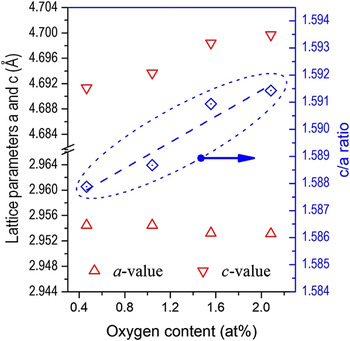
In this section, we provide a discussion regarding the oxygen solid solution in CP-Ti materials and its effect on mechanical properties. It is known that oxygen atoms have an atomic radius roughly equivalent to the volume of octahedral interstitials in the hexagonal close packed (HCP) Ti lattices. As a result, solid solution oxygen prefers to reside in the octahedral sites of an α-Ti lattice and thus act as an α-stabilizer. Reference Conrad12 Both the XRD and EBSD results confirmed that there was only α phase Ti existing in the above samples. In addition, the presence of oxygen solutes at the octahedral interstitials is usually known to expand the c-axis of an HCP lattice. It is confirmed by the peak shift associating with the basal plane shown in the inset of Fig. 1. By using the Bragg’s law, the values of lattice parameters a and c are calculated and shown in Fig. 6 in line with the oxygen percentage, where the values of c/a ratio are also presented. The lattice expansion along the c-axis is evident while that along the a-direction changes insignificantly, resulting in an increasing c/a ratio with oxygen. This result may reversely support the conclusion that the rutile powders were dissolved and the oxygen atoms were dispersed uniformly in the Ti matrix and resided in the octahedral sites of the lattice. This is because a shift of diffraction peak usually means either an expansion or contraction of a lattice along certain directions. For polycrystalline metals, such phenomenon is unlikely to be caused by internal strains (or stresses), as the internal strain is related to localized tension or compression force and are usually associated with peak broadening, instead of shifting. On the other hand, it can be easily caused by solid solution in polycrystals, as the expansion (or contraction) produced by interstitial impurities must be the same in various grains of the same lattice. Therefore, it is highly possible that the peak shift is attributed to oxygen solid solution. Combining with the excellent repeatability of tensile results, it may be concluded that, at least from a macroscopic view, the oxygen were uniformly dispersed in the materials. Certainly, due to the attractiveness of dislocations and twin boundaries to oxygen, Reference Yu, Qi, Tsuru, Traylor, Rugg, Morris, Asta, Chrzan and Minor15,Reference Joost, Ankem and Kuklja22 there might be a small variation of the distribution of oxygen atoms at an atomic view. In a word, the mixed rutile powders can be completely dissolved in the PM CP-Ti. In fact, studies in our laboratory have proved that, for most of common oxides while mixed and sintered with pure Ti powders, decomposition and solid solution are readily taking place.
The typical evolution of lattice parameters against an increasing oxygen atom percentage obtained from the TILOP samples produced by mixing with rutile.

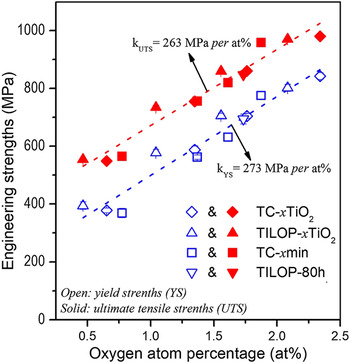
On of the important effects of oxygen solid solution in Ti is to render dramatically increased strengths. For the CP-Ti materials studied here, the strengthening contribution from precipitate or particle strengthening can be excluded as no particles or precipitates were observed in the samples. In addition, the work hardening should also be ignored due to the reason that the samples were all extruded at an elevated temperature. Importantly, all the samples exhibited a well-recrystallized grain structure, especially when extruded at a high extrusion ratio. Thus, the high strength with increasing the oxygen content is only possibly contributed by grain refinement and solid solution strengthening. Figure 7 displays a collection of the 0.2%-yield and UTSs for all the samples that were corrected in terms of mean grain sizes using an Hall–Petch coefficient of 0.40 MPa m0.5. Reference Lederich, Sastry, O’Neal and Rath23,Reference Li, Liu, Zheng, Pan, Zhao and Wang24 A linear relationship with a slope of around 270 MPa per at.% is evident between the YS (also UTS) and oxygen at.%, regardless of the Ti powder type and production method. In comparison to the grain refinement contribution, which is less than 80 MPa, the strength contribution from oxygen solid solution is magnificent. Therefore, it is concluded that the oxygen solid solution strengthening was the primary contribution to the strength improvement in the high oxygen content Ti samples.
A collection of strength values of all the samples after removing the contribution of grain refinement, plotted in line with the oxygen atom percentage.

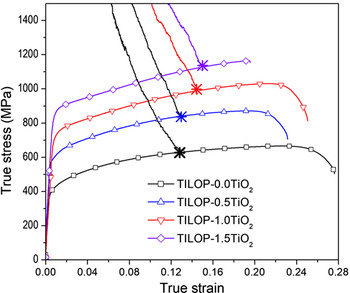
In addition to the strong hardening effect, the oxygen solid solution is also known to degrade the ductility of Ti materials significantly, especially when the mass fraction of oxygen reaches a value over 0.5 wt%. Reference Yan, Xu, Dargusch, Tang, Brandt and Qian17 Nevertheless, in our study, it revealed that the ductility of CP-Ti was hardly reduced up to an oxygen content of around 0.8 wt%, where the strengthening effect was never weakened. It is obvious that the oxygen content used here is far beyond the recognized limit, over which should an embrittlement effect for Ti be expected. The underlying reason why the high ductility was preserved in the PM CP-Ti is unclear and still under investigation. Yet, the increased uniform elongation due to oxygen addition might shed some light on this issue. Figure 8 displays the true stress–strain curves for the TILOP samples produced by mixing with rutile powders overlapped by the strain hardening rate, where the intersection points indicate the turning points for nonuniform deformation. It is clear that as the oxygen content increases, the intersection takes place at a large strain. This may be one of the reasons that led to the remaining large ETF in high oxygen content Ti.
The true stress–strain curves of the TILOP-xTiO2 samples, intersected with the corresponding strain hardening versus true strain curves, where the intersection points indicate the end of uniform deformation.

V. CONCLUSION
In this article, we reported some experimental results that are practically valuable to the development of Ti alloys with high strength and suitable ductility using oxygen addition. In the experimental trials, the oxygen content up to 0.8 wt% was added into pure Ti via different PM methods, where the PM CP-Ti products exhibited dramatically improved strengths (∼900 MPa for YS and over 1000 MPa for UTS) while also remained a high ETF (over 20%) under tensile loading. This result may shed some light on the use of oxygen as a strengthening element in Ti alloys so as to avoid further using expensive and/or toxic alloying elements.
Supplementary Material
To view supplementary material for this article, please visit https://doi.org/10.1557/jmr.2017.338.
ACKNOWLEDGMENTS
This work was partially supported by Japan Science and Technology Agency under Industry-Academia Collaborative R&D Program “Heterogeneous Structure Control: Toward Innovative Development of Metallic Structural Materials” and JSPS KAKENHI Grant Number JP16H02408.