Health is not valued till sickness comes
Thomas Fuller (1654–1734) Reference Fuller(1)
There is hardly a popular magazine or newspaper published these days that does not mention, somewhere within its contents, issues pertaining to health. The importance of health and assuming a healthy lifestyle is undeniable but perhaps the current scrutiny of health-related issues and the ongoing infatuation with defining what is a healthy lifestyle by itself needs monitoring.
Interestingly, general health and well-being have only recently become an area of significant interest in patients with neuropsychiatric disorders and ironically the changes that are of greatest concern appear to be the sequelae of medications.
Risk factors for cardiovascular disease and diabetes have been clustered into metabolic syndrome and although this is an important and useful advance, the criteria used vary and this has caused some ambiguity both in terms of defining risk and the need for intervention.
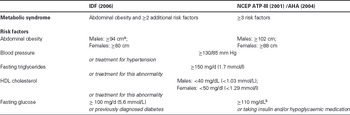
Several criteria have been applied to define metabolic syndrome Reference Eckel, Grundy and Zimmet(2) and in recognition of these inconsistencies the International Diabetes Federation (IDF) in 2006 developed a consensus statement and a new worldwide definition of metabolic syndrome Reference Alberti, Zimmet and Shaw(3). However, this is yet to be universally applied and earlier definitions continue to be applied, particularly the US National Cholesterol Education Program: Adult Treatment Panel lII (NCEP ATP-III) (4), which has been subsequently amended by the National Heart, Lung, and Blood Institute and American Heart Association (AHA) Reference Grundy, Brewer, Cleeman, Smith and Lenfant(5). While the two criteria are similar, there are several important differences. In comparison to the NCEP ATP-III criteria, the IDF definition places greater emphasis on abdominal obesity as it regards this an essential criterion and adopts a lower threshold (Table 1). Consequently, this makes comparisons across studies difficult. For example, applying these varying criteria to the same data set in a sample of patients with schizophrenia, differing prevalence rates for metabolic syndrome are achieved: 28.4% (NCEP ATP-III), 32.3% (AHA modified) and 36.0% (IDF) Reference De Hert, van Winkel and van Eyck(6).
Comparison between two of the most commonly used criteria for metabolic syndrome

a SE Asian males: ≥ 90 cm
b The AHA has proposed a lower threshold of 100 mg/dl for impaired fasting glucose. Reference Grundy, Berewer, Cleeman, Smith and Lenfant(7).
IDF = International Diabetes Federation
NCEP ATP = National Cholesterol Education Program Adult Treatment Panel
AHA = American Heart Foundation
HDL = high density lipoprotein
In addition, there is inconsistency as to whether the use of medications that treat metabolic abnormalities contributes to metabolic syndrome. Again, differences exist across the IDF and NCEP ATP-III criteria but there is also variation between studies as to how to apply each of the criteria. Information about medication usage is not always included in studies and therefore caution is needed when making direct comparisons across studies in regard to prevalence rates.
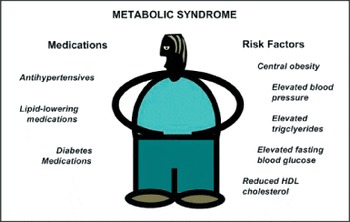
A brief review of prevalence studies in psychiatric populations indicates consensus in some areas, but diversity of opinion in others as to how medications should be incorporated into the definition of metabolic syndrome. When medications are included, there is greater clarity and consistency as regards the use of antihypertensives and antidiabetic medications in formulating the criteria for metabolic syndrome (Fig. 1). However, as regards triglycerides, there is considerable variance and to a lesser extent the same applies to high-density lipoprotein (HDL) cholesterol. In general terms, studies typically do not account for any medication that alter HDL cholesterol or triglyceride categorisations, particularly where NCEP ATP-III criteria are applied (Reference De Hert, van Winkel and van Eyck6,Reference Cohn, Prud’homme, Streiner, Kameh and Remington8–Reference McEvoy, Meyer and Goff10). Further, where they have been used to determine metabolic syndrome the actual lipid-lowering medications that are attributed to triglyceride and/or HDL cholesterol categories are usually not clearly specified (Reference Tirupati and Chua11–Reference Mathias de Almeida, De Macedo-Soares and Issler14).
Determining metabolic syndrome: the role of risk factors, use of metabolic medications and application of criteria. Note: The IDF and NCEP ATP-III and AHA modifications all apply slightly different criteria to determine metabolic syndrome with variations in cut-off levels, necessary criteria and use of medications. When considering the role of medications, the key difficulty arises in relation to lipid-lowering medications and in what way should they contribute to defining metabolic syndrome. Lipid-lowering medications (HMG coA-reductase inhibitors/statins, fibrates, niacin, bile acid sequestants) can have a broad clinical effect in that they can reduce cholesterol and also have an effect on reducing triglycerides, and in some cases increase HDL cholesterol Reference Malik and Kashyap(15,16). Therefore, a lipid-lowering medication may be prescribed for lowering low density lipoprotein (LDL) cholesterol, total cholesterol, triglycerides, or indeed a combination of all of these.

Therefore, the picture of health, or more accurately the picture of what is unhealthy, depends very much on the criteria used. Even if the IDF criteria emerge to be the universally accepted definition there still remain differences in the way the criteria are interpreted. Clearly, this is unsatisfactory, especially for clarity and validity in comparing prevalence rates, and it is important that this key issue is addressed whilst research into this critical area takes shape.
Statements of Disclosure
In the past three years Professor Gin Malhi has served on a number of international and national pharmaceutical advisory boards, received funding for research and has been in receipt of honoraria for talks at sponsored meetings worldwide involving the following companies: AstraZeneca, Eli Lilly, Jansen-Cilag, Organon, Pfizer and Wyeth. Danielle Adams and Jan Plain have no conflicts of interest.