When a child between eight and ten years of age, I was a diligent reader of the Christian Observer, and in particular of the articles in which the great battle was fought against the slave-trade. An impression was then made on my mind which never will be obliterated. A similar conflict is now convulsing this nation—an agitation which every successive year serves to deepen and widen. In this conflict the wise and good of other lands can materially aid us. Footnote 1
Thus Harriet Beecher Stowe, who energized the American abolitionist movement with her release of Uncle Tom's Cabin (1851–1852), described the influence of the British campaign against the Atlantic slave trade in shaping her youthful imagination. Born in 1811, Stowe would have been perusing these reports around 1820, well after Britain and the United States had legally ended their involvement in the international slave trade (1807), but during the heat of the battle for British emancipation. The periodical she read was the Christian Observer. It functioned as the popular literary arm of the so-called “Clapham Sect,” disseminating their views on slavery and other social issues. The Clapham group, active chiefly from 1792 to 1833 and comprised of figures such as William Wilberforce, Henry Thornton, and Zachary Macaulay, has been a subject of steady research.Footnote 2 For some time, scholars, most notably Boyd Hilton, have traced the cultural and political influence of the Claphamites on nineteenth-century Britain.Footnote 3 Recent studies have further explained the impact of their work on Victorian morality, political economy, and philanthropic networks.Footnote 4 Attention, however, has focused almost exclusively on the group's efforts in Britain, with little scholarly work to date on its connections and trajectories overseas.Footnote 5
When the British Parliament passed the Slavery Abolition Act in 1833, it achieved a reform sought for half a century. In the United States, the antislavery movement faced more prolonged opposition, not achieving success until 1865 when the Thirteenth Amendment was ratified after four years of civil war. Despite this chronological distance and longstanding tendencies to write in nationalist frames, historians have increasingly devoted attention to the transatlantic dimensions of the antislavery movement.Footnote 6 Recent trends which privilege the role of black resistance, transnational influences (especially those of Haiti and Sierra Leone), and the longue durée (activism antedating the American Revolution and extending past the American Civil War) have positioned us well to see the breadth of antislavery participation and exposed the limits of only attending to established political structures.Footnote 7 Within this literature, scholars recognize that Claphamites such as Wilberforce and Macaulay communicated with antislavery societies in the United States, but the impact of this correspondence has not been probed.Footnote 8 Meanwhile, historians of transatlantic evangelicalism have spotlighted the Clapham Sect as a paragon of the networks of social activism and piety that the revivalists inspired in Britain.Footnote 9 And from studies of the American Episcopal Church, we know that Wilberforce's Practical View warmed many to the evangelical revival.Footnote 10 Yet, for all of these strides, these bodies of literature on abolition and religion have not analyzed the role of the Clapham Sect in shaping the American abolitionist movement. This is significant because, as Britain's vanguard antislavery unit—and coupled with its evangelical mooring—the Clapham circle captured the attention of a diverse range of Americans—women and men, black and white.Footnote 11
This article examines the influence of Clapham thought and activity in the early American republic. It pursues a straightforward yet multifaceted question: How did the Clapham group's religious outlook affect the abolition movement in the United States? As establishment churchmen deeply influenced by the eighteenth-century Methodist revival, the Clapham Sect occupied a distinctive place within British evangelicalism. Like other “serious Christians,” they stressed the incapacitating effects of sin, God's righteousness given to human beings through Jesus Christ, and a life of active (“vital”) faith that yielded spiritual fruit. Yet, their social location bequeathed particular convictions that differentiated them from other factions of evangelicalism. As members of Parliament, they prioritized using the political order to effect social redemption. As middle/upper-class members of society, they insisted on stewardship of divinely granted resources (which led them, for instance, to become the chief patrons of evangelical Anglican clergy). And as children of merchant families or otherwise connected to trade overseas, they emphasized moral rectitude in imperial affairs. Drawing on David Bebbington's classic definition, on the spectrum of British evangelicalism, Clapham spirituality swung more toward the side of activism—especially via voluntary societies in the public sphere—undergirded by a crucicentrist theology.Footnote 12
This study recovers the transatlantic networks that existed with Clapham-associated figures while exposing the challenges, impact, and limitations of the Claphamites in America. Although the threads of overt ideological influence by the Clapham Sect are thin with respect to antislavery, I argue that more nuanced influences centering on race reveal the profound disparities that characterized the American responses to British evangelical abolition. A key finding, for example, is how influence was received differently by white and black activists. Catherine Hall has pointed out that the historiography of British abolition has suffered from a neglect of the agency of Africans, often regarded as mere pawns “to be pitied and rescued by their more civilised—and white—betters.”Footnote 13 That is, from a British imperial perspective, a focus on white abolitionists—Wilberforce as the “apostle of freedom”—papers over the history of slavery and racial trauma. The following investigation shows how African Americans selected and appropriated intellectual resources and categories of discourse from the Clapham activists. In so doing, it begins to address the problem of disjunction between chronicles of the enslaved and of emancipation.
From an American perspective, meanwhile, scholars of antislavery have been more sensitive to this disjunction, but there is still incongruity. The standard narrative of American abolitionism—rent by division after the early 1830s between immediatists and gradualists—assumes a closed system, the rift arising exclusively from factors in the American context. Thomas Harwood, in an article from over a half century ago, began to notice how antislavery activists’ relationship to Britain might have facilitated the breach when he argued that British evangelical abolitionism contributed to the ecclesiastical divisions in the United States that hastened the coming of the Civil War.Footnote 14 Yet, as evidenced by Manisha Sinha's prize-winning volume, assumptions of continuity persist—of a monolithic ascendant antislavery movement spanning the Anglo-American world.Footnote 15 This common rendering lacks attention to the different ways that various American actors—African American abolitionists, Episcopal churchmen, and evangelical women—related to the British movement. While Sinha, for instance, acknowledges “cosmopolitan cooperation” emanating from the British campaign, she does not examine these transatlantic interactions in much detail.Footnote 16 Responses to the Clapham Sect provide examples of both connection and disruption and thus serve as a way of explaining some of the fault lines between the fields of British and American abolition.
After first tracing transatlantic correspondence and reconstructing activists’ international relationships, I turn in the second half of this article to a close comparison of the U.S. abolitionists and the British movement which helps to explain why the positive influence was limited. The limiting factors, however, are as instructive as the influences. Transnational approaches to history have often erred by overlooking the transformation of religious and moral ideas across borders, leaving our understanding of transatlantic abolitionism theologically impoverished. The following analysis exposes the neglected role of race and competing moralities in nineteenth-century international religious history, confounding notions of simple transference of ideas around the Anglo-American world. As such, it qualifies the claims of historians who have argued that British abolitionism played an influential role in bringing about the end of American slavery.Footnote 17 In other words, it suggests that the contrasts across the Atlantic turn out, in this case, to be more important than the continuities.
I. Colonization and Race
The most direct form of connection between the Clapham figures and the United States occurred via correspondence and interest in Clapham publications in the half century bracketing 1800. These links were numerous and varied: Wilberforce knew and corresponded on several occasions with American “Founding Father” John Jay and partnered with U.S. diplomat Rufus King to translate and disseminate antislavery texts. Granville Sharp, a close associate of the Clapham coterie and sometimes included in their number (as on the memorial tablet outside Clapham's Holy Trinity Church), enjoyed a thirty-six-year correspondence relationship with Benjamin Rush, another U.S. Founder. Zachary Macaulay exchanged letters with New England theologian Samuel Hopkins and leading U.S. abolitionist William Lloyd Garrison. When Garrison visited London, he noted that Macaulay “knelt down by my side in prayer, and invoked the blessing of God upon my head.”Footnote 18 James Monroe solicited a copy of Henry Thornton's Enquiry into the Nature and Effects of the Paper Credit of Great Britain.Footnote 19 Thornton's Family Prayers was edited and warmly commended by Manton Eastburn, bishop of Massachusetts, and published in New York, Boston, and Philadelphia regularly during the mid-nineteenth century. Hannah More's Cheap Repository Tracts sold 40,000 copies in the United States, and she claimed that she had a correspondent in nearly every American town.Footnote 20 When Wilberforce died, many Americans held solemn remembrances. African Americans especially felt a deep affinity for Wilberforce; one eulogy sponsored by a black church in Philadelphia effused: “He lived for Africa—for us—for Christianity, humanity and virtue. Were it not for his great efforts in abolishing slavery and the slave trade, he could never have been particularly dear to us.”Footnote 21 An array of transatlantic connections was thus present. But how deep was the influence?
Americans were keenly interested in Britain's Sierra Leone experiment, which the Claphamites oversaw from the late 1780s to the 1810s. The founding of the British colony for African-descended individuals coming from Nova Scotia (having been formerly enslaved in the U.S.) and the pretext for legitimate trade in West Africa preceded its American counterpart, Liberia, by thirty years.Footnote 22 Samuel Hopkins, after learning to his surprise that he was not “alone in my opposition to the slave trade and the slavery of the Africans,” solicited information from Granville Sharp on the nature and progress of the British colonization project in Sierra Leone for free blacks.Footnote 23 Correspondence between Hopkins and Zachary Macaulay in 1795–1796 evinces collaboration in missionary colonization, selecting worthy free black emigrants to send to Africa. American antislavery politician Rufus King, moreover, lobbied Henry Thornton for black Virginians to be admitted to the Sierra Leone colony, which he believed would pave the way for full emancipation.Footnote 24 In other words, certain influential American abolitionists saw in Britain's repatriation project a promising solution for ending slavery in the United States.
As time went on, American activists looked to Claphamites for insight in their own colonization endeavors. Clapham responses to the American Colonization Society (ACS) proved, at least to U.S. abolitionists, the deleterious effects on race relations of the reverse Middle Passage ventures. The ACS, organized in 1816 ostensibly to aid free blacks in the United States with emigrating to Africa, proposed a scheme to deport all African Americans (an estimated population of 2.5 million people), pitched in terms of a jubilant return to their homeland and a quintessential opportunity for the Christian evangelization of Africa. Some were initially convinced of the plan's efficacy in leading toward the complete abolition of slavery, but the strategy—which led to the founding of the colony of Liberia—remained fraught with questions. As the ACS discerned the prudence of continuing in the mid-nineteenth century, a lengthy American publication used a “protest” from the early 1830s signed by Claphamites—such as Wilberforce, Macaulay, and George Stephen, the son of James Stephen—as fodder for proving the repugnancy of the colonization scheme. The group protest declared that “the professions made by the Colonization Society, of promoting the abolition of slavery, are altogether delusive. … It takes its root from a cruel prejudice and alienation in the whites of America against the colored people, slave or free. … It widens the breach between the two races.”Footnote 25 According to Wilberforce and company, the underlying reason for the ACS ruse, whether realized by its constituents or not, was racial prejudice and a desire to circumvent the establishment of an integrated society.
In an 1833 letter to Garrison, published in The Liberator (the foremost U.S. abolitionist newspaper), Macaulay drove home this point of racial difference as motivating colonization, arguing that the project was founded on “not the love, but the hatred and contempt of the negro race.” To those wrestling with the colonization strategy, Garrison felt that Macaulay's missive provided moral clarity on the racist motivations that amounted to nothing short of ethnic deportation—no small rebuke considering that American political leaders such as James Monroe, Andrew Jackson, and Abraham Lincoln supported the plan of colonization.Footnote 26 Although some colonizationists certainly operated with more worthy intentions than others, according to Macaulay, colonizationists “varnished over” “the unchristian prejudice of color” that birthed the ACS “with other more plausible pretences, and veiled [it] under a profession of a Christian regard for the temporal and spiritual interests of the negro.”Footnote 27 Garrison thus appropriated Macaulay to show that, in the name of Christian benevolence, racial bigotry was masquerading as freedom.
Furthermore, because the desire to share the “good news of Jesus Christ” to the “lost” in Africa played a seminal role in the Claphamite vision for Sierra Leone, racial identity featured in their imagination in a counterintuitive way. Decimated by disease and thwarted by cultural barriers, white missionaries quickly noticed their inferiority in the task of African evangelization and found greater success through former slaves such as Samuel Crowther. Consequently, commissioning black ministers became the modus operandi of Clapham missionary efforts.Footnote 28 In their investigations of race, scholars of the past often seek to discern whether race was a marker of identity and was used to discriminate. The assumption is that if race was constructed to differentiate, it is categorically injurious. Such is the case, for example, in Catherine Hall's claim that abolitionist fervor, particularly in Birmingham, created a vocabulary in which race was still a differentiator in British self-imagination; that is, those of African descent were acknowledged as men, but of a lesser order than the “manly citizens” of Birmingham.Footnote 29 What surfaces, however, in Clapham activists’ uses of race is not stratification but race as an advantage for the spread of the Gospel—not a category for servile labor, but of suitability and genius for communication of God's revelation. Instead of trying to explain away or ignore race, Clapham writings envision race as a force that multiplied the advance of the Christian message. While this conviction could be co-opted as a cloak for more insidious designs, such as racial separation or a white “purified” society in the United States, Clapham ideas of race complicated colonization schemes by infusing them with a heightened layer of racial empowerment.
II. African American Journals and Transatlantic Correspondence
The reception of Clapham ideas is even more clearly shown in antislavery pamphlets that were endorsed and published in American periodicals or reprinted as part of larger works. In 1828, Daniel Wilson—then vicar of Islington and later bishop of Calcutta—penned a tract on British colonial slavery that was reprinted in Freedom's Journal, the first African American newspaper in the United States. Wilson shared strong ties with the Clapham circle, often preaching to members of the Wilberforce, Macaulay, Stephen, and Grant families and even contributing an introductory essay to a new edition of Wilberforce's esteemed Practical View in 1826. In the piece that Freedom's Journal ran, Wilson contended that, while the cruelty and injustice of the slave system had been exposed, the Christian “obligations … of love” and “tenderness which it inspires” had been underemphasized in considerations of the topic. Looking to the past, Wilson reminded his readers:
It is the boast of Christianity that she has diffused a spirit of kindness amongst mankind—that she has mitigated the horrors of war—abolished the gladiatorial spectacles—ameliorated the treatment of captives—introduced hospitals and infirmaries for the sick—banished infanticide—improved the condition of the laborious classes—set apart one day in seven for the repose of the body and the instruction of the mind—softened the administration of absolute governments.Footnote 30
Considering these triumphs of Christian love, Wilson found it inexcusable that Christians should defend oppressors and eschew mercy. Loaded with appeals to biblical texts, Wilson looked to Jesus himself, who was sacrificed “upon the cross to … break down all differences of race” and who taught his followers to operate with the same deracialized outlook.Footnote 31 The editors of the African American journal found resonance with how Clapham thought connected Christian obligations of love as embodied foremost in Christ's sacrificial offering with understanding racial identity.
Indeed, African American appeals to Claphamites provide especial evidence of the traction that the latter's work gained across the Atlantic. In David Walker's 1828 address to the Massachusetts General Colored Association—which, like Wilson's article on slavery, was disseminated in Freedom's Journal—he invoked Granville Sharp and Wilberforce as examples of “our white brethren and friends” among a nation which had “done one hundred times more for the melioration of our condition, than all the other nations of the earth put together.”Footnote 32 Such appeals open up another salient area of consideration regarding Clapham transatlantic influence. In American periodicals, the names of Wilberforce, Sharp, and Thomas Clarkson were regularly strung together as exemplary moral reformers. While Wilberforce (who led the political charge) and Clarkson (who galvanized popular support) enjoyed a brilliant working relationship in their abolitionist endeavors, Clarkson was not part of the community at Clapham. But his lengthy partnership and shared moral convictions with Wilberforce and the Claphamites bolstered their transnational influence.Footnote 33 Indeed, the branches of British antislavery tended to get elided when transferred to the United States and Americans saw commonalities instead of tensions within the movement. To American perceptions, Clarkson and Wilberforce inhabited the same sphere—“their souls were Siametrically knit,” as one African American eulogist of Wilberforce noted—and therefore brief attention must be given to how Clarkson furthered the influence of the British moral reformers across the Atlantic.Footnote 34
The ecumenical British and Foreign Anti-Slavery Society, the successor organization to the Anti-Slavery Society formed by Wilberforce, Macaulay, and Clarkson in 1823, dispatched a number of religious abolitionist tracts across the Atlantic.Footnote 35 Clarkson authored at least three lengthy pieces himself, one to Southern clergy and slave-owning planters and two to Northern Christians, the last of which was printed in The Liberty Bell, an annual abolitionist gift book.Footnote 36 Clarkson's forty-two-page letter to the South reads like an epistle of Saint Paul, reproving pastors for falling into the trap of condoning slavery. Whereas antislavery sentiment could still be ambivalent toward race—and indeed facilitated racist ideologies—Clarkson rooted his argument in the promise of future racial equality. He offered proof of black acumen based on the writings of African American poet Phillis Wheatley and black British author Ignatius Sancho, the mathematical prowess of an African student at Balaam's Academy in Clapham, and the diplomatic “genius” of Henri Christophe, king of Haiti. In Clarkson's view, there was no possibility of a morally acceptable form of slavery: “Slavery is full of sin. … It is sin in its source. It is sin in its effects.”Footnote 37 It both originated in a sinful impulse to steal and begat further sins such as lust, adultery, deceit, and even murder. Clarkson thus anticipated and repudiated the gap that Southerners struggled over—between what Eugene Genovese described as “the realities of slavery and an ideal system of servitude they considered biblically sanctioned.”Footnote 38 There was no way, according to Clarkson, of bifurcating brutality, dehumanization, and racism from slavery.
Clarkson received multiple responses, both truculent and sanguine. James Henry Hammond, former governor of South Carolina, contended that the vast “increase of horrors” since the abolition acts passed—with more Africans on average being trafficked and greater fatality rates occurring along the Middle Passage—demonstrated that Clarkson was, in reality, working against God's designs for the “moral and humane institution” of slavery. His cantankerous letter likened Clarkson to Peter the Hermit whose preaching spurred the First Crusade.Footnote 39 Meanwhile, positive appeal to Clarkson's arguments can be seen in correspondence with New York abolitionist Lewis Tappan and in an 1845 publication of abolitionist Henry Wright. According to an 1844 letter from Tappan to Clarkson informing the British antislavery pioneer of progress in the United States, Tappan believed that “Divine Providence raised you up.”Footnote 40 A similar missive between the two the following year glowingly attested to the “wide circulation” that Clarkson's writings had attained “through the anti-slavery newspapers in this country [the United States].”Footnote 41
More revealing, however, was Henry Wright's essay. Those “who make merchandise of his [God's] image,” Wright contended, should be barred from Christian fellowship. For added force, Wright included a sizable extract from a letter that he had recently received from Clarkson in support of such church discipline. Clarkson opined that the shame of ostracism might be a means to seeing the “moral evil” of “turning an intellectual man, made in the image of God, into a brute.”Footnote 42 Wright's treatise, by staking its formulaic “proofs” against slaveholding in a theology of the imago Dei gleaned from Clarkson, represents the most direct appropriation of the British reformers’ religious convictions. To summarize, then, U.S. abolitionists—especially African Americans—looked to the Claphamites and their affiliates for theological capital in championing racial dignity and empowerment.
III. Charles McIlvaine, George Thompson, and Frederick Douglass
Beyond republications and correspondence, the Claphamites’ American influence is clear in the work of three figures who crisscrossed the Atlantic and associated with Clapham members. Charles Pettit McIlvaine (1799–1873)—Episcopal bishop of Ohio and emissary to Britain for Abraham Lincoln during the American Civil War—was, as biographer Richard Smith has argued, “the central figure in the evangelical Anglican-Episcopal Atlantic community” of the nineteenth century.Footnote 43 On his first visit to England in 1830, McIlvaine was accompanied by James Milnor, former member of the U.S. House of Representatives and subsequently rector of Saint George's Chapel in New York City. The two together contributed to various British benevolent society annual meetings as agents for American affiliate groups. During his 1835 trip to Britain, McIlvaine was active in speaking before the Church Missionary Society, the British and Foreign Bible Society, the Prayer Book and Homily Society, and the London Society for Promoting Christianity Amongst the Jews—all of which were either founded or directed by Claphamites. Although McIlvaine's focus in the 1830s was on conversion and evangelization—not antislavery—he certainly imbibed the abolitionism in Clapham thought. For instance, during his initial visit to Britain, McIlvaine heard Wilberforce speak at a meeting of the Anti-Slavery Society.Footnote 44 In McIlvaine's meetings with both Hannah More and Josiah Pratt (who was part of the clerical network associated with the Claphamites), the topic of antislavery reform arose.Footnote 45 More significantly, McIlvaine's trips—and especially his connections to Clapham figures—initiated cooperation between the benevolent societies of the two countries. Such volunteer civic groups would provide the organizing apparatus for the American antislavery movement.
With McIlvaine as a bridge, Clapham beliefs began to mold the transatlantic evangelical Anglican imagination. Five sermons of the Clapham parson John Venn and six of Clapham-associated Charles Simeon were selected, reprinted, and commended by McIlvaine to those in his Ohio diocese. The chosen homilies were intended for “the promotion of Family Religion” and advance a theology centered on the complete corruption of human nature through sin and the triumph of divine grace in Christ.Footnote 46 Indeed, Clapham influence on American preaching is revealing: McIlvaine's friend William Meade, bishop of Virginia, wrote that he could “well remember the impression made upon me” by Wilberforce's Practical View and the sermons of Beilby Porteus, bishop of London, with whom the Clapham Sect was intimate. “I felt that, if ever permitted to preach, I had only to present the views set forth in these books, and my hearers must be converted,” Meade announced. Along with Hannah More's writings, these books “republished in America … contributed to elevate and evangelize the style of preaching in our Church.”Footnote 47 In short, through McIlvaine and his fellow bishops, Clapham theology revitalized the Episcopal Church in America and contributed to the growth of evangelicalism within it.
Regarding McIlvaine's attitude toward slavery, his early career—as rector at churches in Washington, DC and Brooklyn, New York, and as chaplain and professor of history and ethics at West Point—displayed few signs of antislavery sentiment. But his years in the episcopate reveal progression from a muted abolitionist position—unwilling to address the matter publicly at diocesan conventions to avoid fracturing the denomination and country—to a fully committed, activist approach by the start of the Civil War—openly condemning the moral evil of slavery and the national sin of tolerating it.Footnote 48 In all, four lengthy visits to England between the 1830s and 1850s left the bishop well-connected with Anglican leaders, benevolent societies run by Claphamites, and especially Albert Edward, Prince of Wales. Consequently, President Lincoln selected McIlvaine to advance the Union cause with ruling parties in the United Kingdom—notably, Lord Shaftesbury and, through him, Lord Palmerston and Lord Russell.
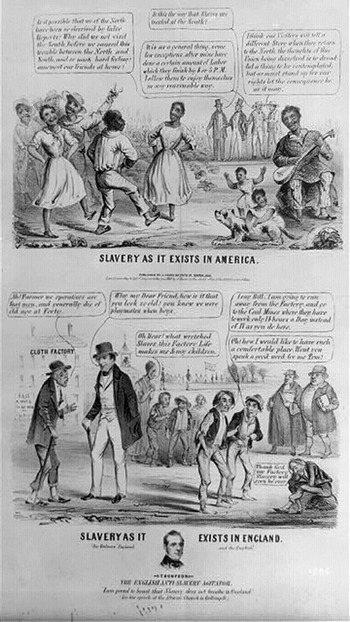
The transatlantic nature of antislavery is embodied perhaps most saliently in George Thompson (1804–1878). The British activist and chief advocate of Wilberforce's 1833 parliamentary bill toured the United States during 1834–1835, 1851, and the Civil War. To American reformers, he was the face of British abolition, and his first visit to the United States won future activist Angelina Grimké to the abolitionist cause.Footnote 49 Thompson, moreover, spent time with African American abolitionist Frederick Douglass during the latter's 1846 visit to Britain. Yet, while Thompson's transatlantic linkages are clear, the challenge arises in discerning theological influences and continuity with the Clapham outlook. William Lloyd Garrison, the most well-known American abolitionist, recalled Thompson's resolutely Christian-informed approach to abolition: “I trust it will be remembered, throughout the mighty struggle that is now going on in this country, that it was upon the shoulders of Christianity, the anti-slavery cause was carried triumphantly to the goal of emancipation.”Footnote 50 Thompson sustained the devotion and activism of the Clapham group and was guided by similar Christian commitments, but there is little parallel in the way of an orienting theological vision. The effects of Thompson's activism, however, mirrored that of Clarkson's transatlantic letters—ossifying positions and heightening rhetoric both favorable and hostile toward emancipation (fig. 1).
Cartoon accusing George Thompson and other British antislavery “agitators” of hypocrisy for overlooking England’s “factory slavery”—purportedly far worse than Southern plantation slavery—“boast[ing] that Slavery does not breathe in England.” John Haven; Slavery as it Exists in America; Slavery as it Exists in England, 1850, lithograph, American Cartoon Print and Filing Series, PC/US-1850.H385, no. 1 (B-size), Prints and Photographs Division, Library of Congress, Washington, D.C., http://www.loc.gov/pictures/item/2008661524/.

Frederick Douglass (1818–1895), the third key Atlantic-traversing figure, was fond of looking to Wilberforce, Clarkson, and Sharp as examples. He saw England as “still the mother country, and the mother, too, of our abolition movement.”Footnote 51 In fact, August 1—the day in 1834 that the British Slavery Abolition Act went into effect—became a rival independence day for white and black American abolitionists alike. Douglass even made one-to-one comparisons of Clarkson, Sharp, and Wilberforce to American counterparts. The black abolitionist went so far as to acknowledge that “England is responsible for our civil war,” holding it up as a positive good to the alternative of nationalized slavery.Footnote 52 Thus, in a historical irony, African American activists acclaimed the nation that originally enslaved their ancestors. Douglass's idealization of Britain was calculated, however, as he recognized the racial and class-based slavery that still proliferated there.Footnote 53 For Douglass, Britain granted an alternative perspective to U.S. society where “the dealers in the bodies and souls of men … give [their] blood-stained gold to support the pulpit, and the pulpit, in return, covers [their] infernal business with the garb of Christianity.”Footnote 54 Douglass continued his critique, saying that “between the Christianity of this land [the United States], and the Christianity of Christ, I recognize the widest, possible difference.”Footnote 55 Slavery was so closely bound up with Christianity in America that it was nearly impossible to pull apart the strands.
For Douglass, the heart of the matter was that, in contrast to the British church's decisiveness, the American church was reluctant to work for the end of slavery. That reluctance perpetuated racial degradation:
There, the question of emancipation was a high[ly] religious question. It was demanded, in the name of humanity, and according to the law of the living God. The Sharps, the Clarksons, the Wilberforces, the Buxtons, and Burchells and the Knibbs, were alike famous for their piety, and for their philanthropy. … The anti-slavery movement in this country will cease to be an anti-church movement, when the church of this country shall assume a favorable instead of a hostile position towards that movement.Footnote 56
Douglass imagined that piety and philanthropy—Christian devotion and care for others—were conjoined in the lives of people like Wilberforce and his accomplices. Following their example, only when the American church embraced its God-given mission to bring freedom to the captives would the mainstream abolitionist movement in the United States align with it. Such pleas might have yielded moral force, but as Van Gosse suggests, the Anglophilia of African American abolitionists such as Douglass and David Walker, combined with white American Negrophobia, fomented British-American and intra-American tensions.Footnote 57 Invoking a perceived British moral superiority prevented broader reception of Clapham principles.
Thus, we observe various transatlantic bonds—but what do they mean? Most of the references by American abolitionists to Wilberforce, Clarkson, and others are adulatory; they see these figures as inspirational, but not formative at a level that appropriated underlying Clapham intellectual or religious views. Where theological ties were present, such as in the case of McIlvaine, the call for antislavery was subverted by a fiercer desire for national unity. Clapham influence, moreover, seemed to have a polarizing effect. Abolitionists who appealed to British reformers, in their militant ardor, fanned division among Americans. In short, Clapham evangelical theology did cross the Atlantic—most notably through McIlvaine—and Clapham-motivated abolition did give credibility to American antislavery authors, but the two were not coterminous.
IV. The American Milieu
Having explored several of the direct exchanges between British and American activists, we are now well-positioned to investigate the contextual nuances that further affected the reception of Clapham ideas. Evangelicals on both sides of the Atlantic were often united in the moral crusades that bequeathed the abolitionist, temperance, social purity, Sabbatarian, and social gospel movements in the nineteenth century.Footnote 58 However, American evangelicals came to realize there was a divergence between the British and American leaders of abolitionism. Henry Ward Beecher, younger brother of Harriet Beecher Stowe and a Congregationalist clergyman, contrasted Garrison's “courage that amounts to recklessness” with the “moderation and urbanity of Clarkson, or the deep piety of Wilberforce” as the reason for why Garrison's leadership in America failed.Footnote 59 Although Garrison may have been viewed as carrying the mantle of Wilberforce, his zealotry detracted from unifying the reform movement. Personal temperament affected reception.
Indeed, when antislavery activists in the United States did appropriate Clapham ideas, their visions often led to different points of emphasis. Those who became immediatists focused on the results, seemingly at all costs, while gradualists harped on the means and method—particularly on Wilberforce's endurance in nearly forty years of continuous agitation and his charity toward opponents. American evangelical abolitionists in the latter category appealed to the comportment of Wilberforce in contrast to the chief American leader Garrison. For example, Catharine Beecher, sister of Harriet and Henry, found no “evidence of his [Garrison] possessing the peculiar traits of Wilberforce.” As Garrison publicly excoriated the American Colonization Society, Beecher evaluated: “Compare this method of carrying a point, with that adopted by Wilberforce and his compeers, and I think you will allow that there was a way that was peaceful and Christian, and that this was not the way which was chosen.”Footnote 60 Beecher and other gradualists’ critique of the perceived Machiavellian approach of Garrison illuminates a core reason for the American antislavery campaign's ineffectiveness: infighting and division. It was a question not of moral rectitude but of the method taken, where Wilberforce and company held deeper influence.
Beyond issues of personal transmission, Americans tussled with the weight of an alternate morality. Sean Scott has drawn attention to the competing moralities of antislavery and unity in the United States—a tension that was not at stake in the same way in the British context.Footnote 61 Because American Christians were pulled in different directions, some seeing abolishing slavery as the greater good and some intent on keeping the nation from fracturing, the failure to synthesize their theology impeded the full embrace of Clapham religious thought. Clapham figures did not—and likely could not—speak to a setting where national unity was up for debate. British abolitionism, moreover, was expedited because the church was tied to the state. Moral issues were perceived as more directly impinging on the fate of the nation in Britain than in the United States, with its comparatively pluralistic civic society. While one might expect the prophetic voice to be forfeited by being part of the church-state establishment, the Clapham preachers found ways to maintain it from within the Anglican hegemony.
In addition, in the American South, orthodox Christian slaveholders were suspicious of abolitionists in part due to the latter's heterodox faith commitments. As a particular social cause became of greatest concern to some, they migrated toward Unitarianism and Universalism—positions that were often seen by Christian slaveholders as abandoning the historic faith. Evangelicals had only to look at the religious identity of prominent voices preaching abolition—from William Ellery Channing to Ralph Waldo Emerson (not to mention Garrison's jettisoning of biblical authority)—to see that abolition and theological innovation were bedfellows.Footnote 62 In sum, Clapham influence was limited because American leaders’ methods encouraged more radical (and more divisive) action, because American national unity complicated an issue that was more straightforward in Britain, and because American abolitionism seemed to tether itself to misbelief.
V. The Moral Responsibility of Empire
In a less direct—though equally paramount—way, the spread of Clapham abolitionist sentiment to the United States, especially to the American South, was hindered by the perception of Britain as a moral police force, wagging its imperial finger at the world post-1833. Relations between Britain and antebellum America were strained—even on the brink of war in the 1830s and 1840s due to disputes over the Canadian border, the slave vessel Caroline, annexation of Texas, and the Pacific Northwest territories—and it does not take much imagination to perceive how British antislavery calls would have been received.Footnote 63 John Calhoun, U.S. Secretary of State, publicized a comment from Lord Aberdeen, the British Foreign Secretary, grandiosely claiming that “Great Britain desires and is constantly exerting herself to procure, the general abolition of slavery throughout the world.”Footnote 64 Coupled with this, Gerald Horne has insightfully drawn attention to Haiti to probe the deeper context of strained U.S.-British relations. To Southern perceptions, Britain was seeking to “internationalize the perceived domestic matter of slavery.”Footnote 65 The rhetoric, moreover, unmasks how race was at the heart of the divide in American and British approaches. As Senator Robert Hayne from South Carolina—in reaction to whether the United States should recognize Haitian independence—demurred: “You find men of color at the head of their Armies, in their Legislative Halls and in their Executive Departments.”Footnote 66 While British activists were certainly not free of racial denigrations, their embrace of black intellectual and political abilities (at least theoretically) accentuated the divide and American circumspection.
At the same time, a genuine fear prevailed among British political leaders that other countries were leaping ahead of them economically, especially after the loss of the West Indian haul. Consequently, abolition became a central negotiation chip in British diplomacy, and American abolitionists could be viewed as agents of British schemes to undermine American national power. The British and Foreign Anti-Slavery Society's World Convention in 1840 seemed a ploy to destabilize countries with slave societies—what David Brion Davis memorably called a “Trojan Horse to enable ‘perfidious Albion’ to gain control of Cuba, Texas, and even such other regions as Canton.”Footnote 67 In short, Britain's moral suasion, even when altruistic, appeared self-righteous when it was rebroadcast by abolitionists such as Garrison and subversive to national unity. In 1859, Henry Wise, governor of Virginia, outright blamed British influence for John Brown's raid on Harpers Ferry and claimed that “the real groundwork of dissension in this country … is the foreign influence of Great Britain.”Footnote 68
To grasp the fullness of the situation in the 1830s–1850s requires a brief foray into British nationalist politics concerning the monitoring of trade among other nations and their colonies in the early nineteenth century. Here is where Clapham influence was oblique but significant. Countries hostile to Britain—particularly, France, Holland, and Spain—were profiting by transporting goods across the Atlantic under neutral flags. Claphamite James Stephen, in a protracted piece entitled War in Disguise; or, The Frauds of the Neutral Flags (1805), appealed to the “Rule of 1756,” which refused British trade with neutral states who were also trading with states belligerent to Britain. By a return to enforcement of this rule, Britain's economic losses relative to its enemies would be reduced, if not altogether reversed.Footnote 69 While there is little mention of the slave trade in Stephen's pamphlet itself, we learn, intriguingly, from Wilberforce's sons that Stephen's underlying aim was propagation of abolition around the Atlantic.Footnote 70 British privateers searched neutral vessels, interdicting the supply of slaves into enemy colonies by neutral slavers. In this way, Stephen's moral convictions became the basis for contriving an argument for imperial protection that took on nationalist tones and won greater approval.
The renewed enforcement of the Rule of 1756, however, ultimately hampered the embrace of British abolitionist ideals across the Atlantic in two significant ways. First, it contributed in large measure to the War of 1812 between Britain and the United States. Hundreds of U.S. ships were seized for transporting goods to French and Spanish colonies in the West Indies, and British-American tensions finally reached a breaking point in June of 1812. Second, reinstatement of the rule strengthened a culture of moral privateering that fully came to bear after the 1833 Abolition Act passed. As Richard Huzzey's recent monograph on so-called gunboat abolitionism demonstrates, a moral platform was co-opted to project imperial power through militant means. Britain entered into treaties with various countries to enforce abolition around the Atlantic. Antislavery thus became a “hegemonic ideology” for Victorian Britain, and as we have seen, abolitionist fervor counterintuitively bred racist attitudes.Footnote 71 Clapham influence was limited in yet another way—because of American resentment of British moral interventionism.
VI. Conclusion
The preceding investigation has illuminated various Clapham connections to the United States that have heretofore not been brought under a single frame. The direct links—correspondence, appeals to Clapham writings, and the Atlantic-traversing abolitionists with ties to Claphamites—manifest that the influence of the Clapham movement can no longer be viewed outside of a transatlantic context. Wilberforce, Macaulay, and Sharp, along with their friend Thomas Clarkson, united networks of activists in the black and the white Atlantic.Footnote 72 Yet, such connections generated surprising results. National context mattered greatly in the reception and use of Clapham ideas. American republications and letters convey apparent influence as they showcase the high esteem in which Americans held Clapham figures. However, personal linkages with those who traveled back and forth—Charles McIlvaine and Frederick Douglass from the United States and George Thompson from Britain—begin to reveal fissures, which become more pronounced in the ideological divergences surrounding gradualist versus immediatist approaches, theological orthodoxy, and post-emancipation Atlantic privateering.
In the end, transplantation of Clapham ideals to America suffered for two principal reasons. First, Clapham abolition was based singularly on the immorality of chattel bondage. In the United States, activists influenced by the Claphamites grappled with a moral responsibility they felt to preserve the Union, which seemed to clash with an ethic of immediately purifying society of the sin of slavery. In fact, the former often trumped the latter in importance in Clapham inheritors’ decision matrix (notably, Bishop McIlvaine). In Britain, the union of the nation was foreclosed; there was no unity/purity moral divide to negotiate. Second, in the splintering of the American abolitionist movement, the two sides both appealed to the British moral reformers. But gradualists like the Beecher family emphasized the manner in which Wilberforce conducted the campaign—with personal piety and with charity toward opponents—whereas immediatists like Garrison emulated Wilberforce's drive for results to the point of personal combativeness and rejection of biblical authority.
Yet, while influence may have been constrained, close attention to the trajectory of Clapham thought exposes significant subtleties. For one, reception in part depended on race. Clapham discourse on racial identity (as distinct from antislavery) complicated colonization programs and empowered black Americans theologically. According to the writings of Clapham associates that African American journals selected to print, creation in the image of God affirmed a universal human dignity, and Christ's atonement removed lines of racial otherness. Indeed, Wilberforce's transatlantic volleys with a clergyman in Jamaica—though beyond the scope of this project—further highlight Claphamite challenges to received interpretations of racial inequality (particularly, stadial theories of human development) and offer a fertile avenue for future research.Footnote 73 A second subtle influence lay in diplomacy. As Clapham principles shaped Britain's policing of the seas and became enacted in imperial policy, British moralism created friction and resentment with the U.S. government. Between 1833 and 1861, Britain occupied a curious role in the American mind. While the Union Jack symbolized to Britons their nation's commitment to freedom in the Atlantic world and British men-of-war served as heroic manifestations of liberty to the enslaved, white Americans often saw the British colors on the high seas as a sign of meddling. What was perceived as a heavy-handed moral superiority thwarted a more ubiquitous reception of Clapham principles.
While scholarly investigations have rightly taken note of the great exchange of ideas across the Atlantic throughout the modern era, on the level of antislavery activism, the story is not one of facile or triumphant continuity. Abolitionist ideas were adjusted as they crossed national boundaries. Attending to religion in the transnational story reveals the fault lines. Tension in moral priorities, the role of personality, and the relationship of antislavery to race elucidate the disparities and pinpoint the challenges of British reformers’ efforts in America. Such findings challenge the way we think about transatlantic, or for that matter transnational, influence. Our tendency is to fix our attention on linear or overt effects. But if influence equally occurs in asymmetrical ways—through phenomena like African American (non-elite) appropriation and through diplomatic decisions—the appearance of discontinuity cannot be the end of the narrative. The range of responses becomes akin to a dispersive prism, scattering light on the receiving context. From this vantage point, the Clapham Sect stands out as an example of how the ideas of a high-profile group in religious history cannot be taken solely at face value. An important difference exists between the fact of influence (mere connection or appeal) and the content of what is received. Far from a simple cautionary tale about ideological fragmentation, then, this study shows how religious values land, disperse, and are asymmetrically appropriated on other shores.