A fair, transparent, and nondiscriminatory peer-review process lies at the core of the scholarly publication process and builds the foundation of a trustful relationship among authors, reviewers, and editors (American Political Science Review 2020, v). Yet, gender publication gaps in leading political science journals—including the American Political Science Review (APSR)—cast doubt on the integrity of this process (Breuning et al. Reference Breuning, Gross, Feinberg, Martinez, Sharma and Ishiyama2018; Brown and Samuels Reference Brown and Samuels2018; Teele and Thelen Reference Teele and Thelen2017). This aligns with recurrently voiced concerns across disciplines questioning whether editors and reviewers from different scholarly groups (e.g., qualitative versus quantitative, senior versus junior, and male versus female) hold manuscripts of authors from other groups to different standards (Card et al. Reference Card, DellaVigna, Funk and Iriberri2020; Lee et al. Reference Lee, Sugimoto, Zhang and Cronin2013).
A fair, transparent, and nondiscriminatory peer-review process lies at the core of the scholarly publication process and builds the foundation of a trustful relationship among authors, reviewers, and editors.
Most studies emphasize the role of editors as the driver of group-specific biases in editorial processes (Squazzoni et al. Reference Squazzoni, Bravo, Dondio, Farjam, Marusic, Mehmani, Willis, Birukou and Grimaldo2020; Teele and Thelen Reference Teele and Thelen2017). Others correlate submission with publication rates and point to systematically lower submission rates of female authors (Brown and Samuels Reference Brown and Samuels2018; König and Ropers Reference König and Ropers2018). Because lower submission rates might be caused by a higher risk aversion of women (Djupe, Smith, and Sokhey Reference Djupe, Smith and Sokhey2019) and/or perceptions that the peer-review process is organized at the expense of female work (Brown et al. Reference Brown, Horiuchi, Htun and Samuels2020), explorative or correlational insights into gender bias risk omitted variable bias from unobserved confounders. In our mixed-design analysis of the APSR, we first explore reviewer bias across authorship type and then use within-manuscript variation from manuscripts that were evaluated by both male and female reviewers to identify the gender-specific impact of reviewers who provide feedback to both editors and authors. Stated differently, if men and women assess the same manuscript to other standards, a nonrandom assignment of reviewers to manuscripts based on gender may set the foundation for gender bias in the review process.
For the period 2007–2020, our explorative findings suggest that a gender bias exists: reviews for manuscripts by male authors reviewed only by men are, on average, more positive than for other types of authors, whereas reviews are more positive for female-authored manuscripts than for other types of authors if only women are reviewing. To enhance the internal validity of our findings—and compared to studies that do not consider unobserved confounders in the peer-review process—we then control for the quality of manuscripts to examine gender-specific reviewer differences in feedback for the same manuscript. Our analysis considers not only reviewer recommendations but also other feedback such as length, sentiment, and duration of reviews. We find that women, who constitute a smaller share of the reviewer pool, provide more positive feedback than men independent of authorship. In addition to a 7% higher likelihood for a non-reject recommendation, the review tone of female reviewers is more positive. However, their reviews take a few days longer but are independent of authors’ gender.
Given the feedback differences between men and women, we recommend ensuring gender diversity in the peer-review process by having at least one woman and one man as manuscript reviewers. This recommendation attempts to consider direct and indirect effects of gender bias by taking into consideration a gender-specific distribution of available reviewers. If the pool of reviewers consists of potential authors, it is likely that—due to their lower share—female authors will have less time for conducting, submitting, and publishing their own research when they spend much of their time to review manuscripts. Inviting more than one female reviewer can increase slightly the chances of a manuscript surviving the peer-review process. However, without compensation, there is a risk to increase the gender gap in top-ranked science journals such as the APSR, which already can be inferred from gender-specific rejections of review invitations.
Given the feedback differences between men and women, we recommend ensuring gender diversity in the peer-review process by having at least one woman and one man as manuscript reviewers.
REVIEWER RECOMMENDATIONS AND GENDER BIAS
A double-blind review process as implemented by the APSR, in which neither the reviewers nor the authors are aware of the others’ group-specific identity, ideally prevents biased reviewing behavior based on author characteristics. Several studies find that double-blindness increases submissions from women (Budden et al. Reference Budden, Tregenza, Aarssen, Koricheva, Leimu and Lortie2008) and provides a fairer review process compared to a single-blind review process with reviewer knowledge about the author (Tomkins, Zhang, and Heavlin Reference Tomkins, Zhang and Heavlin2017). However, the level of anonymity of the double-blind review process can be questioned in practice as reviewers may be able, for example, to infer the identity of authors from “gendered research agendas” (Key and Sumner Reference Key and Sumner2019). As a result, authors may be held to different standards conditional on their gender. It is a disadvantage that women are facing in many areas of the academic profession (e.g., Hengel Reference Hengel2017; Mengel, Sauermann, and Zölitz Reference Mengel, Sauermann and Zölitz2019; Sarsons Reference Sarsons2017).
Our empirical analysis of the APSR’s double-blind peer-review process encompasses submission and review data for the period 2007–2020. We restrict our sample to manuscripts submitted after July 1, 2007, and for which a first decision was made before May 31, 2020 (König and Ropers Reference König and Ropers2021). To obtain information on the gender of authors and reviewers, we coded first names using the genderizeR-package (Wais Reference Wais2016).Footnote 1 Regarding authorship, we differentiate among women only, men only, and mixed-gender submissions of all authors, whereby we aggregate solo and co-authorship by gender.
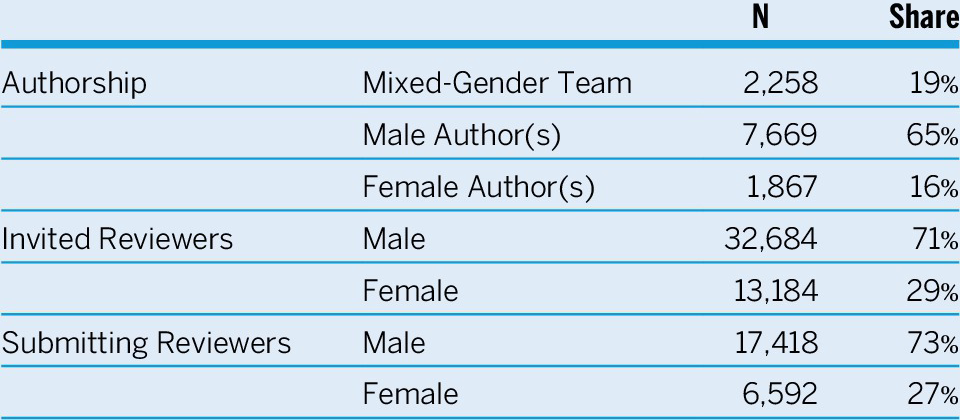
Table 1 lists descriptive statistics by gender. In the overall sample, 65% of submissions were authored by solo male authors or all-male teams; 16% of manuscripts were submitted by solo female authors or all-female teams; and 19% of submissions were authored by mixed-gender teams. Among invited reviewers, women comprise 29% of all reviewers, which corresponds to their 28% share of tenured political science faculty (Alter et al. Reference Alter, Clipperton, Schraudenbach and Rozier2020). The gender distribution among “submitting” reviewers—that is, reviewers who not only accepted a review request but also submitted their report—was slightly lower with 27% of reviewers being women.
Descriptive Statistics: Gender in the APSR

Note: Sample includes manuscripts submitted after July 1, 2007, that received a first decision before May 31, 2020.
Recommendations of reviewers (i.e., accept, minor revision, major revision, or reject) are important signals for the decision of editors to continue with peer review. Assuming that we can recode them on a standard ordinal scale (with equiprobable occurrence probability), we would determine, for example, that an “accept” recommendation is clearly better than a “minor-revision” recommendation. However, this comparison becomes more complicated when the number of reviews increases. To make the set of recommendations comparable across manuscripts with different numbers of reviews, we followed Bravo et al. (Reference Bravo, Farjam, Moreno, Birukou and Squazzoni2018) and calculated a review score for each manuscript. This measures the “value” of a given combination of recommendations by counting all other possible combinations for a given number of recommendations that are both clearly better and clearly worse than those that a manuscript received. For example, for a manuscript with an {accept, major revision} recommendation set, there are two recommendations that clearly are better: {accept, accept} and {accept, minor revision}; six combinations that clearly are worse; and one combination, {minor revision, minor revision}, that is unclear.Footnote 2 Being bound between 0 and 1, the review score allows a comparison of scores for manuscripts that received a different number of review recommendations and is calculated as follows:
 $$ \mathrm{review}\ \mathrm{score}=\frac{\#\mathrm{worse}}{\#\mathrm{better}+\#\mathrm{worse}} $$
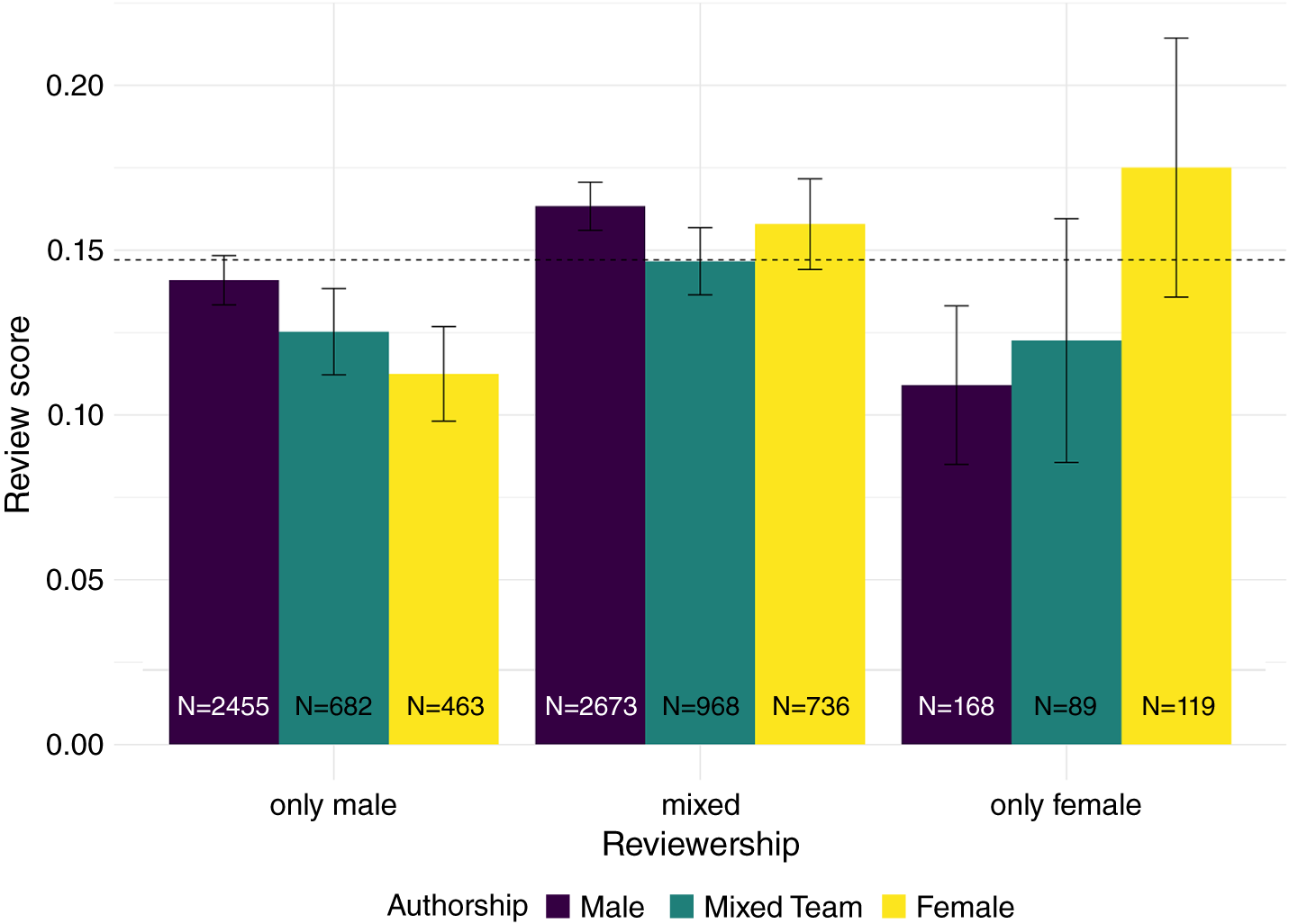
Figure 1 displays the average review scores for the three gender compositions of authors from three different gender-reviewer compositions: all male, mixed-gender, and all female. Two seemingly opposing patterns stand out. First, the average score depicted on the left and right categories in the graph show that if the reviewer composition consists of only the same gender, there is a strong indication of gender bias. That is, when a manuscript is reviewed only by men, male authors receive higher scores compared to scores of manuscripts written by mixed-gender and female authors. Conversely, higher review scores for female authors are associated with female reviewers compared to the scores of male and mixed-gender authors. Both trends point toward the existence of gender bias in the peer-review process. They suggest that both male and female authors are held to different standards conditional on whether they are being reviewed by only male or only female reviewers.
When a manuscript is reviewed only by men, male authors receive higher scores compared to scores of manuscripts written by mixed-gender and female authors.
Average Review Scores by Different Reviewer Gender Compositions Conditional on Authors’ Gender Composition
Note: The dotted horizontal line indicates the average review score in the sample.

Second, figure 1 also shows that the category of mixed reviewers in the middle of the graph is a less gender-biased pattern. There is little variation in the review scores conditional on the type of authors (i.e., 2,673 male, 968 mixed-gender, and 796 female authors) if manuscripts were reviewed by at least one male and one female reviewer. This is an important finding because it suggests that manuscripts—independent of the type of authorship—are held at similar standards when they were reviewed by mixed-gender reviewers and if we assume that the manuscript quality is comparable. Methodologically, however, we cannot rule out that the differences are driven at least partially by selection effects (Helmer et al. Reference Helmer, Schottdorf, Neef, Battaglia and Rodgers2017). In the APSR case, manuscripts written by women have a much larger percentage of female reviewers (36%) compared to both mixed-gender teams (30%) and male authors (25%). Another selection effect concerns field-specific particularities, such as “methodological proclivities” (Teele and Thelen Reference Teele and Thelen2017, 433). All of this suggests that we need to control not only for the type of author (i.e., solo/team, male/female, or mixed gender) but also for the “intrinsic quality of manuscripts” (Squazzoni et al. Reference Squazzoni, Bravo, Dondio, Farjam, Marusic, Mehmani, Willis, Birukou and Grimaldo2020, 4) to ensure the internal validity of findings.
CONTROLLING FOR MANUSCRIPT QUALITY AND REVIEWER FEEDBACK
To control for the quality and other invariant manuscript-level confounders, we turn to a fixed-effects approach at the manuscript level that focuses on the category of mixed-gender reviewed manuscripts. This category constitutes a subsample in which each manuscript received reviews from at least one female and one male reviewer. The resulting regression coefficient for female reviewer estimates the average difference between female and male reviewers using variation from the same manuscript.
We focused on four observable measures of reviewer feedback. Our first measure is the reviewers’ recommendation to either reject or proceed with the peer-review process—often considered as the key signal of reviewers to editors. We used non-reject recommendations as the main measurement for the level of reviewer support. A dummy variable was coded as 1 if a reviewer provided a non-reject recommendation (i.e., major revision, minor revision, or accept).
Recommendations are only one type of reviewer feedback. The second measure and one of the main benefits that authors can take from the review process—which ends with a rejection for more than 90% of submitted manuscripts in premier scholarly outlets such as the APSR—is the substantive feedback of the reviewers who are helping them to improve their research (APSR 2020). Although it is difficult to measure the overall substance of a review, one measure—admittedly very crude—is its length (i.e., number of words).Footnote 3 This may serve as a proxy for how seriously a reviewer assesses a manuscript and how much professional feedback is (quantitatively) provided to improve an author’s research.
The third measure examines the sentiment or tone of the submitted reviews. Specifically, if reviews that women receive are systematically more negative coming from the larger share of the male-reviewer pool, it may discourage them to continue their research and resubmit to a premier scholarly outlet. We used a dictionary approach and calculated a sentiment score defined as the difference between the percentage of words with positive and negative connotations. Higher values measured a more favorable tone. The classification into positively and negatively associated words is based on the Non-Commercial Research Use Word–Emotion Association Lexicon (Mohammad and Turney Reference Mohammad and Turney2013) in the quanteda package (Benoit et al. Reference Benoit, Watanabe, Wang, Nulty, Obeng, Müller and Matsuo2018).
The fourth relevant measure of reviewer feedback, in particular for young professionals, is the time it takes for reviewers to submit their reviews. Hengel (Reference Hengel2017) found that the editorial decision-making process is longer for female authors than for male authors. In contrast, Card et al. (Reference Card, DellaVigna, Funk and Iriberri2020) assessed reviewer differences in the time it takes for reviewers to submit their reports and did not find any differences. To examine whether this duration differs for male and female authors at the APSR, we focused on the time that a reviewer accepted a review until he or she submitted the review.
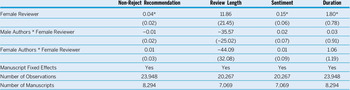
Table 2 presents the average difference between female and male reviewers for each of the four dependent reviewer-feedback variables holding constant quality and other invariant characteristics at the manuscript level. In each model specification, the observations are weighted by the inverse number of reviews for the manuscript and standard errors are clustered at the manuscript level. The baseline is the feedback from male reviewers.
OLS Regression Results: Gender-Reviewing Feedback

Notes: *** p<0.001, ** p<0.01, * p<0.05. Standard errors are clustered at the manuscript level.
We first examine the probability of receiving a non-reject recommendation using a linear probability model. According to the estimates shown in table 2, column 1, female reviewers are about 3 percentage points more likely to give a positive (i.e., non-reject) recommendation on average (standard error: 1 percentage point). Given an average probability for a non-reject recommendation of about 42%, the estimated average effect constitutes an increase of about 7%.
Unlike for recommendations, however, we did not observe a statistical difference in review length between male and female reviewers, on average. Moreover, the substantive size of the point estimate of about 17 fewer words (standard error: 10) also is small given an average text length of about 880 words for manuscripts with at least one male and one female reviewer.
Not only the length of a review but also its tone may affect how authors perceive their submission experience. In this regard, female reviewers seem to be more positive in their tone when writing a review, as shown in the estimates in table 2, column 3. Relative to an average sentiment score of about 3.2, the point estimate of 0.16 corresponds to an increase of about 5%.Footnote 4
Regarding review duration, small differences between female and male reviewers become apparent. Female reviewers take about 1.6 days longer, on average, to submit their review (standard error: 0.4). However, this average difference of less than two days is negligible given an average review duration of about 33 days for the APSR.
In summary, our analyses of reviewer feedback indicate gender differences among reviewers, on average, for three of the four examined outcome measures. We find a higher share of non-reject recommendations and a more positive review tone by women. Moreover, women seem to take about one to two days longer for their review, independent of authorship type, but we do not find differences in review text length. The next section examines whether these differences are amplified conditional on authorship type.
THE ROLE OF AUTHORSHIP TYPE
In the final step of our analysis, we examined whether men and women hold manuscripts to different standards conditional on authorship type. To do so, we interacted reviewer gender with authorship type in our fixed-effects specification. Table 3 presents the coefficient estimates. The interaction effects capture aggregate differences in the assessment between female and male reviewers for different authorship types relative to the average difference between men and women that is estimated for the reference group (i.e., mixed-gender-team submissions). For a causal interpretation, we assumed that the differences between men and women do not change to a different degree for other reasons.
OLS Regression Results: Gender-Reviewing Feedback and Authorship Type

Notes: ***p<0.001, ** p<0.01, * p<0.05. Reference groups are male reviewers and mixed-gender-team authorship. Standard errors are clustered at the manuscript level.
The estimates in the reference group—mixed-gender-team authorship type—correspond to the average estimates shown in table 2. Accordingly, women are more likely than men to provide a non-reject recommendation, are more positive in their writing, and take slightly longer to submit a review. Moreover, for none of the four outcome measures do we find statistically significant interaction effects for other authorship types—that is, statistical differences in the estimate for a female reviewer relative to the reference group (i.e., mixed-gender-team authorship type).
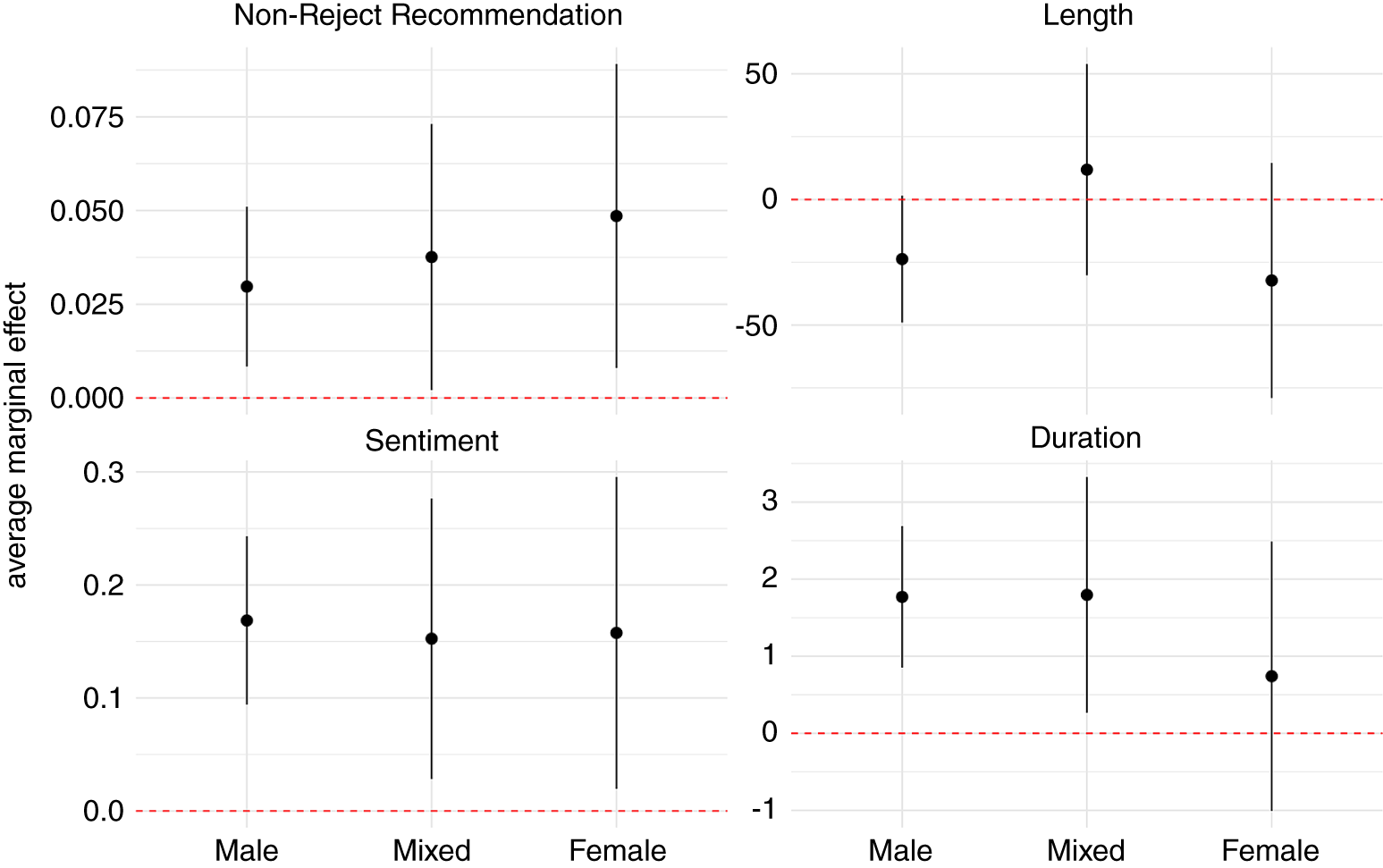
Figure 2 illustrates the corresponding average marginal effects of a female reviewer conditional on authorship type. Two patterns are worth mentioning despite the lack of statistically significant interaction effects. First, the point estimate for the probability of receiving a non-reject recommendation from a female reviewer versus a male reviewer is larger for female-authored manuscripts than for male-authored and mixed-gender-team-authored manuscripts. Second, although female reviewers take about two days longer than men to review both male and mixed-gender-team-authored manuscripts, the marginal effect is statistically indistinguishable from zero for the subgroup of female-authored manuscripts.Footnote 5
Average Marginal Effect of a Female Reviewer Relative to a Male Reviewer Conditional on Authorship Type

Nevertheless, the findings do not allow us to conclude that the type of feedback from men or women depends on authorship type (i.e., gender composition).Footnote 6 Stated differently, the findings suggest that male and female authors are not held to different standards by men and women when they are reviewed by a mixed-gender composition of reviewers.
DISCUSSION AND CONCLUSION
Although a fair peer-review process is essential for a trustful relationship among editors, reviewers, and authors, the underrepresentation of women in many premier scholarly journals casts doubt on the integrity of this process and raises concerns about gender bias. Our analysis of reviewer feedback at the APSR detects a biased pattern in the recommendations of reviewers for authors of the same gender. Using a fixed-effects approach to control for selection effects in reviewer assignment and unobserved confounders at the manuscript level, we also find differences in reviewer feedback between men and women who review the same manuscript. On average, women are more likely to provide a non-reject recommendation and also are more positive than men in their review tone. Moreover, women seem to take about one to two days longer for their review, independent of authorship type, although we find little differences in review text length. However, our results do not suggest that any of these differences in reviewer feedback are conditional on the authorship type for the subsample of manuscripts with mixed-gender reviewer composition.
This study makes two main contributions to the literature on gender bias in premier scholarly journals. First, it adds to an earlier study examining various editorial outcomes in the APSR, including reviewer recommendations. König and Ropers (Reference König and Ropers2018) documented that female reviewers are more likely to provide non-reject recommendations than male reviewers in line with the findings of this article. However, their analysis additionally provided suggestive evidence that women might be particularly friendly toward all-female-author teams (König and Ropers Reference König and Ropers2018, 850). Yet, these authors acknowledge that the across-manuscript comparison of their research design “lack[s] objective information on the quality of manuscripts” (König and Ropers Reference König and Ropers2018, 851) to confidently exclude bias from unobserved confounders that may be driving the reviewer differences between men and women. This caveat is addressed through the fixed-effects approach in this study that focuses on within-manuscript variation to hold the quality of manuscripts constant.
Second, our findings align with recent causal analyses in other disciplines that also control for manuscript-level confounders in reviewer recommendations (Card et al. Reference Card, DellaVigna, Funk and Iriberri2020). By looking closer at different types of reviewer feedback, our study highlights that it is possible to reduce gender bias in several outcomes when reviewers have a mixed-gender background. In this category, we do not find an association between the gender of authors and the overall feedback they receive. If we assume that no confounders exist in the assignment of manuscripts, then our findings suggest that bias can increase or decrease the publication chances of specific groups of authors.
Given the general positivity of female reviewers and that the same-gender reviewer bias for male-authored submissions is slightly smaller than the relative difference in review scores that female-authored submissions receive from all-female compared to all-male reviewer compositions, an exclusive assignment of female reviewers to manuscripts of female authors may reduce the gender publication gap.Footnote 7 However, if such an assignment comes at the expense of increased professional services for women in the discipline, this risks disproportionately keeping women from conducting and submitting their own research to premier scholarly outlets. We have already observed a decrease in women who accept invitations to review for the APSR. Although the acceptance rate of men and women was almost the same until 2011, there is an incrementally increasing gap emerging with a 9-percentage-points lower acceptance of invited female reviewers for manuscripts submitted in 2019 (see also Breuning et al. Reference Breuning, Backstrom, Brannon, Gross and Widmeier2015).
In comparison, our manuscript fixed-effects analysis holding constant confounders like manuscript quality suggests that the assignment of a mixed-gender composition with at least one male and one female reviewer provides a fair peer-review process for all types of authors. Given the high predictive power of the review score for a manuscript’s editorial outcome (as shown in table S4, model 2, in the online appendix), and considering a fair review process for all submitting authors, it is possible to aim for an even distribution of women (or other underrepresented scholarly groups) across manuscripts that are sent out for review. For example, with approximately 30% women in political science (Alter et al. Reference Alter, Clipperton, Schraudenbach and Rozier2020) and typically three reviewers per manuscript in premier journals, this implies inviting at least one woman as reviewer, on average, without the risk of overburdening female scholars.
DATA AVAILABILITY STATEMENT
Research documentation and data that support the findings of this study are openly available on the PS: Political Science & Politics Harvard Dataverse at https://doi.org/10.7910/DVN/LMDUEQ.
Supplementary Materials
To view supplementary material for this article, please visit http://dx.doi.org/10.1017/S1049096521000937.