For decades, archaeologists have challenged each other to move past traditions of androcentric archaeological research and explore the material cultural representations of gendered spaces in past North America (e.g., Claassen and Joyce Reference Claassen and Joyce1997; Conkey and Gero Reference Conkey and Gero1991; Nelson Reference Nelson2006; Spector Reference Spector, Conkey and Gero1991). The topic of menstruation and menarche, however, has seen less archaeological attention (Claassen Reference Claassen2011, Reference Claassen and Claassen2016; Schohn Reference Schohn2001). Menstruation, a simultaneously quotidian and momentous aspect of women's lives, is rarely discussed in archaeological literature. This article addresses this “invisible” element of life (Galloway Reference Galloway, Claassen and Joyce1997) and explores the archaeological signatures of menstrual and menarche lodges in prehistoric North America, as exemplified by an unusual archaeological structure situated in the Interior Pacific Northwest.
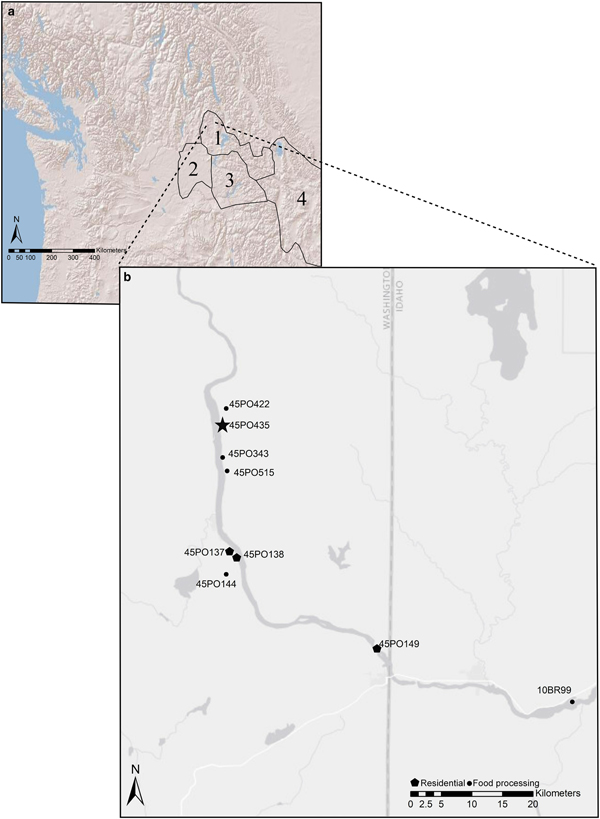
Located in the Pend Oreille Valley in northeastern Washington (Figure 1), Feature 2 of the Flying Goose site (45PO435) was an isolated structure, 3 m in diameter, which burned in situ and lacked a conventional archaeological assemblage or nested features. Feature 2 resembled a small residential structure in size and shape, yet its contents yielded an unusual and well-structured stratigraphic sequence of charred and reddened, or rubified, materials without a hearth. In our review of Plateau archaeology, we found few incidents of burned structures and no references to rubified materials within structures. In lieu of other archaeological correlates, we use ethnographic and archaeological data to create architectural expectations for the assemblage (Table 1), focusing on the paleoethnobotanical and geoarchaeological datasets. To fully address the puzzling sedimentary sequence and paucity of domestic remains, we re-create the events and use-life of the structure. Drawing on theories of structured deposition (Richards and Thomas Reference Richards, Thomas, Bradley and Gardiner1984), ethnographic analogy, and gender archaeology, we explore the archaeological and anthropological signatures of women's spaces in past North America. We ultimately argue that the isolated feature was not domestic and instead represents the location of a menstrual lodge from the Late Archaic period (2000–250 cal BP).
The Flying Goose site (45PO435) in northeastern Washington: (a) Physiographic map of the Pacific Northwest with Interior Salish group lands outlined: 1. Kalispel, 2. Spokane, 3. Coeur d'Alene, 4. Flathead and Pend d'Oreille (loosely adapted from Smith Reference Smith1961; Walker Reference Walker1998:ix); (b) The Pend Oreille Valley and 45PO435 with contemporaneous sites.

Ethnographic and Archaeological Dimensions of Plateau Structures and Features.

* Fire-modified rock
Note: Table adapted from Carney Reference Carney2016:35–37, Table 4.1, and reprinted as Supplemental Table 1. Wherever possible, descriptors, dimensions, and inferred assemblages were drawn from sources geographically and culturally close to the Kalispel people and the Pend Oreille Valley, Washington (Figure 1a).
Structured Deposits and Ethnographic Analogy
In the Columbia Plateau, small and non-domestic structures are poorly defined in the archaeological literature; thus, we looked to theoretical frameworks to tease out meaning from the well-structured deposits encountered at Flying Goose. Drawing on post-processual theories of structure and ritual, European archaeologists use the phrase “structured deposition” to discuss the ways in which deliberate artifact deposition may have been a meaningful practice for prehistoric peoples (Garrow Reference Garrow2012:92). These studies attempt to interpret depositional practices that defy traditionally functionalist explanations (Brück Reference Brück1999a:328). The term is frequently employed in the material culture analysis of Neolithic, Bronze Age, and Iron Age assemblages (e.g., Brück Reference Brück1999a; Pollard Reference Pollard2001; Thomas Reference Thomas1991, Reference Thomas1999), and worldwide similar concepts in interpretations of geoarchaeological data are used (e.g., Roos and Wells Reference Roos, Wells, Roos and Christian Wells2017).
Many authors distinguish between formal or “odd” deposits (with rare or unusual artifacts) and spatial material patterning, noting that these categories form endpoints on a continuum of archaeological deposition (Garrow Reference Garrow2012:94; Richards and Thomas Reference Richards, Thomas, Bradley and Gardiner1984:191). Garrow (Reference Garrow2012:107) argues that structured deposition is often used as a “catch-all” for any unusual deposit, citing scholarly work that primarily sees deposits as the material remnants of ritual behavior (e.g., Bell Reference Bell1992; Van Keuren and Roos Reference Van Keuren and Roos2013; Walker Reference Walker2002). However, as Brück (Reference Brück1999a:317–319) points out, the dualistic conception of ritual and function in much of archaeological interpretation obscures the reality of prehistoric life in which meaningful or symbolic practices may have been embedded within daily actions. Rather than searching for points of behavior on a continuum, we argue for a historical and practice-based approach to depositional behaviors (Brück Reference Brück1999a:327; Thomas Reference Thomas2012:126). By understanding the formation of archaeological deposits within culturally specific social contexts, we can seek to deduce cultural practices, both functional and ritual, enmeshed in ways of living (Pollard Reference Pollard2001).
There is also a tendency to focus on physical objects in the interpretations of structured deposits. More recently, some archaeologists have begun to recognize that places have unique life histories that are significantly different than other places or objects (Boivin Reference Boivin and Gosden2004; Walker Reference Walker, Skibo, Walker and Nielsen1995). Recent geoarchaeological and paleoethnobotanical work has contributed to the understanding of structured deposits and their formation processes (e.g., Goldstein and Hageman Reference Goldstein, Hageman, Staller and Carrasco2009; Kidder and Sherwood Reference Kidder and Sherwood2016; Morehart Reference Morehart2011; Roos and Wells Reference Roos, Wells, Roos and Christian Wells2017; Van Keuren and Roos Reference Van Keuren and Roos2013; Walker Reference Walker2002). These works look at patterning in horizontal space and stratigraphic sequencing to reconstruct behavior. Close examination of stratigraphic sequential organization allows for the interpretation of historic sequences or events in the past (Walker Reference Walker2002). In addition to traditional artifact analyses, or in the absence of these data, environmental archaeological methods are explicitly useful in delineating meaningful patterns of behavior and human practice in the past.
To assess meaning within those past human practices, we look to the regional ethnographic literature. Northwest scholars frequently rely on ethnographic analogy for the creation of testable hypotheses and in interpreting archaeological data (e.g., Coupland et al. Reference Coupland, Clark and Palmer2009; Grier Reference Grier and Miller2007; Lepofsky et al. Reference Lepofsky, Smith, Cardinal, Harper, Morris, Gitla, White, Bouchard, Kennedy, Salomon, Puckett and Rowell2015). In these and our views, historic and ethnographic accounts are not static records of indigenous cultures in a specific period but are part of a long-term and historically contingent cultural context embedded within a group's history (Currie Reference Currie2016; Pauketat Reference Pauketat2001; Sassaman and Holly Reference Sassaman and Holly2011). The rich ethnographic record of the Interior Pacific Northwest provides ample material for creating, testing, and interpreting archaeological data (Mandelbaum Reference Mandelbaum and Spier1938; Ray Reference Ray1939, Reference Ray1954; Smith Reference Smith1936–1938, Reference Smith1961, Reference Smith, Andrefsky, Burtchard, Presler, Samuels, Sanders and Thorns2000; Teit Reference Teit1900, Reference Teit1928). These works capture indigenous Native American lifeways during the colonial era of the late nineteenth and early twentieth centuries. Admittedly, this time period was fraught with disease, population loss, and trauma (e.g., Silliman Reference Silliman2005; Trigger Reference Trigger1984), but we maintain that these records still provide a glimpse into native lifeways at a particular point in time.
In exploring non-domestic structures and past gendered space, Plateau ethnographic accounts illustrate that men and women had distinct but complementary roles with equal rights (Ackerman Reference Ackerman, Klein and Ackerman1995, Reference Ackerman2003; Ray Reference Ray1939, Reference Ray1954). Task-oriented division of labor was the most defining difference between genders, most notably for food procurement (Ackerman Reference Ackerman, Klein and Ackerman1995:80, Reference Ackerman2003; Markstrom Reference Markstrom2008:54; Ray Reference Ray1939:24–25; Reference Ray1954:25–26). Women were strongly associated with plant harvesting, berry processing, and earth-oven cooking in the ethnographic past (Ray Reference Ray1954:98; Smith Reference Smith, Andrefsky, Burtchard, Presler, Samuels, Sanders and Thorns2000:7.5; Teit Reference Teit1928:341). Among Interior Salishan speakers, this division of labor was so distinct that the presence of men near baking ovens was considered taboo (Teit Reference Teit1928:185). We recognize that the remains of plants or plant processing is not necessarily the result of solely female activities; both sexes did and still do partake in all provisioning activities (Brumfiel and Robin Reference Brumfiel and Robin2008). However, observations of past ethnographers and practice today among many Native American and First Nations groups of female-led gathering and cooking activities indicate these practices have deep cultural and historical roots. We therefore draw on ethnographic data to augment our discussion of the well-structured deposits at Flying Goose and in the identification of past gendered spaces.
The Flying Goose Site
The Flying Goose site (45PO435) is located in the floodplain of the Pend Oreille River on the ancestral lands of the Kalispel Tribe of Indians. The Kalispel people are part of the Columbia Plateau culture area (Kroeber Reference Kroeber1947; Lahren Reference Lahren and Walker1998); their traditional territorial range stretched east to west across the northern Rocky Mountains (Smith Reference Smith1936–1938, Reference Smith1961, Reference Smith, Andrefsky, Burtchard, Presler, Samuels, Sanders and Thorns2000). The Pend Oreille Valley is bordered by the Selkirk Mountains to the east and the Calispel Range to the west. The Pend Oreille River, which flows north into Canada to the confluence with the Columbia River, inundates seasonally in late spring and early summer, depositing fine sediment in low-energy, floodplain environments.
The valley rests at the convergence of two major forest vegetation communities; the northern portion of the valley (where 45PO435 is located) falls within the mesic western hemlock zone, while the southern portion is within the more xeric ponderosa pine zone (Daubenmire Reference Daubenmire1968; Franklin and Blinn Reference Franklin and Blinn1988). While a diverse array of tree species occur across the well-drained hillsides and slopes, low-lying areas are characterized by open meadows, bogs, and marshes that often inundate from the seasonal snowmelt flooding.
Unlike other areas within the Pacific Northwest, salmon were not readily available in this watershed. The valley is instead known for bull trout (Salvelinus confluentus), ungulate resources, and, most notably, its abundance of camas (Camassia quamash), a cultural keystone species whose bulbs served as an important food for both coastal and interior groups (Garibaldi and Turner Reference Garibaldi and Turner2004). Camas is common among the valley's riparian and poorly drained habitats (Franklin and Blinn Reference Franklin and Blinn1988:171; Thoms Reference Thoms1989). Groups from neighboring watersheds traveled to the Pend Oreille Valley specifically to harvest and process this abundant food source (Anastasio Reference Anastasio1972). The archaeological record attests to this historic pattern, with most recorded sites in the valley consisting of earth oven features from geophyte processing (Andrefsky Reference Andrefsky, Burtchard, Presler, Samuels, Sanders and Thoms2000 et al.; Gough Reference Gough1997; Thoms Reference Thoms1989; Walker Reference Walker2004).
At the time of European contact, the Kalispel were semi-sedentary, logistical collectors (sensu Binford Reference Binford1980), following patterns of seasonal movement for resources and social gatherings (Smith Reference Smith, Andrefsky, Burtchard, Presler, Samuels, Sanders and Thorns2000:7.22–7.62). Winter was considered a time for communal, familial, and ritual gatherings and was spent in tule (Scirpus sp.) mat lodges in low-elevation villages along rivers. These congregations included large communal buildings, multifamily tule-mat long lodges, smaller nuclear family mat lodges, above and underground storage features, and special-use structures such as sweat and menstrual lodges. In the warmer months, villages fissioned and dispersed to resource locations in the uplands due to seasonal flooding of the river. During this time, smaller groups targeted and procured specific resources to prepare and store for consumption during the winter months.
The Late Archaic (2000–250 BP) period within Columbia Plateau culture history marks a shift toward the logistically oriented settlement systems, delayed return economies, and winter villages that is reflective of the ethnographic period (Ames Reference Ames and Gregg1991, Reference Ames2012; Chatters and Prentiss Reference Chatters and Prentiss2005; Prentiss et al. Reference Prentiss, Chatters, Lenert, Clarke and O'Boyle2006). By 1500–700 cal BP, several residential sites are recorded within the Pend Oreille Valley along with archaeological evidence for discrete resource processing areas, temporary camps, storage pits, and extensive refuse middens (Dohm Reference Dohm, Andrefsky, Burtchard, Presler, Samuels, Sanders and Thorns2000). In the mid-Fraser River region and the lower Columbia River Valley, researchers have identified aggregations of villages and increased sedentism, resource intensification, and some evidence for socioeconomic inequality at the beginning of this period (e.g., Chatters and Pokotylo Reference Chatters, Pokotylo and Walker1998; Hayden Reference Hayden1997; Kuijt and Prentiss Reference Kuijt, Prentiss, Prentiss and Kuijt2004; Prentiss et al. Reference Prentiss, Chatters, Lenert, Clarke and O'Boyle2006).
The Flying Goose site was occupied between 577 and 683 cal BP (Dorwin Reference Dorwin2018:86) at the height of the Little Ice Age, when global temperatures became much cooler, summers shorter and wetter, and sea ice and alpine glacier advanced (Bradley and Jones Reference Bradley and Jones1993; Grove Reference Grove1988; Mann et al. Reference Mann, Zhang, Rutherford, Bradley, Hughes, Shindell, Ammann, Faluvegi and Fenbiao2009; Naftz et al. Reference Naftz, Klushman, Michel, Schuster, Reddy, Taylor, Yanosky and McConnaughey1996). However, occupation and economic preparation of root resources in the Pend Oreille Valley appear unaffected by these changing global climatic conditions. Several sites are contemporaneous with Feature 2 (Figure 1), including both food processing and residential sites (Andrefsky et al. Reference Andrefsky, Burtchard, Presler, Samuels, Sanders and Thoms2000; Gough Reference Gough1997; Herbel and Greiser Reference Herbel and Greiser2008; Sanders Reference Sanders1992; Walker Reference Walker2004).
Summarized Methods and Results
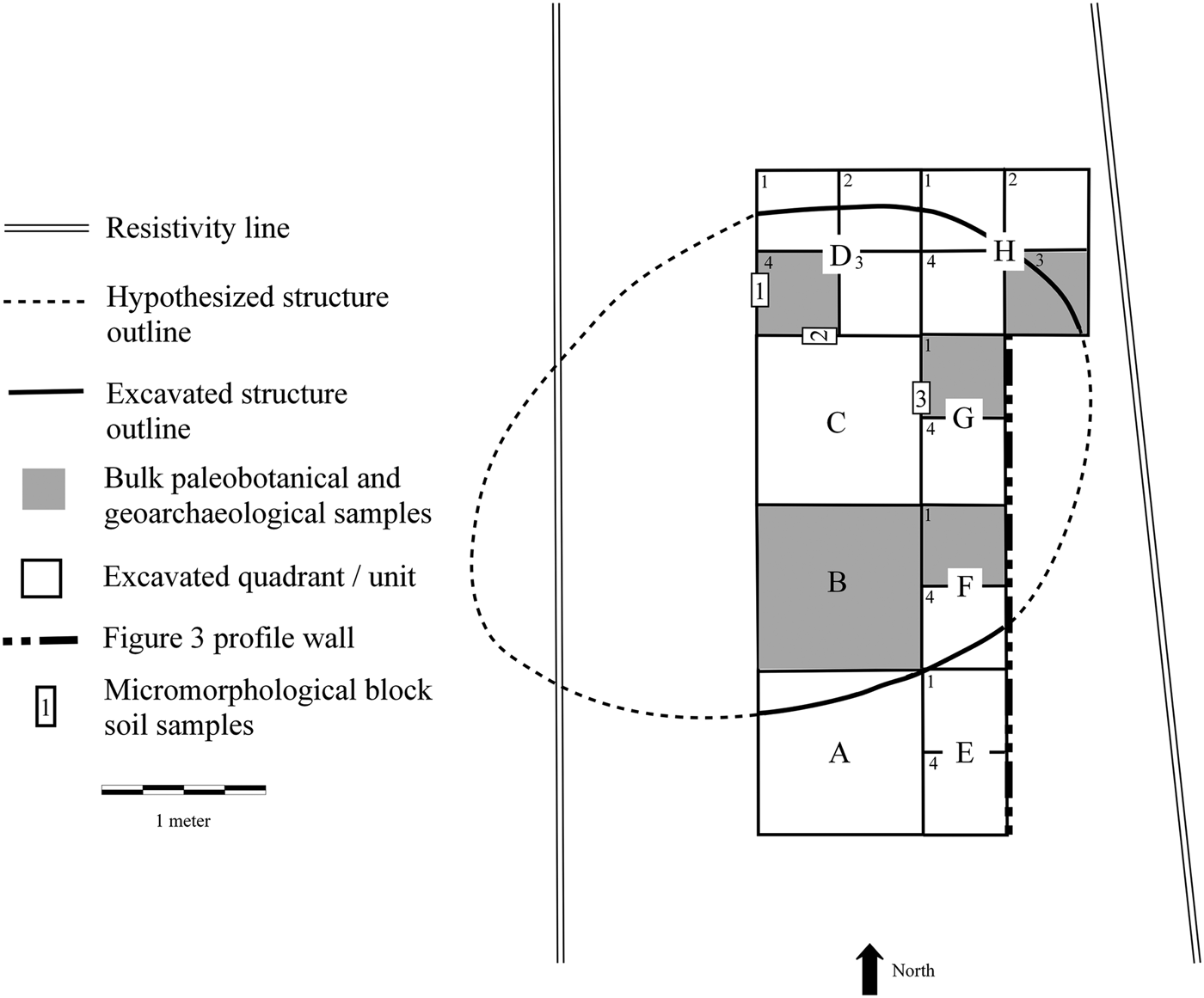
Feature 2 of the Flying Goose site was discovered by the Eastern Washington University field school during the summer of 2014. Field school students excavated portions of a 4 m long trench in 10–20 cm arbitrary levels. Auger probes and electrical resistivity were used to delineate the structure's footprint (Figure 2; Dorwin Reference Dorwin2018:87). These investigations revealed a shallow basin feature roughly 3 m in diameter. Authors Carney and Goodman Elgar sampled the open excavations in late 2014 and collected 32.2 L of soil from the upper strata of Unit B.
Plan view of structure footprint and all excavated units. Units are labeled with letters, while subunit quadrants are numbered. The eastern wall of the excavation, which is bolded, is the profile shown in Figure 3.

In 2015, we partially excavated Feature 2 stratigraphically with an additional 1 × 1 m unit east of the northernmost unit (Unit H), extended the 2014 trench to the east by 0.5 m (Units E, F, G), and excavated the remainder of the original trench to sterile (Units A, B, C, D). We excavated on a 0.5 m2 grid for close spatial control of archaeological remains (e.g., Hrynick and Betts Reference Hrynick and Betts2014; Milek and Roberts Reference Milek and Roberts2013). Bulk soil samples of 4–6 L were collected from each stratum by unit. Sediment blocks for thin sections were collected from three locations (Figure 2). Bulk geoarchaeological soil samples were also collected from a nearby sterile trench as a control. See Supplemental Text for additional details on research methods and laboratory protocols, including excavation, archaeobotany, and experimental firing.
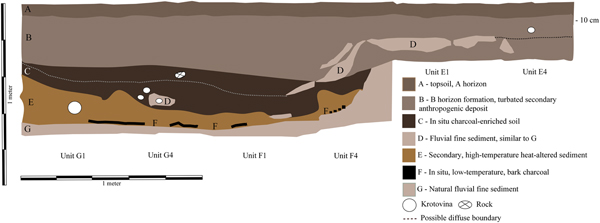
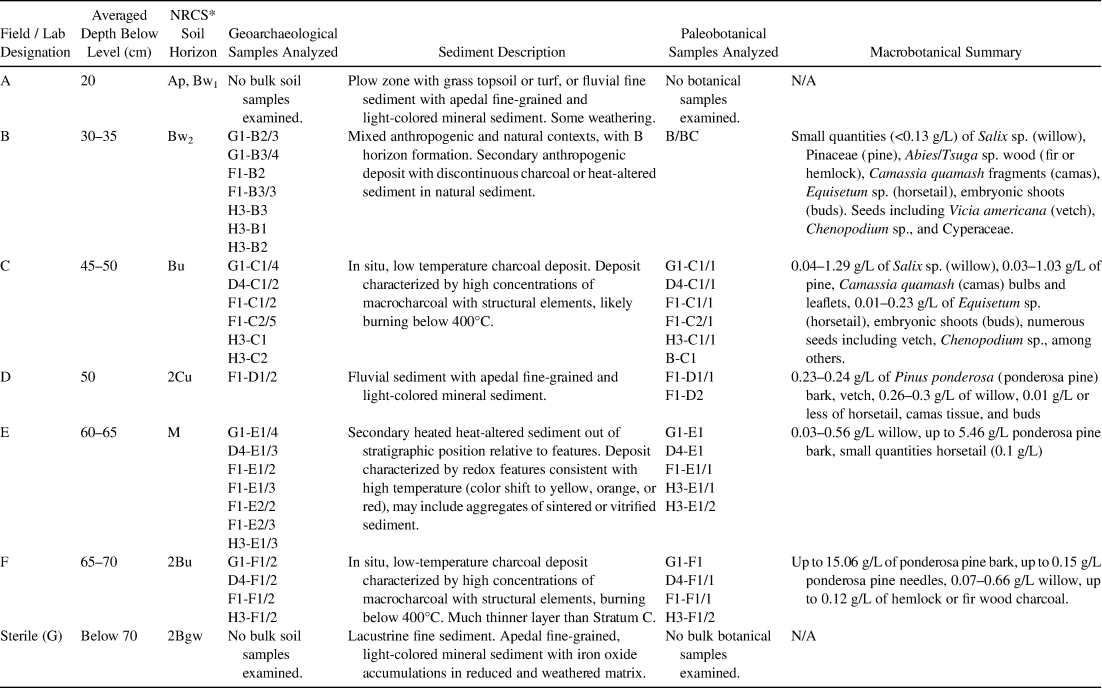
We analyzed materials from seven strata (Table 2). A full description of methods, results, data, and color figures can be found in the supplemental material, Carney (Reference Carney2016), and Goodman Elgar (Reference Goodman Elgar2017). Strata A and B were natural soil formations (i.e., Horizon A topsoil and Horizon B subsoil). The subsequent stratum (Stratum C) was a dark, charcoal-rich layer with profuse charred plant remains (Figure 3). A discontinuous layer (Stratum D), similar to nearby culturally sterile sediments, rested unevenly over the lower cultural strata. Beneath Stratum D lay a sandy, undulating, red sediment with many large (10–15 cm), firm clay aggregates (Stratum E). The final anthropogenic stratum appeared as a thin charcoal-rich layer (Stratum F). Feature 2 was cut into the natural fine sediments of Stratum G, which formed a sharp contact with Stratum F. This well-preserved feature with intact and distinctive stratigraphy did not conform to regional archaeological architectural examples. Given this observation, we turned to the ethnography of the Interior Northwest for architectural correlates in order to understand the structure's function.
East wall profile of Feature 2 illustrating Unit E, the structure rim in Unit F, and the center of the structure in Unit G. Unit H extended further east (Figure 2) and was excavated to capture the structure rim.

Generalized Strata Descriptions.

* Natural Resources Conservation Service
Note: Full paleoethnobotanical counts and weights are available in Supplementary Tables 3 and 4, while geoarchaeological data can be found in Supplementary Tables 5 and 6.
Feature 2 Reconstruction
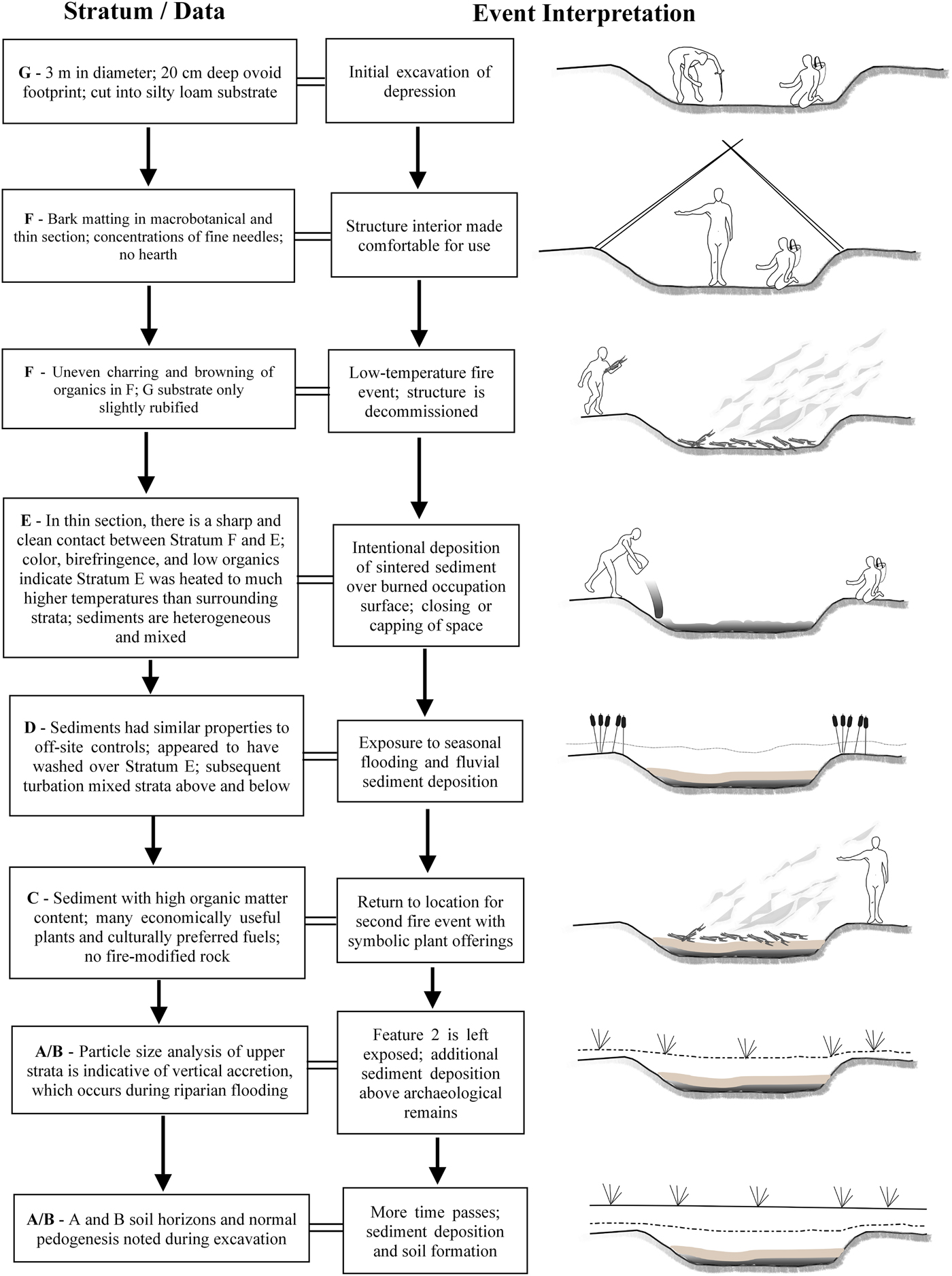
The archaeological and experimental results indicate that Feature 2 was the location of several discrete events indicative of a detailed structural use-life history (Figure 4). These deposits, “odd” in that they are devoid of other material culture, are nonetheless reflective of distinct cultural processes and human behaviors. Below, we summarize salient results from the paleoethnobotanical, micromorphological, experimental, and bulk geoarchaeological analyses and discuss Feature 2's architectural use-life within the context of domestic and non-domestic Plateau structures and features.
Schematic depiction of the Feature 2 sequence of events, outlining data by stratum and our interpretation of that evidence. Figure is not to scale.

In thin section, the basal Stratum G has two microscopic layers (G1, G2). G1 has features consistent with a sterile B horizon and comparable to the offsite profile at similar depth (Supplemental Text:Figure 1). G2 was heat-altered subsoil from the floor fire. The events at Feature 2 fully began with the excavation of a 20 cm deep ovoid depression within the natural substrate. This excavated depression formed the occupational foundation over which Stratum F was lain. Macrobotanical analysis of Stratum F yielded large quantities of ponderosa pine bark that appeared as lining. In thin section, charred macrobotanicals are oriented subhorizontally to horizontally, consistent with woven matting and prepared floors (Matthews Reference Matthews, Barnham and Macphail1995).
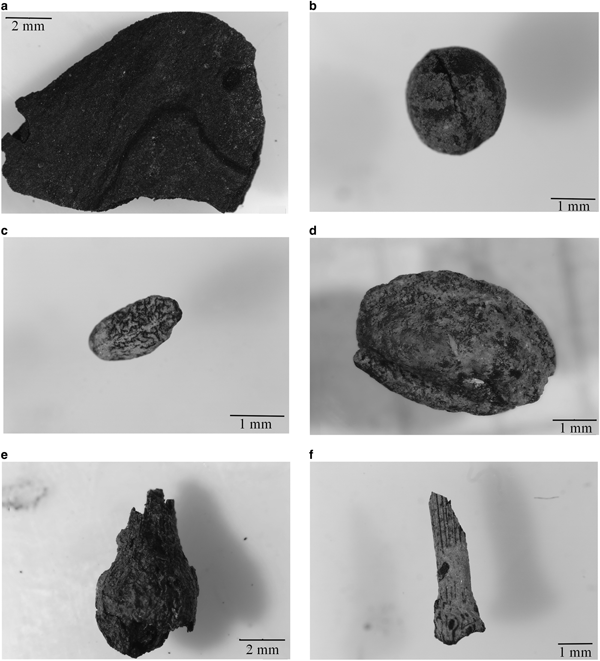
The Stratum F floor also contained up to 0.09 g/L of ponderosa pine needles (Pinus ponderosa) and their fascicles (short stems), large quantities of ponderosa pine bark (up to 15.06 g/L), and concentrations of up to 0.12 g/L of fragmented wood charcoal identified to either fir (Abies sp.) or hemlock (Tsuga sp.) (Figure 5a, Supplemental Figure 5a). Conifer needles are relatively common in Plateau archaeobotanical contexts and are often interpreted as relating to sleeping or work areas when found within structures (Lepofsky et al. Reference Lepofsky, Kusmer, Hayden and Lertzman1996:44; Turner Reference Turner1998:94). Fir and hemlock wood are not commonly noted in Interior Salish ethnographies as a preferred fuel source or recovered in regional paleoethnobotanical assemblages, although fir boughs were used in bedding (Parish et al. Reference Parish, Coupé and Lloyd1996:39, 41; Turner Reference Turner1998:81) and as floorings of menstrual or menarche lodges (Ross Reference Ross2011:135; Teit Reference Teit1900:314). Hemlock boughs were also used as bedding, as a deodorizer, and in some cases medicinally (Parish et al. Reference Parish, Coupé and Lloyd1996:42; Turner Reference Turner1998:98). In the absence of the high quantities of fire-modified rock (FMR) associated with earth ovens, we interpret this botanical assemblage as representing flooring and bedding.
Composite of plants identified: (a) Pinus ponderosa bark scale, (b) Vicia americana, (c) cf. Rubus parviflorus, (d) Crataegus sp., (e) Camassia quamash bulb, (f) Equisetum sp.

After its use, the structure was burned (Figure 4). The fire that charred Stratum F only rubified the surface of Layer G2 and was uneven over the surface as indicated by well-preserved browned and charred organics and possible ash in thin section (Canti Reference Canti2003a; Wattez Reference Wattez1988). This is consistent with a low-intensity fire (Mallol et al. Reference Mallol, Marlowe, Wood and Porter2007). Earth ovens heat sediments to much higher temperatures and produce distinctly rubified sediments at the edges of features (Goodman Elgar Reference Goodman Elgar2017; Jackson Reference Jackson1998; Thoms Reference Thoms1989). As there is no evidence for in situ combustion of siding or roofing materials, we suggest these were taken down prior to the conflagration. Tule, which was commonly used as walling in residential structures, was not recovered within the assemblage.
In thin section, the upper contact of Stratum F plant remains with the oxidized sediments in Stratum E was very sharp and clean, demonstrating that the burned flooring was not exposed to the elements long enough for debris to blow, fall, or wash onto the charred surface. The deposits in Stratum E were heated to variable temperatures but overall appear fired to much higher temperatures than Strata G or F as indicated by color, birefringence, and low organics (Berna et al. Reference Berna, Behar, Shahack-Gross, Berg, Boaretto, Gilboa, Sharon, Shalev, Shilstein, Yahalom-Mack, Zorn and Weiner2007; Canti and Linford Reference Canti and Linford2000; Mentzer Reference Mentzer2014). There is no evidence for a heating front or fuel, and pedofeatures such as clay infillings were not oriented in stratigraphic positions (Miller et al. Reference Miller, Conard, Goldberg and Berna2010; Schiegl et al. Reference Schiegl, Goldberg and Conard2003), which indicates the sediments are not in their primary context. Given Stratum E's low organic matter content, sandy texture, degraded and unidentifiable paleoethnobotanical data, and grainy consistence, we propose that these rubified sediments were acquired from another location and placed over the floor soon after it burned.
There is no evidence that Plateau people had fired ceramic or other high-temperature artifact technology, with only air-dried ceramics reported (Teit Reference Teit1928). However, there is ample evidence for cooking installations with oxidized sediments in the region (Thoms Reference Thoms1989; Walker Reference Walker2004; Willis Reference Willis2012), with contemporaneous camas-roasting features located less than a kilometer away (Gough Reference Gough1997). Given the unusual characteristics of Stratum E, we suggest it was selected for discrete qualities, including color, and purposefully deposited above the occupation surface. The use of earth ovens, and particularly camas oven roasting, are the only known activities that produce such quantities of oxidized sediments. Our sediment firing experiments compared soil samples from a modern camas earth oven to Stratum E sediments (Supplemental Table 9). We found that local sediments must be directly exposed to heat above 500°C to have the properties of Stratum E sediments (Canti and Linford Reference Canti and Linford2000; Goodman Elgar Reference Goodman Elgar2017).
After Stratum E was deposited, Stratum D sediments document that the feature was exposed to at least one spring inundation event (Figure 4). Stratum D sediments had similar texture and color when compared to the off-site profile and appeared to have washed over Stratum E, with subsequent bioturbation and argilliturbation mixing Stratum D into both Strata E and C (Canti Reference Canti2003b; Waters Reference Waters1992).
In Stratum C, cultural activity resumed with another incendiary event consuming many economically useful plants, including American vetch, thimbleberry, hawthorn, and camas (Figure 4, Figure 5b–e). Fabaceae seeds similar to vetch seeds have been found in other regional archaeological sites, often as a lining at the bottom of earth ovens (Herbel et al. Reference Herbel, Hicks, Lyons, Greiser, Smith and Silverman2012:117; Nicolaides Reference Nicolaides2010:117). Two berry species, thimbleberry (cf. Rubus parviflorus) and hawthorn (Crataegus sp.), were key parts of indigenous northwest diets (Hart Reference Hart1979:288, 290; Ross Reference Ross2011:347; Stenholm Reference Stenholm, Andrefsky, Burtchard, Presler, Samuels, Sanders and Thorns2000:14.1–14.66; Teit Reference Teit1928:56; Turner Reference Turner2007:143), although their presence could be attributed to seed rain (Minnis Reference Minnis1981). Camas is also found throughout the assemblage, with leaflets and whole bulbs concentrating in the C and B strata (Figure 5e, Supplemental Figure 5e–h). The Pend Oreille Valley was an important camas gathering ground in the Interior Northwest (Anastasio Reference Anastasio1972; Teit Reference Teit1928:341). 45PO435 lies directly adjacent to both modern camas fields and archaeological camas-roasting earth ovens (Gough Reference Gough1997). Its location in the upper layers of the stratigraphic sequence indicates the camas was not dropped or discarded on the occupation surface during use, and the lack of FMR and heating-front soil features within this stratum do not support earth oven interpretations.
Horsetail (Equisetum sp.) was recovered in many samples but in the highest densities (up to 0.23 g/L) within Strata B and C (Figure 5f). This genus is known colloquially as “Indian Sandpaper,” and several species are ubiquitous within the region (Laser Reference Laser1980:69), although none grows near the site today. Most commonly used as a sandpaper (Turner Reference Turner1998:61), it was also used medicinally to treat menstrual irregularities (Kershaw Reference Kershaw2000:222), in girl's puberty ceremonies (Teit Reference Teit1900:316), and in childbirth and postpartum medicine (Hunn et al. Reference Hunn, Turner, French and Walker1998:536).
Ponderosa pine wood charcoal, bark, and needles and willow (Salix sp.) charcoal also appear throughout the assemblage, with high densities in Stratum C. Both willow and ponderosa pine were frequently used as a fuel (Parish et al. Reference Parish, Coupé and Lloyd1996:75–77; Turner Reference Turner1998:200–202) and grow near the site today. During excavation, concentrations of microcharcoal in the upper E and lower C strata also appeared as fuel sources (Supplemental Text).
We suggest that the remains uncovered at Feature 2 do not conform to domestic or traditional “functional” use. The absence of microdebitage is notable as this is commonly recovered in other Pend Oreille Valley structures (Andrefsky et al. Reference Andrefsky, Burtchard, Presler, Samuels, Sanders and Thoms2000; Sanders Reference Sanders1992). Ethnographic and archaeological examples of residential units indicate that food remains are found in hearth contexts or swept aside on the paleosurface (Lepofsky et al. Reference Lepofsky, Kusmer, Hayden and Lertzman1996:38–40; Ross Reference Ross2011:207; Smith Reference Smith, Andrefsky, Burtchard, Presler, Samuels, Sanders and Thorns2000). However, Feature 2 contains unique pine matting, and imported red sediment was without microdebitage or botanicals common to prehistoric domestic lifeways. By contrast, plants that could be attributed to food remains, ethnographic medicinal plants (horsetail), and fuel (willow) were recovered in the uppermost strata and were not associated with the floor (Carney Reference Carney2016:42–44, Table 4). Sweat lodge correlates suggest those structures included a center shallow pit with a plethora of FMR and/or hearth features (Hrynick and Betts Reference Hrynick and Betts2014; Lafferty Reference Lafferty and Lacquement2007; Ross Reference Ross2011:221), which were absent from Feature 2. Likewise, the absence of FMR throughout the assemblage also rules out earth oven interpretations. In sum, we identify the characteristics of the various strata of Feature 2 as purposeful, behaviorally discrete events. In the absence of regional comparisons, we assess this sequence with reference to the broader archaeological literature on the burning of architectural features and structured deposition.
Structural Transitions and the Significance of Stratum E
Control over architectural construction, design, and destruction is a process that can be related to creating and maintaining social practices (Boivin Reference Boivin and Gosden2004:63; Brück:Reference Brück1999b:145; Souvatzi Reference Souvatzi and Shankland2012:174; Walker Reference Walker2002:163). Archaeological theories of house use-lives are useful models as they envision structures as undergoing a sequence of construction and use stages terminating in destruction or intentional abandonment. Deliberate structural burning is sometimes viewed as a symbolic act in which fire is a transformative agent (Stevanović Reference Stevanović1997:288). We interpret the lack of evidence for a heating front and the low-temperature burn of Stratum F as evidence of an intentional, low-temperature fire. Following these theories of house use-life histories, we suggest the initial incendiary episode in Stratum F was a symbolic act that signified a transition between the use of the structure and its commemoration through structured deposition.
We contend that the sandy, red-colored Stratum E was fired elsewhere, brought to Feature 2, and deposited over the structure's floor. Properties such as color, texture, and consistency are physical qualities that inform the choices people make in selecting and utilizing sediment and may be representative of meaningful qualitative experiences (Goodman Elgar et al. Reference Goodman Elgar, Bettencourt and Conrey2015; Kidder and Sherwood Reference Kidder and Sherwood2016; Sillar and Tite Reference Sillar and Tite2000). The color red is frequently seen as a potent color with blood-like symbolic associations (DeBoer Reference DeBoer2005; Gage Reference Gage1999; Jones and MacGregor Reference Jones, MacGregor, Jones and MacGregor2002; Ray Reference Ray1939:55). These connections between blood and the human body are widespread and often interpreted in fertility, liminality, power, and life and death contexts (e.g., Galloway Reference Galloway, Claassen and Joyce1997). While the semiotics of color are culturally contingent, they are also dependent on historic sequences (Gage Reference Gage1999; Jones and McGregor Reference Jones, MacGregor, Jones and MacGregor2002). We suggest contextually the red sediment from Stratum E was selected for the relationship between the color, blood, female menstruation, and fertility, perhaps related to liminal puberty rites.
The physical act of deposition is significant (Brück Reference Brück1999a:331). After the structure burned, a sediment with distinct properties was placed atop the structure, effectively capping and ending the events that took place therein. Deliberate structural burning with final depositional events have been recorded among Southwest pithouses and kivas (e.g., Adams Reference Adams2017; Stevanović Reference Stevanović1997; Van Keuren and Roos Reference Van Keuren and Roos2013). In these structures, fire was used to transition places between uses, and the act of intentionally burning architecture is considered an aspect of purposeful closure and abandonment. In the mid-Fraser River region, Hayden and Adams (Reference Hayden, Adams, Prentiss and Kuijt2004) suggest that certain pithouses were ritually burned and closed in a similar manner. We suggest the red sediment was deposited as a means of symbolically commemorating the events that took place within the structure or even possibly as a means of containing potent power from the people who used this structure and their associated activities.
Through ignition and deposition, the occupants of Feature 2 transitioned the structure through discrete stages of a special purpose use-life (Goodman Elgar Reference Goodman Elgar, Brück and Goodman1999). The structure was left exposed for at least one spring flooding event (Figure 4), after which it was returned to at least once more. The upper burning event in Strata C and B was placed directly on top of the previous remains. This unusual botanical assemblage, without evidence of any cooking features, suggests patterns of consumption and refuse that are not indicative of everyday life. If we infer that the Strata C and B depositional events are tied to the use-life of the structure, the paleobotanical assemblages are reminiscent of offerings commemorating the prior use of the structure and its occupants, thereby memorializing cultural events that are now lost.
Menstrual Lodges in North America and the Interior Northwest
Menstrual lodges are relatively common in many Amerindian ethnographies across North America (Galloway Reference Galloway, Claassen and Joyce1997; Markstrom Reference Markstrom2008:124–158), and many scholars note that associations of menstruation are culturally specific (Ackerman Reference Ackerman, Klein and Ackerman1995:93, Reference Ackerman2003:84; Buckley and Gottlieb Reference Buckley and Gottlieb1988; Gottlieb Reference Gottlieb, Brettell and Sargent2009; Powers Reference Powers1980). Cross-culturally in North America, menstruation and menstrual fluids are viewed as powerful, with the first cycles as the most potent (Allen Reference Allen1992:252–254; Markstrom Reference Markstrom2008; Marucci Reference Marucci, Wicker and Arnold1999:75). Ackerman (Reference Ackerman2003:83–84) interprets menstruation in Plateau cultures as an uncontrollable magical force capable of great, and possibly negative, power. Ethnographic taboos hint at isolation as a necessary precaution against a women's uncontrolled power during this time (Teit Reference Teit1900:326–327). Other Native American and First Nations writers and ethnographers suggest menstrual blood is representative of healing, curing, or life powers (Beck et al. Reference Beck, Walters and Francisco1996; Marucci Reference Marucci, Wicker and Arnold1999; Powers Reference Powers1980; Wright Reference Wright2003). Additionally, these places were important to all genders, for female seclusion was central to not only women's identities but also had wider cultural associations with spiritual connections to universal life cycles and the earth (Markstrom and Iborra Reference Markstrom and Iborra2003).
Galloway (Reference Galloway, Claassen and Joyce1997) suggests that menstrual lodges should have distinct architectural and artifactual signatures, and several female-specific structures identified in the archaeological record of southeastern North America support her hypotheses (Bengtson Reference Bengtson2017; Claassen Reference Claassen2011, Reference Claassen and Claassen2016; Schohn Reference Schohn2001). In reanalyzing the assemblages of rock shelters on the Cumberland Plateau in eastern Kentucky, Claassen (Reference Claassen2011, Reference Claassen and Claassen2016) argues that the uncommon artifacts and features within certain shelters were left by groups of women retreating from their communities during menstruation and birth. Drawing on Cherokee ceremony and contemporary Lakota practice, Claassen (Reference Claassen and Claassen2016:10) argues that the copious amounts of wood and ash found in only some shelters may be the material remains of ritual burning associated with female medicinal renewal rites. Also in the Southeast, Bengtson (Reference Bengtson2017) and Schohn (Reference Schohn2001) explore the material signatures of Mississippian structures that may have housed women retreating as a group. Bengtson (Reference Bengtson2017) draws on Mississippian feminist and infant-related iconography, symbolism, and cosmology in her reinterpretation of ceramics associated with a special-use structure, seeing this structure as a place for birthing, infants, and motherhood. Like Claassen, Schohn (Reference Schohn2001) focuses on the different-than-expected artifact assemblage. In her examination of an AD 1450–1550 Mississippian site, she found little evidence for lithic manufacture yet notes architectural features associated with ethnographic descriptions of women's retreats. Her analysis of the ceramic assemblage also found an unusual quantity of serving ceramics, which she argues is representative of the remains of ritual taboos preventing the preparation of foods. The high degree of sooting within ceramic vessels, rather than on the outside of sherds, may also be evidence of fire-related rituals associated with retreating women.
While these southeastern examples provide some data on archaeological and material culture expectations, we also look to the ethnographic record of the Plateau in creating expectations for the signatures of menstrual lodges (Mandelbaum Reference Mandelbaum and Spier1938:110–112; Ray Reference Ray1939:54; Spinden Reference Spinden1908:197–198; Teit Reference Teit1900:312–314, 326, Reference Teit1928:142, 346). Menstrual lodges were said to be located away from the main village or encampment (Marucci Reference Marucci, Wicker and Arnold1999:76; Ray Reference Ray1939:54; Smith Reference Smith, Andrefsky, Burtchard, Presler, Samuels, Sanders and Thorns2000:7.52; Teit Reference Teit1928:98; Wright Reference Wright2003:6). Most accounts agree they were excavated deep into the earth (Wright Reference Wright2003:2), though descriptions vary from brush-covered huts to fir-bough-walled structures (Teit Reference Teit1900:312). While in seclusion, some women and young girls used scratchers or drinking tubes, which were believed to prevent pollution (Gottlieb Reference Gottlieb, Brettell and Sargent2009:266; Ray Reference Ray1939:54; Teit Reference Teit1900:312, Reference Teit1928:132). These structures were also where girls' puberty rituals took place, children were born, and where baskets and other articles produced by women were made (Ross Reference Ross2011:134–139; Wright Reference Wright2003:1). It is also hypothesized that women's lodges would include red artifacts or minerals (Galloway Reference Galloway, Claassen and Joyce1997:62).
Menstrual isolation was almost always accompanied by strict taboos. Women were not allowed to consume or touch any meat or fish and primarily ate prepared roots brought to them in special vessels (Ackerman Reference Ackerman, Klein and Ackerman1995:93; Mandelbaum Reference Mandelbaum and Spier1938:110–111; Markstrom Reference Markstrom2008:88; Ray Reference Ray1939:54; Ross Reference Ross2011:135–136; Teit Reference Teit1900:314). Among many Northwest groups, menstrual seclusion was restricted to a young girl's first menses, and other special treatments for young girls were observed (Ray Reference Ray1939:52, 56; Teit Reference Teit1900:198, 314–317). Among the Kalispel and Spokane, menstrual or menarche lodges were burned after use (Ross Reference Ross2011:135; Smith Reference Smith, Andrefsky, Burtchard, Presler, Samuels, Sanders and Thorns2000:7.52).
The data from Feature 2 most closely resemble this latter model of menstrual seclusion and ceremony and the data outlined in Schohn (Reference Schohn2001). The structure footprint has a diameter of less than 3 m, is not located near any other known architectural remains, has limited evidence of food remains or food processing on the floor (Stratum F), and was likely intentionally burned. The deposition of Stratum E and stratigraphic location of plant remains support our interpretation that this structure and its closing were intentional and meaningful. Finally, the lack of stone tool artifacts and presence of economically useful plant remains in the upper (C and B) stratigraphic layers also does not fit with domestic behavioral models. We interpret the remains as representative of a past event in which a women's lodge was closed and burned after use, with symbolic plant remains deposited after the structure's abandonment.
Taking ethnographic analogy further, we conjecture that Feature 2 was a menarche lodge, or the location in which a young girl spent her first menses. Historically, these small lodges were constructed of willow and lined with fir boughs, often located away from the village or camp (Ross Reference Ross2011:135). While taboos restricted the consumption of meat and participation in many tasks, young women in menarche were encouraged to collect berries in late summer and fall (Ross Reference Ross2011:137). Finally, menarche structures were reportedly burned after use (Ross Reference Ross2011:135; Smith Reference Smith, Andrefsky, Burtchard, Presler, Samuels, Sanders and Thorns2000:7.52). The data presented here bear striking resemblance to the menarche ceremony outlined in Ross (Reference Ross2011:135–137). We can even suggest that the sequence of events at Feature 2 reflect a liminal ceremony for young women as they transitioned between life stages.
Summary and Conclusion
Feature 2 yielded no artifacts, yet a careful stratigraphic reconstruction affords a nuanced view to the events that occurred here. A small, elliptical depression was excavated into the earth and covered with a ponderosa pine bark matting over which fir- or hemlock-bough bedding was placed. Unlike typical domestic structures, the floor of Feature 2 had no evidence of food or tool preparation. In the absence of a hearth and FMR, we conclude that the fire that consumed the structure and its sparse contents was intentional. The fire and the overlying rubified sediment have a clean contact, indicating very little time elapsed between these events. This points to a cultural link between these activities. We suggested that the primary available source of heat-altered sediment was nearby camas ovens. If this is correct, the sediment's reddish color and connection to camas reinforce an association with women.
The structure was then left open to the elements and subsequently revisited with another burning event. The unusual botanical assemblage in this second fire, including potential fuel sources and economically useful plants, is reminiscent of the assemblages found in earth ovens (e.g., Lyons et al. Reference Lyons, Prentiss, Peacock and Angelbeck2018; Nicolaides Reference Nicolaides2010:176) yet lacks the other diagnostic features of earth ovens. When this fire was lit, the surface of Feature 2 was very uneven with the fluvial and imported sediments. The botanical assemblage therefore does not appear to derive from consumption and craft activities. Rather, we suggest that these plants were intentionally burned. While ritual can be an interpretive black box in archaeology, we see a strong case for interpreting the events that took place within Feature 2 as socially redolent and consistent with ritual activities.
Although the events and structure outlined here are similar to the ceremony outlined by Ross (Reference Ross2011) and the features discussed by Schohn (Reference Schohn2001), we cannot place Feature 2 within an established understanding of Plateau menstrual lodges as little is known about what artifacts or plants were used within Interior Northwest lodges (Galloway Reference Galloway, Claassen and Joyce1997; Marucci Reference Marucci, Wicker and Arnold1999). Ross (Reference Ross2011:138) notes that it is unlikely that traditional women would have discussed coming-of-age or menstrual rites with male explorers or ethnographers. Thus, while a menstrual lodge appears to be the best structural correlate for the remains recovered from Feature 2 at 45PO435, it is possible that there are other explanations for these remains. Nonetheless, we find that the sequence of events and deposits within Feature 2 support our interpretation that it was a socially significant locale related to women. In the case of this isolated feature, our reconstruction using a structured deposition approach has made prehistoric women visible.
Acknowledgments
Additional excavations of Feature 2 were carried out by volunteer crews under the direction of John Dorwin under ARPA permit BIA/NRO-14-01-154(577). Fieldwork and analyses were conducted with financial support from the Kalispel Natural Resources Department and the Geoarchaeology Laboratory at Washington State University. We would like to thank the numerous people whose assistance and input on iterations of this research helped it progress to this stage including the KNRD CRM field crew, the staff at the Franceschi Microscopy and Imaging Center, the Department of Crop and Soil Sciences at Washington State University, and Sydney Hanson, Nathaniel James, and Caitlin Downey. We would also like to extend our gratitude to the Kalispel Tribe of Indians for allowing us to work with and explore the history of their ancestors.
Data Availability Statement
Data used in this analysis are included in the supplemental data files. Carney's thesis may be found at the Washington State University Research Exchange (http://hdl.handle.net/2376/14111). All other reports may be accessed through the Washington Information System for Architectural and Archaeological Data (WISAARD) portal. All notes, artifacts, and samples from the project are curated at the Kalispel Tribe's curational facility in Usk, Washington.
Supplemental Materials
For supplementary material accompanying this paper, visit https://doi.org/10.1017/aaq.2019.30.
Supplemental Text. Field and laboratory methods.
Supplemental Figure 1. Thin sections and strata designations.
Supplemental Figure 2. (a) Stratum F ponderosa pine bark as it appeared during excavation, surrounded by Stratum E. (b) Stratum F ponderosa pine after removal from matrix.
Supplemental Figure 3. OxCal plot of radiocarbon dates from Stratum F and Stratum C.
Supplemental Figure 4. Organic matter percentage depth plots.
Supplemental Figure 5. Photomicrographs under plane polarized light.
Supplemental Figure 6. Electron micrographs of archaeological charcoal and modern and archaeological camas (Camassia quamash).
Supplemental Figure 7. Composite of additional plants identified.
Supplemental Table 1. Expanded Table 1.
Supplemental Table 2. Density, Species Richness, and Ubiquity Values of Plant Remains from 45PO435.
Supplemental Table 3. Raw Weight (g) of All Paleobotany Samples.
Supplemental Table 4. Raw Count for All Paleobotany Samples.
Supplemental Table 5. Bulk Geoarchaeological Results for Natural Control (N1-N6) and Geoarchaeological Samples.
Supplemental Table 6. Soil Description.
Supplemental Table 7. Thin Section Descriptions.
Supplemental Table 8. Results from Experimental Firing of Natural Substrate to Demonstrate Temperature Dependent Thermal Effects.
Supplemental Table 9. Results from the Second Firing Experiment, an Attempt to Replicate the Consistence of the Stratum E Samples.