A note on dates
Russia used the Julian Calendar until 1918, so that dates in these texts were generally 12 days behind Common Era (Gregorian) dates except for the early part of 1821, when expedition dates were 11 days behind Common Era because Bellingshausen did not adjust his calendar for the circumnavigation until 3(15) February. Because the dates come from the translated texts, they are shown as Julian with the Common Era equivalent in brackets but no further designation, whether Common Era or Old Style. However, marginal dates in Bellingshausen’s book have been left as Julian only to avoid excessive clutter.
Debenham’s Bellingshausen
Captain Faddej Faddeevich Bellinsgauzen of the Imperial Russian Navy, also known as Bellingshausen, completed the narrative of his 1819–1821 voyage of Antarctic exploration in 1824; it was published seven years later (Bellinsgauzen, Reference Bellinsgauzen1831). Frank Debenham, the first director of the Scott Polar Research Institute, took about 15 years to complete his translation of Bellingshausen’s book and then had to wait 6 years for it to be published (Bellingshausen, Reference Bellingshausen1945). Because two earlier German translations were abridged, Debenham’s version became the key source on the voyage for many people. At critical points, however, it is unreliable.
Debenham had no Russian and translated indirectly by compiling and polishing versions provided by other people. His collaborators do not appear to have studied similar Russian texts or contemporary dictionaries. Debenham asked the Soviet Admiralty for other primary sources on the voyage, but in the 1930s they were unable to oblige him. The Soviet reviewer found little wrong with the translation, but others saw it as unsatisfactory on important points (Lebedev, Reference Lebedev1961, 15–16; Shvede, Reference Shvede1947). Some of their criticisms, at least, were valid.
Debenham’s translation was quite loose, with the same word or phrase rendered with gratuitous variety, and precise information, such as temperatures, becoming less so through conversion. Even Bellingshausen’s choices of grammatical subject, as between ‘I’ and ‘we,’ were not respected. The relaxed approach may have increased the risk of mistakes. Thus, the wind direction given as south-east by east for 21 January (2 February) 1820 became “south-east by south”; under 4(16) February, a short paragraph was omitted; and the marginal date for 7(19) February was also omitted (Bellingshausen, Reference Bellingshausen1945, 1, pp. 120, 127, 130).
When Debenham concluded that Bellingshausen had seen “the first undoubted land of the main mass of the continent” on 5(17) February 1820 (Debenham, Reference Debenham1939, p.1), he mentioned only the landlike mass of ice, with no visible limits, recorded for that day. But his opinion, that Bellingshausen’s ‘main coast’ of ice was land, was probably supported by a belief that “ice-covered mountains” were sighted on the following day. Unfortunately, Debenham had translated a phrase meaning ‘icebergs’ with no difficulty but then mistranslated exactly the same phrase as “ice-covered mountains” on the following page (Bellingshausen, Reference Bellingshausen1945, 1, pp. 128–129). (The problem was later exacerbated by Jones’s rendering of the same phrase, from one of Bellingshausen’s reports, as “icy mountains” (Jones, Reference Jones1982, p. 92).) Naturally enough the mistake has been proliferated by repeated citation (e.g. Kirwan, Reference Kirwan1959, p.115; Mickleburgh, Reference Mickleburgh1990, p.26; Bonhomme, Reference Bonhomme2012, p.169). In the second part of the book, by confusing linguistic roots, Debenham’s team also mistranslated Bellingshausen’s explanation of main ice with the obscure nonce word “mother-icebergs” (Bellingshausen, Reference Bellingshausen1945, 2, p. 417).
Like Cook, Bellingshausen usually referred to icebergs as ‘ice islands,’ but in a handful of places he used the newer expression ‘ice hills’ instead. At least, one Soviet commentator believed that Bellingshausen invariably used ‘ice islands’ (Lebedev, Reference Lebedev1962, p.166), which together with Debenham’s mistake requires that the history of the Russian phrase be summarised.
Although ‘ice hill’ began life as a translation of Eisberg, a German word for ‘glacier,’ just like Eisberg it added the meaning ‘iceberg’ before Bellingshausen was born. The polymath Mikhail Vasil′evich Lomonosov was probably the first Russian to refer to icebergs as ‘ice hills,’ in 1763. Of his key texts on the subject, however, one was published but did not use the phrase; one was written in Latin (manuscript now lost) and translated into Swedish, where the word “is-berg” doubtless corresponded to the Latin phrase mons glacialis (Lomonosow, Reference Lomonosow1763, throughout); and the third, though signed on 20 September (2 October) 1763, was not published until 1847 and again in 1854. Lomonosov carefully specified whether “ice hills” were terrestrial glaciers (Reference Lomonosov and Sokolov1854, pp. 76, 79) or aquatic icebergs (pp. 78, 100). The ‘icebergs’ sense recurred 25 years later in a description of the exploration of Novaya Zemlya (Maksimovich, Reference Maksimovich1788, pp. 11, 313). In that example, the phrase denoted icebergs without further explanation, not long after Lomonosov and exactly as used by Bellingshausen about 35 years later. Further examples include a geographical textbook (Stojkovich, Reference Stojkovich1813, p.106) and a contribution from Krusenstern to a book by Otto Kotzebue (Krusenshtern, Reference Krusenshtern and Kotsebu1821, p. cxv). Quite reasonably, Debenham translated ‘ice island’ as ‘iceberg,’ but he was puzzled, apparently, when Bellingshausen occasionally used ‘ice hill’ instead.
New translations
Three key passages in Bellingshausen’s published narrative (referred to here as Two Seasons), together with the corresponding passages in his expedition reports, are believed to show that he sighted an ice coast of Eastern Antarctica in 1820. The first one (B), if accepted, would make the Russian expedition the first people ever to see the ice-girt ‘mainland’ of Antarctica, two days before the crew of the Williams, commanded by Edward Bransfield, Master, R.N., made the first ever sighting of a rocky coast of the mainland, at the mountainous tip of the Antarctic Peninsula, during a survey of the South Shetland Islands. The second passage from Bellingshausen’s book (C) is more widely accepted as a virtual sighting of the mainland but confers only regional rather than continental priority. A third one (D), from the second part of the book, allows us to see how Bellingshausen interpreted the “main of ice” (Bellinsgauzen, Reference Bellinsgauzen1820, f. 242v) or “main [ice] coast” (Bellinsgauzen, Reference Bellinsgauzen1831, 1, p. 189) which he reported.
Bellingshausen’s numbers, points of the compass, units, and dates are rendered just as they occur in the Russian texts. Most of his style, or lack of it, punctuation, and capitalisation, have also been respected. His not infrequent grammatical mistakes seldom translate into a less inflected language like English. That feature, together with verbal slips in longitude such as ‘West’ for ‘East,’ suggests that Two Seasons was under- rather than over-edited, which Soviet commentators often claimed with a view to supplying what, to their minds, must have been removed by unsympathetic hands.
The reports
(A1) Sydney, 10(22) April 1820
[January 1820] Continuing our passage amongst the ice until the 11th [23rd], when ice became less frequent, I began making south again. In heavy overcast, I sailed on S, meeting ice but less often than before. On the 16th [28th], having reached latitude S 69°25′, longitude 2°10′ W, I met continuous ice at its fringes, with [floes] tossed on top of each other and broken to pieces. Within it, to the south, icebergs were visible in various places.
… …
On 1[13] February, lying in latitude S 64°30′ longitude E 16°15′, and having gained 17° to E, I turned S once more in an east wind, and eventually, between the 5th and 6th [17th and 18th], I reached latitude S 69°7′30″ and longitude E 16°15′. There, beyond ice fields comprising small ice and [ice] islands, a main of ice was sighted, the edges of which had broken away perpendicularly, and which stretched as far as we could see, rising to the south like land. The flat ice islands lying close to this main are evidently nothing but detached fragments of this main, since they have edges and upper surfaces that resemble the main.
(Bellinsgauzen, Reference Bellinsgauzen1820, ff. 242–242v)
(A2) Kronstadt, 24 July (5 August) 1821
[January] Continuing the passage until the 11th [23rd], when the [ice] islands became less frequent, I began to make to the south. In heavy overcast and fog I held on south, meeting ice only seldom. On the 16th [28th], having reached latitude S 69°25′ longitude 2°5′ W, I met continuous ice at its fringes, with [floes] tossed on top of each other, and further off a few [ice] islands were scattered in various locations.
… …
On 1st[13th] February, lying in latitude S 64°30′ longitude 16°00′, and having gained 17° to the east, I once again moved south in an east wind, and eventually, between the 5th and 6th [17th and 18th], I reached latitude S 69°7′ longitude E 16°26′. There beyond small continuous ice and [ice] islands main ice was sighted; its edges were perpendicular and it extended south to the limits of our sight, rising into hills like land. The flat, high [ice] islands near this main clearly show that they are fragments of this main since they have edges and upper surfaces that resemble the main.
(Bellinsgauzen, Reference Bellinsgauzen1821, ff. 4–4v)
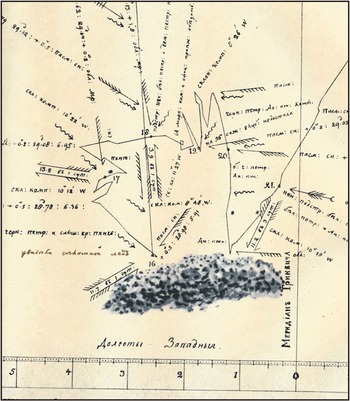
Commentary: The excerpts from the repetition of the first report inside the final report (A2) show, first, that besides revising his longitudes Bellingshausen made some slight changes of wording, such as adding “fog” in the second version, which suggest that it was dictated rather than copied by the naval clerk on Vostok (Bellingshausen’s ship); second, that he replaced “icebergs” (‘ice hills’) with “[ice] islands” under 16(28) January in the second version; but third, that he remained convinced that he had sighted “main ice” on 5–6(17–18) February 1820. It should also be noted that Bellingshausen did not give an extended account, in the reports, of the ice field which barred his way twice between 16(28) January and 2(14) February 1820 (Fig. 1). The scene dated 16(28) January may, therefore, represent his overall impression of that ice field, which was observed in much better conditions on the second than on the first approach (see (B) and Fig. 1).
Detail from Sheet 2 of Bellingshausen’s 1821 track chart (Bellinsgauzen, Reference Bellinsgauzen and Belov1963), corresponding to extract (B).

(B) Two Seasons, vol. 1. 15–21 January (27 January–2 February) 1820
-
15 At 7 o’clock the following morning, although the weather had not changed, but I had no hope of waiting for an improvement, I set course SbW once again. Before noon we passed three ice islands; our position was then latitude 66°53′42″ south, longitude 3°3′54″ west. …
-
16 …
At 9 o’clock in the morning in latitude 69°17′26″, longitude 2°45′46″, the magnetic declination was measured as 8°48′ west. Making further way to the south, at noon in latitude 69°21′28″, longitude 2°14′50″, we met ice which appeared to us, through falling snow, like white clouds. The wind, from NE, was dropping, with a heavy swell from NW. Because of the snow, we could not see far. I gave orders to proceed SE, close-hauled. After proceeding for two [nautical] miles [3.7 km] in that direction, we saw that continuous ice extended from east through south to west. Our course led directly into that ice field, scattered with hillocks. The mercury in the barometer fell from 29.50 to 29 [inches], presaging foul weather; there was 0.5° [Réaumur] of frost. We veered to NWbW in the hope of not meeting ice in that direction. …
-
17 The overcast and snow were unremitting throughout the night. At 2 o’clock the following morning both sloops turned onto a port tack. At 6 o’clock in the morning we saw an ice island dead ahead but were able to veer away from it. The thermometer stood at freezing point. At the same time, the wind began to strengthen, obliging us to take in two topsail reefs. At 8 o’clock sloop Vostok, veering into the wind, closed with sloop Mirnyj. Towards noon the sky, overcast with snow clouds, cleared slightly, and the sun shone out. We succeeded in taking noon sights, which gave our position as latitude 68°51′51″ south, longitude 3°7′6″ west. The current bore us away NW 20° for 30 miles [55 km]. We did not enjoy the radiance of the sun for long, it being so rarely visible in those parts. The fog and snow, those constant companions of the navigator in the Southern Ice Ocean, resumed.
In high latitudes, through which we were sailing, the sea has a very beautiful blue colour, which tends to suggest that land is a long way off. Penguins, whose call we heard, have no need of land. They are also content, even want, to live on flat ice floes the way other birds do on land. …
At 8 o’clock sloop Vostok waited for Mirnyj, then closed with them. We headed into the wind on a starboard tack, so as to bear away from the ice a little and wait out the overcast conditions.
The wind continued the whole time from the north with snow and at rare intervals without it. Murk extended right around the horizon. Throughout our passage in high Southern latitudes, we always had such overcast conditions with north winds. With Southerlies, by contrast, the weather was dry and clear, the horizon clean.
-
18 … …
-
19 The calm ended at 3 o’clock in the morning, and a breeze got up from SEbE, with snow. We lay on a starboard tack to the NE quarter. … At 6 o’clock, the wind freshened from ENE. We furled topgallants and reefed topsails. At 8:30, we veered onto a port tack and hoisted the mainsail. At noon we were in latitude 68°36′36″, longitude 1°43′59″, temperature 0.2°C, no bottom at a hundred fathoms. The snow continued to fall with a contrary wind from E. … …
-
20 At 4:30 in the morning, after tacking 30 miles [55 km] E, in view of the stubbornness of the contrary wind from that bearing, and trusting in Captain Cook’s observation that east winds blow the whole time in high Southern latitudes, I decided to head due south until it became impossible to sail any further, and after that turn back to lower latitudes. … The weather was overcast, and at 3 o’clock in the afternoon snow fell. But at 7 o’clock we sighted an ice island about three quarters of a mile in circumference, height up to 70 feet [21 m], with vertical sides. The swell set from the east before the wind, which showed that on a bearing east there was not much ice nearby.
…
-
21 We continued to head south in light wind from SEbE and clear weather. … An hour after midnight we saw ice ahead, and by 2 o’clock we were surrounded by light ice floes. Further to the south up to 50 variously shaped huge ice masses were arrayed, hemmed around by an ice field. Surveying the expanse of that field to east, south, and west, we could see no end to it. Evidently it was a continuation of the one we saw in overcast conditions on 16[28] January, but on account of the murk and snow were unable to examine thoroughly.
(Bellinsgauzen, Reference Bellinsgauzen1831, 1, pp.171–177)
Commentary: To avoid excessive length, several observations on natural history have been omitted in (B) and (C). The two descriptions in (B), under 16(28) and 21 January (2 February), of the impassable ice field first encountered on the afternoon of 16(28) January 1820, suggest that Bellingshausen was not overly exercised about this event, which resembled their situation 12 days earlier south of the Thule Is. His remark about the colour of the sea confirms that he had no thought of being close to land. (The expedition’s astronomer, Ivan Mikhajlovich Simonov, recorded his impression that the squadron had been “In open water below the Antarctic Circle” on the dates in question (Simonov, Reference Simonov1825, p. 115).) Next, the cross-reference at the end of the passage reinforces the earlier statement that what was seen was a large ice field, containing hillocks at one point and “huge ice masses” at another. Both remarks are consistent with what the reports called icebergs (or ice islands) inside an ice field on 16(28) January (above).
For examples from Russian usage of the word for ‘hill,’ the Sparrow Hills, perhaps the most famous in Russia, rise about 80 m above the Moscow River; the smallest “ice hills” in texts collected by the author were only 3–5 m high (Anon., 1922); and one of the highest icebergs observed during the expedition was measured by Lieutenant Mikhail Petrovich Lazarev, who commanded the expedition’s second ship Mirnyj, as 122 m (Bellinsgauzen, Reference Bellinsgauzen1831, 1, p. 223). Although the Russian word ‘hill’ can also denote mountains in suitable contexts, rather like its German counterpart, the ‘ice hills’ mentioned by naval explorers were icebergs, not topographical mountains. Another significant feature of this excerpt is the absence of the theoretical reflections to which Bellingshausen was prompted by the “main coast” of ice described in (C) below, reflections which he later amplified in (D).
Bellingshausen’s account of heading into an ice field which surrounded the ships on three sides represented a potential embayment, from which he retreated along the only bearing open, NWbW. Writing in 1853, and doubtless with his former commander’s book beside him, Pavel Mikhajlovich Novosil′skij, who had served as a midshipman on Mirnyj, confirmed this with “it was necessary to make our way out of that bay” (Novosil′skij, Reference Novosil′skij1853, p. 29). Unlike the one encountered on 4(16) January 1820, this ‘ice bay’ was not shown on the track chart (Fig. 1). But the chart could not show all the ice they encountered, and between them Bellingshausen and Novosil′skij made the situation clear. Next, in the sentence about the current under 17(29) January, 20° was not a point of the compass but (probably) the result, within the 90° between N and W, of a current offset calculation from course sailed, wind at NbNE, and a current running WbNW at 13.2 nm a day. Lastly, there is a discrepancy between the chart, which seems to show the expedition moving north on 21 January (2 February), and the text, which describes them as heading south for the first part of that day. The most likely explanation is that Bellingshausen forgot to adjust material recorded in the nautical calendar, for which days began at noon on the previous civil day, to the civil calendar – his normal practice. (The chart can be read either way.) The turn away to NEbE (at around midnight of civil 20/21 January (1/2 February)) was described in the next paragraph.
(C) Two Seasons, vol. 1. 4–7(16–19) February 1820
-
4 …At noon, we lay in latitude by account [dead reckoning] 67°16′ south, longitude 17°0′45″ east; declination was measured as 23°14′ west, on a southerly course; there was half a degree of frost at noon precisely.
…
-
5 The night was bright; shortly after midnight the wind fell slightly. At 2 o’clock we passed an ice floe, leaving it to starboard. At 3 o’clock in the morning we let out a reef. There was a heavy swell, and the sloops were rolling and pitching. At 10 o’clock in the morning a bright gleam appeared on the southern horizon [ice blink], a sign of continuous ice. Towards noon, the overcast and a brief shower of dry snow let up, leaving the sky covered with clouds. There were 2° of frost in the open air.
Just before noon ice was observed in the south from the cross-trees; an hour later it could be seen as separate ice islands from the forecastle. Before 3 o’clock we were already sailing within the ice. At that point the waves decreased perceptibly, and as we proceeded the ice became more and more frequent. Eventually, at a quarter past three after noon, we saw a quantity of large, flat, high ice islands, beset with light floes some of which overlay one another in places. The ice formations to SSW join together into hilly, solid standing ice; its edges were perpendicular, forming coves, and its surface rose away to the south, to a distance whose limits we could not make out from the [main] cross-trees. …
Seeing that the ice islands had similar surfaces and edges to the aforementioned large ice formation, which lay before us, we concluded that those huge ice masses and all similar formations get separated from the main coast by reason of their own weight or from other physical causes and, carried by the winds, drift out into the expanse of the Southern Ice Ocean. The other island-high ice islands originate from these. When storms or other forces tear some parts away from the larger islands, those [new] islands lose their balance and float with any edge or corner uppermost, or upside down – hence the many different shapes that are seen. Light floes are produced by the swell, breaking away from those islands, which is why numerous floating pieces of ice are seen downwind from every ice island.
…
-
6 After midnight the sky grew overcast and a light wind blew [from] SEbE, with a moderate current from SE. There were two and a half degrees of frost.
At 4 o’clock in the morning we lay near some light floes. I decided to proceed within them as far as possible towards some distant icebergs, in order to study them from close at hand. We constantly altered course, with a view to avoiding strong concussions from the ice. Sea ice is like stationary bay ice, i.e. flat and from an inch to 4 feet [3 cm–1.2 m] or more thick. The water around it is dense and buoyed up with salt, which starts ice forming when it is compressed by the wind. Provided there is no current, as soon as it is calm, the surface of the water turns into smooth ice, but the first north wind causes a swell that breaks it into pieces. At 6 o’clock in the morning the floes became so frequent and heavy that a further probe to S became impossible at that location, but we could see heaps of floes stacked one on top of another half a mile off in that direction. Further away icebergs similar to, and probably a continuation of, those mentioned above presented themselves. At that point we lay in latitude south 69°6′24″, longitude 15°51′45″ west [east], with no bottom at 180 fathoms and 4° of frost. We veered before the wind and tried to avoid colliding with floes by using the rudder. In order to leave that crowded spot we headed north. Before we could escape, however, and just as we turned and began to leave the ice, we could not prevent some small ice from striking the bow and falling on board. However, the sloops were sailing slowly, so that no great harm was done, except that the heads were torn off a few nails in the copper sheathing at the bows and main wales [exterior planking amidships]. Sloop Mirnyj, behind us, also veered away out of the ice. When the ice became less frequent we laid the sloops into the wind on a starboard tack to NEbE, with a fresh topsail wind from SEbE.
On the evening of the previous day, by way of discovering whether salt seawater could freeze at that degree of frost, I drew some into a small mess-kid and hung it from a stay. In the evening the temperature was 2.8° of frost, by midnight 2.6°, and at 6 o’clock in the morning 4° and the water froze. When they turned the ice out of the mess-kid and gave [me] some of the remaining liquid, the water it had produced was fresh. There can be no doubt that the ice we encountered at 69° was formed and increased on the spot by falling snow and the constant humidity which obtains on the ice, freezing it together and by its unremitting agency forming huge masses of ice.
If there were 4° of frost in summer, in latitude 69°, then probably, when the sun stops warming the region for long periods, the size of the floating ice masses grows twice as fast in the heavy frosts. The sun did not appear that day, so that, as for some days beforehand, we were unable to take observations. There were 2.5° of frost at noon.
… …
-
7 At midnight the thermometer stood at 1¾° below the freezing point. Despite the ice being a long way off, we still saw flashes off it, like lightning. Snow fell occasionally. At 6 o’clock in the morning, when the wind backed into the ENE, I saw that by veering SE I could gain some longitude and then make once more for a higher latitude. I laid a course SE 27°. At 4 o’clock after noon we once again encountered continuous ice, comprising light, horizontal floes. Seven large ice islands with flat surfaces were hemmed around by them. From the cross-trees no end could be seen to the ice to the south. That compelled us to turn onto another tack to NE and head north again, so as to pick up Westerly winds and head east, as we had done earlier in the passage.
Before the turn, we lay in latitude 68°5′ south, longitude 16°37′ east. There were 3° of frost and the mercury in the barometer stood at 29.20°. The wind blew constantly from the east.
That day, as well as snowy and Antarctic petrels, a few birds about the size of a turtle-dove flew around the sloop. They have a red bill and legs, a long forked tail like swallows, and their wings are bent like knees. They differ in flight from petrels, flying very high. Their call is piercing, and for much of the time they circled around the pennant.
(Bellinsgauzen, Reference Bellinsgauzen1831, 1, pp.188–193)
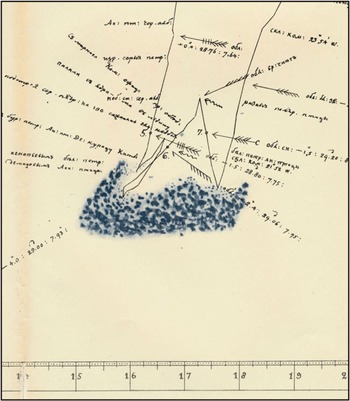
Commentary: The ice encountered on this probe was described in greater detail than the ice field in (B) above and was also discussed theoretically. Although the third group of tabular icebergs, described under 7(19) February, was not explicitly linked to those seen on the previous two days, Bellingshausen evidently viewed them all in much the same light, as originating from the “main coast” of ice which had risen away southwards out of sight two days earlier. (This phrase was perhaps the closest Bellingshausen came, in Two Seasons, to the “main ice” mentioned in the reports (above). With due respect to Dr Tammiksaar (Reference Tammiksaar2016, p.588), ‘main ice’ was used only once in the book, not in (C) but, with the epithet as an indirect plural, in (D-10) below.)
By slipping into the generalised present (“join together” instead of “joined”) in the second paragraph under 5(17) February, Bellingshausen associated that remark with the speculation about the permanency of the ice coast and its production of icebergs in the next paragraph. As extract (D) will show, the term “solid standing ice” became an important category for his final conception of the Antarctic ice cap. The track chart shows that he suspended his detailed narrative in favour of this discussion (Fig. 2).
Detail from Sheet 3 of Bellingshausen’s 1821 track chart (Bellinsgauzen, Reference Bellinsgauzen and Belov1963), corresponding to extract (C). Note that, despite surmising, by 1824, that the “main coast” (C) was the edge of a solid Antarctic ice cap (D–5), in 1821 Bellingshausen still chose to show it as a congelation of distinguishable “ice islands” like the ice field in Figure 1.

Bellingshausen’s description of a “main coast” of “solid standing ice” has been interpreted with good reason as a sighting of one of the (erstwhile) more or less permanent major coastal ice features of Antarctica, and in that sense a sighting of the icebound mainland. His language was very different to that in (B). However, he said nothing about land in either (B) or (C). It was not until a year later, after several further sightings of them, that he would look back to the sea swallows (terns) of 7(19) February 1820 as a sign of land. The statement in the reports (above), that the main ice seen in February was “like land,” confirms that in Bellingshausen’s estimation it was not itself land.
The capacity of a typical mess-kid might amount to 7 l., but this was smaller, perhaps indeed one of those reserved for the commander’s personal use. For a polar voyage, they were probably made of hardwood, reinforced with a brass strop and possibly lined with tin, and fitted with loops from which they could be suspended. The experiment of 5(17) February (described a day later) and its discussion were not so much a retraction of what had just been said, about all Antarctic ice deriving ultimately from the ice main, more an attempt to tackle the obvious question of how such a vast body of ice had formed in the first place. The freezing of seawater was not offered as a new discovery, since it was known to be possible at least since the Barentsz expeditions to Novaya Zemlya in the 1590s. Bellingshausen probably wanted to distinguish his own ideas about marine ice from the rivers theory of icebergs which had dominated European glaciology in the 17th and 18th centuries. But further discussion of that, and of the alternative preferred by Bellingshausen, that massive ice formations were produced by the freezing of seawater plus snowfall, should wait until extract (D) has been presented. Lastly, the 27° under 7(19) February perhaps represents another offset calculation for a freshening easterly, but no current was shown on the chart (Fig. 2).
(D) Two Seasons, vol. 2. 12(23) January 1821
(Paragraphs are numbered in square brackets for cross-reference.)
-
[1] Since the voyage within the ice was now stretching into a second summer, and everywhere encountering the extensive ice fields, high flat ice islands, and large distorted and irregular ice formations, which occupy the Southern Ice Ocean, I consider it not inappropriate to set down my thoughts and observations about their origins, their arrangement into large ice fields (the extent of which, we managed to observe, could be up to 300 miles [550 km]), the formation of the flat ice islands, and lastly their transformation into irregular ones, i.e. those with sharp peaks or varying external aspects.
-
[2] On 5[17] February 1820, lying in latitude south 68°58′, longitude 15°52′ west [east], with 4° of frost, I suspended two mess-kids one beside the other at the same height from the surface of the sea, after filling the first with fresh and the other with salt water. At 8 o’clock the following morning, when we were out of the ice, there were 2¾° of frost, and the water had frozen in both mess-kids. Taking care that the ice should not dissolve in sunlight, we set about examining the water from both mess-kids in the same way, and found that the ice from fresh water was much stronger, and although the ice from salt water was of the same thickness, it was more friable, being composed of thin, flat, horizontal layers, of which those uppermost had already joined together, but the lower they were, the more friable, such that the lowest layers had not yet adhered [to the rest]. When they stood the friable ice up on end in the shade, and the salt water which had composed it ran out, then as the ice came apart it was found to be almost fresh, and had I had more patience and let all the salt water run out, then doubtless [the water] produced by the ice as it dissolved would have been entirely fresh. As further evidence for that, I can attest that the water obtained from the icicles and encrusted ice, which we often broke off the forestays and fore backstays in the bows of the sloop after it formed there from splashes and foam in freezing weather, was fresh.
-
[3] Such an experiment shows that, contrary to numerous writers, ice can form from salt as well as fresh water; it only requires a few more degrees of frost. …
-
[4] While we were in the ice at high southern latitudes, we not infrequently observed small stretches of clear water, but they were ready to freeze by 3° or 4° of frost. On the surface of the sea, the thinnest little sheets of ice (salt) were pushed by the wind into layers, and with such strong pressure of one sheet on another that the parallel layers reached a thickness of between half a foot and a foot [15–30 cm]. Next, the frost transformed them into strong floes, which were broken by wind and waves, pressed onto each other, and quickly frozen to form larger floes, especially in winter when the frosts are severe. If it can be presumed that in the Southern Hemisphere, just like the northern, the sharpest frosts more often occur in calm weather, then at such times, especially in the coves formed by solid standing ice, the sea could very easily freeze, and when the frosts diminish the first current could break such ice into pieces, starting with its edges and then going further.
-
[5] All these floes, filling the Southern Ice Ocean and driven by winds and currents, and encountered on various sides, are eventually compressed into one great expanse and, pressing against each other by mutual force, produce thick, high ice formations. We happened to see such compressed or continuous ice covering an expanse of up to 300 miles [550 km] from west to east, and if its breadth from north to south corresponds or surpasses that extent, which is highly probable, then doubtless the ice at the centre of that expanse, being completely free of currents, freezes together, increases on top from falling snow, hail, and sleet, and is subsequently transformed into solid ice. In that way the ice sinks deeper in the water, in proportion to its increased thickness from above. But since it is evident from the experiment I conducted that ice also adds thin layers by congelation at the base, ice formations held fast in the middle of the sea are able to grow in their natural proportions while preserving their flotation level [lit. balance], i.e. ⅞ remain under the water and just one-eighth above the water.
-
[6] Since the ice does not grow equally everywhere, it cannot have a single flotation level everywhere, and there are ruptures in various places. These can also come about by heavy snow falling on one side of a floe. The congelation at the base of the ice must also be greater further to the south than in the north. From various causes, the floes break apart into large pieces, which become separated by storms or currents. Ice less submerged in the water is subjected to greater wind action than ice that is more submerged. These broken floes, becoming separate from one another, form islands of varying size; the sides of the islands with flat tops are almost always sheer. Meanwhile, whenever there are frosts they continue to grow under water through the congelation of thin layers,Footnote * and above from snowfall, which then turns to ice in the first frost. We happened more than once to see that the surface of such a flat floe was altered as a result of the water which poured off it in warm weather, but later resumed its level appearance thanks to snow and frost. We particularly noticed that sort of change when sailing within the ice; on some islands, the new layer stood out from older snow due to its whiteness.
-
[7] Towards the end of the present summer, we found more unlevel and sharp-pointed islands. These unlevel islands, or rather ice formations, probably originate from the flat ice formations in the following manner. All ice islands originally have flat surfaces. In the summer they undergo more erosion on whichever side receives the most heat. The opposite side, retaining its original state, outweighs the other, and the floe takes on a sloping appearance. We encountered many such ice formations, and we happened to observe the tipping of a small island when we broke off an underwater section with cannon fire. Thus the more such islands lose their balance the greater the slope becomes. Eventually, when they have turned and brought one side uppermost, their appearance becomes sharp-peaked or something else of that sort. The ice which rises above water in such a rotation resembles underwater ice, keeping its attractive greenish-blue colour.
-
[8] Such sharp-peaked ice islands are higher than the flat-topped ones and can even sometimes appear to the beholder like a gothic building, with turrets, obelisks, or monuments on platforms, or in other guises. Such floes are soon subjected to various further changes and erode away into small irregular ice formations, such as the navigator encounters on all sides in high southern latitudes.
-
[9] Driven by winds and currents, pieces of ice that remain intact during summer, and those which fall off the sides of flat-topped floes, may collide with extensive compact fields, or else, in the manner described above, join together, grow, separate, and drift like other floes in the form of an enormous ice island.
-
[10] The enormous ice formations that rear up into sloping hills the nearer they are to the South Pole, I call main, on the supposition that, since there were 4° of frost on the finest summer day, then further south the cold never decreases. I conclude, therefore, that this ice stretches beyond the Pole and must be immobile, in places touching shoals or islands like Peter the First I, which are doubtless located in high southern latitudes and adjacent to its coast [that of the main ice], which exists (in our opinion) near the latitude and longitude where we met the sea swallows (Fig. 2). Although their digits are joined with a thin membrane for swimming, those birds are coastal rather than oceanic. It is worth noting that all oceanic birds, especially those which live in high latitudes and feed on the surface of the sea, have a curved upper bill, but in sea swallows, gulls, and other coastal birds, the bill is straight. We also saw sea swallows near South Georgia and Peter the First I, but never met them far from coasts.
-
[11] I have based my views on the origin, composition, and transport of the floating ice islands that are encountered in the Southern Hemisphere on a long passage among them over two summers, and I presume that the composition of ice in the Northern Hemisphere is much the same. Certainly the original formation of ice in the north is much assisted by river water, for all the rivers of Siberia, like the famous Coppermine River in America and others, flow into the Northern Ice Ocean. Thus there is less salt in offshore waters, so that they ice over sooner than water at some distance from the coast. With the onset of summer the ice probably starts to break out sooner at the mouths of rivers, with their strong flow due to the confluence of fresh water from inland districts. When part of a watercourse is free of ice, then its waves and current exercise their force and break away the remaining ice. If those pieces do not get eroded during the rest of the summer then, uniting with other pieces that have formed further out to sea, or have been washed off ice islands or fixed points by the force of currents and winds, they collect into continuous fields which then, as in the Southern Hemisphere, produce enormous floating ice islands. This seems to me the only cause for there being more ice near the northern coasts of Asia and America, than between Europe and Greenland.
(Bellinsgauzen, Reference Bellinsgauzen1831, 2, pp.243–251)
Commentary: Bellingshausen’s essay on Antarctic ice was a respectable achievement for someone with little scientific training beyond hydrography, in which he was an acknowledged expert. It is longer than Lomonosov’s article on icebergs (Lomonosow, Reference Lomonosow1763), and more than half the length of Buffon’s repetitive treatment of the subject in the first edition of the Histoire Naturelle (Buffon & Daubenton, Reference Buffon and Daubenton1749), which discussed navigation as much as glaciology. The only comparable (though more extensive) treatment was that by William Scoresby Jr., the first version of which might have been offered to Bellingshausen by an astute London bookseller in 1819, although there is no evidence for that. Despite which Bellingshausen’s essay has received very little attention from historians, apart from a few ‘cherry-picking’ remarks from Soviet commentators anxious to highlight the reference to main ice in paragraph (10). (For example, because they hoped to promote passage (B) as the first sighting of the Antarctic mainland, Soviet authors did not point out the reference to sea swallows in (D–10), which links the enormous ice formations under discussion with (C), not (B).)
Before proceeding, we need to reprise the broad outlines of European glaciology prior to Bellingshausen. Subjective fantasies about polar lands and their inhabitants continued to thrive until the 17th century, especially in the work of mapmakers (Tooley, Reference Tooley1963), and those often authoritative conceptions sometimes influenced people taking a more empirical approach, as too did the widespread hope that the ocean might prove more navigable in the high Arctic than further south. Nevertheless, between the 16th and 18th centuries, three proto-scientific theories about polar glaciation emerged. They did so in the form of explanations for the origin of icebergs, and disagreed about the roles of rivers, land, and snow.
The first, most widely held theory emphasised the role of rivers in local Arctic glaciation, usually citing the annual breakout of ice from Siberian rivers into the Kara and Laptev Seas. As Henry Hudson generalised, in his narrative of an Arctic expedition which began in 1608: “It is no marvell that there is so much ice in the Sea toward the Pole, so many sounds and rivers being in the lands of Nova Zembla and Newland to ingender it; besides the coasts of Pechora, Russia, and Greenland, with Lappia…” (Hudson, Reference Hudson and Purchas1625, p. 579). Such observations from mariners, together with his own experiences in the Arctic and laboratory experiments, were then cited by the Irish scientist Robert Boyle in support of his reluctance to believe that the principal source of Arctic ice was the freezing of the sea (Boyle, Reference Boyle1683, pp. 150, 171). The rivers theory also drew support from the discovery that ice from icebergs often melted to give fresh water rather than salt. The famous French naturalist Georges-Louis Leclerc de Buffon extended the theory to the Antarctic: “The ice formations, which people see as obstacles preventing navigation towards the Poles and the discovery of southern lands, only prove that there are very large rivers near the latitudes in which they have been met, thus showing us also that there are vast continents from which those rivers flow”; he suggested that near the South Pole there could be a continent as large as Africa, Asia, and Europe combined (Buffon & Daubenton, Reference Buffon and Daubenton1749, pp. 219, 213). Lomonosov’s 1763 article broadly followed the rivers theory, under the influence of Buffon’s Histoire Naturelle, which Lomonosov acquired in 1762. The persistence of the theory is apparent in (D–11).
A second, less commonly held opinion was that, while land was still needed to produce the ice from which icebergs formed, that could happen through the congelation of snow and the subsequent movement of such ice into the sea through gravity, without much aid from rivers. The English explorer John Davis was one of the earliest proponents of this theory:
I have seen in some part of those seas, tow sortes of yse, in very great quantity, as a kind of yse by seamen named ylands of yse, being very high above the water, forty, and fiftie fadomes [73–91 m] by estimation and higher, and every of those have been seven times as much under the water, … and this kind of yse is nothing but snow, which falleth in those great peeces, from the high mountains bordering close upon the shore depe seas. (Davis, Reference Davis1595, p.28).
Remarkably, Davis wrote this before Barentsz’ discovery of Svalbard in 1596, after which seven ice-calving coastal glaciers became celebrated as the “Seven Icebergs of Spitzbergen” (Martens, Reference Martens1675, p. 19). (Davis’s second kind of ice was “flake ice,” formed along shores and less than 5.5 m thick.)
A variation on the second theory, according to which sea ice originated from snow swept by waves off beaches into seas that were too cold to melt it, was offered by Thomas James. According to his observations, such snow would freeze on the sea to a depth of 5–7.5 cm, and that ice would crumple to a depth of 1.5–1.8 m on meeting obstacles, eventually leading to “an infinite multiplication of ice” (James, Reference James1633, pp.62–63).
Much later, James Cook also rejected the rivers theory:
It is a doubt with me, whether there may be any rivers in these countries. It is certain, that we saw not a river, or stream of water, on all the coast of Georgia, nor on any of the southern lands. … How are we then to suppose that there are large rivers? The valleys are covered, many fathoms deep, with everlasting snow; and, at the sea, they terminate in icy cliffs of vast height. It is here where the ice islands are formed; not from streams of water, but from consolidated snow and sleet, which is almost continually falling or drifting down from the mountains, especially in the winter, when the frost must be intense. During that season, the ice cliffs must so accumulate as to fill up all the bays, be they ever so large. This is a fact which cannot be doubted, as we have seen it so in summer. These cliffs accumulate by continual falls of snow, and what drifts from the mountains, till they are no longer able to support their own weight; and then large pieces break off, which we call ice islands. (Cook, Reference Cook1777, 2, pp. 240–241).
The third theory was the last to appear and focused largely on the Antarctic. Drawing on the known or apparent facts that seawater could freeze, that no land had yet been discovered beyond 56°S, and that the Southern Hemisphere was significantly colder than the northern, Buffon presented a new theory, that a solid and continuous polar ice cap probably occupied the entire surface of the planet beyond 70°S (Buffon, Reference Buffon1778, p. 604). There might or might not be some land beneath the ice, but the ice cap would have formed without it anyway, by the accumulation of ice formed from mist and snow on the surface of the sea and its subsequent regular increase (Buffon, Reference Buffon1778, pp. 609–610). Buffon died in 1788 without drawing attention to the contradiction between this theory and the rivers theory, which he had accepted at the start of the work in 1749, still less attempting to reconcile the two. Both continued to appear in successive editions of the Histoire Naturelle. However, the resonance of Buffon’s second theory in Bellingshausen’s day is suggested by two articles on the Antarctic in the Encyclopédie Méthodique (Desmarest, Reference Desmarest1803, pp. 653–655).
Scoresby’s explanation of polar ice was a blend of all three theories, in which drift ice and field ice were “derived from the ocean, or from sea and atmosphere combined,” but icebergs were at least originally “the product of snow or rain water” and either derived from glaciers or formed in “deep sheltered bays.” But whatever role had originally been played by land, by now the “proximity of land is not essential [to “ice in general”], either for its existence, its formation, or its increase” (Scoresby, Reference Scoresby1818, pp. 293–295).
One factor that possibly told against the snow theories (with or without land) was lack of time. Before the mid-18th century, it was widely believed that the earth was only a few thousand or tens of thousand years old. From such a perspective, a relatively fast-acting mechanism resembling the annual formation of ice in Arctic rivers and estuaries perhaps appeared more plausible than the gradual build-up of compacted snow, and the more so for anyone who thought the poles might have moved in the past (de Brosses, Reference de Brosses1756, 1, p. 49). From the mid-18th century, however, the age of the earth steadily opened up in the conceptions of men like Buffon, James Hutton, and Erasmus Darwin. Such changes in perspective were not mentioned but may have influenced Scoresby’s remark that: “… a continent of ice mountains may exist in regions near the Pole, yet unexplored, the nucleus of which may be as ancient as the earth itself, and its increase derived from the sea and atmosphere combined” (Scoresby, Reference Scoresby1818, p. 294).
Relevant works in the library of Vostok, some translated into Russian, included the voyages of Cook (Kuk, Reference Kuk1796–1800), Phipps (Reference Phipps1774), and Pagès (Reference Pagès1782–1783), histories or collections of voyages by Prévost (Reference Prévost1746–1759), de Brosses (Reference de Brosses1756), and Burney (Reference Burney1803–1817), and Buffon’s Histoire Naturelle (probably the 1769–1778 edition). For the rest, the library contained mainly general technical works and other Pacific voyages with no polar content (Anon., 1819). When formulating his central argument in paragraphs [4]–[9], therefore, Bellingshausen had something to go on besides his own observations and common sense, but less than was available elsewhere. In the absence of other close treatments of the freezing of seawater, Buffon’s suggestion that: “All the aqueous vapours forming fog and snow are turned into ice. They freeze and accumulate on the surface of the sea just as they do on land” (Buffon, Reference Buffon1778, pp. 609–610) may have encouraged Bellingshausen to resist statements to the contrary (de Brosses, Reference de Brosses1756, 2, p. 215). But Buffon’s earlier, very different theory, about a vast Antarctic continent drained by iceberg-bearing rivers, was also present.
The experiment reported in paragraph [2] resembles those reported or conducted by the English naturalist Daines Barrington in the 1770s (Barrington, Reference Barrington and Barrington1781), with the significant difference that Bellingshausen conducted his in the field. A long digression in paragraph [3], about the freezing of seawater at higher temperatures when diluted with fresh, has been omitted to save space, but Bellingshausen’s application of his insight to the Arctic [11] may well be original. Although Scoresby was not such a faithful adherent of ‘Buffon 2’ as Bellingshausen, partly because of the differences between their respective hemispheres, the Russian explorer would doubtless have recognised the detailed account of similar phenomena, complete with pancake ice, recorded by his British counterpart (Scoresby, Reference Scoresby1818, pp. 271–282). However, the fact that Bellingshausen did not mention Scoresby, although he usually acknowledged assistance in whatever form, suggests that he had not seen Scoresby’s work.
For once disregarding Cook, unfortunately, Bellingshausen followed Buffon’s second theory by claiming that the “enormous ice formations,” which probably extended from one side of the South Pole to the other [10], resulted from the freezing of seawater and precipitation without the presence of land. On the question of land, he suggested only that some islands might exist, providing habitat for terns, around the fringes of (“touching”) the ice cap. The phrase translated as “fixed points” in [11] may refer to land, or perhaps more plausibly to places where ice had grounded on the sea floor, whether in deep water or shoal. The repetition of “solid standing ice” from (C) in [4] and [5] of (D) is significant. Bellingshausen seems to have reserved it for ice that was so massive that it had probably grounded. The notion in [5], that central portions of an expanse of high ice must sink steadily deeper over time, also implied that it would eventually take ground.
Bellingshausen did not hesitate to go beyond his observations when he felt it was justified, e.g. in his statements about winter conditions or congelation at the base of ice floes. His boldest move was to infer from a 550-km field of compact ice that a space from about 69°S to the pole and then northwards for a similar distance on the other side, a total of some 4600 km, was entirely filled with “enormous ice formations” like those he had seen.
Bellingshausen’s theory that Antarctic ice underwent a perpetual cycle of fragmentation and re-agglomeration was flawed in two respects. First, as a handful of earlier explorers had believed, ice masses large enough to yield tabular and other large icebergs are accumulated over land, not ocean. And second, Bellingshausen rather played down the evaporation of seawater and its subsequent precipitation, phases of the cycle for which water is not or need not be frozen.
Bellingshausen recorded sightings of sea swallows (Antarctic or Arctic terns) at South Georgia in 1819, shortly before discovering Peter the First and Alexander Islands and a week after the latter in 1821, near Australia and New Zealand, and at Vostok Island near the equator. They were certainly his lucky birds, although he could not distinguish between the species and was unaware that Arctic terns, which migrate across the Southern Ocean in the austral summer, are too pelagic to be reliable indicators of land. The place “where we met the sea swallows” in February 1820 was the only location near which no land was actually seen. By remembering it as such, however, he was not claiming a ‘near miss’ at continental discovery, because as he proposed in his theoretical essay, the region was a closed system of ice for which land was not required, although sundry islands might be located nearby. Modern commentators have sometimes misunderstood Bellingshausen because his conception of an oceanic ice main was so different from the reality of Antarctica and was sometimes, though not always, obscured in translation.
Conclusions
Three conclusions follow from this examination of what Bellingshausen actually said. First, with due respect to Debenham, the expedition did not sight a mountainous and potentially mainland coast (Alexander Island) until 1821, a year after Bransfield. Second, although Bellingshausen’s theory of Antarctic ice was misguided, probably by Buffon, it was frequently shrewd and it underpinned his valid belief that they sighted a “main” ice coast in mid-February 1820. Third, when describing an earlier probe, in late January, he recorded a quite different and less striking Antarctic icescape than the one encountered three weeks later, and so made no claim to have sighted an ice coast on that earlier date.
Acknowledgements
The author would like to thank Professor Aant Elzinga, of the University of Göteborg, for explaining what Lomonosov said and did not say in his 1763 article about the origin of icebergs.
Financial support
None.
Conflict of interest
None.