



An underexplored phenomenon
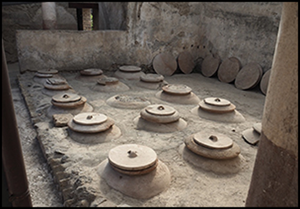
Wine played a fundamental role in Greco-Roman Antiquity (Van Limbergen Reference Van Limbergen2020). A quintessential tool in Roman winemaking was the dolium, a large earthenware vessel with a rounded body, a flat base and a wide mouth that was used for fermenting, storing and ageing wines. Except for in Hispania—where ancient texts and archaeology corroborate the use of free-standing vessels (Varro, Res Rusticae 1.13.6; Hooper & Ash Reference Hooper and Ash2006; Peña Cervantes Reference Peña Cervantes, Van Limbergen, Dodd and Busanain press)—dolia were routinely buried in the ground up to their mouths; hence the Latin term dolia defossa. Such wine cellars have been found all over Italy (Figure 1) and the western Roman world, but those of the Villa Regina and Pisanella farmhouses at Boscoreale near Pompeii (De Caro Reference De Caro1994; Feige Reference Feige2022; Figure 2) and the ‘Villa of Augustus’ at Somma Vesuviana (Aoyagi et al. Reference Aoyagi, De Simone, De Simone, Marzano and Métraux2018) remain the most famous and best-preserved examples. The widespread and extensive use of these vessels is arguably the most striking feature of Roman winemaking, yet the specifics of their role in vinification (the conversion of grape juice into wine through fermentation), as well as their influence on the organoleptic (visual and sensory) characteristics of Roman wine, remain ill-explored.
Wineries with dolia defossa cellars in Italy (red dots). Stars indicate the major urban centres of Ravenna, Rome and Pompeii (map by D. Van Limbergen, using information from Van Limbergen Reference Van Limbergen2011; Van Oyen Reference Van Oyen2020; Dodd Reference Dodd2022; Feige Reference Feige2022).

The dolia defossa wine cellars of (a) Regio II Insula 5 (Pompeii) and (b) Villa Regina (Boscoreale) (photographs by E. Dodd, courtesy of the Ministero della Cultura – Parco Archaeologico di Pompei); and (c) Tortoreto Muracche (Abruzzo) (photograph by Francesco Pizzimenti, courtesy of Soprintendenza Archeologia, Belle Arti e Paesaggio per le province di L'Aquila e Teramo).

Dolia have been a rather neglected category of pottery, in part due to their reputation as a generic class of coarse ware, unworthy of chrono-typology and in-depth study. In recent years, however, the tide has turned with studies of dolia production (Caratto & Cibecchini Reference Carrato and Cibecchini2020; Cheung Reference Cheung2021; Cheung et al. Reference Cheung, Chang and Tibbott2022) and their role in storage (Van Oyen Reference Van Oyen2020) and trade (Marlier Reference Marlier2008). The most striking insights come from archaeometry, the results of which point to the use of specific, well-suited clays in the making of dolia and the export of finished vessels from renowned source areas, over substantial distances (Manca et al. Reference Manca2016; Caratto Reference Carrato2017; Trojsi Reference Trojsi, Pensabene and Sfameni2017; Carrato et al. Reference Carrato, Ferreras, Dautria and Bois2019; Montana et al. Reference Montana, Randazzo, Barca and Carroll2021; Carroll Reference Carroll2022). Contrary to their modern reputation, these vessels were highly valued items that were made by skilled artisans using specially selected clay mixtures.
The existence of specialised dolia workshops and the centrality of these vessels in Roman wine production indicate their intentional and systematic use, in line with good practices and with the aim of obtaining certain desired characteristics within the wine. Grapes and the climate and environment in which they are grown contribute to the character of a wine (Jackson Reference Jackson2008; Dougherty Reference Dougherty2012) but the dominant characteristics are generated during fermentation, maturation and ageing (Martins et al. Reference Martins, Garcia, Mendes, Costa Freitas, Gomes da Silva and João Cabrita2018), in this case inside dolia. Despite knowledge of this fact, no study has yet scrutinised the role of these earthenware vessels in Roman winemaking and their impact on the look, smell and taste of ancient wines. Two barriers have prevented these inquiries. First, while Roman-period texts do refer to wine organoleptic qualities and flaws, these aromas and flavours are never linked to specific winemaking techniques. Second, current interpretations of these texts are largely influenced by modern industrial procedures, which are of little use for understanding the nature of ancient wines.
In contemporary winemaking, earthenware vessels have been replaced by wooden, concrete and steel containers. The use of large ceramic containers has, however, a long-standing tradition in the Mediterranean and beyond. The ancient Greeks called these vessels ‘pithoi’ (Giannopoulou Reference Giannopoulou2010), while contemporary examples in Spain and Portugal are named ‘tinajas’ and ‘talhas’ (Issa-Issa et al. Reference Issa-Issa2021). In the sixteenth century, earthenware vessel fermentation also became widespread in Chile and Peru up to the mid-nineteenth century (Sharratt et al. Reference Sharratt, De France and Williams2019). But the most noteworthy incarnation of large earthenware vessels comes from the Caucasus, where wine production has been practised for over 8000 years (Maghradze et al. Reference Maghradze2016) and these vessels are known as ‘qvevri’ (Georgia) or ‘karas’ (Armenia). Sustained for two millennia by Christianity, for both liturgy and consumption (Chkhartishvili & Maghradze Reference Chkhartishvili, Maghradze, Maghradze, Rustioni, Turok, Scienza and Failla2012), the Georgian tradition is notable for its persistence, being granted UNESCO World Intangible Cultural Heritage status in 2013 (Glonti & Glonti Reference Glonti and Glonti2013; Hovhannisyan et al. Reference Hovhannisyan, Yesayan, Bobokhyan, Dallakyan, Hobosyan and Gasparyan2017; Glonti Reference Glonti and Glonti2018; Figure 3).
a–b) a wine cellar with negatives of buried qvevri, Vardzia monastery, Georgia, twelfth–thirteenth century; c–e) abandoned wine cellar and qvevri, Ikalto monastery, Georgia, fifteenth–sixteenth century; f) modern winery of Orgo, Teleda, Kakheti, Georgia (photographs by D. Van Limbergen).

The Caucasus region is considered a cradle of ancient winemaking and the earliest evidence for spherical ceramic containers comes from Early Neolithic sites in Georgia, dated c. 6000–5800 BC (McGovern et al. Reference McGovern2017; Figure 4). The first attested use of fully buried ceramic vessels for vinification comes from neighbouring Armenia, where the Late Chalcolithic Areni-1 cave has produced evidence of a winery with an earthenware vessel wine cellar dating to 4000–3500 BC (Barnard et al. Reference Barnard, Dooley, Areshian, Gasparyan and Faull2011). Considerable genetic affinity is also apparent between Roman grape cultivars and Georgian (and Caucasian) Vitis grapevines (Vouillamoz et al. Reference Vouillamoz, McGovern, Ergul, Söylemezoğlu, Tevzadze, Meredith and Grando2006; Myles et al. Reference Myles2011; De Lorenzis et al. Reference De Lorenzis2019). All this evidence strengthens the case for a millennia-long transfer of cultivars and techniques from east to west, perhaps brought to Italy through Phoenician and Etruscan contacts (McGovern Reference McGovern, Dodd and Van Limbergen2024). This hypothesis is supported by the use of earthenware vessel fermentation at Bronze Age Byblos along the Canaanite/Phoenician Lebanon coast (Brun Reference Brun2004: 59).
Earthenware vessel decorated with grape motifs, Khramis Didi Gora, Georgia, sixth millennium BC (photograph by D. Van Limbergen, picture courtesy of Georgian National Museum).

The Georgian evidence provides a unique opportunity to unravel procedures and pathways in Roman vinification and, through this, to advance the debate on the nature of ancient wines. Dolia and qvevri are similar vessels in terms of material, shape and setting and the winemaking process for both vessels is broadly the same. Qvevri vinification procedures are, however, documented in much more detail. A comparative study therefore has the potential to greatly enhance our interpretation of the ancient textual sources on viticulture and winemaking. In this article, we compare Roman and Georgian practices through the lens of contemporary oenology to elucidate the fermentation process in large ceramic vessels. We focus on aspects including their burial in the ground, shape, porosity and the role of skin-contact methods (when the grape skins remain in contact with the juice during winemaking) and flor yeasts (yeast cells that float on the surface of the wine).
Are qvevri wines a blueprint for Roman practices?
The basic course of vinification in both qvevri and dolia, as revealed by modern anthropological observations and ancient sources, is remarkably similar. Fermentation in Roman winemaking was spontaneous and entirely dependant on the yeasts present on the grapes. This reliance on natural yeasts partly explains the practice of treading in Antiquity, with grapes gently squeezed (without breaking stems and seeds, which imparts unpleasant flavours) and fermentation put in motion immediately to reduce the risk of failure. Primary fermentation—the first so-called tumultuous phase in which the bulk of the sugars are turned into alcohol—lasted nine to 30 days, during which the dolia were kept open. The jars were then topped up with more must (to minimise air contact) and sealed with a plastered terracotta disc (operculum) or wooden lid or simply with animal skins (Columella, Res Rustica 12.28.3, 12.39.2; Forster & Heffner Reference Forster and Heffner2001). Occasionally, a second convex terracotta cover (tectorium) provided further protection (Thurmond Reference Thurmond2017). The use of such lids is confirmed archaeologically, as seen at Villa Regina and Pisanella (Dodd Reference Dodd2022: 470, fig. 14). Judging the correct moment to seal the dolia was not always easy, and Varro (Res Rustica 1.13.6; Hooper & Ash Reference Hooper and Ash2006) describes dolia cracking under the pressure of unreleased carbon dioxide. Once sealed, the wine remained in the dolia for five to six months until they were opened at the spring equinox (Columella, Res Rustica 12.30; Forster & Heffner Reference Forster and Heffner2001).
In modern Georgian winemaking, spontaneous by choice (and tradition), primary fermentation in qvevri lasts two to three weeks, during which the jars remain open. When fermentation starts, the grape skins and solids rise to the surface because of the production of carbon dioxide, thus forming a ‘cap’ over the fermenting wine. In this phase, the skins and solids are regularly punched down to keep them wet. After two to three weeks, the vessels are sealed with a stone or wooden lid and covered with earth, remaining so for six to nine months. The wine is then bottled for consumption or transferred into clean qvevri for ageing (Feiring Reference Feiring2016). This operational similarity to Roman winemaking is complemented by the materiality of the vessels. Qvevri are generally made from clay mixtures rich in minerals, which impart desirable wine aromas, in particular astringency (a drying sensation in the mouth). In this regard, clay from Imereti in western Georgia is considered the best (Issa-Issa et al. Reference Issa-Issa2021). Archaeometry of Roman dolia remains rare, but the few existing studies point to clay compositions rich in minerals that are similar to Georgian dolia fabrics (Trojsi Reference Trojsi, Pensabene and Sfameni2017; Carrato et al. Reference Carrato, Ferreras, Dautria and Bois2019; Montana et al. Reference Montana, Randazzo, Barca and Carroll2021). This suggests that Roman winemakers not only used similar equipment and procedures but were also aiming to make wines akin in character to those that are now produced in modern-day Georgia.
Porous eggs buried in the ground
Dolia and qvevri are porous vessels, which means that vinification is oxidative. In both cases, however, excessive and harmful oxidation is prevented by the coating of vessel interiors with pitch (dolia) or beeswax (qvevri), which penetrate the clay, thus waterproofing and sterilising the vessels (Barisashvili Reference Barisashvili2011: 16–23). In some areas of the Roman Empire, wax or a mixture of wax and pitch was used (Geoponika 6.3–5; Dalby Reference Dalby2011), but Pliny warns of the resulting sour taste in wine (Naturalis Historia 14.128; Rackham Reference Rackham2005) and Columella recommends it instead for olive oil containers (Columella, Res Rustica 12.52.16–17; Forster & Heffner Reference Forster and Heffner2001). The best pitch came from Bruttium and Rhodes (Columella, Res Rustica 12.18.7; Geop. 6.5). Pitching of vessels was undertaken 40 days before the vintage (Columella, Res Rustica 12.18.5) and repeated at least every two years for hygiene and efficiency (Geop. 6.5). This textual evidence for pitching is supported by iconographic representations (e.g. a calendar mosaic from Saint-Romain-en-Gal) (Balmelle & Brun Reference Balmelle, Brun and Morlier2005) and ethnography (from areas where earthenware vessels are still used, such as Alentejo, Portugal), and has been confirmed by gas chromatography-mass spectrometry of archaeological samples (Pereira & Silvino Reference Pereira, Silvino, Oliveira, Morais and Morillo Cerdán2015; Dodd Reference Dodd2022: 457). Both wood pitch and beeswax have excellent waterproofing capabilities, but the vessels remain porous to a certain extent, and this permits a degree of micro-oxygenation. Unmanaged air contact turns wine into vinegar, but controlled oxidation can result in great wines because it concentrates colour and creates pleasant grassy, nutty and dried fruit-like flavours. As in Georgia today, burying and sealing the vessels further ensured ideal conditions for making fine oxidative wines in Antiquity.
With their egg-like forms, the shapes of clay vessels such as qvevri and dolia play another important role in the creation of quality wines. As primary fermentation produces carbon dioxide and changes the temperature inside these vessels, their ovoid shape creates internal convection currents (Figure 5). These currents act as a kind of natural pumping system, gently stirring up (dead) yeasts, skins and other solids and slowly mixing them with the must (the squeezed grape juice). This continuous blending within the vessels enriches the texture of the wine and promotes uniformity in fermentation, and thus homogeneity in the must (Cheung Reference Cheung2021).
Schematic representation of the fermentation process in dolia/qvevri (figure by D. Van Limbergen, dolia digital image by M. García Ávila, Cella Vinaria Project).

Roman vintners understood that burying dolia could protect the wine from temperature variation (Pliny, Naturalis Historia 14.27; Rackham Reference Rackham2005). Indeed, burying earthenware vessels ensures a constant temperature inside them, providing a stable environment for the wine to ferment and mature through the changing seasons. Fermentation temperature is closely linked with vessel size and is particularly decisive for fermentation speed (lower temperatures reduce the rate of fermentation) and wine characteristics (higher temperatures maximise colour and tannin extraction, while lower temperatures foster fruity flavours). Winemakers could therefore choose between a variety of vessel sizes depending on the desired fermentation pathway and wine style. Notably, there is great variability in the capacity of dolia in Roman wineries across Italy, ranging from 150–2000 litres (Carroll Reference Carroll2022). Qvevri winemakers also use a variety of different sizes within a single cellar; capacities range from a few hundred litres to 5000 litres but the most common size is 1000–2000 litres, as temperature regulation can be difficult in larger sizes.
Temperatures inside qvevri commonly range between 13–15°C and 23–28°C, which is also ideal for malolactic fermentation or the conversion of tart malic acids into softer lactic acids during secondary fermentation. Today, the process is often prevented chemically for white wines, as high concentrations of its natural byproduct (diacetyl) give wines an excessively buttery taste (Robinson Reference Robinson2006). Diacetyl is, however, a key stabilising agent in maturing qvevri wines; lower concentrations are responsible for the caramel and nutty tones of Georgian amber wines.
Skin-contact wines
The colour of wine in Antiquity is much debated (Tchernia & Brun Reference Tchernia and Brun1999; Bouvier Reference Bouvier2000; Kourakou-Dragona Reference Kourakou-Dragona2015: 103–119; Thurmond Reference Thurmond2017: 153–5). Pliny distinguishes four categories: albus (pale white), fulvus (reddish-yellow), sanguineus (bloody-red) and niger (dark, black; Pliny, Naturalis Historia 14.80; Rackham Reference Rackham2005). Greek sources highlight similar differences distinguishing μέλας (black), λɛυκός (white), κιρρός (orange-tawny; Atheneaus, Deipnosophistae. 32e; Douglas Olson Reference Douglas Olson2007), ξανθός (yellow) and ɛρυθρός (red; Hipp. De vict. Acut. comm. 15.627k; Jones Reference Jones1923). This spectrum of wine colours is influenced by several factors during fermentation and storage. White wine, for example, becomes darker with time through oxidation (Tchernia & Brun Reference Tchernia and Brun1999) and this is often considered responsible for the yellowish-orange or tawny colour (ξανθός, κιῤῥóς) of classical Antiquity's most renowned wines (Chian, Lesbian, Falernian, Caecuban; Gal. MM 6.275, 6.801, 10.834-835K; Johnston & Horsley Reference Johnston and Horsley2011; Comp. Med. Loc. 13.513K; Vict. At. 94; Singer Reference Singer1997; Dsc. Mat. Med. 25.698; Beck Reference Beck2005). A few red-grape varieties are ‘teinturiers’, which produce berries with dark-coloured juice (e.g. Georgian Saperavi), and these may be responsible for the ‘black’ wines mentioned by ancient authors (Brun Reference Brun2004; Boulay Reference Boulay2012; Kourakou-Dragona Reference Kourakou-Dragona2015). A much more significant effect, however, comes from the maceration of the must with the pomace (the residue of the skins, seeds and stems), which releases phenolic compounds.
Maceration in modern winemaking is meant to extract colour from the grape skins for making rosé and red wines. The process lasts from a few hours to several days or even weeks depending on the grapes’ phenolic content and the amount of colour desired (Robinson Reference Robinson2006). To this end, punching down the cap of grape solids that forms on top of the fermenting must promotes contact with the pomace. Maceration in this sense is not mentioned in the ancient sources. Together with the agronomists’ recommendation to transfer the must to dolia shortly after pressing, this has generated the idea that Roman vinification made little use of maceration and was in essence a white-winemaking process (Brun Reference Brun2003; Boulay Reference Boulay2012; Harutyunyan & Malfeito-Ferreira Reference Harutyunyan and Malfeito-Ferreira2022). This interpretation, however, is much influenced by strict modern distinctions between white and red wines, which did not existent in Antiquity. Ancient sources also do not state explicitly that the pomace needs to be removed. In fact, Columella mentions the clearing out of the wine dregs or lees—the solid leftovers of winemaking consisting of dead yeast cells, grape skins and seeds, concentrated as sediments—only in the spring, when the new wine was prepared for ageing (Columella, Res Rustica 12.28.4; Forster & Heffner Reference Forster and Heffner2001; Geoponika 7.15; Dalby Reference Dalby2011). This implies that at least part of the pomace remained with the must in the dolia during the entire fermentation cycle. Iconographic evidence further points to the recurrence of grape treading and pressing in Antiquity directly inside the jar in which the wine fermented, again suggesting fermentation on the skins (Kourakou Dragona Reference Kourakou-Dragona2015: 111–118). Finally, there is little evidence for the use of strainers in Roman winemaking. Although filtering might have been achieved with utensils made of organic material (Thurmond Reference Thurmond2017: 155, fig. 23), at least part of the pomace must have remained in the wine and therefore maceration, to some extent, took place.
Direct bioarchaeological evidence for vinification on the lees inside Roman dolia remains elusive. The only confirmed example comes from ‘Herod's Winery’ at Herodium, the winter palace of King Herod the Great, who ruled Judea from 37–4 BC. His winery disposed of a large storage room filled with buried dolia (likely imported from Italy) in which the ample remains of grape seeds strongly point to maceration (Porat et al. Reference Porat2018). The lack of further evidence may relate to the loss of material—through the annual cleaning of dolia before the harvest and the emptying of dolia excavated prior to standardised archaeobotanical sampling (Alessandra Pecci pers. comm.)—rather than the absence of grape solids during vinification. Some support for this argument comes from the Early Imperial ‘Gulf of Diano’ shipwreck off the Ligurian coast. The cargo included 14 large dolia, many of which contained residues with high levels of Vitis pollen, suggesting non-filtered, macerated wines (Arobba et al. Reference Arobba, Caramiello and Martino1997–1998). Additional evidence for the existence of skin-contact vintages is provided by the attestation of grape seeds inside amphorae (Chic García Reference Chic García1978; Bryant & Murry Reference Bryant, Murry, Bass and Van Doorninck1982: 328–9; Bonet Rosado et al. Reference Bonet Rosado, Fumadó Ortega, Aranegui Gascó, Hassini, Vives-Ferrándiz Sánchez and Gascó2005: 131).
Prolonged maceration is a key feature of qvevri wines. Once primary fermentation inside a clay vessel is complete, the grape solids sink naturally to the bottom of the vessel, where they concentrate in its flat and narrow base (Figure 5). At this stage, these solids are removed for red wines, but for white wines they are left in contact with the must for several months to extract colour, tannins, phenols, flavours and anthocyanins. This results in dark yellow, amber-coloured wines, known as ‘orange’ wines, akin to what is described in ancient Roman texts. In a pre-industrial world, this process would have been decisive in a wine's keeping and ageing potential. The concentration of lees and other solids in the vessel's narrow base minimises contact with the maturing wine and reduces the risk of forming reductive compounds (Barisashvili Reference Barisashvili2011). Instead, this setting ensures the continuous and slow release of tannins, polyphenols and mono-proteins in the following months, all beneficial to wine stability (Díaz et al. Reference Díaz, Larie, Molina, Bucking and Fischer2013; Garrido & Borges Reference Garrido and Borges2013). In particular, polyphenols act as natural preservatives due to their anti-oxidative, anti-fungal and anti-bacterial properties (Gutiérrez-Escobar et al. Reference Gutiérrez-Escobar, Aliaño-González and Cantos-Villar2021). This strengthens the case for extensive maceration—and the existence of dry, dark-coloured wines—in Roman Antiquity.
The fundamental role of flor
Wine fermentation is typically caused by top-fermenting yeasts or Saccharomyces cerevisiae, which live on grape skins. But other strains from the Saccharomyces and non-Saccharomyces genus—called ‘flor’ (flower) in Spanish or ‘voile’ (veil) in French—also grow naturally on the surface of wine (Cordero-Bueso et al. Reference Cordero-Bueso, Ruiz-Muñoz, González-Moreno, Chirino, Del Carmen Bernal-Grande and Cantoral2018; Ruiz-Muñoz et al. Reference Ruiz-Muñoz, Hernández-Fernández, Cordero-Bueso, Martínez-Verdugo, Pérez and Manuel Cantoral2022). Studies have shown the presence of various yeast varieties on Georgian grape skins, but Saccharomyces cerevisiae strains dominate wine samples and many of them are flor yeasts (Capece et al. Reference Capece, Siesto, Poeta, Pietrafesa and Romano2013; Vigentini et al. Reference Vigentini2016). These yeasts are also easily observed in most modern qvevri fermentations. Flor yeasts appear spontaneously in wild-fermented wines (Budroni et al. Reference Budroni, Giodano, Pinna and Farris2000) and they create a biofilm on the wine surface after fermentation, thus protecting the wine from unwanted oxidative effects (Alexandre Reference Alexandre2013; Figure 5). This layer, however, only grows on musts with high sugar contents capable of producing wines of 14.5–16 per cent alcohol. Below that threshold, flor fails to develop and acetic fermentation occurs. Conversely, higher levels of alcohol kill flor yeasts and cause oxidative ageing. For successful flor building, the wine container itself also needs to be porous as the yeasts consume alcohol and weaken the must. In containers that do not allow for water evaporation during fermentation (such as stainless-steel tanks), this process turns wine into vinegar (Robinson Reference Robinson2006). Dolia and qvevri, however, are porous, and thus ideal for exploiting the protection of flor yeasts.
Ancient texts give ample evidence for the presence of surface yeasts in Greek and Roman wines. This velum is mentioned in the Geoponica as ἄνθος, whereas Pliny and Columella refer to it as flos vini (Geoponika 7.15, 6; 6.3; Dalby Reference Dalby2011; Pliny, Naturalis Historia 14.136; Rackham Reference Rackham2005; Columella, Res Rustica 12.30; Forster & Heffner Reference Forster and Heffner2001). These ‘flowers’ could have various characteristics: white, flat and soft ones were beneficial; dark, yellow, red, glutinous or those resembling a spider's web were, conversely, noxious. The premature development of a velum—presumably caused by other surface yeasts, such as the harmful Candida mycoderma—was also considered a sign of wine spoilage (Pliny, Naturalis Historia 14.136; Geoponika 7.15). This elucidates Pliny's comments on keeping weak (presumably less stable) wines in buried dolia and strong ones in freestanding vessels (Pliny, Naturalis Historia 14.132–5). Flor growth depends on temperature (growth rates rise with increasing temperature), and weak wines exposed to the warm open air would have built flor too quickly, causing the development of watery wines and acetic fermentation. Colder underground conditions slowed down flor formation and inhibited alcohol loss, though this was less of a problem for stronger wines, as the alcohol loss was insufficient to start acetic fermentation.
There is little doubt that, just as with qvevri, ancient wines stored in dolia were regularly subjected to flor yeasts (Komar Reference Komar2020: 87–95). Sometimes the conditions needed for surface yeasts to act freely were probably not met, for example, when salt or salty water (which increases alkalinity, inhibiting flor development) was added to prevent low-quality wines from turning into vinegar as a consequence of alcohol consumption by yeast (Cato, De Agri Cultura 24, 105, 115, 158; Hooper & Ash Reference Hooper and Ash2006; Columella, Res Rustica 12.21; Forster & Heffner Reference Forster and Heffner2001; Pliny, Naturalis Historia 14.78–79; Rackham Reference Rackham2005; Atheneaus, Deipnosophistae. 32e; Douglas Olson Reference Douglas Olson2007; Dsc. Mat.Med. 5.19; Beck Reference Beck2005), or when an overly thick application of inner pitch cover impeded oxidation. On the other hand, dolia (and qvevri) were made in specialised workshops, using specific clays and firing procedures aimed at obtaining ideal air permeability for wine fermentation, and hence flor formation. In addition, many Roman high-quality wines were made from raisined grapes, which produced musts with high sugar levels ideal for flor building (Van Limbergen Reference Van Limbergen2017, Reference Van Limbergen2020; Dodd Reference Dodd2020: 59–64). These surface yeasts produce several chemical compounds, including acetaldehyde and acetoin, but most notably sotolon, which is responsible for the slightly spicy taste of flor wines (and indeed many qvevri wines), and imparts aromas of toasted bread, apples, roasted walnuts and curry (Robinson Reference Robinson2006). The formation of sotolon depends on temperature (ideally between 15 and 35°C) and on pH levels (Thuy et al. Reference Thuy, Guichard, Schlich and Charpentier1995) and was likely promoted by the conditions obtained through the burial of clay vessels. Experiments by Tchernia and Durand in the 1990s based on Columella's advice resulted in amber-coloured wines with flor yeasts and aromas of sotolon, much like Georgian qvevri wines (Tchernia Reference Tchernia1998; Tchernia & Brun Reference Tchernia and Brun1999).
The popularity of sotolon-induced dolia wines—the characteristic of esteemed ancient wines such as Falernian, Caecuban, Chain, Lesbian and Thasian—is equally reflected in some of the procedures used for masking the taste of lower-quality wines, such as adding fenugreek to the must to imitate sotolon flavours (Columella, Res Rustica 12.21; Forster & Heffner Reference Forster and Heffner2001) or heating and smoking the fermented wine to produce nutty and caramel aromas in the more northern and colder areas of Italy and the western Roman world (Rossiter Reference Rossiter, Lavan, Zanini and Sarantis2008; Busana Reference Busana, Van Limbergen and Doddin press). Popular practices, such as the pitching of wine containers, could also contribute to the sensory experience of wine consumption.
The work ahead
The findings about earthenware vessel vinification presented here change much of our current understanding of Roman winemaking. Contrary to widespread belief, it seems unlikely that most vinification in Antiquity was ‘white’ in the sense of its modern meaning, that is, produced through fermentation without skins and solids. Instead, most grapes—regardless of their berry colour—were vinified according to what we would today call red-wine vinification, with all solids present at least during primary fermentation. This explains in large part the wide colour range of ancient wines, as attested in the ancient sources, and the ability of Roman vintners to make stable wines in an era without artificial additives and preservatives. It is also clear that dolia were no ordinary class of pottery, but highly specialised vessels whose size, shape, materiality and buried setting all contributed decisively to the nature and quality of ancient wines. In addition, by considering the key role of natural yeasts, and in particular flors, we have argued that Roman wines were often characterised by aromas of sotolon, and that this specific organoleptic quality was considered an important feature of fine-quality wines.
Here, we have shown how the study of contemporary and traditional clay vessel wines, informed by modern oenological knowledge, can fundamentally add to our understanding of Roman winemaking. Such interdisciplinary research, however, is only in its infancy and much remains to be done to understand fully the production and character of Roman wine. Substantially more archaeometric data, from both ancient dolia and modern qvevri, are needed to elucidate clay use in Antiquity, to explore the (dis)similarities in clay composition between ancient and modern vessels and to further deepen our insights into the impact of different clays on organoleptic properties of wines. The same is true for organic residue analyses, as these will facilitate the comparison of the chemical compositions of earthenware vessel wines. Unlike concrete and stainless-steel tanks (which are neutral) and oak barrels (which add soft vanillin flavours), both much in use today, pottery vessels can contribute an enormous range of sensory properties to wine through their porosity and clay composition, many of which remain to be identified. A new generation of modern winemakers is experimenting with ceramic vessel vinification, and a systematic scientific study of their efforts would be of great ethnoarchaeological value. We also need DNA studies of yeast varieties, targeted in particular at the detection of flor yeasts, to assess securely their importance in Roman and Georgian winemaking. While we have focused on modern qvevri in this article, a systematic and in-depth study of the wider wine earthenware vessel phenomenon is necessary to advance archaeological interpretation. In particular, a full re-evaluation of dolia wine cellars is required to capture the nature and extent of clay vessel wines in Antiquity. Finally, Roman winemaking techniques and wine sensory profiles are increasingly explored in experimental archaeology, and herein lie further exciting avenues for clay vessel vinification trials (Boulay Reference Boulay and Rudolph2018; Indelicato Reference Indelicato2020). Such holistic studies will have a groundbreaking impact on our views of Roman winemaking.
Funding statement
The research for this article was carried out by Dimitri Van Limbergen when financed by the Research Foundation – Flanders (FWO). Paulina Komar's research project was financed by a grant from the National Science Centre in Poland (no. 2019/35/D/ HS3/02142).



