





Introduction
Social determinants of health (SDOH) are the social, political, and economic conditions in which people are born, grow, work, live, and age spanning macro to individual levels that impact health and well-being (Commission on Social Determinants of Health, 2008). Examples include employment, financial well-being (i.e., ability to afford basic needs), social well-being, and housing. These conditions influence access to resources and opportunities, contributing to unequal patterns and health inequities across populations.
Healthcare settings often lack social needs data at the individual patient level (Andermann, Reference Andermann2011). Many medical organizations, including the College of Family Physicians of Canada (2015), recommend social needs screening to better understand patient context, enhance care delivery, improve health outcomes, and reduce inequities. This has led to increased use of SDOH screening tools in primary care not only across Canada, but internationally in the United States and the UK (British Medical Association, 2011; Rane et al., Reference Rane, Weimer and Baus2025). Although, administrative burden and limited resources are barriers that persist (Byhoff et al., Reference Byhoff, De Marchis, Hessler, Fichtenberg, Adler, Cohen, Doran, Ettinger de Cuba, Fleegler, Gavin, Huebschmann, Lindau, Tung, Raven, Jepson, Johnson, Olson, Sandel, Sheward and Gottlieb2019; Chang et al., Reference Chang, Ceci, Uberoi, Waselewski and Chang2022; Collins et al., Reference Collins, Resendes and Dunn2014; Davis et al., Reference Davis, Qiang, Adekoya MacCarthy, Howse, Seshie, Kosowan, Delahunty-Pike, Abaga, Cooney, Robinson, Senior, Zsager, Aubrey-Bassler, Irwin, Jackson, Katz, Marshall, Muhajarine, Neudorf, Garies and Pinto2025; Waldren and Billings, Reference Waldren and Billings2023).
Alongside these challenges, there is growing recognition that the effectiveness of social needs screening should be informed by patient perspectives (Davis et al., Reference Davis, Dainty, Dhalla, Sheehan, Wong, Pinto and Aé2023). Most research has focused on clinician perspectives (Byhoff et al., Reference Byhoff, De Marchis, Hessler, Fichtenberg, Adler, Cohen, Doran, Ettinger de Cuba, Fleegler, Gavin, Huebschmann, Lindau, Tung, Raven, Jepson, Johnson, Olson, Sandel, Sheward and Gottlieb2019; Waldren and Billings, Reference Waldren and Billings2023) and while some studies have examined patients’ willingness to discuss social needs (Bender et al., Reference Bender, Tong, An, Liu, Shapiro, Avery, Chu, Schulz-Quach, Hales, Maybee, Sayani, Pinto and Lofters2025; Collins et al., Reference Collins, Resendes and Dunn2014), less is known about patient preferences and experiences related to collecting and using this information in clinical settings (Herrera et al., Reference Herrera, Brochier, Pellicer, Garg and Drainoni2019; Lofters et al., Reference Lofters, Shankardass, Kirst and Quiñonez2011; Rudisill et al., Reference Rudisill, Eicken M.G., Gupta, Macauda, Self, Kennedy, Thomas, Kao, Jeanty and Hartley2023; Spain et al., Reference Spain, Monahan, Alvarez and Finno-Velasquez2021; Wilkerson et al., Reference Wilkerson, De Marchis, Rudd, Williams, Pantell, Ackerman, Amerson and Chang2023).
Given the personal nature of social needs data and the role of trust and communication in disclosure (Adekoya et al., Reference Adekoya, Delahunty-Pike, Howse, Kosowan, Seshie, Abaga, Cooney, Robinson, Senior, Zsager, Aubrey-Bassler, Irwin, Jackson, Katz, Marshall, Muhajarine, Neudorf and Pinto2023; Spain et al., Reference Spain, Monahan, Alvarez and Finno-Velasquez2021), centring patient perspectives is essential when developing social needs data collection processes, particularly among diverse populations. The objective of this study was to understand patient perspectives on social needs screening in primary care.
Methods
This qualitative study was part of a larger mixed-methods study aimed at developing and implementing an existing tool to capture demographic and social needs data (the SPARK Tool) (Adekoya et al., Reference Adekoya, Delahunty-Pike, Howse, Kosowan, Seshie, Abaga, Cooney, Robinson, Senior, Zsager, Aubrey-Bassler, Irwin, Jackson, Katz, Marshall, Muhajarine, Neudorf and Pinto2023; Davis et al., Reference Davis, Qiang, Adekoya MacCarthy, Howse, Seshie, Kosowan, Delahunty-Pike, Abaga, Cooney, Robinson, Senior, Zsager, Aubrey-Bassler, Irwin, Jackson, Katz, Marshall, Muhajarine, Neudorf, Garies and Pinto2025).
Study design
In-depth interviews were conducted to explore how participants perceived social needs screening in primary care. We utilized a maximum variation sampling approach to include diversity in ages, racial and ethnic backgrounds, geographic settings, languages, and gender identities (Adekoya et al., Reference Adekoya, Delahunty-Pike, Howse, Kosowan, Seshie, Abaga, Cooney, Robinson, Senior, Zsager, Aubrey-Bassler, Irwin, Jackson, Katz, Marshall, Muhajarine, Neudorf and Pinto2023). One-on-one semi-structured interviews via videoconference software occurred across four Canadian provinces, Ontario (1), Newfoundland and Labrador (5), Saskatchewan (3), and Manitoba (4).
Adults aged >18 were recruited for the larger study from August to December 2021 via community outreach methods such as study advertisements (Appendix 1) in waiting rooms of health and community centres, Facebook, Twitter, and Kijiji, and community collaborator distribution lists (Adekoya et al., Reference Adekoya, Delahunty-Pike, Howse, Kosowan, Seshie, Abaga, Cooney, Robinson, Senior, Zsager, Aubrey-Bassler, Irwin, Jackson, Katz, Marshall, Muhajarine, Neudorf and Pinto2023). The advertisements were available in English, French, and translated to the three most common languages spoken in the study’s participating provinces per the Canadian census (Arabic, Farsi, Punjabi, simplified Chinese, and Tagalog) (Statistics Canada, 2017, 2021).
Data collection
All interviews were conducted by female research staff (AD-P, DH, LK, IA, AZS) with training or prior experience in qualitative interviewing. The research team included individuals from diverse professional backgrounds, consisting of research coordinators, assistants, analysts, and the professional backgrounds and credentials of all involved community partners, PhD, MD, and master’s degree researchers. The study was informed through regular consultation with a national advisory group composed of patient partners, scientists, and collaborators.
Data collection occurred between April 2021 and January 2022. Interviews lasted approximately 60–90 minutes and followed a semi-structured interview guide of fourteen questions focused on social needs data collection and data privacy (Appendix 2). The guide was iteratively refined through research team meetings (Graneheim and Lundman, Reference Graneheim and Lundman2004), and participant feedback. Interview topics included financial well-being, housing, social support, transportation, utilities, and employment.
All interviews were audio-recorded and transcribed verbatim. Interviewers received training to identify issues in question wording, redundancy, and interview length. Written informed consent was obtained for in-person interviews and verbal consent for remote interviews. No prior relationships existed between interviewers and participants. Interviews were conducted in English, and data collection continued until thematic saturation was reached.
Data analysis
A qualitative descriptive approach guided a thematic content analysis (Sandelowski, Reference Sandelowski2000). Interviews were audio recorded, transcribed by To The Letter Transcription and de-identified. The interviewers and analysis team (VHD, JRQ, IAM, DH, AZS, LK, AD-P, ADP), led by VHD and JQR, collaboratively developed the codebook. ADP and IAM created the initial outline after reviewing two transcripts, refined through team discussion, and used to inform the preliminary codebook. Reflexive journaling and memos were written for each participant to document early findings. The team then used the outline to review 10 additional transcripts and iteratively edited the codebook. VHD and JRQ made final updates based on review of two additional transcripts before sharing the final version with the study team. VHD and JRQ independently coded the remaining interviews, randomly divided by province.
Transcripts were coded using a combined inductive and deductive approach. For the inductive approach, segments of text (meaning units) conveying distinct ideas relevant to the study aim (Graneheim and Lundman, Reference Graneheim and Lundman2004; Lindgren et al., Reference Lindgren, Lundman and Graneheim2020) were identified, coded, and organized into themes. For the deductive approach, predefined codes based on the research and interview questions were applied. Themes were finalized through team consensus that they adequately addressed the research questions and aligned with the dataset. Data were analysed using NVivo 12 software. All analytic decisions were documented to support transparency and consistency.
Ethical considerations
Research ethics approval was obtained from Unity Health Toronto (#20-241), the University of Manitoba Health Board (#HS24204), the Newfoundland and Labrador Health Research Ethics Board (#2020.259), and the Saskatchewan Behavioural Research Ethics Board (#2373).
Results
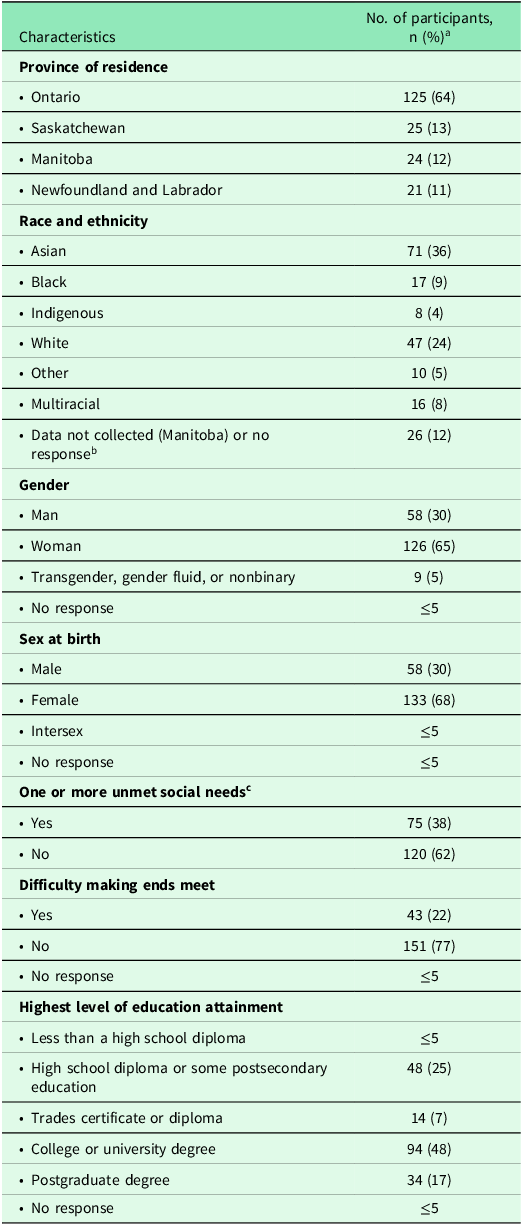
One hundred ninety-five participants were interviewed across the four study provinces. Participant characteristics are described in Table 1.
Demographic characteristics table (n = 195, source Adekoya et al. (Reference Adekoya, Delahunty-Pike, Howse, Kosowan, Seshie, Abaga, Cooney, Robinson, Senior, Zsager, Aubrey-Bassler, Irwin, Jackson, Katz, Marshall, Muhajarine, Neudorf and Pinto2023).

Table 1 Long description
The table presents demographic characteristics of 195 participants from four provinces. It has 12 rows and 2 columns. The columns are labeled Characteristics and No. of participants (%). The rows are grouped under various categories: Province of residence, Race and ethnicity, Gender, Sex at birth, One or more unmet social needs, Difficulty making ends meet, and Highest level of education attainment. Each row lists specific characteristics and the corresponding number and percentage of participants. For example, under Province of residence, Ontario has 125 participants (64 percent), Saskatchewan has 25 participants (13 percent), Manitoba has 24 participants (12 percent), and Newfoundland and Labrador has 21 participants (11 percent). Under Race and ethnicity, Asian participants number 71 (36 percent), Black participants number 17 (9 percent), Indigenous participants number 8 (4 percent), White participants number 47 (24 percent), Other participants number 10 (5 percent), Multiracial participants number 16 (8 percent), and data not collected or no response for 26 participants (12 percent). Gender distribution includes 58 men (30 percent), 126 women (65 percent), 9 transgender, gender fluid, or nonbinary individuals (5 percent), and no response for 5 participants. Sex at birth shows 58 male participants (30 percent), 133 female participants (68 percent), 5 intersex participants, and no response for 5 participants. Regarding unmet social needs, 75 participants (38 percent) have one or more unmet needs, while 120 participants (62 percent) do not. Difficulty making ends meet is reported by 43 participants (22 percent), with 151 participants (77 percent) not experiencing this difficulty, and no response for 5 participants. Education levels include less than a high school diploma for 5 participants, high school diploma or some postsecondary education for 48 participants (25 percent), trades certificate or diploma for 14 participants (7 percent), college or university degree for 94 participants (48 percent), postgraduate degree for 34 participants (17 percent), and no response for 5 participants.
aPercentage values are not provided for values that are ≤5.
bRace and ethnicity data were not collected in Manitoba.
cUnmet social needs were based on the following categories: precarious employment (presence of all of the following: short term, casual, or temporary employment; fear of being fired if raised employment concerns; and varying pay); living in social housing; missed rent or utility bill payments; missed appointment due to transportation cost; avoided filling prescription or made it last longer due to cost; difficulty making ends meet; and lack of social support.
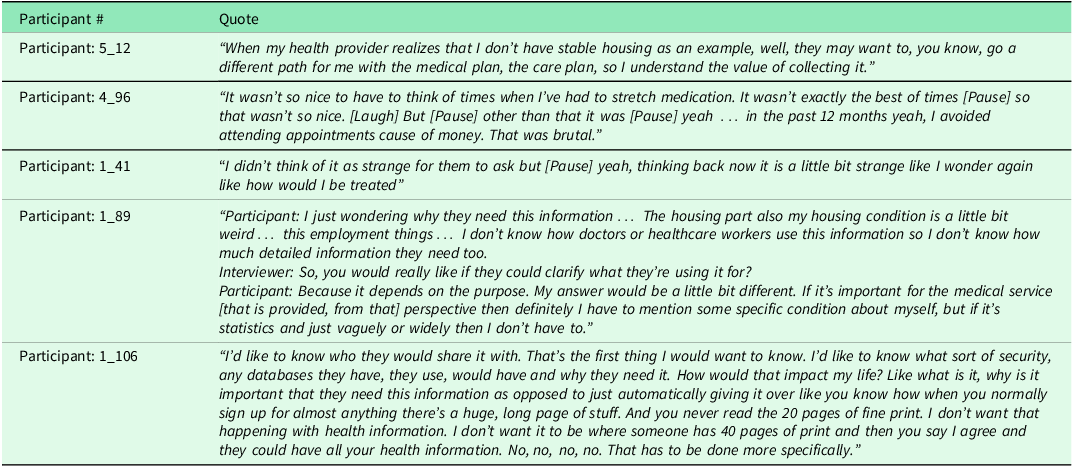
The following sections present the five themes and their respective findings generated from participant interviews, with corresponding quotes noted in brackets and available in Tables 2–6.
Selected quotes for analysis: openness to being screened for social needs

Table 2 Long description
A table with five rows and two columns. The columns are labeled ‘Participant #’ and ‘Quote’. Row 1: Participant 5_12, When my health provider realizes that I don’t have stable housing as an example, well, they may want to, you know, go a different path for me with the medical plan, the care plan, so I understand the value of collecting it. Row 2: Participant 4_96, It wasn’t so nice to have to think of times when I’ve had to stretch medication. It wasn’t exactly the best of times [Pause] so that wasn’t so nice. [Laugh] But [Pause] other than that it was [Pause] yeah ... in the past 12 months yeah, I avoided attending appointments cause of money. That was brutal. Row 3: Participant 1_41, I didn’t think of it as strange for them to ask but [Pause] yeah, thinking back now it is a little bit strange like I wonder again like how would I be treated. Row 4: Participant 1_89, ALERT: Replace the correct entity here Participant: I just wondering why they need this information ... The housing part also my housing condition is a little bit weird ... I don’t know how doctors or healthcare workers use this information so I don’t know how much detailed information they need too. Interviewer: So, you would really like if they could clarify what they’re using it for? Participant: Because it depends on the purpose. My answer would be a little bit different. If it’s important for the medical service [that is provided, from that] perspective then definitely I have to mention some specific condition about myself, but if it’s statistics and just vaguely or widely then I don’t have to, ALERT: Replace the correct entity here. Row 5: Participant 1_106, ALERT: Replace the correct entity here I’d like to know who they would share it with. That’s the first thing I would want to know. I’d like to know what sort of security, any databases they have, they use, would have and why they need it. How would that impact my life? Like what is it, why is it important that they need this information as opposed to just automatically giving it over like you know how when you normally sign up for almost anything there’s a huge, long page of stuff. And you never read the 20 pages of fine print. I don’t want that happening with health information. I don’t want it to be where someone has 40 pages of print and then you say I agree and they could have all your health information. No, no, no, no. That has to be done more specifically.
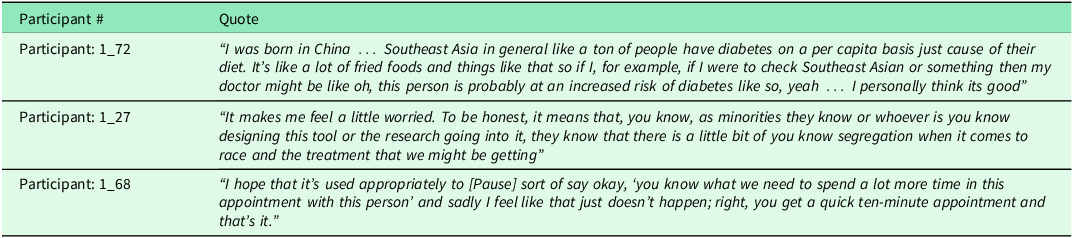
Selected quotes for analysis: value of healthcare providers knowing patient’s social needs

Table 3 Long description
A table with three rows and two columns. The columns are labeled Participant # and Quote. Row 1: Participant # 1_72, Quote I was born in China Southeast Asia in general like a ton of people have diabetes on a per capita basis just cause of their diet. Its like a lot of fried foods and things like that so if I, for example, if I were to check Southeast Asian or something then my doctor might be like oh, this person is probably at an increased risk of diabetes like so, yeah I personally think its good. Row 2: Participant # 1_27, Quote It makes me feel a little worried. To be honest, it means that, you know, as minorities they know or whoever is you know designing this tool or the research going into it, they know that there is a little bit of you know segregation when it comes to race and the treatment that we might be getting. Row 3: Participant # 1_68, Quote I hope that its used appropriately to [Pause] sort of say okay, you know what we need to spend a lot more time in this appointment with this person and sadly I feel like that just doesnt happen; right, you get a quick ten-minute appointment and thats it.
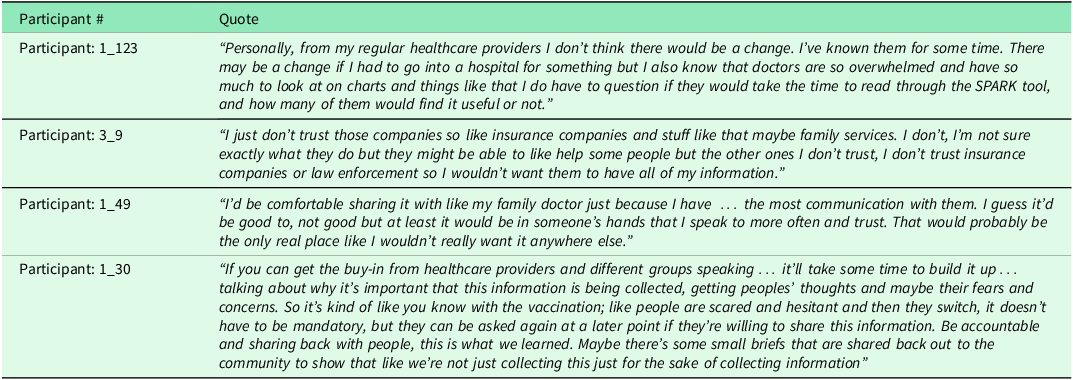
Selected quotes for analysis: overall scepticism and trust/distrust in the healthcare system and professionals

Table 4 Long description
A table with four rows and two columns. The columns are labeled ‘Participant #’ and ‘Quote’. Row 1: Participant # 1_123, Quote: Personally, from my regular healthcare providers I don’t think there would be a change. I’ve known them for some time. There may be a change if I had to go into a hospital for something but I also know that doctors are so overwhelmed and have so much to look at on charts and things like that I do have to question if they would take the time to read through the SPARK tool, and how many of them would find it useful or not. Row 2: Participant # 3_9, Quote: I just don’t trust those companies so like insurance companies and stuff like that maybe family services. I don’t, I’m not sure exactly what they do but they might be able to like help some people but the other ones I don’t trust, I don’t trust insurance companies or law enforcement so I wouldn’t want them to have all of my information. Row 3: Participant # 1_49, Quote: I’d be comfortable sharing it with like my family doctor just because I have the most communication with them. I guess it’d be good to, not good but at least it would be in someone’s hands that I speak to more often and trust. That would probably be the only real place like I wouldn’t really want it anywhere else. Row 4: Participant # 1_30, Quote: If you can get the buy-in from healthcare providers and different groups speaking it’ll take some time to build it up talking about why it’s important that this information is being collected, getting people’s thoughts and maybe their fears and concerns. So it’s kind of like you know with the vaccination; like people are scared and hesitant and then they switch, it doesn’t have to be mandatory, but they can be asked again at a later point if they’re willing to share this information. Be accountable and sharing back with people, this is what we learned. Maybe there’s some small briefs that are shared back out to the community to show that like we’re not just collecting this just for the sake of collecting information.
Selected quotes for analysis: potential for harm

Table 5 Long description
A table with two rows and two columns. The columns are labeled Participant # and Quote. Row 1: Participant: 3_5, I definitely don’t think it should negatively impact the care you know? I definitely don’t think that they should be judgmental like let’s say there’s a financial barrier. I hope that they would not look down on the person or just to maybe kind of like have a tone about them that is condescending cause I truly believe that some people, some human beings are like that and just because somebody’s in healthcare doesn’t mean that they’re not like that, I think that that would be a concern. Row 2: Participant: 1_27, For example, if there’s someone that’s an extremist and Caucasian, they get a South Asian patient like I in colour I am not that dark. They might not be able to tell that by looking at me if it’s not on my record but if they see it on my record and they have these you know preconceived notions on you know this is how this type of person is or their community is then yeah, then I feel that the quality of treatment I might get might be you know not as good.
Selected quotes for analysis: meaningful engagement and provider training on social needs

Table 6 Long description
A table with two rows and two columns. The columns are labeled ‘Participant #’ and ‘Quote’. Row 1: Participant 4_5, Quote: Sometimes you hear about where the doctor talked down to the patient sort of in a blaming way. You know I guess in a rushed world putting the blame on the patient whereas if you saw all these other factors, you might, you know have a little more [Pause] compassion for them. Row 2: Participant 5_3, Quote: Otherwise it sounds like . . . I’m being mined for more data . . . I’m sick of that. I want the data; I want to see how it’s going to actually transform or change the way health providers are addressing . . . these things.
Theme 1: Openness to being screened for social needs
Openness to social needs screening was common among participants but contingent on clarity for and trust in their physicians to clarify their concerns and ease any discomfort.
Some participants reported discomfort when revisiting past hardships. Reflecting on these experiences, one participant shared that it was unpleasant to recall times when they had to stretch their medications or miss appointments due to financial constraints (Participant 4_96), highlighting the emotional difficulty of discussing experiences tied to vulnerability.
Most participants described feeling comfortable when responding to questions about social needs. Participants perceived that questions about their social needs were asked with their best interest in mind and viewed them as useful for helping providers tailor treatment plans to their circumstances (Participant 5_12).
Others described feeling comfortable discussing their social needs in the moment but later reflecting on how these disclosures might shape their providers’ perceptions of them (Participant: 1_41).
Participants expressed the importance of understanding why they are being asked to provide information about their social needs. For many, openness to sharing personal information depended on having this clarity, as it influenced their comfort and the level of detail they were willing to disclose (Participant: 1_89).
Participants noted that transparency in collecting, using and maintaining privacy and security of the data were important. Some suggested that their healthcare practitioners obtain their informed consent to collect the data (Participant: 1_106).
Theme 2: Value of healthcare providers knowing patient’s social needs
Participants generally recognized that providing information about their social needs or personal characteristics could help healthcare providers deliver more tailored and appropriate care. However, there was uncertainty about how their disclosures might be used. They noted that understanding patients’ social circumstances (housing, employment, and racial and cultural background) could guide clinical decision-making, highlight potential health risks, and support more holistic care.
While participants valued this knowledge, they also emphasized that the benefits depended on the information being used appropriately and discussed meaningfully within the clinical encounter. One participant explained how sharing their race could inform preventive care and risk assessment (Participant: 1_72).
As some participants appreciated that social needs information could help providers tailor care, one other participant raised concerns about potential inequities in how the information might be used (Participant: 1_27).
Some participants also noted that social needs data could help providers identify when additional time or attention was needed during appointments, underscoring how such information might inform patient-centred care planning (Participant: 1_68).
Together, these perspectives highlight that while participants recognized the value of providers having insight into their social needs, they also emphasized the importance of using this information equitably, transparently, and to meaningfully improve care experiences.
Theme 3: Overall scepticism and trust/distrust in the healthcare system and professionals
Participants’ discussions revealed underlying scepticism about the healthcare system’s capacity to use social needs data responsibly. Some highlighted that their willingness to share social needs information depended not only on trust in their primary care provider but also on understanding who would have access to the data.
A small number of participants were doubtful that social needs data can be successfully integrated into the delivery of healthcare services due to providers’ time and resource limitations (Participant: 1_123).
Some participants’ distrust extended beyond primary care, encompassing related institutions, such as insurance companies and social services, that they viewed as interconnected in how social needs data might be used or shared (Participant: 3_9).
Participants expressed that this access should be kept to one professional, primarily the patient’s family doctor, and the data should not be accessed by other professionals who are not involved in the patient’s care (Participant: 1_49).
Some participants suggested that transparent communication about the purpose of data collection, addressing patients’ concerns, and providing feedback could help foster trust and encourage sharing, particularly in settings where patients do not have longstanding relationships with the care team (Participant: 1_30).
Theme 4: Potential for harm
Across study participants was the concern that there is potential for harm among those experiencing social disadvantages (i.e., financial difficulties at home). For example, patients may experience perceived judgement related to their income level (Participant: 3_5).
Some participants expressed concern that providing personal information such as race, gender, or financial well-being (ability to afford basic needs and extended health-care related expenses) could expose a patient to bias or differential treatment from healthcare providers (Participant: 1_27).
Theme 5: Meaningful engagement and provider training on social needs
Participants communicated that providing their social needs information alone is not enough to ensure positive change in healthcare delivery and health outcomes. They emphasized that healthcare providers needed the skills and understanding to respond appropriately and engage with social needs in compassionate, non-judgmental conversations (Participant: 4_5).
Several participants also expressed that social needs conversations should feel meaningful rather than purely data driven. More importantly, as one participant (5_3) noted, they wanted assurance that the information they provide would be acted upon. Specifically, that it would lead to tangible support addressing their social needs.
They wanted to understand how sharing information would influence their care, and that it will guide their healthcare providers’ responses to addressing their patient’s social needs.
Discussion
This study assessed patient perspectives of social needs data collection in primary care settings. Our findings identified that participants are generally comfortable answering questions about their social needs, although there were concerns and occasional discomfort around sharing some types of information. Racial or cultural background, employment, housing, or financial strain were the most common sensitive touch points. To address these concerns, participants emphasized appropriate data management guidelines, transparency, privacy, and trust as essential for advancing equity-focused data collection in primary care. This is consistent with other research in this area, which also recommends additional qualitative research to better understand these issues, improved patient education, and collecting data through family physicians’ offices (Lofters et al., Reference Lofters, Shankardass, Kirst and Quiñonez2011; The College of Family Physicians of Canada, 2015).
Participants perceived social needs data to be largely helpful, with disclosure seen as vital to holistic patient care. Many participants also echoed prior findings on patients’ preference for sharing sensitive information with trusted providers (family physicians or certified social or community workers) (Pfeiffer et al., Reference Pfeiffer, De Paula, Flores and Lavallee2022; Spain et al., Reference Spain, Monahan, Alvarez and Finno-Velasquez2021; Waldren and Billings, Reference Waldren and Billings2023; Wilkerson et al., Reference Wilkerson, De Marchis, Rudd, Williams, Pantell, Ackerman, Amerson and Chang2023). At the same time, participants acknowledged possible harms that could occur by sharing sensitive SDoH, highlighting the need to clarify why social needs screening is important to patients (Bender et al., Reference Bender, Tong, An, Liu, Shapiro, Avery, Chu, Schulz-Quach, Hales, Maybee, Sayani, Pinto and Lofters2025; Lofters et al., Reference Lofters, Shankardass, Kirst and Quiñonez2011; Pfeiffer et al., Reference Pfeiffer, De Paula, Flores and Lavallee2022; Rudisill et al., Reference Rudisill, Eicken M.G., Gupta, Macauda, Self, Kennedy, Thomas, Kao, Jeanty and Hartley2023). Moreover, participants indicated wanting their physicians to directly address their social needs if they are going to collect this information. This aligns with previous research suggesting that while patients may agree with the idea of collecting social needs data, their willingness to disclose depends heavily on trust in individual providers and in the broader healthcare system (Spain et al., Reference Spain, Monahan, Alvarez and Finno-Velasquez2021; O’Loughlin et al., Reference O’Loughlin, Shadowen, Haley, Gilbert, Lail Kashiri, Webel, Huebschmann and Krist2022; Pfeiffer et al., Reference Pfeiffer, De Paula, Flores and Lavallee2022; Wilkerson et al., Reference Wilkerson, De Marchis, Rudd, Williams, Pantell, Ackerman, Amerson and Chang2023). Patients often prefer to share personal information with familiar and trusted providers, such as family physicians or community-based professionals (Spain et al., Reference Spain, Monahan, Alvarez and Finno-Velasquez2021; O’Loughlin et al., Reference O’Loughlin, Shadowen, Haley, Gilbert, Lail Kashiri, Webel, Huebschmann and Krist2022; Pfeiffer et al., Reference Pfeiffer, De Paula, Flores and Lavallee2022; Wilkerson et al., Reference Wilkerson, De Marchis, Rudd, Williams, Pantell, Ackerman, Amerson and Chang2023).
Efforts to screen for social needs data in healthcare settings are increasingly common (Davis et al., Reference Davis, Dainty, Dhalla, Sheehan, Wong, Pinto and Aé2023). These efforts can improve care and inform policy only with thoughtful integration of patient perspectives (Davis et al., Reference Davis, Dainty, Dhalla, Sheehan, Wong, Pinto and Aé2023; Hosseinpoor et al., Reference Hosseinpoor, Bergen and Schlotheuber2015; Kirst et al., Reference Kirst, Shankardass, Singhal, Lofters, Muntaner and Quiñonez2017; Pinto et al., Reference Pinto, Glattstein-Young, Mohamed, Bloch, Leung and Glazier2016). When patients are asked to share social needs information, some bring the weight of past experiences, particularly those from racialized communities who have endured discrimination within healthcare and other institutions of authority, such as law enforcement (Williams et al., Reference Williams, Khanna Roy, MacIntyre and Faber2022). These histories shape perceptions of risk, privacy, and trust Comas-Díaz et al., Reference Comas-Díaz, Hall and Neville2019). Without addressing these unmet needs and the legacies of systemic inequity, social needs screening may unintentionally reinforce distrust (Sue et al., Reference Sue, Capodilupo, Torino, Bucceri, Holder A.M., Nadal and Esquilin2007; Williams, Reference Williams2020).
Practice implications
These issues were mirrored in our participants’ own accounts. Throughout our interviews, scepticism about social needs screening and distrust of healthcare institutions was more common among participants from socially disadvantaged groups. Participants highlighted that simply collecting social needs information is insufficient. It requires healthcare professionals to be trained on how to ask specific questions and respond appropriately. These findings underscore the importance of combining provider training with meaningful action to ensure that the information collected leads to positive changes in care (Byhoff et al., Reference Byhoff, De Marchis, Hessler, Fichtenberg, Adler, Cohen, Doran, Ettinger de Cuba, Fleegler, Gavin, Huebschmann, Lindau, Tung, Raven, Jepson, Johnson, Olson, Sandel, Sheward and Gottlieb2019; Collins et al., Reference Collins, Resendes and Dunn2014; Pfeiffer et al., Reference Pfeiffer, De Paula, Flores and Lavallee2022; Wilkerson et al., Reference Wilkerson, De Marchis, Rudd, Williams, Pantell, Ackerman, Amerson and Chang2023).
Policy implications
Our findings show that health systems implementing social needs screening should prioritize (1) robust data governance frameworks that clearly communicate to patients how their information will be stored, accessed, and acted upon. (2) Transparency about data utility, specifically how patients’ social needs data will lead to changes in their care, is essential for sustaining patient willingness to disclose. Policymakers should consider embedding explicitly informed consent processes into screening workflows, ensuring patients retain their agency over their data. Together, these measures would help ensure that social needs data screening fulfills its intended purpose of advancing health equity, rather than becoming an administrative exercise that erodes the patient – provider relationship.
While this study was conducted in Canada, the findings carry relevance for primary care systems internationally. Social needs screening initiatives have expanded considerably in the United Kingdom, where social prescribing has been integrated into their National Health Service primary care system (British Medical Association, 2011; National Health Service, 2019), and in the United States, where policies increasingly encourage SDOH screening (Rane et al., Reference Rane, Weimer and Baus2025; Rj et al., Reference Mazurenko, Hirsh, Harle, Shen, McNamee and Vest2023).Despite different healthcare structures, common themes emerge across Canadian and international contexts: patient trust, privacy concerns, and the expectation that social needs data collection leads into meaningful action in patient care, particularly among those from racialized and socially disadvantaged communities.
Strengths and weaknesses
This study’s strengths include robust qualitative methodological approaches with large, demographically varied sample of one hundred and ninety-five participants across four Canadian provinces, which significantly enhanced the generalizability of the findings. However, the study also has some limitations. We may have preferentially recruited people who may have existing levels of trust in the healthcare system, potentially biasing who and how participants responded to questions. We mitigated this potential bias with our approach to recruitment participants outside of healthcare settings. Another limitation is that our findings are from English-speaking participants only, potentially excluding unique perspectives of non-English speakers, or those who participant in English but were not native speakers and perhaps unable to accurately express themselves despite indicating themselves that no translation services would be needed. The findings may not fully represent all of Canada due to the fact there were seven provinces and territories not included in the sample. Lastly, the interviews were conducted remotely via video, which, while practical, prevented the nuances often gained from in-person interactions.
Conclusion
Collecting social needs data is crucial, but effective implementation depends on addressing patient perspectives and concerns. Participants expressed being generally open to social needs screening but had concerns and occasional discomfort when asked about their racial or cultural background, employment, housing situation, and financial well-being. Our participants consistently raised questions relating to privacy, the patient – provider relationship, access, and security. This underscores the need for transparent communication, robust data governance, and explicit informed consent to build trust. Overall, patients expressed an expectation for social needs data to translate into actionable interventions to address social needs. Future research should focus on patient-informed implementation strategies for social needs screening in primary care, including strengthening data security to build trust and supporting clinicians and administrators in integrating patient perspectives into care planning.
Data availability statement
The data underlying this study are available upon reasonable request from the corresponding author, ADP.
Acknowledgements
We thank the participating clinics, including clinic leadership, providers, and staff, for their contributions to this study. We also acknowledge the SPARK study team, including Antonio Cassano; our patient partners (including co-authors and Jane Cooney); and the advisory group, content experts, and community organizations who supported tool development and implementation. We are grateful to Olivia Neale (Department of Family and Community Medicine, University of Toronto) for assistance in developing the SPARK training module. We also thank Victoria Davis for supporting data analysis and Joseph J. O’Rourke for editing and revising the manuscript for publication.
Author contributions
DH, IA, AD-P, LK, AZS, EA, MR, AZ, DS, KA-B, EGM, NM, CN, SG, and ADP contributed to study conception and design. LK, DH and AZS contributed to data collection. AS-R, JRQ, VHD, DH, IA, AD-P, LK, AZS, EA, MR, AZ, DS, K-AB, EGM, NM, CN and ADP interpreted study results. AS-R and JRQ drafted the manuscript. All authors revised the manuscript for important intellectual content, approved the final version to be published and agreed to be accountable for all aspects of the work. ADP is the guarantor for this study.
Funding statement
This study was funded by the Canadian Institutes of Health Research (CIHR) (Application #345596). Andrew D. Pinto is supported as a Clinician-Scientist by the Department of Family and Community Medicine, Faculty of Medicine at the University of Toronto and at St. Michael’s Hospital, the Li Ka Shing Knowledge Institute, St. Michael’s Hospital, and a CIHR Applied Public Health Chair in Upstream Prevention. The opinions, results and conclusions reported in this article are those of the authors and are independent from any funding sources.
Competing interests
None declared.
Ethical standards
Ethics approval for this study was obtained from the University of Saskatchewan [REB# 3185], University of Manitoba [HS25615 (H2022:245)], Unity Health Toronto [REB# 21-306], Dalhousie University [REB# 1028175] and Memorial University of Newfoundland and Labrador [REB# 20230089].
APPENDICES
Appendix 1. Study recruitment advertisement

Appendix 2. Semi-structured interview guide: social needs data collection question portion




 Open access

